R E S E A R C H
Open Access
Performance of time reversal precoding
technique for MISO-OFDM systems
Thierry Dubois
1*, Maryline Hélard
1, Matthieu Crussière
1and Cécile Germond
2Abstract
Time reversal (TR) is considered as a promising technique for green and multi-user communications thanks to its time and space focusing properties. TR can be viewed as a precoding scheme which can be combined with orthogonal frequency division multiplexing (OFDM) and easily carried out in a multiple transmit antenna context. This paper analyzes the performance of TR for a multiple-input single-output (MISO) OFDM system and provides a comparison with maximum ratio transmission (MRT) and equal gain transmission (EGT) precoding techniques. The analytical performance of the three precoding techniques is derived by computing the capacity and the bit error rate (BER) as a function of the transmit signal-to-noise ratio (SNR). First, the capacity analysis highlights the ability of the TR system to provide higher bit rates than the MRT system at low SNRs, while the capacity of the MRT system is the highest at high SNRs. From the obtained BER analytical expressions, the diversity exploitation of each system is discussed. In particular, it is shown that the TR system only exploits half the available diversity, while the systems using EGT or MRT exploit the full diversity. Hence, contrary to what is expected from the theoretical capacity analysis, the TR system is shown to underperform the other precoding schemes in terms of BER. To overcome such a drawback, the combination of TR with classical adaptive modulation techniques is studied, allowing the achievable throughput to be increased without destroying the focusing properties of TR. It is then observed that TR takes advantage of adaptive modulations and outperforms the other schemes at low SNRs. In this study, analytical results and closed-form expressions of capacity and BER performance are provided and confirmed through Monte Carlo simulations.
Keywords: Time reversal; MISO; OFDM; Capacity; Adaptive modulation
1 Introduction
Multiple-antenna communications have raised intense academic and industrial interests in the last two decades and have become a key technology in the evolution of wireless systems (LTE, WLAN, WiMAX, etc.). This suc-cess comes from the widely recognized ability of multiple-antenna systems to offer significant improvements in system performance by advantageously exploiting mul-tipath signal propagation to achieve diversity or spatial multiplexing gains [1].
For multiple-input multiple-output (MIMO) systems with available channel state information (CSI) at the trans-mitter side, techniques based on singular value decom-position (SVD) efficiently exploit spatial diversity [2]. However, the MIMO-SVD approach suffers from the high
*Correspondence: [email protected]
1Institute of Electronics and Telecommunications of Rennes (IETR), Rennes 35708, France
Full list of author information is available at the end of the article
complexity of the operations required to compute and proceed the precoding and postcoding matrices at the transmitter and receiver sides. Other precoding schemes have thus been introduced, providing suboptimal but sim-pler solutions to the design of MIMO systems using CSI at the transmitter. In 1999, Lo proposed a precoding sys-tem referred to as maximum ratio transmission (MRT) that relies on the matched filter applied at the trans-mitter side [3]. In 2003, a technique called equal gain transmission (EGT) was introduced, allowing transmis-sion with a unitary gain on every link [4]. In this latter case, precoding only consists of a phase rotation and thus avoids any power imbalance between the signals propa-gated by each antenna. Considering multiple antennas at the receiver, combining techniques can be carried out in conjunction with a precoding technique to take advantage of the diversity of the signals intercepted by the antenna array.
As far as multiple-input single-output (MISO) systems are concerned, only diversity gain can be expected since the spatial multiplexing gain is driven by the size of the smallest antenna array between transmitter and receiver [5]. For such systems also, since the number of receive antennasNr = 1, postcoding matrices reduce to a scalar value and only precoding operations can be performed. MISO systems are however of high interest considering wireless systems in which receivers cannot afford addi-tional antennas for complexity or size limitation. Consid-ering precoding schemes applied to the MISO context, MRT was demonstrated to reach equivalent performance as SVD under some normalization or scale factor assump-tions at the transmitter side [6]. It is also known that EGT and MRT systems exploit full space diversity [4]. These studies have however been led under the assumption of signal propagation over single-band flat fading channels, that is, without taking account any frequency diversity considerations. When considering more wideband trans-mission systems, diversity exploitation and performance may vary from one precoding scheme to another. In par-ticular, the analysis of MISO precoding schemes applied to waveforms realizing frequency multiplexing such as orthogonal frequency division multiplexing (OFDM) is of high interest.
In that perspective, time reversal (TR) recently appeared as a strong candidate for MISO transmissions because it relies on a simple preprocessing technique for any number of transmit antennas and involves very simple receivers even considering frequency-selective channels. This tech-nique is different from SVD, MRT, or EGT because of the way of weighting the precoding factors over the fre-quency dimension as it is further detailed in the paper. Moreover, TR benefits from spatial and temporal focus-ing properties as firstly demonstrated in the ultrasound and underwater acoustics [7] and more recently experi-mented in wireless communications [8-11]. Pioneer works of Paulraj et al. have namely shown that the richer the scattering environment, the better the time and focusing gains [12]. In UWB systems for instance, TR is suit-able as a simple and efficient prefiltering technique for pulse amplitude modulation [13-15] since it is realized over large frequency bandwidths. For systems address-ing narrower bandwidths and hereby playaddress-ing with less rich propagation conditions, the so-called rate back-off or oversampling strategies can be used to compensate for some focusing gain degradation [16,17]. An interest-ing alternative rather consists in gettinterest-ing the environment richness back from frequency to space by increasing the number of transmit antennas [12]. However, for practi-cal system design where the frequency bandwidth and the size of antenna arrays are limited, imperfect time focusing is likely to be encountered, preventing from a sufficient mitigation of the channel time dispersions. Multicarrier
systems such as OFDM are commonly used to deal with time-dispersive channels and can be combined with TR to accommodate any residual intersymbol interference (ISI). The combination of TR and OFDM has recently been studied in [18] and [19] and has been proven to allow designing of simple and efficient MISO-OFDM systems. The fact that TR can be considered as a particular pre-coding technique of OFDM signals makes it necessary and interesting to be compared with the conventional state-of-the-art MISO-OFDM precoding systems previously mentioned.
In this paper, we propose to lead a complete analysis on the performance of different MISO-OFDM systems based on precoding techniques, including the recently experimented TR approach. Different precoding schemes are analytically studied in terms of capacity and bit error rate (BER) performance. Our conclusions are further con-firmed through computer simulations. Even though the differences between the investigated techniques could firstly appear as insignificant, the proposed comprehen-sive study aims at highlighting the differences between them and demonstrates that their performance varies from system to another. The optimal MRT approach will be considered as benchmark, and all of the other schemes will be analyzed and discussed in terms of performance, capacity, and diversity exploitation. Last but not least, to have a complete view of things, the study will also con-sider the impact of adaptive modulation strategies applied to the precoded MISO-OFDM systems.
The rest of the paper is organized as follows: In Section 2, the three precoding techniques - MRT, EGT, and TR - are introduced especially when combined with OFDM. In Section 3, the capacity of each system is analytically derived and analyzed. Monte Carlo simula-tion results are also presented to confirm the theoretical results. In Section 4, the average receive signal-to-noise ratio (SNR) and the average BER of every system are computed, analyzed, and corroborated through Monte Carlo simulations. In Section 5, an adaptive modulation approach is implemented to further improve the perfor-mance of every system in terms of achievable throughput. Finally, conclusions are drawn in Section 6.
1.1 Main notations
Vectors and matrices are represented by boldface let-ters.{.}∗,{.}T,{.}†, and Tr{.}are the conjugate, transpose, transconjugate, and trace operators resp. Indices m, n, andkstand for the subcarrier, the time, and the antenna
indices resp. For MIMO systems, Nt and Nr stand for
white Gaussian noise (AWGN) sample of powerσN2
asso-ciated to the mth subcarrier of the nth OFDM symbol
resp. Vectorvm = {Vm,k}stands for the precoding vector
of sizeNtapplied to themth subcarrier. Vectorem,nof size Ntis the transmitted signal vector after precoding. Vector
hm= {Hm,k}of sizeNtconsists of the channel coefficients affecting themth subcarrier of each spatial linkk. Nota-tionλmstands for the eigenvalue ofhmh†m. The argument of the channel coefficient Hm,k is denoted Hm,k.
Nota-tionsCandCmare the capacity of the system and of the mth subcarrier resp. The total transmit power is referred to asPe, andρstands for the transmit SNR.
2 Precoding techniques for MISO-OFDM systems
In this section, the precoding techniques that will be com-pared are introduced. These techniques all require the knowledge of the channel at the transmitter side and are thus suited for closed loop systems. The considered
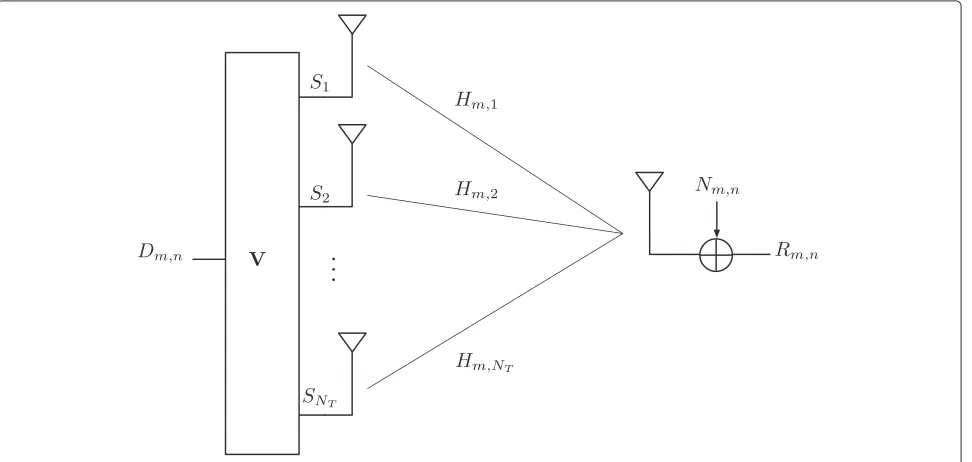
sys-tem is a Nt × 1 MISO-OFDM system as depicted in
Figure 1 for one subcarrier of indexm. In this figure,vm =
Vm,1,. . .,Vm,k,. . .,Vm,Nt T
repre-sents the precoding function associated to subcarrierm that converts the data symbolsDm,ninto the transmitted symbols Em,n,k = Dm,nVm,k, where Vm,k is the precod-ing factor that depends on the antenna indexkas well as on the channel response. The channel coefficient on the mth subcarrier for the kth transmit antenna is denoted Hm,k. We define the channel vector of sizeNt ashm =
Hm,1,. . .,Hm,k,. . .,Hm,Nt
and the transmitted precoded symbol vector asem,n=
Em,n,1,. . .,Em,n,k,. . .,Em,n,Nt
. In our study, the channel is considered as quasi-static which means that it remains constant over several OFDM
symbols. For this reason, note that time indexnis dropped for channel vectorhm and precoding vectorvm, but not for symbol vectorem,n.
The symbol received on each subcarrier depends on the applied precoding technique and can thus be expressed as
Rm,n= Nt
k=1
Hm,kEm,n,k+Nm,n
= Nt
k=1
Hm,kVm,kDm,n+Nm,n (1)
whereNm,n is the AWGN sample associated to themth subcarrier of thenth OFDM symbol.
The capacity and the average BER expressions of each system will be derived in Sections 3 and 4 resp. In that perspective, the different received signals are firstly expressed in the next paragraphs, highlighting the differ-ences between the applied precoding techniques.
2.1 MRT
For MISO-OFDM systems, the optimal MRT precoding technique is applied to the symbolsDm,nto be transmitted using the following precoding factors [20]:
Vm,k= Hm∗,k √
λm
(2)
where√λm=Nk=t1|Hm,k|2is the singular value ofhm. It should be noted that in this context, MRT is a particular case of SVD withNr =1.
When Hm,k follows independent normalized distribu-tion,E[λm]= Ntand the average power of the transmit-ted OFDM symbols on each antenna is equal to 1/Nt. Assuming normalized constellations, total transmit power Peis then equal to 1. Note however that the instantaneous power associated to each subcarrier depends on instan-taneous channel realizations and is not constant across subcarriers.
According to Equations 1 and 2, the received symbol on each subcarrier can finally be expressed as
Rm,n= Nt
k=1|Hm,k|2 √
λm Dm,n+Nm,n
= Nt
k=1
|Hm,k|2Dm,n+Nm,n (3)
2.2 EGT
Equal gain transmission is derived from MRT and also aims at maximizing the SNR at the receiver side [4]. This technique consists in modifying the phase of the complex symbols before their transmission on every subcarrier of the system.
In the MISO-OFDM context, the precoding vector for EGT is thus [20]
Vm,k = ejHm∗,k
√
Nt =
e−jHm,k
√
Nt (4)
where H∗
m,k (Hm,k resp.) is the argument of the
chan-nel fading coefficientHm∗,k (Hm,k resp.) and √
Nt is used for power normalization purpose, that is, to ensurePe = 1. In contrast with the MRT case, the instantaneous power associated to each subcarrier will not vary with the precoding factor since it simply consists of a phase rotation.
According to Equations 1 and 4, the symbol received on each subcarrier is then expressed as
Rm,n= Nt
k=1 Hm,k
e−jHm,k
√
Nt Dm,n+Nm,n
=√1 Nt
Nt
k=1
|Hm,k|Dm,n+Nm,n (5)
2.3 Time reversal
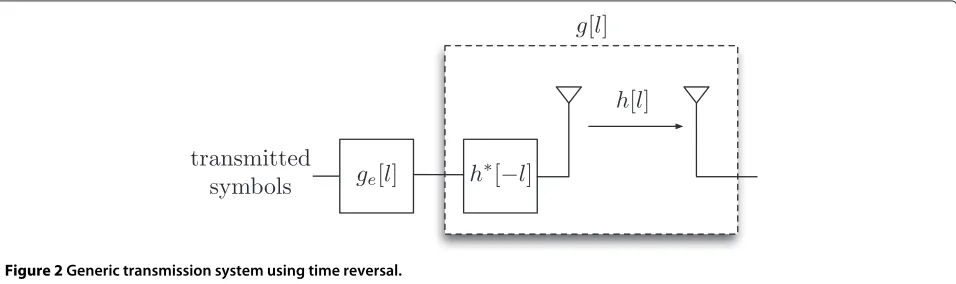
TR principles are presented in detail for acoustic and electromagnetic waves in [7] and [8] resp. Applied to wireless communications, TR consists in prefiltering the signal with the time reversed and conjugated version of the channel impulse response (CIR) between the transmit and the receive antennas. Without loss of generality, such an operation can be represented in discrete time domain as depicted in Figure 2. In this figure, ge[l] is the trans-mit shape filter,h[l] the discrete complex-baseband CIR, h∗[−l] the time reversal filter, andg[l] the so-called equiv-alent channel obtained by convolvingh[l] andh∗[−l].
Consequently, in the time domain, g[l] is made of a central peak of high amplitude and some side lobes. For rich propagation environments, a time focusing effect is obtained as the channel autocorrelation peak is getting sharper and narrower and as side lobes are reduced. In other words, TR leads to time dispersion compression, hereby reducing the ISI occurring between symbols [9]. If time focusing is sufficiently strong for a given sym-bol duration, the receiver could merely be reduced to a threshold detector. Nevertheless, for systems exploiting a restricted bandwidth or a limited number of transmit antennas, residual ISI can be efficiently treated through multicarrier approach. In contrast with TR which does not modify the symbol structure, OFDM deals with multipath channels by enlarging symbol durations and inserting a guard interval to absorb ISI. When combined with TR, the size of the guard interval is chosen according to the
compressed equivalent channel g. Hence, the TR and
multicarrier approaches can be viewed as complemen-tary and compatible processes applied on the signal before transmission, the former trying to compress the channel time dispersions and the latter accommodating with the residual ISI. As already mentioned in the introduction, combination of TR and OFDM is thus of high interest.
In some preliminary work [18], it has been demon-strated that TR can be applied in an OFDM system either in the time or in the frequency domain. For both imple-mentations, the achieved performance is equivalent. In order to keep common notations throughout the paper, we will only consider in the sequel the implementation in the frequency domain.
On that basis, applying TR to an OFDM signal amounts to precoding the symbols on each subcarrier by the conju-gated channel coefficients. These channel coefficients are obtained from the frequency version of the CIR through a Fourier transform.
Therefore, the precoding factor is
Vm,k= Hm∗,k √
Nt
(6)
As in the MRT case, the dependency of the precoding factor to the channel gains leads to instantaneous transmit power variations between the subcarriers. Considering independent normalized processes for theHm,k, the total transmit power is however guaranteed to be unitary.
Considering perfect synchronization and a well-dimen-sioned guard interval, the received symbol after the guard interval removal and after the FFT operation is thus [18]
Rm,n=
2.4 Implementation of the precoding techniques
The choice between these three precoding techniques has to be made considering the multi-antenna array topology. Indeed, the TR and the EGT systems only require the knowledge of the channel for each spatial link independently, i.e., the precoding unit associated to transmit antennakonly needs the knowledge ofHm,kfor
all the subcarriersmbut for fixed antenna indexk. Such precoding functions can therefore be carried out without any information exchanges between the transmit anten-nas and are therefore easy to implement in collocated antenna arrays as well as in a fully distributed architec-ture. Instead, for the MRT precoding, the knowledge of the channel gains for all the spatial links has to be avail-able at each transmit antenna, i.e., each precoding unit has to get the knowledge ofHm,kfor all the subcarriersmand for all the antennask. Consequently, MRT is only suitable for antenna arrays for which information exchanges can exist between the antennas, which might result in some constraints of implementation depending on the radio network topology.
In terms of precoding factor computation, TR and MRT might appear as similar at first glance. However, as can be seen in the second column of Table 1, these two tech-niques are not equivalent. Indeed, the weighting terms of the precoding factor are different, namely √λm in
the MRT case and √Nt in the TR case. The expression
of the received signal for the EGT system then differs from the received signal in the TR case by the power of the modulus of the channel coefficients|Hm,k|. These
differ-ences will lead to different SNR expressions at the receiver side and will finally have impact on system performance as studied later on.
As far as computation complexity is concerned, all three precoding techniques require a complex multipli-cation depending on the channel gains. However, MRT also needs the calculation of the singular values√λm of the channel on every subcarrier and a complex division by these values. Instead, for TR and EGT, a simple real division by √Nt is needed that can be precomputed in advance since it only depends on the number of trans-mit antennas. Concerning EGT however, compared to TR, an additional phase computation has to be performed. For easy implementation, such operation can be obtained through a lookup table. Eventually, one can consider that TR and EGT are of comparable complexity, whereas MRT is the most complex.
3 System capacity
In this section, the capacities of the studied systems are derived and compared. Capacity, defined as the maximum
Table 1 Comparison of the main features of MRT-, EGT-, and TR-precoded MISO-OFDM systems
System Precoding factor Receive SNR limρ→+∞BER BER forNt=2 Exploited
diversity
Nt No general closed form
achievable throughput for an arbitrary low error prob-ability, is expressed in bit/s and provided for a given transmitted powerPe. In a MISO-OFDM case, the capac-ity of the mth subcarrier of bandwidth Wm is given as
Cm=Wmlog2
where we remind that hm contains the related
chan-nel fading coefficients for theNt transmit antennas and
withem = E
em,ne†m,n
being the covariance matrix of transmitted signal vectorem,n. The capacity of the whole MISO-OFDM system can be deduced by summing the capacities of all the subcarriers:
C=
whereWis the total bandwidth of the OFDM signal. In order to evaluate the capacity of each system what-ever the signal bandwidth, we choose to normalize it by the total bandwidth of the signal. It will thus be expressed in bit/s/Hz as
Note that the total transmit power of the system isPe = Tr{em}. In the sequel and in the rest of the paper, the
total transmit power is considered as unitary, whatever the system and the number of transmit antennas.
3.1 Capacity of the studied precoding systems
In the case of a precoded signal, the covariance matrixem
can be calculated as
em=E
where Pem is the average power allocated on the mth
subcarrier before precoding. The capacity can then be deduced as
In the MISO MRT-OFDM case, the precoding vector is equal tovm= h
In the MISO EGT-OFDM case, the precoding vector is equal tovm=√Nm
In the MISO TR-OFDM case, the precoding vector is equal tovm= h
3.2 Systems comparison and simulation results
From Equations 13 and 15, it can be noted that the capac-ities of the MRT and TR systems are very close. They only differ in one weighting term which is 1/λm for the MRT
system and 1/Nt for the TR system. When the number
the MRT and the TR systems in the power of the modulus of the channel coefficients within the sum terms.
To corroborate the analytical results, Monte Carlo simu-lations are carried out. The simulated system is an OFDM system as described above, using either TR, EGT, or MRT as a precoding technique. The channel is supposed to be perfectly known at the transmitter side. More-over, the modulus of each channel coefficient Hm,k is assumed to follow a Rayleigh distribution, independent on each subcarrier and on each antenna, with parame-terσ2= 12. As previously stated, fair performance com-parisons are obtained under the assumption of identical transmit powerPewhatever the precoding scheme.
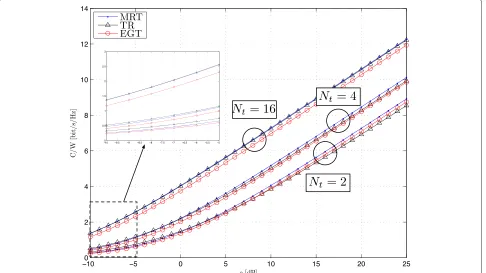
Capacity results are given in Figure 3 forNt = 2, 4, and 16. One can notice that the MRT precoding out-performs the EGT precoding whatever the SNR, with a difference that remains the same whatever the number of transmit antennas. On the other hand, capacity com-parisons between TR and the two other schemes depend both on the SNR range and on the number of antennas. The capacity of the TR system is always better or equal to the capacity of the MRT and EGT systems at low SNRs
whatever the value of Nt. At high SNRs, the MRT and
the EGT systems are the most efficient for a 2×1 sys-tem, whereas TR tends to the MRT performance and even outperforms EGT with more than two transmit anten-nas. Consequently, TR should be preferentially used at
a low-SNR regime, while MRT should be more perfor-mant at a high-SNR regime. Actually, as expected from the theoretical analysis (see Equations 13 and 15), the dif-ference between the capacity of TR and MRT decreases when the number of transmit antennas increases and both systems become equivalent. This is confirmed with the curves obtained forNt = 16. Recall that this behavior is related to the fact thatλmtends towardsNtas the number of transmit antennas increases.
From the above observations, it can be understood that TR acts as a power allocation technique that allocates the power on subcarriers experiencing high SNR values. Since TR can be seen as the matched filter on each link between transmit and receive antennas, it works better at low SNRs, outperforming the two other systems. Further-more, it should be noted that these results do not take into account the spatial focusing property of TR which allows addressing different users while limiting electromagnetic pollution.
4 Bit error rate performance
In this section, the average BER is computed to evalu-ate the performance of the studied systems. As shown in Section 2, the signal received on each subcarrier for each system depends on the used precoding scheme. Also, it is important to note that due to these precoding functions, the signal entries become statistically dependent on the
channel realizations, hereby affecting the receive power level. We therefore defineρas the transmit SNR, i.e., the ratio between the total transmit powerPeand the AWGN power σN2, andρMRT, ρEGT, andρTR as the receive SNR
corresponding to the MRT, EGT, and TR schemes resp. For a same transmit SNRρ, different receive SNRs will be obtained depending on the used precoding function.
The theoretical performance of each of the presented MISO systems is assessed by computing the average BER
for QPSK modulation as a function of transmit SNR ρ.
This amounts to comparing the systems at the same trans-mit power Pe and at the same noise power σN2. For a
receive SNR=xρ, where x is a random variable with
probability density function (PDF)p(x) that depends on the channel and on the transmit precoding scheme, the average BER is computed as
BER(ρ)= 1
The receive SNR for such a transmission, denotedρMRT,
can be derived from Equation 3 as
ρMRT=
The BER is then computed using Equation 16 withx =
Nt
k=1|Hm,k|2. Given the assumptions on|Hm,k|,xis a sum
of independent identically distributed Gaussian variables with standard deviationσ = √1
2. It can be deduced thatx
follows a Gamma distribution with a shape parameter of Ntand a scale parameter of 2σ2=1. Hence,
After integrating Equation 18 in Equation 16 and lead-ing the computation (see Appendix 1, the BER expression becomes
If the transmit SNRρtends towards infinity, the asymp-totic average BER can be computed as the term containing the highest power ofρ:
In the EGT case now, the receive SNRρEGTobtained from
Equation 5 can be expressed as
ρEGT=
It follows that the average BER can be computed as
BEREGT(ρ)=
dom variables following a Rayleigh distribution. No closed form can be found in the literature for anyNt, but some approximations exist. In the following, we propose to derive the exact computation forNt = 2. In Appendix 2, the PDF ofyis proven to be
yielding the following closed-form expression of the BER (see Appendix 2 for further details):
BEREGT(ρ)=
At high SNR, it is also demonstrated in Appendix 2 that
lim
4.3 MISO-TR-OFDM system
Concerning the MISO-TR-OFDM system, the receive SNRρTR is first computed based on the received signal
Equation 7:
The average BER is obtained according to Equation 22 while substitutingybyx = Nt
k=1|Hm,k|2. The PDF ofx is thus the same as in Section 4.1 and follows a Gamma distribution (see Equation 18). After a development in Taylor series of this expression and a variable change (see Appendix 3, one gets
BERTR(ρ)=
At high SNR, we finally have
lim
4.4 System comparison and simulation results
The analytical expressions previously obtained for the receive SNR and the asymptotic BER for any number of transmit antennas are summarized in Table 1. In addi-tion, the last two columns provide the asymptotic BER for Nt=2 and the deduced exploited diversity order for each system whateverNt. Such a diversity order is evaluated by determining the power factor ofρin the asymptotic aver-age BER expressions. As previously explained, no general closed form exists for the asymptotic BER for the EGT system. The expected diversity to be exploited is therefore given by extension from the result obtained forNt=2 and is confirmed hereafter by the simulation results. From this table, many differences have to be highlighted in terms of exploited diversity and SNR gain at high-SNR extreme.
At first, the systems using the MRT and the EGT pre-coding schemes are expected to exploit the full diversity Nt for any number of transmit antennas, while the sys-tem using TR only exploits half the available diversity. Such difference is due to the factors affecting the receive SNR and to their statistical properties. For TR indeed, the factor is a squared sum of the squared modulus of the channel coefficients. By developing this squared sum, some channel coefficients appear with a power equal to 4, whereas in the case of the MRT and EGT, the terms appear with a power equal to 2. After the analytical develop-ments detailed in the previous sections and Appendices,
the obtained BER expressions exhibit a power term ofNt for the MRT precoding andNt/2 for the TR one.
In addition to the considerations on the exploited diver-sity, it is interesting to focus on the receive SNR gains observed at high-SNR regime. From the asymptotic BER
obtained forNt = 2, MRT obviously outperforms EGT
because of the weighting factor of the 1/ρ2term, i.e., 3/16 instead of 1/4. Moreover, the TR asymptotic BER being equal to 4ρ1, TR neither benefits from a diversity gain nor from an SNR gain compared to the other schemes.
Monte Carlo simulations have been carried out to con-firm the analytical results and to extend the previous analytical results whatever the number of transmit anten-nas. The simulated system is the same as described in Section 3.2. Once again, one has to keep in mind that fair performance comparisons are obtained under the assumption of identical transmit power and unchanged noise level whatever the precoding scheme. On that basis, BER curves are plotted versusEb/N0directly derived from
transmit SNRρ, i.e.,(Eb/N0)dB = ρdB−3 dB for QPSK
modulation. Note also that BER results are all obtained keeping the same guard interval size for the three studied precoding systems.
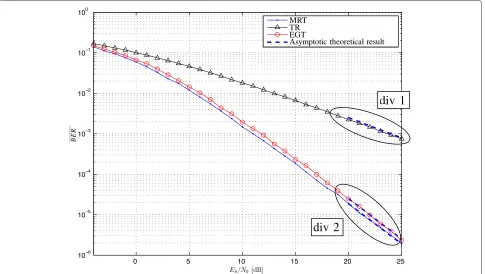
It can be observed in Figures 4 and 5 that the asymptotic slopes summed up in Table 1 perfectly match the average BER curves. More precisely, in Figure 4, for the 2 ×1 system, the average BER of the TR system decreases as −10 dB/decade, which indicates an exploited diver-sity of 1 (div 1 in the figure), whereas the slope for the
EGT and the MRT systems is −5 dB/decade, revealing
an exploited diversity of 2 (div 2 in the figure). The same observations can be made in Figure 5 forNt = 4, where the MRT and the EGT systems both exploit a diversity order equal to 4 (slope of−2.5 dB/decade) and the TR system exploits a diversity order of 2. In addition, note that the MRT system slightly outperforms the EGT system which corresponds to the SNR gain previously discussed. EGT therefore approaches the best BER performance, while keeping a lower complexity as already indicated in Section 2.4. These observations corroborate the theoret-ical results obtained for the MRT and the TR systems on the exploited diversity for aNt×1 system and allow extending the results obtained forNt=2 for the EGT sys-tem. A fundamental conclusion is then that the systems using MRT or EGT exploit the full diversity Nt, while the system using TR only exploit half of the diversity, i.e., Nt/2.
Nevertheless, it has been shown in Section 3 that the capacity of the system using TR is higher than the capacity of the EGT system forNt>2 and very close to the capac-ity of the MRT system. Hence, in terms of BER, the TR system does not perform as good as expected from capac-ity considerations. Indeed, the system would theoretically
BE
R
MRT TR EGT
Asymptotic theoretical result
div 1
div 2
Figure 4BER performance of MRT-, EGT-, and TR-precoded MISO-OFDM systems forNt=2.
a spectral efficiency of 2 bit/s/Hz for Nt = 2 (Nt = 4 resp.). However, using the asymptotic expression for the average BER with QPSK modulation, i.e., at 2 bit/s/Hz (see Table 1), the necessary SNR value to achieve a BER of 10−5 with a TR system is equal to 44 dB forN
t = 2
and 22 dB forNt = 4. Hence, the system should
theo-retically be able to operate at a better rate. On this basis, we propose to study adaptive modulations in the next section.
5 Adaptive modulation
The fact that the TR system underperforms the other schemes in terms of BER can be interpreted as being due to the use of constant order modulation across the subcar-riers of the OFDM system. As evident from Equations 3, 5, and 7, in the TR system, the QPSK symbols experience equivalent channel gains with components proportional to |Hm,k|2 instead of |H
m,k| for the MRT and the EGT schemes. This means that for the subcarriers associated to high|Hm,k|values, TR could probably use modulations of higher order compared to the other schemes. For this rea-son, we propose to study the impact of the use of adaptive modulations.
More generally, a conventional solution to get closer to the capacity when having CSI knowledge at the trans-mitter consists in applying a power allocation algorithm per subcarrier or per antenna. However, the EGT tech-nique, by definition, should not be combined with a power allocation technique as it supposes to have a unity gain on each subcarrier. On the other hand, as the main advantage of TR is its time and spatial focusing prop-erties, combining it with a power allocation algorithm would be equivalent to changing the shape of the fil-ter, hereby destroying the TR focusing effects. The MRT system could benefit from a power allocation algorithm, but for fair comparison purpose, it will not be done here.
To approach capacity, a bit allocation algorithm can alternatively be carried out, leading to adaptive modu-lation strategies [21]. It will allow the three systems to transmit symbols of higher order on subcarriers with a better SNR to ensure a target symbol error rate (SER).
The capacity being calculated for a close to zero BER, a target SER must be set to take into account the per-formance of the QAM modulations. We choose here to set it to 10−5. Knowing the SNR required for different
QAM modulations to achieve a SER equal to 10−5on a
Gaussian channel allows us to determine which order of modulation should be used on each subcarrier accord-ing to the related SNR. As shown in Section 4, such SNR values also depend on the precoding technique carried out in the system, which means that the orders of the constellations will strongly vary from one technique to another. Actually, the maximum throughput that can be
achieved on a given flat-fading channel can be expressed as [21]
R=log2
1+ 1
ρ0 Ps σN2
(29)
wherePsis the power of the transmitted signal and param-eter ρ0 is commonly called the ‘normalized SNR’. It is expressed as
ρ0=
SNR
2R−1 (30)
whereRis the number of bits per symbol.ρ0represents
the SNR gap between the channel capacity and the SER operating point of the QAM modulations with Gray code. This gap turns out to be constant whatever the number of states of the modulation and can easily be obtained from the SER expression as follows [21]:
SER≈2erfc
3R 2(2R−1)
Eb N0
(31)
Using Equations 30 and 31 and knowing that Es/N0 =
REb/N0, it becomes
SER≈2erfc
3 2ρ0
(32)
For instance, a target SER of 10−5leads to a gap value of ρ0 = 6.94, i.e., 8.4 dB. Note that this gap value could be
updated considering a system using channel coding with-out changing the principle of the bit loading approach. In such a case, the allocation process would simply select appropriate modulation/coding couples to respect the tar-get SER.
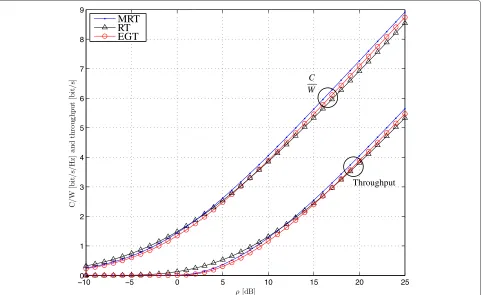
Following this approach, it is possible to compute the achieved throughput for any of the studied precoding
techniques, as proposed in Figure 6 for Nt = 2. The
capacity curve obtained for each of the systems is also drawn in this figure as a reference. One can notice that the hierarchy of the curves obtained for the achieved through-puts remains the same as that obtained when considering capacity results.
+
MRT RT EGT
C W
Throughput
Figure 6Capacity and achievable throughput of MRT-, EGT-, and TR-precoded MISO-OFDM systems for target SER=10−5andN
t=2.
the performance of the MRT scheme at high SNR for a greater number of transmit antennas.
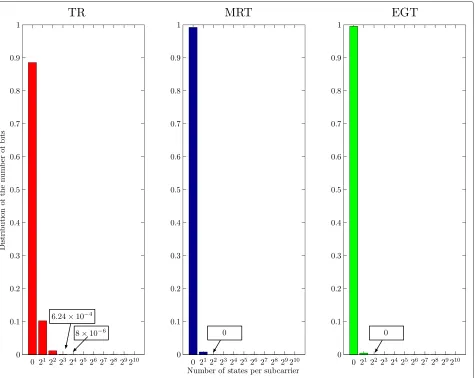
Complementary to throughput results, Figure 7 gives the distribution of the number of states assigned to the subcarriers for a SNR equal to 0 dB. In this figure, value
0 on the x-axis means that no symbol is sent on the
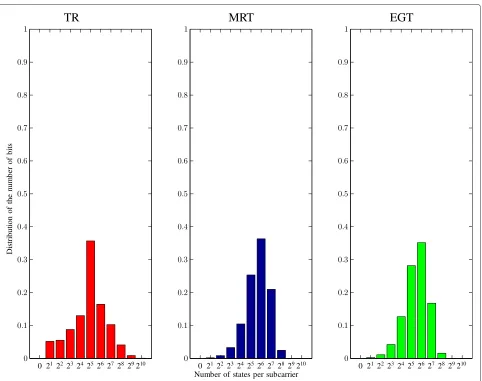
subcarriers. Value 2M means that 2M-QAM symbols are allocated to the subcarriers. It can be noticed that the TR system allocates symbols from the BPSK (1 bit per sym-bol) up to the 16-QAM modulation (4 bits per symsym-bol), whereas the other systems only transmit BPSK symbols and this for a very small number of subcarriers. This reveals that the receive SNR of some subcarriers is bet-ter when using TR than using MRT or EGT. The same kind of distributions can be obtained for a SNR of 25 dB and are given in Figure 8. It can be observed that the TR system range of the used constellation orders is higher than that obtained for the two other systems. More pre-cisely, the TR system allocates 1,024-QAM symbols while the other systems only go up to 512-QAM. This reveals again that some subcarriers experience a better receive SNR in the TR system. On the other hand, the fact that the TR system allocates more BPSK and QPSK symbols reveals that more subcarriers experience a low SNR in the TR system than the two other systems. As mentioned in the beginning of this section, this has to be related
to the fact that modulation symbols experience different equivalent channel gains. As the equivalent channel for the TR system can be viewed as more frequency selec-tive, adaptive modulations lead to the use of a wider range of constellation orders than the other studied systems. Nevertheless, throughput results obtained in Figure 6 show that the three systems tend to perform similarly as the transmit SNR level increases.This can be under-stood by the fact that the subcarriers experiencing high channel gains compensate the other subcarriers for their low channel gains, hereby leading to equivalent average throughput.
6 Conclusion
Figure 7Distribution of number of bits allocated on subcarriers for transmit SNRρ=0dB,Nt=2and target SER of10−5.
must be made considering the size and the topology of the transmit antenna array, the SNR range, and the eventual use of adaptive modulations.
As far as capacity is concerned, it has been shown that the TR system performs the best at low SNRs, whereas the capacity of the MRT system is the best at high SNRs, even if the TR and the MRT systems interestingly become equivalent when the number of transmit antennas increases.
In terms of BER, however, the MISO-OFDM systems using MRT or EGT outperform the MISO-OFDM system using TR when the modulation order is the same for every subcarrier. The reason for this is mainly due to the fact that MRT and EGT exploit the full spatial diversity equal toNt, whereas the TR system only exploits half of this diversity order. Furthermore, the EGT system per-forms very close to the MRT precoding scheme whatever the SNR range and the number of transmit antennas. Nevertheless, the performance loss of the TR scheme is
completely compensated with the use of adaptive modu-lation algorithms. Moreover in this case, we have shown that the TR system is able to achieve a better spectral efficiency for a given SER at low SNRs than the other systems.
MRT
EGT
TR
0 21222324 25262728 29210
Number of states per subcarrier 0 2122 23242526272829210
D
is
tr
ibut
io
n
o
f
the
n
u
m
b
er
o
f
bi
ts
0 212223242526 272829210
Figure 8Distribution of number of bits allocated on subcarriers for transmit SNRρ=25dB,Nt=2and target SER of10−5.
Appendix
Appendix 1: BER of a MISO system using MRT
From Equations 16 and 18
BERMRT(ρ)=
+∞
0
1 (Nt)x
Nt−1e−x1
2erfc !√
xρ"dx
(33)
Using the Taylor series ofe−x, the formula becomes
BERMRT(ρ)= 1 2(Nt)
+∞
k=0 (−1)k
k! +∞
0
xk+Nt−1erfc!√xρ"dx
(34)
By changing the variables asz= √xρand using
+∞
0
z2q−1erfc(z)dz= !
q+ 12"
2√πq (35)
withq=k+Nt, Equation 34 becomes
BERMRT(ρ)=
1 (Nt)
+∞
k=0 (−1)k
k!
1 ρ
k+Nt !k+N
t+12 "
2√π (k+Nt) (36)
The asymptotic average BER is obtained for high SNR val-ues. The expression of the average BER being a sum of powers ofρ, the limit for high SNR values is the term with the highest power. Hence, the asymptotic BER is equal to the first term of the sum, obtained fork=0:
lim
ρ→+∞BERMRT(ρ)=
1 (Nt)
!Nt+12" 2Nt√π
1 ρ
Nt
= 1 (Nt−1)!
(2Nt)!√π 22Nt(Nt)!
1 2Nt√π
1 ρ
Nt
= (2Nt)! 22Nt+1(Nt!)2
1 ρ
Nt
Appendix 2: BER of a MISO system using EGT
The case studied is presented in detail in 4.2 whereNt=2. The first step is to compute the PDF ofy=2k=1|Hm,k|. The terms |Hm,k| being independent, the PDF of the
sum is the convolution of the PDF of each of the term. The modulus|Hm,k|following a Rayleigh distribution and
knowing that such a distribution is equal to zero fort<0, the PDF can be written as
p(y)= e
By changing the variables, one can get to
p(y)= e
Noting that the functions to be integrated are even and performing an integration by parts on the second integral, it becomes
Computation of termT1
Knowing the Taylor seriesez = +∞
IntegratingT1gives the first term of the average BER:
I1=
After changing the variables and using Equation 35, I1
becomes with the lowest powers of ρ1 are computed, giving the asymptotic BER forT1:
I11=
Computation of termT2
IntegratingT2gives the second term of the average BER:
I2=
Changing the variables and using Equation 35,I2becomes
I2=
Appendix 3: BER of a MISO system using TR
The computation of the average BER for a MISO-OFDM system using TR as described in Section 2.3 is detailed here. As said in Section 4, the average BER is equal to
With p(x) given in Equation 18 and using the Taylor series ofe−x, the formula becomes
BERTR(ρ)=
The authors declare that they have no competing interests.
Acknowledgements
This work has been sponsored by Agence Nationale de la Recherche (ANR) project ‘TRIMARAN’.
Author details
1Institute of Electronics and Telecommunications of Rennes (IETR), Rennes 35708, France.2Thales Communications and Security, Genevilliers 92230, France.
Received: 4 March 2013 Accepted: 23 October 2013 Published: 9 November 2013
References
1. GJ Foschini, Layered space-time architecture for wireless communication in a fading environment when using multi-element antennas. Bell Labs Tech. J.1(2), 41–59 (1996)
2. S Zhou, GB Giannakis, Optimal transmitter eigen-beamforming and space-time block coding based on channel mean feedback. IEEE Trans. Signal Process.50(10), 2599–2613 (2002)
3. TKY L o, Maximum ratio transmission. IEEE Int. Conf. Commun. 2, 1310–1314 (1999)
4. DJ Love, JRW Heath, Equal gain transmission in multiple-input multiple-output wireless systems. IEEE Trans. Commun.51(7), 1102–1110 (2003)
5. L Zheng, DNC Tse, Diversity and multiplexing: a fundamental tradeoff in multiple-antenna channels. IEEE Trans. Inf. Theory49(5),
1073–1096 (2003)
6. A Paulraj, R Nabar, D Gore,Introduction to Space-Time Wireless Communications(Cambridge University Press, NY USA, 2008), pp. 95–96 7. M Fink, Time reversal of ultrasonic fields - part i basic principles. IEEE Trans.
Ultrason., Ferroelectr. Freq. Control.39(5), 555–566 (1992) 8. G Lerosey, J De Rosny, A Tourin, A Derode, G Montaldo, M Fink, Time
reversal of electromagnetic waves. Phys. Rev. Lett.92(19), 193904 (2004) 9. P Kyritsi, G Papanicolaou, P Eggers, A Oprea, MISO time reversal and
delay-spread compression for FWA channels at 5 GHz. IEEE Antennas Wireless Propagation Lett.3(1), 96–99 (2004)
10. A Khaleghi, G El Zein, IH Naqvi, Demonstration of time-reversal in indoor ultra-wideband communication time domain measurement. 4th Int. Symp. Wireless Commun. Syst.1, 465–468 (2007)
11. B Wang, Y Wu, F Han, YH Yang, KJR Liu, Green wireless communications: a time-reversal paradigm. IEEE J. Selec. Areas Commun.29(8),
1698–1710 (2011)
12. C Oestges, AD Kim, G Papanicolaou, AJ Paulraj, Characterization of space-time focusing in time-reversed random fields. IEEE Trans. Antennas Propagation53(1), 283–293 (2005)
13. SQ Xiao, J Chen, BZ Wang, XF Liu, A numerical study on time-reversal electromagnetic wave for indoor ultra-wideband signal transmission. Prog. Electromagnetics Res.77, 329–342 (2007)
14. I Naqvi, A Khaleghi, G El Zein, Time reversal UWB communication system: a novel modulation scheme with experimental validation. EURASIP J. Wireless Commun. Network.2010, 398401 (2010)
15. D Abbasi-Moghadam, V Vakili, A SIMO one-bit time reversal for UWB communication systems. EURASIP J. Wireless Commun. Network. 2012(1), 113 (2012)
16. M Emami, M Vu, J Hansen, AJ Paulraj, G Papanicolaou, Matched filtering with rate back-off for low complexity communications in very large delay spread channels. Conf. Rec. Thirty-Eighth Asilomar Conf. Signals, Syst. Comput.1, 218–222 (2004)
17. T Dubois, M Hélard, M Crussière, On the use of time reversal for digital communications with non-impulsive waveforms, inInternational Conference on Signal Processing and Communication Systems, (Gold Coast, Dec 2010), pp. 1–6
18. T Dubois, M Hélard, M Crussière, Time reversal in a MISO OFDM system: guard interval design, dimensioning and synchronisation spects. Wireless World Res. Forum.29, 1–6 (2012)
19. Y Wang, J Coon, Full rate orthogonal space-time block coding in OFDM transmission using time reversal, inProceedings of the IEEE Wireless Communications and Networking Conference, (Budapest, Apr 2009), pp. 1–6 20. GL Stuber, JR Barry, SW McLaughlin, Y Li, MA Ingram, TG Pratt, Broadband
MIMO-OFDM wireless communications. Proc. IEEE92(2), 271–294 (2004) 21. JM Cioffi, A multicarrier primer. Report, ANSI T1E1.4/91-157, Committee
contribution (1991)
doi:10.1186/1687-1499-2013-260
Cite this article as:Duboiset al.:Performance of time reversal precoding technique for MISO-OFDM systems.EURASIP Journal on Wireless Communica-tions and Networking20132013:260.
Submit your manuscript to a
journal and benefi t from:
7 Convenient online submission 7 Rigorous peer review
7 Immediate publication on acceptance 7 Open access: articles freely available online 7 High visibility within the fi eld
7 Retaining the copyright to your article