R E S E A R C H
Open Access
Compressive SAR raw data with principal
component analysis
Wei Wang, Baoju Zhang
*and Jiasong Mu
Abstract
The theory of synthetic aperture radar (SAR) signal model is briefly introduced which is constructed with a series of echo signals in range direction. The procedure of principal component analysis (PCA) is presented which is used as transformation basis to sparsify the signals. The joint compressive sensing (CS) and PCA algorithm is devised to realize SAR raw data compressive measurement. A SAR raw data for a point target is simulated and used to verify the performance of the joint CS and PCA algorithm. The numerical experimental results demonstrate that the PCA method has good sparse performance and the joint CS and PCA algorithm is possible to online compressively measure the SAR raw data.
Keywords:Synthetic aperture radar, Compressive sensing, Principal component analysis, Sparsity
Introduction
Synthetic aperture radar (SAR) is active and coherent microwave radar, which produces high spatial resolution images from a moving platform—an airplane or a satel-lite. SAR systems take advantage of the long-range propagation characteristics of radar signals and the com-plex information processing capability of modern digital electronics to provide high-resolution imagery. SAR technology has provided terrain structural information to geologists for mineral exploration, oil spill boundaries on water to environmentalists, sea state and ice hazard maps to navigators, and reconnaissance and targeting in-formation to military operations [1]. And there are many other applications or potential applications.
A SAR receiver consists of a high-rate A/D converter followed by pulse compression. The resolution of SAR has been limited by the sampling rate of the fastest avail-able A/D. And the performance of SAR system is further degraded by the trade-off that exists between the rate of sampling and the number of quantization level of an A/D. As the development of SAR imaging technol-ogy, the dimension of SAR imagery will become larger and larger and the resolution will become higher and higher [2]. The traditional SAR data acquisition follows the Nyquist sampling theorem and it increases the scale
of SAR system for obtaining more and more data. Thus some problem such as data processing and transmission in real time would occur. Hence, how to compress the imagery data effectively during the acquiring process and reconstruct them accurately is a hot spot [3].
A new theory of compressive sensing (also known under the terminology of compressed sensing, compres-sive sampling, CS) in signal processing provides a funda-mentally new approach to data acquisition which overwhelm the common Nyquist sampling theory. Consider a signal that is sparse in some basis (often using a wavelet-based transform coding scheme), the basic idea of CS is projecting the high-dimensional signal onto a measurement matrix, which is incoherent with the sparsifying basis, resulting to a low-dimensional sensed sequence. Then with a relatively small number of appropriately designed projection measurements, the underlying signal may be recovered exactly [4,5]. In con-trast to the common framework of first collecting as much data as possible and then discarding the redundant data by digital compression techniques, CS seeks to minimize the collection of redundant data in the acquisi-tion step. Because of the special advantages of CS, many references about SAR imagery raw data compressing and reconstruction based on CS have been researched.
Pruente [6] introduced CS to the field of ground moving target indication using multichannel stripmap SAR-data. And the results showed that the approach
* Correspondence:[email protected]
College of Physical and Electronic Information, Tianjin Normal University, Tianjin, China
was stable regarding noise and missing data. Although the statistics of SAR images imply that there was no basis or dictionary where the data could be assumed sparse, Rilling et al. [7] investigated two simple techni-ques, post processing and hybrid compressed sensing, to enhance the quality of the reconstructed SAR image in the non-compressible areas which could not be well described by a sparse approximation. Baraniuk [2] used CS ideas for SAR imaging and proposed two potential improvements: (i) eliminated the matched filter (MF) in the radar receiver and (ii) reduced the required sam-pling rate of the receiver A/D converter. And the author also indicated that there were a number of challengers to be overcome before an actual CS-based radar system would become a reality. Jiao et al. [8] proposed a new pursuit algorithm called Bayesian evolutionary pursuit algorithm for the CS reconstruction problem of SAR images with weak sparsity. To reduce the amount of stored SAR data, Sujit [1] proposed a method based on CS theory. According to the three steps in CS theory, in [3], DWT was utilized to make SAR imagery sparse and the random Gauss matrix after approximate QR decom-position was employed to complete the low-dimension measurement for sparse results based on the original SAR imagery divided into several sub-imageries. Fur-thermore, a modified OMP algorithm was proposed to reconstruct SAR imagery. In [9], the echo model of SAR imagery with multiple ships was converted into a CS model with orthogonal basis and used the CS-based method to achieve higher azimuth resolution. In [10], a sparse reconstruction method for SAR imaging based on CS theory was presented and compared with the traditional MF-based RD imaging method, the proposed method significantly suppressed the sidelobe and greatly improved the imaging performance of SAR when the target space was sparse.
There are three main procedures should be executed in CS theory which is the sparse expression of original signal, low-dimensional sampling, and precisely recon-struction of original signals. According to the above re-search achievements in SAR raw data compressing based on CS theory, we can see that the SAR imagery data usually have poor sparsity feature and looking for suitable sparse transformation basis for SAR images is extremely significant. The two-dimensional SAR image formed is interpreted in the directions of range and azi-muth. The range is the direction of signal propagation and the azimuth is the direction parallel to the flight path. In this article, the SAR signals are thought as com-posed with distributed signals of the range samples and principal component analysis (PCA) can be used to find transformations that sparsify the range samples. The re-mainder of the article is organized as follows. In the fol-lowing section, the SAR raw data model is analyzed. In
Section “Joint PCA and CS for SAR raw data compres-sion”, we summarized a mathematic description of CS and PCA theory and the sparse transform procedure for SAR raw data was proposed. Simulation results are presented in Section “Simulation results and analysis”. Finally, the article is ended with some conclusion.
SAR signal model and imaging theory
SAR is a high-resolution imaging radar technology. For the conventional standard SAR imaging, the high-resolution of range direction is obtained by the pulse compression of chirp signal and the high resolution of azimuth direction is received through the synthetic aper-ture formed by platform movement [11].
SAR signal model
Suppose SAR platform works in stripmap mode. The SAR platform flights along a track parallel to azimuth direction at altitude H with a constant velocity. Assum-ing the radar transmits a linear frequency modulated (LFM) pulse train as
where α is the LFM, f0 denotes carrier frequency, Tr is pulse repetition time and pulse width is τ, and rec(t) denotes the unit rectangular function.
So, the SAR echo signal at timetcan be expressed as
s tð Þ ¼∬
whereDdenotes the radar beam irradiation area,σ(x, r) represents the backscattering coefficients of target point (x,r),Wαð Þ,: Wrð Þ: are antenna gains of azimuth direction and range direction, respectively, and r(x, r) states the distance between radar platform with target point (x, r).
SAR imaging
Assuming Nr and Na denote sample size of range and azimuth dimension signal, respectively, then the matrix of SAR echo signals can be written as
S¼ ½sð1;1Þ;sð1;2Þ;. . .;sð1;NrÞ;sð2;1Þ;sð2;2Þ;. . .;
sð2;NrÞ; . . . ;s Nð a;1Þ;s Nð a;2Þ;. . .;s Nð a;NrÞ
ð3Þ
where s i;ð Þ1 ;s i;ð Þ2 ;. . .;s i;ð NrÞ denotes the echo signal at time i which are sampled following Shannon’s cele-brated theorem. SAR imaging is to extract the two-dimensional distribution of target scattering coefficient
σ(x, r) from echo signal trainS. The most universal meth-ods for SAR imaging are based on MF theory to deal with rang and azimuth dimension signal separately, such as Rang-Doppler algorithm, Chirp-Scaling algorithm, Spec-tral Analysis algorithm, etc. [10]. However, there are many obvious defects in these traditional SAR imaging meth-ods. For instance, according to the Nyquist sampling the-ory, a large number of echo samplers must be gathered in order to raise SAR range resolution which will lead to an excessive burden of SAR acquisition and storage system. Therefore, how to realized high-resolution SAR from low-dimension samplers is extremely significant. The emergence of CS theory makes it possible.
Joint PCA and CS for SAR raw data compression
In this section, we first review the basic theory of CS and PCA and we subsequently illustrate the sparse transformation procedure for SAR raw data.
Basic theory of CS
Recently, CS has received considerable attention. The theory of CS states that a signal may be captured with a small set of non-adaptive, linear measurements as long as the signal is sparse in some basis (such as DCT, wave-let) [12,13]. We can write in matrix notation:
y¼Φx¼ΦΨθ¼Θθ ð4Þ
whereΦis anM×Nmeasurement matrix withM<N, y 2 RMis the vector of samples observed. θ is the trans-form coefficient vector of signal x under orthonormal basisψ, i.e.,θ¼ΨTx.
Known the observed vector y and the measurement matrixΦ, sparse transformation basisψ, the recovery of the unknown signalxcould be achieved by searching for the l0-sparsest representation that agrees with the mea-surements [14]:
θ_ ¼ arg minkθk0 Subject to
y¼ΦΨθ ð5Þ
where the l0 pseudo-norm k k0 corresponds to the number of non-zero elements. As it is well known,
this is a daunting NP-complete combinatorial optimization problem which cannot be solved directly in practice. Instead of solving the l0-minimization problem, non-adaptive CS theory seeks to solve the ‘closest possible’ tractable minimization problem, i.e., the l1-minimization:
θ_ ¼ arg minkθk1
Subject to
y¼ΦΨθ ð6Þ
This modification leads to a much simpler convex problem, but it involves expensive computations when applied to large-scale signals. Therefore, a second ap-proach using iterative greedy methods has been pro-posed, such as matching pursuit (MP), orthogonal matching pursuit (OMP), StOMP, Subspace Pursuit (SP), and CoSaMP.
PCA
From the recovery algorithm of CS, it can be shown ob-viously that the appropriate sparse transformation basis ψ can improve recovery precision and reduce the com-putations. In this article, the PCA is the technique pro-viding the transformation matrixψ.
PCA is a mathematical procedure that uses an orthog-onal transform to convert a set of observations of pos-sibly correlated variables into a set of values of linearly uncorrelated variables called principal components. The number of principal components is less than or equal to the number of original variables.
Assuming xi2RN is the samples at discrete time i=1,2,. . .,K with a fixed sampling rate. The measure-ments mean vector and covariance matrix of xi can be defined as
Considered the above equations, the orthonormal matrixPcan be constructed whose columns are the uni-tary eigenvectors of covariance matrixC, placed accord-ing to the decreasaccord-ing order of the correspondaccord-ing eigen values. Then we can define
zi¼PTðxixÞ ð8Þ
wherePTis the inverse matrix ofP. Due to the construc-tion ofP, we have the entries of ziare ordered as follows:
zið Þj is negligible. In other words, the N-dimensional vector zi can be considered as anM sparse vector and the value of M depends on the level of correlation among the gathered samplesx1;x2;. . .;xK [15,16].
Joint CS and PCA for compressive SAR imaging
Given the SAR imaging theory and Equation (3), we can rewrite the echo signals assi2CNr;i¼1;2; ::::;Na, si¼
s i;ð Þ1 ;s i;ð Þ2 ;. . .;s i;ð NrÞ
½ . Due to the echo signals
re-flect the backscatter coefficients of target, the instances
s1;s2;. . .;sNa are temporally correlated, that is, the PCA
algorithm can be used to sparsify the echo signal. Con-sidered that the echo signals are complex, we can write the compressive measurement of SAR echo signal through CS and PCA as follows.
yire¼Φ½Reð Þ si Reð Þs ¼ΦPreθrei ð9Þ
yiim¼Φ½Imð Þ si Imð Þs ¼ΦPimθimi ð10Þ
The real and imaginary part of echo signal is calcu-lated, respectively. Where s denotes the mean vector of
Si, yre, yim denote the low-dimensional measurements, Pre, Pim represent the orthonormal transformation basis constructed based on Equation (7), θrei and θimi are the sparse coefficients.
As above, we can obtain the recovery sparse vector ^
θire and ^θiim through acquired low-dimensional mea-surements and recovery algorithms such as OMP. Then the estimations ofsican be written as follows.
^si¼Reð Þ þ^si jImð Þ^si
In short, we can achieve high-resolution SAR from low-dimension samplers based on joint CS and PCA schemes. Furthermore, it is noted that real SAR echo signals are in general non-stationary. This means that the statistics that we need to use in the PCA must be acquired at runtime and it makes that an online estima-tion of these parameters possible.
Simulation results and analysis
To illustrate the effectiveness of the proposed joint CS and PCA algorithm, we test its performances on simu-lated SAR imaging of point target. In the experiments, we chose random Gaussian matrix for measurement matrix Φ and OMP for recovery algorithm. Due to the randomness of measurement matrix Φ, all the experi-ment results are the mean value of ten times computa-tions. All the computations are run on a 2.60-GHz Inter Core i5 laptop with 4-GB RAM.
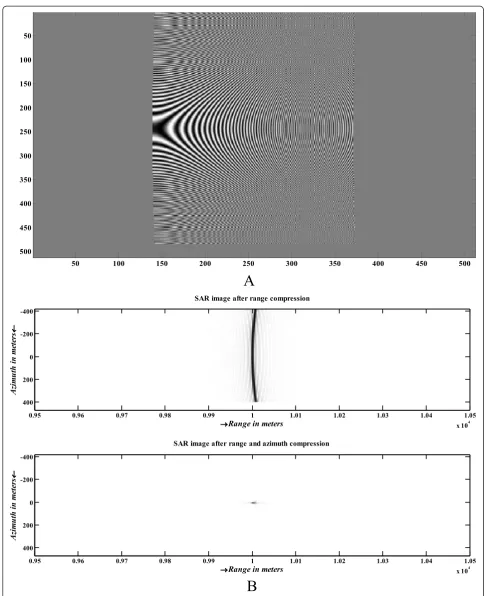
In this section, we simulate the SAR echo signals from a point target with carrier frequency f0¼1 GHz, pulse repetition time Tr¼0:02 s, and pulse width τ¼5 μs. In Figure 1, we show the real part of SAR raw data with
Nr=Na= 512, SAR image after range compression and SAR image after range and azimuth compression.
To test the feasibility of the joint CS and PCA scheme, we test the performance of the algorithm based on the above real part of SAR raw data. In Figure 2, it is showed that the trend of reconstruction error versus the num-ber of CS observations. The reconstruction error is
defined as E¼kðReð ÞS Reð Þ^S Þk2
kReð ÞkS 2 , where S is the original matrix of SAR echo signals according to Equation (3) and Ŝ is the reconstructed matrix of SAR echo signals on the basis of Equations (3) and (11). The number of CS observations is the amount of random measuring with CS measurement matrix Φ for per echo signal si. From Figure 2, it can be seen clearly that we can get high compression effect with CS and PCA and the PCA algorithms have good performance to sparsify the SAR raw data.
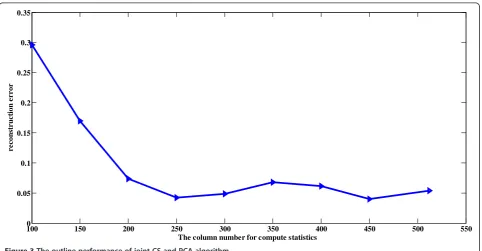
As is clear from the PCA procedure, the statistics (sample mean and covariance matrix) must be gener-ated at runtime. Hence, in order to implement joint CS and PCA for real signals, we should implement our algorithm at two phases: training phase and subse-quent monitoring phase. In training phase, we collect a series of signals to compute samples mean and orthonormal transformation matrix. Then, in the mon-itoring phase, it is compressive measurement of subse-quent received signals using the statistics computed in the previous phase [15]. To test the effective of the al-gorithm of the two phases, we simulate the trend of reconstruction error E versus the number of training signals. In Figure 3, with the constant number of CS observation, the simulation results show that the ten-dency of reconstruction error is decreasing with the increasing amount of training signals. And we can also see that the fluctuation is smaller when a proper amount of training signals is used to compute the sta-tistics. From the experimental results, we can stress that the joint CS and PCA algorithm can readily be applied to online compressively measuring SAR raw data.
Conclusion
has good sparse performance for SAR raw data which are temporal correlated in range dimension and the joint CS and PCA algorithm is possible to online compressive measure the SAR raw data.
However, there are some challenges to be overcome before a high efficient joint CS and PCA algorithm
for time SAR image compression become a real-ity. First, how to decide an appropriate amount of echo signals to determine the statistics should be analyzed in order to lessen computation burden. Sec-ond, for a large number of SAR echo signals, we should decide which part of echo signals is temporal
10 20 30 40 50 60 70
0 0.2 0.4 0.6 0.8 1 1.2 1.4
The number of CS Observation
R
e
c
o
ns
tr
u
c
ti
o
n
Er
r
o
r
Figure 2Performance of joint CS and PCA for SAR raw data.
100 150 200 250 300 350 400 450 500 550
0 0.05 0.1 0.15 0.2 0.25 0.3 0.35
The column number for compute statistics
recon
st
r
u
c
ti
on
e
rror
correlated, and it is the premise to use joint CS and PCA algorithm.
Competing interests
The authors declare that they have no competing interests.
Acknowledgments
This research was supported by the High Education Science & Technology Foundation Planning Project of Tianjin (20100716), the Tianjin Younger Natural Science Foundation (12JCQNJC00400), and the Tianjin Natural Science Foundation (10JCYBJC00400).
Received: 18 July 2012 Accepted: 24 July 2012 Published: 16 August 2012
References
1. B. Sujit, Fast encoding of synthetic aperture radar raw data using compressed sensing, inIEEE/SP 14th Workshop on Statistical. Signal Process
08, 448–452 (2007)
2. R. Baraniuk,Compressive radar imaging, vol. 04 (IEEE Radar Conference, Houston, USA, 2007), pp. 128–133
3. F. Zhu, Q. Zhang, J.-B. Yan et al.,SAR imagery compressing and reconstruction
method based on compressed sensing, vol. 03 (Electromagnetic Research
Symposium Proceedings, KL, Malaysia, 2012), pp. 235–239 4. Y. Rivenson, A. Stern, Compressed imaging with a separable sensing
operator. IEEE Signal Process. Lett.16(6), 449–452 (2009)
5. L. He, L. Carin, Exploiting structure in wavelet-based bayesian compressive sensing. IEEE Trans Signal Process.57(9), 3488–3497 (2009)
6. L. Pruente,Application of compressed sensing to SAR/GMTI-data, vol. 06 (2010 8th European Conference on Synthetic Aperture Radar, 2010)
7. G. Rilling, M. Davies, B. Mulgrew,Compressed sensing based compression of
SAR raw data, vol. 03 (Signal Processing with Adaptive Sparse Structured
Representations, 2009), pp. 1–6
8. W. Jiao, L. Fang, L.C. Jiao et al., Compressive sensing SAR image reconstruction based on Bayesian framework and evolutionary computation. IEEE Trans. Image Process.20(7), 1904–1911 (2011) 9. L. Yabo, Q. Yinghui, L. Jun et al.,SAR imaging of multiple ships based on
compressed sensing, vol. 10 (2nd Asian-Pacific Conference on Synthetic Aperture Radar, 2009), pp. 112–115
10. S.J. Wei, X.L. Zhang, J. Sh et al., Sparse reconstruction for SAR imaging based on compressed sensing. Electromag. Res109, 63–81 (2010)
11. M. Soumekh,Synthetic Aperture Radar Signal Processing with Matlab
Algorithms(Wiley, New York, 1999)
12. E. Candès, T. Tao, Near-optimal signal recovery from random projections: universal encoding strategies. IEEE Trans. Inf. Theory52, 5406–5425 (2006) 13. E. Candès, M. Wakin, An introduction to compressive sampling-a sensing/
sampling paradigm that goes against the common knowledge in data acquisition. IEEE Signal Process. Mag.25(2), 21–30 (2008)
14. A. Averbuch, D. Shai, D. Shay, Adaptive compressed image sensing using dictionaries. SIAM J. Imag. Sci.5(1), 57–89 (2012)
15. R. Masiero, G. Quer, D. Munaretto et al.,Data acquisition through joint
compressive sensing and principal component analysis(IEEE Globecom 2009,
Honolulu, Hawaii, 2009), pp. 1–6
16. R. Masiero, G. Quer, M. Rossi, and M. Zorzi, A Bayesian analysis of compressive sensing data recovery in wireless sensor networks, inIEEE Ultra Modern Telecommunications and Control Systems ICUMT (SenseApp Workshop), 2009 ICUMT’0910, 1–6 (2009)
doi:10.1186/1687-1499-2012-258
Cite this article as:Wanget al.:Compressive SAR raw data with principal component analysis.EURASIP Journal on Wireless Communications and Networking20122012:258.
Submit your manuscript to a
journal and benefi t from:
7 Convenient online submission
7 Rigorous peer review
7 Immediate publication on acceptance
7 Open access: articles freely available online
7 High visibility within the fi eld
7 Retaining the copyright to your article