R E S E A R C H
Open Access
A numerical algorithm based on modified
extended B-spline functions for solving
time-fractional diffusion wave equation
involving reaction and damping terms
Nauman Khalid
1, Muhammad Abbas
2*, Muhammad Kashif Iqbal
3and Dumitru Baleanu
4*Correspondence:
[email protected] 2Department of Mathematics,
University of Sargodha, Sargodha, Pakistan
Full list of author information is available at the end of the article
Abstract
In this study, we have proposed an efficient numerical algorithm based on third degree modified extended B-spline (EBS) functions for solving time-fractional diffusion wave equation with reaction and damping terms. The Caputo
time-fractional derivative has been approximated by means of usual finite difference scheme and the modified EBS functions are used for spatial discretization. The stability analysis and derivation of theoretical convergence validates the authenticity and effectiveness of the proposed algorithm. The numerical experiments show that the computational outcomes are in line with the theoretical expectations. Moreover, the numerical results are proved to be better than other methods on the topic.
Keywords: Time-fractional diffusion wave equation; Finite difference formulation; Caputo’s time-fractional derivative; Modified extended B-spline functions; Modified B-spline collocation method
1 Introduction
The study of fractional calculus is considered to be an extension of classical calculus which has been given significant attentions in last couple of decades. Many applications of fractional differential equations are found in electro-chemistry, biomedical engineering, hydrology, probability theory and finance [1–6]. Fractional-order differential equations appear in mathematical modeling of several natural phenomena such as diffusion proce-dures, viscoelasticity, thermo-elasticity, seepage of a liquid, dynamical processes in self-similar and porous structures, wave propagation, anomalous diffusion transport, signal processing, control theory of dynamical systems, rheology and optics [7–11]. The time-fractional diffusion-wave equation (DWE) is one of them. This mathematical model is formulated from the classical DWE after replacing the second order time derivative by fractional derivative of orderα(1 <α≤2). Consider the following time-fractional DWE with Caputo’s fractional derivative involving reaction and damping terms:
∂αu(z,t) ∂tα +β
∂u(z,t)
∂t +γu(z,t) –
∂2u(z,t)
∂z2 =f(z,t), t∈[0,T],z∈[a,b], (1)
controlled by the following constraints:
u(z, 0) =φ0(z), ut(z, 0) =φ1(z); a≤z≤b, (2)
u(a,t) =ψ0(t), u(b,t) =ψ1(t); 0≤t≤T, (3) wheref(z,t),φi,ψi(i= 0, 1) are smooth functions with second order continuous
deriva-tives andβ,γare coefficients of the reaction and damping terms, respectively. The Caputo fractional derivative ∂α
∂tαu(z,t) of orderα∈(1, 2] is defined as ∂α
∂tαu(z,t) =
1 Γ(2 –α)
t
0
∂2u(z,τ) ∂τ2 (t–τ)
1–α
dτ, 1 <α≤2, (4)
whereΓ denotes the gamma function.
The study of exact and approximate solutions of differential/integral equations has al-ways remained an attractive area of research. The existence and behavior of unique solu-tions for some fractional-order quadratic Volterra equasolu-tions and nonlinear integral equa-tions has been discussed in [12–16]. In the last couple of decades many researchers studied the approximate solution of fractional-order DWE. Dinget al.[17] presented two numer-ical algorithms based on usual finite difference formulation for solving time-fractional DWE. Bhrawyet al.[18] employed the spectral tau method composed with the shifted Jacobi matrix for numerical treatment of second order fractional DWE. A numerical al-gorithm based on radial basis functions for solving fractional DWE was developed by Avazzadehet al.[19]. A triangular function algorithm based on the operational matrix of a fractional-order integration was discussed by Ebadianet al.[20] for solving a time-fractional DWE. Osamaet al. [21] employed the Sinc-Legendre collocation method to explore the numerical solution of a time-fractional DWE by reducing the problem into system of linear algebraic equations. Hooshmandasl et al.[22] numerically solved the fractional sub-diffusion and time-fractional DWE by employing the Galerkin technique depending on the fractional-order Legendre functions.
Chatterjeeet al.[23] used Bernstein polynomials to approximate truncated series for nonlinear fractional-order DWE. A numerical algorithm based on Chebyshev wavelets was formulated by Zhou and Xu [24] to obtain the approximate solution for time-fractional DWE. Numerous researchers have developed various methods for solving a time-fractional DWE; see [14, 25–27]. Recently, Kanwal et al. [28] presented a Ritz– Galerkin method together with two-dimensional Genocchi polynomials to establish the numerical solutions of a time-fractional DWE and a time-fractional Klein–Gordon equa-tion.
[32] discretized the spatial derivatives using extended cubic B-spline (ECBS) functions for solving a time-fractional advection–diffusion equation (ADE).
In the present paper, the application of modified ECBS functions has been presented for a numerical treatment of a time-fractional DWE involving reaction and damping terms. For temporal discretization, a usual finite difference approach consorted with Caputo’s time-fractional derivative has been used, while spatial derivatives are described by modi-fied ECBS functions.
The section-wise organization of the paper is as follows: In Sect.2, derivation of space derivatives via modified ECBS functions has been discussed. The temporal discretization is explained in Sect.3. The description of numerical method is presented in Sect.4. The stability and convergence analysis of the proposed scheme is given in Sect.5. To corrobo-rate the efficiency and validity of the present approach, the experimental results and com-parisons are displayed in Sect.6. Finally, concluding remarks are presented in Sect.7.
2 Modified extended cubic B-spline functions
Consider a partitiona=z0<z1<· · ·<zN=bof the interval [a,b] into subintervals [zi–1,zi]
with equal spacingh= 1
N(b–a),i= 1 : 1 :N.
whereαni(t) are time dependent constants, to be determined, and the ECBS blending func-tions of degree 4,ηi(z), are defined as [32,36]
In the above formulation,μis a free parameter which is used to change the shape of the B-spline curve and –m(m– 2)≤μ≤1,mis the degree of ECBS [35]. Forμ= 0, the ECBS functions reduce to ordinary cubic B-spline functions. Further,η–1,η0, . . . ,ηN+1are taken in such a way that it forms spline basis over [a,b]. The values of ECBS functions and their derivative at nodal points are displayed in Table1. The approximate solutionUin=U(zi,tn)
with its first and second derivative in terms of the time parameterαican be expressed as
Table 1 The coefficients of ECBSηi(z) and their derivatives at nodezi
In the present study, the ECBS functions are modified in such a way that they pre-serve the diagonal dominance property. The modification in ECBS functions is as follows [37]:
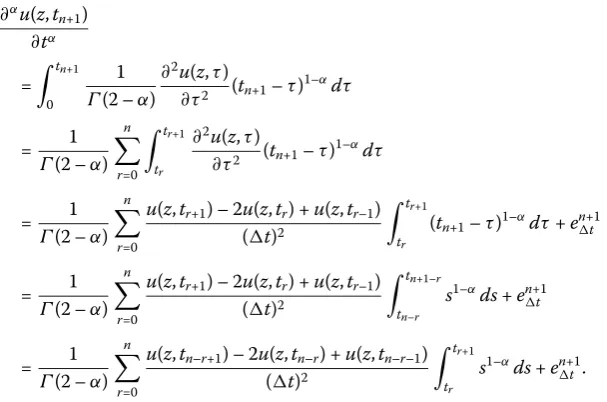
The second order differential operator approximation in time direction, using a finite dif-ference scheme, is given by
Hence
∂αu(z,tn
+1) ∂tα =
1 Γ(3 –α)
n
r=0
br
u(z,tn–r+1) – 2u(z,tn–r) +u(z,tn–r–1)
(t)α +e
n+1
t , (10)
wherebr= (r+ 1)2–α– (r)2–α,s=tn
+1–τ and the truncation errorent+1is bounded such
that
ent+1≤σ(t)2, (11)
whereσ is a constant.
Lemma 3.1 The following properties are fulfilled by the coefficients br[34]:
• br> 0andb0= 1,r= 1 : 1 :n,
• b0>b1>b2>· · ·>br,br→0asr→ ∞,
• –br+ (2br–br–1) + n–1
r=1(–br–1+ 2br–br+1) + (2b0–b1) = 1.
Using Eq. (10) in Eq. (1), we get the following form:
n
r=0
br
u(z,tn–r+1) – 2u(z,tn–r) +u(z,tn–r–1) Γ(3 –α)(t)α +β
u(z,tn+1) –u(z,tn)
t
+γu(z,tn+1) –
∂2u(z,tn +1)
∂z2 =f(z,tn+1). (12)
Assumingρ=Γ(3–α1)(t)α,β0=tβ,un+1=u(z,tn+1), the above expression takes the follow-ing form:
(ρ+β0+γ)un+1– (2ρ+β0)un+ρun–1+ρ
n
r=1
brun–r+1– 2un–r+un–r–1
–∂ 2un+1
∂z2 =f(z,tn+1), (13)
wheren= 0 : 1 :M. We use the initial condition to eliminateu–1, which will occur forn= 0, i.e.
u–1=u1– 2tφ1(z). (14)
In particular, takingn= 0, the scheme takes the following form:
(ρ+β0+γ)u1– (2ρ+β0)u0+ρu–1= ∂2u1
∂z2 +f(z,t1).
Using Eq. (14), the above equation simply leads to the following form:
(2ρ+β0+γ)u1– (2ρ+β0)u0= ∂2u1
4 Description of the numerical scheme
Using the ECBS approximations given in Eq. (7) in Eq. (13), the implicit finite difference formulation yields the following recurrence relation:
procedure. Making use of the initial conditions, we have
Ui0=φ0(zi), fori= 0 : 1 :N. (18)
In matrix notation, the above tri-diagonal system is expressed as
⎛
This section is for the discussion of the stability analysis and theoretical convergence of the proposed scheme.
5.1 Stability analysis
presented numerical algorithm for solving time-fractional DWE. Let Φinbe the growth factor of the fourier mode andΦ˜inbe its approximation. Define the error terminas
ni =Φin–Φ˜in, i= 1 : 1 :N– 1,n= 0 : 1 :M, (20) andn= [n
1,2n,·,Nn–1]T.
It is sufficient to analyze stability of the scheme presented in Eq. (16) for force-free case (f = 0) only. The round-off error equation has been obtained from Eqs. (20) and (16) as
The initial/boundary conditions are satisfied by the error equation such as
0i =φ0(zi), (t)0i =φ1(zi), i= 1 : 1 :N, (22)
and
n0=ψ0(tn), Nn =ψ1(tn), n= 0 : 1 :M. (23)
Now, we define the mesh function as follows:
n=
Expressingn(z) in the Fourier series form:
n(z) =
Using the norm definition, we have
Using the Parseval equality,ab|n|2dz=∞
Suppose the solution in the Fourier series form is presented as follows:
nj =ξneiλjh, (28)
Proof We prove this result by induction. Forn= 0, Eq. (30) implies
Theorem 1 The implicit collocation scheme(16)is unconditionally stable.
Proof By making use of Eq. (27) and Lemma5.1, we get
n
2≤ 0
From the aforementioned relations we conclude that the proposed scheme (16) is
uncon-ditionally stable.
5.2 Convergence analysis
We follow Kadalbajoo and Arora [39] to examine the convergence of the proposed scheme. First of all, we state a theorem due to Boor [40] and Hall [41] which plays a key role for the convergence analysis of the proposed scheme.
Theorem 2 Let,u(z,t)belongs to C4[a,b],f belongs to C2[a,b]andΠ={a=z
0,z1, . . . ,zN=
b}be a partition such that zi=ih,i= 1 : 1 :N.LetU˜(z,t)denote the unique spline approx-imation to the present problem at the knots z∈Π,then∀t≥0,∃aj,free of h,s.t.
Dju(z,t) –U˜(z,t) ∞≤ajh4–j, j= 0, 1, 2. (31)
Lemma 5.2 The modified ECBS set{η0,η1, . . . ,ηN}presented in Eq. (8)satisfy the inequal-ity,
N
i=0
ηi(z)≤
7
4. (32)
Proof Using the triangular inequality, we have
N
i=0 ηi(z)
≤
N
i=0 ηi(z).
For any nodal pointzi, we get
N
i=0
ηi(z)=ηi–1(zi)+ηi(zi)+ηi+1(zi)
=4 –μ 24 +
8 +μ 12 +
4 –μ 24 = 1 <
7 4.
Furthermore, for a pointz∈[zi,zi+1], we obtain
N
i=0
ηi(z)=ηi–1(z)+ηi(z)+ηi+1(z)+ηi+2(z)= 20 +μ
12 ,
where
ηi–1(z)≤ 4 –μ
24 , ηi(z)≤ 8 +μ
12 , ηi+1(z)≤ 8 +μ
12 , ηi+2(z)≤ 4 –μ
24 .
Since –8≤μ≤1, we have 1≤20+12μ≤7 4. Hence,
N
i=0
ηi(z)≤
7
Theorem 3 The numerical approximation U(z,t)to the closed form solution u(z,t)exists for the time-fractional problem(1)–(3).Also,if f∈C2[0, 1],we have
u(z,t) –U(z,t)∞≤κh2, ∀t≥0 (33)
where h is sufficiently small andκ> 0is,a constant,free of h.
Proof LetU˜(z,t) =iN=0di(t)ηi(z) be the computed spline for the approximate solution U(z,t) and exact solutionu(z,t). Using the triangular inequality, the expression can be written as
u(z,t) –U(z,t)∞≤u(z,t) –U˜(z,t)∞+U˜(z,t) –U(z,t)∞.
Using (31), we have
u(z,t) –U(z,t)∞≤a0h4+U˜(z,t) –U(z,t)∞. (34)
LetLu(zi,t) =LU(zi,t) =f(zi,t),i= 0 : 1 :N, be the collocation conditions, then
LU˜(z,t) =f˜(zi,t), i= 0 : 1 :N.
At any time leveln, the given problem in the form of the difference equationL(U˜(zi,t) – U(zi,t)) can be written as follows:
(ρ+β0+γ)c1–c4
νin–1+1+(ρ+β0+γ)c2–c5
νin+1+(ρ+β0+γ)c1–c4
νin+1+1
= (2ρ+β0)
c1νni–1+c2νin+c1νin+1 –ρ
c1νin–1–1+c2νin–1+c1νin+1–1
–ρ
n
r=1
brc1
νin–1–r+1– 2νin–1–r+νin–1–r–1 +c2
νin–r+1– 2νin–r+νin–r–1
+c1
νni+1–r+1– 2νin+1–r+νin+1–r–1 +fin+1. (35)
Also, the boundary conditions take the following form:
c1νin–1+1+c2νin+1+c1νin+1+1= 0, i= 0,N,
where
νin=αni –dni, i= 0 : 1 :N,
and
Ωin=h2fin–f˜in, i= 0, . . . ,N. It is evident from (31) that we have
Ωn
i=h2fin–f˜in≤ah4.
We defineΩn=max{|Ωn
Forn= 0, Eq. (35) together with (14) takes the following form:
Using the initial condition,e0= 0, we have
Taking absolute values ofΩinandνinwith a sufficiently small mesh sizeh, we have
˜
Taking the infinite norm and using Lemma5.1, we obtain
From Eq. (38), Eq. (34) takes the following form:
u(z,t) –U(z,t)∞≤a0h4+ 1.75ah2=κh2,
whereκ=a0h2+ 1.75a.
From the aforementioned theorem and Eq. (11) we conclude that the proposed numer-ical approach is convergent. Hence,
u(z,t) –U(z,t)∞≤κh2+σ(t)2,
whereκandσ are constants.
6 Numerical examples
To examine the accuracy of the proposed computational scheme, some test examples are considered for the time-fractional DWE. TheL2andL∞norms are used to calculate the absolute errors of the proposed method as in [42]. We have
L2= hN
i=0
U(zi,t) –u(zi,t)2, L∞= max
0≤i≤N
U(zi,t) –u(zi,t).
The experimental order of convergence (EOC) is calculated to be [43]
EOC =log(L∞(n)/L∞(2n)) log(2) .
The numerical results obtained from the modified ECBS method are compared with given exact solutions and the numerical methods available in the literature. The software pack-age MATHEMATICA 9.0 is used to run the simulation.
Example1 Consider the time-fractional DWE [33]
∂αu(z,t)
∂tα –
∂2u(z,t) ∂z2
=sin(πz)
2t2–α
Γ(3 –α)–
t1–α
Γ(2 –α)+π
2t2–t , z∈[a,b],t∈[0,T],
with the conditions
u(z, 0) = 0, ut(z, 0) = –sin(πz),
Table 2 Error normL∞att= 0.2, 0≤z≤1 andα= 1.5 for Example1
150 0.00115 3.049×10
–6 7.719×10⁻¹⁶
1 30
1
200 0.00021 3.035×10
–6 8.826×10⁻¹⁶
1 40
1
200 0.00019 1.281×10
–6 2.990×10⁻¹⁶
1 40
1
210 0.00006 1.280×10
–6 2.225×10⁻¹⁶
1 45
1
220 0.00004 8.989×10
–7 9.935×10⁻¹⁷
100 0.01064 3.113×10
–5 4.080×10⁻¹⁴
1 30
1
200 0.00736 9.178×10
–6 9.718×10⁻¹⁵
1 50
1
250 0.00653 1.982×10
–6 3.602×10⁻¹⁵
1 50
1
300 0.00586 1.980×10
–6 3.214×10⁻¹⁵
1 60
1
400 0.00494 1.149×10
–6 2.169×10⁻¹⁵
1 60
1
450 0.00460 1.443×10
–6 2.025×10⁻¹⁵
N CuTBSM [33] Present method
Figure 2Exact and approximate solutions for Example1, whenN= 32,α= 1.5 andt= 0.01
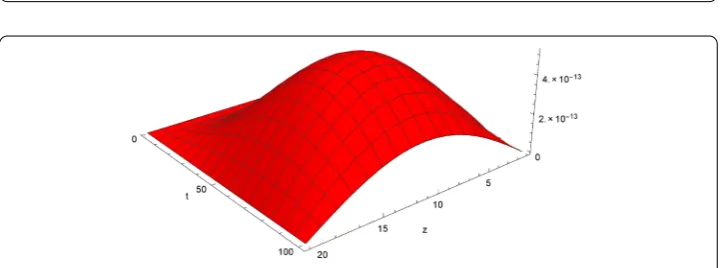
Figure 3Absolute error graph for Example1att= 1 whenN= 20,α= 1.3 and 0≤z≤1
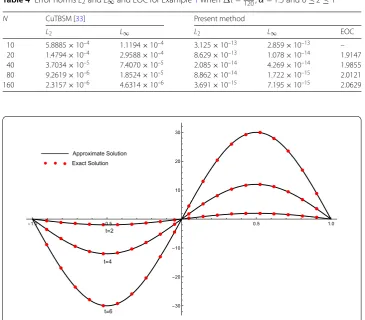
and CuTBSM [33]. Also the results elaborated in Table3show a far better agreement with the analytical exact solution than the other methods att= 0.4,α= 1.7 for different choices ofhandt. The EOC is portrayed in Table4. The error normsL2andL∞are also compared with the method given in [33]. In Fig.1, the approximate solution at different time levels is shown in one frame when –1≤z≤1. The three dimensional visuals given in Fig.2elucidate our claim about accuracy of the proposed scheme forN= 32,t= 0.01 andt= 2. The 3D absolute error graph is displayed in Fig.3forN= 20,t= 1,t= 0.01 andα= 1.3.
Example2 Consider the time-fractional DWE involving damping term [45]
∂αu(z,t) ∂tα +
∂u(z,t) ∂t –
∂2u(z,t) ∂z2 =
6t3–α
Γ(4 –α)+ 3t
2–t3 ez, z∈[0, 1],t∈[0,T],
with the initial/boundary conditions
u(z, 0) =ut(z, 0) = 0
and
u(0,t) =t3, u(1,t) =t2e.
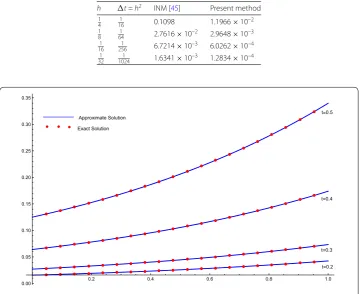
The analytical exact solution isu(z,t) =t3ez. In Table5, the approximate results returned
Table 5 Maximum absolute error (L∞) whenα= 1.85 for Example2
h t=h2 INM [45] Present method 1
4 1
16 0.1098 1.1966×10⁻² 1
8 1
64 2.7616×10⁻² 2.9648×10⁻³ 1
16 1
256 6.7214×10⁻³ 6.0262×10⁻⁴ 1
32 1
1024 1.6341×10
–3 1.2834×10⁻⁴
Figure 4Exact and approximate solutions for Example2att= 0.2, 0.3, 0.4, 0.5 whenN= 10,α= 1.85 and t= 0.001
Figure 5Exact and approximate solutions for Example2, whenN= 50,α= 1.25,t= 2 andt= 0.01
forα= 1.85,t= 1 andt=h2. The graphical representation of exact and numerical solu-tions at different time levels is captured in Fig.4. Figure5depicts the physical behavior of exact and numerical solutions atN= 50,α= 1.25 andt= 1. The comparison of the results shows a reflexive behavior of the approximate solution to the analytical exact solution. Figure6shows a 3D absolute error graph forα= 1.5,t= 1,t= 0.01 andN= 16.
Example3 Consider a time-fractional DWE with a reaction term [19]
∂αu(z,t)
∂tα +u(z,t) –
∂2u(z,t) ∂z2 =
2t2–αsinh(z)
Figure 6Absolute error graph for Example2att= 1 whenN= 16,α= 1.5 and 0≤z≤1
Table 6 Approximate results whenN= 50 att= 1 for Example3
z α= 1.25 α= 1.5
RBF [19] CuTBSM [33] Present RBF [19] CuTBSM [33] Present
0.1 6.63×10⁻⁴ 2.10×10⁻⁶ 4.29×10⁻⁹ 6.55×10⁻⁴ 2.08×10⁻⁶ 3.23×10⁻⁹ 0.2 5.46×10⁻⁴ 4.07×10⁻⁶ 5.96×10⁻⁹ 5.33×10⁻⁴ 4.05×10⁻⁶ 4.49×10⁻⁹ 0.3 5.07×10⁻⁴ 5.81×10⁻⁶ 7.06×10⁻⁹ 4.89×10⁻⁴ 5.79×10⁻⁶ 5.77×10⁻⁹ 0.4 4.68×10⁻⁴ 7.20×10⁻⁶ 8.54×10⁻⁹ 4.48×10⁻⁴ 7.20×10⁻⁶ 7.90×10⁻⁹ 0.5 4.56×10⁻⁴ 8.12×10⁻⁶ 9.02×10⁻⁹ 4.34×10⁻⁴ 8.08×10⁻⁶ 8.09×10⁻⁹ 0.6 4.53×10⁻⁴ 8.41×10⁻⁶ 7.61×10⁻⁹ 4.32×10⁻⁴ 8.38×10⁻⁶ 7.28×10⁻⁹ 0.7 4.75×10⁻⁴ 7.92×10⁻⁶ 7.09×10⁻⁹ 4.57×10⁻⁴ 7.90×10⁻⁶ 6.78×10⁻⁹ 0.8 4.99×10⁻⁴ 6.49×10⁻⁶ 5.72×10⁻⁹ 4.85×10⁻⁴ 6.47×10⁻⁶ 4.70×10⁻⁹ 0.9 5.90×10⁻⁴ 3.92×10⁻⁶ 3.82×10⁻⁹ 5.83×10⁻⁴ 3.91×10⁻⁶ 2.64×10⁻⁹
subject to the initial/boundary constraints
u(z, 0) =ut(z, 0) = 0,
u(0,t) = 0, u(1,t) =sinh(1)t2.
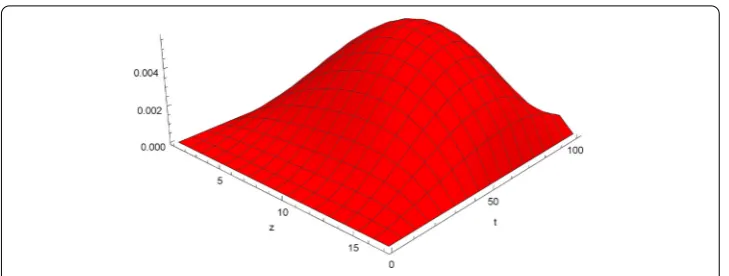
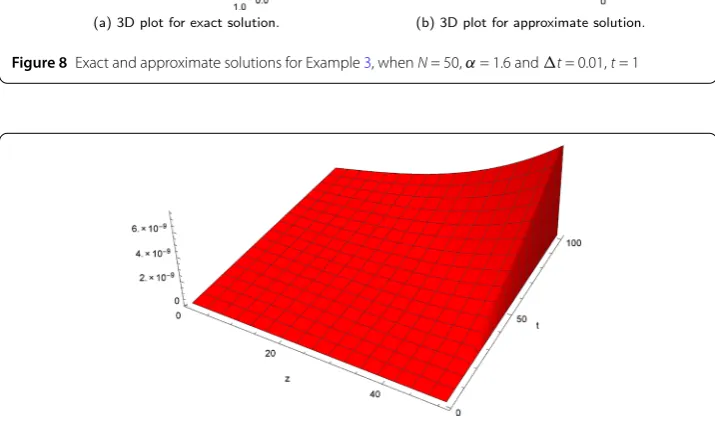
The exact solution isu(z,t) =t2sinh(z). In Table6, the numerical results obtained by means of the modified ECBS method are compared with the radial basis function (RBF) method introduced in [19] and CuTBSM developed in [33]. The absolute computational errors corresponding toN= 50,μ= –0.0196,α= 1.25 andα= 1.5 are reported in Table6. The numerical solutions obtained by the proposed numerical method at different time levels are depicted in Fig.7. The 3D space-time graphs of exact and approximate solutions forN= 50,α= 1.6,t= 1 andt= 0.01 are displayed in Fig.8. The three dimensional pictorizations of the absolute error forN= 50,α= 1.5,t= 1 andt= 0.01 are given in Fig.9.
7 Conclusion
Figure 7Exact and approximate solutions for Example3att= 2, 4, 6, 8, 10 whenN= 10,α= 1.5 andt= 0.01
Figure 8Exact and approximate solutions for Example3, whenN= 50,α= 1.6 andt= 0.01,t= 1
convergence is of order 2. The computational outcomes are proved to be more reliable than the results found in RBF [19], CuTBSM [33], HF [44] and INM [45].
Acknowledgements
The authors are grateful to the anonymous reviewers for their helpful, valuable comments and suggestions in the improvement of this manuscript.
Funding Not applicable.
Availability of data and materials Not applicable.
Competing interests
The authors declare that they have no competing interests.
Authors’ contributions
All authors equally contributed to this work. All authors read and approved the final manuscript.
Author details
1Department of Mathematics, National College of Business Administration & Economics, Lahore, Pakistan.2Department
of Mathematics, University of Sargodha, Sargodha, Pakistan. 3Department of Mathematics, Government College
University, Faisalabad, Pakistan.4Department of Mathematics, Faculty of Arts and Sciences, Cankaya University, Ankara,
Turkey.
Publisher’s Note
Springer Nature remains neutral with regard to jurisdictional claims in published maps and institutional affiliations.
Received: 15 May 2019 Accepted: 27 August 2019 References
1. Miller, K.S., Ross, B.: An Introduction to the Fractional Calculus and Fractional Differential Equations (1993) 2. Podlubny, I.: Fractional Differential Equations: An Introduction to Fractional Derivatives, Fractional Differential
Equations, to Methods of Their Solution and Some of Their Applications. Mathematics in Science and Engineering, vol. 198 (1998)
3. Mainardi, F.: Fractional Calculus, pp. 291–348 (1997)
4. Benson, D.A., Wheatcraft, S.W., Meerschaert, M.M.: Application of a fractional advection–dispersion equation. Water Resour. Res.36(6), 1403–1412 (2000)
5. Meerschaert, M.M., Tadjeran, C.: Finite difference approximations for fractional advection–dispersion flow equations. J. Comput. Appl. Math.172(1), 65–77 (2004)
6. Meerschaert, M.M., Scalas, E.: Coupled continuous time random walks in finance. Phys. A, Stat. Mech. Appl.370(1), 114–118 (2006)
7. Koeller, R.: Applications of fractional calculus to the theory of viscoelasticity. J. Appl. Mech.51(2), 299–307 (1984) 8. Shivanian, E., Jafarabadi, A.: Applications of Fractional Calculus in Physics (2000)
9. Kilbas, A.A., Srivastava, H.M., Trujillo, J.J.: Theory and Applications of Fractional Differential Equations. Elsevier, Amsterdam (2006)
10. Aleroev, T., Aleroeva, H., Huang, J., Nie, N., Tang, Y., Zhang, S.: Features of seepage of a liquid to a chink in the cracked deformable layer. Int. J. Model. Simul. Sci. Comput.1(3), 333–347 (2010)
11. Machado, J.T., Kiryakova, V., Mainardi, F.: Recent history of fractional calculus. Commun. Nonlinear Sci. Numer. Simul. 16(3), 1140–1153 (2011)
12. Mishra, L.N., Sen, M.: On the concept of existence and local attractivity of solutions for some quadratic Volterra integral equation of fractional order. Appl. Math. Comput.285, 174–183 (2016)
13. Mishra, V.N.: Some problems on approximations of functions in Banach spaces. Ph.D. thesis (2007)
14. Mishra, V., Vishal, K., Das, S., Ong, S.H.: On the solution of the nonlinear fractional diffusion-wave equation with absorption: a homotopy approach. Z. Naturforsch. A69(3–4), 135–144 (2014)
15. Deepmala: A study on fixed point theorems for nonlinear contractions and its applications. Ph.D. thesis (2014) 16. Esbo, M.R., Vazifeshenas, Y., Asboei, A.K., Mohammadyari, R., Vandana, V.: Numerical simulation of twisted tapes fitted
in circular tube consisting of alternate axes and regularly spaced tapes. Acta Sci., Technol.40, e37348 (2018) 17. Ding, H., Li, C.: Numerical algorithms for the fractional diffusion-wave equation with reaction term. Abstr. Appl. Anal.
2013, Article ID 493406 (2013)
18. Bhrawy, A., Doha, E.H., Baleanu, D., Ezz-Eldien, S.S.: A spectral tau algorithm based on Jacobi operational matrix for numerical solution of time fractional diffusion-wave equations. J. Comput. Phys.293, 142–156 (2015)
19. Avazzadeh, Z., Hosseini, V., Chen, W.: Radial basis functions and FDM for solving fractional diffusion-wave equation. Iran. J. Sci. Technol., Sci.38(3), 205–212 (2014)
20. Ebadian, A., Fazli, H.R., Khajehnasiri, A.A.: Solution of nonlinear fractional diffusion-wave equation by traingular functions. SeMA J.72(1), 37–46 (2015)
22. Hooshmandasl, M., Heydari, M., Cattani, C.: Numerical solution of fractional sub-diffusion and time-fractional diffusion-wave equations via fractional-order Legendre functions. Eur. Phys. J. Plus131(8), 268 (2016) 23. Chatterjee, A., Basu, U., Mandal, B.: Numerical algorithm based on Bernstein polynomials for solving nonlinear
fractional diffusion-wave equation. Int. J. Adv. Appl. Math. Mech.5, 9–15 (2017)
24. Zhou, F., Xu, X.: Numerical solution of time-fractional diffusion-wave equations via Chebyshev wavelets collocation method. Adv. Math. Phys.2017, Article ID 2610804 (2017)
25. Mitkowski, W.: Approximation of fractional diffusion-wave equation. Acta Mech. Autom.5, 65–68 (2011) 26. Delic, A.: Fractional in time diffusion-wave equation and its numerical approximation. Filomat30(5), 1375–1385
(2016)
27. Ferreira, M., Vieira, N.: Fundamental solutions of the time fractional diffusion-wave and parabolic Dirac operators. J. Math. Anal. Appl.447(1), 329–353 (2017)
28. Kanwal, A., Phang, C., Iqbal, U.: Numerical solution of fractional diffusion wave equation and fractional Klein–Gordon equation via two-dimensional Genocchi polynomials with a Ritz–Galerkin method. Computation6(3), 40 (2018) 29. Khalid, N., Abbas, M., Iqbal, M.K.: Non-polynomial quintic spline for solving fourth-order fractional boundary value
problems involving product terms. Appl. Math. Comput.349, 393–407 (2019)
30. Amin, M., Abbas, M., Iqbal, M.K., Baleanu, D.: Non-polynomial quintic spline for numerical solution of fourth-order time fractional partial differential equations. Adv. Differ. Equ.2019(1), 183 (2019)
31. Yaseen, M., Abbas, M.: An efficient computational technique based on cubic trigonometric B-splines for time fractional Burgers’ equation. Int. J. Comput. Math. (2019).https://doi.org/10.1080/00207160.2019.1612053
32. Mohyud-Din, S.T., Akram, T., Abbas, M., Ismail, A.I., Ali, N.H.: A fully implicit finite difference scheme based on extended cubic B-splines for time fractional advection–diffusion equation. Adv. Differ. Equ.2018(1), 109 (2018)
33. Yaseen, M., Abbas, M., Nazir, T., Baleanu, D.: A finite difference scheme based on cubic trigonometric B-splines for a time fractional diffusion-wave equation. Adv. Differ. Equ.2017(1), 274 (2017)
34. Sayevand, K., Yazdani, A., Arjang, F.: Cubic B-spline collocation method and its application for anomalous fractional diffusion equations in transport dynamic systems. J. Vib. Control22(9), 2173–2186 (2016)
35. Shukla, H., Tamsir, M.: Extended modified cubic B-spline algorithm for nonlinear Fisher’s reaction–diffusion equation. Alex. Eng. J.55(3), 2871–2879 (2016)
36. Wasim, I., Abbas, M., Iqbal, M.K.: A new extended B-spline approximation technique for second order singular boundary value problems arising in physiology. J. Math. Comput. Sci.19(4), 258–267 (2019)
37. Mittal, R., Jain, R.: Numerical solutions of nonlinear Burgers’ equation with modified cubic B-splines collocation method. Appl. Math. Comput.218(15), 7839–7855 (2012)
38. Boyce, W.E., DiPrima, R.C., Meade, D.B.: Elementary Differential Equations and Boundary Value Problems, vol. 9 (1992) 39. Kadalbajoo, M.K., Arora, P.: B-spline collocation method for the singular-perturbation problem using artificial viscosity.
Comput. Math. Appl.57(4), 650–663 (2009)
40. de Boor, C.: On the convergence of odd-degree spline interpolation. J. Approx. Theory1(4), 452–463 (1968) 41. Hall, C.: On error bounds for spline interpolation. J. Approx. Theory1(2), 209–218 (1968)
42. Abbas, M., Majid, A.A., Ismail, A.I.M., Rashid, A.: The application of cubic trigonometric B-spline to the numerical solution of the hyperbolic problems. Appl. Math. Comput.239, 74–88 (2014)
43. Wasim, I., Abbas, M., Amin, M.: Hybrid B-spline collocation method for solving the generalized Burgers–Fisher and Burgers–Huxley equations. Math. Probl. Eng.2018, Article ID 6143934 (2018)
44. Khader, M.M., Adel, M.H.: Numerical solutions of fractional wave equations using an efficient class of fdm based on the Hermite formula. Adv. Differ. Equ.2016(1), 34 (2016)