Volume 2007, Article ID 92659,9pages doi:10.1155/2007/92659
Research Article
Enhancement of Unequal Error Protection Properties
of LDPC Codes
Charly Poulliat, David Declercq, and Inbar Fijalkow
ETIS laboratory, UMR 8051-ENSEA/UCP/CNRS, 6 Avenue du Ponceau, 95014 Cergy-Pontoise, France
Received 13 March 2007; Revised 19 August 2007; Accepted 2 October 2007
Recommended by Michael Gastpar
It has been widely recognized in the literature that irregular low-density parity-check (LDPC) codes exhibit naturally an unequal error protection (UEP) behavior. In this paper, we propose a general method to emphasize and control the UEP properties of LDPC codes. The method is based on a hierarchical optimization of the bit node irregularity profile for each sensitivity class within the codeword by maximizing the average bit node degree while guaranteeing a minimum degree as high as possible. We show that this optimization strategy is efficient, since the codes that we optimize show better UEP capabilities than the codes optimized for the additive white Gaussian noise channel.
Copyright © 2007 Charly Poulliat et al. This is an open access article distributed under the Creative Commons Attribution License, which permits unrestricted use, distribution, and reproduction in any medium, provided the original work is properly cited.
1. INTRODUCTION
The subject of the paper is the enhancement of unequal er-ror protection (UEP) properties of low-density parity-check (LDPC) codes suitable for UEP transmission schemes (scal-able image transmission, etc.). UEP transmission schemes are considered to take into account the different error sen-sitivities of the source bitstream. For example, semantic in-formation like headers have to be almost error free to avoid the crash of the source decoding, whereas the data symbols can usually tolerate some errors. The UEP can significantly enhance the performance of the global communication sys-tem compared to an equal error protection scheme since the overall redundancy is allocated in order to provide more pro-tection to the most sensitive parts of the bitstream.
Apart from multilevel coded modulations, there are com-monly two ways to provide unequal protection depending on the transmission scheme we consider. Firstly, one can adapt the protection level by adaptively changing the code rate through puncturing. Some methods for an efficient de-sign of such adaptive coding schemes are proposed in the literature either for punctured convolutional codes [1], for punctured or pruned turbocodes [2, 3], or for punctured LDPC codes [4,5]. As these schemes are implemented using a unique mother code, which is punctured depending on the required level of protection, they have been widely proposed in combined source and channel coding (CSCC) schemes for the purpose of multimedia transmissions (see, e.g., [6]
and references therein). In these UEP coding schemes, rate-compatible error correcting schemes are combined with a rate-allocation algorithm to mainly minimize the distortion of the source at the receiver. As the channel code design and UEP allocation algorithm are consideredseparately, making the design of good rate compatible coding schemes com-pletely independent of the considered CSCC scheme, these coding schemes can be further improved by considering a joint source-channel (de)coding approach (see [7,8], e.g., in case of LDPC codes). In these approaches, the distortion-rate or mutual information transfer function are directly used for the optimization of the irregularity profiles, and thus, UEP allocation could naturally arise from the optimization pro-cess.
the most sensitive bits are associated to information bit posi-tions with the highest protection level.
In this context, irregular LDPC codes can provide inher-entunequal error capability due to the different connection degrees of the bit nodes. As widely observed, it appears that highly connected nodes are more protected than weakly con-nected ones. This irregularity can be used to provide inher-ent UEP, in the sense that high sensitivity bits are associated with high connection degree bit nodes [11,12]. The opti-mization of the LDPC irregularity has already been proposed for different channels as the binary erasure channel (BEC) [13] or the additive white Gaussian noise (AWGN) channel [14]. In these approaches, the codeword irregularity is glob-ally optimized for a specific channel considering therefore that each and every bit in the codeword has the same aver-age error probability. Thus, the existing optimization tech-niques do not necessarily ensure a good UEP capability, as underlined in [15]. The work in [15] first proposed an ad-hoc graph-based approach to optimize the irregularity pro-file in order to have UEP within a codeword with two classes of sensitivity. This work has been more formally stated and extended by [16–18], for the design of UEP LDPC codes for the BEC: considering two information classes, they first derive the density evolution for the BEC channel using a more refined parametrization to take into account the UEP characterization. Then, they optimize the irregularity profile in order to improve the performance of the most sensitive class; but they only consider partially regular (same variable node degree per class), leading to a limited solution search space. More recently, the studies for the UEP characteriza-tion of LDPC codes have been extended to the case of Raptor codes [19]; but however, no other channel than the BEC has been considered so far for the characterization of the UEP behavior of LDPC codes. All these approaches are mainly based on asymptotic assumptions to derive good irregular-ity profiles, even if they present some algebraic construction aspects for finite-length design [17]. Apart from these con-tributions, LDPC-based algebraic constructions for UEP ap-plications were proposed. A simple scheme based on lower block triangular parity-check matrix has been proposed in [20] with a two-stage decoding algorithm. The UEP property arises directly from the simple structure of the designed code. A more refined algebraic construction has been proposed in [21], where a layered Plotkin-based construction is proposed based on LDPC component codes. In this scheme, the op-timization consists of selecting good component codes, and UEP arises from the structure of the layered coding scheme. Note that for that kind of construction, multistage decoding (or an improved version) is preferred to belief propagation decoding due to the inherent presence of short cycles in the graph of the code.
As opposed to these methods, using asymptotic tools, we investigate the characterization of UEP for LDPC codes for the Gaussian channel by allowing parts of the same codeword to have their own irregularity profiles, regardless of particular algebraic structures. In this paper, we show that it is possible to generalize the asymptotic characterization and optimiza-tion techniques in order to take into account a target UEP behavior of the LDPC code for the Gaussian channel. As
dis-cussed in details inSection 4, we interpret the UEP proper-ties of an LDPC code as different local convergence speeds. Actually, the most protected class will be assigned to the bits in the codeword which converge to their right value in the minimum number of decoding iterations.
The new design strategy that we propose is based on two main differences compared to existing work. Firstly, we show that by appropriately changing the optimization objective function and by adding constraints, it is possible to increase the local convergence speed, and then to enhance the UEP properties of the LDPC code without significantly degrad-ing the overall error convergence performance. Secondly, we use anextended parametrizationfor the LDPC code irregu-larity, that is adapted to a desired UEP scheme, by allowing distinct irregularity profiles for each sensitivity class. We then propose a hierarchical optimization procedure to design effi -ciently an LDPC code irregularity in this framework.
The paper is organized as follows. In Section2, we de-scribe the UEP parameters and give some notations used in the paper. In Section3, we analyze how the irregularity can be exploited for UEP and derive a cost function suitable for UEP. The optimization algorithm we propose is given in Sec-tion4. Optimization results and finite-length simulations are given and interpreted in Section5. Conclusions and perspec-tives are drawn in Section6.
2. UEP PARAMETER DESCRIPTION AND ASSOCIATED LDPC PARAMETRIZATION
2.1. UEP parameter description and notations
The transmission scheme consists of sending a coded bit-stream under given UEP constraints over the AWGN chan-nel with binary input and noise variance parameterσ2. The
UEP-coded bitstream can be described and parameterized as follows: let a channel codeword of a rate RLDPC code be divided into Nc classes ordered in decreasing order of
their error sensitivity. Thus, considering the set ofNcclasses {Ck|k=1. . . Nc},C1will be associated with the highest
re-quired protection level andCNc with the lowest. The
redun-dancy bits of the channel codeword are associated with class CNcand the information bits are associated with the (Nc−1)
first classes. Let the proportionsα= {αk |k=1 : Nc−1}
be the normalized lengths of each class corresponding to the information bits withNc−1
k=1 αk =1. The proportionsαare
usually provided by a data partitioning mechanism, for ex-ample. The proportions of bits in the channel codeword be-longing to the different classes{Ck/k=1. . . Nc}are given by p= {α1R,. . .,αNc−1R, (1−R)}.
Example
We consider a rateR=1/2 code and three sensitivity classes. The redundancy bits are associated with classC3and the
in-formation bits are divided into two error sensitivity classes: C1 is the most sensitive class (typically headers) andC2 is
to the different classes{C1,C2,C3}are given byp= {αR, (1−
α)R, (1−R)}.
Letdcmaxandρ(x)=
dcmax
j=2 ρjxj−1be the maximum check
node connection degree and the generating polynomial of the proportion of edges connected to check nodes with con-nection degreej[22], respectively. We assume thatρ(x) is the
generating polynomial of the proportion of edges connected to bit nodes with connection degreeiand the dual generating
polynomial, whereλ(iCk)is the fraction of degree-ibit nodes.
is a one valued vector andis used for the transpose vector. We assume thatdvmax =max (d
Note that this detailed parametrization of the bit node ir-regularity is specifically matched to several classes of different sensitivities and is a necessary step for LDPC code optimiza-tion under UEP constraints. By allowing parts of the same codeword to have their own irregularity profile, it is possi-ble to exhibit local behavior for the belief propagation (BP) decoder and the adapted optimization strategy described in
Section 4capitalizes on this detailed parametrization in or-der to yield LDPC codes with enhanced UEP properties.
2.2. Mutual information evolution
In order to optimize LDPC codes, we need analytical tools to study the convergence of the LDPC code depending on of the code parameters. Using a Gaussian assumption for log den-sity ratio (LDR) message and independence assumption be-tween LDR messages (infinite codeword size), we can explic-itly give the evolution of the mutual information (MI) asso-ciated with the mean of the LDR messages for one decoding iteration depending on the code parameters when BP decod-ing is used [23]. The explicit relation describing the evolution
of the MI from iterationl−1 to iterationldefines the EXIT chart associated with the LDPC code.
We denotex(ul)andx(vl), the mutual information
associ-ated with LDR messages at the input of bit nodes and the mutual information associated with LDR messages at the in-put of check nodes at thelth decoding iteration, respectively.
Assuming Gaussian approximation [14,23], we have:
(1) check node message update:
x(l−1)
(2) bit node message update:
x(l)
with J(·) being the mutual information function J(m) = 1−E(log2(1 +e−x)) of a Gaussian random
variable x∼N(m, 2m). Combining (3) and (4) gives the EXIT chart of the LDPC code:
x(vl)=F
λ,xv(l−1),σ2
. (5)
For more details on LDPC EXIT charts refer to [23]. The initial condition is given byx(0)v = 0. The
con-ditionF(λ,x,σ2)> x∀x ∈[0, 1) ensures the
conver-gence of BP algorithm to an error-free codeword.
3. COST FUNCTION FOR LDPC OPTIMIZATION WITH UEP CONSTRAINTS
In this section, we discuss and analyze how the irregularity of the LDPC code can be used and optimized to provide UEP.
3.1. Providing UEP with capacity achieving codes: a valid question ?
LDPC codes exhibit a threshold behavior depending on the channel signal-to-noise ratio Eb/N0: above a given Eb/N0
thresholdδ, the word-error probabilityPwis zero as the word
lengthN tends to infinity. Let us remark at this point that the asymptotic performance criterion for optimizing fami-lies of LDPC code is the gap between the convergence thresh-old and the Shannon limit defined asa zero-frame error rate
[24]. As a consequence, the optimized LDPC codes with large code lengths cannot provide any unequal error protection since the goal is to have no errors at all in the codeword. This complicates the task of providing UEP behavior with LDPC codes. On the other hand, more and more standards use modern coding schemes like LDPC or Turbocodes, which means that looking for UEP capabilities with these codes is indeed a key research issue. A general discussion about this issue is done in this section.
only the global behavior of one decoding iteration and no lo-cal behavior is taken into account. With this approach, there is no possibility to provide controlled unequal error protec-tion, which is by nature a local property.
Irregular LDPC codes are however codes which are nat-urally well suited for UEP if we consider the different pro-tection levels as parts of the codeword which converge more rapidly than others. In an irregular LDPC code, some bits are more protected than othersafter a single decoding itera-tion since the connectivity differs from one bit to another. For example, if a bit is connected to a large number of edges, sometimes denoted aselite bit, it gets a lot of information in a single iteration while a low connected bit receives less in-formation and will be less protected.
So even with asymptotic analysis, it is possible to have UEP LDPC codes with the effect of differentlocal convergence speeds. The general idea is then to have the most sensitive class which converges the most rapidly in order to have it er-ror free with the minimum number of iterations. Of course, the difference in error protection will be diminished with an increased number of decoding iterations, and eventually van-ish with an infinite number of iterations.
Let us then illustrate the link between bit node irregu-larity and the associated bit error probability after a finite number of iterations. If we assume that the graph is locally a tree (in the sense of [24]), the bit error probability at the lth decoding iteration for bit nodes with a connection degree iunder Gaussian approximation [14] is given by
Pi(l)=Q
whereQ(·) is the Gaussian tail function given by
Q(x)=√1
u ) is strictly increasing with
decoding iteration l.Q(·) being a strictly decreasing func-tion, (6) shows that, at a given iterationl, the more connected a bit node is, the more “protected” it is, in the sense that it has a smaller error probability. This also implies that the conver-gence is faster for the highly connected bits. Now that we have explained how the irregularity can help us to provide UEP, we focus on the case of a specific class of sensitivity in a coded bitstream.
3.2. Protection within a single class of sensitivity
As defined in Section 2.1, the codeword is divided into Nc
sensitivity classes. For a given code profile, each and ev-ery class Ck within the codeword is associated with a dual
parametrization polynomialλ(Ck)(x)=dvmax
classCkis defined as
P(Ck)
tained using convexity arguments on theQ(·) function and the upper bound is obtained using the decreasing property of theQ(·) function. Note that these bounds are in general very loose and we will use them only to justify our approach:
Q
In (9), the average bit node degree associated with the class Ckis defined as
The lower bound corresponds to the case where we con-sider the bit error probability associated with the mean of thea posterioriLDR messages associated with classCkusing
a Gaussian assumption. The upper bound is the limit case of a uniform connection degree distribution associated with classCk, as if the LDPC code would be regular with degree d(vkmin) in the class.
According to (9), the bit error probability is closely
re-lated toλ(Ck) andd(vkmin) . However, it is not easy to track the behavior of the bit error probability with (9) since the MI
at thelth iterationxu(l) is a function of both quantitiesλ
(Ck)
anddv(kmin) . To circumvent this dependance, we make the as-sumption that two codes with close thresholds have almost the same convergence rate (the evolution of the quantities
xu(l)are very close), regardless of the parameters valuesλ
(Ck)
andd(vkmin) .
Based on this assumption, we can study the influence of
λ(Ck)anddv(kmin) on the bit-error probability:
(1) for a givenλ(Ck), by maximizind(vkmin) , we force the in-equality to be as tight as possible;
(2) by settingλ(Ck)as large as possible, we try to minimize the minimum bit-error probability we can reach for this class.
This implies that, by jointly optimizing the average bit node degree and the minimum bit node degree associated with a class, we expect to obtain a bit-error probability as small as possible for a fixed and relatively small number of decoding iterations. Therefore, for a given classCk, we
pro-pose to use as a cost function the maximization of the average
Inserting (2) in (10) and considering that the code rate Ris constant (and so,k
iλ(iCk)/iis constant), the
maxi-mization of (10) is equivalent to the maximization of
dvmax
i=d(vkmin) λ(Ck)
i . (11)
This can be interpreted as a maximization of the propor-tion of edges in the part of the parity check matrix associated with the the classCk. Thus, more messages will transit to this
part of the graph ensuring a faster local convergence.
4. A HIERARCHICAL APPROACH FOR LDPC CODES OPTIMIZATION WITH UEP CONSTRAINTS
In this section, we present our optimization strategy to en-hance UEP properties of LPDC codes when transmission over the AWGN channel is considered. Based on the previous observations, we show that the optimization problem can be solved through a hierarchical process, each step consisting of the optimization of the average bit node degree in a single class subject to a maximized minimum degree and some con-straints provided by previous steps. Each step can be achieved by linear programming.
According to [14,22], we will consider the LDPC codes that converge to a vanishing bit error probability at a given Eb/N0(thecode threshold). Let us denoteδ the threshold of
the optimized LDPC irregularitywithoutUEP constraints as in [14]. An optimization algorithm that takes into account the specific UEP constraints will result in an optimized code with a threshold greater thanδ(worse threshold).
In order to be sure that the UEP constraints do not lead to a too-large degradation of the threshold, we limit the set of possible LDPC codes to those whose convergence thresh-old lies within [δ,δ+], witha small constant fixed in the optimization algorithm. Ifis small enough, the global con-vergence of the code will be approximatively the same as for the code obtained without UEP constraints, as explained in
Section 3.2.
4.1. The optimization of a class profile as a conditional linear programming problem
In this section, we only focus on the optimization of a sin-gle classCk, that is, the optimization of the irregularity for
the part of the codeword associated with this class. We as-sume that all the optimizations for classes {Ck,k < k}
have already been performed and the results of these opti-mizations are used as constraints in the current optimiza-tion process. At the beginning of the optimizaoptimiza-tion of a sin-gle class Ck, we assume that the following parameters are
given:dvmax,ρ(x),δ,,α, andλ
(Ck)∀k< k(The last
param-eters are assumed to be known from previous optimization steps).
The proposed optimization is performed by maximizing the average bit node degree of the classCk for a decreasing d(vkmin) fromdvmax to 2. The iterative procedure is stopped when a solution of an LDPC code is found which converges at a
(1) Initializationd(vkmin) =dvmax.
(2) While optimization failure (any constraint is not fulfilled): (a) maximize the average bit node degree (cf. (10)
and (11))
max λ λ
(Ck)1
(12)
under the following constraints •global constraints: [C1] rate constraint:
k
λ(Ck)1/dv=(1−R)−1ρ1/dc, (13)
[C2] proportion constraints:
(i)
k
λ(Ck)1=1, (14)
(ii)
∀k∈ {1,. . .,Nc−1},
λ(Ck)1/dv=αc R
1−Rρ
1/dc, (15)
[C3] convergence constraint (cf. (5)):
F(λ,x,σ2)> x, (16)
[C4] stability condition:
k λ(Ck)
2 < e1/2σ
2
/ dcmax
j=2
ρj(j−1), (17)
•class constraint:
[C5] minimum bit node degree constraint:
∀i < d(k) vmin,λ
(Ck)
i =0, (18)
•conditional constraints:
•[C6] Previous optimizations constraints:
∀k< k,λ(Ck) is fixed (19)
(b)d(vkmin) =d
(k) vmin−1
end
Algorithm1
fixed threshold∈[δ,δ+]. For a given thresholdδ+(and then a given noise powerσ2) and a check node degree
dis-tributionρ(x), the optimization of the classCkcan be stated
as a linear programming problem subject to three types of constraints as shown inAlgorithm 1.
When the optimization process is successful, we store the distribution associated to the class being optimized in order to use it as a constraint for the next class.
The cost function used in (12) only depends on λ(Ck)
, which is a cost function only afferent to the class to be op-timized. The optimization results are however the vectors {λ(Ck)
(1) ChooseEb/N0=δ+. (2) Fork=1. . . Nc−1:
a) findλ(Ck)
opt andd( k)
vminoptwith the optimization
procedure described in Section [4.1]. b) compute the constraints of the next step
with{(λ(Ck)
opt ,d(k ) vminopt)∀k
≤k}
Algorithm2: Hierarchical UEP optimization algorithm.
The conditions [C1]–[C4] are global constraints related to
code convergence, rate, and proportion distribution con-straints. [C5] is related to the local constraint of the
mini-mum bit node degree of the classCk; and finally [C6] takes
into account the optimized irregularities of the previous classes.
4.2. Hierarchical optimization algorithm
We propose a hierarchical approach for the successive op-timization of all classes. We will start to optimize the most sensitiveclass and perform the hierarchical optimization in decreasing order of sensitivity. Assuming thatdvmax andρ(x) are given,Algorithm 2illustrates this hierarchical approach.
Optimizing the classes in decreasing order of sensitivity tries to take into account that the source data are partitioned in decreasing order of sensitivity and that the source decod-ing is usually sequential. In the followdecod-ing section, we will apply this algorithm with different values ofand compare to an LDPC code optimized for the AWGN channel without UEP constraints.
5. RESULTS
In this section, some simulation results are presented to illus-trate the performance of the LDPC codes optimized for the AWGN channel with UEP constraints. First, we analyze the results provided by the linear programming optimization in the case of infinite codeword length. Then, we focus on the performance in the case of finite codeword length.
5.1. Influence of threshold offset on the code irregularity
We consider a UEP transmission scheme with 3 classes within a codeword: C1 is the high error sensitivity
infor-mation bits class, C2 the low error sensitivity information
bits class, andC3is assigned to redundancy bits. The
infor-mation bits proportions are given by α = (α1,α2), which
can take different values. We will consider rate R = 1/2 LDPC codes. We assume that dvmax is fixed todvmax = 30. ρ(x)=0.0437x7+ 0.9563x8is fixed to the value of the AWGN
optimized LDPC code [25].δis theEb/N0threshold in dB of
the AWGN optimized code andis theEb/N0offset.
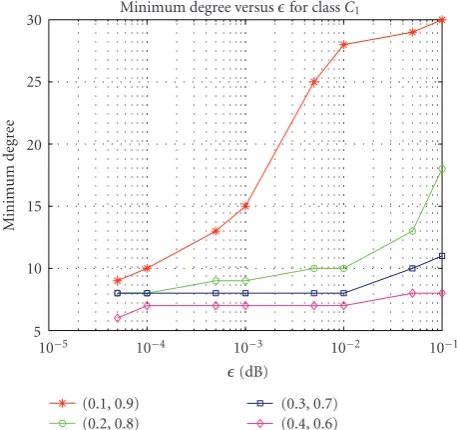
Figure [1] gives the minimum degree for the first class versus for different information bit proportions α = (α1,α2). As we can see, the minimum degree increases with
5 10 15 20 25 30
M
inim
um
deg
ree
10−5 10−4 10−3 10−2 10−1
(dB)
Minimum degree versusfor classC1
(0.1, 0.9) (0.2, 0.8)
(0.3, 0.7) (0.4, 0.6)
Figure1: Minimum bit node degree for class 1 versus. As ex-pected, the minimum bit node degree increases with. The increase is faster when proportions associated with the class 1 are low.
Table1: Degree distributions forR=1/2 AWGN code withα = (0.3, 0.7). The higher connection degrees are associated with the more sensitive class as done in [11].
AWGN
C1 C2 C3
λ7 0.0271 λ3 0.1765 λ2 0.2114 λ8 0.1587 λ5 0.0541 λ3 0.0180
λ30 0.2943 λ7 0.0599 — —
iλ(iC1) 0.4801
iλ(iC2) 0.2905
iλ(iC3) 0.2294
increasing values. Therefore, the UEP-LDPC code is ex-pected to exhibit a better UEP behavior than the AWGN op-timized code for this class; as for lowvalues, the minimum degree converges to the minimum degree of the AWGN op-timized code. We also remark that the increase of the mini-mum degree is less significant whenαcorresponds to a uni-form repartition.
Tables1,2and3give some degree distributions forα= (0.3, 0.7),dvmax =30 andρ(x)=0.0437x7+ 0.9563x8. As we can see, when increases, the minimum degree of the first class is increasing and the total edge proportion associated to the first class is maximized. For the second class, we can see the effect of the hierarchical procedure: we have less diver-sity in terms of connection degrees associated with the sec-ond class. This results in a concentration of the connection degrees of the second class on lower connection degrees.
In order to predict the behavior of the expected gain achieved by the UEP-LDPC codes, we study the asymptotic Eb/N0gains achieved for class 1 and 2 withl=7 decoding
it-erations and bit error rate BER=10−5when using MI
Table2: Degree distributions for the different classes with=0.05. R=1/2.
UEP (=0.05)
C1 C2 C3
λ10 0.2310 λ3 0.14615 λ2 0.2100 λ11 0.0218 λ4 0.11795 λ3 0.0201
λ30 0.2529 — — — —
iλ(C1)
i 0.5058
iλ(C2)
i 0.2641
iλ(C3)
i 0.2301
Table3: Degree distributions for the different classes with=0.5. R=1/2.
UEP (=0.5)
C1 C2 C3
λ16 0.4774 λ3 0.2346 λ2 0.2210
λ17 0.0573 — — λ3 0.0036
λ18 0.0027 — — — —
λ19 0.0010 — — — —
λ20 0.0024 — — — —
iλ(iC1) 0.5408
iλ(iC2) 0.2346
iλ(iC3) 0.2246
codes and the AWGN optimized LDPC codes, we assign for the AWGN optimized code the information bits belonging to the first class to theα1Rmost connected bit nodes, the
in-formation bits of the classC2to theα2Rmost connected
re-maining bit nodes, and so on up to theNth
c −1 class. Finally,
the redundancy bits are associated to the remaining (1−R) bit nodes. This is the natural way of assigning bit nodes to provide enhanced UEP capabilities to the first classes.
The study is done for various α anddvmax = 30 and dvmax =15 andR=1/2. Fordvmax =15, we have the follow-ing parametersρ(x)=x7andα=(0.3, 0.7). The simulation
results are given inFigure 2.
The asymptoticEb/N0gain is defined as the difference in
Eb/N0to reach a BER=10−5(8) between the LDPC codes
op-timized with UEP constraints and the LDPC code, opop-timized for the AWGN channel without UEP constraints. In all cases, theEb/N0gain for the first class increases whenincreases. In
that sense, we have improved the UEP capability for the first class. For the second class, the UEP behavior depends on. For small values ofanddvmax =30, the second class exhibits also a slight improvement compared to the AWGN optimized code. However, whenincreases, the UEP-LDPC codes per-form worse than the AWGN code for the second class. This can be interpreted as follows: whenincreases, since we first optimize the more sensitive class, we assign too many edges to the first class. The second class will be more constrained and will have concentrated low degrees. Moreover, with in-creasing, the global convergence of the UEP-LDPC codes become worse, and since the second class is weaker, it is more sensitive to convergence weakness. For a givenα, we observe that, fordvmax =15, we reach the best UEP capability faster than for dvmax = 30.; but this has to be balanced with the
−0.5 0 0.5 1 1.5 2
As
ym
p
to
ti
c
Eb
/N
0
gain
0 0.05 0.1 0.15 0.2 0.25 0.3 0.35 0.4 0.45 0.5
C1−(0.3, 0.7),dvmax=30
C2−(0.3, 0.7),dvmax=30
C1−(0.2, 0.8),dvmax=30
C2−(0.2, 0.8),dvmax=30
C1−(0.3, 0.7),dvmax=15
C2−(0.3, 0.7),dvmax=15
Figure2:Eb/N0gain for information classeC1andC2. TheEb/N0 gain is obtained for BER=10−5.
performance of the second class: the asymptoticEb/N0loss is
less fordvmax =30 than fordvmax =15. Finally, it can be seen that for a givendvmax, the gain can be better forαthat are far from uniform distribution, since we can allocate more edges for the first class.
All these observations are confirmed by simulations. Hence, in order to select a good candidate for improved UEP, we have to find a code leading to a good tradeoffregarding the performance of the two classes.
5.2. Finite length simulation results
In this section, we study the performance of LDPC codes optimized for the AWGN channel with UEP constraints for finite-length codewords and the case of three classes of sensi-tivity.
The parameters in this section are ρ(x) = 0.0437x7+
0.9563x8,d
vmax = 30,N =4096 andN = 30000,R =1/2, α = (0.2, 0.8), = 0.1, and = 0.5. We compare the BER performance for class 1 and 2 versusEb/N0between the
UEP-LDPC code and the AWGN optimized LDPC code after l=7 decoding iterations. As seen in Figures3and4for BER =10−5and=0.1, we have improved performance for both information classes: about 0.5 dB for class 1 forN = 4096 orN = 30000, and for the second class, about 0.25 dB for N =4096 and 0.2 dB forN =30000. For =0.5, we have improved performance only for the first class: about 0.8 dB
forN = 30000 and 0.7 dB forN = 4096. For the second
10−6 10−5 10−4 10−3 10−2 10−1
BER
0.5 1 1.5 2 2.5 3 3.5
Eb/N0
AWGNC1 AWGNC2 UEP−0.1C1
UEP−0.1C2 UEP−0.5C1 UEP−0.5C2
Figure 3: Bit error rate performance of different classes versus Eb/N0 after 7 decoding iterations. We have improved performance for class 1 and 2 for the LDPC code optimized with UEP constraints N=4096.
10−6 10−5 10−4 10−3 10−2 10−1
BER
0.5 1 1.5 2 2.5 3 3.5 4
Eb/N0
AWGNC1 UEP−0.1C1 UEP−0.5C1
AWGNC2 UEP−0.1C2 UEP−0.5C2
Figure 4: Bit error rate performance of different classes versus Eb/N0 after 7 decoding iterations. We have improved performance for class 1 and 2 for the the LDPC code optimized with UEP con-straintsN=30000.
6. CONCLUSION
In this paper, we have proposed a general method to optimize LDPC codes under UEP constraints. The proposed strategy takes advantage of the link between UEP and local conver-gence speed, and is based on the hierarchical optimization of irregularity profiles in each class of sensitivity under specific UEP constraints. As a local objective function, we have
pro-posed the maximization of the average bit node degree in a given class while guaranteeing a minimum degree as high as possible. This strategy shows encouraging results, since the codes optimized with UEP constraints show better UEP ca-pabilities than existing codes. Note that our method could be extended to other types of memoryless channels without dif-ficulties and we successfully applied it in a progressive image transmission context [26].
One should however recall that LDPC codes are very in-teresting UEP codes if the number of decoding iterations is limited to a reasonable number, which would be fixed by a target latency of the decoder. For example, if the decoder has to work in real time, the number of decoding iterations will be fixed by the channel bit rate as well as the clock frequency and the level of parallelism of the decoder hardware.
ACKNOWLEDGMENTS
This work has partially been presented in IEEE ISIT’04. It was supported by by the French national telecommunication research network (RNRT) project V.I.P.
REFERENCES
[1] J. Hagenauer, “Rate-compatible punctured convolutional (RCPC) codes and their applications,”IEEE Transactions on Communications, vol. 36, no. 4, pp. 389–400, 1988.
[2] A. S. Barbulescu and S. S. Pietrobon, “Rate compatible turbo codes,”Electronics Letters, vol. 31, no. 7, pp. 535–536, 1995. [3] W. Henkel and N. Von Deetzen, “Path pruning for unequal
er-ror protection turbo codes,” inInternational Z¨urich Seminar on Digital Communications, vol. 2006, pp. 142–145, Z¨urich, Switzerland,, February 2006.
[4] J. Ha and S. W. McLaughlin, “Optimal puncturing of irregular low-density parity-check codes,” inProceedings of IEEE Inter-national Conference on Communications (ICC ’03), vol. 5, pp. 3110–3114, Seattle, Wash, USA, May 2003.
[5] C.-F. Lan, K. R. Narayanan, and Z. Xiong, “Scalable image transmission using rate-compatible irregular repeat accumu-late (IRA) codes,” inProceedings of IEEE International Con-ference on Image Processing (ICIP ’02), vol. 3, pp. 717–720, Rochester, NY, USA, September 2002.
[6] X. Pan, A. H. Banishashemi, and A. Cuhadar, “Progres-sive transmission of images over fading channels using rate-compatible LDPC codes,”IEEE Transactions on Image Process-ing, vol. 15, no. 12, pp. 3627–3635, 2006.
[7] C.-F. Lan, Z. Xiong, and K. R. Narayanan, “Source-optimized irregular repeat accumulate codes with inherent unequal error protecticn capabilities and their application to scalable image transmission,”IEEE Transactions on Image Processing, vol. 15, no. 7, pp. 1740–1750, 2006.
[8] C. Poulliat, D. Declercq, C. Lamy-Bergot, and I. Fijalkow, “Analysis and optimization of irregular LDPC codes for joint source-channel decoding,”IEEE Communication Letters, vol. 9, no. 12, pp. 1064–1066, 2005.
[9] I. M. Boyarinov and G. L. Katsman, “Linear unequal error protection codes,”IEEE Transactions on Information Theory, vol. 27, no. 2, pp. 168–175, 1981.
[11] P. S. Guinand, D. Boudreau, and R. Kerr, “Construction of UEP codes suitable for iterative decoding,” inProceedings of the 6th Canadian Workshop on Information Theory, pp. 17–20, Kingston, Ontario, Canada, June 1999.
[12] X. Yang, D. Yuan, P. Ma, and M. Jiang, “New research on unequal error protection (UEP) property of irregular LDPC codes,” inProceedings of IEEE Consumer Communications and Networking Conference (CCNC ’04), pp. 361–363, Las Vegas, Nev, USA, January 2004.
[13] M. Luby, M. Mitzenmacher, and A. Shokrollahi, “Pratical loss resilient codes,” inProceedings of the 29th Annual ACM Sym-posium on Theory of Computing (STOC ’97), pp. 150–159, El Paso, Tex, USA, May 1997.
[14] S.-Y. Chung, T. J. Richardson, and R. L. Urbanke, “Analysis of sum-product decoding of low-density parity-check codes us-ing a Gaussian approximation,”IEEE Transactions on Informa-tion Theory, vol. 47, no. 2, pp. 657–670, 2001.
[15] H. Pishro-Nik, N. Rahnavard, and F. Fekri, “Nonuniform er-ror correction using low-density parity-check codes,” IEEE Transactions on Information Theory, vol. 51, no. 7, pp. 2702– 2714, 2005.
[16] N. Rahnavard and F. Fekri, “Unequal error protection using low-density parity-check codes,” inProceedings of IEEE Inter-national Symposium on Information Theory, p. 449, Chicago, Ill, USA,, June 2004.
[17] N. Rahnavard and F. Fekri, “New results on unequal error protection using LDPC codes,”IEEE Communications Letters, vol. 10, no. 1, pp. 43–45, 2006.
[18] N. Rahnavard, H. Pishro-Nik, and F. Fekri, “Unequal error protection using partially regular LDPC codes,”IEEE Trans-actions on Communications, vol. 55, no. 3, pp. 387–391, 2007. [19] N. Rahnavard, B. N. Vellambi, and F. Fekri, “Rateless codes
with unequal error protection property,”IEEE Transactions on Information Theory, vol. 53, no. 4, pp. 1521–1532, 2007. [20] X. Lin and W. Wu, “LDPC codes for unequal error protection,”
inProceedings of International Conference on Signal Process-ing (ICSP ’04), vol. 2, pp. 1798–1800, BeijProcess-ing, China, August-September 2004.
[21] V. Kumar and O. Milenkovic, “On unequal error protec-tion LDPC codes based on plotkin-type construcprotec-tions,”IEEE Transactions on Communications, vol. 54, no. 6, pp. 994–1005, 2006.
[22] T. J. Richardson and R. L. Urbanke, “The capacity of low-density parity-check codes under message-passing decoding,” IEEE Transactions on Information Theory, vol. 47, no. 2, pp. 599–618, 2001.
[23] T. Richardson and R. Urbanke,Modern Coding Theory, Cam-bridge University Press, CamCam-bridge, UK, 2005.
[24] T. J. Richardson, M. A. Shokrollahi, and R. L. Urbanke, “De-sign of capacity-approaching irregular low-density parity-check codes,”IEEE Transactions on Information Theory, vol. 47, no. 2, pp. 619–637, 2001.
[25] S.-Y. Chung, “On the construction of some capacity-approaching coding schemes,” Ph.D. dissertation, MIT Press, Cambridge, Mass, USA, 2000.