
R E S E A R C H
Open Access
Optimal power allocation and throughput
performance of full-duplex DF relaying
networks with wireless power transfer-aware
channel
Xuan-Xinh Nguyen and Dinh-Thuan Do
*Abstract
In terms of modern applications of wireless sensor networks in smart cities, relay terminals can be employed to simultaneously deliver both information and energy to a designated receiver by harvesting power via radio frequency (RF). In this paper, we propose time switching aware channel (TSAC) protocol and consider a dual-hop full-duplex (FD) relaying system, where the energy constrained relay node is powered by RF signals from the source using decode-and-forward (DF) relaying protocols. In order to evaluate system performance, we provide an analytical expression of the achievable throughput of two different communication modes, including instantaneous transmission and delay-constrained transmission. In addition, the optimal harvested power allocation policies are studied for these transmission modes. Most importantly, we propose a novel energy harvesting (EH) policy based on FD relaying which can substantially boost the system throughput compared to the conventional half-duplex (HD) relaying architecture in other transmission modes. Numerical results illustrate that our proposed protocol outperforms the conventional protocol under the optimal received power for energy harvesting at relay. Our numerical findings verify the correctness of our derivations and also prove the importance of FD transmission mode.
Keywords: Energy harvesting, Full-duplex, Decode-and-forward, Outage capacity, Delay-constrained
1 Introduction
It is undoubted that wireless communication systems have attracted much research interest in recent years. In particular, energy-aware radio access solutions can be implemented to deal with the massive increase in the consumption of energy in telecommunication networks and the efficient use of power is important for energy optimization. In addition, applications based on internet of things networks have become increasingly popular, so they require novel approaches for energy saving applied in low-power devices. Energy harvesting is the amount of energy available at the transceiver node powered by sur-rounding energy sources such as solar, wave, vibration, and radio frequency.
*Correspondence: [email protected]
Wireless Communications Research Group, Faculty of Electrical and Electronics Engineering, Ton Duc Thang University, 19 Nguyen Huu Tho Street, Ho Chi Minh City, Vietnam
Since energy harvesting plays an important role in relay-ing regardless of power optimization at relays which are assumed to be powered by ideal power sources. In sen-sor networks and cellular networks, wireless devices using rechargeable or replaceable batteries are often out of order in a short period of time, as the battery powered devices in such wireless networks usually suffer from limited oper-ating times. Unlike portable devices, the maintenance cost of sensor nodes is often higher in case they are replaced or recharged. Additionally, it is noted that it may be dangerous to replace batteries in toxic environ-ments and powering medical sensors implanted inside human bodies is also challenging. To supply a perpetual power in such networks, energy harvesting is consid-ered as a potential method to prolong lifetime of wireless devices [1, 2]. To take advantage of information transfer over wireless channels, receivers can scavenge power from the transmitted signal. Since ambient radio signals can carry energy and information, energy harvesting brings
more major advantages compared to the conventional grid power supply [3].
Since radio frequency (RF) signals are capable of car-rying both information and energy, a new concept in green wireless communications was put forward, namely simultaneous wireless information and power transfer (SWIPT). To take advantage of SWIPT, more practical receiver architectures have been developed with two sep-arated circuits to carry out energy harvesting and infor-mation decoding [4, 5]. There are two major schemes in the receiver, including time switching and power split-ting. The authors in [4] presented performance of sys-tem under capability of energy harvesting applied in a simple single-input single-output scenario while multiple-input multiple-output (MIMO) broadcasting scenarios was introduced in [6].
In order to obtain practical insights in term of optimal time and power allocation. The work in [7] focused on time allocation policy for the two transmitters in case the efficiency of energy transfer is maximized by an energy beamformer under the impact of Channel State Informa-tion (CSI) received in the uplink by the energy transmitter. Furthermore, in [8], the time fraction in TSR impacts on the optimal throughput and such parameter can be found in a numerical method.
We next consider several system models regarding exist-ing cooperative networks with capability of energy har-vesting. Firstly, the employed relay in SWIPT networks [9, 10] or the source terminal [11] can harvest energy from the radiated signal of the source terminal or the employed relay. Secondly, in multi-hop networks, energy is trans-ferred to remote terminals via hop [12, 13]. In multi-hop systems, the high path loss of the energy-bearing signal can be eliminated [12]. Unlike [12], the authors in [13] investigated a multi-antenna relay adopting two sep-arate terminals with capability of information processing and power transfer, respectively, and the expressions of the transmission rate and outage probability were pre-sented under the impact of remote energy transfer. In addition, relay selection is considered as solution to deter-mine a tradeoff between the efficiency for the information transmission and the amount of energy forwarded to the energy receivers [14–16].
Furthermore, full-duplex (FD) mode was evaluated, in which it allows transmitting and receiving signals at the same frequency band at the same time slot. Various theo-retical analysis and practical designs have been conducted in terms of FD networks like in [17–21]. Thanks to the use of FD mode, the resources are utilized more effi-ciently and it can double the spectral efficiency compared to half-duplex (HD) mode. However, due to practical con-straints, the performance of FD communication can be affected by the self-interference (SI) stemming from FD node transmission.
In addition, energy harvesting along with throughput optimization has been mentioned in previous works. In [22] and [23], throughput optimization with constraints was studied under a static channel condition for obtaining best efficiency of energy harvesting transmitters.
Moreover, energy harvesting based on power control policies for wireless powered transmission over fading channels suffer from several problems, i.e., the random-ness of RF energy source, wireless fading channels and the maximum power constraints. To address this situa-tion, several existing works have considered offline opti-mal power control designs for fading channels [24, 25]. The work in [25] considered that the offline optimiza-tion in an efficient optimal soluoptimiza-tion was presented to achieve optimal energy efficiency. Although the authors in [26] investigated the offline scheduling and formulated the corresponding performance optimization problems of two-way relay networks, the statistics of energy and fading channels are assumed to be parameters at the transmit-ter, and optimal function can be derived in a numerical manner under high computation.
The authors in [27] considered that the optimal time splitting coefficients for the full-duplex dual-hop relay-ing lead to enhance the system throughput in compari-son with the traditional half-duplex relaying scheme for all kinds of modes including instantaneous transmis-sion, delay-constrained transmistransmis-sion, and delay-tolerant transmission. The energy-constrained FD relay node can be applied in the multiple-input single-output (MISO) system; the optimal power allocation and beamform-ing design are investigated in [28]. In another line of research, the FD decode-and-forward system using the time-switching protocol is embedded in the multiple antenna-assisted relay to obtain more energy from the source and transfer signal to the destination as in [29, 30]. Interestingly, in order to achieve the maximal through-put performance, the optimal time switching coefficient is adaptively selected based on channel state information (CSI), accumulated energy, and threshold signal-to-noise ratio (SNR) [31, 32] and [33].
system throughput. In order to compare with the effect of the FD relaying architecture, the HD relaying architec-ture is also investigated. The main aim of this paper is that FD relaying is an attractive and promising solution to enhance the throughput of RF energy harvesting-based relaying systems.
Comparing to [27] and [28], although this work consider a same system model with those works, our investiga-tion also design a novel wireless power transfer strategy to improve the system performance. The authors in [27] con-sider a conventional time splitting protocol, in which relay switches from energy harvesting to information transfer with fixed EH fraction time allocated. While [28] design a self-energy recycling strategy for energy harvesting at relay, this EH manner can collect transmitted signal itself and scavenge to energy. Contrarily, our work redesigns the conventional time switching protocol as in [27] to a novel EH schedule. The proposed EH will acquire the channel state information (CSI) to allocate amount of EH time. In particular, the relay transmission power can be preset level. The magnitude of self interference at relay thus can be controlled based on relay transmitted power, which can improve the system performance.
The main contributions of our paper are summarized as follows:
• A new protocol for wireless power transfer called time switching aware channel protocol (TSAC) is proposed in FD DF relaying networks and further analysis is presented as well.
• We provide analytical expressions in instantaneous transmission mode for both cases, i.e., one antenna and dual antennas at relay node in EH-based networks.
• The outage probability and average throughput for delay-constrained transmission mode are derived in closed-form expressions for tractable computation. The optimal values can be achieved in various simulation results.
• The advantages of the proposed protocol are also compared with the previous works. The most critical performance metric (i.e., optimal throughput efficiency) is thoroughly analyzed and systematically validated via comparative simulations.
• It can be seen that optimal power allocation leads to enhance throughput and resulting in system performance in comparison with non-power allocation solution in the literature.
The remainder of the paper is organized as follows. In Section 2, the energy harvesting cooperative scenario with one source node equipped two antennas in FD mode is considered and two different strategies for sin-gle antenna or dual antennas for energy harvesting are
investigated. In Section 3, the power allocation in instan-taneous transmission is evaluated while outage probability and optimal throughput in delay-constraint are given in Section 4 for performance evaluation. Section 5 exam-ines HD mode for performance comparison with FD relay. Numerical results and useful insights are provided in Section 6. Eventually, Section 7 draws a conclusion for our paper.
2 System model and energy harvesting protocol
2.1 System model
As shown in Fig. 1a, we consider a two-hop relaying net-work consisting of one source denoted byS, one destina-tion denoted byD, and one intermediate node denoted as R. It is assumed that the source and destination node are equipped with single antenna, i.e.,S andDare provided with single antenna, whileRis equipped with two anten-nas, and operated in FD mode. In addition, the relay node is assumed to have no extra embedded energy sources so it requires to harvest energy from the received RF sig-nal from the source node [2, 5, 8, 14, 20, 27–29, 32]. The TSAC protocol is shown in Fig. 1b, in which the relay adjusts EH time to meet the installed transmit power every block time. Therefore, at time slotith, the relay node will energy harvesting withαiT seconds.
Figure 2 shows basic block diagram for the SWIPT system, where TSAC is deployed. The system has one switching unit and one combining unit compared to con-ventional systems as Fig. 2a or as system models intro-duced in [5, 27]. As illustrated in Fig. 2b, we design an architecture exploiting dual antennas to harvest energy at relay during the energy harvesting phase as [27]. In this scheme, we consider WPT phase in which the switching units change the role of both transmitting and receiving antenna to receive energy via RF signal as [27, 30]. Then, those RF signals are combined and used to feed the energy harvester. It is worth noting that case 2 is a natural choice, since it fully exploits the available hardware resources (i.e., antenna components in multiple-input multiple-output (MIMO) systems) to collect more energy [30]. Neverthe-less, due to its straightforward implementation, case 1 could be more practical in certain applications.
2.2 Channel model
Fig. 1Two-hop relaying networks in full-duplex communication with SWIPT.aDescribing two phases of cooperative relay energy harvesting communications with two scenarios of energy harvesting at relay node.bTSAC protocol for energy harvesting full-duplex relaying network
Tand varies independently and identically from one block to the other.
In this paper, we also use characterf to represent the SI link at relay node as normal manner. Due to the short distance of this link, the line-of-sight (LoS) path is likely to represent to SI channel; hence, it can be shown that the Rician distribution can handle such SI channel as [18]. However, due to the complicated Rician fading proba-bility density function (PDF), the analytical expressions become extremely difficult. Fortunately, the alternative model of the Nakagami-mfading distribution provides a very good approximation to the Rician distribution. Moti-vated by this, and to simplify in the analysis, we adopt the Nakagami-m fading with fading severity factor mf
and mean λf to model the loop interference channel in this paper.
So that|h|2and|k|2are independent and identically dis-tributed (i.i.d.), exponential random variables with mean λh and λk, where λh = λk, g2 is exponentially dis-tributed with mean λg. The self-interference power link at relay, i.e.,f2, is a Gamma random variable distributed asmf,λf/mf
, in this paper we also assume mf is an integer number.
The transmit power of source and relay are represented byPS andPR, respectively. Due to the shadowing effect, the direct transmission between source node and desti-nation node does not exist [2, 5, 8, 20, 27, 29, 32]. The FD mode causes self-interference, which can be addressed
a
b
by the novel methods in the literature as [17, 19] and these algorithms are beyond the scope of our paper. Unfortunately, the residual self-interference still exists after interference suppression in the practical receiver architecture and it also impairs the performance of FD relay networks as [17–21, 27]. In this paper, we mainly focus on the impact of the residual self-interference on system performance in terms of the harvested power.
2.3 TSAC protocol description
In this subsection, the energy harvesting protocol is pre-sented. In spirit of [31–33] suggesting adaptive time switching strategies for SWIPT system, we redesigned TS protocol related to CSI for FD relay transmission mode, named TSAC protocol. The detail of modified TSAC pro-tocol is described as below. The harvested energy is stored in a rechargeable battery and then totally used to feed power circuits and transmit information to the destination node. Particularly in TSAC policy, each communication block time is slit into two slots, including wireless power transfer (WPT) slot and wireless information transfer (WIT) slot as mentioned in [4–7, 11, 12, 27, 31–33]. In each block time, WPT slot represents the firstαiTof block time while the WIT slot stands for the rest of(1−αi)T of block time. During WIT phase, the source transmits its symbol toward the intermediate relay simultaneously, the cooperative relay retransmits its decoded symbol to des-tination at the same time and bandwidth. The relay thus suffers from loop interference (LI).
Before further description, some important symbols are listed and defined in Table 1. Moreover, regarding the pro-posed WPT policy,Rwill operate with the preset transmit power,PR, and thusRnode needs to exactly determine the time duration for WPT to harvest a sufficient amount of preset energy,Ei=PR(1−αi)T.
This process can be done as steps below. Because relay only harvests sufficient amount of energy,EiEH = f(αi) (wheref(αi) means that function ofαi), one can exactly determine the EH time by equaling amount of harvested energy and that of preset energy, i.e.,EiEH =Ei. Finally, the
Table 1List of important symbols
Symbol Definition
PS The fixed transmission power, preset at source node.
PR The fixed transmission power, preset at relay node. Ei The relay transmission energy during time slotith
corresponding to preset power,PR.
PEH
R,i The harvested power from EH at relay node at time slotith.
EEH
i The relay transmission energy during time slotith corresponding to harvested powerPEHR,i. αi The duration time allocated to EH in time slotith.
EH time duration,αi, is derived. It is noted that the sug-gested TSAC protocol does not require more additional time slot since the total frame for communication is the same as [27] (see Remark 1), and the preset relay trans-mit power is a constant value (PR) while the EH time is a function of the random variable WPT channel gain(s) as [31–33].
As aforementioned, to exactly determine this duration of energy harvesting time, channel gain(s) of WPT link is an important parameter(s). Therefore, we assume that the channel state information (CSI) during the first hop is available at source and relay node, which can be obtained by using novel estimation algorithm. Interestingly, the TSAC protocol adjusts the WPT time duration, αi, in each time slot to satisfy amount of installed powerPR. In contrast, the fixed-time allocation protocol in [5, 27], the harvested power, PR, vary in each block based on channel gain.
2.4 Signal model
In wireless information transfer phase (WIT) of SWIPT systems, the received signal atR,yR,iandD,yD,iare given respectively as follows:
yR,i= hi
dm1
PSxi+fi
PRxˆi+nR,i, (1)
and
yD,i= gi
d2m
PRxˆi+nD,i. (2)
whereiis the block time index,xiandxˆiare message sym-bol atS and decoded symbol atRwith unit power and zero average, respectively. We also assume that the relay decodes whenS−Rlink does not suffer from outage. It is assumed thatnR,iandnD,iare additive white Gaussian noise (AWGN) atSandDin block timeith, respectively.
From (1) and (2), the signal interference noise ratio (SINR) atRandDin the time slot,ith are determined by
γR i =
PS|hi|2
PRdm1 fi2+dm1σR2,i
, (3)
and
γD i =
PRgi2
dm2σD2,i, (4)
where noise terms atRandD are zero mean and vari-ances ofσR2,i,σD2,i, respectively.
Based on the DF relaying scheme, the end-to-end SINR at block timeith, is expressed as follow
γe2e i =min
γiR,γiD
. (5)
responsible for receiving signals and harvesting RF signals in EH phase or (ii) either two antennas equipped for FD communication can be used during the EH stage.
2.4.1 Single antenna for energy harvesting
In this case, only one antenna receives signals and it scav-enges the RF signal to convert to DC signal. Therefore, the received signal at the relay can be expressed by
yEHR,i= hi d1m
PSxi+nR,i. (6)
In principle, the harvested energy can be stored in an inexpensive capacitor and then entirely use for informa-tion transmission. Thus, the harvested energy atR,EiEH, is given by
EEH i =ηαiT
PS|hi|2
d1m , (7)
where 0≤η≤ 1 is the energy conversion efficiency that depends on the rectification process and the energy har-vesting circuitry. It is noted that we ignore the harvested energy from noise. So that the harvested power can be determined during(1−αi)TasPEHP,i =EiEH/(1−αi)T.
We consider the fixed time scheme assigned for power transfer duration in [5], in which power collected at relay depends on CSI. Contrarily, in our proposed TSAC pro-tocol, the power transmission at relay denoted by PR
corresponding with optimal throughput is preset before the transmission energy at relay thus can be calculated by
Ei=PR(1−αi)T. (8)
Finally, in order to calculate the fraction EH time, we setting (7) equal to (8), i.e.,EiEH = Ei, the allocated frac-tion of time for power transfer in case of single antenna at any block time is computed as
αi=
PRdm1
ηPS|hi|2+PRd1m. (9)
2.4.2 Dual antennas for energy harvesting
In case of FD communication, the expected relay node is provided with two antennas to receive and transmit signals and such operations are utilized thanks to the col-lection of RF signal in EH duration. Thus, the received signal at relay node in this stage can be expressed by
yEHR,i= (hi+ki) dm1
PSxi+nR,i. (10)
Similarly, the harvested and transmitted energy regard-less of the harvested energy from noise atRis given by
EEH i =ηαiT
PS|hi|2+ |ki|2
dm1 . (11)
In order to determined EH time, one setting (8) equal to (11), the fraction of time for power transfer in dual
antennas mode for energy harvesting at any block times is determined as
αi=
PRd1m ηPS|hi|2+ |ki|2
+PRdm1 . (12)
Remarks 1In(9)and (12), the duration of time allo-cated in energy harvesting phase is a function of some variables, including channel gains, optimal power at relay node , the distance betweenSandR, i.e. d1, energy har-vesting coefficient and power transmission at source, i.e. PS. Specifically, this time fraction is always less than one, i.e., αi < 1, which implies the allocated time which is required for simultaneous wireless information and power transfer.
Remarks 2Consider energy harvesting time in(9)and (12), to convenience in represent we use two characters αsinglei andαidual to denoteαiin(9)and(12), respectively. We can observe that, since |ki|2 ≥ 0 and other parame-ters are invariable thenαisingle ≥ αduali . This implies that the time EH with dual antennas is less than that with sin-gle antenna. In other words, the amount of WIT time with dual antennas EH case is greater than that with single antenna EH case.
Remarks 3The proposed modifying TSAC protocol for FD cooperative relaying system is not more require addi-tional time slot since the total frame for communication is as same as[27](see Remark 1), and the prior installed relay transmit power is a constant value (PR) while the EH time is a function of the random variable WPT channel gain(s) as[31–33].
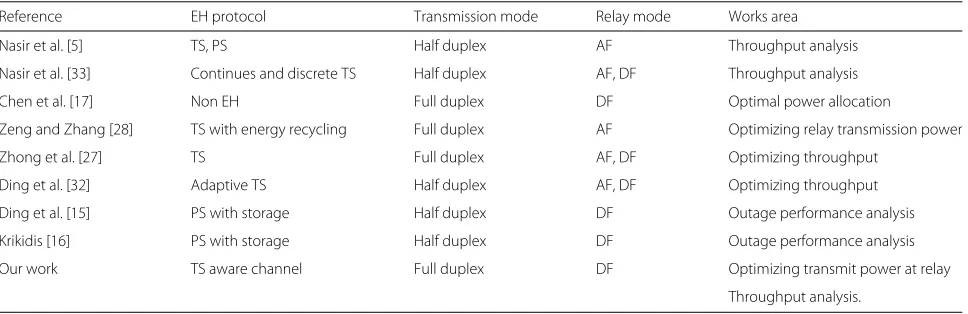
It is worth noting that the Tables 2 and 3 confirmed that our study aims to find power allocation to obtain optimal performance in energy harvesting networks. Such scheme relies on calculation of CSI feedback signal and so-called offline power allocation due to requiring low complexity in design of real applications.
3 Optimal power allocation for maximized
instantaneous throughput
Energy harvesting is an effective method to enhance the performance of the power-constrained relay with avail-able RF signals, in which the transmission power at relay is allocated to maximize the instantaneous throughput. In this paper, the optimal transmitted power in energy harvesting scheme is proposed for FD relay networks.
The instantaneous throughput of FD relay can be expressed by
Table 2The previous relevant works and their contributions
Reference EH protocol Transmission mode Relay mode Works area
Nasir et al. [5] TS, PS Half duplex AF Throughput analysis
Nasir et al. [33] Continues and discrete TS Half duplex AF, DF Throughput analysis
Chen et al. [17] Non EH Full duplex DF Optimal power allocation
Zeng and Zhang [28] TS with energy recycling Full duplex AF Optimizing relay transmission power
Zhong et al. [27] TS Full duplex AF, DF Optimizing throughput
Ding et al. [32] Adaptive TS Half duplex AF, DF Optimizing throughput
Ding et al. [15] PS with storage Half duplex DF Outage performance analysis
Krikidis [16] PS with storage Half duplex DF Outage performance analysis
Our work TS aware channel Full duplex DF Optimizing transmit power at relay
Throughput analysis.
The optimal transmit power allocated for relay node is formulated as
PoptR =arg max
PR {C(PR)},
s.t.0≤PR.
(14)
3.1 Energy harvested by single antenna
Substituting (3), (4), (5), and (9) into (13), the instanta-neous throughput is the function of relay transmit power which can be written as follow
C(PR)=
1− PRd
m 1
ηPS|h|2+PRdm1
×log2
1+min
PS|h|2
PRdm 1 f
2
+dm 1σR2
,PRg
2
dm2σD2
.
(15)
Theorem 1The optimum transmitted power at the energy-constrained relay for maximizing instantaneous throughput is calculated by
PoptR =
⎧ ⎪ ⎨ ⎪ ⎩
eW
π2π3−1
e
+1 −1
π2 , e
Wπ2π3−1
e
+1
< π2
√ −π0 2π1 +1, √
−π0
2π1 , otherwise.
(16)
whereπ0= d m
1σR2 PS|h|2,π1=
dm1|f|2
PS|h|2,π2= | g|2 d2mσD2 ,π3=
ηPS|h|2 dm1 ,
=π2
0+ 4ππ21, andW(x)is the Lambert function in[34],
whereW(x) can be found due to the problem solving of Wexp(W)=x.
ProofPlease see in Appendix A.
3.2 Energy harvested by dual antennas
Similarly, substituting (3), (4), (5), and (12) into (13), the instantaneous throughput can be formulated as below
C(PR)=
1− PRd
m 1
ηPS|h|2+ |k|2+PRd1m
×log2
1+min
PS|h|2
PRdm1 f2+dm1σR2 , PRg2
dm2σD2
.
(17)
The optimal relay transmission power is derived in the same way as (14).
Theorem 2The optimal allocation of transmit power at relay in case of two antennas equipped for EH for maximizing instantaneous mode is given by
PoptR =
⎧ ⎪ ⎨ ⎪ ⎩
eW
π2π4−1
e
+1 −1
π3 , e
Wπ2π4−1
e
+1
< π2
√ −π0 2π1 +1, √
−π0
2π1 , otherwise.
(18)
whereπ4 =
ηPS
|h|2+|k|2
dm
1 and other related parameters are defined as in Theorem1.
Table 3CSI requirement for proposed TSAC protocol schemes
EH type Transmission mode CSI requirements Channel information
Single antennas Instantaneous High |hi|2,|gi|2,fi2
Single antennas Delay-constrained Medium |hi|2, and distributions of|gi|2,fi2
Dual antennas Instantaneous High |hi|2,|ki|2,|gi|2,fi2
ProofThe Theorem can be explained by using in a similar way to Theorem 1.
Remarks 4In practical wireless system, only causal channel information and harvested energy are useful in calculation of power allocation. Unfortunately, the offline power allocation policy is not readily applicable in reality. Considering at a given time slot, the CSI in the second hop of the relaying network and the upcoming harvested energy are not known in advance and hence power allocation is evaluated in stochastic circumstance. However, such solu-tion only requires low complexity when comparing online power allocation which is high computational complexity and may not be implementable in practice.
4 Analysis of outage probability and throughput
in delay-constrained transmission mode
In this section, we consider the optimal throughput and outage probability of two-hop relaying networks in FD transmission mode. In this scenario, the system is designed with the fixed transmission rate or the preset SNR thresholdγ0. In particular, the system suffers from outage when the SNR performance, i.e.,γie2edrops below the threshold value. Therefore, the expression of outage probability can be obtained by
OPi=Pr
and the expected value of outage probability can be obtained by substituting (3) and (4) into (19).
As aforementioned in protocol description subsec-tion 2.3, since the relay node will harvest a sufficient amount of energy,Ei, before operating WIT phase, it is noted that the relay be certainly performed because the harvesting energy time is always less than 1, see Remark 1. Therefore, the relay transmit powerPRis a constant value during the transmission duration, see Remark 3. This quantity of power is preset before (such as by technicians). It is worth noting that theγiR,γiDare independent in term ofPRas in [31–33].
With the fact that such channel is independent to each other, it can be shown that [17, 20]
E{OPi} =1−E|h
whereE{.}is the expectation function.
In the delay-constrained transmission mode, the throughput efficient in the time slotith, which is the func-tion of outage probability and the EH durafunc-tion time, can be formulated by
τDC
i =(1−OPi) (1−αi). (21)
Therefore, the average throughput efficient of system is written by
τDC=EτDC i
=E{1−OPi}−E{(1−OPi) αi}. (22)
The optimal value of transmit power for throughput optimization can be presented as below
PoptR = arg max
4.1 Energy harvested by single antenna
The system throughput in this case can be determined as (22) and the next theorem is proposed.
Theorem 3When the relay uses single antenna to har-vest energy, then the average throughput efficient of the system is given by
τDC=exp exponential integral function as (Eq. 8.211) in[35], and
τ31=(−1)i+1ϑiexp
Proof The detailed explanation of the Theorem 3 is provided in Appendix B.
Alternatively, we can use the following closed-form when the SI channel modeled by Rayleigh fading as fol-lowing corollary.
τDC=exp
ProofThe Corollary 1 can be obtained easily by substi-tutingmf =1 into the expression in Theorem 3.
Extracting (23) by using (24), the optimal transfer power at relay with the aim of optimizing the system throughput can be obtained. SinceτDC(PR)is a concave function of
PR, the optimal valuePoptR can be obtained by solving the equation∂τDC(PR)/∂PR=0. Although the derivation of closed-form optimal expressions is challenging, the opti-mal value can be obtained by using numerical simulations which are presented in the next section.
4.2 Energy harvested by dual antennas
In this case, we also study the throughput in the delay-constrained mode with the following theorem.
Theorem 4We consider a cooperative scenario with two-hop source-relay-destination pair and two antennas provided at energy harvesting relays, the throughput can be determined as
τDC=exp
ProofPlease see in Appendix C.
When the SI channel is modeled by Rayleigh fading con-nection, the throughput performance of system is given as corollary below.
Corollary 2When mf =1(or the SI link at relay expe-rience Rayleigh fading model) the throughput performance in case of dual antenna for EH at relay node is given as
τDC=exp
ProofIt is easy to obtain the Corollary 2 by substituting mf =1 into the expression in Theorem 4.
Remarks 5Regarding impact of self-interference (SI) cancellation, the active SI suppression methods were shown experimentally to be capable of facilitating FD at short range communication. To apply energy harvesting in a real FD system, it is critical to accurately measure and suppress the SI in such FD networks. In this paper, we investigate SI in system performance through numerical simulation results.
5 Half-duplex relaying networks
In HD transmission mode, the relay node uses single antenna for energy harvesting and information process-ing. In order to compare with the FD relaying systems, we consider different transmission modes. Some of the results have been derived in [31–33]; however, we present here to make our work self-contained.
In this scenario, the received signal at relay in HD mode is presented as
yR,i=
And the SNR at relay node given by
γR i =
PS|hi|2
5.1 Instantaneous transmission mode
In this scenario, the instantaneous throughput can be illustrated as
CHD = 1
2(1−α)log2
1+γe2e. (30)
The optimal allocation for power transmission at relay is similar to (14)
Theorem 5The optimal power allocation in HD relay-ing networks for instantaneous transmission mode can be calculated as
PoptR =
⎧ ⎨ ⎩
eW
2π2θ−1
e
+1 −1
π2 , e
W2π2θ−1
e
+1
< 1
π0 +1, 1
π0π2, otherwise.
(31)
whereθ = π3in case of single antenna,θ = π4in case of dual antennas. Andπ0,π2,π3,π4are defined as below Theorem 1.
ProofThe proof is similar to that of Theorem 1.
5.2 Delay-constrained transmission mode
The throughput of HD relaying can be obtained as
τDC i =
1
2(1−OPi) (1−αi). (32) In comparison with the calculation of throughput in FD mode, in (21), the factor 2 can be seen by the denom-inator denoting as transmission efficiency. In following calculation, we can obtain two theorem which are solved similarly as that in Theorem 4.
Theorem 6 In the HD mode relaying, the throughput in case of single antenna given by
τHD= 1 2exp
−γ0HDdm2σD2 λgPR
×
exp
−γ0HDdm1σR2 λhPS
+χ1 λh
exp
χ
1 λh
Ei
−(χ1+ϑ1) λh
"
.
(33)
Theorem 7 In case that the energy is harvested by dual antennas, the throughput of HD relaying networks can be determined as
τHD= 1 2exp
−γ0HDdm2σD2
λgPR exp
−γ0HDdm1σR2
λhPS
− χ1 λhλk
exp
χ
1 λk
×
λkexp
−ϑ1+χ1 λk
+ (ϑ1+χ1)Ei
−ϑ1λ+χ1
k "
,
(34)
whereχ1= PRd m
1 2ηPS ,ϑ1=
γHD
0 dm1σR2 PS .
6 Numerical results
In this section, numerical simulation results are demon-strated to validate analytical expressions as concerns in the previous section, and the impact of key system param-eters is investigated in detail in terms of system through-put. The energy harvesting efficiency is set η = 0.8, while the path loss exponent is set m = 3. The dis-tances, d1 and d2 are normalized values which are set d1 = 3 and d2=1, respectively. The simulation envi-ronments are associated with the detailed parameters as γ0=10 dB,λf =0.01,λh=1,λk=1,λg=1,PS =26 dB
and noise terms as σD2 = −5 dB,σR2 = −10 dB. In this subsection, we present simulation results to verify the analytical results. The throughput performance is calcu-lated by averaging the throughput values over a 100,000 blocks, while fading channels for each block is perfectly independent.
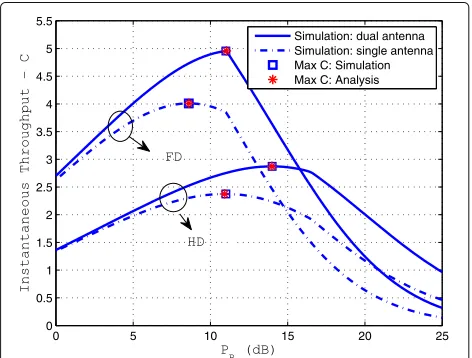
Figure 3 illustrates the impact of received power at relay node on the instantaneous throughput. To com-pare the performance of FD and HD relay, we set
f2=0.05,|h|2=1.2,g2=1.4,|k|2=1. The figure proves that the analytical results based on curves match well with the simulation results. It is noted that the optimal received power at relay for single antenna in HD case and FD case is smaller than those schemes with dual antennas, and the highest instantaneous throughput of FD case outperforms the HD case. When the received power is small, more energy can be collected to facilitate the information transmission while more received power or strong loop-back interference is produced such as the excessive amount of harvested energy, which is the primary cause of worse system performance.
0 5 10 15 20 25
0 0.5 1 1.5 2 2.5 3 3.5 4 4.5 5 5.5
Simulation: dual antenna Simulation: single antenna Max C: Simulation Max C: Analysis
The average throughput in delay constraint mode is pre-sented in Fig. 4. It can be observed that the dual antenna case outperforms the single antenna case in terms of the received power at relay. In fact, the dual antennas case can harvest more energy with less transmit power. How-ever, when the transmit power is larger than the optimal harvested power, it results in lower average throughput caused by loop-back interference. On the other hand, the gap between throughput of single antenna and dual anten-nas is still trivial due to short time for energy harvesting. In general, there should be a balance between energy har-vesting capability and noise processing. One can increase PRto the optimal value, at approximately 10 dB to achieve optimal throughput. As the previous illustration, it is con-firmed that FD relay is better than HD relay when the received power at relay is small.
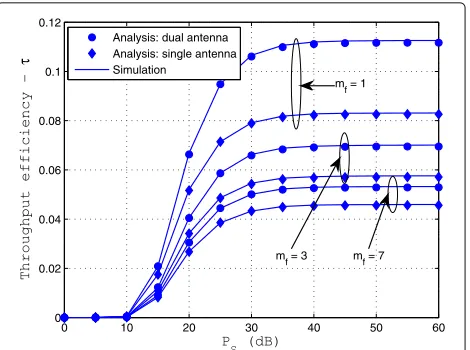
Next, it can be observed that throughput performance improves as increasing transmit power of the source node as in Fig. 5. To evaluate the impacts of the factormf in Nakagami channel of SI on system performance, in this experience we set λf = 0.1 andPR = PS − 10 (dB).
The smallest of mf brings the highest throughput per-formance. A general observation is that the dual antenna model significantly outperforms the single antenna coun-terpart at any values of transmit power of the source. Interestingly, when the transmit power overcome about 40 dB, the throughput still remain the peak value in stable floor.
To illustrate the impact of noise variance at relay and destination node in case of optimal throughput, Figs. 6 and 7 also show that dual antennas in FD mode outper-form FD single antenna. This can be explained as follows: A lower noise variance decreases the outage probability and and hence we obtain more throughput. Conversely, as for higher noise variance, the outage probability increases while the throughput falls dramatically. Thus, the system
0 5 10 15 20
0 0.05 0.1 0.15 0.2 0.25 0.3 0.35 0.4 0.45
Throughput efficiency −
τ
FD
HD
Simulation Analysis: dual antenna Analysis: single antenna Maxτ
Fig. 4Throughput efficiency versusPRin FD relay withmf=1
0 10 20 30 40 50 60
0 0.02 0.04 0.06 0.08 0.1 0.12
τ
Analysis: dual antenna Analysis: single antenna Simulation
m f = 3
m f = 1
m f = 7
Fig. 5Throughput efficiency versusPSwith difference case ofmf, λf=0.1 andPR=PS−10 (dB)
performance is affected more by erroneous information processing, leading to a waste of resources during the whole block time. In addition, it can be seen that the impact of noise term at relay affects the noise term at destination more. As a result, throughput performance in Fig. 7 declines sharply when noise varies from−5 to 5 dB. In Fig. 8, the simulation results present the throughput efficiency versusγ0and compare with existing protocols in [27] and [28]. The main observation is the effect of threshold SNR on throughput in delay constraint mode using TSAC, which is investigated with different quanti-ties of antennas, especially in comparison with traditional energy harvesting protocols. The simulation parameters are installed asα = 0.2,PR = 10 dB. The throughput in case of TSAC is better than the traditional case due to optimal time for energy harvesting which is solved in
−300 −25 −20 −15 −10 −5 0 5 10
0.1 0.2 0.3 0.4 0.5 0.6 0.7 0.8 0.9
σ
τ Simulation
Analysis: dual antenna Analysis: single antenna
Fig. 6Throughput efficiency versusσ2
−300 −25 −20 −15 −10 −5 0 5 10 0.05
0.1 0.15 0.2 0.25 0.3 0.35 0.4 0.45
σ
τ
Simulation Analysis: dual antenna Analysis: single antenna
Fig. 7Throughput efficiency versusσ2
Rwithmf=1
the proposed TSAC. In case ofγ0described below 14 dB, the proposed protocol related to the optimal throughput efficiency outperforms the existing protocols. However, in high threshold regime, the self-energy recycling proto-col proposed in [28] is slightly better than those schemes. In general, this figure reveals that the FD relay has worse performance at higher threshold SNR, which means the system may require higher bit per channel.
As depicted in Fig. 9, the dual antenna FD relay based on TSAC outperforms the single antenna in terms of resid-ual self-interference. When the residresid-ual self-interference is greater than −5 dB, throughput decreases signifi-cantly, since this loop-back noise impairs the overall performance. Therefore, the self-interference should be remained lower than acceptable value to satisfy system performance and the FD transmission is only beneficial, if
0 5 10 15 20
0 0.1 0.2 0.3 0.4 0.5 0.6 0.7 0.8
γ0 (dB)
Optimal Throughput efficiency −
τ FD: dual antenna
FD: single antenna Exist protocol in [27] Exist protocol in [28] HD: dual antenna HD: single antenna
Fig. 8Throughput efficiency versusγ0and the comparison with existing protocols in [27, 28] withλf= −20dBandmf=1
−20 −15 −10 −5 0
0.25 0.3 0.35 0.4 0.45 0.5 0.55 0.6 0.65
λf (dB)
Optimal Throughput efficiency −
τ
Analysis: dual antenna Analysis: single antenna Exist protocol in [27] Exist protocol in [28]
HD mode FD mode
Fig. 9The impact of residual self-interference on the throughput and in comparison with existing protocols in [27, 28] withγ0=5 dB and mf =1
the loop-back noise is eliminated. When SI factor ranges from−20 to−5 dB, the performance of TSAC scheme is superior to the existing protocols, but when SI parame-ters are greater than−5 dB, the optimal throughput of the proposed protocol in [28] is a prime candidate. Thanks to the EH protocol proposed in [28], the loop interference at relay is reused for self-energy recycling. As a result, part of the energy (loop energy) is used for information transmission by the relay and it improves the scheme’s performance.
According to Fig. 10, the throughput changes dramat-ically when we move the relay node in several positions between the source and destination node. The results are then obtained by settingd1 = 0.2 → 3.8,d2 = 4−d1.
0 0.5 1 1.5 2 2.5 3 3.5 4
0 0.1 0.2 0.3 0.4 0.5 0.6 0.7 0.8 0.9
Throughput efficiency −
τ
Simulation Analysis: dual antenna Analysis: single antenna
The distance between relay and source has a capabil-ity of energy harvesting which can illustrate how much energy can be obtained via wireless channel. It can be seen clearly that opposite trends for optimal throughput with the received power at relay,PR =3 dB andPR=12 dB.
7 Conclusion
In this paper, the throughput of FD and HD relaying in RF energy harvesting systems is investigated. Interestingly, the number of antennas equipped at each relay has sig-nificant influence to throughput performance due to the harvested energy at the relay node. Regarding optimal throughput, analytical expressions for the outage proba-bility and throughput capacity of the system were derived. Therefore, the optimal time switching of energy harvest-ing was comprehensively evaluated. It is confirmed that by employing dual antennas at relay for energy harvest-ing is beneficial, and the throughput gain is significant when transmit power at source and the received power at relay are carefully calculated. In addition, in compari-son with HD relaying networks, our results indicate that FD relaying can substantially boost the system throughput with optimal power allocation policy at energy harvesting-enabled relay. Via mathematical and numerical analysis, the optimal throughput in both instantaneous transmis-sion mode and delay constraint transmistransmis-sion mode can be obtained. More importantly, in order to compute opti-mal time switching fractions in energy harvesting protocol so-called TSAC, it solely relies on the channel statistics without the need of instantaneous CSI, and it has become an attractive solution to implement in future RF energy harvesting cooperative systems. Finally, for enhancing energy harvesting efficiency, future works should take into account the extra energy with multiple antenna system model (MIMO) to transmit wireless power.
Appendix
A Proof of Theorem 1
Settingπ0 = d m
1σR2
PS|h|2 andπ1 = dm1|f|2
PS|h|2,π2 = | g|2 dm
2σD2 ,π3 =
ηPS|h|2 dm
1 , the formula (15) can be re-expressed as
C(PR)=
1−π PR
3+PR
×log2
1+min
1
π0+π1PR,π2PR
.
(35)
In (35), two cases can be calculated as below
C(PR)=
π3
π3+PRlog2(1+π2PR), ifπ2PR< π0+π11PR,
π3 π3+PRlog2
1+π 1 0+π1PR
, otherwise.
(36)
In case π2PR < π0+π11PR and combine the power at relay, e.g PR, is the non-negative number, we achieve 0≤PR<
√ −π0 2π1 .
Taking the derivative ofC(PR)with respect toPRand
setting equal zero, we have
π2 1+π2PR =
ln(1+π2PR)
π3+PR . (37)
After some algebraic manipulations, we have
π2π3−1 e =exp
!
ln
1+π2PR
e
"
ln
1+π2PR
e
.
(38)
Using the form of Lambert function, (38) can be written as
ln
1+π2PR
e
=W
π
2π3−1 e
. (39)
With (39), after some algebraic manipulations, we get
PoptR = e
Wπ2π3−1
e
+1
−1 π2
. (40)
In case 2, where π 1
0+π1PR ≤ π2PR or PR ≥
√ −π0
2π1 the instantaneous throughput is C(PR) = log21+π 1
0+π1PR
π3
π3+PR. Getting the first coefficient of
throughput,C(PR)with respect ofPRvariable, we have
∂{C(PR)} ∂PR = −
π0
(π3+PR)2 log2
1+ 1
π0+π1PR
−ln1(2) π1
(π0+π1PR) (π0+π1PR+1)
π3
π3+PR.
(41)
In (41), the derivative expression involves a negative value. Hence,C(PR)is the restrictive function with the increase in variable,PR. Therefore, the optimal power can be obtained as
PoptR =
√ −π0 2π1
. (42)
B Proof of Theorem 3
throughput of system can be expressed
τDC=E
The first item could be evaluated with the fact that the
gi2channel experience exponential distribution, yields
τDC
whereFX(x)is the cumulative distribution function (cdf ) function of random variableX.
And the second item can be obtained as
τDC experience exponential distribution, stage (b) is revealed by using (eq. 3.381.4) in [35].
Finally, the third element is determined as
τ3=E|hi|2,|f
where the step (a) can be derived by applying given in ([35], Eq. 3.352.2). The last item in (46) can be reduced as
τ31=(−1)iϑi
Substituting (44), (45), (46), and (47) into (43), Theorem 3 is simply derived. This ends the proof.
C Proof of Theorem 4
τDC=E obtained as (44), (45) in Appendix 7, respectively. And the third item can be expressed as
τDC
The integral can be derived with help of (Eq. 5.221.8) and (Eq. 6.224.1) given in [35] and
τ42=
where the last integral can be derived by applying (Eq. 3.352.2) given in [35] To this end, pulling everything together and after some simple mathematical manipula-tions, Theorem 4 is derived. This is the end of the proof.
Funding
The author declares that there is no fund of this work.
Authors’ contributions
The individual contributions of each authors to the manuscript are the same. Both authors read and approved the final manuscript.
Competing interests
The author declares that there is no competing interests.
Publisher’s Note
Springer Nature remains neutral with regard to jurisdictional claims in published maps and institutional affiliations.
Received: 20 January 2017 Accepted: 23 August 2017
References
1. H Chingoska, Z Hadzi-Velkov, I Nikoloska, N Zlatanov, Resource Allocation in Wireless Powered Communication Networks With Non-Orthogonal Multiple Access. IEEE Wirel. Commun. Lett.5(6), 684–687 (2016) 2. D-T Do, Energy-Aware Two-Way Relaying Networks under Imperfect
Hardware: Optimal Throughput Design and Analysis. Telecommun. Syst. (Springer).62(2), 449–459 (2015)
4. X Zhou, R Zhang, CK Ho, Wireless information and power transfer: Architecture design and rate-energy trade-off. IEEE Trans. Wirel. Commun. 61(11), 4754–4767 (2013)
5. AA Nasir, X Zhou, S Durrani, RA Kennedy, Relaying protocols for wireless energy harvesting and information processing. IEEE Trans. Wirel. Commun.12(7), 3622–3636 (2013)
6. R Zhang, CK Ho, MIMO broadcasting for simultaneous wireless information and power transfer. IEEE Trans. Wirel. Commun.12(5), 1989–2001 (2013)
7. X Chen, C Yuen, Z Zhang, Wireless energy and information transfer tradeoff for limited feedback multi-antenna systems with energy beamforming. IEEE Trans. Veh. Technol.63(1), 407–412 (2014) 8. KT Nguyen, DT Do, XX Nguyen, NT Nguyen, DH Ha, inProc. of AETA 2015:
Recent Advances in Electrical Engineering and Related Sciences. Wireless information and power transfer for full duplex relaying networks: performance analysis, (Ho Chi Minh, 2015), pp. 53–62
9. HS Nguyen, DT Do, M Voznak, Two-Way Relaying Networks in Green Communications for 5G: Optimal Throughput and Trade-off between Relay Distance on Power Splitting-based and Time Switching-based Relaying SWIPT. AEU Int. J. Electron. Commun.70(3), 1637–1644 (2016) 10. DT Do, HS Nguyen, A Tractable Approach to Analyze the Energy-Aware Two-way Relaying Networks in Presence of Co-channel Interference. EURASIP J. Wirel. Commun. Netw.271(2016)
11. DWK Ng, ES Lo, R Schober, Wireless information and power transfer: energy efficiency optimization in OFDMA systems. IEEE Trans. Wirel. Commun.12(12), 6352–6370 (2013)
12. X Chen, C Yuen, Z Zhang, Wireless energy and information transfer tradeoff for limited feedback multi-antenna systems with energy beamforming. IEEE Trans.Veh. Technol.63(1), 407–412 (2014) 13. G Yang, CK Ho, YL Guan, Dynamic resource allocation for
multiple-antenna wireless power transfer. IEEE Trans. Signal Process. 62(14), 3565–3577 (2014)
14. DS Michalopoulos, HA Suraweera, R Schober, Relay selection for simultaneous information transmission and wireless energy transfer: A tradeoff perspective. IEEE J. Sel. Areas Commun.33(8), 1578–1594 (2015) 15. Z Ding, I Krikidis, B Sharif, HV Poor, Wireless information and power
transfer in cooperative networks with spatially random relays. IEEE Trans. Wirel. Commun.13(8), 4440–4453 (2014)
16. I Krikidis, Relay selection in wireless powered cooperative networks with energy storage. IEEE J. Sel. Areas Commun.33(12), 2596–2610 (2015) 17. L Chen, S Han, W Meng, C Li, Optimal Power Allocation for Dual-Hop Full-Duplex Decode-and-Forward Relay. IEEE Commun. Lett.19(3), 471–474 (2015)
18. M Duarte, C Dick, A Sabharwal, Experiment-driven characterization of full-duplex wireless systems. IEEE Trans. Wirel. Commun.11(12), 4296–4307 (2012)
19. Y Hua, P Liang, Y Ma, AC Cirik, Q Gao, A method for broadband full-duplex MIMO radio. IEEE Signal Process. Lett.19(12), 793–796 (2012)
20. H Liu, KJ Kim, KS Kwak, HV Poor, Power Splitting-Based SWIPT With Decode-and-Forward Full-Duplex Relaying. IEEE Trans. Wirel. Commun. 15(11), 7561–7577 (2016)
21. I Krikidis, HA Suraweera, PJ Smith, C Yuen, Full-duplex relay selection for amplify-and-forward cooperative networks. IEEE Trans. Wirel. Commun. 11(12), 4381–4393 (2012)
22. K Tutuncuoglu, A Yener, Optimum transmission policies for battery limited energy harvesting nodes. IEEE Trans. Wirel. Commun.11(3), 1180–1189 (2012)
23. J Yang, S Ulukus, Optimal packet scheduling in an energy harvesting communication system. IEEE Trans. Commun.60(1), 220–230 (2012) 24. F Yuan, Q Zhang, S Jin, H Zhu, Optimal harvest-use-store strategy for energy harvesting wireless systems. IEEE Trans. Wirel. Commun.14(2), 698–710 (2015)
25. J Xu, R Zhang, Throughput optimal policies for energy harvesting wireless transmitters with non-ideal circuit power. IEEE J. Select. Areas Commun. 32(2), 322–332 (2014)
26. Z Chen, Y Dong, P Fan, KB Letaief, Optimal Throughput for Two-Way Relaying: Energy Harvesting and Energy Co-Operation. IEEE J. Sel. Areas Commun.34(5), 1448–1462 (2016)
27. C Zhong, HA Suraweera, G Zheng, I Krikidis, Z Zhang, Wireless information and power transfer with full duplex relaying. IEEE Trans. Commun.62(10), 3447–3461 (2014)
28. Y Zeng, R Zhang, Full-duplex wireless-powered relay with self-energy recycling. IEEE Wirel. Commun. Lett.4(2), 201–204 (2015)
29. M Mohammadi, BK Chalise, HA Suraweera, C Zhong, G Zheng, I Krikidis, Throughput analysis and optimization of wireless-powered multiple antenna full-duplex relay systems. IEEE Trans. Commun.64(4), 1769–1785 (2016)
30. Z Ding, C Zhong, DWK Ng, M Peng, HA Suraweera, R Schober, HV Poor, Application of smart antenna technologies in simultaneous wireless information and power transfer. IEEE Commun. Mag.53(4), 86–93 (2015) 31. X Ji, J Xu, YL Che, Z Fei, R Zhang, Adaptive Mode Switching for Cognitive Wireless Powered Communication Systems. IEEE Wirel. Commun. Letters. 6(3), 386–389 (2017)
32. H Ding, X Wang, DB da Costa, Y Chen, F Gong, Adaptive Time-Switching Based Energy Harvesting Relaying Protocols. IEEE Trans. Commun.65(7), 2821–2837 (2017)
33. AA Nasir, X Zhou, S Durrani, RA Kennedy, Wireless-powered relays in cooperative communications: Time-switching relaying protocols and throughput analysis. IEEE Trans. Commun.63(5), 1607–1622 (2015) 34. RM Corless, GH Gonnet, DE Hare, DJ Jeffrey, DE Knuth, On the Lambert W
function. Adv. Comput. Math.5(1), 329–359 (1996)


![Fig. 9 The impact of residual self-interference on the throughput andin comparison with existing protocols in [27, 28] with γ0 = 5 dB andmf = 1](https://thumb-us.123doks.com/thumbv2/123dok_us/928875.1112741/12.595.58.296.524.703/impact-residual-interference-throughput-andin-comparison-existing-protocols.webp)
