CUAJ • July 2019 • Volume 13, Issue 7 © 2019 Canadian Urological Association
E183
Perceptions on Competence by Design in urology
Original research
Peter (Zhan Tao) Wang, MD
1; Ernest Chan, MD
1; Adam Forster, MD
2; Jennifer Vergel De Dios, MD
3;
Alp Sener, MD
1,4; Sumit Dave, MD
1,5; Saad Chahine, MD
61Department of Surgery, Division of Urology, Western University, London, ON, Canada; 2Schulich School of Medicine & Dentistry, Western University, London, ON, Canada; 3Department of Anesthesiology,
Western University, London, ON, Canada; 4Department of Microbiology and Immunology, Western University, London, ON, Canada; 5Department of Pediatrics, Western University, London, ON, Canada; 6Department of Medicine, Faculty of Education, Western University, London, ON, Canada
Cite as: Can Urol Assoc J 2019;13(7):E183-9. http://dx.doi.org/10.5489/cuaj.5610
Published online November 20, 2018
Abstract
Introduction: The Royal College of Physicians and Surgeons of
Canada has begun implementing Competence by Design (CBD). However, it is unclear how much urology trainees and faculty know about CBD, their attitudes towards this change, and their willing-ness to embrace and participate in this new model of training.
Methods: This cross-sectional study was conducted through an
online survey, which was administered to all trainees and faculty at Canadian urology programs prior to the implementation of CBD. The final survey consisted of eight demographic questions, 17 five-point Likert items, one visual analog scale question, 11 multiple-choice questions, and two open-ended questions.
Results: A total of 74 participants (38 faculty and 36 trainees)
across 12 universities responded, with a completion rate of 82.4%. This corresponded to an overall response rate of 20.5%. Overall, there was a lack of resounding enthusiasm towards this shift to CBD in urology. Although both trainees and faculty had overall positive perceptions of CBD on assessment, teaching, and readi-ness, most agreed that this transition will be costly and associated with increased requirements for time, funding, and administrative support. Furthermore, there were significant concerns regarding the lack of valid assessment tools and evidence for the validity of entrustable professional activities.
Conclusions: While this survey has demonstrated an appreciation
for the benefits of CBD, challenges are equally anticipated. CBD in urology will be a fertile research area; this study has identi-fied several important educational questions regarding the mod-el’s effectiveness and consequences, thus, providing collaborative opportunities among all Canadian programs.
Introduction
Introducing competency-based medical education (CBME) without understanding readiness for program transition may be detrimental to its successful implementation. Globally, training programs are embarking on this major transformation
by moving away from the “time-based” model of postgradu-ate medical education and instead focusing on the process of attaining competence on key expectations of the profession.1,2
The Royal College of Physicians and Surgeons of Canada (RCPSC) has begun implementing a customized version of this learner-centered, outcomes-based approach to training and assessment called Competence by Design (CBD). This approach to training fits within the Canadian context and is proposed to be more flexible, accountable, and adaptable.3,4
Using a staged rollout, the process has already started in urology as of July 2018. However, it is unclear how much urology trainees and faculty know about CBD, their atti-tudes towards this change in medical pedagogy, and their willingness to embrace and participate in this new model of medical training.
Literature review
Little is known about the readiness of programs embark-ing on a CBD transformation.5 Interviews with Canadian
program directors and residents in anesthesiology prior to the implementation of CBD indicated a variety of perceived challenges, including increased burden on program admin-istration, implications for trainees, and ambiguity regard-ing “competence” and how evaluation will be performed.6
Similar findings were demonstrated by Mann et al in a pre-liminary study of residents on their perceptions of CBD.7
In the U.S., members of the Residency Review Committee for Urology highlighted the paucity of effective evaluation tools and lack of evidence that these changes will ultimately improve the training of residents.8 Despite these
uncertain-ties, all urology residency training programs will be making the transition to CBD.
pro-CUAJ • July 2019 • Volume 13, Issue 7 E184
Wang et al
ficiency in required entrustable professional activities (EPAs) prior to the conclusion of training. EPAs are the fundamental units of training that are required for unsupervised practice in each program, developed by consensus agreements within specialty working groups for that program.
Some have challenged the comprehensiveness of EPAs to act as a representation of physician competency. Inconsistencies also exist in the decisions surrounding which EPAs should be assessed, how the milestones (subunits of EPAs) ought to be evaluated, and how many times a trainee needs to be evaluated on an EPA to be deemed competent. This lack of agreement, coupled with unfamiliarity about CBD, may result in “logistical chaos.”9
Furthermore, some authors have postulated that an EPA-centric curriculum would remove important clinical experiences deemed unnecessary to achieve competence, creating a utilitarian approach to the trainee.9 However,
our current experience is unknown, and these uncertain-ties undocumented.
Objectives
In this study, we seek to compare the perceptions and atti-tudes of trainees (residents/fellows) and faculty towards CBD within urology, as well as identify perceived benefits and challenges of this transition.
Methods
Institutional ethical approval was obtained (IRB#111397). This cross-sectional study was conducted through an online survey (Qualtrics) comprising both qualitative- and quantitative-based items. The survey was administered to all trainees and faculty at Canadian urology programs in April 2018, with all data collected prior to the implementation of CBD in July 2018.
Survey design
The survey was designed to evaluate five constructs related to CBD: teaching, assessment, institutional readiness, influ-ences on academic/clinical practice, and time commitment. An extensive list of survey items was developed by three educators (PW, SC, and JV) using brainstorming sessions and literature review.
Survey items were then reviewed by five urology faculty members at Schulich School of Medicine & Dentistry. These experts rated items from 1–10 (10=very important). Items that were rated 7 or higher were kept for the final survey, while items rated 4 or below were removed. Items rated 5–6 were modified, retained, or removed based on expert opinion.
The final survey consisted of eight demographic questions, 17 five-point Likert items (5=strongly agree, 1=strongly dis-agree), one visual analog scale (VAS) question, 11
multiple-choice questions, and two open-ended questions (Appendix 1). All but the open-ended questions were required for the completion of the survey. The multiple-choice questions elic-ited binary responses (agree/disagree) on benefits (26 items) and challenges (27 items) of CBD described by previous qualitative studies and the RCPSC.2,6,10
Participant recruitment
Trainees and faculty from 12 Canadian urology programs were electronically solicited to participate in the study. Participants were provided with an anonymous link to the survey. Participation was voluntary with submission of the survey implying consent. All potential participants were invited to respond within one month, with a reminder sent four weeks afterwards.
Statistical analysis
Descriptive statistics were performed on the demographic data. Prior to comparative analyses, Cronbach’s alphas were computed to investigate the reliability of the constructs used to design the survey and to provide evidence supporting valid interpretations. The Kuder-Richardson-20 (KR-20) reli-ability index was used to estimate internal consistency within the perceived benefits and challenges.
Perceptions of the five constructs, as well as the per-ceived benefits and challenges between faculty and train-ees, were compared using independent samples t-tests with Bonferroni corrections applied. Statistical analyses were conducted using SPSS (version 25, IBM) and Iteman (http:// www.assess.com/iteman/).
Qualitative analysis
A general thematic analysis was used to determine patterns of responses to open-ended questions. Each response was reviewed and thematically coded by two research team members (AF and EC). The team met after the initial coding to refine the themes. Themes were then reviewed once more for final confirmation. The most common themes identified are presented in this paper with representative quotes.
Results
CUAJ • July 2019 • Volume 13, Issue 7 E185
competence by Design in urology
Overall, there were no significant differences between trainees and faculty in terms of favorability of CBD (6.0±2.1 vs. 5.0±2.5; p = 0.91), such that both groups did not have overtly positive or negative favorability towards the imple-mentation of CBD. Among faculty, 24 (64.9%) believed that their program was ready for CBD.
Perceptions
Four of the five constructs were made up of multiple items, while time commitment was summarized in one item. The four multi-item constructs analyzed are summarized in Supplementary Table 1. Overall, the four multi-item constructs had high internal consistency: teaching (a=0.87), assessment (a=0.83), readiness (a=0.81), and influence (a=0.87).
Table 2 summarizes the comparison of CBD perceptions between faculty and trainees. Specifically, there were no significant differences between faculty and trainees with regard to their perceptions of assessment, teaching, and readiness; both groups had overall positive perceptions towards these constructs. For example, both faculty and trainees perceived a benefit on the assessment of trainees, which included improved quality of feedback and ability to identify specific areas of weakness (faculty 3.82±0.90 vs. trainees 3.83±0.66; p=0.865).
While both groups agreed CBD would increase the time commitment required of faculty, there was a signifi-cant difference in the strength of agreement (4.57±0.56 vs. 4.00±0.89; p=0.002). However, more faculty perceived a negative influence of CBD on their clinical or academic practice, whereas trainees demonstrated an overall neutral stance on this construct (2.57±0.81 vs. 3.15±0.91; p=0.006).
Benefits and challenges
There was high internal consistency for the benefit (KR-20=0.94) and challenge (KR-(KR-20=0.94) items on the multiple selection questions. Overall, participants agreed on 46% of the 26 benefit items. Similarly, participants agreed on 46% of the challenges. The correlation was moderate (r=0.52), suggesting those who perceived more benefits also perceived more challenges.
The perceived benefits are summarized in Table 3. The most common benefit perceived by both groups was an improved ability to identify specific areas of weakness, although a significantly higher proportion of trainees per-ceived this to be a benefit compared to faculty (97.1% vs. 74.2%; p=0.026).
The most prevalent theme among the top benefits related to assessment and feedback (8/10). The last two items relat-ed to improvrelat-ed accountability and transparency in resident training. Surprisingly, the role of a competency committee was not globally perceived as a benefit. Similarly, most respondents did not view CBD as being beneficial to patient care, resident wellness, or the transitions between medical school, residency, and independent practice.
Table 4 highlights the top challenges perceived by the participants. There were no statistical differences in the responses between the two groups. The top six challenges were related to increases in the resources required for the implementation of CBD (time, cost, and administrative sup-port) and the subsequent impact on clinical practice.
The four challenges described concerns regarding “pro-cess” items of CBD, including the lack of valid assessment tools, difficulties in achieving rare EPAs, unequal distribution of evaluations among faculty (“gaming” the system by train-ees), and remediation in the form of individualized learn-ing programs. Items relatlearn-ing to number of common cases, resident competition, and scheduling, as well as impacts on future fellowship and employment were not viewed as significant challenges.
Table 2. Perceptions of CBD between faculty and trainees
Construct Faculty (n=38)
Resident/fellow (n=36)
Mean ± SD p
Teaching 3.40±0.86 3.71±0.76 0.107
Assessment 3.82±0.90 3.83±0.66 0.865
Readiness 3.66±0.86 3.42±0.72 0.254
Influence 2.57±0.81 3.15±0.91 0.006
Time commitment 4.57±0.56 4.00±0.89 0.002
Likert scale: 5=strongly agree and 1=strongly disagree. CBD: Competence by Design; SD: standard deviation.
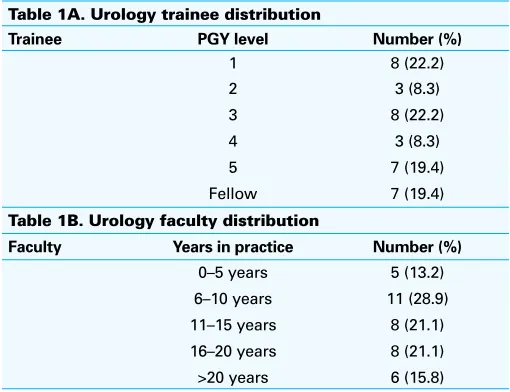
Table 1A. Urology trainee distribution
Trainee PGY level Number (%)
1 8 (22.2)
Table 1B. Urology faculty distribution
CUAJ • July 2019 • Volume 13, Issue 7 E186
Wang et al
Qualitative analysis
The common themes identified from the qualitative analy-sis were similar to our quantitative results. Representative quotes are included in Supplementary Table 2 to exemplify the emotional tone of the responses.
When the respondents were asked to comment on their greatest concern regarding this transition into CBD, two common themes were identified: burden and lack of evi-dence. Overall, burden was the most prevalent theme and created the greatest degree of concordance between faculty and trainee. There is particular emphasis on time commit-ment required to complete EPAs meaningfully and a general paucity of preparedness at an administrative level. In addi-tion, there was a collective concern regarding the unin-tended consequences of this increased burden on faculty, residents, and patient care. The theme relating to the lack of evidence centered on EPAs as appropriate targets for resident competency, leading to a broader lack of confidence towards CBD as an effective way to structure a residency program.
This thematic analysis also identified two common ben-efits from the respondents: early identification and teaching/
feedback. Unsurprisingly, the theme of identifying trainees with specific or global deficiency was common among the respondents. However, the general conviction and tone regarding this benefit were irresolute. Furthermore, there was a perception that CBD could foster consistent and continu-ous improvement among trainees through improved teaching resulting from regular feedback and well-defined targets.
Discussion
The RCPSC’s CBD initiative branched from the recom-mendations by the Future of Medical Education in Canada Postgraduate Project (FMEC PG).1 The rationale behind
this shift towards CBD is that responsible medical educa-tion involves systematic deliberaeduca-tion (i.e., designing) of a learner’s journey throughout his/her entire career.11 Through
CBD, this is achieved by training learners based on com-petencies that are required by an independently practicing healthcare professional. This is facilitated through disci-pline-specific assessment, increased emphasis on direct and indirect observation, and provision of timely, constructive, and specific feedback.4,12
Table 3. Comparison of top 10 perceived benefits between trainees and faculty
Rank (%) Perceived benefits Trainee (%) Faculty (%) p
1 (86.2) Improve ability to identify specific areas of weakness 97.1 74.2 0.026 2 (83.1) Identification of residents who require extra assistance 91.2 74.2 0.141
3 (78.5) More personalized feedback 85.3 71.0 0.243
4 (76.2) Improve residents’ knowledge of the competencies they are expected to achieve
75.8 76.7 0.959
5 (76.2) Improve residents’ awareness/clarity of competency level that residents are expected to attain
75.8 76.7 0.447
6 (75.4) Facilitate feedback delivery 76.5 74.2 0.263
7 (75.4) Increase frequency of structured feedback 79.4 71.0 0.084
8 (75.4) Increase accountability of faculty for resident education 76.5 74.2 0.311 9 (64.6) Improve faculty awareness/clarity of competency level that residents are
expected to attain
64.7 64.5 0.175
10 (64.5) Promote transparency in residency training 68.8 60.0 0.769
Rank is based on response from both faculty and trainee.
Table 4. Comparison of top 10 perceived challenges between trainees and faculty
Rank (%) Perceived challenge Trainee (%) Faculty (%) p
1 (93.4) Increased administrative burden for faculty 90.3 96.7 0.513
2 (90.2) Increased administrative burden for coordinators 87.1 93.3 0.189
3 (88.5) Increased faculty time commitment to teaching 83.9 93.3 0.499
4 (88.5) Need for faculty commitment and participation 83.9 93.3 0.395
5 (80.3) Increased burden on clinical practice 80.3 80.0 0.111
6 (77.0) Increase expenses required for implementation and maintenance of CBD 71.0 86.7 0.119 7 (68.9) Lack of valid and reliable tool to measure program-specific competencies 64.5 73.3 0.715 8 (67.2) Difficulty achieving competence in EPAs that occur uncommonly 64.5 70.0 0.398 9 (67.2) Promote selective evaluation by residents (residents choose "easy" evaluators) 64.5 70.0 0.31 10 (65.6) Need for development of individualized learning programs 61.3 70.0 0.75
CUAJ • July 2019 • Volume 13, Issue 7 E187
competence by Design in urology
By focusing on the development of competence through EPAs, CBD shifts the focus of residency to learning as opposed to time spent in training. This is thought to ensure compe-tence, support development of skills and abilities throughout practice, address gaps in training, increase accountability, and promote transparency in resident training.4 Such needs
in urology have previously been described by Morrison and MacNeily, who indicated that many specialized clinical areas of urology required increased emphasis, as well as a need for preparing residents in their transition to indepen-dent practice.13
In this study, we found a general sense of uncertainty and neutral favorability toward CBD among urologists and urol-ogy trainees in Canada. The perceived benefits of CBD are self-evident. Both faculty and trainees agreed that improved assessment and feedback were the overarching hallmark of this training model, with a specific focus on the ability to identify specific areas of weakness. These findings correlate well with previous qualitative studies.6,7 However, when
dis-cussing this benefit, Boet et al caution us that one must also note and understand the ambiguity surrounding definitions of “competence.”6
Competency, as defined by the RCPSC, is “an observable ability of a health professional to integrate multiple com-ponents, such as knowledge, skills, values, and attitudes. Since competencies are observable, they can be measured and assessed to ensure their acquisition. Competencies can be assembled like building blocks to facilitate pro-gressive development.”2,9,12 However, the competencies of
surgeons also include procedural skills, which may not have a predefined gold standard. Furthermore, these ben-efits are grounded on the assumption that providing rou-tine evaluation and feedback improves learning. However, this also assumes that we have valid and effective evalua-tion tools for our EPAs. This may not be the case, as lack of valid assessment tools was perceived to be a common challenge among urologists. This limitation is further com-pounded by the variability in the development of assess-ment tools across the different programs in Canada, as well as the pseudo-requirement of basing these tools on the Ottawa Surgical Competency Operating Room Evaluation (O-SCORE), which was validated on a population of ortho-pedic and general surgery residents.14
Similar concerns were found regarding the accuracy of EPAs in our qualitative analyses. Apramian et al described how different surgeons had divergent views on whether or not certain procedural steps were principles vs. preferences for the same surgery.15,16 If the success of CBD is predicated
on the accurate measurement of competence and constructs of EPAs, then this discordance further muddies the potential benefit of CBD.
The challenges demonstrated in this study were similar to previous studies, citing increased resource allocation as
a major deterrent to the implementation of CBD. This chal-lenge includes both the increased financial and administra-tive burden placed on Canadian programs. Overall, 80% of participants perceive a detrimental effect on the day-to-day clinical practice of faculty due to CBD. In addition, there were concerns regarding “gaming” or choosing “easy” evalu-ators by trainees and whether this would unevenly distribute the burden of assessment.
These perceived challenges provide insight into impor-tant educational questions: What are the unintended conse-quences of this implementation moving forward? How will the increased frequency of assessment affect the emotional well-being of the trainees and faculty? How will trainee or faculty fatigue affect the accuracy of these assessments? Certain parallels may be drawn from the frequent high-stakes “testing” of the “No Child Left Behind” initiative in the U.S. A survey conducted by Jones et al showed that 48.5% of teach-ers felt frequent high-stakes testing had a negative impact on students’ “love of learning” and 61% percent felt their students were more anxious because of it.17 Educator
burn-out due to this initiative has also been described.18
Limitations
The interpretation of this study is limited by the biases inher-ent to a relatively small response rate and study population. Furthermore, a French language version of this survey was not available, which may have reduced our response rates. In addition, given the fait acompli of CBD implementation, the responses to this survey may be different if this study was performed prior to the decision of implementing CBD. Lastly, the current trainees taking part in this survey are unaffected by the process, as CBD is only relevant and instituted for new PGY1s.
Although this is the first study to uniformly survey both faculty and trainees of a subspecialty surgical program, these findings may not be generalizable to non-surgical programs. However, the findings of this survey may provide important insight to other surgical programs due for CBD implementa-tion in the coming years.
Conclusions
CUAJ • July 2019 • Volume 13, Issue 7 E188
Wang et al
regarding the model’s effectiveness and potential conse-quences, thus providing collaborative opportunities among all Canadian programs.
Competing interests: The authors report no competing personal or financial interests related to this work.
This paper has been peer-reviewed.
References
1. Busing N, Harris K, MacLellan A-M, et al. The future of postgraduate medical education in Canada. Acad Med 2015;90:1258-63. https://doi.org/10.1097/ACM.0000000000000815
2. Harris K, Frank J. Competence by design: Reshaping Canadian medical education. Royal College of Physicians and Surgeons of Canada 2014. Available at: www.royalcollege.ca. Accessed June 6, 2019. 3. Iobst WF, Sherbino J, Cate OT, et al. Competency-based medical education in postgraduate medical
educa-tion. Med Teach 2010;32:651-6. https://doi.org/10.3109/0142159X.2010.500709 4. Competence by Design. The Royal College of Physicans and Surgeons of Canada, 2017. Available at: at
http://www.royalcollege.ca/rcsite/cbd/competence-by-design-cbd-e. Accessed Nov. 26, 2017. 5. Van Melle E, Frank J, Brzeznia S, et al. Competency by Design – Residency education: A framework for
program evaluation. Ottawa, ON: Royal College of Physicians and Surgeons of Canada; 2017. Available at: www.royalcollege.ca. Accessed June 6, 2019.
6. Boet S, Pigford A-AE, Naik VN. Program director and resident perspectives of a competency-based medical education anesthesia residency program in Canada: A needs assessment. Kor J Med Educ 2016;28:157-68. https://doi.org/10.3946/kjme.2016.20
7. Mann S, Hastings A, Egan R; Royal College of Physicians and Surgeons of Canada. Resident perceptions of competency-based medical education 2016. Available at: www.royalcollege.ca. Accessed June 6, 2019.
8. Kerfoot BP, Mitchell ME, Novick AC. Grappling with the evaluation of clinical competencies: A view from the Residency Review Committee for Urology. Urology 2002;60:223-4. https://doi.org/10.1016/ S0090-4295(02)01826-5
9. Frank JR, Snell LS, Cate OT, et al. Competency-based medical education: Theory to practice. Med Teach 2010;32:638-45. https://doi.org/10.3109/0142159X.2010.501190
10. Sonnadara RR, Mui C, McQueen S, et al. Reflections on competency-based education and training for surgical residents. J Surg Educ 2014;71:151-8. https://doi.org/10.1016/j.jsurg.2013.06.020 11. Royal College of Physicians and Surgeons of Canada. Competence by Design: What you need to know. A
resident’s guide, 2017. Available at: www.royalcollege.ca. Accessed June 6, 2019.
12. Holmboe ES, Sherbino J, Long DM, et al. The role of assessment in competency-based medical education. Med Teach 2010;32:676-82. https://doi.org/10.3109/0142159X.2010.500704
13. Morrison KB, MacNeily AE. Core competencies in surgery: Evaluating the goals of urology residency training in Canada. Can J Surg 2006;49:259-66.
14. Gofton WT, Dudek NL, Wood TJ, et al. The Ottawa Surgical Competency Operating Room Evaluation (O-SCORE): A tool to assess surgical competence. Acad Med 2012;87:1401-7. https://doi. org/10.1097/ACM.0b013e3182677805
15. Apramian T, Cristancho S, Sener A, et al. How do thresholds of principle and preference influence sur-geon assessments of learner performance? Ann Surg 2018;268:385-90. https://doi.org/10.1097/ SLA.0000000000002284
16. Apramian T, Cristancho S, Watling C, et al. Thresholds of principle and preference: Exploring procedural variation in postgraduate surgical education. Acad Med 2015;90:S70-6. https://doi.org/10.1097/ ACM.0000000000000909
17. Jones MG, Jones BD, Hardin B, et al. The impact of high-stakes testing on teachers and students in North Carolina. Phi Delta Kappa 1999;81:199-203.
18. Berryhill J, Linney JA, Fromewick J. The effects of education accountability on teachers: Are policies too stress-provoking for their own good? Int J Educ Policy Lead 2009;4:1-14.
Correspondence: Dr. Peter (Zhan Tao) Wang, Department of Surgery, Division of Urology, Western University, London, ON, Canada; [email protected]
Supplementary Table 1. Constructs and included items used for validity and reliability testing
Construct Item Mean SD n
Teaching 3.44 0.87 73
CBD will improve my teaching of residents 3.45 0.91 73
CBD will improve my role as a teacher 3.44 0.88 73
CBD helps identify residents who require extra assistance 3.77 0.97 73
Assessment 3.83 0.78 73
CBD will improve my feedback to residents 4.19 0.79 73
CBD will improve my ability to identify specific areas in need of improvement for resident feedback
3.86 0.93 73
CBD will improve my evaluation of residents 3.77 1.01 73 CBD makes my institution more accountable for our graduates 3.47 1.09 72
Readiness 3.51 0.80 72
I am comfortable with my current knowledge of CBD 3.64 0.98 72 I received or will receive adequate training prior to the implementation of CBD 3.76 0.87 68 I am comfortable with the implementation process of CBD 3.13 1.19 70 My program is/was prepared for the transition into CBD 3.59 0.93 69
Influence 2.86 0.90 72
CBD will have a positive influence on my academic practice 3.04 1.04 70 CBD will have a positive influence on my clinical practice (output) 2.60 1.01 70 CBD will have a positive influence on patient care 2.90 0.98 60
Time CBD increases staff time commitment to residents 4.29 0.79 73
CUAJ • July 2019 • Volume 13, Issue 7 E189
competence by Design in urology
Supplementary Table 2. Common themes and representative quotes from qualitative analysis
Themes Representative quotes
Burden “This is going to be a big burden on residents and staff for the frequent evaluations that have to be done for each EPA. I’m just not sure how receptive the staff will be with each evaluation.”
“…the quality of evaluations will be meaningless. We don’t have time to do these many evaluations. We are first and foremost providing patient care, and this CBD structure will compromise patient care.”
Lack of evidence “(The) specificity of the EPA model loses any value when the ITER/global assessment model may have had in determining whether the resident is ‘getting along well’, which is different from ‘meeting an academic milestone’.”
“(There is a) lack of evidence first off to suggest it is any better (than the current model). Lack of validated competency endpoints.”
“Validated assessment tools are lacking.”
“There is no objective measure to indicate that this will create a more competent resident after five years.”
“Inter-rater reliability creates further assessment challenges.” Early
identification
“(CBD will) hopefully be able to pick out people who are struggling earlier on.”
“Timely constructive feedback will enhance early education.” Teaching/
feedback
“Increased…awareness of EPAs among attendings will foster better attention to the specifics of the task and attention to components of patient care that may be undersubscribed.”
“The increased frequency in feedback will allow residents to improve more continuously.”
7/14/2018 Qualtrics Survey Software
https://uwo.eu.qualtrics.com/ControlPanel/Ajax.php?action=GetSurveyPrintPreview 3/16
Resident/Fellow
Faculty
0-5 years
6-10 years
11-15 years
16-20 years
> 20 years
Not applicable
PGY-1
PGY-2
PGY-3
PGY-4
PGY-5
PGY-6
Postgraduate Fellow
Yes
No
Prefer not to say
Q1.1.
What is your status?
Q1.2.
How many years of practice have you been in?
Q1.3.
What is your PGY level?
Q33.
Are you currently in a competency-based medical education stream, e.g. Competence by
Design (CBD)?
Q1.4.
What is your gender?
7/14/2018 Qualtrics Survey Software
https://uwo.eu.qualtrics.com/ControlPanel/Ajax.php?action=GetSurveyPrintPreview 4/16
Yes
No
Yes
No
Q1.5.
What is your institutional name?
Western University
Q1.6.
Are you currently a member of the Competence Committee?
Q1.7.
Are you currently a member of your department/division's Residency Program/Training
Committee?
Perceptions of CBD
Q2.1.
MEDICAL EDUCATIONPlease choose the statement that most accurately describes your opinion:
"CBD improved or will improve..."
DisagreeStrongly Disagree
Neither Disagree or
Agree Agree StronglyAgree ApplicableNot
DisagreeStrongly Disagree
Neither Disagree or
Agree Agree StronglyAgree ApplicableNot My teaching of residents
My role as a teacher My feedback to residents
My ability to identify specific areas in need of improvement for resident feedback
My evaluation of
residents
Q28.
MEDICAL EDUCATIONPlease choose the statement that most accurately describes your opinion:
7/14/2018 Qualtrics Survey Software
https://uwo.eu.qualtrics.com/ControlPanel/Ajax.php?action=GetSurveyPrintPreview 5/16
CBD improved or will improve...
DisagreeStrongly Disagree
Neither Disagree or
Agree Agree StronglyAgree ApplicableNot
DisagreeStrongly Disagree
Neither Disagree or
Agree Agree StronglyAgree ApplicableNot Staff teaching of
residents
Staff role as a teacher Staff feedback to
residents
Staff ability to identify specific areas in need of improvement for resident feedback
Staff evaluation of
residents
Q2.2.
MEDICAL EDUCATIONPlease choose the statement that most accurately describes your opinion:
DisagreeStrongly Disagree
Neither Disagree or
Agree Agree StronglyAgree ApplicableNot
DisagreeStrongly Disagree
Neither Disagree or
Agree Agree StronglyAgree ApplicableNot I am comfortable with my
current knowledge of
CBD
CBD makes my institution more accountable for our graduates
CBD helps identify residents who require
extra assistance CBD increases staff time commitment to residents
Q2.3.
IMPLEMENTATIONPlease choose the statement that most accurately describes your opinion:
7/14/2018 Qualtrics Survey Software
https://uwo.eu.qualtrics.com/ControlPanel/Ajax.php?action=GetSurveyPrintPreview 6/16
DisagreeStrongly Disagree Disagree orAgree Agree StronglyAgree ApplicableNot I received or will receive
adequate training prior to the implementation of CBD
I am comfortable with the implementation process
of CBD
My program is/was prepared for the
transition into CBD
Q2.4.
INFLUENCE OF CBD
Please choose the statement that most accurately describes your opinion:
"CBD has or will have a positive influence on..."
DisagreeStrongly Disagree
Neither Disagree or
Agree Agree StronglyAgree ApplicableNot My academic practice
My clinical practice
(output)
Patient care
Favorability of CBD
Perceived Benefits
Q32.
For the next set of questions, please drag-and-drop the "Item" from the left to the most
appropriate response category on the right ("Benefit", "Not a Benefit", or "Unsure") that
represents your views.
Q3.1.
How favourable are you towards Competence by Design (CBD) for postgraduate training in your program?
Favorability of CBD
7/14/2018 Qualtrics Survey Software
https://uwo.eu.qualtrics.com/ControlPanel/Ajax.php?action=GetSurveyPrintPreview 7/16
Benefit
Not a Benefit
Unsure
Benefit
Q4.1.
Identifying residents & skill acquisition
In your opinion, what benefits have resulted or will result from CBD?
Items
5 / 5
Q4.2.
Faculty & feedback
In your opinion, what benefits have resulted or will result from CBD?
Items
Identification of residents who require extra assistance Identification of residents who are more advanced
Improve ability to identify specific areas of weakness Improve acquisition of technical skills
Improve acquisition of non-technical skills
Improve faculty
awareness/clarity of competency level that residents are expected to attain
7/14/2018 Qualtrics Survey Software
https://uwo.eu.qualtrics.com/ControlPanel/Ajax.php?action=GetSurveyPrintPreview 8/16
Not a Benefit
Unsure
Benefit
Not a Benefit
5 / 5
Q4.4.
Residents
In your opinion, what benefits have resulted or will result from CBD?
Items
4 / 4 attain
Improvement of residents’
knowledge of the competencies they are expected to achieve
Improvement of residents’
awareness/clarity of competency level that residents are expected to attain
Improvement of residents’
7/14/2018 Qualtrics Survey Software
https://uwo.eu.qualtrics.com/ControlPanel/Ajax.php?action=GetSurveyPrintPreview 9/16
Unsure
Benefit
Not a Benefit
Unsure
Q53.
Accuracy of evaluation & graduates
In your opinion, what benefits have resulted or will result from CBD?
Items
5 / 5 Improved accuracy of residency progression through a Competence Committee
Improved accuracy of evaluation through a Competence Committee
Improved transition of
residents from medical school into residency
Improved transition of residents from residency into independent practice
7/14/2018 Qualtrics Survey Software
https://uwo.eu.qualtrics.com/ControlPanel/Ajax.php?action=GetSurveyPrintPreview 10/16
Benefit
Not a Benefit
Unsure
Benefit
Q4.5.
Training program
In your opinion, what benefits have resulted or will result from CBD?
Items
3 / 3
Q4.6.
Miscellaneous
In your opinion, what benefits have resulted or will result from CBD?
Items
Promote smoother credentialing and accreditation
Flexibility in training time Promote transparency in residency training
Improved resident self-l d l i
Improved resident wellness Improved resident
7/14/2018 Qualtrics Survey Software
https://uwo.eu.qualtrics.com/ControlPanel/Ajax.php?action=GetSurveyPrintPreview 11/16
Not a Benefit
Unsure
Challenge
Not a Challenge
4 / 4
Perceived Challenges
Q5.1.
Faculty
In your opinion, what challenges have resulted or will result from CBD?
Items
7 / 7 regulated learningprofessionalism
Increased administrative
burden on frontline faculty Increased faculty time
commitment to teaching Increased burden on clinical practice
Need for faculty commitment and participation
Worsen faculty-resident relationship
Focusing on competencies may miss other facets of training found in the traditional model
Increased administrative
7/14/2018 Qualtrics Survey Software
https://uwo.eu.qualtrics.com/ControlPanel/Ajax.php?action=GetSurveyPrintPreview 12/16
Unsure
Challenge
Not a Challenge
Unsure
Q5.2.
Assessment
In your opinion, what challenges have resulted or will result from CBD?
Items
6 / 6 Subjectivity regarding acceptable standards for competency
Difficulty assessing specific entrustable professional activities (EPAs)
Difficulty achieving
competence in entrustable professional activities (EPAs) that occur uncommonly
Difficulty in summarizing progress of resident training Ambiguity of program-specific objectives during off-service rotations
7/14/2018 Qualtrics Survey Software
https://uwo.eu.qualtrics.com/ControlPanel/Ajax.php?action=GetSurveyPrintPreview 13/16
Challenge
Not a Challenge
Unsure
Q5.3.
Training program
In your opinion, what challenges have resulted or will result from CBD?
Items
5 / 5
Q5.4.
Residents
In your opinion, what challenges have resulted or will result from CBD?
Need for development of individualized learning programs
Insufficient case load for evaluation requirements for specific competencies
Difficulties with scheduling and clinical coverage due to CBD mandate
Unpredictable changes in program size
7/14/2018 Qualtrics Survey Software
https://uwo.eu.qualtrics.com/ControlPanel/Ajax.php?action=GetSurveyPrintPreview 14/16
Challenge
Not a Challenge
Unsure
Challenge
Not a Challenge Items
7 / 7
Q5.5.
Miscellaneous
In your opinion, what challenges have resulted or will result from CBD?
Items
2 / 2 Additional pressure on residents to perform
Promote selective evaluation by residents (residents choose “easy” evaluators) Worsen resident wellness Results in increased competition amongst residents
Negative implications for future employment due to novelty of new training modality
Negative impact for future postgraduate fellowships Residents graduating with greater knowledge/training gaps
7/14/2018 Qualtrics Survey Software
https://uwo.eu.qualtrics.com/ControlPanel/Ajax.php?action=GetSurveyPrintPreview 15/16
Survey Powered By Qualtrics
Unsure
Open-ended Questions Regarding CBD
Q6.1.
What are you most concerned about regarding the transition to CBD?
Q6.2.