R E S E A R C H A R T I C L E
Open Access
A dynamic scheduling algorithm for energy
harvesting embedded systems
Yonghong Tan
1*and Xiangdong Yin
2Abstract
Energy harvesting embedded systems are embedded systems that integrate with energy harvesting modules. In this kind of systems, service tasks and energy harvesting tasks must be scheduled efficiently to keep the whole system working properly as long as possible. In this paper, we model an energy harvesting embedded system with an energy model, a task model, and a resource model and propose a dynamic task scheduling algorithm. The proposed algorithm is based on dynamic voltage and frequency scaling technique and dynamically concentrates all disperse free time together to harvest energy. We validate the efficiency and effectiveness of the proposed algorithm under both energy-constraint and non-energy-constraint situations with the Yartiss simulation tool.
Keywords:Energy harvesting embedded systems, Dynamic scheduling algorithm, Energy model
1 Introduction
In embedding systems, the energy is usually provided with batteries, and the requirements of real time and many extensive smart functions make embedding systems consume more and more energy [1]. If we run the embedding systems arbitrarily, the energy would run out very quickly; this would shorten the working time of smart devices. The techniques of dynamic voltage and frequency scaling (DVFS) [2] and dynamic power management (DPM) [3] could decrease the power consumption of embedding systems whereas satisfying the time constraints. However, once deployed, the embedded application will run a long time, and the energy of the battery will run out finally. Besides replacement of the battery, the embedded systems can harvest energy from the external environment [4], such as sunshine [5], wind [6], and vibration [7]. By applying these energy harvesting techniques [8, 9], the working time of embedded systems can be increased. While harvesting energy from the environment, both the harvest and storage of energy need processing time, and this needs to reschedule the processor and thus interrupts the working tasks. So, an energy harvesting embedded
system is an embedded system with different kinds of energy harvesting modules inside.
In energy harvesting embedded systems [10], one needs to schedule tasks between harvesting tasks with working tasks, and the aim is to keep the energy of embedded systems in a reasonable level, while providing normal working services at the same time. During the scheduling of the tasks in energy harvesting embedded systems, both the energy output and storage units are the physical environment and the change of status is a continuous physical process [11]. The physical process provides much information for the computing environ-ment, and the decision-making process of the computing environment affects the physical environment too. Ac-cording to interaction and fusion [12] of the computing and physical environment, one can allocate the resources efficiently and thus optimize the performance of the whole system.
In this paper, we study the problem of task scheduling in energy harvesting embedded systems. In an energy harvesting embedded system, the system needs to harvest energy from the external environment during free or idle time. We model an energy harvesting em-bedded system with an energy model, a task model, and a resource model and propose a dynamic task schedul-ing algorithm. Based on dynamic voltage and frequency scaling techniques, the proposed algorithm concentrates * Correspondence:[email protected]
1Experimental Training Center, Hunan University of Science and Engineering,
YongZhou, Hunan Province, China
Full list of author information is available at the end of the article
all disperse free time together to harvest energy by dy-namically scheduling harvesting tasks and service tasks.
The rest of the paper is organized as follows. In Section 1.2, we review related works about scheduling algorithms in embedded systems. In Section 1.3, we propose a model for energy harvesting embedded systems. In Section 1.4, we propose a dynamic task scheduling algorithm. Experiments and conclusions are given in Sections 1.5 and 2, respectively.
2 Related works
In this section, we review related works about scheduling algorithms in embedded systems, especially focus on en-ergy saving and enen-ergy harvesting scheduling algorithms.
2.1 Energy saving scheduling algorithms
Energy saving task scheduling is a key research in embedded systems and sensor networks. The techniques of energy saving scheduling can be classified into trad-itional scheduling method and utility-based scheduling method. Traditional energy-saving scheduling methods [13, 14] can be applied to the simple task-arrival mode, such as period tasks, but it cannot assure the arrival tasks to be scheduled in real time.
In general, every completion of a task would bring some utility, and the utility depends on the running time of the task. The longer the running time, the smaller the utility is. Jensen et al. [15] proposed a time/utility function to describe the relationship between the running time and the utility of a task, and their aim is to maximize the total utility by finishing all tasks as quickly as possible. Refer-ences [16–18] studied how to get the maximal utility with limited energy. In addition, in order to satisfy the utility acquirement and the energy budget, Wu et al. [19] proposed a unimodal arbitrary arrival with energy bounds algorithm (EBUA), and the EBUA solved the problem of task scheduling based on unimodal arbitrary arrival model.
2.2 Energy harvesting scheduling algorithms
The task scheduling problem in energy harvesting embedded systems was first proposed by Allavena and Mossé in [20], and then some algorithms for solving this problem were proposed. The lazy scheduling algorithm (LSA) proposed by Moser et al. [21] adjusts the worst-case execution time by adjusting frequency of the CPU according to tasks’energy consumption. The LSA is based on a strong assumption that the worst-case execution time of a task is related with its energy consumption dir-ectly, and this assumption is impractical [22]. Chandarli et al. [23] proposed an ALAP scheduling algorithm, and it was a fixed-priority scheduling policy that delayed the executions of jobs as long as possible. Abdeddaïm et al. [24] proposed an ASAP algorithm, and this algorithm
scheduled tasks as soon as possible when there was available energy in the battery and suspended execution to replenish the energy needed to execute one time unit. Under constraints of energy and time, ASAP is proved to be optimal.
In addition, in order to get better system performance and less energy consumption, some scheduling algorithms [25, 26] take dynamic voltage frequency scaling into consideration. The EA-DVFS algorithm [25], proposed by Liu et al., adjusts the CPU frequency by the remaining energy of the system. If there is not enough energy to run the task, then it decreases the CPU frequency; otherwise, it runs the task with maximal CPU frequency. The HA-DVFS algorithm [26] optimizes the system per-formance and improves the energy utilization further based on the EA-DVFS algorithm. However, in some real-time embedded systems with high reliability, DVFS and related algorithms can extend the running time of tasks, affect the run-time attribute of the system, and thus decrease its reliability.
3 Energy harvesting embedded system model
In this section, we model the embedded system with an energy model, a task model, and a resource model.
3.1 The energy model
In this paper, we applied the system-level energy model proposed by Martin [27] in his doctoral thesis. We let the CPU value be 1, if it runs with maximal speed. So, the amount of computation is also the number of clock period under maximal speed. We assume that the embedded system supports DVFS and the CPU has d
discrete speeds (or frequencies) fi(1≤i≤d). The CPU
speed fi means that the CPU runs fi clock periods per
second. When the CPU runs with speed f, the energy consumption can be described as
PC¼S3f3þS2f2þS1f þS0; ð1Þ
whereS3,S2,S1, andS0are constants.
In the above model, the system-level energy consump-tion includes dynamic energy consumpconsump-tion, static energy consumption, and the energy consumed by other components. So, when the system runs with frequencyf, the energy consumption of every clock period is
E fð Þ ¼S3f2þS2f þS1þ S0
f ð2Þ
3.2 The task model
We assume that the embedded system is a preemp-tive real-time system and the task set is Γ= {τ1,
⋯,τn}. Every arrival task is an instance of its
denoted as τi,j. In a unimodal arrival model, each task
is related with one tuple <ai,Pi>, and the tuple
means that the maximal number of arrival instances is
ai in any sliding window Pi. The periodic real-time task
mode is a special case of the unimodal arrival model, where the valueaiequals to 1.
We useUi(⋅) to denote the time/utility function of the
task τi, and thus,Ui(⋅) is the time/utility function of any
instance ofτi. Ifτi,jfinishes with time t, then the utility
is Ui(t). In addition, we define the beginning time ofUi
with the arrival time ofτiand define the ending time of Uiwith the sum of its beginning time and the length of
the sliding window Pi We let the number of clock
periods be ci and the relative deadline be Di, and both
computations ofciandDican be found in [19].
3.3 The resource model
We define the sharing resource set except for the CPU as SR = {SR1, SR2,⋯SRr, where each sharing resource
SRi can be shared among all tasks but can only be
accessed by one task at one time. Once some task has been authorized to access sharing resource, then this task executes a critical section. After executing of the critical section, the task releases the sharing resource. We denote the jth critical section of task τi as zi,j, then
the amount of computation is ccs(zi,j) and the accessed
resource is denoted as s(zi,j)∈SR. In addition, letNcs(τi)
be the number of critical sections for τi, and the total
amount of computation for τi under all non-critical
sections be cns(τi), then the amount of computation for
taskτiis
The critical sections of a task can be nested, that is for critical sections zi,jand zi,k of task τi, we can have zi,j⊂ zi,k,zi,k⊂zi,j, orzi,j∩zi,k= null.
4 Dynamic task scheduling algorithm
In this section, we propose a dynamic resource sched-uling algorithm. Here, “dynamic” means that the en-ergy harvesting module is activated dynamically to maximize the harvested energy, and at the same time, the normal services cannot be disturbed. For conveni-ence, we denote τi,j as τi in the following sections.
The dynamic scheduling algorithm preserves the com-puting ability for the following tasks, and for each τi,
constraints the number of instances in any sliding window to be capacity(τi). In addition, we keep the
running speed in the critical section to be equal to the static frequency, and thus, the dynamic algorithm can acquire the speed in the non-critical section ac-cording to the current running status. In order to
describe the proposed algorithm, we define some pa-rameters and functions first:
crnsðτi;tÞis the remaining computing ability in the non-critical section of taskτiat timet.
crcs zi;j;t
is the remaining computing ability in critical sectionzi,jat timet.
EET(τi,t) is the required estimating time for the remaining part of taskτiat timet, which can be computed with the remaining computing ability, the running speed in the non-critical section, and the static running speed in the critical section.
EEC(τi,t) is the estimation of the required energy of taskτiat timet, which can be computed with the remaining computing ability, the running speed in the non-critical section, the static running speed in the critical section, and the energy consumption defined in Section1.2.1.
UER(τi,t) is the estimated ratio of utility to the energy of taskτistarting from timet, while it is not blocked, that isUER(τi,t) =Ui(t+EET(τi,t))/EEC(τi,t). UER′(τi,t) is the maximal speed of taskτistarting
from timet, while it is not blocked.
queueis the waiting queue of arrival tasks.
recordtime(τi) is the starting time of the sliding window of taskτi, which initializes to be 1.
RC(τi,t) returns the number of instances, which can be accepted in the future, of taskτiat timet, and it equals tocapacity(τi) minus the accepted number of instances of taskτiin the current sliding window.
checkfeasible(τi,t) checks whether or not the current sliding window can accept new instances of taskτi at timet, and ifqueue= null,t−recordtime(τi)≥Di
orRC(τi,t) > 0, then this is the idle rate of taskτiat timet, which can be computed by the following equation:
1. runningstate(τi,t) reflects the running status of task
τiat timet, which returns true ifτiis selected to run as a candidate task beforet, and false, otherwise. 2. f(τi,t) is the current running speed of taskτiat time
t, which can be computed by Theorem 1.
3. increaseslu(τi,sl,t) increases the idle rate of taskτiat timet, that isSLU(τi,t) =SLU(τi,t) +sl/Di.
4. decreaseslu(τi,sl,t) decreases the idle rate of taskτi at timet, that isSLU(τi,t) =SLU(τi,t) +sl/Di.
5. selectcandidate(t) selects a candidate task to run. 6. resource(τi,t) is the resource accessed by taskτiat
Theorem 1. Ifτiis selected to run as a candidate task
at time t, then resource(τi,t) returns null, and the
run-ning speed of τiin the previous non-critical section is
f(τi,t). In order to satisfy the schedulability of taskτi, the current running speed is
fðτi;tÞ ¼crnsðτi;tÞ= crnsðτi;tÞ
fðτi;t′Þ þ
min
∀j≥i SLU τj;t
Dj
Þ:
ð4Þ
Proof.As can be seen from the assumption, the taskτi
runs in the critical section, so we have crnsðτi;tÞ ¼crns τi;t′
ð Þ. At time t, the available free time for the task τi is min∀j<i{SLU(τi,t) ×Dj}. At the same time, we
have
crnsðτi;t′Þ
fðτi;t′Þ þ
min∀j≤i SLU τj;t
Dj
¼crnsðτi;tÞ
fðτi;t′Þ:
So, we can get the following result
fðτi;tÞ ¼crnsðτi;tÞ= cr
nsðτi;tÞ fðτi;t′Þþ
min∀j≥i SLU τj;t
Dj
:
Algorithm 1 describes the proposed dynamic DVFS algorithm. Line 3 rectifies the accepted number of in-stances in the current sliding window; line 5 selects a candidate task to run; and line 6 adjusts the running speed of the candidate task (details are in Algorithm 2). If a new sliding window is opened (line 10), we use line 11 to initialize the parameters and preserve the computing ability for the following tasks. When a new task arrives, line 14 restricts the number of the following tasks by adjustingRC(τi,t). From lines 11 to 13, we see that every
sliding window of taskτican havecapacity(τi) instances at
most. Lines 15 to 17 reselect a candidate task and com-pute its running speed.
The aim of Algorithm 2 is to decrease the energy con-sumption by releasing/recycling free time and maximize the total utility. When a candidate task starts to run, lines 1 and 2 recycle the free time between the maximal blocking time with the practical blocking time. When the resource occupied by taskτiat timetis null (line 3),
line 4 computes the running speed of the candidate task in non-critical sections, line 5 selects the running speed for taskτiat timet, and line 6 is equal to∀j≥i{SLU(τj,t) ×Dj.
When we have the running speed of the candidate task, the available time of the task would be deducted (line 8) or released (line 10). Finally, we use line 12 to assure that the running speed of the candidate task in the critical section is equal to its static running speed.
5 Experiments 5.1 Experimental setup
simulation tool Yartiss [28] to implement these algo-rithms. Yartiss provides a simulation framework, and this framework can execute massive tasks of different algo-rithms with different parameters. We let the output of en-ergy harvesting unit be equal to the enen-ergy supply rateebat
of the system, and every time unit provides several energy units. The energy consumption of a task is linear, and every task consumesEi/Ci energy units per time unit. In
order to evaluate the performance of algorithms, we com-pare our proposed algorithm with the ASAP and ALAP algorithms under both energy-constraint and non-energy constraint situations. Under energy constraints, we evaluate the performance of algorithms by increasing the number of tasks; and under non-energy constraints, we design six application scenes with different amount of batteries and let Ph=ebat= 15, Emin= 0, and the running
timeDuration= 2550.
In simulation experiments, we use the following six metrics:
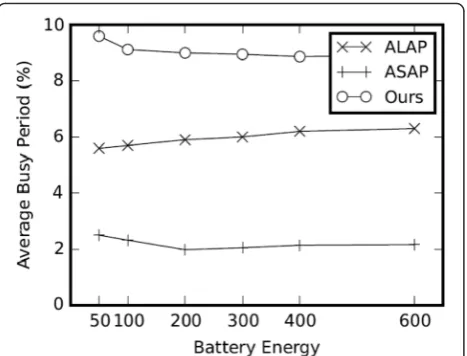
1)Average busy periodis the average period of the CPU under simulation. The longer the average busy period, the higher the utility of the CPU is.
2)Average idle periodis the average period of the CPU while it is free. Under energy constraints, it includes free time and relaxed time. The longer the average idle period, the higher the average energy level is, and thus, the lower energy constraints the system has.
3)Average overheadis the average time required to execute a task under simulation. The bigger the average overhead, the more likely the task will be missed before the stopping time.
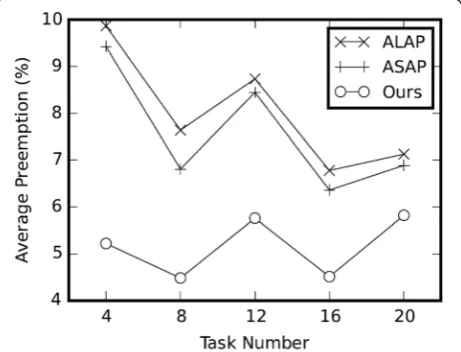
4)Average preemptionis the ratio of the preempted tasks to total tasks. The bigger the average preemption, the more context switches it has, and thus, the heavier the overhead is. The heavy overhead will decrease the performance of the
Fig. 1Average busy period under non-energy constraints
Fig. 2Average idle period under non-energy constraints
Fig. 3Average overhead under non-energy constraints
whole system and make the scheduling algorithm unpracticable.
5)Average energy levelis the average energy percent of batteries. The higher the average energy level, the lower energy constraints the system has.
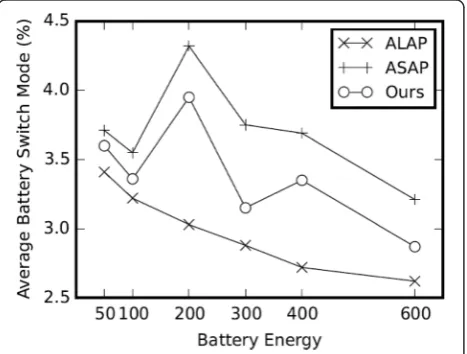
6)Average battery switch modeis the ratio of battery switch modes to total tasks. The more the average battery switch mode, the lower the energy utility is. Low energy utility would make the system work un-properly.
5.2 Experimental results
We compare our proposed algorithm with the ASAP and ALAP algorithms under both the non-energy-constraint and the energy-constraint situations, and the results are in Figs. 1, 2, 3, 4, 5, 6, 7, 8, 9, and 10.
Under non-energy constraints, the comparisons of average busy period, average idle period, average
overhead, and average preemption are in Figs. 1, 2, 3, and 4, respectively. The ALAP algorithm postpones the execu-tion of tasks as long as possible, and it generates massive free time, so both the average busy period and idle period are minimum. However, with the increase of the number of tasks, the average overhead of the ALAP algorithm increases obviously. The ASAP algorithm executes tasks as soon as possible, and it is equal to the scheduling of fixed-priority preemption. Our algorithm is based on fixed-priority preemption, and increases the threshold of preemption, so it has similar average busy period, average idle period, and average overhead to the ASAP algorithm. In addition, with the introduction of preemption threshold, our algorithm avoids the tasks with high priorities preempted, while keeping these tasks finished in time. So, our algorithm has the least number of preemptions.
Under energy constraints, the comparisons of average busy period, average idle period, average overhead,
Fig. 5Average busy period under energy constraints
Fig. 6Average idle period under energy constraints
Fig. 7Average overhead under energy constraints
average energy level, average preemption, and average battery switch mode are in Figs. 5, 6, 7, 8, 9, and 10, respectively. As we can see from these figures, our algo-rithm has the least preemption too. The reason is that the ASAP algorithm judges preemption after every exe-cution time unit and our algorithm runs tasks concen-tratedly. When the energy is not enough, our algorithm concentrates all available relaxed time to harvest energy, which reduces the preemptions caused by lacking energy. Our algorithm reduces the battery switch mode, uses the relaxed time to harvest energy, and then maximizes the busy period and idle period. So, our algorithm provides higher energy level and decreases the energy constraints of the system. The overheads of all the above algorithms tend to be identical. Our algorithm keeps the battery being on charge or discharge mode all the time and has less battery switch mode than the ASAP algorithm.
6 Conclusions
In energy harvesting embedded systems, the system needs to harvest energy from the external environment during free or idle time and schedule service tasks and energy harvesting tasks to keep the whole system work-ing properly as long as possible. In this paper, we study the problem of task scheduling in energy harvesting embedded systems. We model an energy harvesting embedded system with an energy model, a task model, and a resource model and propose a dynamic task scheduling algorithm. Based on the dynamic voltage and frequency scaling techniques, the proposed algorithm concentrates all disperse free time together to harvest energy by dynamically scheduling harvesting tasks and service tasks. In the future, we will build a real energy harvesting embedded system, which implements the proposed algorithm. Currently, we only do some simula-tion experiments to validate the effectiveness of the proposed algorithm theoretically, and real improvement of lifetime on a real system will be our future work too.
Competing interests
The authors declare that they have no competing interests.
Acknowledgements
The work was supported by the following funds: Hunan Provincial Natural Science Foundation of China (Grant No.2015JJ6043); Hunan University of Science and Engineering; Scientific Research Fund of Hunan Provincial Education Department(Grant No.12A054); and The Construct Program of the Key Discipline in Hunan University of Science and Engineering(Circuits and Systems).
Author details
1Experimental Training Center, Hunan University of Science and Engineering,
YongZhou, Hunan Province, China.2School of Electronics and Information
Engineering, Hunan University of Science and Engineering, YongZhou, Hunan Province, China.
Received: 26 September 2015 Accepted: 4 April 2016
References
1. TA Nguyen, M Aiello, Energy intelligent buildings based on user activity: a survey. Energy Build.56, 244–257 (2013)
2. EL Sueur, G Heiser, Dynamic voltage and frequency scaling: the laws of diminishing returns. International Conference on Power Aware Computing and Systems. USENIX Association, 1-8 (2010)
3. L Benini, A Bogliolo, G De Micheli, A survey of design techniques for system-level dynamic power management. IEEE Trans. Very Large Scale Integr. VLSI Syst.8(3), 299–316 (2000)
4. S Chalasani, JM Conrad, A survey of energy harvesting sources for embedded systems. Southeastcon. 442-447 (2008)
5. V Raghunathan, A Kansal, J Hsu, J Friedman, M Srivastava, Design considerations for solar energy harvesting wireless embedded systems. In: Proceedings of the 4th International Symposium on Information Processing in Sensor Networks, (IEEE Press, 2005), p. 64
6. S Li, J Yuan, H Lipson, Ambient wind energy harvesting using cross-flow fluttering. J. Appl. Phys.109(2), 26104 (2011)
7. SP Beeby, MJ Tudor, N White, Energy harvesting vibration sources for microsystems applications. Meas. Sci. Technol.17(12), 175 (2006) 8. A Kansal, J Hsu, S Zahedi, MB Srivastava, Power management in energy
harvesting sensor networks. ACM Trans. Embed. Comput. Syst.6(4), 32 (2007) 9. RV Prasad, S Devasenapathy, VS Rao, J Vazifehdan, Reincarnation in the
ambiance: devices and networks with energy harvesting. IEEE Commun. Surv. Tutorials16(1), 195–213 (2014)
Fig. 9Average preemption under energy constraints
10. V Raghunathan, PH Chou, Design and Power Management of Energy Harvesting Embedded Systems. International Symposium on Low Power Electronics and Design. 369-374 (2006)
11. T Tong, S Ulukus, W Chen, Optimal packet scheduling for delay
minimization in an energy harvesting system. IEEE International Conference on Communications. IEEE, 4241-4246 (2015)
12. M Song, Y Zhang, M Peng, J Zhai, Low frequency wideband nano generators for energy harvesting from natural environment. Nano Energy6, 66–72 (2014). Tan and Yin Page 8 of 8
13. Y Zhang, XS Hu, DZ Chen, Task scheduling and voltage selection for energy minimization. Proceedings of the 39th Annual Design Automation Conference (ACM), 183–188 (2002)
14. G Quan, X Hu, Energy efficient fixed-priority scheduling for real-time systems on variable voltage processors. Design Automation Conference, 2001. Proceedings (IEEE), 828–833 (2001)
15. ED Jensen, CD Locke, H Tokuda, A time-driven scheduling model for real-time operating systems. RTSS85, 112–122 (1985)
16. L Huang, MJ Neely, Utility optimal scheduling in energy-harvesting networks. IEEE/ACM Trans. Networking21(4), 1117–1130 (2013) 17. A Jaleel, HH Najaf-Abadi, S Subramaniam, SC Steely, J Emer, Cruise: cache
replacement and utility-aware scheduling. ACM Comp. Ar.40, 249–260 (2012). ACM
18. D Xue, R Murawski, E Ekici, Distributed utility-optimal scheduling with finite buffers. International Symposium on Modeling and Optimization in Mobile, Ad Hoc and Wireless Networks. IEEE, 278-285 (2012)
19. H Wu, B Ravindran, ED Jensen, Utility accrual real-time scheduling under the unimodal arbitrary arrival model with energy bounds. IEEE Trans. Comput. 56(10), 1358–1371 (2007)
20. A Allavena, D Mossé, Scheduling of frame-based embedded systems with rechargeable batteries, inWorkshop on Power Management for Real-Time and Embedded Systems (in Conjunction with RTAS 2001), 2001
21. C Moser, D Brunelli, L Thiele, et al. Lazy Scheduling for Energy Harvesting Sensor Nodes[M]// From Model-Driven Design to Resource Management for Distributed Embedded Systems. (Springer US, 2006) 125-134 22. R Jayaseelan, T Mitra, X Li, Estimating the worst-case energy consumption
of embedded software. Real-Time and Embedded Technology and Applications Symposium. Proceedings of the 12th IEEE (IEEE), 81–90 (2006) 23. Y Chandarli, Y Abdeddaim, D Masson, The Fixed Priority Scheduling
Problem for Energy Harvesting Real-Time Systems. 2012 IEEE International Conference on Embedded and Real-Time Computing Systems and Applications. IEEE Computer Society, 415-418 (2012)
24. Y Abdeddaïm, Y Chandarli, D Masson, Toward an optimal fixed-priority algorithm for energy-harvesting real-time systems, inRTAS 2013 WiP, 2013, pp. 45–48
25. S. Liu, Q. Qiu, Q. Wu, Energy aware dynamic voltage and frequency selection for real-time systems with energy harvesting. In: Design, Automation and Test in Europe, 2008. DATE’08 (IEEE, 2008), p. 236–241 26. S Liu, J Lu, Q Wu, Q Qiu, Harvesting-aware power management for
real-time systems with renewable energy. IEEE Trans. Very Large Scale Integr. VLSI Syst.20(8), 1473–1486 (2012)
27. TL Martin,Balancing Batteries, Power, and Performance: System Issues in CPU Speed-Setting for Mobile Computing. PhD thesis, PhD thesis, Department of Electrical and Computer Engineering, Carnegie Mellon University, 1999 28. Y Chandarli, F Fauberteau, D Masson, S Midonnet, M Qamhieh, Yartiss: a
tool to visualize, test, compare and evaluate real-time scheduling algorithms, inProc. of the 3rd Int’l Workshop on Analysis Tools and Methodologies for Embedded and Real-time Systems, 2012, pp. 21–26
Submit your manuscript to a
journal and benefi t from:
7Convenient online submission
7Rigorous peer review
7Immediate publication on acceptance
7Open access: articles freely available online
7High visibility within the fi eld
7Retaining the copyright to your article