R E S E A R C H
Open Access
Existence and exponential stability of
pseudo almost automorphic solutions for
Cohen-Grossberg neural networks with
mixed delays
Hongying Zhu
1, Quanxin Zhu
2,3, Xianbo Sun
1and Hongwei Zhou
4**Correspondence:
4School of Information Engineering,
Nanjing Xiaozhuang University, Nanjing, Jiangsu 211171, China Full list of author information is available at the end of the article
Abstract
In this paper, we consider a class of Cohen-Grossberg neural networks with mixed delays. Different from the previous literature, we study the existence and exponential stability of pseudo almost automorphic solutions for the suggested system. Our method is mainly based on the Banach fixed point theorem and the Lyapunov functional method. Moreover, a numerical example is given to show the effectiveness of the main results.
Keywords: existence and exponential stability; pseudo almost automorphic solution; Banach fixed point theorem; Cohen-Grossberg neural networks
1 Introduction
The concept of pseudo almost automorphy was first introduced by Xiaoet al.[], which is a natural generalization of almost periodicity and almost automorphy. Meanwhile, the pseudo almost automorphic functions are more general and complicated than pseudo al-most periodic functions and alal-most automorphic functions. The existence and stability of almost automorphic and pseudo almost automorphic solutions are the most attractive topics in qualitative theory of differential equations due to their significance and applica-tions in physics, mechanics and mathematical biology. In recent years, the existence and stability of almost automorphic and pseudo almost automorphic solutions on different kinds of differential equations have been widely studied; for instance, see [–] and the references therein.
On the other hand, there have been extensive results on the problem of the existence and uniqueness of solutions or their dynamic analysis for Cohen-Grossberg type neural net-works; see [–] among others. However, there have been few results for pseudo almost automorphic functions since they are more general and complicated than both pseudo almost periodic functions and almost automorphic functions. To the best of our knowl-edge, the existence of pseudo almost automorphic solution to Cohen-Grossberg neural networks (CGNNs) with variable coefficients and mixed delays has not been studied.
Motivated by the above discussion, in this paper we study the existence, uniqueness, and exponential stability of pseudo almost automorphic solutions for the following CGNNs:
⎧ ⎪ ⎪ ⎨ ⎪ ⎪ ⎩
xi(t) = –ai(xi(t))[bi(xi(t)) –mj=cij(t)fj(xj(t)) –mj=dij(t)gj(xj(t–τij(t))) –mj=pij(t)–∞t Gij(t–s)hj(xj(s))ds–Ii(t)], t≥,
xi(t) =i(t), t< .
()
By using the Banach fixed point theorem and the Lyapunov functional method, we prove the existence, uniqueness, and exponential stability of pseudo almost automorphic solu-tions to system ().
The organization of this paper is as follows. In Section , we introduce some basic defi-nitions, assumptions and preliminary lemmas. In Section , we establish the existence and uniqueness of pseudo almost automorphic solution of system () by applying the Banach fixed point theorem. In Section , the exponential stability result is shown. In Section , an example is provided to demonstrate the effectiveness of the main results. In Section , we conclude the paper with some general remarks.
2 Preliminaries
In this section, we introduce some basic definitions, assumptions and preliminary lem-mas. Throughout this paper, unless otherwise specified,Rdenotes the set of real num-bers,R+denotes the set of non-negative real numbers,Rmdenotes the realm-dimensional space.
Definition .[] A continuous functionf :R→Rmis said to be almost automorphic if for every sequence of (sn)n∈N, there exists a subsequence (sn)n∈N⊂(sn)n∈N such that
g(t) = lim
n→∞f(t+sn)
is well defined for eacht∈R, and
lim
n→∞g(t–sn) =f(t)
for each t ∈ R. The collection of all almost automorphic functions is denoted by AA(R,Rm). It is well known that the setAA(R,Rm) is a Banach space with supremum
norm.
Remark . The functiongin Definition . is measurable but not necessarily continu-ous. Moreover, ifgis continuous, thenf is uniformly continuous. Besides, if the conver-gence in Definition . is uniform int∈R, thenf is almost periodic. For example, Bocher [] gave an almost automorphic but not almost periodic function defined in the integer set
ϕ(n) =signum(cosπnθ), –∞<n<∞,
Definition .[] A continuous functionf :R×Rm→Rmis said to be almost automor-phic if for every sequence of (sn)n∈N, there exists a subsequence (sn)n∈N ⊂(sn)n∈N such that
g(t,x) = lim
n→∞f(t+sn,x)
is well defined for eacht∈R,x∈Rm, and
lim
n→∞g(t–sn,x) =f(t,x)
for eacht∈R,x∈Rm. The collection of all almost automorphic functions is denoted by AA(R×Rm,Rm).
Define the class of functionsPAA(R,Rm) andPAA(R×Rm,Rm) as follows:
PAAR,Rm =
f ∈BCR,Rm lim T→+∞
T
T
–T
f(t)dt=
,
PAA
R×Rm,Rm
=
f∈BCR×Rm,Rm lim T→+∞
T
T
–T
f(t,x)dt= ,∀x∈Rm
,
whereBC(R,Rm) (orBC(R×Rm,Rm)) is the collection of the set of bounded continuous functions fromR(orR×Rm) toRm.
Definition . [, ] A functionf ∈BC(R,Rm) (orBC(R×Rm,Rm)) is called pseudo almost automorphic if it can be expressed as
f =f+f,
wheref∈AA(R,Rm) (orAA(R×Rm,Rm)) andf∈PAA(R,Rm) (orPAA(R×Rm,Rm)).
The collection of such functions will be denoted byPAA(R,Rm) orPAA(R×Rm,Rm)).
Remark . Obviously, we have
APR,Rm ⊂AAR,Rm ⊂PAAR,Rm ⊂BCR,Rm ,
whereAP(R,Rm) is the collection of all almost periodic functions fromRtoRm.
Lemma .[, ] Suppose f,g∈PAA(R,Rm)and for allτ ∈R,then the following holds
true:
() f+g,τf,fτ(t,x) :=f(t+τ,x)andf(–t,x)∈PAA(R,Rm). () f is bounded for eachx∈Rm.
Lemma .[, ] Let f =f+f∈PAA(R×Rm,Rm),where f(t,ϕ)∈AA(R×Rm,Rm),
f(t,ϕ)∈PAA(R×Rm,Rm).Moreover,assume that the following conditions are satisfied:
(b) f(t,ϕ)is uniformly continuous(or satisfies the Lipschitz condition)for every bounded subsetK⊂Rmandt∈R.
Then the function ζ :t→ζ(t) =f(t,ϕ(t))is pseudo almost automorphic for all ϕ ∈
PAA(R,Rm).
Lemma . [, ] Assume that f ∈ AA(R,Rm) and φ ∈ C(Rm,Rn), then φ(f(t)) ∈ AA(R,Rn).
Lemma .(Lebesgue’s dominated convergence theorem) Let{fn}be a sequence of
real-valued measurable functions on a measurable set E.Suppose that the sequence converges pointwise to a function f and is dominated by some integrable function F in the sense that |fn(x)| ≤F(x)for all numbers n in the index set of the sequence and all points x∈E.Then f
is integrable andlimn→∞
Efn(x)dx=
Ef(x)dx.
Throughout this paper, we make the following assumptions.
(H): ai(u)are uniformly continuous functions and there are positive constantsa+i,a–i such that
<a–i ≤ai(u)≤a+i, ∀u∈R,i= , , . . . ,m.
(H): bi(u),i= , , . . . ,m, are uniformly continuous functions and there exist positive con-stantsb–
i,b+i such that
b–i ≤bi(u) –bi(v) u–v ≤b
+
i, ∀u,v∈R,u=v,bi() = .
(H): cij(t),dij(t),pij(t),Ii(t)∈C(R,R), τij(t)∈C(R,R+) are pseudo almost automorphic
functions, wherei,j= , , . . . ,m.
(H): The delay kernel functionGij: [, +∞)→[, +∞)is piecewise continuous and inte-grable, and there exists a real numberεsuch that
+∞
Gij(u)du= ,
∞
eεuGij(u)du< +∞, i,j= , , . . . ,m.
(H): The functionsfj(u),gj(u),hj(u)∈C(R,R)satisfy the Lipschitz condition,i.e., there are nonnegative constantsLfj,Lgj, andLhj such that
fj(u) –fj(v)≤Lfj|u–v|, ∀u,v∈R,j= , , . . . ,m,
gj(u) –gj(v)≤Lgj|u–v|, ∀u,v∈R,j= , , . . . ,m,
hj(u) –hj(v)≤Lhj|u–v|, ∀u,v∈R,j= , , . . . ,m.
Constantsc+ij,d+ij,p+ij,Ii+(i= , , . . . ,m) are denoted as follows:
sup t∈R
cij(t) =c+ij> , sup t∈R
dij(t) =dij+> ,
sup t∈R
pij(t) =p+ij> , sup t∈R
3 The existence and uniqueness of pseudo almost automorphic solutions In this section, we study the existence and uniqueness of pseudo almost automorphic so-lutions of system ().
By the assumption (H), we know that the antiderivative of a
i(xi(t)) exists. Then we choose an antiderivativeFi(xi) ofa
i(xi(t))withFi() = . It is clear thatF
i(xi) = ai(xi(t)). Since
ai(xi(t)) > , we see thatFi(xi) is increasing onxiand there exists an inverse functionFi–(xi) ofFi(xi), which is continuous and differential. Moreover, we have (Fi–(xi))=ai(xi(t)). De-notingFi(xi)xi(t) =
xi(t)
ai(xi(t)):=u
i(t), we getxi(t) =Fi–(ui(t)). Then it follows from () that
⎧ ⎪ ⎪ ⎪ ⎪ ⎪ ⎨ ⎪ ⎪ ⎪ ⎪ ⎪ ⎩
ui(t) = –bi(Fi–(ui(t))) +
m
j=cij(t)fj(Fj–(uj(t))) +mj=dij(t)gj(Fj–(uj(t–τij(t)))) +mj=pij(t)
t
–∞Gij(t–s)hj(Fj–(uj(s)))ds+Ii(t), t≥,
ui(t) =Fi(i(t)), t< .
()
By the assumption (H) and the mean value theorem, we obtain
bi
Fi–ui(t) =bi
Fi–θiui(t)
ui(t) :=b∼i ui(t) ui(t),
whereθiis a constant such that ≤θi≤. Substituting this into () yields,
⎧ ⎪ ⎪ ⎪ ⎪ ⎪ ⎨ ⎪ ⎪ ⎪ ⎪ ⎪ ⎩
ui(t) = –b∼i(ui(t))ui(t) +mj=cij(t)fj(F–
j (uj(t))) +mj=dij(t)gj(Fj–(uj(t–τij(t))))
+mj=pij(t)–∞t Gij(t–s)hj(Fj–(uj(s)))ds+Ii(t), t≥,
ui(t) =Fi(i(t)), t< .
()
Obviously, system () has a unique pseudo almost automorphic solution, if and only if sys-tem () has a unique pseudo almost automorphic solution. So we only need to consider the pseudo almost automorphic solution of system (). It follows from the Lagrange theorem that
Fi–(u) –Fi–(v)=Fi–v+θi(u–v) (u–v)=ai
v+θi(u–v) |u–v|.
By (H) again, we get
a–i|u–v| ≤Fi–(u) –Fi–(v)≤a+i|u–v|.
Combined with (H), we have
b–ia–i ≤bi
Fi–(·) ≤b+ia+i.
In order to prove our main result, we present the following lemma.
Lemma . Assume that the assumption(H)holds andϕj(·)∈PAA(R,R).Then
ij:t→
t
Proof Noting thatϕj(·)∈PAA(R,R), then it follows from Definition . that
ϕj=ϕj+ϕj,
and so
ij=
t
–∞Gij(t–s)ϕj(s)ds+ t
–∞Gij(t–s)ϕj(s)ds
=ij+ij.
The rest of the proof is divided into two steps.
Step : We first proveij∈AA(R,R).
Let (sn) be a sequence of real numbers. By Definition ., there exists a subsequence (sn) of (sn) such that for allt,s∈R,
lim
n→∞ϕj(t+sn) =ϕj(t), nlim→∞ϕj(t–sn) =ϕj(t).
Define
ij:t→ t
–∞Gij(t–s)ϕj(s)ds.
Then we have
ij(t+sn) –ij(t)
=
t+sn
–∞ Gij(t+sn–s)ϕj(s)ds– t
–∞Gij(t–s)ϕj(s)ds
=
t
–∞Gij(t–v)ϕj(v+sn)dv– t
–∞Gij(t–s)ϕj(s)ds
≤ t
–∞Gij(t–s)
ϕj(s+sn) –ϕj(s)ds.
By the Lebesgue dominated convergence theorem and (H), we obtain
lim
n→∞ij(t+sn) =ij(t).
Similarly, we have
lim
n→∞ij(t–sn) =ij(t), which implies thatij:t→
t
–∞Gij(t–s)ϕj(s)dsbelongs toAA(R,R). Step : Next, we prove thatij∈PAA(R,R). In fact,
lim T→+∞
T
T
–T|
ij|dt=sup t∈R
lim T→+∞
T
T
–T
–∞t Gij(t–s)ϕj(s)ds dt
≤sup t∈R
lim T→+∞
T
+∞
Gij(u)
T+u
–T+u
ϕj(v)dv du= ,
Therefore, we see thatij:t→
t
–∞Gij(t–s)ϕj(s)dsbelongs toPAA(R,R).
Theorem . Suppose that assumptions(H)-(H)hold,and fj,gj,hjare as in Lemma..
Then system()has a unique pseudo almost automorphic solution in the regionz–z ≤ δI
–δ,ifδ< ,where
δ= max
≤i≤m
b–ia–i
m
j=
Lfjc+ij+Lgjd+ij+Lhjp+ij a+j
< ,
I= max
≤i≤m
I+
i
b–
ia–i
,
z=
t
–∞I(s)e
–stb∼(φ(τ))dτ
ds, . . . ,
t
–∞Im(s)e
–stb∼m(φm(τ))dτds
.
Proof For allz(t) =φ(t)T= (φ
(t), . . . ,φm(t))T∈PAA(R,Rm), and for any given function ui(t)∈PAA(R,Rm), we define the nonlinear operator
T:z(t)→T(z)(t) =xφ(t) T
, ()
where
xφi(t) =
t
–∞e
–stb∼i(ui(τ))dτ
m
j= cij(s)fj
Fj–φj(s)
+ m
j= dij(s)gj
Fj–φj
s–τij(s)
+ m
j= pij(s)
s
–∞Gij(s–v)hj
Fj–φj(v) dv+Ii(s)
ds.
Now, we prove that
T:PAAR,Rm →PAAR,Rm .
Forz(t)∈PAA(R,Rm), it follows from Lemmas ., ., . that the function
Eij:s→ m
j= cij(s)fj
Fj–φj(s) + m
j= dij(s)gj
Fj–φj
s–τij(s)
+ m
j= pij(s)
s
–∞Gij(s–v)hj
Fj–φj(v) dv+Ii(s)
belongs toPAA(R,R). Therefore, we can write
xφi(t) =
t
–∞e
From Definition ., we haveEij=Eij+Eij, whereEij∈AA(R,R),Eij∈PAA(R,R).
Then
xφi(t) =
t
–∞e
–stb∼i(ui(τ))dτE
ij(s)ds+ t
–∞e
–stb∼i(ui(τ))dτE ij(s)ds
=Tij+Tij,
whereTij= t
–∞e–
t
sb∼i(ui(τ))dτE
ij(s)ds,Tij= t
–∞e–
t
sb∼i(ui(τ))dτE ij(s)ds.
From the assumptions (H) and (H) and Lemma ., the functionρi:τ→b∼i (ui(τ)) belongs toAA(R,R).
Let (sn) be a sequence of real numbers. Then it follows from Definition . that there exists a subsequence (sn) of (sn) such that for allt,s∈R
lim
n→∞ρi(t+sn) =ρi(t), nlim→∞ρi(t–sn) =ρi(t), and
lim
n→∞Eij(t+sn) =Eij(t), nlim→∞Eij(t–sn) =Eij(t).
Taking
Tij(t) = t
–∞e
–stρi(τ)dτE ij(s)ds,
then we have
Tij(t) –Tij(t) = t+sn
–∞ e
–st+snρi(τ)dτE
ij(s)ds– t
–∞e
–stρi(τ)dτE ij(s)ds
=
t+sn
–∞ e
–st–snρi(σ+sn)dσ
Eij(s)ds– t
–∞e
–stρi(τ)dτE ij(s)ds
=
t
–∞e
–utρi(σ+sn)dσ
Eij(u+sn)du– t
–∞e
–stρi(τ)dτE ij(s)ds
=
t
–∞e
–utρi(σ+sn)dσE
ij(u+sn)du–
t
–∞e
–utρi(σ+sn)dσE ij(u)du
+
t
–∞e
–utρi(σ+sn)dσ
Eij(u)du– t
–∞e
–stρi(σ)dσE ij(u)du
=
t
–∞e
–utρi(σ+sn)dσE
ij(u+sn) –Eij(u)
du
+
t
–∞
e–
t
uρi(σ+sn)dσ –e–
t
sρi(σ)dσE
ij(u)du.
By the Lebesgue dominated convergence theorem, we get
lim
n→∞Tij(t+sn) =Tij(t). Similarly, we can prove that
lim
n→∞Tij(t–sn) =Tij(t),
On the other hand, we have
≤ max
≤i≤m
b–
ia–i m
j=
Lfjc+ij+Lgjd+ij+Lhjp+ij a+j
z
=δz ≤ δI
–δ,
which implies thatT(z)(t)∈B∗, and thereforeT is a self-mapping fromB∗toB∗. Finally, we will prove that the mappingTis a contraction mapping.
In view of (H)-(H), we have, for any z,z∗ ∈B∗, where z= (φ, . . . ,φm)T, z∗ = (φ∗,
. . . ,φm∗)T,
T(z) –Tz∗
=sup t∈R
max
≤i≤m
t
–∞e
–stb∼i(ui(τ))dτ
n
j= cij(s)fj
Fj–φj(s) –fj
Fj–φ∗j(s)
+ n
j=
dij(s)gj(Fj–φj
s–τij(s) –gj
Fj–φ∗js–τij(s)
+ n
j= pij(s)
s
–∞Gij(s–v)
hj
Fj–φj(v) –hj
Fj–φj∗(v) dv
ds
≤ max
≤i≤m
b–ia–i
m
j=
Lfjc+ij+Lgjd+ij+Lhjp+ij a+j
z–z∗
=δz–z∗.
Noting thatδ< , we see that the mappingTis a contraction mapping. Hence, there exists a unique fixed pointϕ∗∈B∗such thatTϕ∗=ϕ∗. Takeui(t) =ϕi(t) in (). Thus (ϕ∗)T is a pseudo almost automorphic solution of system () inB∗. This completes the proof.
Corollary . In(),assume that cij(t),dij(t),pij(t),Ii(t)∈C(R,R),τij(t)∈C(R,R+)are all
almost automorphic functions.ai(u)∈C(R,R),bi(u)∈BC(R,R)and there are positive con-stants a+i,a–
i,b–i,b+i such that
<a–i ≤ai(u)≤a+i, ∀u∈R,
b–i ≤bi(u) –bi(v) u–v ≤b
+
i, u=v,∀u,v∈R,bi() = .
where i,j= , , . . . ,m.If the conditions(H)-(H)hold,and then system()has a unique almost automorphic solution.
cij(t),dij(t) =bij(t),pij(t) =cij(t), we can get the corresponding recurrent neural networks of []:
⎧ ⎪ ⎪ ⎨ ⎪ ⎪ ⎩
xi(t) = –di(t)xi(t) +mj=aij(t)fj(xj(t)) +mj=bij(t)gj(xj(t–τij(t))) +mj=cij(t)
t
–∞Gij(t–s)hj(xj(s))ds+Ji(t), t≥,
xi(t) =xˆi(t), t< .
()
It should be mentioned that only the almost automorphic solution was studied in [], and pseudo almost automorphic solution was not discussed in []. So, our result can be regarded as a generalization and improvement of that obtained in [].
Remark . In [], the authors studied the existence ofk-almost automorphic sequence solution to the discrete analog of the cellular neural networks,
⎧ ⎨ ⎩
xi(t) = –ai(t)xi(t) +
m
j=bij(t)fj(xj([tk]k– [ αij
k]k)) +Ii(t),
xi(t) =φi(t), t∈[–αij, ].
It should be mentioned that the activity functionfjin [] was required to be global Lip-schitz continuous and boundedness. However, in this paper we remove the condition of boundedness imposed on the activity functionsfj,gj,hjof ().
4 The exponential stability of pseudo almost automorphic solution
In this section, we study the exponential stability of the unique pseudo almost automor-phic solution of the system ().
Theorem . Suppose that assumptions(H)-(H)hold.Let z∗(t) = (x∗(t), . . . ,x∗m(t))be a unique pseudo almost automorphic solution to system()in B∗.Ifτ˙ij(t)≤τ∗< ,τij(t)≤τ,
and
(H) : –bi+ m
j= c+jiLfi+
m
j= dji+Lgi
–τ∗ +
m
j=
p+jiLhi < ,
then there exist constantsε> and k> such that for any solution x(t)of system(),we havemi=|xi(t) –x∗i(t)| ≤ke–εt,t> .
Proof Letz∗(t) = (x∗(t), . . . ,x∗m(t)) be a unique pseudo almost automorphic solution to sys-tem () inB∗.z(t) = (x(t), . . . ,xm(t)) is any solution of system (). Consider the Lyapunov functionalV(t) =V(t) +V(t), where
V(t) =eεt
m
i= xxi(t)
i(t)
ai(s)
ds,
V(t) = m
i=
m
j= d+
ijL g j –τ∗
t
t–τij(t)
xj(s) –x∗j(s)eε(s+τ)ds
+p+ijLhj ∞
Gij(u)
t
t–u
xj(s) –x∗j(s)eε(s+u)ds du
Noting that–˙–τijτ(∗t)> andeτ–τij(t)> , we have
So it follows that
Define the function
Utilizing the continuity of the functionH(·), there exists a real numberεsuch that
H(ε) =
Remark . In [], sufficient conditions were obtained to ensure the existence and sta-bility of an almost automorphic solution to recurrent neural networks () by using the Lebesgue dominated convergence theorem and Banach fixed theorem. It is worth point-ing out that the authors in [] assumed that the kernelKij(·) is almost automorphic and there existM> andw> such thatKij(t)≤Me–tω. However, in this paper we only as-sume that the kernel functionsGij(·) are piecewise continuous, integrable, and satisfying
+∞ significance in theories as well as in applications of pseudo almost automorphic solutions.
5 An example
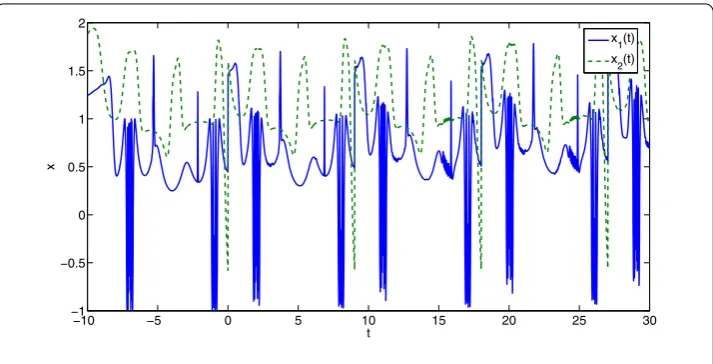
In this section, an example is given to illustrate the feasibility of our result. Let us consider the following simple neural network:
xi(t) = –ai
where the initial functions
Figure 1 Simulation result of the solution.
fj(xj) =gj(xj) =hj(xj) =
|x+ |–|x– |
, Gij(u) =e
–u.
Then we havea+i = ,a–i = ,bi–= ,c+ij=d+ij=p+ij=, Lfj =Lgj =Lhj = , wherei,j= , . Moreover,
δ=max
≤i≤
b–
ia–i
j=
Lfjc+ij+d+ij+p+ij a+j
= < .
Therefore, by Theorem ., we see that system () has a unique pseudo almost automor-phic solution. The corresponding simulation result of the solution is seen in Figure . Moreover, we verify the condition of Theorem .:
(H) : –bi+
j= c+jiLfi+
j= dji+Lgi
–τ∗ +
m
j= p+jiLh
i = –
< , i= , .
Therefore, the pseudo almost automorphic solutions of system () is exponential stable.
6 Conclusions
In this paper, we have studied the existence, uniqueness, and exponential stability of pseudo almost automorphic solutions of system (). By applying the Banach fixed point theorem and the Lyapunov functional method, some novel sufficient conditions are ob-tained to ensure the existence, uniqueness, and exponential stability of pseudo almost au-tomorphic solutions of system (). The results have an important role in the design and applications of CGNNs. Moreover, an example is given to demonstrate the effectiveness of the obtained results. In the future, we will study the other dynamic behaviors of system ().
Competing interests
The authors declare that they have no competing interests.
Authors’ contributions
Author details
1School of Information and Statistics, Guangxi University of Finance and Economics, Nanning, 530003, P.R. China.2School
of Mathematical Sciences and Institute of Finance and Statistics, Nanjing Normal University, Nanjing, Jiangsu 210023, China.3Department of Mathematics, University of Bielefeld, Bielefeld, 33615, Germany.4School of Information
Engineering, Nanjing Xiaozhuang University, Nanjing, Jiangsu 211171, China.
Acknowledgements
This work was jointly supported by the Alexander von Humboldt Foundation of Germany (Fellowship CHN/1163390), the National Natural Science Foundation of China (61374080, A010702), the Open scientific research project in Guangxi University of Finance and Economics(2015XK29), the Priority Academic Program Development of Jiangsu Higher Education Institutions, the Middle-aged and Young Teachers’ Basic Ability Promotion Project in Guangxi (ky2016yb401), and the Play of Nature Science Fundamental Research in Nanjing Xiao Zhuang University (2012NXY12).
Received: 28 October 2015 Accepted: 31 March 2016
References
1. Xiao, T-J, Liang, J, Zhang, J: Pseudo almost automorphic solutions to semilinear differential equations in Banach space. Semigroup Forum76(3), 518-524 (2008)
2. Abbas, S, Xia, Y: Existence and attractivity ofk-almost automorphic sequence solution of a model of cellular neural networks with delay. Acta Math. Sci.33(1), 290-302 (2013)
3. Chérif, F: Sufficient conditions for global stability and existence of almost automorphic solution of a class of RNNs. Differ. Equ. Dyn. Syst.22(2), 191-207 (2014)
4. Diagana, T: Almost Automorphic Type and Almost Periodic Type Functions in Abstract Spaces, pp. 167-188. Spring International Publishing, Switzerland (2013)
5. N’Guerekata, GM: Topics in Almost Automorphy. Springer, New York (2005)
6. Zhao, Z, Chang, Y, N’Guerekata, GM: Pseudo-almost automorphic mild solutions to semilinear integral equations in a Banach space. Nonlinear Anal., Theory Methods Appl.74(8), 2887-2894 (2011)
7. Abdurahman, A, Jiang, H: The existence and stability of the anti-periodic solution for delayed Cohen-Grossberg neural networks with impulsive effects. Neurocomputing149, 22-28 (2015)
8. Cheng, L, Zhang, A, Qiu, J, Chen, X, Yang, C, Chen, X: Existence and stability of periodic solution of high-order discrete-time Cohen-Grossberg neural networks with varying delays. Neurocomputing149, 1445-1450 (2015) 9. Bao, H: Dynamic analysis of stochastic fuzzy Cohen-Grossberg neural networks with time-varying delays. Adv. Differ.
Equ.2015, 196 (2015)
10. Xu, C, Wu, Y: Anti-periodic solutions for high-order cellular neural networks with mixed delays and impulses. Adv. Differ. Equ.2015, 161 (2015)
11. Liang, T, Yang, Y, Liu, Y, Li, L: Existence and global exponential stability of almost periodic solutions to
Cohen-Grossberg neural networks with distributed delays on time scales. Neurocomputing123, 207-215 (2014) 12. Yu, S, Zhang, Z, Quan, Z: New global exponential stability conditions for inertial Cohen-Grossberg neural networks
with time delays. Neurocomputing151, 1446-1454 (2015)