© 2015, IRJET.NET- All Rights Reserved
Page 1937
Increase in Strength of Concrete by Using Bottle Caps
G.C. Behera
1, R.K, Behera
21
Prof & Head, Civil Engineering Department, BIET, Bhadrak, Odisha, India,756113
2M.Tech Student, Civil Engineering Department, ITER, BBSR, Odisha, India
---***---headache to environmental engineers. On the other hand concrete, the most popular construction material, second highest consumed material after food is very strong in compression. It has some limited properties, low tensile strength, low ductility, low energy absorption, and shrinkage, cracking associated with hardening and curing. Out of all these drawbacks low tensile strength is the important one and to counteract this problem some fiber like material can be added to concrete to increase its tensile strength. Hence an attempt has been made in the present investigations to study the influence of addition of waste materials like soft drink bottle caps from workshop at a dosage of 0.25%, 0.5% and 1.0%, of total weight of concrete as fibres. In this investigation caps were cut into strips of size of 3mm width and 10mm length. Experimental investigation was carried out adding bottle caps in concrete and tests were carried out as per recommended procedures by relevant codes. The experimental values such as compressive strength, split tensile strength and flexural strength were found to be increased. The experimental results revealed that increase in compressive strength is not prominent up to 1.0 % addition bottle cap fiber. Split tensile and flexural strength of 1.0 % bottle cap fiber concrete increase upto 12.59% and 16.96 % more than plain
concrete(without bottle cap fiber) respectively. The experimental results of flexural strength and split tensile strength is compared with different codal
values. The results revealed that ACI-1985
approximately predicts the split tensile strength while Foster and ACI-1995 overestimates these values.
Key Words:
Bottle caps, Concrete mix, Compressive
strength, Split tensile strength, Flexural strength.
1. INTRODUCTION
Concrete has an extensive role to play in the construction and improvement of our civil engineering and infrastructure development. Its great strength, durability and veracity are the properties that are utilized in construction of Roads, Bridges, Airports, Railways, and Tunnels, Port, Harbours, and many other infrastructural project.
Concrete being a brittle material which has low tensile strength and low strain capacity, as a result, the mechanical behaviour of concrete is critically influenced by crack propagation. Concrete in service may exhibit failure through cracks which are developed due to brittleness. To improve properties of concrete like low tensile and low strain capacity fiber reinforced concrete (FRC) has been developed which is defined as concrete containing dispersed randomly oriented fibers[2]. Use of Fibers in concrete experimented in 1910 [3] and research on steel fiber addition in concrete started in early 1960s [4]. Use of admixtures to concrete has long been practised since 1900. In the early 1900s, asbestos fibres were used in concrete. There was a need to find replacement for the asbestos used in concrete. By the 1960s, steel, glass (GFRC) and synthetic fibres such as polypropylene fibres were used in concrete.
Concrete in general is weak in tensile strength and strong in compressive strength. The main object of this investigation is to improve the tensile strength of concrete. To overcome this serious defect partial incorporation of fibres is practised.
Glass Fiber Reinforced Concrete (GFRC):Glass fiber reinforced concrete has been successfully used since the last 25 years for concrete reinforcement, in addition to steel. GFRC is being manufactured into big panels with a simple configuration or into intricate shapes by using special techniques. Originally, GFRC components were anchored directly with the buildings by the use of metal studs. It was revealed that GFRC shifts considerably due to which the direct anchors are being replaced by slip anchors. Several structures use GFRC for dissimilar facing like ceramic tiles, bricks, and architectural purposes.
© 2015, IRJET.NET- All Rights Reserved
Page 1938
concrete by withstanding tensile cracking. The flexuralstrength of fiber reinforced concrete is greater than the un-reinforced concrete. Reinforcement of concrete by steel fibers is isotropic in nature that improves the resistance to fracture, disintegration, and fatigue. Steel fiber reinforced concrete is able to withstand light and heavy loads.
Natural fiber reinforced concrete (NFRC) : consists of cellulose fibers that are processed from pine trees. This category is also producing good results. The recycled carpet waste has been successfully used for concrete reinforcement by using the waste carpet fibers. Polypropylene Fiber Reinforced (PFR)
concrete: Polypropylene is a cheap and abundant polymer widely used due to its resistance to forming chemical reactions.
Asbestos Fibers: These fibers are cheap and provide the cement with mechanical, chemical and thermal resistance, although the asbestos fiber reinforced concrete appears to have low impact strength.
Carbon Fibers: These fibers have been recently used due to their very high modulus of elasticity and flexural strength. Characteristics such as strength and stiffness are better than those of steel fibers, although they are more susceptible to damage.
Inclusion of above mentioned fibers provide better tensile strength and crack arresting capacity to concrete, can be practised in developed countries and use of these fibers in concrete industry is rare in developing countries from the point of cost benefit ratio[5].Higher quantities of steel waste fibers are generated from industries related to lathes, empty beverage metal cans and soft drink bottle caps. This is an environmental issue as steel waste fibres are difficult to biodegrade and involves processes either to recycle or reuse. Now, much more importance is given for 3R’s (Reduce, Reuse and Recycle). Preservation of environment and conservation of rapidly diminishing natural resources should be the essence of sustainable development. Bottle caps are the substitute for fibers and added to enhance the mechanical properties of concrete. The resulting compressive strength, split tensile strength and flexural strength of the mixture depends on the type of cement, size and type of aggregate, period and type of curing adopted. To investigate the increase in mechanical strength of normal concrete by addition of different percentage of bottle cap fibers, an experiment was set up. Plain Concrete with target mean strength 33.75 N/mm2
was designed according [6] and cast base concrete. The main variables in this experimental investigation are Bottle cap fibers with 0.25%, 0.5% and 1.0% (total wt. of concrete ingredients) which added to above plain concrete enhancement of mechanical properties of concrete. The test results were analyzed and mechanical properties are found to be increasing with addition of bottle cap considered are the percentage of bottle cap fibers.
2.1 Material and Material Properties
a) Cement
Ordinary Portland cement of 53 grade conforming to [7] is used throughout the experimental program. The standard consistency is 28% where as the initial and final setting time is 95 min. and 210 min. respectively. The specific gravity of cement is 3.14 and its compressive strength after 28 days is found to be 57 MPa.
b) Coarse Aggregate:
Crushed hard granite stone of maximum size 20 mm is used for concrete. The bulk density of aggregates is 16.95 kN/m3 and specific gravity is found 2.65.
c) Fine Aggregate
Fine aggregate used for this entire investigation for concrete is river sand conforming to zone-II of [8]. The fineness modulus is 2.81. The specific gravity of sand is 2.65. The bulk density is found 16.05 kN/ m3.
d) Water
Potable water is used for casting as well as curing as per [9].
e) Bottle cap as Fiber:
Bottle caps were cut into 3mm width and 10 mm length and mixed uniformly in concrete. Fig- 1 shows bottle cap fibers ready for mixing in concrete.
Fig- 1: Bottle caps as fibers
2.2 Casting of Specimen
© 2015, IRJET.NET- All Rights Reserved
Page 1939
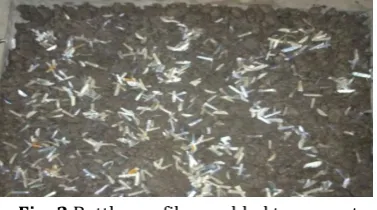
demoulded and put in a curing tank. Fig-2 shows thespreading of bottle cap fibers in the tray.
Fig- 2 Bottle cap fibers added to concrete
Specimens cast for investigation purpose are listed in Table 1.
Table-1: Compressive, Split tensile and Flexural strength of bottle cap fiber added concrete
% of Fiber
No. of Cubes cast
Number of cylinders cast)
No. of Prisms cast
0 3 3 3
0.25 3 3 3
0.50 3 3 3
1.00 3 3 3
2.3 Testing
After 28 days of curing, the specimens are removed from the curing tank and kept on the floor for some time so that the surface to become dry. Cubes and cylinders were tested in the compression testing machine for cube strength and split tensile strength respectively. Prisms were tested in flexural testing machine. The experimental results of specimens are presented in Table 2.
Table -2: Compressive, Split tensile and Flexural strength of bottle cap fiber added concrete
% of Fiber
Compressive Strength ( N/mm2)
Split tensile strength ( N/mm2)
Flexural strength ( N/mm2)
0 34.21 2.78 5.07
0.25 34.67 2.92 5.27
0.50 34.80 3.02 5.53
1.00 34.87 3.13 5.93
3.0 INTERPRETATION OF TEST RESULTS
The test results were tabulated in Table-6.2 and compared with values obtained from various codes. The test results such as compressive strength, split tensile strength and flexural strength with different proportion of coconut shell aggregate were discussed below.
3.1
Compressive Strength
Compressive strength is the measure parameter which influences other properties of concrete. Compressive strength of concrete specimen without fiber (Control Specimen) was found to be 34.21 MPa. The mix prepared with 0.25%, 0.5 % and 1.00% bottle cap fiber were found to be 34.67 MPa, 34.80 MPa and 34.87 MPA respectively. From the above test results, it is clear that when fibers are added, the compressive strength is found to be increasing. The same was observed by the earlier researchers [10].This may be due to the fact that the failure of plain concrete is caused by mortar (sand + cement) failure. The bond between mortars with fiber in fiber reinforced concrete is stronger than that of plain concrete. Compressive strength with 0%, 0.25%, 0.5 % and 1.0% fiber was plotted in Fig.3. The percentage increase in compressive strength of 0.25%, 0.5% and 1.0% fiber with respect to 0%
fiber was 1.34, 1.72 and 1.93
respectively which was presented in Fig.4.The
increase in strength was found to be very less and
the variation was linear. The earlier researchers
opined that there was increase of compressive
strength with increase of % of fiber and this increase
is not marginal up to 3.5%.The same was observed in
this investigation.
Fig. 6 Percentage increase in Split tensile strength of various percentage of fibers over plain concrete .
© 2015, IRJET.NET- All Rights Reserved
Page 1940
3.2
Split Tensile Strength
Split tensile strength of concrete specimen without bottle cap fiber addition was found to be 2.78 MPa. The mix prepared with 0.25% fiber was found to be 2.92 MPa and that with 0.50% and 1.0% was found to be 3.02 MPa and 3.13 MPa respectively. Test results of split tensile strength were plotted in Chart-3.
The percentage of increase of split tensile strength with 0.25 %, 0.5 % and 1.0 % over zero percentage fiber was presented in Chart-4.
The split tensile strength was found to be increasing with increase of percentage of bottle cap fiber. The percentages of increase of 0.25 %, 0.5 % and 1.0 % fiber over zero percentage fiber were found to be 5.04, 8.63 and 12.59 respectively.
The theoretical values of split tensile strength were calculated from ACI-1985, ACI-1995 and Foster. Test results along with theoretical values are plotted in Chart-5. The split tensile strength was found to be increasing with increase of percentage of bottle cap fiber. The predicted results ACI 1995 and Foster overestimate, while ACI 1985 underestimates. According to ACI-1985, the percentages of underestimation for 0%, 0.25 %, 0.5 % and 1.0 % are -2.14%, 2.04%, 5.09 % and 8.32 % respectively. Average underestimation by ACI-1985 is 3.33 %. For ACI-1995, the percentages of overestimation for 0%, 0.25 %, 0.5 % and 1.0 % are found to be 28.53 %, 23.28 %, 19.45 % and 15.38 % respectively. Average underestimation by ACI-1995 is 21.66 %. For Foster, the percentages of overestimation for 0%, 0.25 %, 0.5 % and 1.0 % are found to be 24.13 %, 18.97 %, 15.25 % and 11.31 % respectively. Average underestimation by Foster is 17.42 %. In this ACI-1985 approximately predicts the split tensile strength.
3.3
Flexural Strength
Flexural strength of concrete specimens with 0 % , 0.25 %, 0.5 % and 1.0 % were found to be 5.07 MPa, 4.85.27 MPa, 5.53 MPa and 5.93 MPa respectively and plotted in Chart-6.The percentage of increase in split tensile strength with 0.25%, 0.5 % and 1.0 % over zero percentage fiber were found to be 3.94 %, 9.07% and 16.96 % respectively and plotted in Chart-7. The flexural strength was found to be increasing with increase of percentage of fiber. The increase is found to be prominent with increase in percentages of bottle cap fibers.
Chart-2: Percentage increase in compressive strength of various percentages of fibers over plain concrete.
Chart-3: Variation of Split tensile strength with percentage of fiber.
Chart-4: Percentage increase in Split tensile strength of various percentages of fibers over plain concrete.
© 2015, IRJET.NET- All Rights Reserved
Page 1941
The theoretical values of flexural strength were calculatedfrom ACI-1985, ACI-1992, ACI-1995 and IS-456. Test results along with theoretical values are plotted in Chart-8.
The predicted results are found to be less than experimental values. The percentages of underestimation of predicted values for different percentages of fibers are tabulated in Table-3.
Table-3: Percentage of underestimation of codal values
Percentage of fiber
Percentages of underestimation by different Codes
ACI-1985
ACI-1992
ACI-1995 IS-456
0
21.19
3.01
36.03
19.25
0.25
23.50
6.06
38.04
21.79
0.50
26.91
10.31
40.84
25.33
1.0031.75
16.28
44.78
30.29
Average25.84
8.91
39.92
24.16
The predicted results by different codes are found to be almost same for different percentages of fibers. This is due to the fact that flexural strength varies with compressive strength. Here the increase in compressive strength for different percentage of fibers is found to be very marginal. The presence of fibers has increased the flexural strength much more than the compressive strength. Addition of 1.0 % of bottle cap fiber, increases compressive strength 1.93% more than plain concrete while its flexural strength increases 16.96 % more than plain concrete. Flexural strength increases linearly with increase of percentages of bottle cap fiber. The equation to predict the flexural strength is shown in Chart-8 taking percentage of fiber as variable.
3. CONCLUSIONS
From the test results and codal provisions, the following conclusions were drawn
1 Compressive strength increases with increase in percentage of bottle cap fibers. The increase is not prominent up to 1.0 % as the increase is only 1.93 % for addition of 1.0 % fiber.
2 Split tensile strength increases with increase in percentage of fiber. The enhancement for 1.0 % fiber concrete is 12.59 % over plain concrete. 3 Flexural strength increase is more prominent with
increase in percentage of bottle cap fiber. Flexural strength of 1.0 % bottle cap fiber enhanced by 16.96 % over plain concrete. The increase is not prominent up to 0.25%.
4 Experimental result interprets that addition of fiber increases compressive strength to a limited capacity, while the increase is prominent in split tensile and flexural strength.
Chart-6: Variation of Flexural strength with percentage of fiber
Chart-7: Percentage increase in Flexural strength of various percentages of fibers over plain concrete.
© 2015, IRJET.NET- All Rights Reserved
Page 1942
ACKNOWLEDGEMENT
The authors are grateful to the Principal, Bhadrak Institute of Engineering and Technology, Barapada, Bhadrak, Odisha India for encouragement and granting permission for this project and also to publish this project. The authors would also like to thank to management to give financial support for this work. Authors acknowledge the support received from the department and well wishers. The authors are also grateful to the management of ITER, BBSR for their support.
REFERENCES
[1] Z. Jhang and H. Stang, “Application of stress crack width relationship in predicting the flexural behaviour of fiber reinforced concrete,”Cement and Concrete Research,Vol.28(3), pp.439-452, 1998. [2] C.D. Johnson, “ Steel fiber reinforced mortar and
concrete – A review of mechanical properties,” Fiber reinforced Concrete, SP-44, American Concrete, Detroit, pp. 127-142, 1974.
[3] A.E. Naman,“ Fiber reinforcement for concrete,” Concrete International Design and Construction,” Vol-7(3), pp.21-25,1985.
[4] J.P. Romualdi, and G.B. Baston, “.Mechanics of crack arrest in concrete. Journal of Engineering Mechanics Div., ASCE,Vol.89, No. EM3, pp.147-168, June, 1963. [5] G.C. Behera, T.D.G.Rao, and C.B.K.Rao, “.Torsional
Capacity of High Strength Concrete Beams jacketed with ferrocement U wraps" Asian Journal of Civil Engineering, Vol.9,Number 4, pp.411-422, August, 2008. .
[6] M.S.Setty, “Concrete Technology,” S.Chand and Company Ltd, Third Edition, pp 608, 1982.
[7] IS: 12269-1987 ”Specification for 53 Grade ordinary Portland cement”. of Indian Standard, Manak Bhavan, Bahadurshah Zafar Marg, New Delhi,1987.
[8] IS 383-1970: “Specifications for Coarse and Fine Aggregates from Natural Sources for Concrete” (Second Revision), Bureau of Indian Standard, Manak Bhavan, Bahadurshah Zafar Marg, New Delhi,1970. [9] IS 456-2000, “Code of Practice for Plain and
Reinforced Concrete Structures”, Bureau of Indian Standard, Manak Bhavan, Bahadurshah Zafar Marg, New Delhi, 2000.
[10]G.Rajan, R. Saravanakumar, N. Raghaban, G. Murali, and B. Mohan, “Influence of bottle caps as a fiber in concrete structures,” International Journal of Advanced Scientific research and Technology, vol. 3, no. 2, pp. 531-533, June, 2012.