R E S E A R C H
Open Access
Uniform ultimate boundedness of
solutions of predator-prey system with
Michaelis-Menten functional response on
time scales
Yang-Yang Yu, Lin-Lin Wang
*and Yong-Hong Fan
*Correspondence:
[email protected] School of Mathematics and Statistics Science, Ludong University, Yantai, 264025, P.R. China
Abstract
In this paper, a predator-prey system with Michaelis-Menten functional response on time scales is investigated. First of all, we generalize the semi-cycle concept to time scales. Second, we obtain the uniformly ultimate boundedness of solutions of this system. Our results demonstrate that when the death rate of the predator is rather small without prey, whereas the intrinsic growth rate of the prey is relatively large, the species could coexist in the long run. In particular, ifT=RorT=Z, some
well-known results have been generalized. In addition, for the continuous case, we provide a new idea to prove its permanence. Finally, a numerical simulation is given to support our main results.
MSC: 34N05; 37N25
Keywords:
ω
-periodic solutions; uniform ultimate boundedness; semi-cycle; time scales; predator-prey system1 Introduction
The permanence is based on a global criterion for the coexistence of species, which de-scribes a numerical technique for assembly of ecological communities of Lotka-Volterra form []. During the last few years, the permanence of ecological models has been dis-cussed by many authors [–]. In [, , , ], the comparison method was used, and some sufficient conditions of permanence of biological systems were established. In [], by using the semi-cycle and related concepts, they discussed the permanence of a discrete biological system.
To the best of our knowledge, the permanence of biological system on time scales was first discussed by Zhang and Zhang []. Using the theory of differential inequality, they obtained the permanence of a cooperation system with feedback controls on time scales. But for the system itself, we could verify that some additional conditions in [] may not be necessary. For further study, in [], Li and Wang obtained a permanence result for a multispecies Lotka-Volterra mutualism system by establishing some dynamic inequalities on time scales.
In the following we shall use the notation
l=min[,∞)∩T, Iω= [l,l+ω]∩T,
fM=sup
t∈Tf(t), f
m=inf
t∈Tf(t), f =
ω
Iω
f(s)s,
wherefis a periodic rd-continuous function with periodωinT. We assume thats+ω∈T for anys∈T.
Remark . For anyt>l,t∈T, we havet–ρ(t)≤ω.
Proof For anyt>l,ρ(t)∈T, thenρ(t) +ω∈T, ift–ρ(t) >ω, thenρ(t) +ω<t, this implies ω= , we arrive at a contradiction. Thust–ρ(t)≤ωholds.
As is well known, predator-prey systems play an important role in ecosystems [–, – , –]. We find that there are few papers discussing the permanence of these systems on time scales.
In this paper, we are concerned with the following predator-prey system with Michaelis-Menten functional response:
x
(t) =a(t) –b(t)exp{x(t)}–β(t)exp{cx(t)(texp)}+γ{x(t()texp)} {x(t)},
x
(t) = –d(t) +
f(t)exp{x(t)} β(t)exp{x(t)}+γ(t)exp{x(t)},
t∈Tk, ()
with the initial condition
x(t),x(t)∈R, t∈T,
on time scalesT, wherea,b,c,d,f,β,γ ∈Crd(T,R) are positiveω-periodic functions. The
stands for the delta derivative.
Letx(t) =exp{x(t)},y(t) =exp{x(t)},β(t) = , ifT=R, then () reduces to the continu-ous predator-prey system
x(t) =x(t)[a(t) –b(t)x(t) –x(t)+γc(t)y((tt))y(t)],
y(t) =y(t)[–d(t) +x(tf)+γ((t)xt(t))y(t)], t∈R. ()
In [], Fanet al.studied some basic problems of system (), such as positive invariance, permanence, non-persistence, extinction, dissipativity, and globally asymptotic stability. The methods they used were comparison theorems, coincidence degree theory, and the Lyapunov functional. Much attention has been paid to this predator-prey system or its analogs in [–, –]. In [], Fan and Li considered the permanence of the general de-layed ratio-dependent predator-prey model
x(t) =x(t)[a(t) –b(t)x(t)] –c(t)g(xy((tt)))y(t),
y(t) =y(t)[–d(t) +e(t)g(yx((tt–τ–τ)))], t∈R, ()
Theorem . Assume
(C) a>mc; (C) ke>d
hold,here m=supz∈[,+∞){g(z)/z}.Then system()is permanent.
LetN(k) =exp{x(k)},N(k) =exp{x(k)},β(k) = , ifT=Z, then () is reformulated as
N(k+ ) =N(k)exp{a(k) –b(k)N(k) –N(kc()+γ(k)Nk()kN)(k)},
N(k+ ) =N(k)exp{–d(k) + f(k)N(k) N(k)+γ(k)N(k)},
k∈Z, ()
this predator-prey system or its other forms has attracted the attention of many authors [–]. Fan and Li [] considered the permanence of a delayed discrete predator-prey model with Holling-type III functional response
⎧ ⎨ ⎩
N(k+ ) =N(k)exp{b(k) –a(k)N(k– [τ]) –Nα(k)N(k)N(k) (k)+m(k)N(k)}
,
N(k+ ) =N(k)exp{–b(k) + α(k)N (k–[τ])
N
(k–[τ])+m(k)N(k–[τ])},
k∈Z, ()
the comparison theorem, and the theory of population equation. They obtained the fol-lowing.
Theorem . Assume
(B) mb>α;
(B) α>b;
(B) (b(k))M<
hold.Then system()is permanent.
In fact, (B) is not necessary. In [], by using the semi-cycle and related concepts, Fan and Li considered permanence of the system (), and obtained the following.
Theorem . Assume
(H) a>c/γ; (H) f >d
hold.Then system()is permanent.
In recent years, the existence of periodic solutions of predator-prey systems on time scales has been obtained by coincidence degree theory in many articles [–], since the existence result could be obtained by coincidence degree theory both in the continuous case and the discrete case. Fazly and Hesaaraki [] obtained the existence of periodic so-lutions of nonautonomous predator-prey dynamical system with Beddington-DeAngelis functional response by coincidence degree theory. Tonget al.[] investigated the exis-tence of periodic solutions of a predator-prey system with sparse effect and Beddington-DeAngelis or a Holling III functional response. By using a continuation theorem based on coincidence degree theory, they obtained sufficient criteria for the existence of periodic solutions for the system.
Also, in order to delete the additional condition (B) and the additional conditions of The-orem . in [], we need to extend the semi-cycle concept of the discrete case to that of time scales.
Noticing that system () and () is derived from () by exponential transformations,
x(t) =exp{x(t)},y(t) =exp{x(t)}, andN(k) =exp{x(k)},N(k) =exp{x(k)}, respectively, whenT=RandT=Z. Obviously, when solutions of system () are uniformly ultimate bounded, systems () and () are both permanent, and the contrary also holds true. Thus, our aim is to prove the uniform ultimate boundedness of solutions of system () by using the semi-cycle concept on time scales instead of comparison theorems. Our result is an unification and extension of a continuous and discrete analysis.
The rest of the paper is organized as follows. In Section , we state some basic prop-erties about time scales, and generalize the semi-cycle concept to time scales. Section is devoted to the uniform ultimate boundedness of solutions of system (). A discussion is presented in Section . The final section of the paper contains a numerical example supporting the result.
2 Preliminary
First we will give some definitions about time scales before presenting our main result (see [, ]).
Definition . A time scale is an arbitrary nonempty closed subsetTof the real num-berR.
Definition . Fort∈Twe define the forward jump operatorσ :T→T, and the back-ward jump operatorρ:T→T, by
σ(t) :=inf{s∈T:s>t}, ρ(t) :=sup{s∈T:s<t},
respectively.
Throughout this paper we often assumea≤b,a,b∈T, and define the interval [a,b] in
Tby
[a,b] :={t∈T:a≤t≤b}.
Definition . Assumef :T→Ris a function and lett∈Tk, where throughout the paper
Tk=
T\(ρ(supT),supT], if supT<∞,
T, if supT=∞.
Then we definef(t) to be the number (provided it exists) with the property that, given
anyε> , there exists a neighborhoodUoftsuch that
fσ(t)–f(s)–f(t)σ(t) –s ≤ε σ(t) –s for alls∈U.
The following lemmas will be useful to prove our main result. Their proofs are similar to [], we omit them here.
Lemma . The equation
x(t) =a(t) –b(t)exp{x(t)}, x() =x> ,
has at least one periodic solution x(t)if a(t),b(t)are bothω-periodic rd-continuous func-tions and a> ,b(t) > ;moreover,the inequalities
x(t)≤ln(a/b) +aω, x(t)≥ln(a/b) –aω
hold.
Lemma . Assume that d, f, β,γ are all positiveω-periodic rd-continuous functions,
then,for any positive constant M,the equation
x(t) = –d(t) + f(t)M β(t)M+γ(t)exp{x(t)},
x() =x> ,
has at least one periodic solution x(t)provided with d<f/β;moreover,the inequalities
x(t)≤ln(f/βM/d–M)/γ(t)/β(t)m+dω,
x(t)≥ln(f/βM/d–M)/γ(t)/β(t)M–dω
hold.
Similar to the definition of semi-cycle in discrete case (see []), we give the definition of a semi-cycle on time scales.
Definition . A positive semi-cycle of a rd-continuous functionf :T→Rconsists of a ‘string’ of terms{f(t),t∈[s,t],s,t∈T}, all greater than or equal to . A negative semi-cycle of a rd-continuous functionf :T→Rconsists of a ‘string’ of terms{f(t),t∈[p,q],p,q∈ T}, all less than or equal to .
3 The uniform ultimate boundedness
Before giving our main result, we list the definition of uniform ultimate boundedness.
Definition . Solutions of () are said to be uniformly ultimate bounded if there exist two constantsλandλsuch that, for any initial condition (x(),x())T∈R,
λ≤ lim
t→∞infxi(t)≤tlim→∞supxi(t)≤λ, i= , .
Here we say ‘uniformly’, becauseλandλare independent on (x(),x())T.
Theorem . Assume
(A) a>c/γ; (A) d<f/β
hold.Then the solutions of system()are uniformly ultimate bounded.
Proof We will proveλ≤lim inft→∞xi(t)≤lim supt→∞xi(t)≤λ,λandλare constants, i= , . Thus, we divide the proof into four parts.
Part.lim supt→∞x(t)≤K, that is to say,x(t) is uniformly ultimate bounded above. From (), whentis sufficiently large, we know
x(t)≤a(t) –b(t)expx(t), () and construct the following auxiliary equation:
y(t) =a(t) –b(t)expy(t). () Note thata(t),b(t) are positiveω-periodic functions, we can seea> . By Lemma ., () has at least oneω-periodic solution, denote it asy∗(t), we have
y∗(t)≤ln(a/b) +aω, y∗(t)≥ln(a/b) –aω. ()
From () and (), we have
x(t) –y∗(t)≤–b(t)expx(t)––b(t)expy∗(t) = –b(t)expx(t)–expy∗(t) = –b(t)expy∗(t)expx(t) –y∗(t)
– , letu(t) =x(t) –y∗(t), then
u(t)
≤–b(t)expy∗(t)expu(t)
– . ()
Now, the proof has two cases according to the oscillating property ofu(t). First we assume thatu(t) does not oscillate about zero, thenu(t) will be either eventually positive or eventually negative. If the latter holds, then
x(t) <y∗(t)≤ln(a/b) +aω. ()
If the former holds, then (u(t))< , which means thatu(t) is eventually decreasing, also
in terms of its positivity, we know thatlimt→∞u(t) exists. Then () yieldslimt→∞u(t) = ,
which leads to
lim
t→∞supx(t)≤ln(a/b) +aω. ()
Now we assume u(t) oscillates about zero, by (), we know that u(t)≥ implies (u(t))≤. Thus, by the semi-cycle concept, we letu(t)≥, fort∈[sα,tα],sα,tα∈T,
(a) For anyα,β∈L, ifα=β,[sα,tα]∩[sβ,tβ] =∅. (b) Ifsαis left-scattered, thenu(ρ(sα)) < .
(c) Ifsαis left-dense, then there exists a hollow left neighborhoodU–˚ (sα)ofsαsuch thatu(t) < , fort∈U–˚ (sα).
(d) Iftαis right-scattered, thenu(σ(tα)) < .
(e) Iftαis right-dense, then there exists a hollow right neighborhoodU+˚ (tα)oftαsuch thatu(t) < , fort∈U+˚ (tα).
Notice thatlim supt→∞u(t) =lim supα→∞u(sα). Ifsαis left-scattered, by integrating () over the set [ρ(sα),sα], we have
u(sα) –uρ(sα)≤
sα
ρ(sα)
–b(t)expy∗(t)expu(t)– t,
by (b), it follows that
u(sα)≤
sα
ρ(sα)
b(t)expy∗(t)t<∞, ()
if and only if
sα–ρ(sα)≤ω, ()
it is easy to see () holds from Remark ..
Ifsα is left-dense, we chooset∈U–˚ (sα), such thatsα–t≤ω. By integrating () over the set [t,sα], we have
u(sα) –u(t) =
sα
t
–b(t)expy∗(t)expu(t)– t,
notice thatu(t) < , it follows that
u(sα)≤
sα
t
b(t)expy∗(t)t<∞. ()
Then from () and (),u(t) =x(t) –x∗(t) is uniformly ultimate bounded above, thus
lim
t→∞supx(t)≤ln(a/b) +aω+aωexp(aω) :=K. ()
Therefore from (), (), and (),x(t) is uniformly ultimate bounded above.
Part.k≤lim inft→∞x(t), that is to say,x(t) is uniformly ultimate bounded below. Also from (), whentis sufficiently large, we know
x(t)≥a(t) –c(t)/γ(t) –b(t)expx(t), ()
and construct the following auxiliary equation:
From (A) and Lemma ., () has at least oneω-periodic solution, denote it asz∗(t), we have
z∗(t)≤ln(a–c/γ)/b+aω, z∗(t)≥ln(a–c/γ)/b–aω. () From () and (), we have
x(t) –z∗(t)≥–b(t)expx(t)––b(t)expz∗(t) = –b(t)expx(t)
–expz∗(t) = –b(t)expz∗(t)expx(t) –z∗(t)
– , letu(t) =x(t) –z∗(t), then
u(t)≥–b(t)expz∗(t)expu(t)– , () from () and (), we know whentis sufficiently large,
u(t)≤lna/(a–c/γ)+ aω+aωexp(aω) :=M. () Now, the proof has two cases according to the oscillating property of u(t). First we assume thatu(t) does not oscillate about zero, thenu(t) will be either eventually positive or eventually negative. If the former holds, then
x(t) >z∗(t)≥ln(a–c/γ)/b–aω. () If the latter holds, then (u(t))> , which means thatu(t) is eventually increasing, also in
terms of its negativity, we know thatlimt→∞u(t) exists. Then () yieldslimt→∞u(t) = ,
which leads to
lim
t→∞infx(t)≥ln
(a–c/γ)/b–aω. ()
Now we assume u(t) oscillates about zero, by (), we know thatu(t)≤ implies (u(t))≥. Thus, by the semi-cycle concept, we letu(t)≤, fort∈[pα,qα],pα,qα∈T,
α∈L, whereLis an index set, and the interval [pα,qα] satisfies: (a) For anyα,β∈L, ifα=β,[pα,qα]∩[pα,qα] =∅.
(b) Ifpαis left-scattered, thenu(ρ(pα)) > .
(c) Ifpαis left-dense, then there exists a hollow left neighborhoodU˚–(pα)ofpαsuch
thatu(t) > , fort∈U–˚ (pα).
(d) Ifqαis right-scattered, thenu(σ(qα)) > .
(e) Ifqαis right-dense, then there exists a hollow right neighborhoodU+˚ (qα)ofqα
such thatu(t) > , fort∈U+˚ (qα).
Notice that lim inft→∞u(t) =lim infα→∞u(pα). Ifpα is left-scattered, by integrating
() over the set [ρ(pα),pα], we have
u(pα) –uρ(pα)≥
pα
ρ(pα)
by (b), from (), it follows that
u(pα)≥
pα
ρ(pα)
–b(t)exp{M}exp
z∗(t)t,
from Remark ., we can see
pα–ρ(pα)≤ω,
thenu(tn) is lower bounded.
Ifpα is left-dense, we chooset∈U–˚ (pα), such thatpα–t≤ω. Notice thatu(t) > , by integrating () over the set [t,pα], we have
u(pα) –u(t)≥
pα
t
–b(t)expz∗(t)expu(t)– t,
from (), we have
u(pα)≥
pα
t
–b(t)exp{M}expz∗(t)t,
in this case,u(pα) is also lower bounded.
Thenu(t) =x(t) –z∗(t) is uniformly ultimate bounded below, hence
lim
t→∞infx(t)≥ln
(a–c/γ)/b–aω– (a–c/γ)ωexp(aω+M) :=k. ()
Thus from (), (), and (),x(t) is uniformly ultimate bounded below. Then Part holds.
Therefore, from Part and Part ,x(t) is uniformly ultimate bounded, we can assume
m≤exp{x(t)} ≤Mfor anyt∈[T,∞)∩T, whereTis sufficiently large.
Part.k≤lim inft→∞x(t), that is to say,x(t) is uniformly ultimate bounded below. From (), whentis sufficiently large, we know
x(t)≥–d(t) + f(t)m
β(t)m+γ(t)exp{x(t)}, ()
and we construct the following auxiliary equation:
z(t) = –d(t) + f(t)m
β(t)m+γ(t)exp{z(t)}, ()
from Lemma . and (A), we find that () has at least oneω-periodic solution, denote it asz∗(t), we have
z∗(t)≤ln(f/βm/d–m)/γ(t)/β(t)m+dω,
From () and (), we have
Now, the proof has two cases according to the oscillating property of v(t). First we
assume thatv(t) does not oscillate about zero, similar tou(t) in Part , we obtain left-scattered, integrating inequality () fromρ(pα) topα, we have
Thenv(t) =x(t) –z∗(t) is uniformly ultimate bounded below, hence
lim
t→∞infx(t)≥ln
(f/βm/d–m)/γ(t)/β(t)M–dω
–mf/γ ωγ(t)/β(t)Mexp(dω)/(f/βm/d–m) :=k. () Thus from () and (),x(t) is uniformly ultimate bounded below.
Part.lim supt→∞x(t)≤K, that is to say,x(t) is uniformly ultimate bounded above. Also from (), whentis sufficiently large, we know
x(t)≤–d(t) + f(t)M
β(t)M+γ(t)exp{x(t)}
, ()
and we construct the following auxiliary equation:
y(t) = –d(t) + f(t)M
β(t)M+γ(t)exp{y(t)}, ()
from Lemma . and (A), we find that () has at least anω-periodic solution, denote it asy∗(t), we have
y∗(t)≤ln(f/βM/d–M)/γ(t)/β(t)m+dω,
y∗(t)≥ln(f/βM/d–M)/γ(t)/β(t)M–dω.
()
From () and (), we have
x(t) –y∗(t)≤ f(t)M
β(t)M+γ(t)exp{x(t)}
– f(t)M
β(t)M+γ(t)exp{y∗(t)}
= f(t)Mγ(t)(exp{y ∗
(t)}–exp{x(t)})
(β(t)M+γ(t)exp{x(t)})(β(t)M+γ(t)exp{y∗(t)})
= f(t)Mγ(t)exp{x(t)}(exp{y ∗
(t) –x(t)}– )
(β(t)M+γ(t)exp{x(t)})(β(t)M+γ(t)exp{y∗(t)})
.
Similarly, letv(t) =x(t) –y∗(t), then
v(t)≤ f(t)Mγ(t)exp{x(t)}(exp{–v(t)}– )
(β(t)M+γ(t)exp{x(t)})(β(t)M+γ(t)exp{y∗(t)}), ()
from () and (), we know, whentis sufficiently large,
v(t)≥ln
f/βm/d–m
(γ(t)/β(t))M–m(f/βM/d–M)
– dω
–mf/γ ωγ(t)/β(t)Mexp(dω)/(f/βm/d–m) :=m. () Now, the proof has two cases according to the oscillating property ofv(t). First we as-sume thatv(t) does not oscillate about zero, similar tou(t) in Part , we obtain
lim
t→∞supx(t)≤ln
Now we assume v(t) oscillates about zero, by (), we know that v(t)≥ implies (v(t))≤. Thus, by the semi-cycle concept, we letv(t)≥, fort∈[sα,tα],sα,tα∈T,
α∈L, whereLis an index set, the interval [sα,tα] satisfies (a)-(e) by replacingu(t) in Part withv(t).
Notice thatlim supt→∞v(t) =lim supα→∞v(sα). By a similar analysis to Part , ifsαis left-scattered, integrating inequality () fromρ(sα) tosα, we have
v(sα) –vρ(sα)≤
sα
ρ(sα)
f(t)Mγ(t)exp{x(t)}(exp{–v(t)}– )
(β(t)M+γ(t)exp{x(t)})(β(t)M+γ(t)exp{y∗(t)})t,
by (b), from (), it follows that
v(sα)≤
sα
ρ(sα)
f(t)Mγ(t)exp{x(t)}exp{–m}
(β(t)M+γ(t)exp{x(t)})(β(t)M+γ(t)exp{y∗(t)})t
≤
sα
ρ(sα)
f(t)Mexp{–m}
γ(t)exp{y∗(t)} t<∞. ()
Ifsαis left-dense, we chooset∈U–˚ (sα), such thatsα–t≤ω. By integrating () over the set [t,sα], we have
v(sα) –v(t) =
sα
t
f(t)Mγ(t)exp{x(t)}(exp{–v(t)}– )
(β(t)M+γ(t)exp{x(t)})(β(t)M+γ(t)exp{y∗(t)})t,
notice thatv(t) < , hence
v(sα)≤
sα
t
f(t)Mγ(t)exp{x(t)}exp{–m}
(β(t)M+γ(t)exp{x(t)})(β(t)M+γ(t)exp{y∗(t)})t
≤
sα
t
f(t)Mexp{–m}
γ(t)exp{y∗(t)} t<∞. ()
Then from () and (),v(t) =x(t) –y∗(t) is uniformly ultimate bounded above, thus
lim
t→∞supx(t)≤ln
(f/βM/d–M)/γ(t)/β(t)m+dω
+Mf/γ ωγ(t)/β(t)Mexp(dω–m)/(f/βM/d–M) :=K. ()
Thus from () and (),x(t) is uniformly ultimate bounded above. Therefore, from Part and Part ,x(t) is uniformly ultimate bounded.
Finally, we chooseλ=min{k,k},λ=max{K,K}. This completes the proof of
Theo-rem ..
4 Discussion
From the proof of Theorem ., we can easily see that our methods can also be used to study the following generalized predator-prey system with functional response:
x
(t) =a(t) –b(t)exp{x(t)}–c(t)h(exp{x(t) –x(t)}), x(t) = –d(t) +e(t)g(exp{x(t) –x(t)}),
()
hereh(u) =g(u)/u, whereg(u) is monotonic increasing and there exists a constantksuch thatlimu→+∞g(u) =k. The coefficient functions are all bounded.
As is well known, the permanence of the periodic biological system is closely associated with the existence for the periodic solutions of the system, in general, when the periodic system is permanent, then there must exist at least one positive periodic solution. By a similar analysis to that in Fan and Wang [], we can obtain the following remark.
Remark . Assume (A), (A) hold, then system () has at least oneω-periodic solution.
This shows that the conditions for uniform ultimate boundedness of solutions are the same as that for the existence of periodic solutions of the system.
5 Numerical example
In this section, we give a numerical example to support our main result. Assume that
a(t) = . + .sin(πt),b(t) = . + .sin(πt),c(t) = . + .cos(πt),d(t) = . + .sin(πt),f(t) = . + .cos(πt),γ(t) = . + .cos(πt),β(t) = . + .cos(πt), andT=∞k=[k, k+ ]. In this case, we can see
⎧ ⎪ ⎪ ⎨ ⎪ ⎪ ⎩
x(k) =x(k– ) +a(k– ) –b(k– )exp{x(k– )}
– c(k–)exp{x(k–)}
β(k–)exp{x(k–)}+γ(k–)exp{x(k–)},
x(k) =x(k– ) –d(k– ) + f(k–)
exp{x(k–)}
β(k–)exp{x(k–)}+γ(k–)exp{x(k–)},
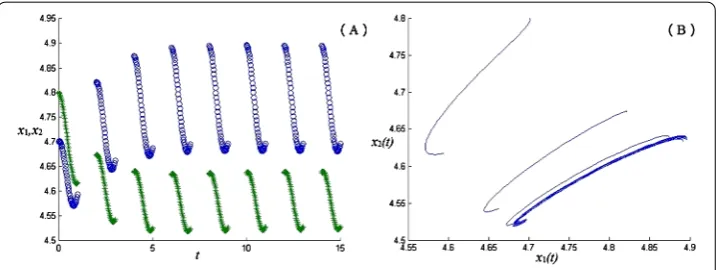
herek= , , , . . . . In applying a numerical analysis using Matlab, we assume thatx() = .,x() = ., and then obtain Figure . It is easy to seex(t),x(t) are uniformly ultimate
bounded. We also obtain the relationship betweenx(t) andx(t) (see (B) of Figure ). Our numerical simulation supports our theoretical findings (see the figures). We conclude that it is valid for any initial condition (x(),x())T∈R.
Competing interests
The authors declare that they have no competing interests.
Authors’ contributions
All authors contributed equally to this work. All authors read and approved the final manuscript.
Acknowledgements
This work is supported by NSF of China (11201213, 11371183), NSF of Shandong Province (ZR2015AM026, ZR2013AM004) and the Project of Shandong Provincial Higher Educational Science and Technology (J15LI07).
Received: 28 June 2016 Accepted: 18 November 2016
References
1. Law, R, Morton, RD: Permanence and the assembly of ecological communities. Ecology77, 762-775 (1996) 2. Cui, JA, Takeuchi, Y: Permanence, extinction and periodic solution of predator-prey system with
Beddington-DeAngelis functional response. J. Math. Anal. Appl.317, 464-474 (2006)
3. Chen, FD, You, MS: Permanence, extinction and periodic solution of the predator-prey system with
Beddington-DeAngelis functional response and stage structure for prey. Nonlinear Anal., Real World Appl.9, 207-221 (2008)
4. Fan, YH, Li, WT: Permanence in delayed ratio-dependent predator-prey models with monotonic functional responses. Nonlinear Anal., Real World Appl.8, 424-434 (2007)
5. Fan, YH, Li, WT: Permanence for a delayed discrete ratio-dependent predator-prey system with Holling type functional response. J. Math. Anal. Appl.299, 357-374 (2004)
6. Fan, YH, Li, WT: Harmless delays in a discrete ratio-dependent periodic predator-prey system. Discrete Dyn. Nat. Soc. 2006, Article ID 12176 (2006)
7. Huo, HF, Li, WT: Permanence and global stability of positive solutions of a nonautonomous discrete ratio-dependent predator-prey model. Discrete Dyn. Nat. Soc.2005, 135-144 (2005)
8. Zhang, HT, Zhang, F: Permanence of anN-species cooperation system with time delays and feedback controls on time scales. J. Appl. Math. Comput.46, 17-31 (2014)
9. Xu, CJ, Wu, YS, Lu, L: Permanence and global attractivity in a discrete Lotka-Volterra predator-prey model with delays. Adv. Differ. Equ.2014, 208 (2014)
10. Zhang, XL, Huang, YH, Weng, PX: Permanence and stability of a diffusive predator-prey model with disease in the prey. Comput. Math. Appl.68, 1431-1445 (2014)
11. Muhammadhaji, A, Teng, ZD: Permanence and extinction analysis for a periodic competing predator-prey system with stage structure. Int. J. Dyn. Control (2015). doi:10.1007/s40435-015-0211-0
12. Yang, LY, Xie, XD, Chen, FD, Xue, YL: Permanence of the periodic predator-prey-mutualist system. Adv. Differ. Equ. 2015, 331 (2015)
13. Lu, HY, Yu, G: Permanence of a Gilpin-Ayala predator-prey system with time-dependent delay. Adv. Differ. Equ.2015, 109 (2015)
14. Ouyang, MQ, Li, XY: Permanence and asymptotical behavior of stochastic prey-predator system with Markovian switching. Appl. Math. Comput.266, 539-559 (2015)
15. Li, YK, Wang, P: Permanence and almost periodic solution of a multispecies Lotka-Volterra mutualism system with time varying delays on time scales. Adv. Differ. Equ.2015, 230 (2015)
16. Fan, M, Wang, Q, Zou, XF: Dynamics of a non-autonomous ratio-dependent predator-prey system. Proc. R. Soc. Edinb. 133, 97-118 (2003)
17. Fan, YH, Wang, LL: Multiplicity of periodic solutions for a delayed ratio-dependent predator-prey model with monotonic functional response and harvesting terms. Appl. Math. Comput.224, 878-894 (2014)
18. Chen, W, Wang, M: Qualitative analysis of predator-prey models with Beddington-DeAngelis functional response and diffusion. Math. Comput. Model.42, 31-44 (2005)
19. Bohner, M, Fan, M, Zhang, J: Existence of periodic solutions in predator-prey and competition dynamic systems. Nonlinear Anal., Real World Appl.7, 1193-1204 (2006)
20. Luo, ZG, Dai, BX, Zhang, QH: Existence of positive periodic solutions for an impulsive semi-ratio-dependent predator-prey model with dispersion and time delays. Appl. Math. Comput.215, 3390-3398 (2010) 21. Zeng, XZ, Zhang, JC, Gu, YG: Uniqueness and stability of positive steady state solutions for a ratio-dependent
predator-prey system with a crowding term in the prey equation. Nonlinear Anal., Real World Appl.24, 163-174 (2015)
22. Fazly, M, Hesaaraki, M: Periodic solutions for predator-prey system with Beddington-DeAngelis functional response on time scales. Nonlinear Anal., Real World Appl.9, 1224-1235 (2008)
23. Tong, Y, Liu, ZJ, Gao, ZY, Wang, YH: Existence of periodic solutions for a predator-prey system with sparse effect and functional response on time scales. Commun. Nonlinear Sci. Numer. Simul.17, 3360-3366 (2012)
24. Zeng, ZJ: Periodic solutions for a delayed predator-prey system with stage-structured predator on time scales. Comput. Math. Appl.61, 3298-3311 (2011)
25. Liu, J, Li, YK, Zhao, LL: On a periodic predator-prey system with time delays on time scales. Commun. Nonlinear Sci. Numer. Simul.14, 3432-3438 (2009)
26. Zhang, WP, Bi, P, Zhu, DM: Periodicity in a ratio-dependent predator-prey system with stage-structured predator on time scales. Nonlinear Anal., Real World Appl.9, 344-353 (2008)
27. Fan, M, Wang, K: Periodic solutions of a discrete time nonautonomous ratio-dependent predator-prey system. Math. Comput. Model.35, 951-961 (2002)
28. Hilger, S: Ein Masskettenkalkül mit Anwendung auf Zentrumsmannig faltigkeiten. PhD thesis, Universität of Würzburg, Würzburg (1988)
29. Bohner, M, Peterson, A: Dynamic Equations on Time Scales: An Introduction with Applications. Birkhäuser, Boston (2001)