R E S E A R C H
Open Access
Orthogonal signals with jointly balanced spectra:
Application to cdma transmissions
Thierry Chonavel
Abstract
This paper presents a technique for generating orthogonal bases of signals with jointly optimized spectra, in the sense that they are made as close as possible. To this end, we propose a new criterion, the minimization of which leads to signals with close energy inside a set of prescribed subbands. Starting with the case of a single subband, we illustrate it by building orthogonal signals with maximum energy concentration in time and in frequency, with the same energy rate outside a fixed frequency interval or a fixed time interval, by resorting to Slepian sequences or Slepian functions, respectively. Then, we present spectrum balancing in a set of frequency intervals. We apply this method to Slepian sequences and Slepian functions, as well as to Walsh-Hadamard codes. On these examples, we point out a number of nice properties of the so-built orthogonal families that are of interest for signaling applications.
PACS: signal processing techniques and tools; modulation techniques
Keywords:orthogonal signaling bases, spectrum balancing, Slepian sequences, Slepian functions, Walsh-Hadamard, scrambling, CDMA, UWB
1 Introduction
A few studies have been carried out to build orthogonal signals with flat spectrum. Several of these studies are based on invariance property of Hadamard matrices w.r. t. orthogonal transforms.
More specifically, approaches presented in [1] and [2] account for the fact that when collecting orthogonal codes represented by column vectors in a matrix, then any permutation of the lines of the matrix yields col-umns that represent a new family of orthogonal codes. In [1], this principle is applied to Walsh codes and authors mention the fact that new codes spectra may be more flat than initial Walsh codes. However, permuta-tions are performed randomly, and no criterion is sup-plied to optimize spectrum flatness. In fact, flatness will occur randomly in generated codes. In [2], the same approach is considered, but spectrum flatness is achieved by changing codes at each data transmission by considering a new random permutation at each time. Thus, flatness is not achieved by each code but only as a mean spectrum property among codes.
Alternatively, for controlling the spectra of the codes, one can generate white noise vectors and then apply amplitude distortion in the Fourier domain to achieve desired spectra. Finally, orthonormality of the codes is achieved by means of a singular value decomposition [3]. Another technique that enables better control of spectral shape consists in splitting code sequences spec-tra in a set of subbands of interest. In each subband, the Fourier transforms of the sequences are chosen as orthogonal Walsh codes with fixed amplitudes [4]. Pro-ceeding so in each subband yields orthogonal signals in the Fourier domain. Thanks to unitarity of the Fourier transform, orthogonality of sequences is also achieved in the time domain. Note, however, that with these approaches the shape of the signal in the time domain is not controlled.
In a CDMA (Code Division Multiple Access) context [5], users transmit simultaneously and inside the same frequency band. They are distinguished thanks to dis-tinct signaling codes. Often, Walsh codes are considered for multiusers spread spectrum communications. Walsh codes of given length show very variable spectra, and thus, they fail to achieve an homogeneous robustness of all users signaling against multi-path fading that occurs
Correspondence: [email protected]
Télécom Bretagne, UEB, Lab-STICC UMR CNRS 3192, Technopôle Brest-Iroise, Institut Télécom, CS 83818, 29238 Brest Cedex 3, France
during transmission. Classically, users signals are whi-tened through the use of a scrambling sequence that consists of a sequence with long period that is multi-plied, chip by chip, with users’spread data [6]. Scram-bling also enables neighboring basestations insulation in mobile communication networks.
In radiolinks, synchronization of scrambling sequences between basestations and mobiles is not much a pro-blem. Thus, in UMTS (Universal Mobile Telecommuni-cations System) [6], the transmitted chip rate is 3.84Mchips/s and a distance of 1 km represents a pro-pagation delay equivalent to (103/3 × 108) × 3.84 × 106 ≈13 chips. This shows that scrambling code synchroni-zation search, which is made necessary by transmitter and receiver relative position uncertainty, is not much complicated. On the contrary, in an underwater acoustic CDMA communication, with typical underwater chip rate of only 3.84 kchips/s for communications ranging to a few kilometers [7], a 1 km difference in the distance between both ends of the acoustic link results in a pro-pagation delay equivalent to (103/1.6 × 103) × 3.84 × 103 = 2, 400 chips. Thus, it is clear that there are situa-tions where scrambling sequence synchronization can be difficult. In such difficult situations, instead of con-sidering complex scrambling code synchronization, we rather propose to build orthogonal families of codes made of spreading sequences with flat spectra inside the sequences bandwidth. In addition, we would like to be able to build large sets of such signaling bases, for using distinct ones in neighboring basestations and/or to be able to change codes during the communications of a given basestation, for instance for robustness against communication interception.
In order to build such codes, starting from a given othonormal code family, we propose to transform it by means of an orthogonal transform. This orthogonal transform is built by minimizing jointly the mean squared errors among energies of all transformed sequences inside fixed subbands that form a partition of the whole sequences bandwidth.
This technique enables building arbitrarily large num-ber of bases of spectrally balanced orthogonal codes. This is achieved by changing the initialization of the algorithm that we describe in the paper. In particular, distinct bases can be considered for neighboring bases stations in replacement of scrambling sequences. In addition, for a given basestation, it is also possible to change the codes family during transmission. Finally, basestations insulation, spectrum whitness of trans-mitted signals and data protection that are achieved by scrambling can also be obtained through balanced sequences generation.
To further motivate our search for chip-shaped CDMA sequences rather than more general waveforms,
let us recall that CDMA systems employ chip-shaped sequences and that this structure has given rise to speci-fic processing techniques. For instance, in downlink CDMA systems, the emitted signal is made of multiuser chip symbols shaped by the chip waveform at the trans-mitter output. At the receiver side, chip rate MMSE (Minimum Mean Square Error) equalizers are an effi-cient tool for downlink CDMA receivers that exploit this data structure [8]. Clearly, chip level equalization cannot be considered for continuously varying signalings such as those considered in [3] and [4]. This motivates our search for chip-shaped sequences.
In this paper, we shall consider balancing of CDMA sequences. Without loss of generality, balancing of CDMA codes will be studied for Walsh codes. We shall see that the corresponding balanced sequences exhibit several nice suitable properties such as low autocorrelation and cross-correlation peaks and good multiuser detection BER per-formance in asynchronous transmissions.
In order to introduce spectrum balancing, we first study balancing in a single subband and propose an algorithm to perform this task. We use it to supply solutions to the pro-blems of building orthogonal bases of finite time signals with maximally concentrated energy in a frequency band-width and its dual that consists in building bases of signals with prescribed bandwidth and maximally concentrated energy in a time interval. This can be achieved by applying the algorithm to Slepian sequences and PSWFs (Prolate Spheroidal Wave Functions), respectively.
Slepian sequences and PSWFs [9,10] have been used for long in classical areas as varied as spectrum estima-tion [11] and constantly find applicaestima-tions to new areas such as semiconductor simulation [12] or compressive sensing [13]. In communications, they have been used in particular for subcarriers signaling in OQAM and OFDM digital modulations [14,15] or channel modeling and estimation [16,17]. Spectral balancing of Slepian sequences or PSWFs could be of potential interest for some of these areas. It is also of interest for UWB (Ultra Wide Band) communications. Indeed, in UWB, M-ary pulse shape modulation has been proposed and it can be achieved with orthogonal signals such as PSWFs [18]. However, the spectra of Slepian sequences or PSWFs are slightly shifted upward as the sequence order increases. Instead, spectrally balanced pulses have spectra that better occupy the whole bandwidth, thus being more robust against multipath. For this reason, after introducing the spectrum balancing algorithm over a set of frequency intervals, we shall apply it to Slepian sequences and PSWFs balancing.
transform, preserving thus orthogonality of transformed signals. In section 3, we extend this method through the minimization of a criterion intended to jointly equalize energies of signals in a set of frequency subin-tervals. We propose an iterative minimizing algorithm to per-form this task, and we apply it to Slepian sequences and PSWFs balancing. In section 4, we consider Walsh code balancing. Simulations show that spectrum whitening achieved by balancing yields good correlation properties of balanced sequences, resulting thus in improved per-formance of multiuser asynchronous communications.
2 Energy balancing in one frequency band
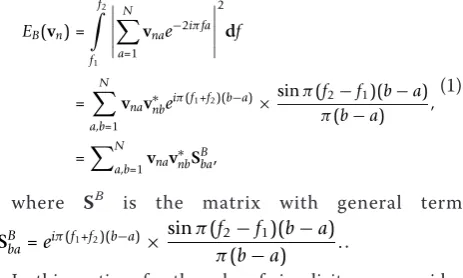
In this section, we introduce an orthogonal transform that enables transforming an or-thonormal family of sig-nals into another orthonormal family, the elements of which all have the same energy in a prescribed fre-quency interval. We shall denote by v1, ..., vLan initial
family of sampled orthonormal signals, with vn= (vn1, ..., vnN)T. The energy of vn inside a given frequency
where SB is the matrix with general term
SBba=eiπ(f1+f2)(b−a)×sinπ(f2−f1)(b−a)
π(b−a) ..
In this section, for the sake of simplicity, we consider a frequency interval Bof the form B= [-F, F] and the matrixSBwill simply be denoted by S. Then,
Sab=
with the same energy inside [-F, F]. This transformation can be expressed asW=VU, whereUis some
orthogo-nal matrix of size L. The equal energy constraint
amounts to the fact that all diagonal entries ofM=UH (VHSV)Umust be equal. Letting d1, ...,dL denote the
diagonal entries of VHSV, it is clear that the diagonal
entries of UH(VHSV)U must all be equal to
¯
d=L−1
k=1,Ldk since orthonormal base changes do not affect the trace.
2.1 Energy balancing algorithm
Finding in a direct wayUsuch that Mhas equal diago-nal entries is unfeasible. Thus, we resort to an iterative procedure to equalize by pairs diagonal entries of M.
This is achieved by updating U by means of Givens
rotations [19]. In the following, we shall noteD=diag (d1, ..., dL) and R(a,b)(θ) will represent the Givens
rota-tion with angle θ in the subspace of dimension 2 with entry (a,b).
Table 1 describes the procedure for eigenvectors bal-ancing. In Table 1, we have setε≪1 and the angleθis chosen so as to ensure that entries (a,a) and (b,b) are equal after matrix updatingM® R(a,b)(θ) ×M×R(a,b) (θ)T. So, by iteratively applying this averaging among diagonal entry pairs, matrix M converges to a matrix with all diagonal terms equal to d¯.
By changing the initializationU0 of the matrix U in the algorithm, distinct matrices Ware obtained. Thus, there are infinitely many distinct orthonormal families with equal energy inside [-F,F] in the space spanned by the columns ofV, obtained by changingU0.
The two following results establish the convergence of the algorithm in Table 1 toward an orthonormal balanced basis. Proofs are supplied in the Appendix.
Theorem 1 Iterations of the balancing algorithm in Table1lead to a sequence of matricesM(1), M(2), .... The diagonal part of these matrices converges to d¯I,whereI is the identity matrix.
Let Δ(M) denote the diagonal matrix withith diagonal entry [Δ(M)]ii =Mii, where [P]abdenotes the entry (a, b) of matrixP. Then, we have
Theorem 2Whence the diagonal part ofMis equal to ¯
dI,the transformed vectorsW = [W1, ...,WL]satisfy the orthonormality property WTW = I and the S-norm property
Table 1 Energy balancing algorithm
θ = 1
Note that that the proofs of theorems 1 and 2 show that convergence is achieved regardless U0. At conver-gence, all signals in the columns ofW =VU have the same amount of energy inside [-F, F] since these are given by the diagonal entries ofM=WTSW. Further-more, we have checked on the examples in the next subsection that convergence is fast for any choice ofU0.
2.2 Examples
2.2.1 Slepian sequences
For a given time interval, say [0,T], regularly sampled with Nsamples, and a fixed bandwidth [-F, F], one can ensure that there exists a basis with d sequences of length Nthat concentrate most of their energy inside [-F,F], provided T≥ d/(2F). The elements of this basis are named spheroidal wave sequences or Slepian sequences [10].
Slepian sequences of length Nare the eigenvectors of
the matrix S of size N with general term
Smn=
sin(2πF(m−n))
π(m−n) . From earlier discussion, it is clear that the eigenvalues ofScorrespond to the percen-tage of the energy of the corresponding eigenvectors inside interval [-F, F]. These eigenvectors can be calcu-lated accurately by means of a procedure proposed in [20]. Note that numerically this is not a straightforward task since most eigenvalues are either very close to zero or to one. More precisely, it is well-known that the 2FT largest eigenvalues are close to one and that others show fast decay to zero.
In the particular case of Slepian sequences, Theorem 2 leads to
that represents the value of the energy of the sequence Wilying inside the frequency interval [-F, F]. Thus, all
the (Wi)i = 1,L have energy outside [-F, F] equal to
1− ¯d.
Building 2FTsequences with the same (small) amount of energy outside [-F,F] can be of interest for applica-tions. For instance, this could be interesting for multiu-ser communications on narrow frequency subbands.
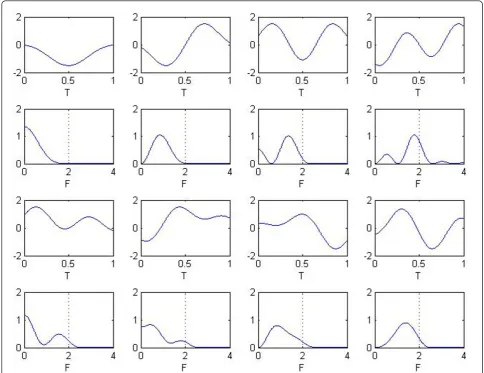
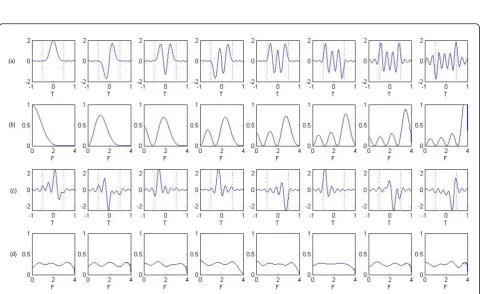
Figure 1 shows balancing of Slepian sequences. We are looking for sequences that generate the space of
sequences of duration T = 1, with more than 90% of
their energy inside bandwidth [-F,F], with F= 2. Signals are sampled with 500 time samples over [0, 1]. If we look at the first four Slepian sequences, we can check
that the proportion of their energy outside [-F, F] is, respectively, (0.00, 0.00, 0.04, 0.28). These sequences are plotted on the first line of Figure 1 and the correspond-ing spectra on the second line. Clearly, the energies of the sequences tend to be located in continguous inter-vals with increasing center frequency. This explains why the last sequences have more outband energy. The energy balancing procedure leads to sequences pre-sented on the third line of Figure 1. The corresponding spectra are on the fourth line of Figure 1, and their out-band energy are all equal to 0.08 = (0.00+0.00+0.04 +0.28)/4.
As we can see it, although outband energies are equal, inband spectra remain very different and we will address spectrum equalization of sequences in Section 3.
To study convergence speed, we considered 103
Monte Carlo simulations whereU0 is chosen randomly among orthogonal matrices with uniform distribution. More details about the uniform distribution on orthogo-nal matrices and how to sample from it can be found in [21]. The value of the stopping parameter has been set to ε= 10-10. In average, convergence is achieved after 8 iterations with best and worst cases of 5 and 10 itera-tions, respectively. Thus, convergence is very fast when balancing is performed with a single-frequency band for any choice ofU0.
2.2.2 PSWFs time energy balancing
Alternatively, one may look for signaling functions basis that concentrate all their energy within frequency inter-val [-F,F] and with most of their energy concentrated in a time interval of lengthT. The solution of this problem is supplied by Slepians’s prolate spheroidal wave func-tions (PSWFs) basis [9] that consists in a family of orthogonal functions that are solutions of the following integral equation we can approximate solutions v(t) by their truncated Shannon representation [22]:
In [22], maximization ofris solved by replacing v(t) by its approximation in Equation (5), leading thus to
ρ≈ vTSv˜
vTv , (7)
where v = [v-N/2, ..., vN/2-1]T and the matrix S˜ is defined by
˜
Sab= T/2
−T/2
sin(2πF(t−a))
π(t−a) ×
sin(2πF(t−b))
π(t−b) dt. (8)
Thus, successive PSFWs are supplied by successive eigenvectors of matrix S˜, starting with the one with lar-gest eigenvalue that represents the PSFW with maxi-mum energy concentration inside [-T/2,T/2].
Hence, looking for energy-balanced PSWFs, that is, PSWFs linear combinations that yield an orthonormal family of functions with the same minimum energy ratio 1 -r outside time interval [-T/2, T/2], can be reformu-lated from our energy balancing framework by replacing matrixSby S˜.
Thus, we see that the algorithm in Table 1 can be adapted to cope with several problems by changing the scalar product matrixS. Note in particular that conver-gence theorems 1 and 2 are valid regardless the choice of the scalar productS.
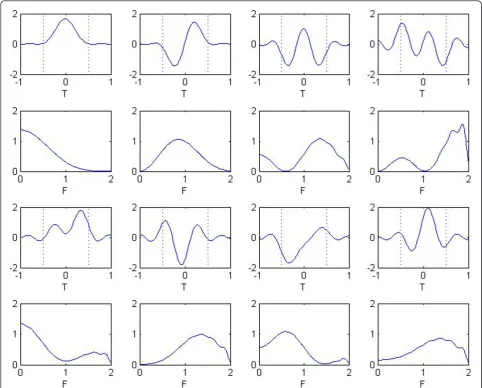
outage energy mitigation outside [-T/2,T/2] in the time domain among balanced PSWFs.
Here again, convergence is fast: forε= 10-10 and 103 Monte Carlo simulations, whereU0 is chosen randomly among orthogonal matrices with uniform distribution, convergence is achieved after 15 iterations in average. Best and worst convergence cases are obtained for 13 and 16 iterations, respectively.
3 Spectrum balancing of an orthonormal family of signals
Here above, we have introduced an iterative technique for energy balancing inside a prescribed bandwidth. With a view to get orthogonal families of signals with similar spectra in the space spanned by vectors {vk}k= 1,
L, we derive an iterative technique to jointly equalize
energies of these vectors in a set of frequency intervals, extending thus the technique proposed in the previous section.
Let us now introduce some notations. Considering Equation (1), we define a set of matrices {Sk}k = 0,K-1 associated with a partition {Bk}k= 0,K-1 of the frequency support of signals. For real valued signals, spectra are even functions, letting [-KF, KF] denote the bandwidth of signalsv1, ...,vL, we can take frequency sub-bands in
the form
Bk= [(−k−1)F, (−k+ 1)F]∪[(k−1)F, (k+ 1)F].(9)
Then, corresponding matricesSkare written as
S0ab= sin 2πF(a−b)
π(a−b) ,
and
Skab= 2 cos(2πkF(a−b))×
sin 2πF(a−b)
π(a−b) , fork= 1, ...,K−1, (10)
where Skab is a compact form for [Sk]ab. Although
extension to the complex case is straightforward, in this paper, we restrict ourself to the case of real valued signals.
3.1 Balancing algorithm
As before,Uis the orthogonal transform applied to the signals matrixV = [v1, ...,vL]. We shall noteMk= UT
(VTSkV)U, for k= 0, ...,K - 1. Diagonal entries of Mk
represent the energies of the signals given by the col-umns of the matrixVUthat lie insideBk. Our goal is to
build a matrix U such that the diagonal parts of all matrices (Mk)k= 0,...,k-1 become as close as possible. As above, this will be achieved by successive updatings ofU by means of Givens rotations. The updateU® URab(θ)
T
ofU amounts to the update Mk ® Rab(θ)MkRab(θ)T
ofMk. In order to jointly equalize diagonal terms ofMk,
we can chooseθsuch that it is a solution of the follow-ing minimization problem:
the minimum of which is of the form
θ=1 be obtained by checking which of the four possible values 0, 1, 2 or 3 achieves the minimum. In practice, it appears that after a few rotation updates the optimumn is always 0, because θbecomes small. Then, it can be checked that takingn = 0 in any iteration of the algo-rithm does not modify significantly its behavior while making it work faster. In this case, we can note that for K= 1, we get
, that is, the value found in Table 1 for a single inter-val. Indeed, letting α=M0aa−M0bb,β=M0aa+M0bb and
On another hand, since the term (Mk
aa−Mkbb)2 in the denominator of the arctan(.) function in Equation (12) could be a source of unstability and should become close to zero at convergence (Mk
aa≈Mkbb), we set it to 0 from the beginning of the algorithm.
The spectrum balancing algorithm that we obtain is summarized in Table 2. One can observe that this algo-rithm resorts to ideas quite similar as those developed for joint diagonalization of matrices [23,24]. As sug-gested above, the algorithm is implemented with n(nÎ {0, 1, 2, 3}) set to 0 in each loop.
3.2 Examples
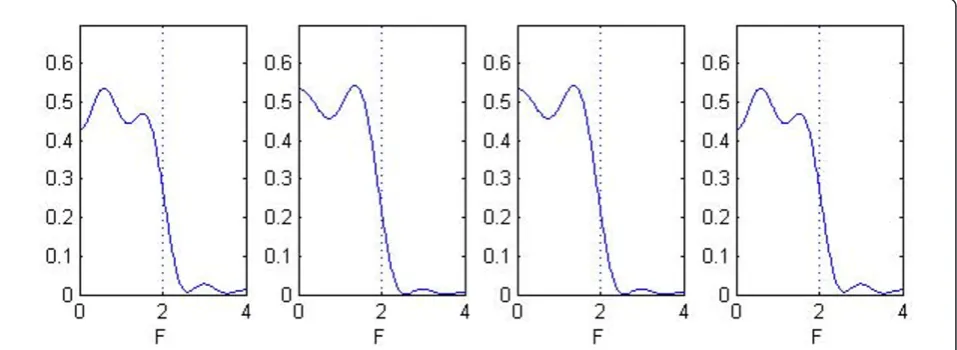
In the previous section, we have considered energy bal-ancing of Slepian sequences. We have checked in Figure 1 that Slepian sequences tend to have spectra concen-trated in distinct contiguous subbands of [-F, F] and that after energy balancing over interval [-F, F] with the algorithm in Table 1, spectra remain very dissimilar. Now, we apply the spectrum balancing algorithm in Table 2 with energy balancing inside a partition of [-F, F] into K = 16 subbands and againF = 2. Results are presented in Figure 3. It appears that with spectrum bal-ancing, spectra are now quite similar. Now considering T= 1 andF= 4, there are 8 sequences that concentrate most of their energy inside [-F, F]. Figure 4 shows the corresponding spectra. In both cases, the energy is bet-ter spread inside [-F,F] after balancing.
In Figure 5, spectrum balancing of PSWFs is per-formed forT = 1 andF= 4. We can see that spectrum
balancing with K= 16 subbands yields very smooth
spectra inside the bandwidth.
As already mentioned in the introduction, we can check in Figure 5 that Slepian sequences or PSWFs are slightly shifted upward as order increases while spec-trally balanced sequences have spectra that better occupy the whole bandwidth.
More generally, spectrum balancing could be consid-ered for other UWB orthogonal pulses, such as Gaus-sian, Hermite or Legendre functions, where elements of the family of increasing order tend to have spectra that are centered at increasing frequencies [25].
Achieving spectrum flattening is an interesting prop-erty for combatting multipath as we shall see in the next section for another kind of waveform (more specifi-cally balanced Walsh sequences).
3.3 Convergence
When one single subband is considered for spectrum
balancing (K = 1), which amounts to search for an
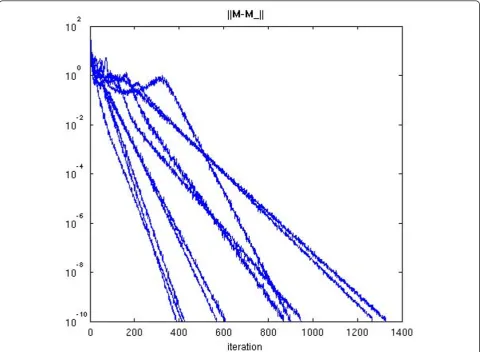
is fast in practice. When several frequency intervals are considered (K> 1), convergence issue is more involved and will be considered in future works. However, simu-lations suggest that between two successive iterations, sayn andn+ 1, of the main loop of the algorithm, the norm error of matrix M = M(n) decreases to zero at exponential rate:
||M(n+1)−M(n)|| ≤Ce−nβ, (15)
where Cand bare positive constants. A straightfor-ward consequence of Equation (15) is that the sequence of matrix (M(n))n≥0 converges and convergence is achieved at geometric rate.
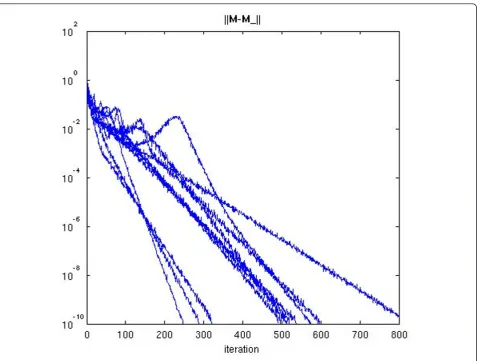
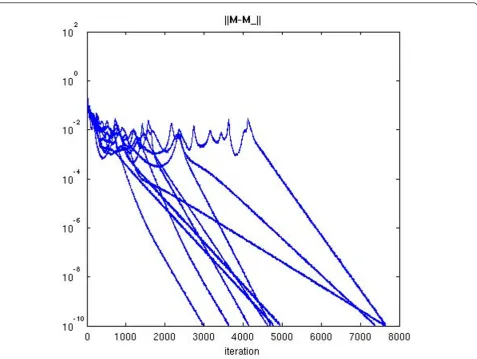
This is illustrated in Figures 6 and 7 where 10 plots of the convergence of the evolution of || M(n+1) - M(n)||
are presented for 2FT = 8 and 32, respectively. In both cases the number of subbands is set equal to 2FT. We can check that initial convergence depends on U0. When the criterion becomes small enough, convergence occurs at a geometric rate, but it somewhat varies among experiments. It seems that there is no simple way to boost convergence thanks to a convenient choice of the matrixU0. In particular, we can see that between two experiments initial convergence can be faster, while the asymptotic geometric convergence rate can be smal-ler. The problem of boosting initial convergence is beyond the scope of this paper.
4 Walsh codes balancing
As discussed in the introduction, in a CDMA context we are looking for signals that are constant over chip
Table 2 Spectrum balancing algorithm
- SetU=U0withUT0U0=I,
Mk=UT(VTSkV)U, M−k = 0(k= 0, ...,K−1) andM= [M0, ...,MK−1],M−= [M−0, ...,M−K−1]
- Iterations:
while||M-M-||≥ε, (ε≪1)
M−k =Mk, (k= 0, ...,K−1)
loopa= 1®L- 1 loopb=a+ 1®L
θ = 1
4arctan
2K−k=01(Mkab+Mkba)(Mkaa−Mkbb)
K−1
k=0 (Mkab+M k ba)
2
Mk=R(a,b)(θ)MkR(a,b)(-θ), (k = 0,...,K- 1)
U=U R(a,b),
(-θ) end loopb and loopa end while W=VU
Figure 4Spectra of spectrally balanced first 8 Slepian sequences overK= 16 subintervals.Dotted linerepresents the maximum inband frequencyF= 4.
intervals, a natural approach is to search them in the space spanned by the orthogonal Walsh-Hadamard basis. Then, if the sampled signals of this basis are given columnwise in a matrix form, any new orthogonal basis of the vector space is achieved by applying an orthogo-nal matrix transform on the right-hand side. Note that instead, references [1] and [2] in the introduction apply matrix permutations on the left-hand side of the matrix of code sequences.
As in the case of continuous signals discussed in the examples of Sections 2 and 3, the algorithm works by starting from an orthonogonal basis and successively transform it into new orthonogonal bases of the same vector space. Of course, some specific properties of the initial family such as constant absolute amplitude in the case of Walsh codes are not preserved by orthogonal transforms, while others such as the chip structure of codes (signal constant over chip durations) are pre-served because this property is shared by all signals in the vector space spanned by initial Walsh codes.
4.1 Spectral balancing of Walsh sequences
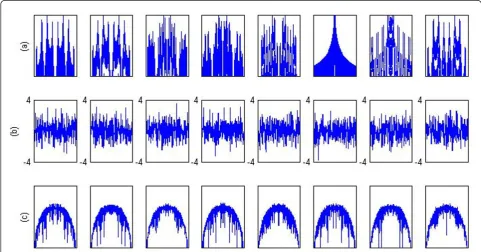
We illustrate Walsh codes spectral balancing with lengths 8 and 32 in Figures 8, 9 and 10, respectively. In Figure 8, only one subband is used and poor results are achieved in terms of spectrum balancing, although results are better than with the initial Walsh family. In Figures 9 and 10, spectrum balancing is searched overK = 8 and K= 32 subbands, respectively, and codes of lengths 8 and 32 chips, respectively. In Figure 10, only 8 randomly chosen codes are plotted among the 32 codes of length 32. Code vectors are sampled with 8 samples per chip. Figure 11 has been obtained when balancing
Walsh codes of length 256 over K = 256 frequency
intervals, showing thus that long spreading sequences can be produced by the algorithm.
4.2 Convergence and balanced codes properties 4.2.1 convergence
10 experiments with random initialization ofU0. We observe that convergence in Figures 12 and 13 is very similar to the convergence obtained for PSWFs balan-cing in Figures 6 and 7, respectively. Thus, the discus-sion about convergence of PSWFs balancing presented in Section 3.3 could be reproduced here with the same words.
For codes of length 256, convergence becomes very slow. This is because when using K subbands for codes of K chips, the main loop of the algorithm requires aboutK3operations. However, we checked that stopping the algorithm after about 100 iterations already yields quite good mixing in terms of spectral shapes (see Fig-ure 11) and, as we shall see it in section 4.3, BER performance.
4.2.2 Amplitude
With a view to practical use of spectrally balanced codes, one may wonder whether the maximum ampli-tude of balanced codes remains small enough. Indeed, orthogonal transformation of binary codes preserves
energy but not amplitude. Based on a Gaussian approxi-mation of the amplitude of combined chips in the bal-ancing procedure, together with the orthogonal property of the transform, the distribution of the maximum of
the chips amplitude among Ntransformed orthogonal
codes of lengthNis given by
pN(z)≈N2
2
πe −z
2
2
erf
z
√ 2
N2−1
. (16)
This stems from the fact that chips in matrix W
approximately have an N(0, 1) distribution. Here, we have assumed initial binary codes with amplitude equal to 1. The values of pN(z) are drawn in Figure 14 for
codes of length N= 2k and k = 3,4,...,10. We see that these maximum amplitudes grow quite slowly as sequences length increases. In addition, for short sequences, the Gaussian assumption is not well satisfied and we have checked that the approximation is very pessimistic.
Figure 8a Walsh codes of length 8, b corresponding spectra, c spectrally balanced codes, d spectra of balanced codes, for K = 1.
We have just seen that the amplitudes of balanced codes can have continuous values. Thus, using the pro-posed codes instead of classical binary codes such as Walsh codes results in slight increase of complexity of the system, mainly at the receiver side where sequence
matched filtering will involve multiplications instead of sign shifts of sampled received signals. Although chip amplitude of balanced codes can have continuous values, in practical systems they should be rounded to remain in some discrete alphabet and thus facilitate Figure 10a Walsh codes of length 32, b corresponding spectra, c spectrally balanced codes, d spectra of balanced codes.
digital processing. We have checked that 8 bits encoding of the chips of balanced codes is enough to avoid BER performance degradation for codes of length 32 and codes of length 256. In other words, rounded balanced codes yield no noticeable difference in the BER curves of balanced codes, as it will be shown in section 4.3. 4.2.3 Correlation and cross-correlation of sequences Correlation and cross-correlation properties of codes dictate the performance of a multiuser communication system at high SNR [26]. For simple receivers based on single-user matched filter, correlation properties are important in particular for receiver synchronization, while in asynchronous systems, cross-correlations of codes limits performance. Thus, we are going to con-sider these properties and compare them between Walsh codes and balanced codes.
Balanced sequences appear to have nice correlation properties. This is illustrated in Figure 15. The two first subfigures on the first line in Figure 15 show superim-posed correlation functions of the 32 Walsh and balanced codes, respectively. Clearly, balanced codes
have good autocorrelation properties. In particular, around the main peak correlation coefficients are close to 0. This is an interesting property for CDMA commu-nications, for instance for multipath detection and esti-mation, but also for using such codes in applications such as synchronization or localization with radars or po-sitionning systems [27].
Since Walsh codes are not considered as good codes in terms of correlation and cross-correlation, we also made a comparison with brute force codes considered in [28]. These codes are obtained by means of an exhaustive search algorithm among codes with good cross-correlation properties. Figure 15 shows that these codes achieve quite poor correlation performance, even when removing the constant code autocorrelation (the one with triangular shape).
As far as cross-correlations are considered, the second line in Figure 15 shows that both balanced and brute force codes achieve good performance, unlike Walsh codes.
performance, at the expense of relaxation of the con-stant amplitude property.
4.3 Asynchronous transmission
Let us now consider an asynchronous transmissions with the above families of codes and simple matched fil-ter detection. Transmission on an AWGN (additive white Gaussian noise) in the presence of 2 users is pre-sented for Walsh, balanced and brute force codes in Fig-ure 16. Clearly, balanced and brute force codes achieve similar performance, while Walsh codes perform poorly at high SNR. The stars in Figure 16 represent the per-formance lower bound for matched filter detectors under the standard Gaussian asumption upon interfer-ence [26], while the lower curve is the single-user per-formance bound. We see that both balanced and brute force codes reach the bound, proving thus their optimal-ity in terms of level of interference. Another example is supplied in Figure 17 for codes of lengths 256 and 32 users. For this code length, brute force codes are not
available in [28]. Balanced codes still show performance closer to the interference lower bound than Walsh codes.
Of course, for a fixed spreading code length, the matched filter receiver performs worse as the number of interfering users increases and decorrelator or MMSE detectors would lead to improved BER curves [5]. How-ever, here we only considered the simpler matched filter receiver to focus on code properties rather than on receiver performance.
5 Conclusion
sequences for CDMA multiuser communications that show performance similar in terms of BER to brute force optimized binary sequences. Large numbers of such families of codes can be built thanks to the relaxa-tion upon the constant amplitude constraint, but codes maximum amplitude remains acceptable for most appli-cations. Clearly, using balanced signals in applications such as synchronization or for designing radar wave-forms is promising, due in particular to nice correlation properties and the wide variety of waveforms that can be generated.
Let M’ a matrix obtained by applying to M. The
Givens rotation R(a,b)(θ) that transformsMaaandMbb
Figure 15Superimposed correlations (up) and cross-correlations (down) of Walsh, balanced and brute force codes.
would exist M(k)
The last inequality shows that there would exist an
entryb such that M(aak)−Mbb
2
>3α. Of course, one of the entriesaorb can be set to 1. As a consequence, from the structure of the algorithm that builds the sequence of matrices Mand because J decreases each time we apply the Givens rotation,
J(M(k))−J(M(k+1))≥ L+ 2
with right-hand side strictly less thana provided we choose
ε < 3α(L+ 2)
2L2 . (24)
This is contradictory with asumption J(M(k+1)) <a. finally, we must have
Since diagonal entries of matrix M =UHDUare all equal to d¯ and
WTSW=UTVTSVU=UTDU=M, (26)
we have WTiSWi=Mii=d¯. Furthermore, vectors (Wi)i
= 1,Lform an orthogonal basis for the euclidian scalar
product since
WTW=UTVTVU=I. (27)
Competing interests
Patent CE FR2934696 (A1), 2010-02-05, CIB: G06F17/14; H04J11/00. Publication of is paper has been sponsored by Institut Télécom (http://www. institut-telecom.fr/).
Received: 20 April 2011 Accepted: 21 November 2011 Published: 21 November 2011
References
1. T Giallorenzi, S Kingston, L Butterfield, W Ralston, L Nieczyporowicz, A Lundquist, Non recursively generated orthogonal pn codes for variable rate CDMA. Patent US, 6091 760 (2000)
2. S Ghassemzadeh, M Sherman, Method for whitening spread spectrum codes. Patent US, 7 075 968 (2006)
3. DKBJ Hunsinger, Method and system for simultaneously broadcasting and receiving digital and analog signals. Patent US, 5745 525 (2003) 4. B Lozach, J Bollo, AL Guyader, Method for generating mutually orthogonal
signals having a controlled spectrum, Patent PCT/FR2008/050 391. (2008) 5. S Verdu,Multiuser Detection(Cambridge University Press, 1998) 6. Universal mobile telecommunications; spreading and modulation (fdd),
3GPP technical specification, technical report TS 25.213 V4.2.0. Technical Report (2001)
7. K Ouertani, S Saoudi, M Ammar,Interpolation Based Channel Estimation Methods for DS-CDMA Systems in Rayleigh Multipath Channels. IEEE Oceans08 (Quebec, 2008)
8. T Krauss, M Zoltowski, G Leus, Simple mmse equalizers for CDMA downlink to restore chip sequence: comparison to zero-forcing and rake, inIEEE Proceedings of the Acoustics, Speech, and Signal Processing (ICASSP) 2000, vol. 2. Indonesia, pp. 2865–2868 (2000)
9. D Slepian, O Pollack, Prolate spheroidal wave functions, fourier analysis and uncertainity. Bell Syst Tech J.40, 43–63 (1961)
10. D Slepian, On bandwidth, inProceedings of the IEEE, vol. 64. (Springer, 1976), pp. 457–459
11. D Thomson, Spectrum estimation and harmonic analysis. Proc IEEE.70, 1055–1096 (1982)
12. C Huang, Semiconductor nanodevice simulation by multidomain spectral method with chebyshev, prolate spheroidal and laguerre basis functions. Comput Phys Commun.180(3), 375–383 (2009). doi:10.1016/j. cpc.2008.10.010
13. S Senay, L Chaparro, M Sun, R Sclabassi, Compressive sensing and random filtering of eeg signals using slepian basis, inProceedings of EUSIPCO 2009, (Lausanne, Switzerland, 2008)
14. SZI Raos, I Arambasic,Slepian Pulses for Multicarrier OQAM, EUSIPCO 06 (2006)
15. S Pfletschinger, J Speidel, Optimized impulses for multicarrier offset-QAM. in Global Telecommunications Conference, GLOBECOM’01.1, 207–211 (2001) 16. T Zemen, CF Mecklenbruker, Doppler diversity in MC-CDMA using the
slepian basis expansion model, inProceedings of EUSIPCO 2004, (Vienna, 2004)
17. J Kim, CW Wang, Frequency domain channel estimation for OFDM based on slepian basis expansion, inProceedings of ICC 07, Glasgow, Scotland, pp. 3011–3015 (2007)
18. HZK Usuda, M Nakagawa, M-ary pulse shape modulation for PSWF-based uwb systems in multipath fading environment. inProceedings of IEEE GLOBCOM’043498–3504 (2004)
19. G Golub, CV Loan,Matrix Computation, 3rd edn. (Johns Hopkins, 1996) 20. D Gruenbacher, D Hummels, A simple algorithm for generating discrete
prolate spheroidal sequences. IEEE Trans Signal Process.42(11), 3276–3278 (1994). doi:10.1109/78.330397
21. P Diaconis, M Shahshahani, The subgroup algorithm for generating uniform random variables. Probab Eng Inf Sci.1, 15–32 (1987). doi:10.1017/ S0269964800000255
22. G Walter, T Soleski, A new friendly method of computing prolate spheroidal wave functions and wavelets. J Appl Comput Harmon Anal.19(3), 432–443 (2005). doi:10.1016/j.acha.2005.04.001
23. J Cardoso, A Souloumiac, Blind, beamforming for non gaussian signals. IEE Proc F.140(6), 362–370 (1993)
24. JCA Belouchrani, K Abed-meraim, E Moulines, A blind source separation technique using second order statistics. IEEE Trans Sig process.45(2), 434–444 (1997). doi:10.1109/78.554307
25. H Nikookar, R Prasad, inIntroduction to Ultra Wideband for Wireless Communications(Springer, 2009)
26. K Chen, E Biglieri, Optimal spread spectrum sequences constructed from gold codes. inProceedings of IEEE GLOBECOM867–871 (2000) 27. N Levanon,Radar Principles(Wiley, NY, 1988)
28. R Poluri, A Akansu, New linear phase orthogonal binary codes for spread spectrum multicarrier communications, inProceedings of Vehicular Technology Conference, VTC-2006(2006)
doi:10.1186/1687-1499-2011-176
Cite this article as:Chonavel:Orthogonal signals with jointly balanced spectra: Application to cdma transmissions.EURASIP Journal on Wireless Communications and Networking20112011:176.
Submit your manuscript to a
journal and benefi t from:
7Convenient online submission
7 Rigorous peer review
7Immediate publication on acceptance
7 Open access: articles freely available online
7High visibility within the fi eld
7 Retaining the copyright to your article