R E S E A R C H
Open Access
An OFDMA resource allocation algorithm based
on coalitional games
Farshad Shams
1, Giacomo Bacci
2*and Marco Luise
2Abstract
This work investigates a fair adaptive resource management criterion (in terms of transmit powers and subchannel assignment) for the uplink of an orthogonal frequency-division multiple access network, populated by mobile users with constraints in terms of target data rates. The inherent optimization problem is tackled with the analytical tools of coalitional game theory, and a practical algorithm based on Markov modeling is introduced. The proposed scheme allows the mobile devices to fulfill their rate demands exactly with a minimum utilization of network resources. Simulation results show that the average number of operations of the proposed iterative algorithm are much lower thanK·N, whereNandKare the number of allocated subcarriers and of mobile terminals.
1. Introduction
The advent of high-definition entertainment services justifies the need for wideband, high-capacity wireless communication technologies that use the available bandwidth efficiently and provide data rates close to channel capacity [1]. Multicarrier channel access techni-ques such as orthogonal frequency-division multiple access (OFDMA) can be exploited to increase data rates, by dividing a frequency-selective broadband channel into a multitude of orthogonal narrowband flat-fading subchannels. An intelligent and scalable joint power and bandwidth allocation mechanism is crucial to ensure the quality of service (QoS) to the consumer at a reasonable cost [2].
The problem of subcarrier and power assignment in OFDMA has been extensively considered in the litera-ture during the last few years. The proposed solutions mainly fall into two different categories: margin-adap-tive and rate-adaptive methods. The goal of margin-adaptive schemes (such as [3]) is to minimize the total transmit power expenditure to achieve the (minimum) QoS requirements. Algorithms based on the rate-adap-tive criterion (such as [4]) aim on the contrary at achieving the maximum data rate subject to different QoS constraints.
Most algorithms focus on the downlink scenario, with constraints on the total power transmitted by the radio base station. In the uplink scenario, the restrictions apply on an individual basis to each user terminal, and the simplest solution to maximize channel capacity of mobile devices under a power constraint is the water filling (WF) criterion [5]. In this case, channel capacity is increased when every subcarrier is assigned to the user with the best path gain, and the power is distribu-ted according to the WF criterion. However, the WF solution is highly unfair, since only users with the best channel gains receive an acceptable channel capacity, while users with bad channel conditions achieve very low data rates. To derive fair resource allocation schemes, we resort to other techniques, described in the following.
Generally, a resource allocation algorithm can be eithercentralizedordistributed. In centralized schemes like [6,7], the algorithm is executed by a central unit (like the radio base station) that is aware of the channel conditions and the demands of all mobile terminals. In a distributed model (such as [8]), each mobile terminal tries to accomplish its own (minimum) QoS autono-mously. In general, centralized techniques show better performance at the expense of a higher signaling between terminals and central unit, and lower scalabil-ity. In the context of distributed algorithms, several cross-layer approaches were developed (e.g., [9,10]) to reduce the total power consumption and to support dif-ferent services and traffic classes in the downlink
* Correspondence: [email protected] 2
Dipartimento di Ingegneria dell’Informazione, University of Pisa, Via G. Caruso, 16, Pisa 56122, Italy
Full list of author information is available at the end of the article
channel of an OFDMA system. Maximizing the power efficiency in uplink OFDMA has also been tackled in [7,11,12] using different formulations for the joint resource allocation problem.
Recently, coalitional game theory [13,14] has been used to address the problem of fair resource allocation for OFDMA systems using either centralized or dis-tributed algorithms. Roughly speaking, coalitional game theory studies the actions of a group of individual agents (such as mobile devices) that compete for a common resource (such as the wireless medium) by possibly finding synergies and forming coalitions among each others. Han et al. in [6] introduce a dis-tributed algorithm for the OFDMA uplink based on the Nash bargaining solution (NBS) [13] and the Hun-garian method [15] to maximize the overall system rate under individual power and rate constraints. The NBS guarantees each user to achieve its own demand, thus providing fairness to the resource allocation. The proposed algorithm shows a complexity O(K2Nlog2N+K4), without considering the expensive computational load to solve the (convex) equations of the NBS. In [16], Chee et al. propose a centralized algorithm for the OFDMA downlink scenario based on NBS and Raiffa-Kalai-Smorodinsky bargaining solution (RBS) [17]. NBS guarantees the minimum rate, while RBS bounds the maximal rate achieved by each user, respectively. The results show a good performance only when the gap between the maximum and the minimum rate is large. The complexity of this algo-rithm isO(K N+K2), again without considering the
solution of the RBS. In [18], Noh proposes a distribu-ted and iterative auction-based algorithm in the OFDMA uplink scenario with incomplete information. The experimental complexity of the algorithm is O(K Nlog2K). However, the simulation parameters are not realistic (three users and subcarriers), and it is thus hard to estimate the computational complexity when using real-world network parameters.
All the mentioned schemes, which represent, to the authors’ knowledge, the most relevant algorithms for OFDMA resource allocation with coalitional game the-ory, exhibit a good trade-off between overall system rate and fairness. Unfortunately, they also present a number of common problems: (i) most algorithms are based on non-linear programming, which is computa-tionally expensive and hardly scalable when consider-ing thousands of subcarriers and tens of users. Thus, they are not suitable for implementation by network designers; (ii) although the resource apportionment results to be fair from the users’ point of view, the achieved QoS may be much larger than demanded. This implies a waste of network resources from the
service provider perspective, which has not been con-sidered by previous works; and (iii) to reduce the com-putational burden, each subcarrier is allocated to mobile terminal in an exclusive manner, although this may limit the number of simultaneous connections in the uplink channel.
In this work, we aim at fulfilling each user’s QoS requirement in terms of target transmit rates exactly with the best utilization of the network resources, so as to satisfy both the users and the service provider. We also aim at designing a low-complexity algorithm that allows a centralized solution for the joint power and bandwidth allocation for OFDMA uplink channels to be achieved in a few steps using typical network para-meters. In our approach, we allow every subcarrier to be possibly shared among more than one user, and we add a constraint on the maximum number of used subcar-riers per terminal. This is achieved by dividing the avail-able bandwidth into a number of disjoint blocks of consecutive subcarriers and forcing each terminal to use at most one subcarrier per block. The motivation of this is twofold: we wish to (i) increase the signal-to-interfer-ence-plus-noise ratio (SINR) on the used subcarriers, which also simplifies channel estimation; and (ii) exploit the frequency diversity to increase the performance of forward error correction techniques.
The remainder of the paper is structured as follows. Section 2 introduces the basics of coalitional game the-ory. In Section 3, we formulate the resource allocation problem in the uplink OFDMA scenario as a coalitional game, whereas in Section 4 we introduce a solution algorithm based on Markov modeling. Section 5 pre-sents our the experiment results, and some conclusions are drawn in Section 6.
Notation: For the reader’s convenience, Section 7 reports the list of symbols used throughout the paper.
2. Brief review of coalitional game theory
A coalitional game is a game where groups of players (the coalitions), instead of single players, interact and compete [13,14]. It is denoted asG= (M, ν), whereM denotes the set of players andν the coalition function. We also denote with xm the payoff of player min M,
m= 1, 2, . . .,M=|M|. IfS⊆Mis a coalition (subset) ofMformed inG, then its members get an overall pay-offν(S), with ν(S) = 0when S=∅. In a cooperative game with transferable utility (TU), the payoff of a coali-tion can be expressed by a real value.
of all the agents) [14]. The grand coalition is formed only if the game issuperadditive:
Definition 1:A TU gameGis superadditive if
ν(S∪T)≥ν(S) +ν(T)∀S,T ⊂M s.t.S∩T =∅ (1) ■
An important issue in a coalitional TU game is how to distribute the payoff of the grand coalition among agents. The fundamental solution is thecore solution, defined as follows:
Definition 2: Let Mbe the set of M players of the superadditive TU gameG, and let ν be the payoff of the game. The core ofGis the set
In other words, the core of a coalitional game is the set of all payoff vectors (i.e., all those vectors whose entries add up to a same amount equal to the utility of the grand coalition) such that the sum of all payoffs of the players in any existing coalitionSis no smaller than the utility of the coalition.
For a non-superadditive coalitional game, the net-work formation process does not lead the players to form a grand coalition. In this case, Definition 2 does not apply. Let us redefine the core set in a gen-eral (not necessarily superadditive) coalitional forma-tion TU game. Let ψ = [S1,S2,. . .,Sm] denote a
partition of the set Mwherein Si∩Sj=∅for i ≠ j,
m
i=1Si=M and Si=∅ for i = 1, ... m, and let Ψ
denote the set of all possible partitions ψ. Let us also define F= [S1,S2,. . .,Sm], such thatmi=1Si=Mand
Si=∅for i = 1, ... m, as a family of (non-disjoint)
coalitions.
Definition 3: Acore apportionmentx ÎℝMis a payoff distribution with the following property:
⎧
Note that, if G is superadditive,
maxψ∈S∈ψν(S) =ν(M).■
The core allocation set can be found through linear programming and can also be an empty set. We can study the non-emptiness of the core without explicitly solving the core equation, using the following lemma:
Lemma 1 [13]: A necessary and sufficient condition for the core of a TU game to be non-empty is the TU game to be balanced.
Definition 4:A superadditive TU game Gfor a family F of coalitions is balanced if, for any S∈F, the inequality
S∈F
μS·ν(S)≤ν(M) (4)
holds, whereμSis a collection of numbers in [0, 1] (balanced weights) such that
S∈F
μS·1S =1M (5)
with1S ∈RMdenoting the characteristic vector whose
elements are
Definition 5:A non-superadditive TU game Gfor a familyF of coalitions isbalanced if, for every balanced collection of weightsμS, and for anyS ∈F,
Let us consider the uplink of a single-cell infrastructure OFDMA system with total bandwidth B, subdivided in Nsubcarriers with frequency spacingΔf=B/N. The cell is populated by K mobile terminals, each terminal k∈K= [1,. . .,K]experiencing a complex-valued chan-nel gain Hkn on thenth subcarrier to the base station
and having a data rate requirement Rk (in bit/s). We
assume that fulfilling such constraints simultaneously by all terminals is feasible.
To ensure fairness among users, the set N = [1,. . .,N] of available subcarriers is grouped inD blocks of N/D contiguous subcarriers N(d)= [N
D(d−1) + 1,. . ., N
Dd]⊂N, with 1 ≥ d≥ D, as
shown in Figure 1. Each terminal is allowed to take at most one subcarrier per each subblock. This is done to avoid assignments of contiguous blocks of subcarriers to users that may be in a deep-fading frequency range.
Our resource allocation strategy consists in finding a vector of transmit powersPk, wherePk= [pk1, ...,pkN],
withpknrepresenting the power allocated by terminalk
over the nth subcarrier, that allows the QoS constraint Rk to be satisfied. We decouple the problem into the
A. Subchannel assignment
We describe here two different options to perform this function:
1) Best-carrier assignment: For every subblockN(d),
every terminal k∈K is assigned its best subcarrier n(kd)= arg maxn∈N(d)|Hkn|2. The probability of assigning the same subcarrier to multiple mobile terminals is non-null.
2) Vacant-carrier assignment:In a sequential manner, for every subblockN(d), every terminalk∈Kis assigned
its best subcarrier n(kd)= arg maxn∈N(d)|Hkn|2. But, if k≤
N/D, we would like to ensure exclusive use of each sub-carriern∈N(d)to better exploit the available bandwidth
B(i.e., to reduce the multiple access interference). So, if n(kd)has been already assigned to some other terminal ℓ <k, then terminal kis assigned the best vacant (unas-signed) subcarrier ton(kd)within the channel coherence bandwidth. Clearly, this is not considered if k>N/D, so that terminalkis assigned its best subcarrier in the sub-block anyway. Note that the ordering ofKhas a negligi-ble impact on system performance whenNis, as usual, sufficiently high.
Both assignment strategies can be modified to address the case in which each terminal is allowed to have a dif-ferent number of assigned subcarriers (difdif-ferent Dk for
each mobile terminal), based on its own data rate requirement Rk. This can be done, for instance, by
assigning the subcarriers on a terminal basis rather than on a subblock basis. This modification to the algorithm might lead to a bad performance given particular config-urations of the network, whereas the average perfor-mance in the long run proves to be experimentally equivalent to the case of equal number of blocks D across all users. However, for the sake of simplicity, we consider the sameDfor all terminals from now on. B. Power allocation
To derive a stable solution to the power allocation sub-problem, we consider it as a coalitional game, in which each subchanneln(kd)∈N is identified as a player in the game. To model the coalitional game, we build K coali-tionsψ = [S1,. . .,SK], to be assigned to theKterminals.
Each coalition Sk, k∈K, contains the D players
n(kd):Sk= [nk(1),. . .,n(kD)]. Note that (i) the members of
each coalition are fixed, since one player cannot move from one coalition to another; and (ii) since a subcarrier n∈N can be shared among multiple users, there exist virtual copies of it belonging to different coalitions. For the sake of notation, we will identify with a generic n∈Skany of the subcarriers assigned to terminal k. The
strategy of each playern∈Skis represented by the
opti-mal power expenditure pkn∈[0,p¯kn], where p¯knis the
maximum power expenditure over subcarrier nby term-inalk. Note that (i) ifn∈/Sk, pkn= 0; and (ii) ifn∈Sk,
we can also have pkn = 0, which means that the kth
terminal does not transmit on thenth subcarrier, and it thus bears an actual number of active subcarriers Dk<D.
The system under investigation aims at fulfilling the QoS requirement of every terminal kin terms of target rate Rk. For simplicity, we estimate the achieved data
rate as the Shannon capacityCk of terminalkthat can
be approached by using suitable channel coding techni-ques [19]:
Ck=
n∈N
Ckn (8)
where Ckis the Shannon capacity achieved by
term-inalkon its subcarriern∈N: Ckn =f ·log2(1 +γkn)
=f ·log2
1 + |Hkn|
2p kn
j=k|Hjn|2pjn+σw2
(9)
Clearly,Ckn = 0 ifn∈/Sk, sincepkn = 0. Ifn∈Sk, Ckn
depends on the received SINRgknat the base station on
subcarriern, which is a function of the strategy (i.e., the transmit power) chosen by player n(i.e., one of the D subcarriers assigned to thekth terminal), of the transmit power of other terminals on the same subcarrier (if n∈/ Sk, pjn= 0), of the corresponding channel gains, and
of the power of the additive white Gaussian noise (AWGN)σw2. Note that, in an OFDMA system, there is no interference between adjacent subcarriers. Hence, Ckn considers only intra-subcarrier noise that occurs
when the same subcarrier is shared by more terminals. Each playern∈Skcauses interference only to its virtual
N
:
N
(1)
N
(2)N
(D)N/D subcarriers
copies, i.e., to the players of other coalitions such that n(jd)=n∈Sj, withj≠kand for anyd’, 1 ≤d’≤D.
The mobile terminals and the service provider are mostsatisfied when each mobile terminalkachieves its own data rate requirementexactly: Ck =Rk. In view of
this goal, we can force all players in each coalitionSkto
select their strategies (i.e., the power allocation for term-inalkover the available bandwidthB) so as to maximize a utility function for thekth coalitionSk, defined as
ν(Sk) =
1
|Ck
Rk−1|
−α·u(1−Ck/Rk) (10)
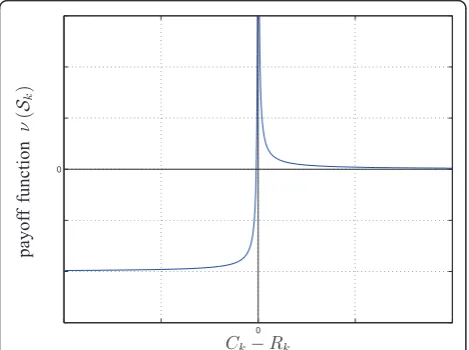
where u(·) is the step function, with u(y) = 1 if y ≥ 0 and u(y) = 0 otherwise (see Figure 2). If Ck = Rk, Sk,
earns the highest possible payoffν(Sk) = +∞. IfCk>Rk,
Skgets a positive payoff, whereas it obtains a negative
payoff if Ck <Rk. The factora is a finite positive
con-stant (much) greater than one (i.e., 1 ≪ a < +∞) that ensuresν(Sk)to be negative whenCk <Rk. This is
expe-dient to let the players distinguish a capacityCkthat is
lower/upper than Rkonly by knowing their own
coali-tion’s payoff. Note that, in practice, +∞ can be repre-sented by the largest countable number available (e.g., 264- 1) in a given simulation platform.
The payoff of each coalition is a real number and, in our formulation, the most important parameter is the gain of each coalition, whereas the outcome of each player does not matter at all. For instance, we can equally divide the payoff of the coalition among all players. Therefore, this game is a TU one [13,14]. The specific shape of our utility function (10) is actually immaterial and was chosen to ensure fast convergence
of the iterative algorithm that will be introduced later on. We could have considered any utility function that increases as the differenceCk- Rk moves from ±∞to 0,
just to make sure that, for anyCk≠Rk, each coalition
has an incentive to move towardCk=Rk.
To provide further insight into the problem, we inves-tigate now some properties of the proposed gameG. As a first step, we note that the players in G= (M=k∈KSk,ν)with the utility function (10) do
not tend to form the grand coalition. This is because every player n∈Skcannot leave its coalition Sk: the
members of every coalition are fixed and do not change during the game. This may appear inappropriate to the notion of a coalitional game. However, our assumption is fairly common in economic problems like the study of a bargaining game between two corporations when each corporation has its own business branches. In this case, the members (branches) of each coalition (corpora-tion) are fixed [20].
A relevant result for our game is the following:
Theorem 1: The core of the game
G= (M=k∈KSk,ν)with utility function (10) is not
empty.
Proof: The number of coalitions and the number of players in each coalition are both fixed. Since each player belongs just to one coalition, the unique balanced collection of weights (μS)S∈ψ is μS = 1 ∀S∈ψ. To conclude the proof, we must verify that
S∈ψν(S)≤maxψ∈S∈ψν(S). Since the target rates of all terminals are assumed to be feasible, then every coalition expects Ck to approach Rk. Therefore,
every coalition is allowed to earn the highest possible payoff.■
In the following section, we will show how the funda-mental properties of our game lead to a practical alloca-tion algorithm.
4. The best-response algorithm
We are interested in answering questions like:How do the players set their proper transmit power amounts? Dynamic learning models provide a framework for analyzing the way the players may set their proper strategies. A player adopts a certain power amount if and only if this matches its coalition’s interests, and this goal can be achieved through a best-response iterative algorithm [21] based on Markov modeling [22]. Each player takes its own decisions individually, myopically, and concurrently with the others, so as to lead its own coalition’s payoff toward +∞(Ck =Rk). At
each (discrete) time step of the algorithm, the autono-mous players simultaneously adjust their transmit powers based on a model to increase the payoff of their own coalitions. Although this leads to 0
0
Ck−Rk
payof
f
function
ν
(
Sk
)
Figure 2Shape of the utility as a function of the Shannon
interference when virtual copies of the same subcar-riers simultaneously change their powers, we show that this dynamic myopic procedure guarantees the maxi-mum payoff to each coalition.
The process starts up at time stept= 0 with an arbi-trary assignment of the transmit powerspt=0
kn to allK·D
players in the game (that are grouped in Kcoalitions with playersn∈Skwithn=nk(d), 1≤d≤D). At the
gen-eric time stept, our system is in the state ωt= (ψt, νt) where ψt is the set [S1t,. . .,SKt], and
νt= [ν(St
1),. . .,ν(SKt)]∈RKcontains the payoffs of the
coalitions in ψt. The evolution of the Markov chain is then dictated by the strategy of the game. The strat-egy of each player n∈Skis to find the best power
amount pt
kn that leads to an increase in the payoff ν(Skt)of its own coalition Sk. In practice, playern∈Sk
decides whether to change its power allocation, mak-ing its coalition better off, or to keep transmittmak-ing at the same power level (e.g., when its coalition’s payoff is infinite). The following snippet pseudocode shows how each player n∈Sktakes its decision during time
stept.
if ν(Skt) = +∞, then ptkn+1=ptkn, exit; else //setting correct power range
ifν(Skt)≤0, then p˜kn=ptkn, p˜maxkn =p¯kn;
else ˜pkn= 0 p˜maxkn =p t kn;
repeat
ˆ
pkn=p˜kn; //saving tentative power
compute ν(S˜k); //tentative payoff
p˜kn = unif [0,pkn]; //random power step
˜
pkn=p˜kn+p˜kn; //tentative power
until (ν(S˜k)> ν(Skt)) or (p˜kn >p˜maxkn )
if (ν(S˜k)> ν(Skt)), thenptkn+1=pˆkn; //accept
else ptkn+1=ptkn; //discard
In this algorithm,ν(S˜k)is the“trial”value of the
cur-rent payoff of the coalition when the tentative powerp˜kn
is adopted: it is computed with pjn =ptjnfor alln∈N
and for any j ≠ k, and pkn=p˜kn. At each step of the
update process, the power stepp˜knis the particular
outcome (value) of a random variable uniformly distrib-uted between 0 and pkn, with pkn ¯pkn. As better
detailed in Section 5, optimal values for pkn can be found in order to minimize the algorithm computational load, based on experimental results. Ifν(Skt)≤0, then Ck <Rk, and the best strategy for player n∈Skis to
increase its current transmit power so as to increase its coalition’s payoff. As a result of the random power
stepping, the tentative power is a random number in the interval[pt
kn,p¯kn]. Playern∈Skaccepts this value if and
only if the coalition payoffν(Skt)increases, otherwise it ends up transmitting at its previous value. If 0< ν(St
k)<∞, playern∈Sksbest strategy is on the
contrary to decreaseptkn, and thus the tentative (random) transmit power belongs to the interval[0,ptkn]. At the end of each time step t, the base station computes the payoff ν(Sk), ∀k∈K with updated power amounts. A
uniformly distributed random power stepping is adopted to increase the probability of picking the (unknown) best adjustment value, and thus both to reduce the con-vergence time of the algorithm and to possibly minimize the overall power consumption. As is apparent, the con-vergence speed of the algorithms depends not only on the parameters of the network but also on the choice of the maximum update steppkn.
As already stated, two copiesn∈Sk andn∈Sj(the
virtual copies of the same subcarrier n) may happen to wish to adjust their transmit powers in a conflicting (and thus incompatible) way. If we assume that each player just follows the decision rules listed in the pseu-docode above, then the probability of conflicting deci-sions will be high. To reduce the occurrence of this event, we modify our algorithm by requesting each playernotto update its transmit power at every step of the game with a probability l Î [0, 1]. At each time step t, every playern∈Skselects a random numberξknt
uniformly distributed in [0, 1]. Ifξknt > λ, then the player applies the algorithm and (possibly) update pt+1
kn,
other-wise ptkn+1=ptkn (i.e., during time step t, it skips the update process, and the value ofpt
knis maintained). Ifl
is close to 1, then the probability of conflicting decisions tends to 0, but the algorithm will have a large conver-gence time, since the probability of updates is low. In addition to the conflicts described above, another poten-tially disruptive condition may arise between different subcarriers belonging to the same coalition: if both (myopic) players simultaneously increase their powers pt
kn>0andptkn >0, it may occur that Ck>Rk. To
less than the previous time step, all players assign the previous power amount for the next time step. There may exist network configurations in which the iterative algorithm is not guaranteed to converge. To account for these situations, we place a maximum number of opera-tionsΘ, beyond which the algorithm is stopped, and the sum of the users’demands is supposed to be unfeasible.
We show now that our proposed algorithm reaches a stable state, which corresponds to the core apportion-ment of the game. We model the evolution of the algo-rithm as the output of a finite-state Markov chain with state spaceΩ= {ω= (ψ,ν)|ψÎ Ψ,νÎ ℝK}. For all time stepst, ψt=ψbelongs to the subset of all possible dis-joint coalitionsΨ with exactly Dmembers, and remains fixed for the whole duration of the algorithm. The time evolution of the algorithm as a Markov chain is due to time variability ofνt, which depends on the power levels ptknchosen by the players in the coalitions collected by
ψt
. We the use this notation for the sake of convenience, to emphasize thatνtis directly connected toψt.
The Markov process asymptotically tends toward a stable coalition structure state, where no player has any incentive to change its power. In other words, all coali-tions get their maximum payoffs. Our algorithm guaran-tees that whent® ∞, this Markov chain tends toward a singleton steady state with probability 1.
Definition 6[22]: A set F⊂Ωis anergodic setif, for anyω Î Fandω’ Î F, the probability of reaching the state ω’starting fromωis zero. Once the Markov chain falls into a state belonging to an ergodic set, it never leaves that set, and it wavers between the states in that ergodic set from then on. The probability of reaching any state in the ergodic set is strictly positive.■
Lemma 2[22]: In any finite Markov chain, no matter which state the process starts from, the probability of ending up into an ergodic set tends to 1 as time tends to infinity.
Definition 7 [22]: Singleton ergodic sets are called absorbing states.■
If Fis an absorbing state andω Î F, the probability of ending up into state ω when beginning from ω is one. In fact, absorbing states individually represent points of equilibrium.
Lemma 3:The state ω= (ψ,ν) is an absorbing state of the best-response process if and only if
ν(Sk) = +∞ ∀Sk∈ψ (11)
Proof: This condition ensures that no player has any incentive to change its power amount. If this condition is met, then no coalition can get a higher payoff by deviating from stateω= (ψ,ν). Since all the target rates are feasible, this condition is also necessary.
Theorem 2:The best-response process has at least one absorbing state.
Proof:Since the best-response algorithm is a Markov process, Lemma 2 ensures that the best-response pro-cess reaches an ergodic setF. To conclude the proof, it is enough to show that Fis singleton. Suppose that the number of states in the ergodic set is |F| > 1. Then, all players revise their strategies without conflicting deci-sions with a non-null probability. As a consequence, the Markov process moves to a new state, in which all coali-tions’payoff are higher than those achieved in the pre-vious state. This means that the probability of going back to the previous state is null, which contradicts the notion of an ergodic set.■
Note that Theorem 2 does not ensure the uniqueness of the ergodic set in the best-response process. There may exist some different combinations of the power allocation for the players to reach to a steady state. It means that the game possesses multiple equilibria. The major finding of Theorem 2 is that according to the way the players adjust their strategies, the best-response pro-cess leads to one of the steady states, in which no player has any incentive to revise its power allocation.
Theorem 3: The set of payoffs associated with an absorbing state of the best-response process coincides with the set of core allocation:
i. ifω = (ψ, ν) is an absorbing state, thenν is a core allocation.
ii. if ν is a core allocation, then all ω = (ψ, ν) are absorbing states.
Proof:
Part (i) Suppose ω= (ψ, ν) is an absorbing state butν is not a core allocation. In this case, there exist some coalitions that can obtain a higher payoff. This is con-tradictory, since the game reaches an absorbing state when every coalition gets the maximum payoff.
Part (ii) Ifν is a core allocation, then no coalition can earn by letting its member change their powers. This implies that the state will not move to a new state, and thus the current state is absorbing.■
Coalitional games aim at identifying the best coalitions of the agents and a fair distribution of the payoff among the agents. Interestingly, in this game the absorbing state coincides with one of the Nash equilibria [13] of the game. Suppose there are K= 2 mobiles connected to a base station with N = 1 subcarrier only. In this case, the M =K· N= 2 copies of the subcarrier, each constituting a coalition, are engaged in a 2 × 2 game. Every player has two strategies: either pk = 0 orpk=p¯k.
stability of the static game. With due attention to the notation, we can extend this result to a general case.
Theorem 4: The set of absorbing states in the best-response process and the set of Nash equilibria of the sta-tic game are asymptosta-tically (in the long run) equivalent.
Proof: Let us consider the coalitions in the best-response process as players in a static game. Lemma 2 ensures that this process reaches an ergodic set in the long run. According to Theorem 2, this set is singleton, and thus its member is an absorbing state. Hence, no coalition (i.e., no player in the static game) has any incentive to revise its strategy. In static games, this is the definition of a Nash equilibrium.■
We can now conclude that the absorbing state is an extension of the Nash equilibrium, since the coalitions bind agreements with each other as economic agents and earn a vector value rather than a real number. Once the coalitions reach the absorbing state, their payoff is the highest possible (+∞), and no coalition is willing to revise its current strategy. In general, as follows from Theorem 4, the Nash equilibrium of the game is Pareto-optimal (efficient), since no other strategy can achieve a payoff greater than +∞.
5. Numerical results
In this section, we evaluate the performance of the best-response algorithm presented in Section 4. We consider some cases with different numbers of mobile terminals, target data rates, and subcarriers, showing that our sug-gested scheme reaches a steady state after a few steps only. To increase the convergence speed of the algo-rithm, we introduce a tolerance parameter εin our uti-lity function, such that if |Ck/Rk- 1| <ε, then we assume
that the payoff is +∞. We can possibly set an asym-metric range [ε1, ε2] such that ε1 ≤(Ck/Rk - 1)≤ ε2, so
as to favor solutions withCk>Rk.
We consider the following parameters for our simula-tions: the maximum power of each terminal kon each subcarriernis ¯pkn=p¯= 3μW; the power of the ambient
AWGN noise on each subcarrier is σ2
w= 100 nW, and
the constant number in (10) isa= 5000. We also setΘ = 10K·Nas the stopping criterion of the iterative algo-rithm, where K andN depend on the network para-meters of the simulation. The path coefficients Hkn,
corresponding to the frequency response of the multi-path wireless channel at the carrier frequency nΔf, are computed using the 24-tap ITU modified vehicular-B channel model adopted by the IEEE 802.16m standard [23]. To account for the large-scale path loss, we assumed the terminals to be uniformly distributed between 3 and 100m. Based on numerical optimizations, the parameterlthat reduces the probability of conflict-ing decisions among members of different coalitions for
different number of terminals, subcarriers, and signal bandwidth isl= 0.97.
The initial power allocation is pkn = 0∀k∈K and
∀n∈N. This experimentally provides the minimal power consumption at the steady state, and in most cases the minimum number of steps of the algorithm.
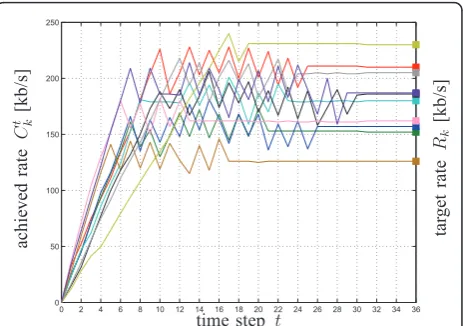
Figure 3 reports the behavior of the achievable rateCk
as a function of the time step tin a network withK= 10 terminals,N= 1024 subcarriers, and bandwidthB= 10 MHz using the vacant-carrier assignment scheme. The target rates, reported in Figure 3 with solid markers on the right axis, are assigned randomly to each term-inal using a uniform distribution in the range [100, 250] kb/s. Further parameters are as follows: toleranceε1 = 0,
ε2 = 0.01 power update step pkn=p¯kn/25 = 120 nW,
and number of subblocks D = 32. Numerical results show the convergence of Ck to the respective target
ratesRkafter 31 steps of the best-response algorithm.
In the remainder of this section, we will evaluate the average performance of our proposed algorithm in terms of power expenditure and computational burden using realistic system parameters and extensive simula-tion campaigns. Note that we are not able to implement the joint resource allocation techniques available in the literature and reviewed in Section 1, mainly due to the unfeasible algorithmic complexity when using tens of terminals, hundreds of subcarriers, and high data rates (on the order of Mb/s). As a consequence, in the follow-ing we will compare our measured results with the theo-retical performance provided by the literature. The complexity figures given in Section 1 will be used as a reference to compare the performance of our proposed scheme in terms of computational demand.
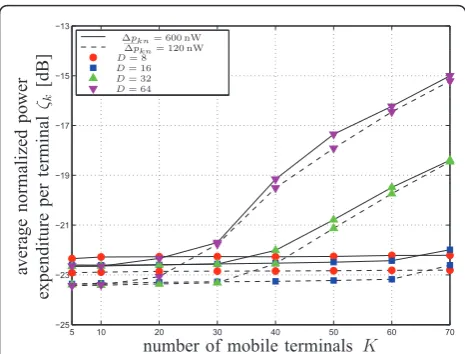
Figures 4 and 5 report the simulation results obtained after 500 random realizations of a network with Rk=R= 200 kb/s∀k∈K, N = 1024,B = 10 MHz, and
0 2 4 6 8 10 12 14 16 18 20 22 24 26 28 30 32 34 36 0
50 100 150 200 250
time step t
achi
ev
ed
rat
e
C
t k[kb/s]
ta
rg
et
ra
te
Rk
[kb/s]
ε1 = 0, ε2 = 0.04 again with the vacant-carrier assign-ment strategy. Solid lines represent the case
pkn=p¯kn/5 = 600 nW, whereas dashed lines depict the
case pkn=p¯kn/25 = 120 nW. Circles, squares, upper
triangles, and lower triangles correspond toD= {8, 16, 32, 64}, respectively. Figure 4 shows the average normal-ized power expenditureζkat the steady state as a
func-tion ofK, computed by averagingζk= N1 n∈N pp¯knkn over all terminals. This serves as a measure for the average total power consumption normalized to the maximum power expenditure available to each terminal. As can be noticed,ζkincreases for K≥N/D, since the number of
shared subcarriers increases and the terminals must spend more power to overcome the intra-subcarrier noise. Interestingly, the power expenditure of the pro-posed centralized algorithm shows higher efficiency than the distributed and cross-layer schemes available in the literature (e.g., see [7,10,12]). For instance, when consid-ering 500 random realizations of a system with band-widthB= 10 MHz andN= 1024 subcarriers, and using the vacant-carrier assignment model, we find that, in the case of a total sum-rate demand of 20 Mb/s (i.e., with a spectral efficiency of 2 b/s/Hz) and Rk =R200
kb/s (i.e., K= 100 terminals), the maximum power con-sumption per user is 31μW and the average power con-sumption of the system is 0.53 mW. In the multicell scenario of [7], the average power expenditure for each cell is 8 mW when the achievable data rate is 40 Mb/s. When considering the cross-layer algorithm proposed in [10], the average power expenditure per mobile terminal is 0.4 W with maximal spectral efficiency of 2 b/s/Hz, whereas the average power expenditure per mobile
terminal required by the energy-efficient techniques pro-posed in [12] is 0.4 and 1.2 W when the achieved data rate is equal to 40 and 140 kb/s, respectively.
Figure 5 shows the computational burden of our algo-rithm expressed in terms of the average number of operations per terminal required to reach the steady state as a function of the number of terminals K, with the vacant-carrier assignment model. The number of operations is measured experimentally by counting the number of steps required by the subchannel assignment plus the total number of trials required to update the transmit power according to the best-response algo-rithm. As can be seen, the number of operations increases as Dincreases. This can be justified since increasing Dincreases the number of players K · D, which yields an increase in the number of conflicting decisions. Note that the proposed algorithm is able to provide a spectral efficiency higher than 1 b/s/Hz, which occurs, for instance, when we assume more thanK= 50 users with ratesRk= 200 kb/s over a bandwidth B= 10
MHz in the proposed scenario, with a linear computa-tional burden at the base station using appropriate values for the parameters. In this particular example, a good trade-off between performance and complexity is D= {8, 16} andpkn= 600 nW. Using these values, the number of operations of the proposed algorithm is experimentally lower than the productK · N, and so considerably lower than the number of operations required by the schemes available in the literature (e.g., see [6,16,18]). Our experiments with different data rate demands show that a smaller data rate reduces also the number of operations significantly. To further reduce
5 10 20 30 40 50 60 70
number of mobile terminals K
av
Figure 4Average normalized power expenditure as a function
ofK, withB= 10 MHz,N= 1024, and
number of mobile terminals K
av
Figure 5Experimental average number of operations as a
function ofK, withB= 10 MHz,N= 1024, and
Rk=R=200 kb/s∀k∈Kin the case of vacant-carrier
the number of operations, we can also increase the tol-erance parameters (e.g., withε2 = 0.1, we experience a reduction in the number of operations on the order of 20-30%). Note also that the spectral efficiency achieved by the proposed fair resource allocation method, while showing a linear computational burden, is comparable with that provided by sum-rate maximizing algorithms (e.g., see [24]). In practice, a reasonable value for the maximum spectral efficiency achieved by the network in the region of linear computational load in all simulated scenarios (not reported here for the sake of brevity) is slightly lower than 2 b/s/Hz. For higher spectral efficien-cies, no parameter selections can achieve the optimal resource allocation with linear complexity, and the num-ber of operations appears to increase exponentially with the number of mobile terminals. However, note that the solutions can be found in most cases.
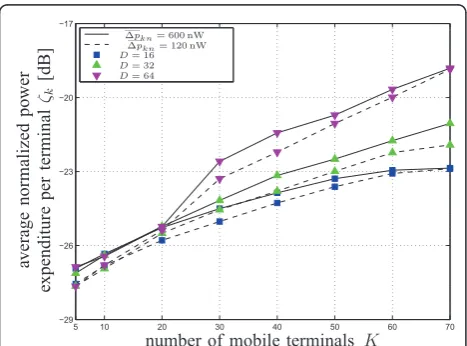
Figures 6 and 7 depict the simulation results of a net-work with Rk=R= 200 kb/s∀k∈K, N= 1024, B= 10
MHz, andε1= 0,ε2= 0.04 using the best-carrier assign-ment model. Solid lines represent the case
pkn=p¯kn/5 = 600 nW whereas dashed lines depict the
case pkn=p¯kn/25 = 120 nW. Squares, upper triangles,
and lower triangles correspond to D = {16, 32, 64}, respectively. Figure 6 shows the average normalized power expenditureζkat the steady state as a function of
K. As can be seen, the average power expenditure using the best-carrier assignment model is lower than with the vacant-carrier assignment, since the terminals having better channel conditions can spend less power.
A drawback of the best-carrier assignment is an increased number of operations required by the algo-rithm. Figure 7 shows the average number of operations
per terminal required to reach the steady state as a function of the number of terminalsK. As can be seen, the best-carrier assignment model has a computational burden higher than vacant-carrier assignment model, since the number of shared subcarriers in the best-car-rier assignment model is larger than in the vacant-car-rier assignment, which increases the probability of interference between simultaneous decisions in the best-reply algorithm. Note that, using the best-carrier assign-ment model, the case D= 16 appears to be computa-tionally expensive.
Figure 8 shows the average number of operations per terminal in the case of a network with parameters Rk=R= 500 kb/s∀k∈K, N= 512,B= 10 MHz, andε1 = 0, ε2 = 0.04 using vacant-carrier assignment model. Solid and dashed lines represents the casespkn= 3μW and pkn= 600 nW, respectively, whereas circles, squares, upper triangles, and lower triangles depict D= {8, 16, 32, 64}, respectively. Even in this case, with more severe requirements in terms of target data rates, the number of operations is shown to be lowerthan the product K· N, again using spectral efficiencies higher than 1 b/s/Hz.
Finally, Figure 9 shows the average number of opera-tions per terminal in the case of a network with para-metersB= 20 MHz,N= 2048,Rk= 2 Mb/s, ε1 = 0, and
ε2 = 0.04 with vacant-carrier assignment model. Solid and dashed lines represent the casespkn= 3μW and
pkn= 600 nW, respectively, whereas circles, squares,
and upper triangles depictD= {64, 128, 256}, respec-tively. The number of operations is againlowerthanK· Neven in the case of high data rate demands.
5 10 20 30 40 50 60 70
number of mobile terminals K
av
Figure 6Average normalized power expenditure as a function
ofK, withB= 10 MHz,N= 1024, and
number of mobile terminals K
av
Figure 7Experimental average number of operations as a
function ofK, withB= 10 MHz,N= 1024, and
Rk=R=200 kb/s∀k∈Kin the case of best-carrier
As can be seen in Figures 5, 7, 8, and 9, due to the random behavior of the proposed algorithm, there is a strict relation between the average number of opera-tions, the network parameters, and the algorithm para-meters (including the channel assignment model). Depending on the parameter selection, we see different shapes (linear or exponential behavior) for the average number of operations. Thus, estimating the analytical complexity function for the best-response algorithm is hard to do. However, for all tested scenarios (not reported here for the sake of brevity), there exist prop-erly tuned values (such asD,pkn) that provide an aver-age number of operations for the proposed algorithm that are lowerthan the product K· N, even with high data rate demands like in the cases of Figures 8 and 9. The parameter that most impacts on the number of operations is D. Our experiments show that, for the optimal parameter selection (i.e., when the number of operations scales linearly with Nand K), the average number of active subcarriers per terminal (i.e., those which bear pkn > 0) is approximately D/2 when the
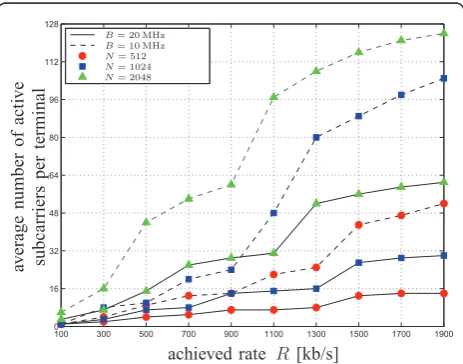
vacant-carrier model is adopted. This rule of thumb can be used as a design criterion for the proposed algorithm. Let us consider Figure 10, which reports the average number of active subcarriers to each mobile terminal as a function of the achieved rateR, in the linear computa-tional load regime and using pkn= 600 nW. Dashed and solid lines depict the cases B = {10, 20}MHz, respectively, whereas circles, squares, and upper trian-gles represent N= {512, 1024, 2048}, respectively. For instance, whenB= 20 MHz,N= 512, and R= 500 kb/ s, the average number of active subcarriers is 4. If we look back at Figure 8, we can verify that the linear
number of operations can be achieved using D = 8. Note that the number of active subcarriers in the case ofB= 10 MHz is higher than in the case B= 20 MHz, since the subcarrier spacing is halved.
6. Conclusion
This paper described a computationally inexpensive cen-tralized algorithm based on coalitional game theory to address the issue of fair optimal resource allocation (in terms of subcarrier assignment and power control) for the uplink of an infrastructure OFDMA wireless net-work. The scheme derived here is designed to meet the required data rates exactly, thus ensuring a fair
5 10 15 20 25 30
number of mobile terminals K
av
Figure 8Experimental average number of operations as a
function ofK, withB= 10 MHZ,N= 512, and
number of mobile terminals K
av
Figure 9Experimental average number of operations as a
function ofK, withB= 20 MHz,N= 2048, and
Rk=R=2 Mb/s∀k∈Kin the case of vacant-carrier
assignment model.
100 300 500 700 900 1100 1300 1500 1700 1900 0
Figure 10Average number of active subcarriers as a function
of the achieved rate, withp
kn=600 nWin the case of
performance apportionment to both users and service providers, with the best utilization of the network resources (minimum power expenditure and good spectral efficiency). The proposed algorithm can be analyzed as a Markov model that converges to an absorbing state with unitary probability in the long run. Our criterion also allows us to trade-off system performance and computational burden of the algo-rithm, based on the number of subblocks used to apportion the available bandwidth and the data rate requirements of the terminals. Simulations show that the target rates are achieved with a low-complexity procedure, even in the case of populated networks and stringent QoS requirements. The (greedy) best-carrier assignment rule results into a higher number of opera-tions but a lower power expenditure compared to the case with full use of the available subcarriers. The pre-sented coalition-based strategy appears to be a good trade-off between computational load and power effi-ciency in comparison with the schemes available in the literature and achieves a spectral efficiency larger than 1 b/s/Hz.
7. List of symbols
1Scharacteristic vector of coalitionS BOFDM signal bandwidth
CkShannon capacity achieved by terminalk
Ckn Shannon capacity achieved by terminalkon the
carriern
dgeneric index for carrier subblock Dnumber of carrier subblocks
Dknumber of subcarriers assigned to terminalk F family of coalitions
Gcoalitional game
Hknchannel response of the channel between terminal
kand the base station over carriern kgeneric index for a terminal Knumber of terminals Kset of terminals
mgeneric index for a player Mnumber of players Mset of players
ngeneric index for a subcarrier Nnumber of carriers
N set of carriers
N(d)set of carriers of thedth subblock
pkntransmit power of terminalkover carriern
ptkntransmit power of terminalkover carriernat time stept
˜
pkntentative transmit power of terminalkover carriern
ˆ
pknprevious tentative transmit power of terminal k
over carriern
¯
pknmaximum transmit power of terminalk over
car-riern
˜
pmax
kn maximum tentative transmit power of terminalk
over carriern
Rktarget data rate of terminalk
Scoalition (subset) of players Stcoalition at time stept
tgeneric time step
T generic coalition of players xmpayoff of playerm
xpayoff distribution across players
ageneric positive constant
gkn received signal-to-interference-plus-noise ratio of
terminalkover carriern Δfcarrier spacing
p˜kn power step to update the tentative transmit
power of terminalkover carriern
pknmaximum power step to update the tentative transmit power of terminalkover carriern
εtolerance parameter
Θstopping criterion of the iterative algorithm
lprobability of transmit power update
μSbalanced weight of coalitionS
νcoalition utility function
νset of coalition utilities
νt
set of coalition utilities at time stept
ξt
knuniformly distributed random variable σ2
wAWGN power
Fergodic set
ψset of disjoint coalitions
ψt
set of disjoint coalitions at time stept Ψset of all possibleψ
ωstate of the Markov chain
ωt
state of the Markov chain at time stept
Ωstate space of the Markov chain
ζk normalized average power expenditure of
terminal k
Abbreviations
AWGN: additive white Gaussian noise; NBS: Nash bargaining solution; OFDMA: orthogonal frequency-division multiple access; QoS: quality of service; RBS: Raiffa-Kalai-Smorodinsky bargaining solution; SINR: signal-to-interference-plus-noise ratio; TU: transferable utility; WF: waterfilling.
Author details
1Department of Computer Science and Engineering, IMT Institute for
Advanced Studies, Piazza San Ponziano, 6, Lucca 55100, Italy2Dipartimento di Ingegneria dell’Informazione, University of Pisa, Via G. Caruso, 16, Pisa 56122, Italy
Competing interests
The authors declare that they have no competing interests.
References
1. AJ Goldsmith,Wireless Communications(Cambridge University Press, Cambridge, 2005)
2. AR Bahai, BR Saltzberg, M Ergen,Multi-Carrier Digital Communications Theory and Applications of OFDM, 2nd edn. (Springer, Boston, 2004)
3. N Hassan, M Assaad, Low complexity margin adaptive resource allocation in downlink MIMO-OFDMA system. IEEE Trans Wireless Commun.8(7), 3365–3371 (2009)
4. J Hui, Y Zhou, Enhanced rate adaptive resource allocation scheme in downlink OFDMA system, inProceedings of the IEEE Vehicular Technology Conference (VTC), Melbourne, Australia, 2464–2468 (Sept. 2006) 5. T Peng, W Wang, Q Lu, W Wang, Subcarrier allocation based on
water-filling level in OFDMA-based cognitive radio networks, inProceedings of the International Conference on Wireless Communications, Networking and Mobile Computing, Shanghai, China, 196–199 (Sept. 2007)
6. Z Han, KJR Liu, Fair multiuser channel allocation for OFDMA networks using Nash bargaining solutions and coalitions. IEEE Trans Commun.53(8), 1366–1376 (2005). doi:10.1109/TCOMM.2005.852826
7. Z Han, Z Ji, KJR Liu, Non-cooperative resource competition game by virtual referee in multi-cell OFDMA networks. IEEE J Select Areas Commun.25(6), 1079–1090 (2007)
8. D Yu, D Wu, Y Cai, W Zhong, Power allocation based on power efficiency in uplink OFDMA systems: a game theoretic approach, inProceedings of the IEEE International Conference on Communication Systems (ICCS), Singapore, Singapore, 92–97 (Nov. 2008)
9. V Tralli, A Perez-Neira, P Henarejos, A cross-layer scheduling strategy for the downlink of a MIMO-OFDMA system with heterogeneous traffic, in
Proceedings of the Newcom++/Cost2100 Workshop, Vienna, Austria, (Sept. 2009)
10. G Dainelli, M Moretti, A Zalonis, N Dimitriou, Distributed subcarrier allocation schemes for OFDMA multiple access systems, inProceedings of the Newcom++/Cost2100 Workshop, Vienna, Austria, (Sept. 2009) 11. YJ Zhang, KB Letaief, An efficient resource-allocation scheme for spatial
multiuser access in MIMO/OFDM systems. IEEE Trans Commun.53(1), 107–116 (2005). doi:10.1109/TCOMM.2004.840666
12. L Yang, Z He, L Wang, W Wu, A new utility based subcarrier and power joint allocation scheme in uplink OFDMA systems, inProceedings of the IEEE Vehicular Technology Conference (VTC), Dublin, Ireland, 2756–2760 (Apr. 2007)
13. MJ Osborne, A Rubinstein,A Course in Game Theory(MIT Press, Cambridge, 1994)
14. B Peleg, P Sudhölter,Introduction to the Theory of Cooperative Games, 2nd edn. (Springer, Berlin, 2007)
15. R Burkard, M Dell’Amico, S Martello,Assignment Problems(Society for Industrial and Applied Mathematics (SIAM), Philadelphia, 2009) 16. TK Chee, C-C Lim, J Choi, A cooperative game theoretic framework for
resource allocation in OFDMA systems, inProceedings of the IEEE International Conference on Communication Systems (ICCS), Singapore, Singapore, (Oct. 2006)
17. E Kalai, M Smorodinsky, Other solutions to Nash’s bargaining problem. Econometrica.4, 513–518 (1975)
18. W Noh, A distributed resource control for fairness in OFDMA systems: English-auction game with imperfect information, inProceedings of the IEEE Global Communications Conference (GLOBECOM), New Orleans, LA, 1–6 (Dec. 2008)
19. E Biglieri, J Proakis, SS Shitz, Fading channels: information-theoretic and communications aspects. IEEE Trans Inf Theory.44(6), 2619–2692 (1998). doi:10.1109/18.720551
20. MJ Osborne, A Rubinstein,Bargaining and Markets(Academic Press, San Diego, 1990)
21. M Agastya, Perturbed adaptive dynamics in coalition form games. J Econ Theory.89(2), 207–233 (1999). doi:10.1006/jeth.1999.2574
22. JG Kemeny, JL Snell,Finite Markov Chains, 2nd edn. (Springer, Berlin, 1976) 23. IEEE 802.16 Broadband Wireless Access Working Group, IEEE 802.16m
Evaluation Methodology Document (EMD), Technical Report IEEE 802.16m-08/004r5, (Jan. 2009)
24. T Wang, L Vandendorpe, Resource allocation for maximizing weighted sum min-rate in downlink cellular OFDMA systems, inProceedings of the IEEE International Conference Communications, Cape Town, South Africa, (May 2010)
doi:10.1186/1687-1499-2011-46
Cite this article as:Shamset al.:An OFDMA resource allocation algorithm based on coalitional games.EURASIP Journal on Wireless Communications and Networking20112011:46.
Submit your manuscript to a
journal and benefi t from:
7Convenient online submission
7Rigorous peer review
7Immediate publication on acceptance
7Open access: articles freely available online
7High visibility within the fi eld
7Retaining the copyright to your article