Volume 2007, Article ID 41941,12pages doi:10.1155/2007/41941
Research Article
Tower-Top Antenna Array Calibration Scheme for
Next Generation Networks
Justine McCormack, Tim Cooper, and Ronan Farrell
Centre for Telecommunications Value-Chain Research, Institute of Microelectronics and Wireless Systems, National University of Ireland, Kildare, Ireland
Received 1 November 2006; Accepted 31 July 2007
Recommended by A. Alexiou
Recently, there has been increased interest in moving the RF electronics in basestations from the bottom of the tower to the top,
yielding improved power efficiencies and reductions in infrastructural costs. Tower-top systems have faced resistance in the past
due to such issues as increased weight, size, and poor potential reliability. However, modern advances in reducing the size and complexity of RF subsystems have made the tower-top model more viable. Tower-top relocation, however, faces many significant engineering challenges. Two such challenges are the calibration of the tower-top array and ensuring adequate reliability. We present a tower-top smart antenna calibration scheme designed for high-reliability tower-top operation. Our calibration scheme is based upon an array of coupled reference elements which sense the array’s output. We outline the theoretical limits of the accuracy of this calibration, using simple feedback-based calibration algorithms, and present their predicted performance based on initial
prototyping of a precision coupler circuit for a 2×2 array. As the basis for future study a more sophisticated algorithm for array
calibration is also presented whose performance improves with array size.
Copyright © 2007 Justine McCormack et al. This is an open access article distributed under the Creative Commons Attribution License, which permits unrestricted use, distribution, and reproduction in any medium, provided the original work is properly cited.
1. INTRODUCTION
Antennas arrays have been commercially deployed in recent years in a range of applications such as mobile telephony, in order to provide directivity of coverage and increase system capacity. To achieve this, the gain and phase relationship be-tween the elements of the antenna array must be known. Im-balances in these relationships can arise from thermal effects, antenna mutual coupling, component aging, and finite man-ufacturing tolerance [1]. To overcome these issues, calibra-tion is required [2,3]. Traditionally, calibration would have been undertaken at the manufacturer, address static effects arising from the manufacturing tolerances. However, imbal-ances due to dynamic effects require continual or dynamic calibration.
Array calibration of cellular systems has been the subject of much interest over the last decade (e.g., [4–6]), and al-though many calibration processes already exist, the issue of array calibration has, until now, been studied in a “tower-bottom” smart antenna context (e.g., tsunami(II) [2]). In-dustry acceptance of smart antennas has been slow, princi-pally due to their expense, complexity, and stringent
relia-bility requirements. Therefore, alternative technologies have been used to increase network performance, such as cell split-ting and tower-bottom hardware upgrades [7,8].
To address the key impediments to industry acceptance of complexity and expense, we have been studying the fea-sibility of a self-contained, self-calibrating “tower-top” base transceiver station (BTS). This system sees the RF and mixed signal components of the base station relocated next to the antennas. This provides potential capital and operational savings from the perspective of the network operator due to the elimination of the feeder cables and machined duplexer filter. Furthermore, the self-contained calibration electron-ics simplify the issue of phasing the tower-top array from the perspective of the network provider.
TRx
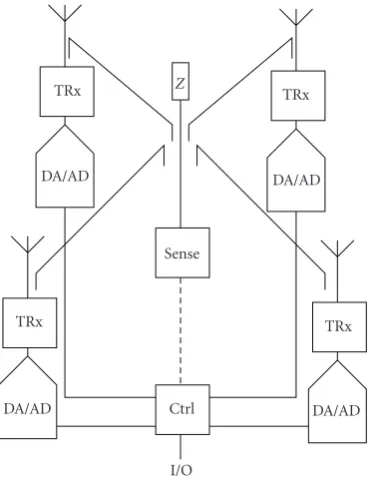
Figure1: The hardware division between tower top and bottom for the tower-top BTS.
exploration of novel basestation architectures, with examples such as reduced RF feeder structures utilising novel switching methodologies [10,11], and the development of basestation hotelling with remote RF heads [12]. Such approaches aim to reduce capital infrastructure costs, and also site rental or acquisition costs [13].
In this paper, we present our progress toward a reliable, self-contained, low-cost calibration system for a tower-top cellular BTS. The paper initially presents a novel scheme for the calibration of an arbitray-sized rectilinear array us-ing a structure of interlaced reference elements. This is fol-lowed in Section 3by a theoretical analysis of this scheme and predicted performance.Section 4presents a description of a prototype implementation with a comparison between experimental and predicted performance.Section 5presents some alternative calibration approaches utilising the same physical structure.
2. RECTILINEAR ARRAY CALIBRATION
2.1. Array calibration
To yield a cost-effective solution for the cellular BTS mar-ket, we have been studying the tower-top transceiver config-uration shown inFigure 1. This configuration has numerous advantages over the tower-bottom system but, most notably, considerably lower hardware cost than a conventional tower-bottom BTS may be achieved [14].
We define two varieties of array calibration. The first, radiative calibration, employs free space as the calibration path between antennas. The second, where calibration is per-formed by means of a wired or transmission line path and any radiation from the array in the process of calibration is ancillary, is refered to as “nonradiative” calibration. The setup of Figure 2 is typically of a nonradiative calibration process [2]. This process is based upon a closed feedback loop between the radiative elements of the array and a sensor. This sensor provides error information on the array output and generates an error signal. This error signal is fed back to correctively weight the array element’s input (transmit
cal-TRx
Figure2: A simplified block schematic diagram of a typical array calibration system.
ibration) or output (receive calibration). It is important to observe that this method of calibration does not correct for errors induced by antenna mutual coupling. Note that in our calibration scheme, a twofold approach will be taken to com-pensate for mutual coupling. The first is to minimise mu-tual coupling by screening neighbouring antennas—and per-haps using electromagnetic (EM) bandgap materials to re-duce surface wave propagation to distant antennas in large arrays. The second is the use of EM modelling-based mitiga-tion such as that demonstrated by Dandekar et al. [6]. Fur-ther discussion of mutual coupling compensation is beyond the scope of this paper.
While wideband calibration is of increasing interest, it re-mains difficult to implement. On the other hand, narrow-band calibration schemes are more likely to be practically implemented [1]. The calibration approach presented here is directed towards narrowband calibration. However, the methodology supports wideband calibration through sam-pling at different frequencies.
2.2. Calibration of a2×2array
Our calibration process employs the same nonradiative cal-ibration principle as shown in Figure 2. The basic build-ing block, however, upon which our calibration system is based is shown inFigure 3. This features four radiative array transceiver elements, each of which is coupled by transmis-sion line to a central, nonradiative reference element.
In the case of transmit calibration (although by reci-procity receive calibration is also possible), the transmit sig-nal is sent as a digital baseband sigsig-nal to the tower-top and is split (individually addressed) to each transmitter for SISO (MIMO) operation. This functionality is subsumed into the control (Ctrl) unit ofFigure 3.
Z
TRx TRx
DA/AD DA/AD
TRx TRx
DA/AD Ctrl DA/AD
I/O Sense
Figure3: A central, nonradiative reference sensor element coupled to four radiative array transceiver elements.
TRx TRx TRx
Ref Ref
TRx TRx TRx
Figure4: A pair of reference elements, used to calibrate a 2×3 array.
relative phase and amplitude imbalance between the feed points of each of the transceivers is used to create an error signal. This error signal is fed back and used to weight the in-put signal to the transceiver element—effecting calibration. Repeating this procedure for the two remaining elements cal-ibrates our simple 2×2 array. This baseband feedback system is to be implemented in the digital domain, at the tower-top. The functionality of this system and the attendant comput-ing power, energy, and cost requirements of this system are currently under investigation.
2.3. Calibration of ann×narray
By repeating this basic 2×2 pattern with a central reference element, it becomes possible to calibrate larger arrays [15]. Figure 4shows the extension of this basic calibration princi-ple to a 2×3 array.
X+ΔTx1 ΔC1 ΔC2 X+ΔTx1 +ΔC1−ΔC2
Ref
ΔTx1 Tx Tx ΔTx2
X q[ ] Y
−
+ +
Err
Figure5: Propagation of error between calibrating elements.
To calibrate a large,n×n, antenna array, it is easy to see how this tessellation of array transceivers and reference ele-ments could be extended arbitrarily to make any rectilinear array geometry.
From the perspective of a conventional array, this has the effect of interleaving a second array of reference sensor el-ements between the lines of radiative transceiver elel-ements, herein referred to as “interlinear” reference elements, to per-form calibration. Each reference is coupled to four adjacent radiative antenna elements via the six-port transmission line structure as before. Importantly, because there are reference elements shared by multiple radiative transceiver elements, a sequence must be imposed on the calibration process. Thus, each transceiver must be calibrated relative to those already characterised.
Cursorily, this increase in hardware at the tower-top due to our interlinear reference elements has the deleterious ef-fect of increasing the cost, weight, and power inefficiency of the radio system. The reference element hardware overhead, however, produces three important benefits in a tower-top system: (i) many shared reference elements will enhance the reliability of the calibration scheme—a critical parameter for a tower-top array; (ii) the array design is inherently scalable to large, arbitrary shape, planar array geometries; (iii) as we will show later in this paper, whilst these reference nodes are functional, the multiple calibration paths between them may potentially be used to improve the calibration accuracy of the array. For now, however, we consider basic calibration based on a closed loop feedback mechanism.
3. RECTILINEAR CALIBRATION—THEORY OF OPERATION
3.1. Basic calibration
constants (Δi, where iis the system element in question). Where there is no variation between the coupled paths and the accuracy of the phase measurement process is arbitrarily high, then, as can be seen inFigure 5, the calibration process is essentially perfect.
However, due to finite measurement accuracy and coup-ler balance, errors propagate through the calibration scheme. Initial sensitivity analysis [16] showed that when the reso-lution of the measurement accuracy, q[ ], is greater than or equal to 14 bits (such as that attainable using modern DDS, e.g., AD9954 [17] for phase control), the dominant source of error is the coupler imbalance.
FromFigure 5it is clear that an error, equal in magnitude to the pair of coupler imbalances that the calibration signal encounters, is passed on to the feed point of each calibrated transceiver. If this second transceiver is then used in subse-quent calibration operations, this error is passed on. Clearly, this cumulative calibration error is proportional to the num-ber of the calibration couplers in a given calibration path. For simple calibration algorithms such as that shown inFigure 5, the array geometry and calibration path limit the accuracy with which the array may be calibrated.
3.2. Theoretical calibration accuracy
3.2.1. Linear array
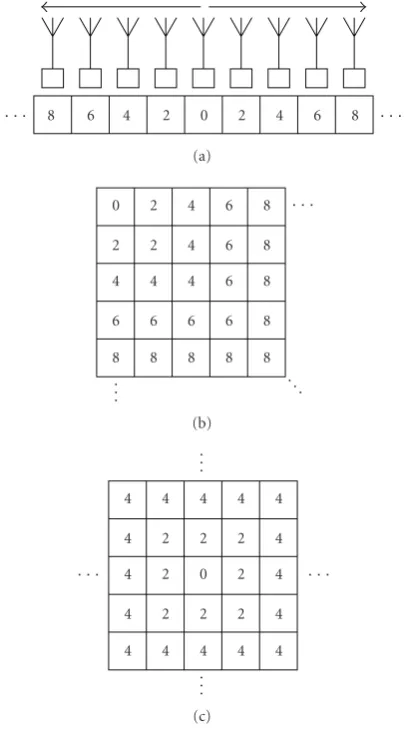
Figure 6(a)shows the hypothetical calibration path taken in phasing a linear array of antennas. Each square represents a radiative array element. Each number denotes the number of coupled calibration paths accrued in the calibration of that element, relative to the first element numbered 0 (here the centremost). If we choose to model the phase and ampli-tude imbalance of the coupler (σck) as identically distributed Gaussian, independent random variables, then the accuracy of calibration for the linear array ofN elements relative to the centre element,σak, will be given by the following:
evenN:
where the subscriptk=Aorφfor amplitude or phase error. With this calibration topology, linear arrays are the hardest to accurately phase as they encounter the highest cumulative error. This can be mitigated in part (as shown here) by start-ing the calibration at the centre of the array.
3.2.2. Square array
Based on this observation, a superior array geometry for this calibration scheme is a square. Two example square ar-rays calibration methods are shown in Figures6(b)and6(c). The former initiates calibration relative to the top-left hand
· · · 8 6 4 2 0 2 4 6 8 · · ·
Figure6: Calibration paths through (a) the linear array. Also the square array starting from (b) the top left and (c) the centre of the array.
transceiver element. The calibration path then propagates down through to the rest of the array taking the shortest path possible. Based upon the preceding analysis, the predicted calibration accuracy due to coupler imbalance of ann×n
array is given by
σ2
with coupler error varianceσ2
ck, centred around a mean equal to the value of the first element.
11
Number of elements,N Top left
Centre
Figure7: Comparison of the theoretical phase accuracy predicted by the closed form expressions for the square array calibration
schemes, withσcφ=3◦.
Figure8: Block schematic diagram of the array calibration simula-tion used to test the accuracy of the theoretical predicsimula-tions.
oddn:
A graph of the relative performance of each of these two calibration paths as a function of array size (for square arrays only) is shown inFigure 7. This shows, as predicted, that the phasing error increases with array size. The effect of this error accumulation is reduced when the number of coupler errors accrued in that calibration is lower—that is, when the cali-bration path is shorter. Hence, the performance of the centre calibrated array is superior and does not degrade as severely as the top-left calibrated array for large array sizes.
As array sizes increase, the calibration path lengths will inherently increase. This will mean that the outer elements will tend to have a greater error compared to those near the reference element. While this will have impact on the ar-ray performance, for example, in beamforming, it is difficult to quantify. However, in a large array the impact of a small number of elements with relatively large errors is reduced.
Table1
Number of elements,N Theory
Simulation
Figure9: The overall array calibration accuracy predicted by (4)
and the calibration simulation forσcφ=3◦.
3.3. Simulation
3.3.1. Calibration simulation system
To determine the accuracy of our theoretical predictions on array calibration, a simulation comprising the system shown inFigure 8was implemented. This simulation was based on the S-parameters of each block of the system, again assuming perfect impedance matching and infinite measurement reso-lution. Attributed to each block of this schematic was a mean performance (μi
k) and a normally distributed rms error (σik), which are shown inTable 1.
3.3.2. Results
F E
A B
C D
Figure10: Schematic representation of the six-port, precision di-rectional coupler.
3.3.3. Practical calibration accuracy
These calibration schemes are only useful if they can calibrate the array to within the limits useful for adaptive beamform-ing. The principle criterion on which this usefulness is based is on meeting the specifications of 1 dB peak amplitude er-ror and 5◦rms phase error [16]. The preceding analysis has shown that, in the absence of measurement error,
lim
σc→0σa−→0, (6)
whereσais the rms error of the overall array calibration er-ror. Because of this, limiting the dominant source of phase and amplitude imbalance, that of the array feed-point cou-pler structure, will directly improve the accuracy of the array calibration.
4. THE CALIBRATION COUPLER
4.1. 2×2array calibration coupler
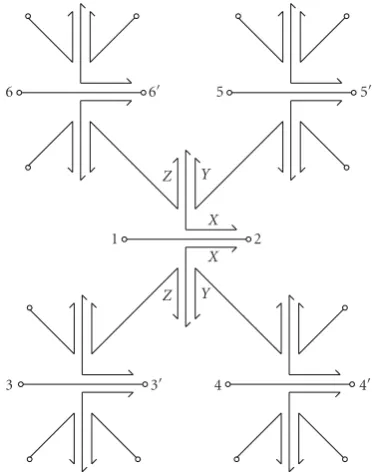
The phase and amplitude balance of the six-port coupler structure at the feed point of every transceiver and refer-ence element inFigure 4is crucial to the performance of our calibration scheme. This six-port coupler structure is shown schematically inFigure 10. In the case of the reference ele-ment, the output (port B) is terminated in a matched load (antenna) and the input connected to the reference element hardware (port A). Ports C−F of the coupler feed adjacent transceiver or reference elements. Similarly, for the radiative transceiver element, port B is connected to the antenna ele-ment and port A the transceiver RF hardware. For the indi-vidual coupler shown inFigure 10using conventional low-cost, stripline, board fabrication techniques, phase balance of 0.2 dB and 0.9◦is possible [18]. By interconnecting five of these couplers, then the basic 2×2 array plus single refer-ence sensor element building block of our scheme is formed. It is this pair of precision six-port directional couplers whose combined error will form the individual calibration paths be-tween transceiver and reference element.
A schematic representation of the 2×2 array coupler is shown inFigure 11. This forms the feed-point coupler struc-ture ofFigure 4, with the central coupler (port 1) connected to the reference element and the load (port 2). Each periph-eral couplers is connected to a radiative transceiver element
6 6 5 5
Z Y
X
1 2
X
Z Y
3 3 4 4
Figure11: Five precision couplers configured for 2×2 array cali-bration.
(ports 3–6). By tiling identical couplers at half integer wave-length spacing, our objective was to produce a coupler net-work with very high phase and amplitude balance.
4.2. Theoretical coupler performance
The simulation results for our coupler design, using ADS momentum, are shown inFigure 12[19]. Insertion loss at the design frequency of 2.46 GHz is predicted as 0.7 dB. The intertransceiver isolation is high—a minimum of 70.4 dB be-tween transceivers. In the design of the coupler structure, a tradeoffexists between insertion loss and transceiver isola-tion. By reducing the coupling factor between the antenna feeder transmission line and the coupled calibration path (markedXonFigure 11), higher efficiency may be attained. However, weaker calibration coupling than−40 dBm is un-desirable from the perspective of calibration reference ele-ment efficiency and measurement reliability. This necessi-tates stronger coupling between the calibration couplers— this stronger coupling in the second coupler stage (marked
Y orZ onFigure 11) will reduce transceiver isolation. It is for this reason that−20 dB couplers are employed in all in-stances (X,Y, andZ).
The ADS simulation predicts that the calibration path will exhibit a coupling factor of−44.4 dB, slightly higher than desired.
0
−20
−40
−60
−80
−100
−120
−140
A
m
plitude
(dB)
1 1.5 2 2.5 3 3.5 4 4.5 5
Frequency (GHz) S21
S31
S34 S36
Figure12: The theoretically predicted response of the ideal 2×2 coupler.
0.6 0.5 0.4 0.3 0.2 0.1 0
−0.1
−0.2
−0.3
Phase
imbalanc
e
(deg
re
es)
1 1.5 2 2.5 3 3.5 4
Frequency (GHz) Error 31–41
Error 31–51 Error 31–61
Figure13: The predicted phase imbalance of an ideal 2×2 coupler.
A,D(X,Z) type error and anA,C(X,Y) type error. This has the overall effect of reducing error. Were there to be a diago-nal bias toward the distribution of error, then the error would accumulate.
Also visible in these results is a greater phase and am-plitude balance between the symmetrically identical coupler pairs. For example, the phase and amplitude imbalance be-tween ports 3 and 6 is very high. This leads to efforts to in-crease symmetry in the design, particularly the grounding via screens.
4.3. Measured coupler performance
Our design forFigure 11 was manufactured on a low-cost FR-4 substrate using a stripline design produced in Eagle
0.06 0.04 0.02 0
−0.02
−0.04
−0.06
−0.08
A
m
plitude
imbalanc
e
(dB)
1 1.5 2 2.5 3 3.5 4
Frequency (GHz) Error 31–41
Error 31–51 Error 31–61
Figure14: The predicted amplitude imbalance of an ideal 2×2 coupler.
Figure 15: The PCB layout of the centre stripline controlled impedance conductor layer.
[20]—seeFigure 15. Additional grounding strips, connected by blind vias to the top and bottom ground layers, are visi-ble which provide isolation between the individual couplers. A photograph of the finished 2×2 coupler manufactured by ECS circuits [21] is shown inFigure 16. Each of the coupler arms is terminated in low-quality surface mount 47Ω resis-tors.
Figure16: A photograph of the transceiver side of the calibration coupler board. The opposite side connects to the antenna array and acts as the ground plane.
0
−20
−40
−60
−80
−100
−120
A
m
plitude
(dB)
1 1.5 2 2.5 3 3.5 4
Frequency (GHz) S21
S31
S34 S36
Figure17: The measured performance of the prototype 2×2 cou-pler.
coupled calibration path exhibits the desired coupling fac-tor of−38.8 dB at our design frequency of 2.46 GHz. This stronger coupling, together with the finite loss tangent of our FR4 substrate, explain the increased insertion loss. The measured inter-transceiver isolation was measured at a min-imum of−60.9 dB—thus the dominant source of (neighbor-ing) inter-element coupling is likely to be antenna mutual coupling.
The other important characteristics of the coupler, its phase and amplitude balance, are shown in Figures18 and 19respectively. Phase balance is significantly poorer than in-dicated by the theoretical value. The maximum phase error recorded at our design frequency of 2.46 GHz for this cou-pler is 0.938◦—almost an order of magnitude worse than the predicted imbalance shown inFigure 13.
15 10 5 0
−5
−10
−15
−20
Phase
imbalanc
e
(deg
re
es)
1 1.5 2 2.5 3 3.5 4
Frequency (GHz) Error 31–41
Error 31–51 Error 31–61
Figure18: The measured phase imbalance of the 2×2 coupler.
3.5 3 2.5 2 1.5 1 0.5 0
−0.5
A
m
plitude
imbalanc
e
(dB)
1 1.5 2 2.5 3 3.5 4
Frequency (GHz) Error 31–41
Error 31–51 Error 31–61
Figure19: The measured amplitude imbalance of the 2×2 coupler.
The amplitude balance results, Figure 19, are similarly inferior to the ADS predictions (contrast with Figure 14). The greatest amplitude imbalance is between S31 and S61 of 0.78 dB—compared with 0.18 dB in simulation. However, clearly visible in the amplitude response, and hidden in the phase error response, is the grouping of error characteristics between the paths S31-S41 and S51-S61.
Because the coupler error did not cancel as predicted by the ADS simulation, but is closer in performance to the series connection of a pair of individual couplers, future simulation of the calibration coupler should include Monte Carlo analy-sis based upon fabrication tolerance to improve the accuracy of phase and amplitude balance predictions.
1
Figure 20: The measured coupler amplitude imbalance fitted
a Gaussian probability density function, σA = 0.4131 dB, μA =
0.366 dB.
Figure21: The measured coupler phase imbalance fitted to a
Gaus-sian probability density functionσφ=1.672◦,μφ=0.371◦.
results, three 2×2 coupler boards were manufactured and the phase and amplitude balance of each of them recorded at our design frequency of 2.46 GHz. These results are plotted against the Gaussian distribution to which the results were fitted for the amplitude and phase (Figures20and21 cor-respondingly). Whilst not formed from a statistically signifi-cant sample (only nine points were available for each distri-bution), these results are perhaps representative of the cali-bration path imbalance in a small array. The mean and stan-dard deviation of the coupler amplitude imbalance distri-bution areμcA =0.366 dB andσcA =0.4131 dB. This error is somewhat higher than predicted by our theoretical study. Work toward improved amplitude balance is ongoing. The phase balance, with an rms error of 1.672◦, is of the order anticipated given the performance of the individual coupler.
0.9
Number of elements,N Simulation
Theory
Figure22: The theoretical prediction of overall array amplitude cal-ibration accuracy based upon the use of the coupler hardware of
Section 4.1.
Number of elements,N Simulation
Theory
Figure23: The theoretical prediction of overall array phase cali-bration accuracy based upon the use of the coupler hardware of
Section 4.1.
With this additional insight into the statistical distribu-tion of error for a single coupled calibradistribu-tion path, we may make inferences about the overall array calibration accuracy possible with such a system.
4.4. Predicted array calibration performance
TRx TRx TRx
Sense Sense
TRx TRx TRx
Sense Sense
TRx TRx TRx
Figure24: The redundant coupled calibration paths which may be useful in enhancing the quality of calibration.
The results from these figures show that the approach yields a highly accurate calibration, with rms phase errors for a typical 16-element array of less than 2◦and a gain imbal-ance of less than 0.55 dB. As arrays increase in size, the er-rors do increase. For phase calibration, the increase is small even for very large arrays. Gain calibration is more sensitive to size and a 96-element array would have a 0.85 dB rms er-ror. Ongoing work is focused upon improving the gain cali-bration performance for larger arrays. The following section is presenting some initial results for alternative calibration schemes which utilise the additional information from the redundant calibration paths.
5. FUTURE WORK
5.1. Redundant coupler paths
In each of the calibration algorithms discussed thus far, only a fraction of the available coupled calibration paths is em-ployed.Figure 24shows the coupled paths which are redun-dant in the “top-left” calibration scheme ofFigure 6(b). The focus of future work will be to exploit the extra information which can be obtained from these redundant coupler paths.
5.2. Iterative technique 5.2.1. Operation
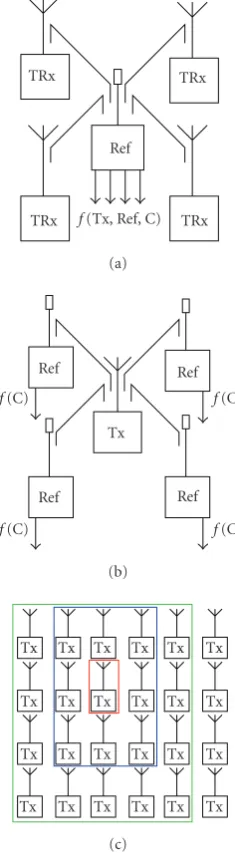
Given that we cannot measure the array output without in-curring error due to the imbalance of each coupler, we have devised a heuristic method for enhancing the antenna array calibration accuracy. This method is designed to exploit the additional, unused coupler paths and information about the general distribution and component tolerance of the errors within the calibration system, to improve calibration accu-racy. One candidate technique is based loosely on the iter-ative algorithmic processes outlined in [23]. Our method is a heuristic, threshold-based algorithm and attempts to in-fer the actual error in each component of the calibration system—allowing them to be compensated for.
TRx TRx
Ref
TRx f(Tx, Ref, C) TRx (a)
Ref Ref
Tx
Ref Ref
f(C) f(C)
f(C) f(C)
(b)
Tx Tx Tx Tx Tx Tx Tx Tx Tx Tx Tx Tx Tx Tx Tx Tx Tx Tx Tx Tx Tx Tx Tx Tx
(c)
Figure25: The two main processes of our heuristic method: (a) reference characterisation and (b) transmitter characterisation. (c) The error dependency spreads from the neighbouring elements with each iteration of the heuristic process.
The second phase,Figure 25(b), repeats the process de-scribed above, this time for each transmitter. Here the func-tionally equivalent step of measuring each transmitter by the four neighbouring references is performed. Again, the mean performance of each block in the signal path is calculated and subtracted. However, during this phase the reference error is treated as aknownquantity—using the inferred value from the previous measurement. Based on this assumption, the re-sultant error signal is a function of the coupler error and the common transceiver element alone.
By extrapolating the transmitter error, using the same process as for the reference element, the coupler errors may be calculated and compensated for by weighting the transceiver input. This process is repeated. In each subse-quent iteration, the dependency of the weighting error sig-nal is dependent upon successive concentric array elements as illustrated inFigure 25(c).
The iterative process continues for much greater thann iterations, until either subsequent corrective weightings are within a predefined accuracy, or until a time limit is reached. Cognisant of the negative effect that the peripheral ele-ments of the array will have on the outcome of this calibra-tion scheme, these results are discarded. For the results pre-sented here, this corresponds to the connection of an addi-tional ring of peripheral reference elements to the array. Fu-ture work will focus on the combining algorithmic and con-ventional calibration techniques to negate the need for this additional hardware.
5.2.2. Provisional results
To test the performance of this calibration procedure, the results are of 1000 simulations of a 10× 10 array, each performed for 100 calibration iterations, was simulated us-ing the system settus-ings ofSection 4.4. The centre calibration scheme gave an overall rms array calibration accuracy (σa) of 0.857 dB and 2.91◦. The iterative calibration procedure gives a resultant phase accuracy of 1.32◦and amplitude accuracy of 0.7148 dB.Figure 26shows how the amplitude accuracy of the iterative calibration varies with each successive iteration. The horizontal line indicates the performance of the centre-referenced calibration. A characteristic of the algorithm is its periodic convergence. This trait, shared by simulated anneal-ing algorithms, prevents convergence to (false) local min-ima early in the calibration process. This, unfortunately, also limits the ultimate accuracy of the array calibration. For in-stance, the phase accuracy of this array (Figure 27) degrades by 0.1◦to 1.32◦from its minimum value, reached on the 37th iteration. Future work will focus on tuning the algorithm’s performance, perhaps to attenuate this oscillation in later it-erations with a temperature parameter (T) and associated re-duction function f(T). Hybrid algorithms—targeting diff er-ent calibration techniques at different sections of the array— are also currently under investigation.
6. CONCLUSION
In this paper, we have presented a new scheme for tower-top array calibration, using a series of nonradiative, interlinear
1.5
Figure26: Resultant array amplitude feed-point calibration
accu-racy (σaA) for a singleN =100 array, plotted versus the number of
Figure27: Resultant array phasing feed-point calibration accuracy
(σaφ) for a singleN=100 array, plotted versus the number of
cali-bration iterations.
reference elements to sense the output of the array. The ac-curacy of this calibration scheme is a function of the array size, the calibration path taken in calibrating the array, and the coupler performance. Where the measurement accuracy is unlimited, then the accuracy of this calibration is depen-dent upon the number of couplers in a given calibration path. The basic building block of this calibration scheme is the 2×2 array calibration coupler. We have shown that using low-cost fabrication techniques and low-quality FR-4 sub-strate, a broadband coupler network with rms phase balance of 1.1175◦and amplitude balance of 0.3295 dB is realisable.
precision coupler network and on the development of cali-bration algorithms to further reduce this requirement.
Finally, we presented examples of one such algorithm— whose performance, unlike that of the conventional feedback algorithms, improves with array size. Moreover, this calibra-tion algorithm, which is based upon exploiting randomness within the array, outperforms conventional calibration for large arrays. Future work will focus on use of simulated an-nealing and hybrid calibration algorithms to increase calibra-tion accuracy.
ACKNOWLEDGMENT
The authors would like to thank Science Foundation Ireland for their generous funding of this project through the Centre for Telecommunications Value-Chain Research (CTVR).
REFERENCES
[1] N. Tyler, B. Allen, and H. Aghvami, “Adaptive antennas: the
calibration problem,” IEEE Communications Magazine, vol.
42, no. 12, pp. 114–122, 2004.
[2] C. M. Simmonds and M. A. Beach, “Downlink calibration re-quirements for the TSUNAMI (II) adaptive antenna testbed,” inProceedings of the 9th IEEE International Symposium on Per-sonal, Indoor and Mobile Radio Communications (PIMRC ’98), vol. 3, pp. 1260–1264, Boston, Mass, USA, September 1998. [3] K. Sakaguchi, K. Kuroda, J.-I. Takada, and K. Araki,
“Com-prehensive calibration for MIMO system,” inProceedings of
the 5th International Symposium on Wireless Personal Multime-dia Communications (WPMC 3’02), vol. 2, pp. 440–443, Hon-olulu, Hawaii, USA, October 2002.
[4] C. M. S. See, “Sensor array calibration in the presence of
mu-tual coupling and unknown sensor gains and phases,”
Elec-tronics Letters, vol. 30, no. 5, pp. 373–374, 1994.
[5] R. Sorace, “Phased array calibration,”IEEE Transactions on
Antennas and Propagation, vol. 49, no. 4, pp. 517–525, 2001. [6] K. R. Dandekar, L. Hao, and X. Guanghan, “Smart antenna
ar-ray calibration procedure including amplitude and phase
mis-match and mutual coupling effects,” inProceedings of the IEEE
International Conference on Personal Wireless Communications (ICPWC ’00), pp. 293–297, Hyderabad, India, December 2000. [7] T. Kaiser, “When will smart antennas be ready for the market?
Part I,”IEEE Signal Processing Magazine, vol. 22, no. 2, pp. 87–
92, 2005.
[8] F. Rayal, “Why have smart antennas not yet gained traction
with wireless network operators?”IEEE Antennas and
Propa-gation Magazine, vol. 47, no. 6, pp. 124–126, 2005.
[9] G. Brown, “3G base station design and wireless network
eco-nomics,”Unstrung Insider, vol. 5, no. 10, pp. 1–30, 2006.
[10] J. D. Fredrick, Y. Wang, and T. Itoh, “A smart antenna re-ceiver array using a single RF channel and digital
beamform-ing,”IEEE Transactions on Microwave Theory and Techniques,
vol. 50, no. 12, pp. 3052–3058, 2002.
[11] S. Ishii, A. Hoshikuki, and R. Kohno, “Space hopping scheme under short range Rician multipath fading environment,” in Proceedings of the 52nd Vehicular Technology Conference (VTC ’00), vol. 1, pp. 99–104, Boston, Mass, USA, September 2000.
[12] A. J. Cooper, “‘Fibre/radio’ for the provision of
cord-less/mobile telephony services in the access network,”
Electron-ics Letters, vol. 26, no. 24, pp. 2054–2056, 1990.
[13] G. Brown, “Open basestation bonanza,” Unstrung Insider,
vol. 4, no. 7, pp. 1–20, 2005.
[14] T. Cooper and R. Farrell, “Value-chain engineering of a
tower-top cellular base station system,” inProceedings of the IEEE
65th Vehicular Technology Conference (VTC ’07), pp. 3184– 3188, Dublin, Ireland, April 2007.
[15] T. S. Cooper, R. Farrell, and G. Baldwin, “Array Calibration,” Patent Pending S2006/0482.
[16] T. Cooper, J. McCormack, R. Farrell, and G. Baldwin, “To-ward scalable, automated tower-top phased array calibration,” inProceedings of the IEEE 65th Vehicular Technology Conference (VTC ’07), pp. 362–366, Dublin, Ireland, April 2007. [17] Analog Devices Datasheet, “400 MSPS 14-Bit DAC 1.8V
CMOS Direct Digital Synthesizer,” January 2003.
[18] T. S. Cooper, G. Baldwin, and R. Farrell, “Six-port precision
directional coupler,” Electronics Letters, vol. 42, no. 21, pp.
1232–1234, 2006.
[19] Agilent EEsof, Palo Alto, Calif, USA. Advanced Design System, Momentum.
[20] CadSoft Computer, 801 South Federal Hwy., Suite 201, Delray Beach, FL 33483-5185. Eagle.
[21] ECS Circuits, Unit 2, Western Business Park, Oak Close, Dublin 12, Ireland.
[22] Rhode & Schwartz Vertiriebs-GmbH, Muehldorfstrasse 15, 81671 Muenchen, Germany.
[23] J. Hromkovic, Algorithmics for Hard Problems, Springer,