Volume 2008, Article ID 851726,9pages doi:10.1155/2008/851726
Research Article
DOA Estimation in the Uplink of Multicarrier CDMA Systems
Antonio A. D’Amico, Michele Morelli, and Luca Sanguinetti
Department of Information Engineering, University of Pisa, Via Caruso, 56126 Pisa, Italy
Correspondence should be addressed to Antonio A. D’Amico,[email protected]
Received 15 May 2007; Accepted 23 October 2007
Recommended by Luc Vandendorpe
We consider the uplink of a multicarrier code-division multiple-access (MC-CDMA) network and assume that the base station is endowed with a uniform linear array. Transmission takes place over a multipath channel and the goal is the estimation of the directions of arrival (DOAs) of the signal from the active users. In a multiuser scenario, difficulties are primarily due to the large number of parameters involved in the estimation of the DOAs which makes this problem much more challenging than in single-user transmissions. The solution we propose allows estimating the DOAs of different users independently, thereby leading to a significant reduction in the system complexity. In the presence of multipath propagation, however, estimating the DOAs of a given user through maximum-likelihood methods remains a formidable task since it involves a search over a multidimensional domain. Therefore, we look for simpler solutions and discuss two alternative schemes based on the SAGE and ESPRIT algorithms.
Copyright © 2008 Antonio A. D’Amico et al. This is an open access article distributed under the Creative Commons Attribution License, which permits unrestricted use, distribution, and reproduction in any medium, provided the original work is properly cited.
1. INTRODUCTION
Antenna arrays at the base station (BS) can dramatically im-prove the capacity of a communication system [1–3]. Ac-tually, they can be exploited in various ways. First, to form retrodirective beams that select the desired signals and at-tenuate the interfering ones. Secondly, antenna arrays make it possible to implement space-time selective transmission in the downlink. Finally, they can provide accurate local-ization of the user terminals [4], which is of interest in ad-vanced handover schemes, public safety services, and intel-ligent transportation systems. In all these applications, ac-curate estimation of the directions of arrival (DOAs) of the desired signals is required.
DOA estimation has received much attention in the past years and several solutions are available in the technical lit-erature (see [5–9] and the references therein). In particular, the schemes discussed in [5,6] have good performance but are only devised for single-user applications and cannot be directly used in the uplink of a multiuser system. A tuto-rial review of subspace-based methods for DOA estimation is provided in [7]. The main drawback of these algorithms is that they can only handle a limited number of users since the overall number of resolvable paths cannot exceed the num-ber of sensors in the antenna array. For this reason their
ap-plication to a scenario with tens of users and several paths per user (as envisioned in fourth generation wireless sys-tems) seems hardly viable. Schemes for estimating the DOAs in a CDMA multiuser system have been recently proposed in [8,9]. In particular, the method discussed in [9] concentrates on a single user’s parameters and models the multiple-access interference (MAI) as colored Gaussian noise. This idea is ef-fective as it splits the multiuser DOA estimation problem into a series of simpler tasks in which DOAs of different users are estimated independently instead of jointly. A possible short-coming of this method is that it requires knowledge of the MAI covariance matrix, which must be estimated in some manner.
the channel response and the data symbols of each active user by resorting to the method discussed in [12]. Once channel estimates and data decisions are obtained, they are exploited to reconstruct the interfering signals, which are then sub-tracted from the received waveform. This produces an MAI-free signal which is finally used for DOA estimation. In this way the DOAs are estimated independently for each user but, contrarily to [9], no knowledge of the MAI statistics is re-quired.
In spite of the significant simplification achieved by means of users’ separation, estimating the DOAs of a given user through ML methods is still difficult as it involves a numerical search over a multidimensional domain. To re-duce the system complexity we investigate two alternative schemes. The first is based on the space-alternating gener-alized expectation-maximization (SAGE) algorithm [13], in which the DOAs of a given user are estimated sequentially in-stead of jointly. This reduces the original multidimensional problem to a sequence of one-dimensional searches. The second scheme exploits the ESPRIT (Estimation of Signal Parameters by Rotational Invariance Techniques) algorithm [14] and estimates the DOAs in closed form.
The main contribution of this paper is a method for esti-mating the DOAs of all active users in an MC-CDMA sce-nario characterized by multiple resolvable paths. As men-tioned previously, the major difficulty comes from the need of separating each user from the others before his DOAs can be estimated. Notice that conventional DOA estimation algo-rithms cannot be employed in such a scenario unless users’ separation has been successfully completed, since otherwise the number of sensors in the antenna array should be pro-hibitively high (on the order of the total number of resolv-able paths). To the best of the authors’ knowledge, a similar problem has previously been addressed only in [15]. In par-ticular, the solution proposed in [15] is tailored for the rate 3/4 space-time block code introduced by Tarokh in [16] and assumes a static channel with a single DOA for each user. Un-fortunately, its extension to a time-varying multipath chan-nel with possibly multiple DOAs for each user does not seem straightforward. A second contribution is a comparison be-tween two popular schemes, namely, the SAGE and ESPRIT algorithms, both in terms of estimation accuracy and system complexity.
The rest of the paper is organized as follows.Section 2 describes the signal model and introduces basic notation. In Section 3we derive the methods for estimating the DOAs. Simulation results are discussed inSection 4and some con-clusions are offered inSection 5.
2. SIGNAL MODEL
2.1. MC-CDMA system
We consider the uplink of an MC-CDMA network employ-ingNsubcarriers for the transmission ofNu< N data
sym-bols. TheNumodulated subcarriers are located in the middle
of the signal bandwidth and are divided into smaller groups ofQelements [17]. The remainingN−Nusubcarriers at the
edges of the spectrum are not used to limit the out-of-band
radiation (virtual carriers). The BS is equipped with P an-tennas and employs the subcarriers of a given group to com-municate withKusers that are separated through orthogo-nal Walsh-Hadamard (WH) codes of lengthQ≥K. Without loss of generality, we concentrate on a single group and as-sume that theQsubcarriers are uniformly spread over the signal bandwidth so as to exploit the channel frequency di-versity. We denote{in; 1≤n≤Q}the subcarrier indices in
the group, within=i1+ (n−1)Nu/Q.
Theith symbolak(i) of thekth user is spread overQchips
using the code sequence ck = [ck(1)ck(2)· · ·ck(Q)]T,
whereck(n)∈ {±1/
Q}and the notation (·)Tmeans trans-pose operation. The resulting vectorak(i)ckis then mapped
ontoQsubcarriers using an OFDM modulator. The chan-nel is assumed static over an OFDM block (slow-fading) and anNG-point cyclic prefix (longer than the channel impulse
response) is inserted to avoid interference between adjacent blocks.
At the receiver side the incoming waveform is first fil-tered and then sampled with period Ts = TB/(N +NG),
where TB is the block duration. Next, the cyclic prefix is
removed and the remaining samples are passed to an N -point discrete Fourier transform (DFT) unit. We concen-trate on the mth MC-CDMA block and denote Xp(m) =
[Xp(m,i1)Xp(m,i2)· · ·Xp(m,iQ)]T the demodulator
out-puts at thepth antenna corresponding to theQsubcarriers of the considered group. Also, we assume a quasisynchronous system in which each user is time-aligned to the BS reference in a way similar to that discussed in [18]. In these circum-stances we have
Xp(m)= K
k=1
ak(m)up,k(m) +wp(m), p=1, 2,. . .,P,
(1)
whereup,k(m) is aQ-dimensional vector with entries
up,k
m,n=Hp,k(m,in)ck(n), 1≤n≤Q, (2)
and Hp,k(m,in) is the kth user’s channel frequency
re-sponse over the inth subcarrier at the pth antenna. Also,
wp(m) = [wp(m,i1)wp(m,i2)· · ·wp(m,iQ)]T is thermal
noise, which is modeled as a Gaussian vector with zero mean and covariance matrixσ2I
Q(we denoteIQthe identity matrix
of orderQ).
2.2. Channel model
We assume that the P receive antennas are arranged in a uniform linear array with interelement spacing δ. The sig-nal transmitted by each user propagates through a multipath channel withLdistinct paths. Thus, thekth baseband chan-nel impulse response (CIR) at thepth antenna during the
mth MC-CDMA block takes the form
hp,k(m,t)= L
=1
α,k(m)ej(p−1)ω,k(m)g
t−τ,k(m)
, (3)
-path andα,k(m) the corresponding complex amplitude.
equivalent to measuringϕ,k(m) since there is a one-to-one
relation between these quantities provided that ϕ,k(m) is
limited within±90◦andδ≤λ/2. In the following we assume that the path delays and DOAs do not change significantly with time, that is, we setτ,k(m)≈τ,kandϕ,k(m)≈ϕ,k.
Vice versa, the path gainsα,k(m) are modeled as
indepen-dent Gaussian random processes with zero-mean and aver-age powerσ2
=E{|α,k(m)|2}.
The channel frequency responseHp,k(m,in) is computed
as the Fourier transform ofhp,k(m,t) at f =in/Tand reads
CDMA block andG(in) is the frequency response ofg(t) at
theinth subcarrier. In the sequel, we assume that theNu
mod-ulated subcarriers are located within the flat region ofG(in).
In these circumstances,Hp,k(m,in) reduces to
whereG(in) has been set equal to unity without loss of
gen-erality.
Notice that our multiuser scenario assumesKLresolvable paths. In practice,KLmay be so large to prevent the joint es-timation of the DOAs of all active users. To overcome this obstacle, we propose to estimate the DOAs of each user sepa-rately. In doing so we first compute estimates of the channel responses and data symbols of all active users. Next we ex-ploit these results to reconstruct the interfering signals and cancel them out from the DFT output, thereby isolating the signal of the desired user. The problem of channel estima-tion and data detecestima-tion is accomplished using the method discussed in [12] which provides accurate results with lim-ited complexity. For this purpose, we assume that the MC-CDMA blocks are organized in frames. As shown inFigure 1, each frame is composed byNB data blocks preceded byNT
training blocks that are exploited to get initial estimates of Hp,k(m) (acquisition). Such estimates are then updated
dur-ing the data section of the frame (trackdur-ing) by means of the least-mean-square (LMS) algorithm.
3. DOA ESTIMATION
In this section, we show how the channel estimates and data decisions are exploited to perform DOA estimation. To this end, we denote by {ak(m)}the data decisions and
NTtraining blocks NBdata blocks Figure1: Frame structure.
sponses. We begin by computing the following quantities during themth received block:
yp,k
It is worth noting that apart from thermal noise, only the contribution of thekth user is present in the right-hand side (RHS) of (9). This amounts to saying that the quantities
{yp,k(m,in)}are MAI-free and, therefore, they can be used
to estimate the DOAs of thekth user. In this way, DOA esti-mation is performed independently for each active user in-stead of jointly and the complexity of the overall estimation process is significantly reduced.
As mentioned inSection 2.2, measuringω,kis equivalent
to measuring the DOAϕ,k. Without loss of generality, in this
3.1. ML estimation
During themth received block, the quantities{yp(m,in)}are
arranged intoP-dimensional vectors
ym,in
We assume slow channel variations so thatd(m,in) can be
considered practically constant overNsconsecutive blocks.
Then, we divide the data section of the frame into adjacent segments, each containingNsblocks, and compute the
fol-lowing average:
whereris the segment index andRdenotes the number of segments within the frame (the number of data blocks in each frame isNB=Ns×R). Substituting (9) into (11),
bear-statistically independent Gaussian vectors with zero-mean and covariance matrix Cη = (σ2/Ns)IP. Letting F(ω) =
irrelevant terms and factors, the log-likelihood function for
ωand{dr(in)}takes the form
eters while·denotes Euclidean norm. Keepingωfixed and lettingdr(in) vary, the minimum of (14) is achieved for
Next, substituting (15) into (14) and maximizing with re-spect toωproduce
Unfortunately there is no closed form solution to the maxi-mization of (16). The only possible approach is to perform a search over theL-dimensional space spanned byω. As the computational load would be too intense, in the next subsec-tion we employ the SAGE algorithm to find an approximate solution of (16).
Remark 1. The ML estimators (15)-(16) have been derived using channel estimates given in (7). In principle, one can di-rectly use the estimates provided by the LMS channel tracker, which are more or less correlated depending on the value of the step-size employed in the tracking algorithm. In contrast, assuming perfect interference cancellation, it is easily recog-nized that (7) provides uncorrelated channel estimates that facilitate the derivation of the joint ML estimator ofωand
{dr(in)}. Since the additional complexity involved by (7) is
negligible, we have adopted the latter approach.
3.2. SAGE-based estimation
In a variety of ML estimation problems the maximization of the likelihood function is analytically unfeasible as it in-volves a numerical search over a huge number of parame-ters. In these cases the SAGE algorithm proves to be effec-tive as it achieves the same final result with a comparaeffec-tively simpler iterative procedure. Compared with the more famil-iar EM algorithm [19], the SAGE has a faster convergence rate. The reason is that the maximizations involved in the EM algorithm are performed with respect to all the unknown parameters simultaneously, which results in a slow process that requires searches over spaces with many dimensions. Vice versa, the maximizations in SAGE are performed vary-ing small groups of parameters at a time. In the followvary-ing, the SAGE algorithm is applied to our problem without fur-ther explanation. The reader is referred to [13] for details.
Returning to the joint estimation ofωand{dr(in)}, we
apply the SAGE algorithm in such a way that the parame-ters of a single path are updated at a time. This leads to the following procedure consisting of cycles and steps. A cycle is made ofLsteps and each step updates the parameters of a single path. In particular, the-step of theith cycle looks for the minimum of
{dq,r(in),ωq}are exploited to cancel out the multipath
inter-Note that only one-dimensional searches are involved in (19).
The following remarks are of interest.
(1) The maximization in the RHS of (19) is pursued through a two-step procedure. The first (coarse search) computes Ψ(i)(ω) over a grid of Ng values, say
{ω(j);j =1, 2,. . .,Ng}, and determines the location
ωmax of the maximum. In the second step (fine search) the quantities {Ψ(i)(ω(j))} are interpolated and the
local maximum nearest toωmax is found.
(2) From (21) it follows thatΨ(i)(ω) is a periodic function
of ω with period 2π. Thus, the maximum ofΨ(i)(ω)
lies in the interval (−π,π] and, in consequence, the es-timator (19) gives correct results provided that|ω|<
π. From (4) it is seen that this condition is easily met using an antenna array with interelement spacing less than half the free-space wavelength.
(3) In applying the SAGE we have implicitly assumed knowledge of the numberLof paths. In practiceLis unknown and must be established in some way. One possible way is to chooseLlarge enough so that all the paths with significant energy are considered. Alterna-tively, an estimate ofLcan be obtained in the first cycle as follows. Physical reasons and simulation results in-dicate that in any cycle the multipath components are taken in a decreasing order of strength. On the other hand, if{d(1),r(in)}are the estimates of{d,r(in)}at the
first cycle, an indication of the energy of theth path is
Thus, the first cycle may be stopped at that step, say , whereE drops below a prefixed threshold andL=
−1 may be taken as an estimate of the number of significant paths.
(4) The computational load of the SAGE is assessed as follows. Evaluating {Y(i,)r(in)}forr = 1, 2,. . .,R and
n = 1, 2,. . .,Q needs O(RQLP) operations at each step. The complexity involved in the computation of
{d(i,)r(in)}in (20) isO(RQP) whileO(RQPNg)
opera-tions are required to compute the quantitiesΨ(i)(ω(j))
forj=1, 2,. . .,Ng. DenotingNithe number of cycles
and bearing in mind that each cycle is made ofLsteps, it follows that the overall complexity of the SAGE is O[RQLPNi(L+Ng+ 1)].
3.3. ESPRIT-based estimation
An alternative approach for estimating the DOAs relies on subspace-based methods like the MUSIC (Multiple Signal Classication) [20] or ESPRIT algorithms [14]. In the follow-ing we discuss DOA estimation based on ESPRIT. The reason is that this method provides estimates in closed form while a grid-search is needed with MUSIC.
To begin, we exploit vectors{y(m,in)}in (10) to compute
the sample correlation matrix
Then, based on the forward-backward (FB) approach [21], we obtain the following modified sample correlation matrix
in whichJis the exchange matrix with 1’s on its antidiagonal and 0’s elsewhere.
In the ESPRIT method, the eigenvectors associated with the L largest eigenvalues of Ry are arranged into a P ×L
matrix V = [v1 v2· · · vL]. Next, we consider the
matri-cesV1 = [IP−10]VandV2 = [0 IP−1]V, where0 is anL -dimensional column vector with zero entries. The estimate ofωis eventually obtained as
The following remarks are of interest.
(1) A necessary condition for the existence of (VH
1V1) −1
in RHS of (26) is that the number of rows inV1is greater than or equal to the number of columns. SinceV1has dimension (P−1)×L, the above condition implies thatP ≥L+ 1, that is, the number of antennas must be greater than the number of multipath components. We also observe that the inverse ofFH(ω)F(ω) in the
ML estimator (16) exists provided thatF(ω) is full rank andP≥L. Thus, DOA estimation with ESPRIT needs one more antenna compared with the ML estimator. It is worth noting that the minimum number of an-tennas required by both schemes isindependentof the numberKof contemporarily active users.
the correlation matrixRyin (24) (arranged in a
non-increasing order of magnitude). Then, an estimate ofL
is computed as
L=arg min
L∈{0,1,...,P−1}
−NBQ
P−Llog GML
AML
+1 4L
2P−L+ 1logNBQ
,
(27)
whereLis a trial value ofLwhile GM(L) and AM(L) denote thegeometricandarithmeticmeans of{μi;L+
1≤i≤P}respectively, that is,
GML=
P
i=L+1 μi
1/(P−L) ,
AML= 1
P−L
P
i=L+1 μi.
(28)
(3) The complexity of the ESPRIT is assessed as follows. Evaluating Ry in (23) needs O(P2NBQ) operations.
Bearing in mind that inverting an L×L matrix re-quiresO(L3) operations, it follows that the complexity involved in the computation of Sin (26) is approxi-mately O[L2(L+ 3P)]. Finally, computing the eigen-vectors of SneedsO(L3) operations. In summary, the overall complexity of the ESPRIT isO[P2N
BQ+L2(2L+
3P)]. In writing this figure we have ignored the oper-ations required to computeRy,V1, andV2since these matrices are easily obtained from Ry with negligible
complexity.
4. SIMULATION RESULTS
4.1. System parameters
We consider a cellular system operating over a typical ur-ban area with a cell radius of 1 km. The transmitted sym-bols belong to a QPSK constellation and are obtained from the information bits through a Gray map. The number of modulated subcarriers is Nu = 48 and the DFT has
di-mensionN = 64. Walsh-Hadamard codes of lengthQ =8 are used for spreading purposes. The signal bandwidth is B=8 MHz, so that the useful part of each MC-CDMA block has lengthT = N/B = 8 microseconds. The sampling pe-riod isTs = T/N = 0.125 microsecond and a cyclic prefix
ofTG =2 microseconds is adopted to eliminate interblock
interference. This corresponds to an extended block (includ-ing the cyclic prefix) of 10 microseconds. The users are syn-chronous within the cyclic prefix and have the same power. The carrier frequency is f0 = 2 GHz (corresponding to a wavelengthλ =15 cm) and the interelement spacing in the antenna array isδ=λ/2. The channel impulse responses of the active users are generated as indicated in (3) with three paths (L =3). Pulseg(t) has a raised-cosine Fourier trans-form with roll-off0.22 and duration Tg = 8Ts = 1
mi-crosecond. The path delays and DOAs of the desired user are
equal to (τ1 = 0,ϕ1=0◦), (τ2 = 1.5Ts,ϕ2 = −20◦), and (τ3 = 3.5Ts,ϕ3=45◦). Vice versa, path delays and DOAs of the interfering users are uniformly distributed within [0, 1] microseconds and [−60◦, 60◦], respectively, and are kept constant over a frame. For all active users (including the de-sired one), the path gains have powers
σ2=σ2Hexp (−), =0, 1, 2, (29)
whereσ2
His chosen such that the channel energy is
normal-ized to unity, that is,E{Hp,k(m)2} = 1. Each path varies
independently of the others within a frame and is generated by filtering a white Gaussian process in a third-order lowpass Butterworth filter. The 3-dB bandwidth of the filter is taken as a measure of the Doppler rate fD= f0v/c, wherevdenotes the speed of the mobile terminal andc=3×10⁸m/s is the speed of light.
A simulation run begins with the generation of the chan-nel responses of each user. Chanchan-nel acquisition is performed using Walsh-Hadamard training sequences of lengthNT =8
while channel tracking is accomplished by exploiting data de-cisions provided by a parallel interference cancellation (PIC) receiver [12]. Throughout simulations the number of data blocks per frame is set toNB=128. Once channel estimates
and data decisions are obtained, they are passed to the pro-posed SAGE- or ESPRIT-based DOA estimators. The SAGE computes the functionΨ(i)(ω) over a grid of Ng =64 values
and it is stopped at the end of the second cycle (Ni=2).
Pa-rameterNsin (11) is fixed to 16, so thatR=NB/Ns=8. The
mobile velocity, the number of users, and the number of an-tennas are varied throughout simulations so as to assess their impact on the system performance.
4.2. Performance assessment
The system performance has been assessed in terms of root mean-square-error (RMSE) of the DOA estimates. For sim-plicity, the numberLof paths is assumed perfectly known at the receiver.
Figure 2illustrates the performance of the SAGE-based scheme versusEb/N0 (Eb is the average received energy per
bit andN0/2 is the two-sided noise power spectral density) for a half-loaded system (K=4). The mobile speed is 10 m/s and the number of sensors in the array isP =6. Marks in-dicate simulation results while solid lines are drawn to ease the reading. We see that the curves exhibit a floor. In par-ticular, the RMSE of the weakest path is approximately 15 degrees forEb/N0 >10 dB. The appearance of the floor can be explained as follows. Inspection of (19) and (21) reveals that at the first step of the first cycle, the SAGE looks for the maximum of the periodogramψ(1)1 (ω). Neglecting the effect of thermal noise, we expect thatψ(1)1 (ω) has three peaks lo- cated at the angular frequenciesωi=πsin ϕifori=1, 2, 3.
24 21 18 15 12 9 6 3 0
Eb/N0(dB)
0 5 10 15 20 25
RMSE
(deg
rees)
1st path 2nd path 3rd path
SAGE K=4,P=6
v=10 m/s
Figure2: Performance of the SAGE estimator withK =4,P =6, andv=10 m/s.
in the absence of noise. Note that inFigure 2we haveω1=0, ω2 = −π sin 20◦ and P = 6, so that the separation be-tween the first and second paths is close to the resolution limit 2π/P. Extensive simulations (not shown for space lim-itations) indicate that the floor of the SAGE estimator be-comes smaller and smaller as the difference between the pow-ers of the first and second path increases. The reason is that in these circumstances the smearing effect reduces and the parameters of the strongest path can be accurately estimated and canceled out fromYr(in) (see (18)).
Figure 3shows simulation results as obtained with the ESPRIT estimator in the same operating conditions of Figure 2. As we see, the RMSE curves have no floor. The reason is that ESPRIT is ahigh-resolutiontechnique, mean-ing that it can resolve angular frequencies separated by less than 2π/P. Comparing toFigure 2, however, it turns out that the SAGE estimator performs better than the ESPRIT at low signal-to-noise ratios (SNRs).
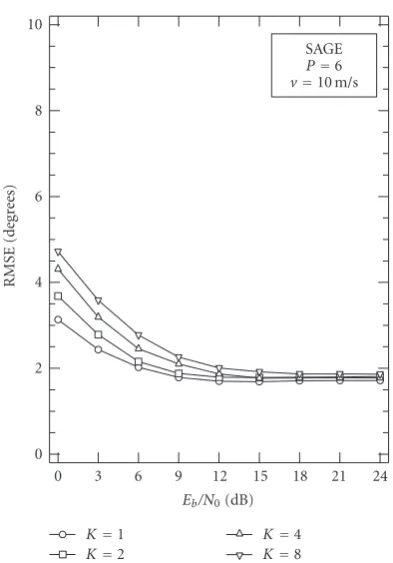
Figure 4 shows the performance of the SAGE scheme withP =6,v=10 m/s, andK =1, 2, 4, or 8. In order not to overcrowd the figure, only the RMSE of the strongest path is shown. It turns out that the number of active users has lit-tle impact on the accuracy of the SAGE-based estimator. In particular, the comparison with the single-user case (K=1) demonstrates the effectiveness of the proposed cancellation scheme in combating the multiple-access interference.
24 21 18 15 12 9 6 3 0
Eb/N0(dB)
0 5 10 15 20 25
RMSE
(deg
rees)
1st path 2nd path 3rd path
ESPRIT K=4,P=6
v=10 m/s
Figure3: Performance of the ESPRIT estimator withK=4,P=6, andv=10 m/s.
24 21 18 15 12 9 6 3 0
Eb/N0(dB)
0 2 4 6 8 10
RMSE
(deg
rees)
K=1 K=2
K=4 K=8
SAGE P=6 v=10 m/s
Figure 4: Performance of the SAGE estimator forP = 6, v =
24 21 18 15 12 9 6 3 0
Eb/N0(dB)
0 2 4 6 8 10
RMSE
(deg
rees)
K=1 K=2
K=4 K=8
ESPRIT P=6 v=10 m/s
Figure5: Performance of the ESPRIT estimator forP = 6,v =
10 m/s, and some values ofK.
The same conclusions hold for the ESPRIT-based estima-tor, as shown by the simulation results reported inFigure 5.
The dependence of the system performance on the num-ber of antennas is shown inFigure 6. As expected, the estima-tion accuracy improves asPincreases. In particular, the floor in the SAGE algorithm is approximately 1.8 degrees when P = 6 and reduces to 0.75 degrees withP =8. This can be explained bearing in mind that the resolution capability of the SAGE estimator increases withP.
Figure 7 illustrates the performance of the proposed schemes for several mobile speeds. The system is half-loaded and the number of antennas isP=6. For simplicity, only the RMSE of the strongest path is shown. At first sight the results of this figure look strange in that the system performance im-proves as the mobile speed increases. The explanation is that the channel variations provide the system with time diversity. Actually, the DOA estimate of a weak multipath component improves if the path strength varies over the frame duration. Figure 8shows the complexity of the proposed DOA esti-mation schemes as a function of the observation length (ex-pressed in number of data blocks per frame). The curves are computed settingP = 6 while the other system parameters are chosen as indicated inSection 4.1. The number of itera-tions with SAGE is eitherNi=2 orNi=3. We see that
ES-PRIT affords substantial computational saving with respect to the SAGE estimator. ForNB=128, the latter requires
ap-proximately 2×10⁵ operations while the ESPRIT allows a reduction of the system complexity by a factor 5.
24 21 18 15 12 9 6 3 0
Eb/N0(dB)
0 2 4 6 8 10
RMSE
(deg
rees)
P=6 P=8
ESPRIT
SAGE SAGE & ESPRIT
K=4 v=10 m/s
Figure6: Comparison between the SAGE and ESPRIT estimators forK=4,v=10 m/s, andP=6 or 8.
24 21 18 15 12 9 6 3 0
Eb/N0(dB)
0 2 4 6 8 10
RMSE
(deg
rees)
v=5 m/s v=10 m/s v=20 m/s
ESPRIT
SAGE
K=4 P=6
128 64 32 16 8 4 2 0
NB
102
103
104
105
106
N
u
mb
er
of
op
er
at
ions
Ni=3
Ni=2
ESPRIT SAGE
Figure8: Complexity of the proposed estimators versusNB.
5. CONCLUSIONS
We have discussed a method for estimating the DOAs of the active users in the uplink of an MC-CDMA network. Con-ventional DOA estimation schemes cannot be directly ap-plied in a multiuser scenario due to the large number of pa-rameters involved in the estimation process. Our solution ex-ploits channel estimates and data decisions to isolate the con-tribution of each user from the received signal. In this way, DOA estimation is performed independently for each user employing either SAGE or ESPRIT algorithms.
Comparisons between the proposed schemes are not simple because of the different weights that may be given to the various performance indicators, that is, estimation accu-racy and computational complexity. It is likely that the choice will depend on the specific application. For example, the ES-PRIT is simpler and has good accuracy. On the other hand, the SAGE outperforms ESPRIT at low SNR values but has limited resolution. Using more antenna elements can alle-viate this problem at the cost of an increased complexity. Computer simulations indicate that both schemes are robust against multiuser interference and channel variations.
REFERENCES
[1] L. C. Godara, “Application of antenna arrays to mobile communications—part I: performance improvement, feasi-bility, and system considerations,” Proceedings of the IEEE, vol. 85, pp. 1029–1060, 1997.
[2] A. F. Naguib, A. Paulraj, and T. Kailath, “Capacity improve-ment with base-station antenna arrays in cellular CDMA,”
IEEE Transactions on Vehicular Technology, vol. 43, no. 3, part 2, pp. 691–698, 1994.
[3] J. C. Liberti Jr. and T. S. Rappaport, “Analytical results for ca-pacity improvements in CDMA,”IEEE Transactions on Vehic-ular Technology, vol. 43, no. 3, part 2, pp. 680–690, 1994. [4] J. J. Caffery and G. L. St¨uber, “Overview of radiolocation
in CDMA cellular systems,”IEEE Communications Magazine, vol. 36, no. 4, pp. 38–45, 1998.
[5] M. Wax and A. Leshem, “Joint estimation of time delays and directions of arrival of multiple reflections of a known sig-nal,”IEEE Transactions on Signal Processing, vol. 45, no. 10, pp. 2477–2484, 1997.
[6] A.-J. van der Veen, M. C. Vanderveen, and A. Paulraj, “Joint angle and delay estimation using shift-invariance techniques,”
IEEE Transactions on Signal Processing, vol. 46, no. 2, pp. 405– 418, 1998.
[7] L. C. Godara, “Application of antenna arrays to mobile communications—part II: beam-forming and direction-of-arrival considerations,”Proceedings of the IEEE, vol. 85, no. 8, pp. 1195–1245, 1997.
[8] Z. Lei and T. J. Lim, “Estimation of directions of arrival of mul-tipath signals in CDMA systems,”IEEE Transactions on Com-munications, vol. 48, no. 6, pp. 1022–1028, 2000.
[9] A. A. D’Amico, U. Mengali, and M. Morelli, “DOA and chan-nel parameter estimation for wideband CDMA systems,”IEEE Transactions on Wireless Communications, vol. 3, no. 6, pp. 1942–1947, 2004.
[10] K. Fazel, “Performance of CDMA/OFDM for mobile commu-nication system,” inProceedings of the 2nd International Con-ference on Universal Personal Communications (ICUPC ’93), vol. 2, pp. 975–979, Ottawa, Ontario, Canada, October 1993. [11] S. Hara and R. Prasad, “Overview of multicarrier CDMA,”
IEEE Communications Magazine, vol. 35, no. 12, pp. 126–133, 1997.
[12] L. Sanguinetti and M. Morelli, “Channel acquisition and tracking for MC-CDMA uplink transmissions,”IEEE Trans-actions on Vehicular Technology, vol. 55, no. 3, pp. 956–967, 2006.
[13] J. A. Fessler and A. O. Hero, “Space-alternating generalized expectation-maximization algorithm,” IEEE Transactions on Signal Processing, vol. 42, no. 10, pp. 2664–2677, 1994. [14] R. Roy and T. Kailath, “ESPRIT-estimation of signal
param-eters via rotational invariance techniques,”IEEE Transactions on Acoustics, Speech, and Signal Processing, vol. 37, no. 7, pp. 984–995, 1989.
[15] K. Deng, Q. Yin, M. Luo, and Y. Zeng, “Blind uplink channel and DOA estimator for space-time block coded MC-CDMA system with uniform linear array,” inProceedings of the 59th IEEE Vehicular Technology Conference (VTC ’04), vol. 1, pp. 69–73, Milan, Italy, May 2004.
[16] V. Tarokh, H. Jafarkhani, and A. R. Calderbank, “Space-time block codes from orthogonal designs,”IEEE Transactions on Information Theory, vol. 45, no. 5, pp. 1456–1467, 1999. [17] S. Kaiser,Multi-carrier CDMA mobile radio systems—analysis
and optimization of detection, decoding, and channel estimation, Ph.D. thesis, VDI-Verlag, Fortschittberichte VDI, University of Kaiserslautern, Dusseldorf, Germany, 1998.
[18] M. Morelli, “Timing and frequency synchronization for the uplink of an OFDMA system,”IEEE Transactions on Commu-nications, vol. 52, no. 2, pp. 296–306, 2004.
[19] A. P. Dempster, N. M. Laird, and D. B. Rubin, “Maximum like-lihood from incomplete data via the EM algorithm,”Journal of the Royal Statistical Society, vol. 39, no. 1, pp. 1–38, 1977. [20] R. Schmidt, “Multiple emitter location and signal parameter
estimation,” inProceedings of the 2nd RADC Spectrum Estima-tion Workshop, pp. 243–258, Rome, NY, USA, October 1979. [21] P. Stoica and R. Moses, Introduction to Spectral Analysis,
Prentice-Hall, Englewood Cliffs, NJ, USA, 1997.