R E S E A R C H
Open Access
Blind and semi-blind ML detection for
space-time block-coded OFDM wireless
systems
Alam Zaib
1*and Tareq Y Al-Naffouri
1,2Abstract
This paper investigates the joint maximum likelihood (ML) data detection and channel estimation problem for Alamouti space-time block-coded (STBC) orthogonal frequency-division multiplexing (OFDM) wireless systems. The joint ML estimation and data detection is generally considered a hard combinatorial optimization problem. We propose an efficient low-complexity algorithm based on branch-estimate-bound strategy that renders exact joint ML solution. However, the computational complexity of blind algorithm becomes critical at low signal-to-noise ratio (SNR) as the number of OFDM carriers and constellation size are increased especially in multiple-antenna systems. To overcome this problem, a semi-blind algorithm based on a new framework for reducing the complexity is proposed by relying on subcarrier reordering and decoding the carriers with different levels of confidence using a suitable reliability criterion. In addition, it is shown that by utilizing the inherent structure of Alamouti coding, the estimation performance improvement or the complexity reduction can be achieved. The proposed algorithms can reliably track the wireless Rayleigh fading channel without requiring any channel statistics. Simulation results presented against the perfect coherent detection demonstrate the effectiveness of blind and semi-blind algorithms over frequency-selective channels with different fading characteristics.
Keywords: Blind ML detection; OFDM; Space-time block coding
1 Introduction
The increasing demand for higher data rates in recent years has called for transmissions over a broadband wire-less channel which is frequency selective. The wirewire-less channel is thus prone to inter-symbol interference (ISI) which severely degrades the system performance and requires complex equalization techniques at the receiver. The orthogonal frequency-division multiplexing (OFDM) has emerged as the most promising scheme to combat ISI and improve system performance. OFDM essentially transforms a broadband channel into a number of par-allel narrowband channels using a cyclic prefix (CP) of appropriate length and renders simple one-tap channel equalizer for each OFDM subcarrier [1,2]. Due to these crucial advantages, OFDM is not only being used in many
*Correspondence: [email protected]
1Department of Electrical Engineering, King Fahd University of Petroleum and Minerals, Dhahran 31261, Saudi Arabia
Full list of author information is available at the end of the article
existing standards such as digital subscriber line (DSL), WLAN standards (IEEE 802.11 a/b/g), LAN standard (IEEE 802.11n) [3], MAN standards (IEEE 802.16e), digital audio broadcast (DAB), and digital video broadcast (DVB) [4] but also adopted for future wireless standards such as LTE and 4G+ [5]. Besides OFDM, the spatial dimen-sions in wireless communications are often exploited to further enhance the system capacity and /or improve the transmission reliability by employing multiple anten-nas at the transmitter and/or receiver. This offers many advantages over single-antenna systems including multi-plexing gain and diversity gain [6]. Of several diversity schemes available in the literature, the Alamouti scheme [7] with two transmit and one receive antenna is the opti-mum in both the capacity and the diversity. Alamouti coding achieves full spatial diversity at full transmission rate for any signal (real or complex) constellation and offers very simple receiver structures. However, to decou-ple the signals at the receiver side via simdecou-ple decoding,
the Alamouti scheme requires the channel between each transmit-receive antenna to be constant over two con-secutive OFDM symbols. Moreover, when dealing with frequency-selective channel, the Alamouti scheme has to be implemented over the block level.
In many wireless communications studies, it is often assumed that channel state information (CSI) is avail-able at the receiver side for coherent data detection. This assumption is certainly not realistic. The current stan-dards use pilot symbols to estimate the channel, thus sacrificing bandwidth which otherwise would have been available for data transmission. In high-mobility wireless systems, the channels may even change so rapidly that this approach will become infeasible. Blind or semi-blind detection over time-varying wireless channels has shown to enhance the system performance considerably [8,9].
There are numerous blind estimation and equalization techniques available in the literature, namely, subspace-based methods [10,11], second-order statistics [12], Cholesky factorization [13] , and iterative methods [14]. These methods either suffer from slow convergence, higher computational costs or assume channel to be sta-tionary over several OFDM symbols. These drawbacks make maximum likelihood (ML)-based approaches, e.g., [15,16] more attractive due to their fast convergence despite having the higher computational cost. Usually, suboptimal techniques are employed to reduce the com-putational cost by restricting the search space of exhaus-tive ML search. Some of the suboptimal techniques are applicable to specific constant modulus constellations [17,18]. Recently, in [19] and [20], the authors have pro-posed a low-complexity blind ML method for general con-stellations for single-input-multiple-output (SIMO) and single-input-single-output (SISO) systems, respectively, which form the basis of our paper.
1.1 Contributions
In this paper, we extend the previous algorithm developed for SISO OFDM systems [20] to multiple-input-single-output (MISO) OFDM systems with two transmit anten-nas and employing Alamouti coding. Parallelizing the results and discussions therein, we first derive the exact blind ML algorithm based on branch-estimate-and-bound strategy and then reduce its complexity using differ-ent methods. Then, a semi-blind version is proposed by assuming that few training symbols are available. The pro-posed algorithms offers low complexity, fast convergence, works for signals drawn from general modulation con-stellations, and do not require any channel statistics. The contributions are listed as:
1. Extension of blind algorithm for SISO to MISO OFDM systems and derivation of bound used to abort a certain search path in the blind search
algorithm. The bound is calculated in a recursive manner offering low computations.
2. Using semi-orthogonality of the subcarriers by exploiting the structure of fast Fourier transform (FFT) matrix in order to reduce the computations for calculation of bound during the blind search. 3. Reducing the complexity at low signal-to-noise ratio
(SNR) regime by employing the reliable carriers to accelerate the convergence of blind algorithm by reordering the subcarriers according to their reliability. Calculation of reliability, however, requires initial tentative channel estimates; therefore, a semi-blind mode is adopted.
4. Reducing the complexity and or improving the estimation performance of proposed algorithm by exploiting the orthogonal structure of Alamouti coding.
The framework of semi-blind algorithm is based on reli-ably decoding the carriers by computing the vector-wise likelihood ratio first suggested in [21]. By supplying the algorithm with reordered carriers according to their reli-ability index, the backtracking is minimized which is the major source of complexity especially at low SNR. At higher SNR regime, it has been shown that the probabil-ity of backtracking is almost zero [20], while the number of operations is of the order of constant times the total number of OFDM subcarriers.
1.2 Organization of the paper
Section 2 describes the Alamouti coded OFDM system model with frequency-selective time-variant channels, and Section 3 describes the proposed blind ML algorithm. In Section 4, a low complexity variant of blind ML algo-rithm is derived by exploiting the structure of the FFT matrix. To further reduce the complexity of the algorithm, we propose a semi-blind algorithm in Section 5, and in Section 6, we show how the structure of the Alamouti coding can be utilized to favour certain advantages. Sim-ulation results are detailed in Section 7, and we conclude in Section 8.
1.3 Notation
where we define Qas ql,k = e−j2πlk/N with l,k = 0, 1, 2,· · ·,N −1. The notation a2B represents weighted norm defined asa2B=aHBa.
2 System model
Consider a single-user OFDM system with two trans-mit and one receive antenna as shown in Figure 1. The frequency-selective channels from two transmit anten-nas to the receive antenna are modelled as finite impulse response (FIR) filters. We assume that both channels are independent Rayleigh-fading channels having maximum lengthLand that OFDM CP length is at least L− 1 to avoid ISI.
LetX represent information symbols and that OFDM system hasNsubcarriers so that after IFFT operation the OFDM symbol can be written as
x=√NQHX, (1)
whereQis FFT matrix with [Q]l,k=e−j2πlk/N. Let thenth symbol ofkth transmitted block from antennai(= 1 or 2) be denoted byx(ik)(n), withn=0, 1,· · ·,N−1. At times
k = 0, 2, 4,· · · pair of blocksx(1k)(n)andx(2k)(n)are gen-erated according to the following Alamouti coding rule [7,22]:
x(1k+1)(n)= −x∗2(k)((n)N)
x(2k+1)(n)=x∗1(k)((n)N),
(2)
where, (.)N is the modulo N operation. Each antenna transmits a data block of length N according to space-time block-coded (STBC) scheme after appending the CP. Adding CP eliminates inter-block interference and con-verts linear convolution into circular convolution. In the presence of additive white Gaussian noise (AWGN), the received data blocks over two consecutive time instants after discarding the CPs can be written as
y(j)=√ρH1x(1j)+√ρH2x(2j)+n(j),j=k,k+1, (3) whereρis the SNR,H1andH2are circular channel matri-ces from transmit antenna-1 and transmit antenna-2 to receive antenna, respectively, andnis circular symmetric AWGN withpdf:n ∼ CN(0,I). In (3), we also assumed that channel is static over two consecutive OFDM blocks
at time instantskandk+1. Specifically, the structure of two circular channel matrices is
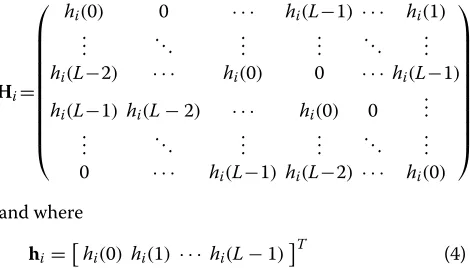
Hi=
represents the impulse response sequence of theith chan-nel matrix. At the receiver side, the frequency domain received symbols after FFT operations are obtained as
Y(j)=√ρ matrices whose entries areN-point discrete Fourier trans-form (DFT) ofhiafter zero padding andN(j)= √1NQn(j). Expanding (5) and using DFT properties, we get:
Y(k)=√ρ
By stacking the received data symbols over consecu-tive intervals in one column and so as the DFT channel coefficients, (6) can be written in matrix-vector notation as
This allows us to rewrite (7) as
or even more compactly as
Y=√ρXah+N, (10)
whereYandNare 2N×1 observed data and noise vec-tors, respectively,Xais a 2N×2Ldata matrix, which we shall refer to asAlamouti matrix, andhis a 2L×1 compos-ite channel vector. This model can be easily transformed to SISO-OFDM system of [20] by replacingXawithN×N square matrix diag(X)containingNdata symbols on its diagonal. Specifically, the SISO model corresponding to (10) is given by
Y=√ρdiag(X)h+N, (11)
whereYandN areN-dimensional received OFDM sym-bol and noise vector, respectively, whilehis the lengthL
SISO channel vector. In either case, the task of receiver is to jointly estimate the channelhand the data vector X given only the received data symbolY.
3 Joint ML/MAP solution
Considering the data model in (10), the joint ML chan-nel estimation and data detection problem reduces to minimizing the following objective function:
JML= min
where 2N denotes all possible 2N-dimensional signal vectors. As seen from (12), the joint ML problem is a com-binatorial problem involving||2Nhypothesis tests, and it is almost impossible to solve it exactly for sufficiently large andN.
To solve it efficiently, we propose the following strategy. We start by decomposing the original cost function as
JML= min
as the partial joint ML metric up to the index i forX,
where Xa(i) =
is the partial data
vector of dimension 2i×1 and the partial matrixAH(i) con-sists of firstirows ofAH. It should be noted that partial Alamouti matrix Xa(i) is the function of the first i data points, while Xa(i) is a function of the ith data point. Obviously, the solution that minimizes this partial joint ML metric is not the globally optimal. But we have the following lemmaa:
Lemma 1.Let R represent the optimal value of the objec-tive function in (12). If MX(i) > R, then X(i) cannot be
the ML solutionXˆML(i) of (12). In other words, for any esti-mateXˆ(i)to correspond to the ML solution, we should have
MX(i) <R.
From Lemma 1, if the optimal value R of objective function (12) can be estimated, then we can adopt the following tree search procedure for joint estimation and detection: At each subcarrieri, make a guess of new value ofX(i) =X1(i) X2(i) Tand use that along with previ-ous estimates to constructXˆ(i)andXˆa(i). Then, estimate hto minimize the associated cost function:
MXˆ(
and calculate the resulting metricMXˆ(
i). IfMXˆ(i) <R, then proceed to the next subcarrieri+1; otherwise, backtrack and change the guess of X(j) for somej ≤ i. We call this approach as the branch-estimate-and-bound strategy, which reduces the search space of exhaustive ML search to those (partial) sequences that satisfy the given constraint
MXˆ
(i) <R. This approach however does not work fori≤L asXa(i)will be full rank for any choice ofX(i), and there-fore,hwith 2Ldegrees of freedom can always be chosen by least squares (LS) to yield the trivial (zero) value for
MXˆ
(i). To obtain a non-trivial value ofMXˆ(i), we have to use
Lpilots, but it would defeat our original motive ofblind
estimation. To overcome this problem, we adopt weighted regularized LS and instead of minimizing the ML objec-tive function,JML, we minimize the maximuma posteriori
whereRh is the block diagonal autocorrelation matrix of the composite channel vectorh, i.e.,Rh = E
hhH. The objective function in (16) can also be decomposed as
JMAP= min
whose optimum valuehˆ and the cost can be computed [23].
3.1 Recursive derivation of bound
For our blind search strategy, the calculation of the metric or bound MXˆ(
i) is needed at each tree node for com-parison with the optimal value of objective function, R. This bound can be derived recursively by simply express-ingMXˆ(
i) in terms of new observation and an additional regressorXˆa(i)as follows:
By invoking the block version of recursive least squares (RLS) algorithm to the cost function in (19) with the data vector of size 2×1 and the regressor matrix of dimension 2×2L, we get [23] The RLS recursions are initialized by
MXˆ(
i−1)=0,hˆ−1=0 and P−1=Rh.
Before introducing our algorithm, we first number the ||2 combinations of the constellation points from two antennas by 1, 2,. . .,||2 and treat them as a big con-stellation set, where thekth)1≤k≤ ||2*vector con-stellation point is denoted by(k). We then perform the depth-first search of signal tree for joint ML solution.
Algorithm 1 Blind MAP algorithm
Parameters: Initial search radius r,ρand channel covari-ance matrixRh.
Inputs: Y, modulation constellation and the 1 × N
carrier index vector I.
Outputs: Estimated channelhˆand data vectorXˆ.
1. (Initialize) Seti=1,I(i)=1,Xˆ(i)=)I(i)*and construct the Alamouti matrixXˆa(i).
2. (Compare with lower bound) Compute and store the metricMXˆ(
i). IfMXˆ(i) >r; go to 3; else go to 4. 3. (Backtracking) Find the largest1≤j≤isuch that
I(j) <||2. If there exists such j, seti=jand go to 5; else go to 6.
4. (Increment subcarrier) Ifi<N, set
i=i+1,I(i)=1,Xˆ(i)= (I(i))and go to 2; else
6. (End/Restart) If a full-length sequenceXˆ(N)has
been found in step 4, output it as the MAP solution and terminate; otherwise, double ’r’ and go to 1.
The algorithm essentially reduces the search space of exhaustive ML search by performing a trimmed search over the signal tree ofN layers, where each tree node at the ith layer corresponds to a specific partial sequence
The parameterρcan be easily determined by estimating the noise variance, whereas forRh, our simulation results indicate that we can replace it with an identity matrix with almost no effect on the performance via carrier reorder-ing (see next section). To obtain the initial guess of search radius, we can use the strategy described in [20] to deter-mine rthat would guarantee a MAP solution with very high probability. Nevertheless, the algorithm itself takes care of the value ofr, in that if it is too small such that the algorithm is not able to backtrack, then it doubles the value ofr; if it is too large such that the algorithm reaches the last subcarrier too quickly, then it reduces r to the most recent value of objective function (see steps 4 and 6). Therefore, any choice of r would guarantee the MAP solution.
The complexity of the algorithm is mainly attributed to the calculation of the boundMXˆ(i) (step 2) and the back-tracking (step 3). The rest of the steps are simple additions and subtractions. From the RLS recursions, it can be seen that the calculation of the bound depends heavily on com-putation of 2L×2LmatrixPiin (25). In Section 4, we shall see how computation ofPi can be avoided by exploiting the structure of the FFT matrix, while in Section 5 we shall deal with the issue of backtracking.
4 Low-complexity blind algorithm
As mentioned earlier, the complexity of computing the metric MXˆ(
i) depends heavily on computation of matrix Pi. We show how we can completely avoid computing Pi and hence simply discard (25) from RLS recursions. This means that RLS algorithm will reduce to least mean square (LMS) in terms of complexity.
4.1 Reducing complexity by avoidingPi
Let us assume thatP1 = Iand thataiare orthogonal for
i = 0, 1, 2,· · ·,N−1, i.e.aiHaj = 0 fori = jb. First, we merge (24) and (25) to get
Pi=Pi−1−ρPi−1XˆaH(i)iHXˆa(i)Pi−1 (26) Now using (26) and our assumptions, it follows by induction that PiXˆHa(i+1)= ˆXHa(i+1),PiXˆHa(i+2) =
ˆ
XHa(i+2)andPi+1XˆaH(i+2)= ˆXHa(i+2). This means that if the successive regressors are orthogonal, we can sim-ply replacePi with an identity matrix and hence discard Equation 25. Moreover, from the orthogonality assump-tions, it also follows that
ˆ
whereInrepresents ann×nidentity matrix. Incorporating these results into the RLS recursions, the matricesiand Gibecome independent ofPiand are given by
i=
The resulting low-complexity blind algorithm based on (20) to (22), (28) and (29) for metric computation, requires no matrix inversion or computation ofPi.
4.2 Reducing complexity by carrier reordering
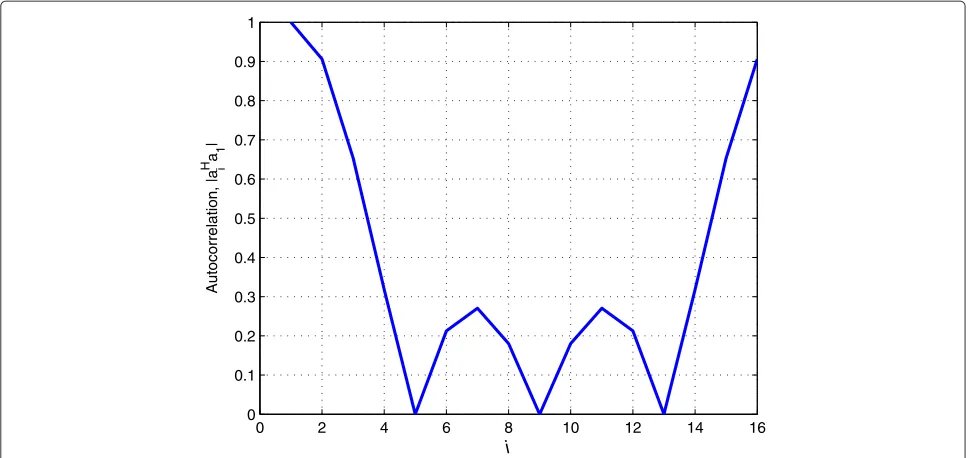
In the above approximation, we assumed that P1 = I andaiare orthogonal which allows us to use (27). How-ever, ai are columns of the partial FFT matrix Ai, so strictly speaking, they are not orthogonal. Hence, the suc-cessive regressor matrices would not be orthogonal, too. We will show that we can make them orthogonal or semi-orthogonal by carrier reordering. To understand the idea, we compute and plot the magnitude of autocorrelation of these partial vectors given by
|aHi al| = orthogonal to each other and so are the columns 2, 6, 10, 14 and so on. If we visit the subcarriers in the order 1, 5, 9, 13, 2, 6, 10, 14,· · ·, 4, 8, 12, 16, we find that consec-utive vectors will be orthogonal or approximately orthog-onal. In general, it is found that with =N/L, the vectors ai,ai+,ai+2,∀i are approximately orthogonal. There-fore, by simple reordering the carriers, we can achieve orthogonality among different subcarriers and use that fact to reduce the complexity of our algorithm as done in section 4.1.
5 Complexity reduction by using reliable carriers Despite avoidingPiand the carrier reordering approach, it has been observed that complexity of algorithm becomes very large in multiple-antenna systems as compared to single-antenna systems especially in the low SNR regime. The major source of complexity is attributed to backtrack-ing of the proposed algorithm. Backtrackbacktrack-ing occurs when-ever the constraintMXˆ(
0 2 4 6 8 10 12 14 16 0
0.1 0.2 0.3 0.4 0.5 0.6 0.7 0.8 0.9 1
i
Autocorrelation, |a
i
Ha
1
|
Figure 2Autocorrelation as a function ofiforN=16 andL=4.
inevitable in all blind search algorithms. Although it can-not be avoided, we propose to minimize its effect by using the concept of reliable carriers. The previous methods of reducing the complexity have the following drawbacks:
1. The proposed solutions are still very complex as they do not take into account the issue of backtracking which is a major source of complexity. They can be considered to have low complexity only in the high SNR regime, where we essentially get rid of backtracking.
2. The proposed solutions do not work in low SNR regime and becomes infeasible for multiple-antenna systems. This is due to the fact that the search space at each node grows as||Ntas compared to||for the SISO system, where||is the alphabet size and
Ntis the number of transmit antennas. Thus, the complexity of the proposed algorithms due to backtracking ultimately dominates the complexity induced by computing the matrixPi(or its inverse) and becomes the real bottleneck.
3. The proposed methods do not make use of the fact that pilots are usually present in real systems to aid in channel estimation and that the channel is usually slowly varying.
We can make use of the third point to our advantage. Specifically, the presence of some pilots and slow varia-tion in the channel allows us to get a tentative estimate of the data. If we are able to arrange the data according to its reliability, starting with the most reliable data, then there would be a less chance that we need to backtrack. Since
earlier data is reliable, there is no need to backtrack for this part. The later data might not be reliable, but by the time we start processing this data, the algorithm would have been already converged. However, measuring data relia-bility requires tentative channel/data estimates. Thus, the blind algorithm can be turned into a semi-blind algorithm to reliably track the channel along with the data detection. The semi-blind algorithm would require a short training sequence ofLsymbols only at the start of transmission to get a tentative estimate of the data and its reliability and no further pilots or channel statistics would be required.
5.1 Measuring the reliability
For measuring the reliability of data carriers, we borrow the idea presented in [21] by the author of the current paper, where it was used in the context of non-linear dis-tortion mitigation in OFDM. To minimize backtracking, the algorithm must devise a procedure to identify the reli-able subcarriers from the tentative estimates of channel and the data. With receiver having an estimate of channel, the decoding process can be accomplished by rewriting (10) into the form as shown below:
+
Y =√ρHaX+,N, (31)
where Y+ = Y(k)!T Y∗(k+1)!T
T
,,N = N(k)!T
N∗(k+1)!T
T
andHais anAlamouti-likematrix defined as
Ha
1 2 ∗
2 −∗1
By left multiplying both sides of (31) with √1ρH−a1and rearranging the terms, we get:
ˆ
X =X+D (33)
with the difference vector;D √1ρH−a1,N. The imperfect knowledge of the channel results in an estimation error Ha and consequently the vectorDrepresents the dis-tortion due to channel estimation error and the effect of additive noise.
To assess the reliability, consider a data carrier Xˆ(k)
(in scalar case) and its nearest constellation point ˆX(k). Treating channel estimation error as noise, ML-based decoding would yieldX(k)by mappingXˆ(k)to the near-est constellation point ˆX(k). Such a scheme would be very efficient at higher SNR if distortion was only due to AWGN. However, in our case, we have an additional perturbation due to channel estimation error that is inde-pendent of SNR, and therefore, we expect that part of data samples would be severely effected by the channel distortion and fall outside their actual decision regions. Clearly, there is a need to assess and identify these unre-liable data coefficients for our algorithm to reduce the backtracking.
Authors in [21] have developed a rigorous method for assessing the reliability of estimated data coefficients. Intuitively, for the data carrierXˆ(k), we can measure its reliability based on relative posterior probability that the difference termD(k)equalsXˆ(k)− ˆX(k)to the proba-bility that it equals some other vectorXˆ(k)−m|m = ˆX(k). For example,
R(k)=log
Pr
ˆX(k) =X(k)| ˆX(k)
Pr
ˆX(k) =XNN(k)| ˆX(k)
=log
Pr
D(k)= ˆX(k)− ˆX(k)
Pr
D(k)= ˆX(k)−XNN(k)
(34)
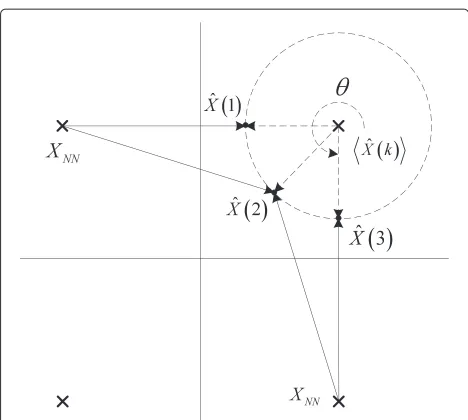
defines the reliability in decodingXˆ(k)to the closest con-stellation point relative to decoding to the nearest neigh-bourXNN(k). Figure 3 illustrates this concept, such that for instance even thoughXˆ(1) andXˆ(2) have the same distance from ˆX(1) = ˆX(2),Xˆ(2)has a higher reli-ability thanXˆ(1)as it is farther from nearest neighbour. This suggests the dependence of phaseθXˆ(k)− ˆX(k)on the reliability in addition to the magnitude| ˆX(k)− ˆX(k)|. In essence, the reliability of a measurement at each tone is a function that maps a triple (magnitude, phase and chan-nel gain) into R[1,∞]. The exact expression for reliability
Figure 3Reliability of data carriersXˆ(k)relative to the nearest neighbour constellation pointsXNN.
is the generalization of (34) to the vector-wise likelihood ratio defined as
Rexact=log
fD
ˆ
X − ˆX -||−1
m=0,m= ˆXfD
ˆ X−m
, (35)
where fD(.) is the pdf of the distortion vectorD, which by definition, can be easily seen to be Gaussian circu-larly symmetric with varianceσD2 = ρ1)Ha−1* )Ha−1*H. The above computation for exact reliability is however inefficient since it would requireO(N||)evaluations of
fD(.)which grows with constellation size||. Alternately, the geometric-based approximations for assessing relia-bility as derived in [21] may be employed with marginal loss in the performance. Ultimately, once the vector R is computed, we can proceed to select the most reliable data tones. These reliable data tones can then be sup-plied to our algorithm for initial search of the ML solution. Based on the above developments, we now introduce the semi-blind algorithm.
5.2 The semi-blind algorithm
1. Obtain an initial estimate of the channel vectorh fromL training/pilot symbols at start of
transmission, then repeat the following steps over two consecutive time instants.
2. Predict and decode the carriersXˆ from previous channel estimatehˆand observation vectorY+. 3. Use (35) to compute reliability of data carriers,
represents the total number of reordered carriers used by the algorithm.
4. Run the blind algorithm proposed previously, starting with most reliable data first, to obtain the exact ML estimates of the channel and the data.
Remarks: The first three steps of the semi-blind algo-rithm serve as pre-processing steps tailored to minimizing the backtracking of blind algorithm in step 4. One can easily obtain the channel estimates from pilots in step 1. The prediction step 2 is trivial and would suffer only lit-tle distortion as the channel does not change much in slow fading. To initiate the RLS recursions of blind algo-rithm in step 4, we initialize the channel vector with its previous estimate and setPi = I; thus, no channel statis-tics are requireda priori. The blind algorithm is supplied with reordered carriers with most reliable data to start over the search (step 3), so that the there will be almost no backtracking during the convergence of the algorithm. However, we observe that the carrier reordering based on reliability measures does not ensure orthogonality of suc-cessive regressors; therefore, the low complexity variants of RLS introduced earlier cannot be employed.
6 Exploiting the structure of Alamouti coding In our previous approaches to reducing the complexity of blind algorithm, we did not use the Alamouti coding structure, which can simplify the receiver design by lin-early processing the received data samples. We will show that by exploiting the orthogonal structure of Alamouti coding, we can either achieve (a) The complexity reduc-tion of blind algorithm for MISO OFDM system to that of SISO OFDM system of [20] with little effect on estimation performance, or (b) improve the estimation performance of our algorithm with full complexity of the MISO OFDM. To achieve the first goal, we start by multiplying (31) by HHa to get
z=HHaY+=√ρHHaHaX +HHaN,
=√ρBX+w,
(36)
where z is the new observation vector, w is the noise vector, and the block diagonal matrixBis defined as
B=I2⊗)∗11+∗22*, (37) where⊗represents the Kronecker product. Thus, owing to the orthogonal structure of Alamouti, the system in (36) is decoupled into two SISO OFDM systems as
z1=√ρ+BX(1k)+w1 (38) z2=√ρ+BX2(k)+w2, (39) where +B = )∗11+∗22
*
. The joint ML solutions for SISO systems (42) would involve only 2||N
hypoth-esis tests as opposed to ||2N for the original system, which implies huge reduction in complexity. However, this comes at the cost of estimation performance as number of unknown channel parameters in (42) are increased to 2L
as opposed toLis the SISO system. In a similar fashion, the estimation performance of the blind algorithm can be improved by multiplying (10) byXHa as follows:
z=XHaY=√ρXHaXah+XHaN
=√ρBh+w,
(40)
where z is the new observation vector, w is the noise vector, and the block diagonal matrixBis
B=I2⊗
Adiag
|X(k)
1 |2+ |X
(k) 2 |2
AH
(41)
We can see that the system in (40) can also be decoupled as
z1=√ρ+Bh1+w1 (42)
z2=√ρ+Bh2+w2, (43)
where +B = Adiag|X(1k)|2+ |X(2k)|2AH. It can be seen that the above equations correspond to the SISO sys-tems for which the joint ML solution can be derived easily. It is worth mentioning that the search space for blind ML is not reduced due to dependence of observations and the matrixBonX(1k)andX(2k). However, the number of channel parameters is reduced to half, which results in an improved estimation performance. In short, the Alamouti structure enables us to either improve upon the estima-tion performance or the complexity reducestima-tion but not the both.
7 Simulation results
For simulations, we first consider OFDM system with
N = 16 subcarriers and channel length L = 4 for each transmit-receive channel and CP length of at least
L−1. For blind algorithm, both channels are independent Rayleigh fading, assumed stationary over two consecu-tive OFDM blocks and each having an exponential power decay profile, i.e.E|hi(τ)|2
=e−0.2τ. Information sym-bols are modulated using binary phase shift keying (BPSK) or quadrature amplitude modulation (QAM).
0 5 10 15 20 25 10−6
10−5 10−4 10−3 10−2 10−1 100
SNR (dB)
BER
Blind Algo. with Pi set to I
Blind Algo. with subcarrier reordering Proposed blind algorithm
Perfectly known channel
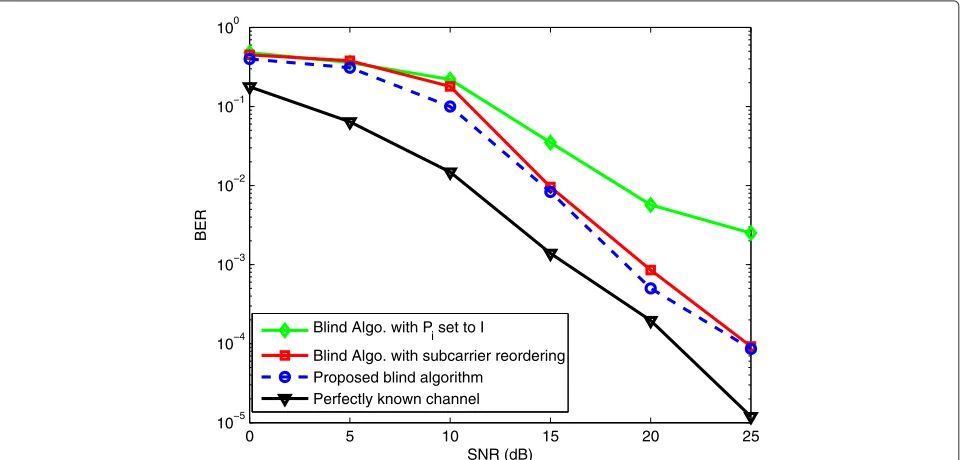
Figure 4BER vs SNR for Alamouti-coded BPSK OFDM over Rayleigh fading channel withN=16 andL=4.
without requiring the channel statistics. A similar trend is observed in Figure 5, when 4-QAM signal modulation is considered.
For semi-blind algorithm, we adopt the AR(1) process to model the slow rayleigh fading channels, where the chan-nel weight vector varies as [23]:h(n)=αh(n−1)+q(n)
and where α = J0(2πfdTs) and qis a complex normal vector with covariance matrix(1−α2)I. The product of
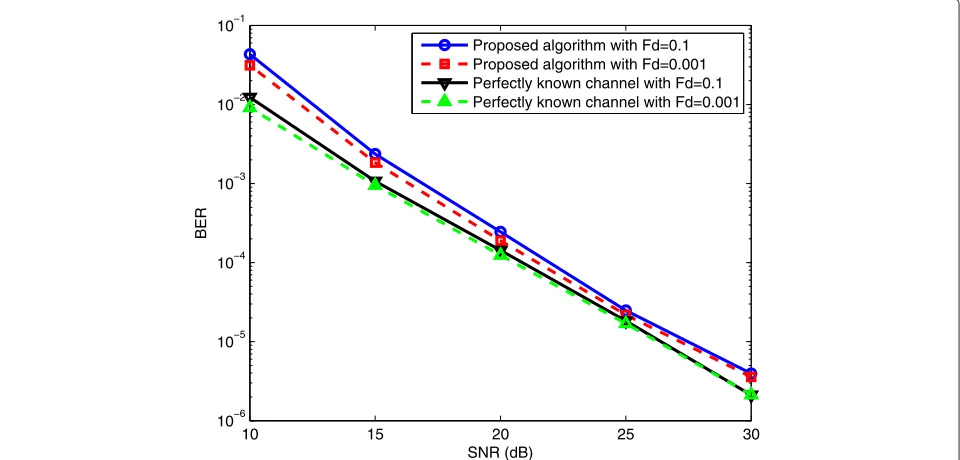
maximum Doppler frequency fd and sampling time Ts referred to as normalized Doppler frequencyFD, controls the amount of variations in the channel statistics. Two dif-ferent values of normalized Doppler frequency, i.e., 0.1 and 0.001, are considered in the simulations. Results for semi-blind algorithm are presented against perfect coher-ent detection in Figures 6 and 7 for BPSK and 4−QAM modulations respectively which show favourable
perfor-0 5 10 15 20 25
10−5 10−4 10−3 10−2 10−1 100
SNR (dB)
BER
Blind Algo. with Pi set to I
Blind Algo. with subcarrier reordering Proposed blind algorithm
Perfectly known channel
5 10 15 20 25 10−6
10−5 10−4 10−3 10−2 10−1
SNR (dB)
BER
Proposed algorithm with Fd=0.1 Proposed algorithm with Fd=0.001 Perfectly known channel with Fd=0.1 Perfectly known channel with Fd=0.001
Figure 6BER vs SNR for MISO-OFDM with BPSK modulation over Rayleigh fading channel withN=32 andL=4.
mance of algorithm under different fading conditions. For higher modulations and number of subcarriers, we use the SISO OFDM systems obtained after decoupling by Alam-outi structure and results are presented in Figure 8 for 16−QAM constellation withN=64.
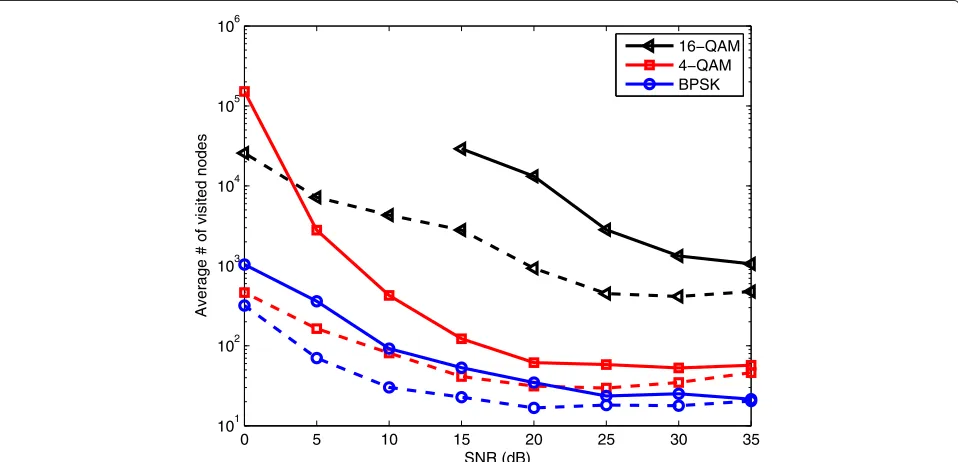
To assess the computational complexity of proposed algorithm, we compare the average number of nodes vis-ited by the algorithm with various reliability measures
in Figure 9. It is clearly observed that proposed reliabil-ity scheme offers significantly lower complexreliabil-ity at lower SNR values. At higher SNR, the complexity is constant, confirming the fact that there is almost no backtrack-ing. Figure 10 shows that the performance for various degrees of reliability measures is almost identical which means that computational advantages are attained with-out degrading the performance. Through simulations, it
10 15 20 25 30
10−6 10−5 10−4 10−3 10−2 10−1
SNR (dB)
BER
Proposed algorithm with Fd=0.1 Proposed algorithm with Fd=0.001 Perfectly known channel with Fd=0.1 Perfectly known channel with Fd=0.001
15 20 25 30 35 40 45 10−5
10−4 10−3 10−2 10−1
SNR (dB)
BER
Proposed algorithm with Fd=0.1 Proposed algorithm with Fd=0.001 Perfectly known channel with Fd=0.1 Perfectly known channel with Fd=0.001
Figure 8BER vs SNR for SISO-OFDM with 16-QAM modulation over Rayleigh fading channel withN=64 andL=4.
has also been observed that the reliability of around 50% to 60% is enough for a good performance, although more importantly, the algorithm does not disfavour the usage of more reliable carriers.
Finally, in Figure 11, the complexity of comparison for different modulation schemes such as BPSK, 4-QAM and 16-QAM is presented which clearly indicates the compu-tational advantages of proposed reliability-based method.
8 Conclusions
In this paper, we presented a blind ML algorithm for joint channel estimation and data detection in OFDM wireless systems using Alamouti STBC coding. The simu-lation results show favourable performance of algorithm. As evident from simulations, our low-complexity blind algorithm performs equally well as exact blind algorithm. Moreover, the new algorithm does not need any prior
0 5 10 15 20 25 30
0 200 400 600 800 1000 1200
SNR (dB)
Average # of visited nodes
Proposed algo. (without reliable carr.) Proposed algo. (with 20% reliable carr.) Proposed algo. (with 50% reliable carr.) Proposed algo. (with 80% reliable carr.)
0 5 10 15 20 25 30 10−4
10−3 10−2 10−1 100
SNR (dB)
BER
Perfectly known channel
Proposed algo. (without reliable carr.) Proposed algo. (with 20% reliable carr. Proposed algo. (with 50% reliable carr) Proposed algo. (with 80% reliable carr.)
Figure 10Performance of the proposed algorithm with various degrees of reliability measurements.BPSK modulation withN=16 and L=4.
information about channel statistics as it avoids calculat-ing matrixPi with subcarrier reordering. Another major source of complexity in blind algorithm is the issue of backtracking which becomes more prominent in the low-SNR regime. This issue was not tackled in the previous studies. We proposed a semi-blind algorithm which min-imizes the probability of backtracking by supplying the
blind algorithm with reordered subcarriers based on their reliability computations using a sophisticated reliabil-ity criterion. By minimizing the backtracking, significant improvement is achieved in terms of complexity without compromising the performance. Moreover, the orthog-onal structure of Alamouti coding was also exploited to yield complexity reduction or improved estimation
0 5 10 15 20 25 30 35
101 102 103 104 105 106
SNR (dB)
Average # of visited nodes
16−QAM 4−QAM BPSK
performance. The reduced complexity variant turns out to be very handy when large number of subcarriers and/or large size constellation modulations are employed.
Endnotes
aThis lemma was proved in [20] for SISO case; we
simply extend it here to the multi-antenna case.
bIn fact, a weaker condition that three consecutive
vectorsai,ai+1andai+2are orthogonal would suffice.
Competing interests
The authors declare that they have no competing interests.
Acknowledgements
The authors would like to acknowledge the support provided by the Deanship of Scientific Research (DSR) at King Fahd University of Petroleum & Minerals (KFUPM) for funding this work through project No. RG122-CES-112.
Author details
1Department of Electrical Engineering, King Fahd University of Petroleum and
Minerals, Dhahran 31261, Saudi Arabia.2Department of Electrical Engineering, King Abdullah University of Science and Technology, Thuwal 23955-6900, Saudi Arabia.
Received: 15 November 2013 Accepted: 7 August 2014 Published: 26 August 2014
References
1. LJ Cimini, Analysis and simulation of a digital mobile channel using orthogonal frequency division multiplexing. IEEE Trans. Commun.33(7), 665–675 (1985)
2. H Bölcskei,Principles of MIMO-OFDM Wireless Systems,Chapter inCRC Handbook on Signal Processing for Mobile Communications, M. Ibnkahla, Ed, (Ch. 12 2004)
3. BP Crow, I Widjaja, JG Kim, PT Sakai, IEEE 802.11 wireless local area networks. IEEE Commun. Mag.35(9), 116–126 (1997)
4. I Koffman, V Roman, Broadband wireless access solutions based on OFDM access in IEEE 802.16. IEEE Commun. Mag.40(4), 96–103 (2002) 5. 3GPP TR 36.211, Evolved Universal Terrestrial Radio Access (E-UTRA);
Physical Channels and Modulation (ver. 10.5.0, 2012)
6. E Telatar, Capacity of multi-antenna gaussian channels. Eur. Trans. Telecomm.10(6), 585–595 (1999)
7. S Alamouti, A simple transmit diversity technique for wireless communications. IEEE J. Selected Areas Commun.16(8), 1451–1458 (1998)
8. P Stoica, G Ganesan, Space-time block codes: trained, blind and semi-blind detection.IEEE International Conference on Acoustics, Speech, and Signal Processing (ICASSP), vol. 2 (IEEE Orlando, FL, USA, 13–17 May 2002). pp. 1609–1612
9. AL Swindlehurst, G Leus, Blind and semi-blind equalization for generalized space-time block codes. IEEE Trans. Signal Process.50(10), 2489–2498 (2002)
10. B Muquet, M De Courville, P Duhamel, Subspace-based blind and semi-blind channel estimation for OFDM systems. IEEE Trans. Signal Process.50(7), 1699–1712 (2002)
11. C-C Tu, B Champagne, Subspace-based blind channel estimation for MIMO-OFDM systems with reduced time averaging. IEEE Trans. Veh. Tech. 59(3), 1539–1544 (2010)
12. H Bolcskei, RW Heath, AJ Paulraj, Blind equalization in OFDM-based multi-antenna systems.The IEEE 2000 Adaptive Systems for Signal Processing, Communications, and Control Symposium (AS-SPCC)(IEEE, Lake Louise, Alta, 01–04 Oct 2000), pp. 58–63
13. J Choi, C-C Lim, A Cholesky factorization based approach for blind FIR channel identification. IEEE Trans. Signal Process.56(4), 1730–1735 (2008) 14. SA Banani, RG Vaughan, OFDM with iterative blind channel estimation.
IEEE Trans. Veh. Tech.59(9), 4298–4308 (2010)
15. T Cui, C Tellambura, Joint data detection and channel estimation for OFDM systems. IEEE Trans. Commun.54(4), 670–679 (2006)
16. EG Larsson, P Stoica, J Li, On maximum-likelihood detection and decoding for space-time coding systems. IEEE Trans. Signal Process.50(4), 937–944 (2002)
17. T-H Chang, W-K Ma, C-Y Chi, Maximum-likelihood detection of orthogonal space-time block coded OFDM in unknown block fading channels. IEEE Trans. Signal Process.56(4), 1637–1649 (2008) 18. TY Al-Naffouri, AA Quadeer, Cyclic prefix based enhanced data recovery
in OFDM. IEEE Trans. Signal Process.58(6), 3406–3410 (2010) 19. W Xu, M Stojnic, B Hassibi, Low-complexity blind maximum-likelihood
detection for SIMO systems with general constellations.IEEE International Conference on Acoustics, Speech and Signal Processing (ICASSP)(IEEE, Las Vegas, NV, USA, 31 Mar–4 Apr 2008), pp. 2817–2820
20. TY Al-Naffouri, AA Dahman, MS Sohail, W Xu, B Hassibi, Low-complexity blind equalization for OFDM systems with general constellations. IEEE Trans. Signal Process.60(12), 6395–6407 (2012)
21. EB Al-Safadi, TY Al-Naffouri, Pilotless recovery of clipped OFDM signals by compressive sensing over reliable data carriers, inIEEE 13th International Workshop on Signal Processing Advances in Wireless Communications (SPAWC)(IEEE Cesme, 17–20 June 2012), pp. 580–584
22. N Al-Dhahir, Single-carrier frequency-domain equalization for space-time block-coded transmissions over frequency-selective fading channels. IEEE Commun. Lett.5(7), 304–306 (2001)
23. AH Sayed,Fundamentals of Adaptive Filtering. (Wiley, New York, 2003)
doi:10.1186/1687-6180-2014-131
Cite this article as:Zaib and Al-Naffouri:Blind and semi-blind ML detection for space-time block-coded OFDM wireless systems.EURASIP Journal on Advances in Signal Processing20142014:131.
Submit your manuscript to a
journal and benefi t from:
7Convenient online submission
7Rigorous peer review
7Immediate publication on acceptance
7Open access: articles freely available online
7High visibility within the fi eld
7Retaining the copyright to your article