Space-Time Chip Equalization for Maximum
Diversity Space-Time Block Coded DS-CDMA
Downlink Transmission
Geert Leus
Faculty of Electrical Engineering, Mathematics, and Computer Science, Delft University of Technology, Mekelweg 4, 2628CD Delft, The Netherlands
Email:[email protected]
Frederik Petr ´e
Wireless Research, Interuniversity Micro-Electronics Center (IMEC), Kapeldreef 75, 3001 Leuven, Belgium Email:[email protected]
Marc Moonen
Department of Electrical Engineering (ESAT), Katholieke Universiteit Leuven (K.U.Leuven), Kasteelpark Arenberg 10, 3001 Leuven, Belgium
Email:[email protected]
Received 24 December 2002; Revised 4 August 2003
In the downlink of DS-CDMA, frequency-selectivity destroys the orthogonality of the user signals and introduces multiuser in-terference (MUI). Space-time chip equalization is an efficient tool to restore the orthogonality of the user signals and suppress the MUI. Furthermore, multiple-input multiple-output (MIMO) communication techniques can result in a significant increase in capacity. This paper focuses on space-time block coding (STBC) techniques, and aims at combining STBC techniques with the original single-antenna DS-CDMA downlink scheme. This results into the so-called space-time block coded DS-CDMA downlink schemes, many of which have been presented in the past. We focus on a new scheme that enables both the maximum multiantenna diversity and the maximum multipath diversity. Although this maximum diversity can only be collected by maximum likelihood (ML) detection, we pursue suboptimal detection by means of space-time chip equalization, which lowers the computational com-plexity significantly. To design the space-time chip equalizers, we also propose efficient pilot-based methods. Simulation results show improved performance over the space-time RAKE receiver for the space-time block coded DS-CDMA downlink schemes that have been proposed for the UMTS and IS-2000 W-CDMA standards.
Keywords and phrases:downlink CDMA, space-time block coding, space-time chip equalization.
1. INTRODUCTION
Direct sequence code division multiple access (DS-CDMA) has emerged as the predominant multiple access technique for 3G cellular systems. In the downlink of DS-CDMA, or-thogonal user signals are transmitted from the base station. All these signals are distorted by the same channel when propagating to the desired mobile station. Hence, when this channel is frequency-selective, the orthogonality of the user signals is destroyed and severe multiuser interference (MUI) is introduced. Space-time chip equalization can then restore the orthogonality of the user signals and suppress the MUI [1,2,3,4].
Multiple-input multiple-output (MIMO) systems, on the other hand, have recently been shown to realize a significant
later generalized in [12] for any number of transmit anten-nas, are particularly appealing because they facilitate maxi-mum likelihood (ML) detection with simple linear process-ing. However, these STBC techniques have originally been developed for signaling over frequency-flat channels, and do not enable the maximum multiantenna and multipath diver-sity present in frequency-selective channels. Therefore, im-proved STBC techniques have recently been developed for signaling over frequency-selective channels [13,14,15]. The STBC technique proposed in [13] enables the maximum multiantenna diversity, and although it is presented as a tech-nique that provides the maximum multipath diversity, it is not possible to prove it without any proper discussion on how to treat the edge effects at the beginning and the end of a burst. If the edge effects are handled by a cyclic prefix as in [14], maximum multipath diversity is not guaranteed. On the other hand, if the edge effects are handled by a zero post-fix as in [15], maximum multipath diversity is guaranteed.
Up till now, research on STBC techniques has mainly focused on single-user communication links. In this pa-per, we aim at combining STBC techniques with the orig-inal single-antenna DS-CDMA downlink scheme, resulting into so-called space-time block coded DS-CDMA downlink schemes. As an example, we mention the space-time block coded DS-CDMA downlink schemes that have been pro-posed for the UMTS and IS-2000 W-CDMA standards, both special cases of the so-called space-time spreading scheme presented in [16], which consists of a mixture of the original single-antenna DS-CDMA downlink scheme and the STBC technique of [12]. However, this scheme does not enable the maximum multiantenna and multipath diversity present in frequency-selective channels. A second example is the space-time block coded DS-CDMA downlink scheme presented in [17], which consists of the original single-antenna DS-CDMA downlink scheme followed by the STBC technique of [14]. However, this scheme only enables the maximum multiantenna diversity but not the maximum multipath di-versity (due to the fact that maximum multipath didi-versity is not provided by the STBC technique of [14]). Therefore, in this paper, we consider the space-time block coded DS-CDMA downlink scheme that consists of the original single-antenna DS-CDMA downlink scheme followed by the STBC technique of [15]. This scheme enables both the maximum multiantenna diversity and the maximum multipath diver-sity (due to the fact that maximum multipath diverdiver-sity is pro-vided by the STBC technique of [15]). Although this max-imum diversity can only be collected by ML detection, we pursue suboptimal detection by means of space-time chip equalization, which lowers the computational complexity significantly. Note that this suboptimal detection technique can also be applied to the STBC technique of [15] on its own, without combining it with the original single-antenna DS-CDMA downlink scheme.
Assuming there areJtransmit antennas, the straightfor-ward way to implement space-time chip equalization is to applyJspace-time chip equalizers to recover theJ transmit-ted space-time block coded multiuser chip sequences, then to apply space-time decoding to recover J subsequences of
the original multiuser chip sequence, and finally, to perform simple despreading. Since this comes down to an equaliza-tion problem with J sources, we needJ + 1 chip rate sam-pled outputs at each mobile station for a finite-length zero-forcing (ZF) solution to exist (i.e., J + 1 receive antennas if the antennas are sampled at chip rate). However, we will show that the space-time chip equalization and space-time decoding operations can be swapped, which allows us to first apply space-time decoding, then to applyJspace-time chip equalizers to recoverJsubsequences of the original multiuser chip sequence, and finally, to perform simple despreading. Since this comes down toJequalization problems with only one source, we need only two chip rate sampled outputs at each mobile station for a finite-length ZF solution to exist (i.e., two receive antennas if the antennas are sampled at chip rate). To design the space-time chip equalizers, we finally propose efficient pilot-based methods.
InSection 2, we discuss the transceiver design of the pro-posed space-time block coded DS-CDMA system. We dis-tinguish between the transmitter design, the channel model, and the receiver design, where the latter is based on space-time chip equalization. In Section 3, we then propose two pilot-based methods for practical space-time chip equalizer design. We show some simulation results in Section 4. In Section 5, we finally draw our conclusions.
Notation
We use upper (lower) bold face letters to denote matri-ces (vectors). Superscripts∗,T, andHrepresent conjugate, transpose, and Hermitian, respectively. Further, · repre-sents the flooring operation, andE{·}represents the expec-tation operation. We denote theN×Nidentity matrix asIN and theM×Nall-zero matrix as0M×N. Next, [A]m,ndenotes
the entry at position (m,n) of the matrixA. Finally, diag{a}
represents the diagonal matrix with the vectoraon the diag-onal.
2. TRANSCEIVER DESIGN
We consider the downlink of a space-time block coded DS-CDMA system. We assume the base station is equipped with Jtransmit antennas, and the mobile station is equipped with M receive antennas. In the following, we discuss the trans-mitter design, the channel model, and the receiver design.
2.1. Transmitter design
At the base station, a space-time block coded DS-CDMA downlink scheme transforms {su[k]}uU=1 and sp[k], where
su[k] is theuth user’s data symbol sequence andsp[k] is the pilot symbol sequence, intoJ space-time block coded mul-tiuser chip sequences{uj[n]}Jj=1.
u1[n]
u2[n]
P/S
P/S
u1[i]
KN+L
u2[i]
KN+L
T
T x2[i]
KN
x1[i]
KN ST block code
x[i] KN S/P x[n] Interfering users
· · ·
Pilot cu[n]
N× su[k]
× +
Figure1: Proposed space-time block coded DS-CDMA downlink scheme.
(J > 2) are straightforward and can be developed following the design rules presented in [18].
Figure 1 depicts the proposed space-time block coded DS-CDMA downlink scheme (N×repeats each sample N times, whereas “S/P” and “P/S” represent a serial-to-parallel and parallel-to-serial conversion, respectively). First, the original multiuser chip sequencex[n] is constructed:
x[n] := U
u=1
sun/Ncu[n] +spn/Ncp[n], (1)
where cu[n] is the uth user’s code sequence and cp[n] is the pilot code sequence. We assume that both cu[n] and cp[n] are normalized and consist of a multiplication of a user/pilot specific orthogonal Walsh-Hadamard spreading code of lengthNand a base-station specific long scrambling code. Note that the above pilot insertion technique is simi-lar to the so-called common pilot channel (CPICH) [19] in forthcoming 3G systems. Second, the original multiuser chip sequencex[n] is serial-to-parallel converted into the 1×KN multiuser chip block sequencex[i]:
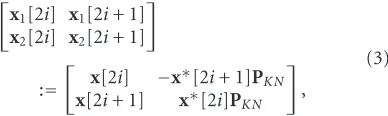
x[i] :=x[iKN],. . .,x(i+ 1)KN−1. (2) Third, the multiuser chip block sequencex[i] is transformed into the two 1×KNblock sequencesx1[i] andx2[i]:
x1[2i] x1[2i+ 1]
x2[2i] x2[2i+ 1]
:=
x[2i] −x∗[2i+ 1]PKN x[2i+ 1] x∗[2i]PKN
,
(3)
wherePN is anN×Npermutation matrix that performs a reversal of the entries, that is, [PN]n,n =δ[n+n−N−1].
Fourth, we add a zero postfix of lengthLto each block of the block sequencexj[i], resulting into the 1×(KN+L) block sequenceuj[i]:uj[i] :=xj[i]T, whereTis theKN×(KN+L) zero postfix insertion matrix:T:=[IKN,0KN×L]. Finally, the block sequenceuj[i] is parallel-to-serial converted into the space-time block coded multiuser chip sequenceuj[n]:
uji(KN+L),. . .,uj(i+ 1)(KN+L)−1:=uj[i], (4) which is transmitted at the jth transmit antenna with rate 1/Tc(the chip rate).
2.2. Channel model
Assuming themth receive antenna is sampled at the chip rate, the received sequence at themth receive antenna can be writ-ten as
ym[n]=
2
j=1
L
l=0
hm,j[l]uj[n−l] +em[n], (5)
whereem[n] is the additive noise at themth receive antenna andhm,j[l] is the channel from the jth transmit antenna to
themth receive antenna, including transmit and receive fil-ters. We assume thathm,j[l] is FIR with orderLj,mand that
Lis a known upper bound on maxj,m{Lj,m}. Note thatLwas also chosen as the zero postfix length inSection 2.1.
2.3. Receiver design
A first option is to serial-to-parallel convert the received se-quenceym[n] into the 1×(KN+L) received block sequence ym[i]:
ym[i] :=ymi(KN+L),. . .,ym(i+ 1)(KN+L)−1, (6)
then to apply space-time decoding and Viterbi equaliza-tion as in [18], and finally, to perform simple despread-ing. This detection technique is overall ML, but leads to a very large computational complexity. That is why we pur-sue suboptimal detection by means of space-time chip equal-ization, which lowers the computational complexity signif-icantly. Note that this suboptimal detection technique can also be applied to the STBC technique of [15] on its own, without combining it with the original single-antenna DS-CDMA downlink scheme.
We first introduce some new notation. Defining theM×1 vector
y[n] :=y1[n],. . .,yM[n]T, (7) we can write
y[n]=
2
j=1
L
l=0
hj[l]uj[n−l] +e[n], (8)
wheree[n] is similarly defined asy[n], and
Further, defining the (Q+ 1)M×KNmatrix
The parameter Q basically represents the order of the adopted space-time chip equalizer. This equalizer orderQis usually chosen to be close to the channel orderL. For the sake of conciseness, we assumeQ=L. However, the proposed re-sults can easily be extended to other values of the equalizer orderQ.
ChoosingQ=L, it is clear from the zero postfix insertion thatUj[i] can be expressed as
To proceed, the straightforward way is to apply two space-time chip equalizers onY[i] to recoverx1[i] andx2[i],
then to apply space-time decoding to recoverx[2i] andx[2i+ 1], and finally, to perform simple despreading. Since this comes down to an equalization problem with two sources, we need three chip rate sampled receive antennas at each mo-bile station for a finite-length ZF solution to exist (forJ >2 transmit antennas, we needJ+ 1 chip rate sampled receive antennas at each mobile station). However, we will show that the space-time chip equalization and space-time decoding operations can be swapped, which allows us to first apply space-time decoding on Y[2i] andY[2i+ 1], then to apply two space-time chip equalizers to recoverx[2i] andx[2i+ 1], and finally, to perform simple despreading. Since this comes
down to two equalization problems with only one source, we need only two chip rate sampled receive antennas at each mo-bile station for a finite-length ZF solution to exist (even for J >2 transmit antennas, we need only two chip rate sampled receive antennas at each mobile station). The latter option clearly has more degrees of freedom to tackle the equaliza-tion problem, and therefore leads to a better performance. This option is explained in more detail next.
2.3.1. Space-time decoding
rive from (13) that
Tx2[2i+ 1]
Conjugating Y[2i+ 1] and multiplying it to the right-hand side withPKN, we then arrive at
and using the fact thatx1[2i]=x[2i] andx2[2i]=x[2i+ 1]
(see (3)), we finally obtain
¯
Y[i]=HX¯[i] + ¯E[i], (19) where ¯E[i] is similarly defined as ¯Y[i],
H :=
H1 H2
H∗
2P2L+1 −H1∗P2L+1
,
¯ X[i] :=
Tx[2i] Tx[2i+ 1]
.
(20)
2.3.2. Space-time chip equalization
We now apply two space-time chip equalizers on ¯Y[i]:feand fo. The 1×2(L+ 1)Mspace-time chip equalizerfeis designed to extract the even multiuser chip blockx[2i], whereas the 1×
2(L+ 1)Mspace-time chip equalizerfois designed to extract the odd multiuser chip blockx[2i+ 1]:
ˆ
x[2i]=feY¯[i], xˆ[2i+ 1]=foY¯[i]. (21) Note thatx[2i] andx[2i+ 1] are two distinct rows of ¯X[i].
A first possibility is to apply two ZF space-time chip equalizers, completely eliminating the interchip interference (ICI) at the expense of potentially excessive noise enhance-ment:
fe=ieHHRe−1H−1HHR−e1, fo=ioHHR−1
e H−1HHR−e1,
(22)
whereieis a 1×(4L+2) unit vector with a one in the (L+1)th position, io is a 1×(4L+ 2) unit vector with a one in the (3L+ 2)th position, andRe :=1/(KN)E{E¯[i] ¯EH[i]}. A sec-ond possibility is to apply two minimum mean-squared error (MMSE) space-time chip equalizers, balancing ICI elimina-tion with noise enhancement:
fe=ieHHR−1
e H+R−x1−1HHR−e1, fo=ioHHR−1
e H+R−x1−1HHR−e1,
(23)
whereRx:=1/(KN)E{X¯[i] ¯XH[i]}.
Assuming the additive noise sequences {em[n]}Mm=1 are
mutually uncorrelated and white with variance σ2
e, we can write Re = σ2
eI2(L+1)M. Furthermore, assuming the data symbol sequences{su[n]}Uu=1are mutually uncorrelated and
white with varianceσ2
s, the original multiuser chip sequence x[n] is white with varianceσ2
x =σs2J/N (justified by the long scrambling code), and we can writeRx=σ2
xdiag{[rx,rx]} = σ2
sJ/Ndiag{[rx,rx]}, whererx=[(KN−L)/(KN),. . ., (KN− 1)/(KN), 1, (KN−1)/(KN),. . ., (KN−L)/(KN)].
2.3.3. Despreading
We define the 1×KUmultiuser data symbol blocks[i] as s[i] :=s1[i],. . .,sU[i]
, (24)
wheresu[i] is theuth user’s 1×Kdata symbol block given by su[i] :=su[iK],. . .,su(i+ 1)K−1. (25) Note that the 1×Kpilot symbol blocksp[i] is similarly de-fined as su[i]. We further define the multiuser code matrix C[i] as
C[i] :=C1[i]T,. . .,CU[i]TT, (26) whereCu[i] is theuth user’s code matrix given by
Cu[i] :=
cu[iK] . ..
cu(i+ 1)K−1
, (27)
withcu[k] :=[cu[kN],. . .,cu[(k+ 1)N−1]]. Note that the pilot code matrixCp[i] is similarly defined asCu[i]. It is then clear from (1) that the multiuser chip blockx[i] can be ex-pressed as
x[i]=U
u=1
su[i]Cu[i] +sp[i]Cp[i]
=s[i]C[i] +sp[i]Cp[i].
(28)
Hence, by despreading the multiuser chip blockx[i] with the uth user’s code matrixCu[i], we obtain
su[i]=x[i]CHu[i] (29) becauseCp[i]CHu[i]=0K×K,Cu[i]CHu[i]=0K×K foru=u,
and Cu[i]CHu[i] = IK. Therefore, once x[i] has been esti-mated, we can find an estimate forsu[i] by simple despread-ing:
ˆ
su[i]=xˆ[i]CHu[i]. (30) Plugging (30) into (21), we thus obtain
ˆ
su[2i]=feY¯[i]CHu[2i], ˆ
su[2i+ 1]=foY¯[i]CHu[2i+ 1].
(31)
From these equations, it is also clear that the order of equal-ization and despreading can be reversed. In other words, we can first despread ¯Y[i] withCu[2i] andCu[2i+ 1], and then perform space-time chip equalization on both results.
3. PRACTICAL SPACE-TIME CHIP EQUALIZER DESIGN
proposed space-time coded DS-CDMA downlink scheme. We consider a burst of 2Idata symbol blocks.
The goal of thetraining-basedmethod is to compute the uth user’s even and odd data symbol blocks{su[2i]}Ii=1and
The goal of the semiblind method is to compute the uth user’s even and odd data symbol blocks{su[2i]}Ii=1and
knowledge of the active codes. This knowledge can be ob-tained by means of a limited feedback from the base station to the mobile station (only the indices of the active codes have to be fed back). However, this knowledge can also be ob-tained by first adopting the training-based method to design a space-time chip equalizer, and then comparing for each code the energy obtained after equalization and despreading with some threshold in order to decide whether this code is active or not.
For the sake of conciseness, we will only focus on block implementations. These block implementations might look rather complex, but they form the basis for practical low-complexity adaptive implementations, which can be derived in a similar fashion as done in [20,21].
For the sake of simplicity, we make the following assump-tions:
(A1) the matrixHhas full column rank 4L+ 2;
(A2) the matrices ¯X[2i] and ¯X[2i+ 1] have full row rank 4L+ 2 for alli∈ {1,. . .,I}.
The first assumption requires that 2(L+ 1)(M−1) ≥ 2L, which means we need onlyM ≥2 receive antennas at each mobile station (even forJ > 2 transmit antennas, we need only M ≥ 2 receive antennas at each mobile station). The second assumption requires that 4L+ 2 ≤ KN. Note that these assumptions are not really necessary for the proposed methods to work. The only true requirement is thatx[2i] and x[2i+ 1] belong to the row space of ¯Y[i] for alli∈ {1,. . .,I}. Assumptions (A1) and (A2) are sufficient but not necessary conditions for this. However, they considerably simplify the analysis.
Assume no noise is present. Because of assumption (A1), the row space of ¯Y[i] equals the row space of ¯X[i]. Hence,
Because of assumption (A2), these two space-time chip
equalizersfeandfoare ZF. By using (28), we then obtain
feY¯[i]−s[2i]C[2i]−sp[2i]Cp[2i]=01×KN, foY¯[i]−s[2i+ 1]C[2i+ 1]−sp[2i+ 1]Cp[2i+ 1]=01×KN.
(33)
3.1. Training-based method
By despreading (33) with the even and odd pilot code matri-cesCp[2i] andCp[2i+ 1], we obtain
feY¯[i]CHp[2i]−sp[2i]=01×K,
foY¯[i]CHp[2i+ 1]−sp[2i+ 1]=01×K (34) because C[i]CHp[i] = 0K×K and Cp[i]CHp[i] = IK. The training-based method solves (34) forfe andfo for alli ∈ {1,. . .,I}. In the noisy case, this leads to the following least
which can be interpreted as follows. The space-time de-coded output matrix ¯Y[i] is first equalized with the even and odd space-time chip equalizersfe andfo, and then de-spread with the even and odd pilot code matricesCp[2i] and Cp[2i+ 1]. The resulting even and odd vectorsfeY¯[i]CHp[2i]
The obtained space-time chip equalizers ˆfe and ˆfo are sub-sequently used to estimate theuth user’s even and odd data symbol blockssu[2i] andsu[2i+ 1] for alli∈ {1,. . .,I}:
3.2. Semiblind method
The semiblind method directly solves (33) for (fe,s[2i]) and (fo,s[2i+ 1]) for alli∈ {1,. . .,I}. In the noisy case, this leads to the following LS problems:
min
which can be interpreted as follows. The space-time decoded output matrix ¯Y[i] is first equalized with the even and odd space-time chip equalizersfeandfoand then projected on the orthogonal complement of the subspace spanned by the even and odd multiuser code matrices C[2i] andC[2i+ 1]. The resulting even and odd vectorsfeY¯[i](IKN−CH[2i]C[2i]) and foY¯[i](IKN−CH[2i+ 1]C[2i+ 1]) should then be as close as possible in an LS sense to the even and odd pilot chip blocks sp[2i]Cp[2i] andsp[2i+ 1]Cp[2i+ 1] for alli ∈ {1,. . .,I}. The solutions of (40) can be written as
ˆ
The obtained space-time chip equalizers ˆfe and ˆfo are sub-sequently used to estimate theuth user’s even and odd data symbol blockssu[2i] andsu[2i+ 1] for alli∈ {1,. . .,I}:
These soft estimates are fed into a decision device that deter-mines the nearest constellation point.
With some algebraic manipulations, it is easy to prove that (40) is equivalent to
min
4. SIMULATION RESULTS
In this section, we compare the proposed space-time chip equalizer for the proposed space-time coded downlink CDMA transmission scheme with the space-time RAKE re-ceiver for the space-time spreading scheme, which encom-passes the space-time coded downlink CDMA transmission schemes that have been proposed for the UMTS and IS-2000 W-CDMA standards [16]. We do not consider channel codes when comparing the above transceivers. Otherwise, it will not be very clear whether a performance gain is due to the transceiver or the channel code. Moreover, the influence of channel codes on performance has been studied extensively in literature. In W-CDMA, the target coded BER typically is 10−6, which boils down to an uncoded BER of 10−2with a
convolutional code of rate 1/2, constraint length 7, and soft decision Viterbi [22]. Therefore, we compare the different transceivers at an uncoded BER of 10−2in the sequel.
We consider a downlink CDMA system with a spreading factor ofN=32,J=2 transmit antennas at the base station, andM =2 receive antennas at each mobile station. We as-sume that all channels are independent. We further asas-sume that each channel hj,m[n] is FIR with order Lj,m = 3 and
has independent Rayleigh fading channel taps of equal vari-anceσh2. Note that the bandwidth efficiency of the proposed space-time coded downlink CDMA transmission scheme is
1 = KU/(KN+L), whereas the bandwidth efficiency of
the space-time spreading scheme is 2 = U/N. Hence, in
order to make a fair comparison between the two systems, their spectral efficiencies should be comparable. We therefore take K = 5 andL = 3 for the proposed space-time coded downlink CDMA transmission scheme, which results into
1/2 ≈ 0.98. We assume QPSK modulated data symbols,
and define the signal-to-noise ratio (SNR) as the received bit energy over the noise power:
SNR=σ
2
s/22j=1
L
l=0E
hj[l]2 σ2
e
=2(L+ 1)σ2σs2σh2
e .
(44)
Two test cases are investigated.
Test case 1
We first assume that the pilot enables us to obtain perfect channel knowledge at the receiver. We then compare the pro-posed MMSE space-time chip equalizer for the propro-posed space-time coded downlink CDMA transmission scheme with the MMSE time RAKE receiver for the space-time spreading scheme (see [23,24]), which is different from the matched space-time RAKE receiver for the space-time spreading scheme (see [16]) because it uses an MMSE filter instead of a matched filter to combine the finger outputs. It has been shown in [23,24] that for the space-time spreading scheme, the MMSE space-time RAKE receiver significantly outperforms the matched space-time RAKE receiver. Figures 2,3, and4compare the performance of the two transceivers
20 15
10 5
0
SNR (dB) 10−4
10−3
10−2
10−1
100
101
BER
Proposed transceiver Existing transceiver ML bound
Figure2: Performance comparison forU=1.
20 15
10 5
0
SNR (dB) 10−4
10−3
10−2
10−1
100
101
BER
Proposed transceiver Existing transceiver ML bound
Figure3: Performance comparison forU=15.
forU = 1,U = 15, andU = 31 users, respectively. The performance results are averaged over 1000 random chan-nel realizations, where for each chanchan-nel realization, we con-sider 10 random data and noise realizations corresponding toI=10 (100 data symbols per user). Also shown is the the-oretical performance of j,m(Lj,m+ 1) = 16-fold diversity over Rayleigh fading channels [22].
20 15
10 5
0
SNR (dB) 10−4
10−3
10−2
10−1
100
101
BER
Proposed transceiver Existing transceiver ML bound
Figure4: Performance comparison forU=31.
user loads. More specifically, at a BER of 10−2, the proposed
transceiver incurs a 0.1, 1, and 1.8 dB loss compared to the theoretical ML bound forU=1,U=15, andU=31 users, respectively. The existing transceiver, on the other hand, per-forms poorly at medium-to-high user loads. At a BER of 10−2, it incurs a 0.5, 3, and 8.2 dB performance loss
com-pared to the proposed transceiver forU = 1,U =15, and U=31 users, respectively. The existing transceiver is not ca-pable of completely suppressing the MUI at high SNR. This results into a flooring of the BER at high SNR. Note that the flooring level increases with the number of usersU.
Test case 2
We now investigate the performance of the pilot-based meth-ods. Note that for the space-time spreading scheme, it is easy to derive a training-based method to estimate the combining filter of the space-time RAKE receiver based on the knowl-edge of the pilot. The performance results are again averaged over 1000 random channel realizations, where for each chan-nel realization, we consider 10 random data and noise re-alizations corresponding to I = 10 (100 data symbols per user). Figures 5,6, and 7compare the performance of the different methods forU = 1,U = 15, andU = 31 users, respectively.
First of all, we observe that the difference between the training-based method and the semiblind method for the proposed transceiver decreases with an increasing user load, as indicated in Section 3.2. Next, we observe that the training-based method for the existing transceiver performs much worse than the training-based and semiblind meth-ods for the proposed transceiver at medium-to-high user loads. Finally, note that for the proposed transceiver, the MMSE performance discussed in test case 1 can be viewed
20 15
10 5
0
SNR (dB) 10−4
10−3
10−2
10−1
100
101
BER
Proposed transceiver: training-based Proposed transceiver: semiblind Existing transceiver: training-based
Figure5: Performance of pilot-based methods forU=1.
20 15
10 5
0
SNR (dB) 10−4
10−3
10−2
10−1
100
101
BER
Proposed transceiver: training-based Proposed transceiver: semiblind Existing transceiver: training-based
Figure6: Performance of pilot-based methods forU=15.
20 15
10 5
0
SNR (dB) 10−4
10−3
10−2
10−1
100
101
BER
Proposed transceiver: training-based Proposed transceiver: semiblind Existing transceiver: training-based
Figure7: Performance of pilot-based methods forU=31.
5. CONCLUSIONS
We have aimed at combining STBC techniques with the orig-inal single-antenna DS-CDMA downlink scheme, resulting into the so-called space-time block coded DS-CDMA down-link schemes. Many space-time block coded DS-CDMA downlink transmission schemes can be considered. We have focussed on a new scheme that enables both the maxi-mum multiantenna diversity and the maximaxi-mum multipath diversity. Although this maximum diversity can only be col-lected by ML detection, we have pursued suboptimal detec-tion by means of space-time chip equalizadetec-tion, which low-ers the computational complexity significantly. To design the space-time chip equalizers, we have also proposed efficient pilot-based methods. Simulation results have shown im-proved performance over the space-time RAKE receiver for the space-time block coded DS-CDMA downlink schemes that have been proposed for the UMTS and IS-2000 W-CDMA standards.
ACKNOWLEDGMENTS
This research work was carried out in the frame of the Bel-gian State’s Interuniversity Poles of Attraction Programme (2002–2007): IAP P5/22 (“Dynamical Systems and Control: Computation, Identification, and Modelling”) and P5/11 (“Mobile Multimedia Communication Systems and Net-works”); the Concerted Research Action GOA-MEFISTO-666 (Mathematical Engineering for Information and Com-munication Systems Technology) of the Flemish Govern-ment; and Research Project FWO no. G.0196.02 (“Design of Efficient Communication Techniques for Wireless Time-Dispersive Multiuser MIMO Systems”). Part of this work
ap-peared in the proceedings of the International Conference on Communications (ICC), New York city, NY, April-May 2002. During this research work, Geert Leus was a Postdoctoral Fellow of the Fund for Scientific Research Flanders (FWO -Vlaanderen), and Frederik Petr´e was a Research Assistant of the Institute for the Promotion of Innovation by Science and Technology in Flanders (IWT).
REFERENCES
[1] A. Klein, “Data detection algorithms specially designed for the downlink of CDMA mobile radio systems,” inProc. IEEE Vehicular Technology Conference, vol. 1, pp. 203–207, Phoenix, Ariz, USA, May 1997.
[2] I. Ghauri and D. Slock, “Linear receivers for the DS-CDMA downlink exploiting orthogonality of spreading sequences,” inProc. 32nd Asilomar Conf. on Signals, Systems, and Comput-ers, vol. 1, pp. 650–654, Pacific Grove, Calif, USA, November 1998.
[3] T. P. Krauss, W. J. Hillery, and M. D. Zoltowski, “Downlink specific linear equalization for frequency selective CDMA cel-lular systems,”Journal of VLSI Signal Processing, vol. 30, no. 3, pp. 143–161, 2002.
[4] C. D. Frank, E. Visotsky, and U. Madhow, “Adaptive inter-ference suppression for the downlink of a direct sequence CDMA system with long spreading sequences,” Journal of VLSI Signal Processing, vol. 30, no. 1–3, pp. 273–291, 2002. [5] G. J. Foschini and M. J. Gans, “On limits of wireless
commu-nications in a fading environment when using multiple an-tennas,” Wireless Personal Communications, vol. 6, no. 3, pp. 311–335, 1998.
[6] G. G. Raleigh and J. M. Cioffi, “Spatio-temporal coding for wireless communications,”IEEE Trans. Communications, vol. 46, no. 3, pp. 357–366, 1998.
[7] D. Gesbert, H. Bolcskei, D. Gore, and A. Paulraj, “MIMO wireless channels: capacity and performance prediction,” in
IEEE Global Telecommunications Conference, 2000, vol. 2, pp. 1083–1088, San Francisco, Calif, USA, December 2000. [8] A. Paulraj and T. Kailath, “Increasing capacity in wireless
broadcast systems using distributed transmission/directional reception (DTDR),” U.S. Patent 5345599, Stanford University, Stanford, Calif, USA, September 1994.
[9] G. J. Foschini, “Layered space-time architecture for wireless communication in a fading environment when using multiple antennas,”Bell Labs Technical Journal, vol. 1, no. 2, pp. 41–59, 1996.
[10] V. Tarokh, N. Seshadri, and A. R. Calderbank, “Space-time codes for high data rate wireless communication: perfor-mance criterion and code construction,” IEEE Transactions on Information Theory, vol. 44, no. 2, pp. 744–765, 1998. [11] S. M. Alamouti, “A simple transmit diversity technique for
wireless communications,” IEEE Journal on Selected Areas in Communications, vol. 16, no. 8, pp. 1451–1458, 1998. [12] V. Tarokh, H. Jafarkhani, and A. R. Calderbank, “Space-time
block codes from orthogonal designs,” IEEE Transactions on Information Theory, vol. 45, no. 5, pp. 1456–1467, 1999. [13] Lindskog E. and A. Paulraj, “A transmit diversity scheme for
channels with intersymbol interference,” inProc. IEEE Con-ference on International Communications, vol. 1, pp. 307–311, New Orleans, La, USA, June 2000.
[15] S. Zhou and G. B. Giannakis, “Space-time coding with max-imum diversity gains over frequency-selective fading chan-nels,” IEEE Signal Processing Letters, vol. 8, no. 10, pp. 269– 272, 2001.
[16] B. Hochwald, T. L. Marzetta, and C. B. Papadias, “A trans-mitter diversity scheme for wideband CDMA systems based on space-time spreading,” IEEE Journal on Selected Areas in Communications, vol. 19, no. 1, pp. 48–60, 2001.
[17] S. Barbarossa, G. Scutari, and A. Swami, “MUI-free CDMA systems incorporating space-time coding and channel short-ening,” inProc. IEEE Int. Conf. Acoustics, Speech, Signal Pro-cessing, pp. 2213–2216, Orlando, Fla, USA, May 2002. [18] S. Zhou and G. B. Giannakis, “Single-carrier space-time block
coded transmissions over frequency-selective fading chan-nels,” IEEE Transactions on Information Theory, vol. 49, no. 1, pp. 164–179, 2003.
[19] H. Holma and A. Toskala, Eds., WCDMA for UMTS: Radio Access for Third Generation Mobile Communications, John Wi-ley & Sons, New York, NY, USA, 2001.
[20] F. Petr´e, G. Leus, M. Engels, M. Moonen, and H. De Man, “Space-time chip equalization for WCDMA forward link with code-multiplexed pilot and soft handover,” inIEEE Global Telecommunications Conference, 2001, vol. 1, pp. 280–284, San Antonio, Tex, USA, November 2001.
[21] F. Petr´e, G. Leus, L. Deneire, M. Engels, and M. Moonen, “Adaptive space-time chip-level equalization for WCDMA downlink with code-multiplexed pilot and soft handover,” in
Proc. IEEE Conference on International Communications, pp. 1635–1639, New York City, NY, USA, April 2002.
[22] J. G. Proakis, Digital Communications, McGraw-Hill, New York, NY, USA, 3rd edition, 1995.
[23] M. Lenardi, A. Medles, and D. T. M. Slock, “Comparison of downlink transmit diversity schemes for RAKE and SINR maximizing receivers,” inProc. IEEE Conference on Inter-national Communications, pp. 1679–1683, New Orleans, La, USA, June 2001.
[24] C. D. Frank, “MMSE reception of DS-CDMA with open-loop transmit diversity,” inProc. 2nd International Conference on 3G Mobile Communication Technologies, 2001, pp. 156–160, London, UK, March 2001.
Geert Leuswas born in Leuven, Belgium, in 1973. He received his Electrical Engineering degree and the Ph.D. degree in applied sci-ences from the Katholieke Universiteit Leu-ven, Belgium, in June 1996 and May 2000, respectively. He has been a Research Assis-tant and a Postdoctoral Fellow of the Fund for Scientific Research - Flanders, Belgium, from October 1996 till September 2003. During that period, Geert Leus was affi
li-ated with the Electrical Engineering Department, the Katholieke Universiteit Leuven, Belgium. Currently, Geert Leus is an Assis-tant Professor at the Faculty of Electrical Engineering, Mathemat-ics, and Computer Science, Delft University of Technology, The Netherlands. During the summer of 1998, he visited Stanford Uni-versity, and from March 2001 till May 2002, he was a Visiting Re-searcher and Lecturer at the University of Minnesota. His research interests are in the area of signal processing for communications. Geert Leus received a 2002 IEEE Signal Processing Society Young Author Best Paper Award. He is a member of the IEEE Signal Pro-cessing for Communications Technical Committee, and an Asso-ciate Editor for the IEEE Transactions on Wireless Communica-tions and the IEEE Signal Processing Letters.
Frederik Petr´e was born in Tienen, Bel-gium, 1974. He received the Electrical En-gineering degree and the Ph.D. in Applied Sciences from the Katholieke Universiteit Leuven, Leuven, Belgium, in July 1997 and December 2003, respectively. In September 1997, he joined the Design Technology for Integrated Information and Communica-tion Systems (DESICS) division, Interuni-versity Micro-Electronics Center (IMEC),
Leuven, Belgium. Within the Digital Broadband Terminals (DBATE) group of DESICS, he first performed predoctoral re-search on wireline transceiver design for twisted pair, coaxial ca-ble, and powerline communications. During the fall of 1998, he visited the Information Systems Laboratory (ISL), Stanford Univer-sity, California, USA, working on OFDM-based powerline commu-nications. In January 1999, he joined the Wireless Systems (WISE) group of DESICS as a Ph.D. Researcher, funded by the Institute for Scientific and Technological Research in Flanders (IWT). Since Jan-uary 2004, he is a Senior Scientist within the Wireless Research group of DESICS. He is investigating the baseband signal pro-cessing algorithms and architectures for future wireless communi-cation systems, like third generation (3G) and fourth generation (4G) cellular networks, and wireless local area networks (WLANs). His main research interests are modulation theory, multiple ac-cess schemes, channel estimation and equalization, smart antenna, and MIMO techniques. He is a member of the ProRISC technical program committee and the IEEE Benelux Section on Communi-cations and Vehicular Technology (CVT). He is a member of the Executive Board and Project Leader of the Reconfigurable Radio project of the Network of Excellence in Wireless Communications (NEWCOM), established under the sixth framework of the Euro-pean Commission.
Marc Moonenreceived the Electrical Engi-neering degree and the Ph.D. degree in ap-plied sciences from the Katholieke Univer-siteit Leuven, Leuven, Belgium, in 1986 and 1990, respectively. Since 2000, he has been an Associate Professor at the Electrical En-gineering Department, Katholieke Univer-siteit Leuven, where he is currently head-ing a research team of sixteen Ph.D. candi-dates and postdocs working in the area of