Volume 2007, Article ID 31976,13pages doi:10.1155/2007/31976
Research Article
Wireless Mesh Networks to Support Video Surveillance:
Architecture, Protocol, and Implementation Issues
Francesco Licandro and Giovanni Schembra
Dipartimento di Ingegneria Informatica e delle Telecomunicazioni, University of Catania, Viale A. Doria 6, 95125 Catania, Italy
Received 29 June 2006; Revised 21 December 2006; Accepted 30 January 2007
Recommended by Marco Conti
Current video-surveillance systems typically consist of many video sources distributed over a wide area, transmitting live video streams to a central location for processing and monitoring. The target of this paper is to present an experience of implementation of a large-scale video-surveillance system based on a wireless mesh network infrastructure, discussing architecture, protocol, and implementation issues. More specifically, the paper proposes an architecture for a video-surveillance system, and mainly centers its focus on the routing protocol to be used in the wireless mesh network, evaluating its impact on performance at the receiver side. A wireless mesh network was chosen to support a video-surveillance application in order to reduce the overall system costs and increase scalability and performance. The paper analyzes the performance of the network in order to choose design parameters that will achieve the best trade-offbetween video encoding quality and the network traffic generated.
Copyright © 2007 F. Licandro and G. Schembra. This is an open access article distributed under the Creative Commons Attribution License, which permits unrestricted use, distribution, and reproduction in any medium, provided the original work is properly cited.
1. INTRODUCTION
Video-surveillance systems are very important in our daily lives due to the number of applications they make possible. The reasons for interest in such systems are diverse, ranging from security demands and military applications to scientific purposes. Video-surveillance systems are currently undergo-ing a transition from traditional analog solutions to digi-tal ones. This paradigm shift has been triggered by techno-logical advances as well as increased awareness of the need for heightened security in particular vertical markets such as government and transportation. Compared with traditional analog video-surveillance systems, digital video surveillance
offers much greater flexibility in video content processing
and transmission. At the same time, it can also easily im-plement advanced features such as motion detection, facial recognition, and object tracking. Many commercial
compa-nies now offer IP-based surveillance solutions. For
exam-ple, Texas Instruments DSPs can be used to design vari-ous video-surveillance systems from low-end to high-end and from a portable implementation to plug-in implemen-tation. The TMS320C64x DSP provides users with a high-resolution video-surveillance system over the Internet proto-col, thanks to its architecture and peripherals such as video
ports and on-chip ethernet media access controller (EMAC)
[1].
The paper starts from an experience of deployment of a prototype of a large-scale distributed video-surveillance sys-tem that the authors’ research group is realizing as a com-mon testbed for many research projects. It consists of sixty video cameras distributed over the campus of the University of Catania, transmitting live video streams to a central loca-tion for processing and monitoring.
Deployment and maintenance of large-scale distributed video-surveillance systems are often very expensive, mainly due to the installation and maintenance of physical wires. The solution is chosen in order to significantly reduce the overall system costs, while increasing deployability, scalabil-ity, and performance is the use of wireless interconnections
[2,3].
With this in mind, the idea at the basis of this work is to
apply multihop wireless mesh networks (WMN) [4–9] as the
interconnection backbone of a wireless video-surveillance network (WVSN). The proposed architecture is shown in
Figure 1. As we will see inSection 2, it fits in well with the
structure of a WMN [10], where traffic sources are
Internet
WMN RC-video source
RC-video source
RC-video source
RC-video source
RC-video source
RC-video source
Processing proxy server (PPS)
Monitoring station (MS)
Figure1: WVSN architecture.
sources with connections towards a video proxy with pro-cessing and filtering capabilities. Video proxies are typically located in the wired network.
Nevertheless, implementing an intelligent, scalable, and massively distributed video-surveillance system over wireless networks remains a research problem and leads to at least the following important issues, some of which have been raised
by Feng et al. [11]:
(i) transmission bandwidth and transmission power are scarce resources in wireless environments;
(ii) wireless links are more vulnerable to interceptions and external attacks;
(iii) the high loss percentage of wireless links requires so-phisticated techniques for channel encoding that often increase transmission delays.
On the contrary, a video-surveillance system presents the fol-lowing features:
(a) commonly used computer vision algorithms in a video-surveillance environment perform better when video is encoded with high PSNR and temporal qual-ity. However, increasing video quality causes an in-crease in both the required transmission bandwidth and transmission power;
(b) interceptions and external attacks are a serious prob-lem in video-surveillance applications;
(c) delay and delay jitter are very harmful, and therefore must be kept below a given acceptable threshold.
So, the target of this paper is twofold: describing a real ex-perience based on a new WVSN architecture, defined by the authors, which is based on a wireless mesh network as the in-terconnection backbone; analyzing its performance in order to evaluate some protocol and implementation issues, and provide some insights into the choice of design parameters that will optimize the quality of video received at destination by the processing proxy server. This can be achieved by trying
to obtain the best trade-offbetween video encoding quality
and the network traffic generated at the source side, and
using suitable routing algorithms in the wireless mesh net-work. The video quality at destination is evaluated through an objective quality parameter which is able to simultane-ously account for packet losses in the network (impacting the received frame rate) and encoding quality (impacting the PSNR of the decoded frames).
The paper is structured as follows.Section 2introduces
the related work.Section 3describes the proposed
architec-ture.Section 4discusses the achieved performance. Finally,
Section 5concludes the paper.
2. RELATED WORK
Analog video-surveillance systems (e.g., CCTV) are in-creasingly being replaced by more advanced digital video-surveillance (DVS) solutions, often utilizing IP technologies and networked architectures. Besides the ever-increasing de-mand for security, the low cost of cameras and
network-ing devices has contributed to the spread of digital
dis-tributed multimedia surveillance systems. This now consti-tutes an emerging field that includes signal and image pro-cessing, computer vision, communications, and hardware.
The automated analysis and processing of video surveil-lance is a central area of study for the computer vision and pattern recognition research community. IBM Research’s
PeopleVision [12] project, for example, has focused on the
concept of Smart Surveillance [13], or the application of
automated analysis of surveillance video to reduce the te-dious, time-consuming task of viewing video feeds from a large number of security cameras. There have been a num-ber of famous visual surveillance systems. The real-time
vi-sual surveillance system W4 [14] employs a combination of
shape analysis and tracking and constructs models of ple’s appearances in order to detect and track groups of peo-ple as well as monitor their behaviors even in the presence of occlusion and in outdoor environments. This system uses a
is a 3D-model-based vehicle tracking system. The Pfinder
system [16] is used to recover a 3D description of a person in
a large room. It tracks a single nonoccluded person in com-plex scenes, and has been used in many applications. The
sys-tem at CMU [17] can monitor activities over a large area
us-ing multiple cameras that are connected into a network. As far as hardware for video surveillance is concerned, companies like Sony and Intel have designed equipments suitable for visual surveillance, for example, active
cam-eras, smart cameras [18], omnidirectional cameras [19,20],
and so on. Networking devices for video surveillance are the Intelligent Wireless Video Systems proposed by Cisco with the 3200 Series Wireless and Mobile Routers. Cisco
Systems offer, for example, an outdoor and mobile
wire-less router with intelligent video functions, addressing public safety and transportation customer needs for highly secure,
cost-efficient, and standards-based video-surveillance
appli-cations [21].
Another important focus of research into video-surveil-lance systems is on communications between networked cameras and video processing servers. This is the field of this paper.
The classical approach to digital video-surveillance sys-tems is based on wired connections with existing
Ether-net and ATM dedicated-medium Ether-networks [22]. Another
wired-based approach is proposed in [23], where IEEE 1394b
FireWire is investigated as a shared medium protocol for ad hoc, economical installation of video cameras in wireless sen-sor networks (WSNs). However, they are the cost and perfor-mance bottleneck to further deployment of large-scale
video-surveillance systems with highly intelligent cameras [11]. A
hybrid routing protocol for future arbitrary topology WSNs is presented. It uses distributed location servers which main-tain the route-attribute-location knowledge for routing in WSNs.
The latest step in the evolution of video-surveillance systems, aimed at increasing the scalability of large video-surveillance systems, is the migration to wireless intercon-nection networks. Many solutions have been proposed in this context, by both industries and research institutions. Fire-tide Inc., a developer of wireless multiservice mesh technol-ogy, and Axis Communications, a company working on net-work video solutions, have announced a strategic partner-ship to deliver high-quality video over wireless mesh net-works, which are being used by a number of cities to provide wireless video surveillance. In Massachusetts, for example, the Haverhill Police Department selected these technologies
for its own video-surveillance system [24]. Initially installed
in a small, high-crime area downtown, the solution consists of Firetide HotPort outdoor and indoor wireless mesh nodes and AXIS 214 PTZ (pan-tilt-zoom) and AXIS 211 fixed cam-eras.
A great amount of work has been done to reduce power consumption in wireless video-surveillance networks.
Ref-erence [25] defines some QoS-parameters in video
surveil-lance, like video data quality and its distortions in net-work transmission (jitter). Further parameters include qual-ity metrics such as image size, data rate, or the number of
frames per second (fps). The work in [3] investigates the
trade-offbetween image quality and power consumption in
wireless video-surveillance networks. However, existing im-plementations lack comprehensive handling of these three
correlating parameters. In [26], an adaptive checkpointing
algorithm is proposed that also minimizes energy consump-tion.
Another important issue to be considered from the com-munications point of view is routing. A very large amount of research has been carried out regarding routing in ad hoc wireless networks. Now we have to take into account that the network environment we are considering in this pa-per is a wireless mesh network, which is a particular case of wireless ad hoc networks. In addition, as we will illus-trate in the following section, we will apply multipath rout-ing, given that multiple paths can provide load balancrout-ing,
fault-tolerance, and higher aggregate bandwidth [27]. Load
balancing can be achieved by spreading the traffic along
multiple routes. This can alleviate congestion and bottle-necks. From a fault tolerance perspective, multipath rout-ing can provide route resilience. Since bandwidth may be limited in a wireless network, routing along a single path may not provide enough bandwidth for a connection. How-ever, if multiple paths are used simultaneously to route data, the aggregate bandwidth of the paths can satisfy the band-width requirement of the application. Also, since there is more bandwidth available, a smaller end-to-end delay can be achieved.
Many multipath routing protocols have been defined in the past literature for ad hoc wireless networks. The
multipath on-demand routing (MOR) protocol [28] was
de-fined to connect nodes in wireless sensor networks. Other important routing protocols for ad hoc networks are DSR
[29], TORA [30], and AODV [31]. DSR is an on-demand
routing protocol which works on a source routing basis. Each transmitted packet is routed carrying the complete route in its header. TORA is an adaptive on-demand routing protocol designed to provide multiple loop-free routes to a destina-tion, thus minimizing reaction to topological changes. The protocol belongs to the link reversal algorithm family. AODV is an on-demand distance-vector routing protocol, based on hop-by-hop routing. It is a modified DSR protocol incorpo-rating some features presented in the DSDV protocol, such as the use of hop-by-hop routing, sequence numbers, and peri-odic beacon messages.
However, all the above protocols are reactive, or on-demand, meaning that they establish routes as needed. The advantage of this approach is obvious if only a few routes are required, since the routing overhead is less than in the proactive approach of establishing routes whether or not they are needed. The disadvantage of on-demand establishment of routes is that connections take more time if the route needs to be established. However, given that the wireless mesh net-works considered in this paper have stable topologies because nodes are fixed and powered, the proactive approach works better. For this reason we propose to use the distance-vector
multipath network-balancing routing algorithm [32], which
In
te
rn
et
Processing proxy server (PPS) Monitoring station
(MS)
Wireless link Wired link
Figure2: WVSN topology.
3. DESCRIPTION OF THE WVSN SYSTEM
In this section, we will describe the video-surveillance plat-form considered in the rest of the paper. The system
topol-ogy is shown inFigure 2. It is made of an access network and
a core network. In order to monitor six different areas of the
campus, the access network comprises six edge nodes. Edge
and core nodes are sketched inFigure 3. Each edge node is
equipped with one omnidirectional antenna to allow wire-less access to video cameras. Both edge and core nodes are routers wirelessly connected to the other nodes by high gain directional antennas to minimize interferences, and so to avoid network capacity degradation. All the links of the mesh network are IEEE 802.11b wireless connections at 11 Mbps. More specifically, the following antennas have been used:
(a) omnidirectional antenna installed in each edge node for connection of wireless cameras: pacific wireless 2.4 GHz PAWOD24-12, with a gain of 12 dBi, a fre-quency range of 2400–2485 MHz, and a vertical beam width of 7 degrees;
(b) unidirectional antenna installed in each node (both edge and core) for point-to-point connection with the other nodes: pacific wireless 2.4 GHz Yagi PAWVA24-16, with a gain of 16 dBi, a frequency range of 2400– 2485 MHz, and a beam width of 25 degrees.
Radio frequencies have been designed in such a way that
different radio interfaces on the same node use different
radio channels.
The wireless mesh network is connected to the Internet through the gateway nodes. We have chosen a number of two gateway nodes to distribute network load and to guarantee path diversity towards the proxy server.
Video sources are networked digital video cameras nected to the edge nodes through IEEE 802.11b wireless
con-(a) Edge node (b) Core node Figure3: Mesh network routers.
nections at 11 Mbps. Specifically, ten wireless video cameras are connected to each edge node. Video cameras are set to
encode video with a 352×288 CIF format, using a
stan-dard MPEG-4 encoder at a bit-rate settable in the range be-tween 100 kbps and 600 kbit/s, and a frame rate of 12 fps.
Each frame is encoded as anI-frame.
4. WVSN ARCHITECTURE
The distributed architecture defined for the
video-surveillance system is sketched in Figure 1. It consists
of a number of wireless networked rate-controlled video cameras (RC-video sources) which, thanks to the WMN, access the Internet and continuously transmit their video
flows to aprocessing proxy server(PPS) for processing and
filtering. The PPS is directly, or again through the Internet,
connected to one or more monitoring stations (MS). Not
every video stream that is sent to the PPS for processing is shown to the end user at the MS. In fact, the PPS analyzes all the received video flows, and alerts the MS only if a suspicious event is detected. The focus of our paper is concentrated on the RC-video sources (and video stream destination at the PPS) and the wireless mesh network. They
will be described in Sections 4.1 and 4.3. The Processing
Proxy Server will be briefly described in Section 4.2, even
though the internal algorithms are beyond the scope of this paper.
4.1. RC-video source
The logical architecture of the RC video system is sketched inFigure 4. It is an adaptive-rate MPEG video source over a UDP/IP protocol suite. The video stream generated by the
RC-video source Figure4: RC-video source architecture.
the MPEG-4 video standard [33,34]. In the MPEG encoding
standard, each frame, corresponding to a single picture in a video sequence, is encoded according to one of three possible
encoding modes: intraframes (I), predictive frames (P), and
interpolative frames (B). Typically, I-frames require more
bits than P-frames, while B-frames have the lowest
band-width requirement. For this reason the output rate of MPEG video sources needs to be controlled, especially if the gener-ated flow is transmitted on the network. Thus, as usual, a rate
controller combined with the transmission buffer has been
introduced in the video encoding system. It works accord-ing to a feedback law by appropriately choosaccord-ing the so-called
quantizer scale parameter(QSP) in such a way that the
out-put rate of the MPEG encoder results in as much constant
as possible. TheMPEG encoderoutput is packetized in the
packetizeraccording to the UDP/IP protocol suite and sent
to thetransmission bufferfor transmission.
The QSP value can range within the following set [1, 31]: 1 being the value giving the best encoding quality but requir-ing the maximum number of bits to encode the frame, and 31 the value giving the worst encoding quality, but requiring the minimum number of bits. However, let us note that it is not possible to encode all the frames with the same number of bits at least for the following three reasons: (1) quantizer scale is chosen a priori before encoding, and this choice is only based on long-term video statistics, and not on the par-ticular frame to be encoded; (2) quantizer scale parameter can assume 31 values only, and therefore granularity is not so high to obtain any value desired for the number of bits of the encoded frame; (3) sometimes, for example, when scene activity is too high or too low, the desired number of bits can-not be obtained for none of the 31 quantizer scale
parame-ter values. Taking into account this, the transmission buffer
role is necessary to eliminate residual output rate
variabil-ity. In fact, the transmission buffer is served with a constant
rate, and therefore its output is perfectly constant, except for
the cases when it empties. Of course, the transmission buffer
queue should not saturate because high delays and losses should be avoided, and therefore the rate controller presence is fundamental to maintain the queue around a given thresh-old, avoiding both empty queue and saturation states.
So the rate controller is necessary to make the output rate of the MPEG video source constant, avoiding losses in the
transmission buffer, and maximizing encoding quality and
stability. As said so far, it works according to a given feedback law. This law depends on the activity of the frame being en-coded and the current number of packets in the transmission
buffer. More specifically, in order to keep the output rate as
constant as possible, a frame-based feedback law is used [35].
According to this law, the target is to maintain the queue of
the transmission buffer very close to a given threshold, θF.
This is based on the statistics of the video flow, expressed in
terms of rate and distortion curves [36,37].
The rate curves, Ra,j(q), give the expected number of
bits which will be emitted when the jth frame in the GoP
has to be encoded, if its activity value isa, and is encoded
with a QSP valueq. The distortion curves,F(j)(q), give the
expected encoding PSNR for each value of the QSP [38].
The rate and distortion curves for the implemented
video-surveillance system are shown inFigure 5.
As said so far, the aim of the rate controller is to maintain
the transmission buffer queue length lower than and very
close to θF at the end of each frame encoding interval.
In-dicating the frame to be encoded as j, its activity asa, and
the number of data units in the transmission buffer queue
before encoding assQ, the expected number of packets to
en-code can be calculated from the rate curve,Ra,j(q). So, the
frame-based feedback law works by choosing the QSP as fol-lows:
4.2. Processing proxy server
The logical architecture of the PPS is sketched inFigure 6. Its
main task is to process the video signals in order to detect an intrusion in the controlled area and to send the relative video to the MS.
The RC-video receiver block receives the video flows from the distributed video-surveillance network through the
Internet. It is made up by three fundamental blocks: apacket
reordering bufferand ajitter compensator buffer, with the aim
of eliminating loss of packet order and delay variations
intro-duced by the network, and anMPEG decoder blockto decode
the received video flow.
The decoded video streams are processed by the video
36 38 40 42 44 46 48 50 52
PSNR
(dB)
0 5 10 15 20 25 30 35
Quantizer scale parameter
I-frame
(a) Distortion curve
0 10 20 30 40 50 60 70 80 90
B
it
rat
e
(pack
ets/fr
ame)
0 5 10 15 20 25 30 35
Quantizer scale parameter
I-frame
(b) Rate curve Figure5: Rate-distortion curves.
In
te
rn
et
Packet reordering buffer
Jitter compensator buffer
MPEG decoder
RC-video receiver
Packet
reordering buffer compensator buJitter ffer
MPEG decoder
RC-video receiver
Video processor and alarm trigger
Packet
reordering buffer compensator buJitter ffer
MPEG decoder
RC-video receiver
Video mosaic multiplexer
Monitoring station (MS) .
. .
Figure6: Processing proxy server architecture.
detected by the video processor, the trigger system sends the
relative video images to the video mosaic multiplexer block
which makes a spatial composition of the videos. Finally, the multiplexer output video is sent to the monitoring station (MS) for visualization by the final user.
4.3. Wireless mesh network
a number of gateway nodes, all interconnected through wire-less links. It is a multihop wirewire-less network which, unlike mobile ad hoc networks (MANET), is constituted by fixed nodes. RC-video sources are connected to edge nodes, while the WMN is connected to the Internet through the gateway nodes. The number and location of the edge nodes have to be chosen in such a way as to allow the connection of all the networked wireless cameras.
An important role in this architecture is played by the routing algorithm. Given that the WMN is stable in time because nodes are powered and fixed, a proactive discovery of paths is the best solution since it provides reduced packet
delays (deleterious for video-surveillance applications) [39].
On the other hand, additional packet latency due to on-demand route discovery, typical in reactive routing strategies, is not acceptable.
Bearing in mind the above-mentioned issues, we have used a distance-vector multipath network-balancing
rout-ing algorithm [32]. According to this algorithm each node,
thanks to a distance-vector algorithm, knows the distance from the Internet through each path in the mesh network, and forwards packets, in a round-robin fashion, through all the paths having the same minimum cost to reach the Internet, whatever the destination gateway node is. The distance-vector multipath network-balancing routing algo-rithm is used for two reasons: first it is able to reduce delay
[32,40,41]; second, thanks to its multipath peculiarity, it
in-creases the robustness of the architecture to external attacks and interceptions. In fact, if a path is (maliciously or not) shielded, or its quality is temporally degraded, all the pack-ets flowing through it are lost; however, the application of the multipath network-balancing routing algorithm guaran-tees that a high percentage of packets are able to reach the video decoder block, and therefore frames can be decoded, by applying an error concealment video decoding algorithm
[42–44].
Mesh nodes are implemented as software routers run-ning on low-cost computers with the Click modular router
[45,46] on a Linux platform. Hardware of each node is
re-alized by using the Soekris Engineering net4801 single board
computer, shown inFigure 7(a), chosen as a good trade-off
between costs and performance.
Click is a software architecture for building flexible and configurable routers. A Click router is assembled from packet processing modules called elements. Individual ele-ments implement simple router functions like packet clas-sification, queueing, scheduling, and interfacing with net-work devices. A router configuration is a directed graph with elements at the vertices; packets flow along the edges of the graph. A standards-compliant Click IP router has sixteen elements on its forwarding path. Click configura-tions are modular and easy to extend. The Click modu-lar router configuration we have designed and implemented
for mesh nodes is shown in Figure 7(b). The AOMDV
element implements the multipath routing algorithm by communicating with the other network nodes through the network interfaces, represented as eth0 and eth1 in
Figure 7(b). Then it elaborate information and manages the
IP routing table, which is read by the LookupIPRoute
ele-ment.
5. NUMERICAL RESULTS
In this section, we will analyze the performance of the wire-less video-surveillance system described so far, and the qual-ity of service (QoS) perceived at the PPS video processor block, which is crucial for the detection of suspicious events. More specifically, we will discuss the following two main issues:
(i) delay analysis for jitter compensation buffer
dimen-sioning;
(ii) quality of service (QoS) perceived at destination by the PPS, and in particular by its video processor block, which is crucial for the detection of suspicious events.
Both analyses are carried out by comparing the distance-vector multipath network-balancing routing algorithm pro-posed for this system with classic single-path minimum hop count routing, in order to evaluate the advantages and disad-vantages of the proposed approach.
The analysis has been carried out versus the encoding rate imposed by the rate controller to each video source. This rate was changed in the range [200, 600] kbps, given that greater rates cannot be supported by the four bottleneck links con-necting the mesh network to the gateway nodes, because each link has a maximum transmission rate of 11 Mbps.
As regards the delay analysis, we considered both the end-to-end average delay and the delay jitter, represented by the
standard deviation of the delay distribution [21].
The quality of service (QoS) perceived at destination by the PPS video processor block depends on both the encoding quality at the source and losses occurring in the network and
the jitter compensation buffer. More specifically, the
encod-ing quality is decided by settencod-ing the quantizer scale
parame-ter,q, as described inSection 4.1. Losses in both the network
and the jitter compensation buffer cause an additional
degra-dation of the quality of the decoded frames at destination, given that some frames will never arrive at destination, while other frames will arrive corrupted because not all their pack-ets are available to the decoder at the right time. In this case an error concealment technique is used at destination to ef-ficiently reconstruct corrupted and missing frames and thus improve the quality of the decoded video.
Given that the concealment technique used is beyond the scope of our paper, in order to achieve results indepen-dently of it, we assumed that all frames which have registered a loss percentage greater than a given threshold, here set to
τ =20%, are not decodable; instead, frames with fewer lost
packets are reconstructed, with a quality depending on the percentage of arrived packets.
To summarize, losses in the network and the jitter
com-pensation buffer cause both a reduction in the quality of
de-coded frames, and a frame rate reduction due to nondecod-able and nonarrived frames.
(a) Soekris Engineering net4801 board for hardware implementation
From device (eth0) From device (eth1)
Classifier(. . .) ARP
queriesrespondersARP IP AOMDV
Classifier(. . .) ARP
queriesrespondersARP IP AOMDV
ARP responder
(1.0.01. . .) To ARP querier
To paint
To queue
Paint (1)
ARP responder
(2.0.0.1. . .) To ARP querier
To paint
To queue
Paint (2)
From classifier From classifier
Paint (1) Paint (2)
Strip 14
Chek IP header(. . .)
Get IP address(16)
Look IP route(. . .) AOMDV(. . .)
To ARP querier To ARP querier
To Linux
Drop broadcasts
Check paint(1)
IPGW options(1.0.0.1)
Fix IPSrc(1.0.0.1)
DecIPTTL
IP fragmenter(1500)
From classifier From AOMDV
ARP querier(1.0.0.1. . .)
To device(eth0)
ICM error redirect
ICM error bad process
ICM error TTL expired
ICM error must frag
Drop broadcasts
Check paint(2)
IPGW options(2.0.0.1)
Fix IPSrc(2.0.0.1)
DecIPTTL
IP fragmenter(1500)
From classifier From AOMDV
ARP querier(2.0.0.1. . .)
To device(eth1)
ICM error redirect
ICM error bad process
ICM error TTL expired
From device (eth0)
(b) Click modular router configuration for software implementation
Figure7: Edge and core node implementation.
between the maximum possible power of a signal and the
power of corrupting noise that affects the fidelity of its
rep-resentation. The PSNR is most easily defined via the mean
squared error (MSE). For twom×nmonochrome imagesI
andK, whereIis the original image before encoding andK
is the reconstructed image at destination, MSE is defined as
MSE=m1·n
m−1
i=0
n−1
j=0
I(i,j)−K(i,j)2.
(2)
Then the PSNR is defined as
PSNR=20 log10
MAX2I
MSE
, (3)
where MAXIis the maximum pixel value of the image. Since
pixels are represented using 8 bits per sample, this is 255. More generally, when samples are represented using linear
PCM withBbits per sample, MAXIis 2B−1. PSNR is usually
0.03
200 250 300 350 400 450 500 550 600 Bit rate (kbit/s)
Multipath Single path
Figure8: End-to-end average delay.
0.5
200 250 300 350 400 450 500 550 600 Bit rate (kbit/s)
Multipath Single path
Figure9: End-to-end delay standard deviation.
In order to account for the frame rate reduction as well,
we used the objective quality parameterQproposed in [22],
defined as
Q=0.45·psnr+(fr−5)
10 −17.9, (4)
wherepsnr is the PSNR value measured at the destination,
after error concealment processing, while fr is the frame
rate of the video sequence perceived at destination, counting
decoded frames only. The constant coefficients in (4) were
calculated in [22] by evaluating the data set obtained in a
survey, and assuming a minimum acceptable frame rate of
0
(a) Source bit rate 200 kbit/s
0
(b) Source bit rate 400 kbit/s
0
(c) Source bit rate 600 kbit/s
Figure10: End-to-end delay distribution for single-path routing.
5 frame/s. According to the above definition, the greater the
PSNR and the frame rate at destination are, the greater theQ
parameter is.
Given that the WMN is made up of wireless lossy links, usually constituting bottlenecks due to their low transmis-sion capacity, the Internet is considered as lossless, jitter and losses being introduced by the WMN only.
Figures8and9show the average value and the measured
0
(a) Multipath 200 kbit/s
0
(b) Multipath 400 kbit/s
0
(c) Multipath 600 kbit/s
Figure11: End-to-end delay distribution for multipath routing.
25
200 250 300 350 400 450 500 550 600 Bit rate (kbit/s)
Multipath Single path
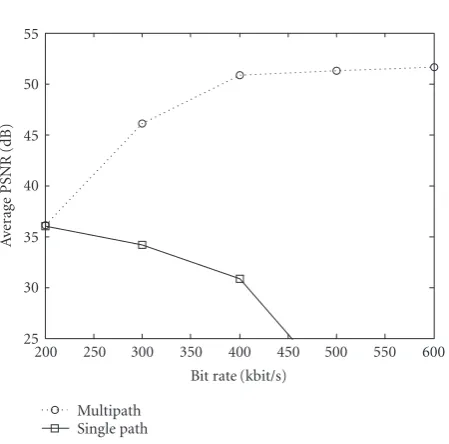
Figure12: Average PSNR.
follow different paths, and therefore may experience different
delays. In order to highlight this phenomenon better, Figures
10and11present the end-to-end delay probability
distribu-tions for both the single-path and multipath routing tech-niques, respectively.
By comparing all the figures from 8 to 11 we can deduce that multipath routing causes higher jitter values, which have
to be compensated for by the jitter compensator buffer at
the PPS. To this end, delay distributions are used to choose
the value of the thresholdσJ leaving on its right a negligible
portion of probability, representing the percentage of packets
that are lost if the jitter compensator buffer equalizes delays
to the chosen thresholdσJ. Of course, the greater the value
ofσJ is, the less the loss percentage introduced by the jitter
compensation buffer is, but the higher the equalization delay
is. In our system we choseσJ such that 0.1% of packets suffer
a delay greater thanσJ, and are therefore discarded.
0
200 250 300 350 400 450 500 550 600 Bit rate (kbit/s)
Multipath Single path
Figure13: Packet loss rate.
In order to evaluate the QoS perceived at destination, we first calculated the following:
(i) the average PSNR, measured at the destination side as
specified in (2) and (3) on the frames fully or partially
arrived and decoded (Figure 12);
(ii) the packet loss rate in the WMN network (Figure 13);
(iii) the video frame corruption percentage (Figure 14),
and the consequent effective frame rate,fr, measured
at destination (Figure 15), obtained as the ratio of the
number of frames that have been decoded (also thanks to the application of the error concealment decoding technique) over the measurement period.
Figure 12shows thepsnr term, defined in (4) as the PSNR calculated at the destination, after error concealment
pro-cessing. We can observe that thepsnrobtained with
0
200 250 300 350 400 450 500 550 600 Bit rate (kbit/s)
Multipath Single path
Figure14: Video frame corruption percentage.
routing. In this case, in fact, the reduced packet loss rate in the network allows the error concealment algorithm run at destination to work better, therefore providing frames with a better quality, more similar to the original ones. How-ever, when the encoding bit rate is too high (over 400 kbit/s), the PSNR increase at the source side corresponds to PSNR degradation due to network losses, and the PSNR therefore exhibits a flat trend. Of course, with encoding bit rate val-ues higher than 600 kbit/s, not shown here because of being unrealistic due to the enormous loss rate, the curve would have exhibited a decreasing trend. On the other hand, the huge number of losses encountered with single-path routing, which increases with the encoding bit rate, causes a decreas-ing PSNR trend, although the PSNR at the source increases.
Figures 13 and 14 present the packet loss rate in the
WMN network, and the consequent video frame corrup-tion percentage. From these figures we can notice that when the output bit rate increases, the destination frame rate achieved with single-path routing soon becomes too low, while multipath routing allows the source to encode at a high rate while maintaining a high destination frame rate: losses remain low up to 400 kbps.
As shown inFigure 14, with low bit rate values, we can
reduce packet losses by decreasing the video source trans-mission bit rate. In fact, by decreasing it, the probability of a packet being discarded decreases, and the received video quality grows.
Finally,Figure 16summarizes the QoS perceived at
des-tination by showing the overall objective quality parameter
Qdefined in (4), and demonstrates the power of multipath
routing in guaranteeing a perceived QoS greater than that achieved by single-path routing with any video source output rate. The behavior of this parameter is determined by both
thepsnrparameter shown inFigure 12, and thefrparameter
shown in Figure 15. We can observe that when single-path
routing is used the overall quality decreases with increasing
0
200 250 300 350 400 450 500 550 600 Bit rate (kbit/s)
Multipath Single path
Figure15: Average video frame rate,fr.
−6
200 250 300 350 400 450 500 550 600 Bit rate (kbit/s)
Multipath Single path
Figure16: Objective parameterQ.
encoding bit rates, and the best quality is achieved with the minimum considered encoding bit rate, equal to 200 kbit/s. On the contrary, using multipath routing allows us to encode at a higher bit rate the best being between 500 and 600 kbit/s. To summarize, taking into account that multipath rout-ing, besides robustness to external attacks and interceptions, provides a higher decoding quality and less delay than single-path routing, it is the best solution for the proposed video-surveillance system. The only problem of multipath routing is that delay jitter is higher, but this can be compensated for
6. CONCLUSIONS
This paper describes a real experience of a wireless video-surveillance system, illustrating the overall architecture and the structure of each component block. Specifically, video sources use rate control to emit a constant bit-rate flow, while the access network is a WMN implementing a mul-tipath routing algorithm to minimize delay and intrusions. However, this causes jitter, which is not acceptable for video-surveillance applications but can be compensated at desti-nation if delay statistics are known. Analysis is carried out against the emission bit rate, and quality perceived at desti-nation is evaluated with an objective parameter. Numerical results have demonstrated that multipath routing guarantees less delay and the best quality at destination. So it is the best solution for the proposed video-surveillance system with any encoding bit rate.
ACKNOWLEDGMENTS
The authors wish to thank the anonymous reviewers for their detailed reviews and many constructive suggestions which have improved the paper significantly. The work was par-tially supported by the Italian Ministry for University and Scientific Research (MIUR) through the BORA-BORA Prin project under Grant 2005097340.
REFERENCES
[1] C. Peng, “Introduction to Video-Surveillance Systems over the Internet Protocol,” Real World Video & Imaging: Texas Instru-ments White Papers, October 2003.
[2] R. T. Collins, A. J. Lipton, H. Fujiyoshi, and T. Kanade, “Algo-rithms for cooperative multisensor surveillance,”Proceedings of the IEEE, vol. 89, no. 10, pp. 1456–1477, 2001.
[3] C.-F. Chiasserini and E. Magli, “Energy consumption and im-age quality in wireless video-surveillance networks,” in Pro-ceedings of the 13th IEEE International Symposium on Personal, Indoor and Mobile Radio Communications (PIMRC ’02), vol. 5, pp. 2357–2361, Lisbon, Portugal, September 2002.
[4] I. F. Akyildiz, X. Wang, and W. Wang, “Wireless mesh net-works: a survey,”Computer Networks, vol. 47, no. 4, pp. 445– 487, 2005.
[5] Mesh Networks,http://www.meshnetworks.com/. [6] Radiant Networks,http://www.radiantnetworks.com/. [7] R. Karrer, A. Sabharwal, and E. Knightly, “Enabling
large-scale wireless broadband: the case for TAPs,” inProceedings of the 2nd Workshop on Hot Topics in Networks (HotNets-II ’03), Cambridge, Mass, USA, November 2004.
[8] P. Bhagwat, B. Raman, and D. Sanghi, “Turning 802.11 inside-out,” in Proceedings of the 2nd Workshop on Hot Topics in Networks (HotNets-II ’03), Cambridge, Mass, USA, November 2003.
[9] Tropos Networks,http://www.tropos.com/.
[10] R. Draves, J. Padhye, and B. Zill, “Routing in multi-radio, multi-hop wireless mesh networks,” inProceedings of the 10th Annual International Conference on Mobile Computing and Networking (MOBICOM ’04), pp. 114–128, Philadelphia, Pa, USA, September-October 2004.
[11] W. Feng, J. Walpole, W. Feng, and C. Pu, “Moving towards massively scalable video-based sensor networks,” in
Proceed-ings of the Workshop on New Visions for Large-Scale Networks: Research and Applications, pp. 12–14, Washington, DC, USA, March 2001.
[12] PeopleVision Project, IBM Research, http://www.research. ibm.com/peoplevision/.
[13] A. Hampapur, L. Brown, J. Connell, S. Pankanti, A. Senior, and Y. Tian, “Smart surveillance: applications, technologies and implications,” inProceedings of the Joint Conference of the 4th International Conference on Information, Communications and Signal Processing, and the 4th Pacific Rim Conference on Multi-media, vol. 2, pp. 1133–1138, Singapore, December 2003. [14] I. Haritaoglu, D. Harwood, and L. S. Davis, “W4: real-time
surveillance of people and their activities,”IEEE Transactions on Pattern Analysis and Machine Intelligence, vol. 22, no. 8, pp. 809–830, 2000.
[15] T. N. Tan, G. D. Sullivan, and K. D. Baker, “Model-based local-isation and recognition of road vehicles,”International Journal of Computer Vision, vol. 27, no. 1, pp. 5–25, 1998.
[16] C. R. Wren, A. Azarbayejani, T. Darrell, and A. P. Pentland, “Pfinder: real-time tracking of the human body,”IEEE Trans-actions on Pattern Analysis and Machine Intelligence, vol. 19, no. 7, pp. 780–785, 1997.
[17] A. J. Lipton, H. Fujiyoshi, and R. S. Patil, “Moving target clas-sification and tracking from real-time video,” inProceedings of the 4th IEEE Workshop on Applications of Computer Vision (WACV ’98), pp. 8–14, Princeton, NJ, USA, October 1998. [18] S. E. Kemeny, R. Panicacci, B. Pain, L. Matthies, and E. R.
Fossum, “Multiresolution image sensor,”IEEE Transactions on Circuits and Systems for Video Technology, vol. 7, no. 4, pp. 575–583, 1997.
[19] T. Boult, “Frame-rate multi-body tracking for surveillance,” inProceedings of DARPA Image Understanding Workshop, pp. 305–308, Monterey, Calif, USA, November 1998.
[20] A. Basu and D. Southwell, “Omni-directional sensors for pipe inspection,” inProceedings of the IEEE International Conference on Systems, Man and Cybernetics, vol. 4, pp. 3107–3112, Van-couver, BC, Canada, October 1995.
[21] Cisco Systemsdocumentation, “Intelligent Wireless Video Surveillance Solutions,” http://www.cisco.com/en/US/pro-ducts/hw/routers/ps272/prod brochure0900aecd804a8cad. html.
[22] “People-Mover Project Brings 21st Century Surveillance System to Dallas Airport,” Telindus, 2002 http://www. telindus.com/resources/ref case dallas-screen.pdf.
[23] V. Chandramohan and K. Christensen, “A first look at wired sensor networks for video surveillance systems,” inProceedings of the 27th Annual IEEE Conference on Local Computer Net-works (LCN ’02), pp. 728–729, Tampa, Fla, USA, November 2002.
[24] “Firetide, Axis partner to deliver wireless video surveil-lance,” Telematics Journal, September 2006, http://www. telematicsjournal.com/content/newsfeed/8344.html. [25] A. Doblander, A. Maier, and B. Rinner, “Increasing service
availability in intelligent video surveillance systems by fault detection and dynamic reconfiguration,” in Proceedings of the Telecommunications and Mobile Computing Workshop on Wearable and Pervasive Computing (TCMC ’05), Graz, Austria, March 2005.
[26] Y. Zhang and K. Chakrabarty, “Energy-aware adaptive check-pointing in embedded real-time systems,” inProceedings of the Design, Automation and Test in Europe Conference and Exhibi-tion (DATE ’03), pp. 918–923, Paris, France, March 2003. [27] S. Mueller, R. P. Tsang, and D. Ghosal, “Multipath
Performance Tools and Applications to Networked Systems, M. C. Calzarossa and E. Gelenbe, Eds., vol. 2965 ofLecture Notes in Computer Science, pp. 209–234, Springer, Berlin, Germany, 2004.
[28] E. Biagioni and S. H. Chen, “A reliability layer for ad-hoc wire-less sensor network routing,” inProceedings of the 37th Hawaii International Conference on System Sciences (HICSS ’04), pp. 4799–4806, Big Island, Hawaii, USA, January 2004.
[29] D. B. Johnson, D. A. Maltz, and J. Broch, “DSR: the dy-namic source routing protocol for multi-hop wireless ad hoc networks,” in Ad Hoc Networking, chapter 5, pp. 139–172, Addison-Wesley, New York, NY, USA, 2001.
[30] V. D. Park and M. S. Corson, “A highly adaptive distributed routing algorithm for mobile wireless networks,” in Proceed-ings of the 16th Annual Joint Conference of the IEEE Com-puter and Communications Societies (INFOCOM ’97), vol. 3, pp. 1405–1413, Kobe, Japan, April 1997.
[31] C. E. Perkings, E. Belding-Royer, and S. R. Das, “Ad hoc on-demand distance vector routing,” RFC 3561, 2003.
[32] S. Vutukury and J. J. Garcia-Luna-Aceves, “MDVA: a distance-vector multipath routing protocol,” inProceedings of the 20th Annual Joint Conference on the IEEE Computer and Communi-cations Societies (INFOCOM ’01), vol. 1, pp. 557–564, Anchor-age, Alaska, USA, April 2001.
[33] “Coded Representation of Picture and Audio Information,” International Standard ISOIEC/JTC1/ Sc29/WG11, MPEG Test Model 2. July 1992.
[34] “Coding of Moving Pictures and Associated Audio for Dig-ital Storage Media up to 1.5 Mbit/s—Part 2,” Video. Inter-national Standard ISO-IEC/JTC1/SC29/WG11, DIS11172-1. March 1992.
[35] A. Lombardo and G. Schembra, “Performance evaluation of an adaptive-rate MPEG encoder matching intserv traffic con-straints,”IEEE/ACM Transactions on Networking, vol. 11, no. 1, pp. 47–65, 2003.
[36] C.-F. Chang and J.-S. Wang, “A stable buffer control strategy for MPEG coding,”IEEE Transactions on Circuits and Systems for Video Technology, vol. 7, no. 6, pp. 920–924, 1997. [37] A. Cernuto, F. Cocimano, A. Lombardo, and G. Schembra, “A
queueing system model for the design of feedback laws in rate-controlled MPEG video encoders,”IEEE Transactions on Cir-cuits and Systems for Video Technology, vol. 12, no. 4, pp. 238– 255, 2002.
[38] W. Ding and B. Liu, “Rate control of MPEG video coding and recording by rate-quantization modeling,”IEEE Transactions on Circuits and Systems for Video Technology, vol. 6, no. 1, pp. 12–20, 1996.
[39] X. Yuan, Z. Sun, Y. Varol, and G. Bebis, “A distributed visual surveillance system,” inProceedings of the IEEE Conference on Advanced Video and Signal Based Surveillance (AVSS ’03), pp. 199–204, Miami, Fla, USA, July 2003.
[40] S. Vutukury and J. J. Garcia-Luna-Aceves, “A simple ap-proximation to minimum-delay routing,” in Proceedings of the ACM Conference on Applications, Technologies, Architec-tures, and Protocols for Computer Communication (ACM SIG-COMM ’99), pp. 227–238, Cambridge, Mass, USA, August-September 1999.
[41] S. Vutukury and J. J. Garcia-Luna-Aceves, “A practical frame-work for minimum-delay routing in computer netframe-works,” Journal of High Speed Networks, vol. 8, no. 4, pp. 241–263, 1999.
[42] Y.-C. Lee, Y. Altunbasak, and R. M. Mersereau, “Multi-frame error concealment for MPEG-coded video delivery over
error-prone networks,”IEEE Transactions on Image Processing, vol. 11, no. 11, pp. 1314–1331, 2002.
[43] S.-C. Pei and Y.-Z. Chou, “Novel error concealment method with adaptive prediction to the abrupt and gradual scene changes,”IEEE Transactions on Multimedia, vol. 6, no. 1, pp. 158–173, 2004.
[44] S. Tsekeridou and I. Pitas, “MPEG-2 error concealment based on block-matching principles,”IEEE Transactions on Circuits and Systems for Video Technology, vol. 10, no. 4, pp. 646–658, 2000.
[45] “The Click Modular Router Project,” http://pdos.csail.mit. edu/click/.