A Low-Complexity Approach to Space-Time Coding
for Multipath Fading Channels
Mari Kobayashi
Institut Eur´ecom, 2229 Route des Cretˆes, B.P. 193, 06904 Sophia-Antipolis Cedex, France Email:[email protected]
Giuseppe Caire
Institut Eur´ecom, 2229 Route des Cretˆes, B.P. 193, 06904 Sophia-Antipolis Cedex, France Email:[email protected]
Received 7 October 2004; Revised 9 March 2005; Recommended for Publication by Richard Kozick
We consider a single-carrier multiple-input single-output (MISO) wireless system where the transmitter is equipped with multiple antennas and the receiver has a single antenna. For this setting, we propose a space-time coding scheme based on the concatena-tion of trellis-coded modulaconcatena-tion (TCM) with time-reversal orthogonal space-time block coding (TR-STBC). The decoder is based on reduced-state joint equalization and decoding, where a minimum mean-square-error decision-feedback equalizer is combined with a Viterbi decoder operating on the TCM trellis without trellis state expansion. In this way, the decoder complexity is inde-pendent of the channel memory and of the constellation size. We show that, in the limit of large block length, the TCM-TR-STBC scheme with reduced-state joint equalization and decoding can achieve the full diversity offered by the MISO multipath channel. Remarkably, simulations show that the proposed scheme achieves full diversity for short (practical) block length and simple TCM codes. The proposed TCM-TR-STBC scheme offers similar/superior performance with respect to the best previously proposed schemes at significantly lower complexity and represents an attractive solution to implement transmit diversity in high-speed TDM-based downlink of third-generation systems, such as EDGE and UMTS.
Keywords and phrases:space-time coding, trellis-coded modulation, joint equalization and decoding.
1. MOTIVATIONS
In classical wireless cellular systems, user terminals are miniaturized handsets and typically cannot host more than a single antenna. On the other hand, base stations can be eas-ily equipped with multiple antennas. Hence, we are in the presence of a multiple-input single-output (MISO) channel. For pedestrian users in an urban environment, the prop-agation channel is typically slowly fading and frequency selective. For single-carrier transmission, as used in cur-rent third-generation standards [1, 2], frequency selectiv-ity generates intersymbol interference (ISI). In systems that do not make use of spread-spectrum waveforms, such as GPRS and EDGE [2] or certain modes of wideband CDMA [1] using very small spreading factors, ISI must be han-dled by linear/decision-feedback equalization or maximum-likelihood sequence detection [3].
Due to the slowly varying nature of the fading channel, a codeword spans a limited number of fading degrees of
free-This is an open access article distributed under the Creative Commons Attribution License, which permits unrestricted use, distribution, and reproduction in any medium, provided the original work is properly cited.
dom. In the absence of reliable channel state information at the transmitter, the word-error probability (WER) is domi-nated by the so-called information outage event, namely, the event that the transmitted coding rate is above the mutual information of the channel realization spanned by the trans-mitted codeword [4]. In such conditions, the WER can be greatly improved by using space-time codes (STCs), that is, coding schemes whose codewords are transmitted across the time dimension as well as the space dimension introduced by the multiple transmit antennas [5].
In a frequency-selective MISO Rayleigh fading chan-nel with M transmit antennas andP independent (separa-ble) multipath components, it is immediate to show that the best WER behavior achievable by STC for high SNR is
O(SNR−dmax), whered
max=∆ MPis the maximum achievable diversity orderof the channel, equal to the number of fading degrees of freedom. We hasten to say that in this work we fo-cus on MISO channels and on STC design for achieving max-imum diversity. Obviously, the STC scheme proposed in this paper can be trivially applied to the case of multiple receiver antennas (MIMO channel). However, forNr>1 antennas at
the spatial multiplexing capability of the channel, that is, the ability to create up to min{M,Nr}parallel channels
be-tween transmitter and receiver, thus achieving much higher spectral efficiency. The optimal tradeoffbetween the achiev-able spatialmultiplexing gainanddiversity gainin frequency-flat MIMO channels was investigated in [6] and the analysis has been recently extended to the frequency-selective case in [7].
The design of space-time codes (STCs) for single-carrier transmission over frequency-selective MISO chan-nels has been investigated in a number of recent contribu-tions [8, 9, 10, 11]. Maximum-likelihood (ML) decoding in MISO frequency-selective channels is generally too com-plex for practical channel memory and modulation constel-lation size. Hence, research has focused on suboptimal low-complexity schemes. We may group these approaches into two classes. The first approach is based on mitigating ISI by some MISO equalization techniques, and then designing a space-time code/decoder for the resulting flat-fading chan-nel. For example, the use of a linear minimum mean-square-error (MMSE) equalizer combined with Alamouti’s space-time block code [12] has been investigated in [11]. However, this scheme does not achieve, in general, the maximum di-versity order offered by the channel. The second approach is based on designing the STC by taking into account the ISI channel and then performing joint equalization and de-coding. For example, trellis coding and bit-interleaved coded modulation (BICM) with turbo equalization have been pro-posed in [9,13]. Time-reversal orthogonal space-time block codes (TR-STBC) [8] (see also [9]) converts the MISO nel into a standard single-input single-output (SISO) chan-nel with ISI, to which conventional equalization/sequence detection techniques, or turbo equalization, can be applied. Turbo-equalization schemes need a soft-in soft-out MAP de-coder for the ISI channel, whose complexity is exponential in the channel impulse response length and in the constel-lation size. For example, MAP symbol-by-symbol detection implemented by the BCJR algorithm [14] runs on a trel-lis with |X|L−1 states, where |X| denotes the size of the
transmitted signal constellationX ⊂ C, andLdenotes the channel impulse response length (expressed in symbol inter-vals).
In this work, we consider the concatenation of TR-STBC with an outer trellis coded modulation (TCM) [15]. At the receiver, we apply reduced-state sequence detection based on joint MMSE decision-feedback equalization (DFE) and de-coding (notice that sequence detection for TR-STBC with-out with-outer coding has been considered in [16,17]). The deci-sions for the MMSE-DFE are found on the surviving paths of the Viterbi decoder acting on the trellis of the TCM code. Since the joint equalization and decoding scheme works on the trellis of the original TCM code, without trellis state ex-pansion due to the ISI channel, the receiver complexity is in-dependent of the channel length and of the constellation size. This makes our scheme applicable in practice even for large signal constellations and channel impulse response length as specified in second- and third-generation standards, while the schemes proposed in [9,10,13] are not.
We show that, in the limit of large block length, the TCM-TR-STBC scheme with reduced-state joint equalization and decoding can achieve the full diversity offered by the MISO multipath channel. Remarkably, simulations show that the proposed scheme achieves full diversity for short (practical) block length and simple TCM codes.
A significant advantage of the proposed TCM-TR-STBC scheme is that TCM easily implements adaptive modulation by adding uncoded bits (i.e., parallel transitions in the TCM trellis) and by expanding correspondingly the signal con-stellation [15]. Since the constellation size has no impact on the decoder complexity, variable-rate (adaptive) mod-ulation can be easily implemented. This fact has particu-lar relevance in the implementation of high-speed down-link schemes based on dynamic scheduling, where adaptive modulation is required [18]. Remarkably, simulations show that the TCM-TR-STBC scheme achieves WER performance at least as good as (if not better than) previously proposed schemes [9,10,13] that are more complex and less flexible in terms of variable-rate coding implementation.
The rest of the paper is organized as follows. Sections
2 and3describe our concatenated TCM-TR-STBC scheme and the low-complexity reduced-state joint equalization and decoding scheme. In Section 4, we derive two approxima-tions to the WER of the proposed scheme. Numerical results are presented inSection 5, andSection 6concludes the pa-per.
2. THE CONCATENATED TCM-TR-STBC SCHEME
2.1. System model
The channel from the ith transmit antenna to the receive antenna is formed by a pulse-shaping transmit filter (e.g., a root-raised cosine pulse [3]), a multipath fading channel with P separable paths, an ideal lowpass filter with band-width [−Ns/(2Ts),Ns/(2Ts)] whereNs≥2 is an integer and
Ts is the symbol interval, and a sampler takingNssamples
per symbol. We assume that the fading channels are ran-dom but constant in time for a large number of symbol intervals (quasistatic assumption). We also assume that the overall channel impulse response spans at most L symbol intervals, corresponding to Ng =∆ LNsreceiver samples. Let
(si[0],. . .,si[N−1], 0,. . ., 0) denote the sequence of symbols
transmitted over antennai, where we add a tail ofL−1 zeros in order to avoid interblock interference. The discrete-time complex baseband equivalent MISO channel model can be written in vector form as
r=
M
i=1 Hgi
si+w, (1)
wherer∈ CNs(N−1)+Ng,w ∼N
C(0,N0I) is the complex
cir-cularly symmetric additive white Gaussian noise (AWGN), si = (si[0],. . .,si[N−1])T, andH(gi) ∈ C(Ns(N−1)+Ng)×N
column ofH(gi) is given by
TR-STBC [8] is a clever extension of orthogonal space-time block codes based on generalized orthogonal designs (GODs) [19,20,21] to the frequency-selective channel. As we will briefly review in the following, the TR-STBC turns a frequency-selective MISO1 into a standard SISO channel
with ISI, by simple linear processing given by matched filter-ing and combinfilter-ing.
A [T,M,k]-GOD is defined by a mappingS:Ck→CT×M
such that, for allx∈Ck, the corresponding matrixS(x)
sat-isfiesS(x)HS(x)= |x|2I. Moreover, the elements ofS(x) are
linear combinations of elements ofxand ofx∗.
LetSbe a [T,M,k]-GOD with the following additional property: (A1) the row index {1,. . .,T} set can be parti-tioned into two subsets, T1 andT2, such that all elements
of the tth rows witht ∈ T1 are given byat,ixπ(t,i), for i =
1,. . .,M, and all elements of thetth rows witht ∈ T2are
given byat,ix∗π(t,i), fori=1,. . .,M, whereat,iare given
com-plex coefficients andπ:{1,. . .,T} × {1,. . .,M} → {1,. . .,k}
is a given indexing function.
Given a [T,M,k]-GODS satisfying property (A1) and two integers N ≥ 1 and L ≥ 1, we define the associated TR-STBCTwith parameters [T,M,k,N,L] as the mapping
the complex conjugate time-reversal operator◦is defined by
◦v[0],. . .,v[N−1]T=v∗[N−1],. . .,v∗[0]T. (3)
The time-reversal operator satisfies the following elemen-tary properties: (B1) let H(g) be a convolution matrix as defined by (2) ands ∈ CN, then,◦(H(g)◦s) = H(◦g)s;
(B2) letgandhbe two impulse responses of lengthNg, then
H(g)HH(h)=H(◦h)HH(◦g).
In order to transmit the k blocks of N symbols each over the MISO channel defined by (1) by using a TR-STBC scheme with parameters [T,M,k,N,L], the columns ofT(x1,. . .,xk) are transmitted in parallel, over theM
anten-nas, inT(N+L−1) symbol intervals. Due to the insertion of the tails ofL−1 zeros, the received signal can be parti-tioned intoT blocks ofNs(N−1) +Ng samples each,
with-out interblock interference. Ift∈T1, thetth block takes on
1Extension to MIMO is straightforward, but as anticipated inSection 1, it is less relevant due to the significant spectral efficiency loss of orthogonal STBCs in MIMO channels.
tth block takes on the form
◦rt=
the underlying GODSand from property (B2) it is straight-forward to show that
where we define the combined total channel response
Γ=∆
whereΓis anN×NHermitian symmetric nonnegative defi-nite Toeplitz matrix. Therefore, by passing the received signal
rthrough the bank of matched filters for the channel impulse responsesgiand combining the matched-filter outputs
(sam-pled at the symbol rate), thekblocks of transmitted symbols are completely decoupled. The equivalent channel for any of these blocks (we drop the block index from now on for sim-plicity) is given by
y=Γx+z, (9)
wherez∼NC(0,N0Γ).
The TR-STBC scheme has turned the MISO frequency-selective channel into a standard SISO channel with ISI, and the channel model (9) represents the so-called sam-pled matched-filteroutput of the equivalent SISO channel, in block form. Notice that the noisezis correlated.
2.3. Concatenation with TCM
TCM
encoder Interleaver
TR-STBC formatting D
L−1
N
x1x2x3
x1
x2
x3
− ◦x2
◦x1
− ◦x3
◦x1
−x3
x2 =
T(x)T T(N+L−1)
(a)
TR process sampled MF
y Feedforward
filter Deinterleaver
zj PSP
decoder
ISI cancellation
L−1
PSP decoding (b)
Figure1: Block diagram of the TCM-TR-STBC scheme forM=3. (a) Transmitter. (b) Receiver.
For outer coding, we choose standard TCM [15,22,23,24] for the following reasons: (1) it is very easy to implement variable-rate coding by adding uncoded bits, expanding the signal set correspondingly, and increasing the number of par-allel transitions in the same basic encoder trellis; (2) they can be easily decoded by the Viterbi algorithm (VA) which is par-ticularly suited to the low-complexity joint equalization and decoding scheme proposed in the next section; (3) after the TR-STBC combining, we are in the presence of an ISI chan-nel whose impulse response is given by the coherent combi-nation of theM channel impulse responses of the underly-ing MISO channel. Due to the inherent diversity combinunderly-ing, the effect of fading is reduced and it makes sense to choose the outer coding scheme in a family optimized for classical AWGN-ISI channels [24]. Since TCM is standard, we will not discuss further details here for the sake of space limita-tion.
In the proposed TCM-TR-STBC scheme, the blocks of symbols (x1,. . .,xk) of the TR-STBC transmit matrix
T(x1,. . .,xk) are obtained by interleaving the output
se-quence produced by a TCM encoder. As we will see in the next section, a block interleaver with suitable depthDis nec-essary in order to enable the low-complexity joint equal-ization and decoding scheme to work efficiently. We con-sider a row-column interleaver formed by an array of size
N ×D, where the symbols produced by the TCM encoder (in their natural time ordering) are written by rows, and the columns form the blocksxj mapped into the TR-STBC
transmit matrix.
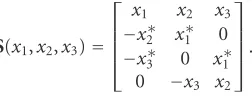
Figure 1ashows the block diagram of the proposed con-catenated scheme for M = 3, based on the rate-3/4 STBC
with block lengthT=4 defined by
S(x1,x2,x3)=
x1 x2 x3 −x∗2 x∗1 0 −x∗3 0 x1∗
0 −x3 x2
. (10)
The sequence generated by the TCM encoder is arranged in the interleaving array by rows. The resulting D vectors of length N are mapped onto theT(N+L−1)×M TR-STBC transmit matrix (this is shown transposed inFigure 1a
where the shadowed areas correspond to zeros). The spec-tral efficiency of the resulting concatenated scheme is given by η = N/(N+L−1)RSTBCRTCM, where RSTBC is the rate
[symbol/channel use] of the underlying STBC, and RTCM
is the rate [bit/symbol] of the outer TCM code. The factor
N/(N+L−1) is the rate loss due to the insertion of the zero padding, and can be made small by lettingNL.
3. REDUCED-STATE JOINT EQUALIZATION AND DECODING
An MMSE-DFE deals with the causal part of ISI by using the reliable decisions found on the survivors of the VA operat-ing on the trellis of the underlyoperat-ing TCM code. The noncausal part of the ISI is mitigated by the forward filter of the MMSE-DFE.
In order to compute the MMSE-DFE forward filter with linear complexity in the channel length L and in the TR-STBC block sizeN, we use the block formulation based on Cholesky factorization of [27]. For the sampled matched-filter channel model in vector form, given in (9), we compute the Cholesky factorization
N0I+Γ=BH∆B, (11)
whereBis upper triangular with unit diagonal elements and ∆=diag(σ[N−1],. . .,σ[0]) is a diagonal matrix with pos-itive real diagonal elements. The feedback filter matrix is equal toB−I, which is strictly causal. The Schur algorithm computes this factorization with linear complexity inLand
N by considering the banded Toeplitz structure ofΓwhere each row contains at most 2L−1 nonzero elements [27]. The MMSE-DFE forward filter is given by
F=∆−1B−H. (12)
The output of this filter can be obtained efficiently by apply-ing back substitution toy, yielding linear complexity inLand
N.
Let{z[j]}be the sequence of symbol-rate samples ob-tained after forward filtering and block deinterleaving. Due to the structure of the interleaver, the decisions in the decision-feedback section of the equalizer can be found on the survivors of the VA acting on the original TCM trellis (i.e., without state expansion). The resulting VA is fully de-fined by its branch metric. Consider theqth parallel transi-tion at the jth trellis step, extending from statesand merging to states. The corresponding branch metric is given by
ms,s,q[j]= tion symbol labeling theqth parallel transition of the trellis branchs→s,xn−D(s) are the tentative decisions found on
the surviving path terminating in states, and (bn,1,. . .,bn,L)
are the coefficients of the MMSE-DFE feedback filter where
bn,is the (N−1−n,N−1−n+)th element of the matrixB.
Thanks to the interleaving depthD, the tentative deci-sions are found at leastDtrellis steps before the symbol of interest (step j in the trellis). IfDis larger than the Viterbi decoding delay (typically 5 or 6 times the code constraint length), the corresponding decisions are reliably obtained from the Viterbi decoder output [26]. As a matter of fact, simulations show that the scheme is extremely robust and, even if Dis much smaller than the typical Viterbi decod-ing delay, the WER performance of the proposed scheme is
almost identical to that of a genie-aided scheme that makes use of ideal feedback decisions. The minimal Dfor which ideal-feedback performance is attained depends on the spe-cific code and should be optimized by extensive simulation.
4. WER ANALYSIS
In this section, we provide two approximations to the WER of the proposed TCM-TR-STBC scheme. Both approxima-tions are based on the assumption of a genie that helps the equalization and decoding scheme.
4.1. Matched-filter bound (MFB)
Assuming that a genie removes the whole ISI and that dein-terleaving suffices to decorrelate the Gaussian noise, (9) is turned into the ISI-free AWGN channel
y(MFB)[j]=γ
The coefficient γ0 can be expressed by using the
eigende-composition of the covariance matrix of gi, given byRg =∆
E[gigTi], that we assume independent ofifor simplicity. We
let Rg = UΛUH whereΛ = diag{λ1,. . .,λP} contains the
nonzero eigenvalues on the diagonal and U ∈ CNg×P has
orthonormal columns. The number P of positive eigenval-ues of Rg represents the number of fading effective degrees
of freedom of the multipath channel, that is, the number of
separable paths.2In the rest of this paper, we assume Rayleigh
fading, uncorrelated scattering, and that the channel impulse responses of different antennas are statistically independent. We use the Karhunen-Loeve decomposition
gi=UΛ1/2hi, (15)
where hi = (hi[1],. . .,hi[P])T are complex circularly
sym-metric Gaussian vectors with i.i.d. components∼NC(0, 1). It follows that
where theα[p]’s are i.i.d. central Chi-squared random vari-ables with 2Mdegrees of freedom.
The WER conditioned with respect toγ0under the MFB
assumption is upper bounded by
P(MFB)
whereK =DNdenotes the frame length in trellis steps and
Adis the average number ofsimpleerror events atnormalized
squared Euclidean distanced2.3This function can be
evalu-ated numerically by using the Euclidean distance enumerator
{Ad}of the TCM code. In practice, the (possibly truncated)
distance enumerator can be computed by several algorithms depending on geometrical uniformity of the TCM code un-der examination [22,28,29]. In order to obtain the average WER over the realization of the channelγ0, we cannot
aver-age the conditional union bound (17) term by term because the union bound averaged over the fading statistics may be very loose or even not converge if an infinite number of terms are taken into account in the union bound summation (see [30]). Then, we follow the approach of [30] and obtain
where the expectation is with respect to the statistics ofγ0,
that can be easily obtained by numerical integration. Since we have used a union upper bound in the MFB lower bound, (18) is neither a lower nor an upper bound. Rather, it pro-vides a useful approximation for the actual WERPw(e).
4.2. Genie-aided MMSE-DFE Gaussian approximation Here we assume that a genie removes only the causal ISI (i.e., the MMSE-DFE works under the ideal feedback assump-tion). The channel presented to the VA can be modeled as
y(GAB)[j]="βx[j] +w[j], (19)
whereE[|w[j]|2]=1, andEβis the
signal-to-interference-plus-noise ratio (SINR) at the output of the MMSE-DFE un-der the ideal feedback assumption, given by [31]
βE =exp
time Fourier transform of the symbol-rate sampled autocor-relation function of theith channel impulse responsegi. The
SINR expression (20) is obtained in the limit for large block length (N→ ∞) that makes the vector model (9) stationary. Since the term w[j] in (19) contains both noise and anti-causal ISI, we make a Gaussian approximation and letw[j]∼ NC(0, 1). The approximated error probability for this model can be derived exactly in the same manner as for the MFB, by replacing the SNRγ0E/N0in (18) byβE. Unfortunately, the
expectation with respect to βmust be evaluated by Monte Carlo average, since the pdf of βcannot be given in closed form. Remarkably, simulations show that this approxima-tion is very tight and predicts very accurately the WER of the TCM-TR-STBC scheme under the actual joint equalization and decoding scheme (i.e., without ideal decision feedback).
3Having put in evidence the average symbol energyE, we define the normalized Euclidean distancedbetween two code sequencesxandx by d2= |x−x|2/E.
4.3. Achievable diversity
The maximum achievable diversity in the MISO channel withMindependent antennas andPseparable paths is obvi-ously given bydmax=MP. Consider the input
single-output channel with ISI obtained by including the TR-STBC encoding (at the transmitter) and combining (at the receiver) as part of the channel. Standard results of information the-ory show that the maximum information rate achievable by signals with frequency-flat power spectral density is given by [32]
For the quasistatic fading model considered in this paper, it follows that the best possible WER for any code, in the limit of large block length, is given by theinformation outage prob-ability
and, by following the argument of [6,7], that the high-SNR slope of the outage probability curve, defined by the limit
lim
It is also well known that the information rate (21) can be achieved by Gaussian codes, block interleaving, and by joint MMSE-DFE equalization and decoding (see, e.g., the tutorial presentation in [33, Section VII.B] and references therein). We conclude that, in the limit of large interleaving depthDandNL, MMSE-DFE equalization and decoding with ideal Gaussian (capacity achieving) codes achieves max-imum diversity. Our low-complexity decoding scheme can be seen as a practical version of this asymptotically optimal scheme and differs in two key aspects that make it practical: (1) it uses a very short interleaving depthD; (2) it uses very simple off-the-shelf TCM codes. ShortDimplies unreliable feedback decision. Simulations show that the PSP approach is able to mitigate this effect and that full diversity is easily achieved by our scheme under no ideal feedback assumption.
5. NUMERICAL RESULTS
In order to evaluate the performance of the proposed scheme, simulations have been performed in the follow-ing conditions. Two ISI channel models are considered: a symbol-spacedP-path channel with the equal strength paths and the pedestrian channel B [34] for the TD-SCDMA third-generation standard [35]. Classical Ungerboeck TCM codes are used with different signal constellations and spectral effi -ciencies. WER curves are plotted versus eitherEb/N0or SNR
in dB, where we define SNR =∆ ME/N0 as the total
100
10−1
10−2
10−3
10−4
FER
6 7 8 9 10 11 12 13 14 15 16
SNR (dB) Zhou-Giannakis, Liu-Fitz-Takeshita 16-state, # iter.=5
TR-STBC with 16-state TCM TR-STBC with 64-state TCM Outage probability
256 (info.bits/block) 2 (bit/Hz/s)
Figure2: Comparison with previously proposed STC schemes (2-Tx-antenna systems over 2-path ISI channel).
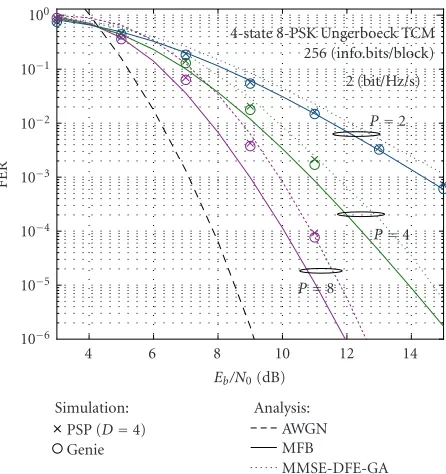
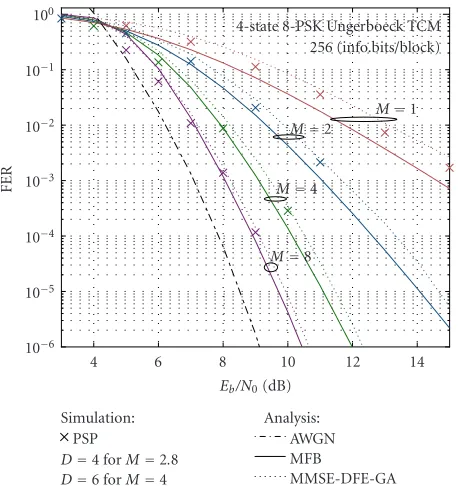
in agreement with standard STC literature. In the following, the simulated WER curves for the actual per-survivor pro-cessing decoder are denoted by “PSP” with an interleaving depth D, the simulated WER curves for a genie-aided de-coder that makes use of ideal feedback decisions are denoted by “Genie,” the MFB approximation is denoted by “MFB,” and the MMSE-DFE Gaussian approximation is denoted by “MMSE-DFE-GA.”
5.1. Comparison with other schemes
Figure 2 compares the TCM-TR-STBC scheme with previ-ously proposed schemes forη=2(bit/channel use),M =2 andP=2 equal strength ISI channels. The corresponding in-formation outage probability is shown for comparison. The ST-BICM schemes of [9,13], employing turbo equalization and decoding based on a BCJR algorithm for the ISI channel and for the trellis code, yield performance similar to ours. However, these schemes have much higher receiver complex-ity.4In the case of [9], the memory-one ISI channel with
8-PSK modulation has trellis complexity 64 and the 16-state convolutional code of rate-2/3 used in the BICM scheme has trellis complexity 64. Five iterations are required, yielding a total complexity of 5×128=640 branches per coded sym-bol. In the case of [36], the memory-two MISO ISI chan-nel with 4-PSK modulation has trellis complexity 256 and
4In order to obtain an implementation-free complexity estimate, we as-sume that the complexities of the BCJR and of the PSP algorithms are es-sentially given by their trellis complexity (number of branches per coded symbol). Hence, we evaluate the receiver complexity as the overall trellis complexity times the number of equalizer/decoder iterations.
100
10−1 10−2
10−3 10−4
10−5 10−6
FER
4 6 8 10 12 14
Eb/N0(dB) Simulation:
PSP (D=4) Genie
Analysis: AWGN MFB
MMSE-DFE-GA 4-state 8-PSK Ungerboeck TCM
256 (info.bits/block) 2 (bit/Hz/s)
P=2
P=4
P=8
Figure3: Performance of the TCM-TR-STBC scheme forM =2 and increasing number of paths (2-Tx-antenna TR-STBC overP -path ISI channel).
the 16-state TCM space-time code used has trellis complex-ity 64. Five iterations are required, yielding a total complexcomplex-ity of 5×320=1600 branches per coded symbol. Our scheme, with a 64-state rate-2/3 8-PSK TCM code and no iterative processing, has trellis complexity of 256 branches per coded symbol.
5.2. Some aspects of the TCM-TR-STBC scheme
In Figure 3, we evaluate the impact of the number of sep-arable paths on the WER with M = 2 for a spectral effi -ciency of 2(bit/channel use). A 4-state 8-PSK Ungerboeck TCM is used. As the number of paths increases, the slope of the curves becomes steeper and gets closer and closer to that of an unfaded ISI-free AWGN channel (TCM perfor-mance in standard AWGN). Since Ungerboeck TCM codes are optimized for the AWGN channel, this fact justifies the choice of these codes for the concatenated scheme. The per-formance of the actual PSP decoder lies in between the MFB and the MMSE-DFE-GA approximations. We have also sim-ulated the performance of a genie-aided decoder that makes use of ideal feedback decisions. We notice that the perfor-mance of the PSP decoder coincides with that of the genie-aided decoder, showing that the effect of nonideal decisions in the MMSE-DFE is negligible in the proposed PSP scheme already for interleaving depthD=4.
100
10−1
10−2
10−3
10−4
10−5
10−6
FER
4 6 8 10 12 14
Eb/N0(dB) Simulation:
PSP
D=4 forM=2.8 D=6 forM=4
Analysis: AWGN MFB
MMSE-DFE-GA 4-state 8-PSK Ungerboeck TCM
256 (info.bits/block)
M=1 M=2
M=4
M=8
Figure4: Performance of the TCM-TR-STBC scheme forP=4 and increasing number of transmit antennas (M-Tx-antenna TR-STBC over 4-path ISI channel).
the actual WER performance gets closer to the MFB approx-imation and for 4 and 8 antennas, the system achieves the MFB. This shows that the effect of ISI is reduced by increas-ing the system transmit diversity. In fact, the matrix Γ de-fined in (8) is given by the sum ofM independent Toeplitz matricesH(gi)HH(gi) where the diagonal terms are real and
positive while the off-diagonal terms are complex and added noncoherently with different phases. Hence, asMincreases, Γbecomes more and more diagonally dominated.
Figure 5shows the performance of our PSP scheme com-pared to the information outage probability for different modulation schemes (increasing spectral efficiency) over 4-path equal-strength ISI channel for M = 2. The 4-state Ungerboeck TCM codes are used over different constella-tions and the resulting spectral efficiencies are 1, 2, 3, 4 (bit/channel use) for QPSK, 8-PSK, 16-QAM, 32-cross, re-spectively. For all spectral efficiencies, the gap between the outage probability and the WER of the actual schemes is almost constant. This fact is due to the optimality of the underlying Alamouti code for the 2-antenna MISO chan-nel in the sense of the diversity-multiplexing tradeoff of [6].
Figure 6shows anM=4 antenna system over the pedes-trian channel B. The TCM-TR-STBC scheme is obtained by concatenating a 16-state Ungerboeck TCM code with the TR-STBC obtained from the rate-3/4 GOD with parame-ters [T = 8, M = 4, k = 6] [20]. The spectral effi -ciencies for QPSK, 8-PSK, 16-QAM, 32-cross are 0.75, 1.5, 2.25, 3(bit/channel use). Even on a realistic channel model where the number of separable pathsPis much smaller than the length of the channel impulse response, the proposed scheme shows the same slope of the information outage
100
10−1
10−2
10−3
10−4
10−5
FER
0 4 8 12 16 20 24
SNR (dB) Simulation:
PSP (D=4) Genie
Analysis:
Outage probability MFB
MMSE-DFE-GA 4-state Ungerboeck TCM
128 (symbol/block)
QPSK 8-PSK 16-QAM 32-cross
Figure5: Comparison with outage probability forM=2 andP=4 (2-Tx-antenna TR-STBC over 4-path ISI channel).
100
10−1
10−2
10−3
10−4
10−5
FER
0 4 8 12 16 20
SNR (dB) Simulation:
PSP (D=6)
Analysis: Outage probability
QPSK 8-PSK 16-QAM 32-cross
16-state Ungerboeck TCM 114 (symbol/block)
3.8 dB 4.2 dB
5 dB 5.4 dB
Figure6: Performance over the pedestrian B channel, withM=4 transmit antennas (4-Tx-antenna TR-STBC over pedestrian chan-nel).
6. CONCLUSION
We proposed a concatenated TCM-TR-STBC scheme for single-carrier transmission over frequency-selective MISO fading channels. Thanks to a reduced-state joint equaliza-tion and decoding approach, our scheme achieves much lower complexity with similar/superior performance than previously proposed schemes for the same spectral efficiency. Moreover, since the receiver complexity is independent of the modulation constellation size and Ungerboeck TCM schemes implement very easily different spectral efficiencies with the same encoder, by introducing parallel transitions and expanding the signal constellation, our scheme is suit-able for implementing adaptive modulation with low com-plexity. This is a key component in high-speed downlink transmission with transmitter feedback information.
We wish to conclude with a simple numerical example inspired by a third-generation system setting, showing that very high data rates with high diversity can be easily achieved with the proposed scheme. Consider a MISO downlink sce-nario such as TD-SCDMA [35]. This system is based on slotted quasisynchronous CDMA at 1.28 Mchip/s (∼2 MHz bandwidth). A slot, of duration 675 microseconds, is formed by two data-bearing blocks of 352 chips that are separated by 144 chips of midamble for channel estimation. At the end of the second block, 16 chips of guard interval are added for slot separation. With 128 chips plus 16 chips of guard interval (total 144 chips), we can estimate easily 4 channels of length 16 chips in the frequency domain, using an FFT of length 128 samples. We can use the rate-3/4 TR-STBC forM =4 antennas with an 8-PSK TCM code. Using blocks ofN=76 [symbols],L=17, andRTCM = 2(bit/channel use), the
re-sulting spectral efficiency isη = (3/4)(76×8/864)RTCM =
1.056(bit/chip). This yields 1.35 Mbps on a single carrier. On three carriers (equivalent to the 5 MHz of the European UMTS), we obtain 4.05 Mbps, well beyond the “dream” tar-get of 2 Mbps of high-speed links in third-generation sys-tems. We conclude that the TCM-TR-STBC scheme repre-sents a valid candidate for the high data rate downlink of TD-SCDMA.
ACKNOWLEDGMENTS
This work was supported by France Telecom. The content of this paper was partially presented in WPMC’2003, Yokosuka, Japan, in 2003.
REFERENCES
[1] H. Holma and A. Toskala,WCDMA for UMTS, John Wiley & Sons, New York, NY, USA, 2000.
[2] “Digital cellular communications system (Phase 2+),” Tech. Specifications 3GPP TS 05.01-05, ETSI/3GPP, Sophia-Antipolis, Valbonne, France, 2001.
[3] J. G. Proakis, Digital Communications, McGraw-Hill, New York, NY, USA, 1997.
[4] E. Biglieri, J. G. Proakis, and S. Shamai, “Fading channels: information-theoretic and communications aspects,” IEEE Trans. Inform. Theory, vol. 44, no. 6, pp. 2619–2692, 1998.
[5] V. Tarokh, N. Seshadri, and A. R. Calderbank, “Space-time codes for high data rate wireless communication: perfor-mance criterion and code construction,”IEEE Trans. Inform. Theory, vol. 44, no. 2, pp. 744–765, 1998.
[6] L. Zheng and D. N. C. Tse, “Diversity and multiplexing: a fun-damental tradeoffin multiple-antenna channels,”IEEE Trans. Inform. Theory, vol. 49, no. 5, pp. 1073–1096, 2003.
[7] A. Medles, Coding and advanced signal processing for MIMO systems, Ph.D. thesis, Ecole Nationale Sup´erieure des T´el´ecommunications, Paris, France, 2004.
[8] E. Lindskog and A. Paulraj, “A transmit diversity scheme for channels with intersymbol interference,” inProc. IEEE Inter-national Conference on Communications (ICC ’00), vol. 1, pp. 307–311, New Orleans, La, USA, June 2000.
[9] S. Zhou and G. B. Giannakis, “Single-carrier space-time block-coded transmissions over frequency-selective fading channels,”IEEE Trans. Inform. Theory, vol. 49, no. 1, pp. 164– 179, 2003.
[10] H. El Gamal, A. R. Hammons Jr., Y. Liu, M. P. Fitz, and O. Y. Takeshita, “On the design of space-time and space-frequency codes for MIMO frequency-selective fading channels,”IEEE Trans. Inform. Theory, vol. 49, no. 9, pp. 2277–2292, 2003. [11] W.-J. Choi and J. M. Cioffi, “Multiple input/multiple output
(MIMO) equalization for space-time block coding,” inProc. IEEE Pacific Rim Conference on Communications, Computers and Signal Processing (PACRIM ’99), pp. 341–344, Victoria, British Columbia, Canada, August 1999.
[12] S. M. Alamouti, “A simple transmit diversity technique for wireless communications,” IEEE J. Select. Areas Commun., vol. 16, no. 8, pp. 1451–1458, 1998.
[13] A. O. Berthet, R. Visoz, and J. J. Boutros, “Space-time BICM versus space-time trellis code for MIMO block fading mul-tipath AWGN channel,” in Proc. IEEE Information Theory Workshop (ITW ’03), pp. 206–209, Paris, France, March–April 2003.
[14] L. R. Bahl, J. Cocke, F. Jelinek, and J. Raviv, “Optimal decoding of linear codes for minimizing symbol error rate (Corresp.),” IEEE Trans. Inform. Theory, vol. 20, no. 2, pp. 284–287, 1974. [15] G. Ungerboeck, “Trellis-coded modulation with redundant
signal sets I: Introduction,” IEEE Commun. Mag., vol. 25, no. 2, pp. 5–11, 1987.
[16] R. Schober, H. Z. B. Chen, and W. H. Gerstacker, “Decision-feedback sequence estimation for time-reversal space-time block-coded transmission,”IEEE Trans. Veh. Technol., vol. 53, no. 4, pp. 1273–1278, 2004.
[17] N. Al-Dhahir, “Decision-feedback sequence estimation for time-reversal space-time block-coded transmission,” IEEE Trans. Veh. Technol., vol. 53, no. 4, pp. 1273–1278, 2004. [18] T. E. Kolding, K. Pedersen, J. Wigard, F. Frederiksen, and P.
Mogensen, “High speed downlink packet access: WCDMA evolution,” IEEE Vehicular Technology Society (VTS) News, vol. 50, no. 1, pp. 4–10, 2003.
[19] O. Tirkkonen and A. Hottinen, “Square-matrix embeddable space-time block codes for complex signal constellations,” IEEE Trans. Inform. Theory, vol. 48, no. 2, pp. 384–395, 2002. [20] X.-B. Liang, “Orthogonal designs with maximal rates,”IEEE Trans. Inform. Theory, vol. 49, no. 10, pp. 2468–2503, 2003. [21] V. Tarokh, H. Jafarkhani, and A. R. Calderbank, “Space-time
block codes from orthogonal designs,” IEEE Trans. Inform. Theory, vol. 45, no. 5, pp. 1456–1467, 1999.
[22] E. Biglieri, D. Divsalar, P. J. McLane, and M. K. Simon, Introduction to Trellis-Coded Modulation with Applications, Macmillan, New York, NY, USA, 1991.
[24] G. D. Forney Jr. and G. Ungerboeck, “Modulation and cod-ing for linear Gaussian channels,”IEEE Trans. Inform. Theory, vol. 44, no. 6, pp. 2384–2415, 1998.
[25] R. Raheli, A. Polydoros, and C.-K. Tzou, “Per-survivor pro-cessing: a general approach to MLSE in uncertain environ-ments,”IEEE Trans. Commun., vol. 43, no. 234, pp. 354–364, 1995.
[26] G. Caire and G. Colavolpe, “On low-complexity space-time coding for quasi-static channels,”IEEE Trans. Inform. Theory, vol. 49, no. 6, pp. 1400–1416, 2003.
[27] G. K. Kaleh, “Channel equalization for block transmission systems,” IEEE J. Select. Areas Commun., vol. 13, no. 1, pp. 110–121, 1995.
[28] C. Schlegel,Trellis Coding, IEEE Press, New York, NY, USA, 1997.
[29] R. D. Wesel, “Reduced complexity trellis code transfer func-tion computafunc-tion,” in Proc. Communication Theory Mini-Conference, pp. 37–41, Vancouver, British Columbia, Canada, June 1999.
[30] E. Malkamaki and H. Leib, “Evaluating the performance of convolutional codes over block fading channels,”IEEE Trans. Inform. Theory, vol. 45, no. 5, pp. 1643–1646, 1999.
[31] J. M. Cioffi, G. P. Dudevoir, M. V. Eyuboglu, and G. D. For-ney Jr., “MMSE decision-feedback equalizers and coding. I. Equalization results,”IEEE Trans. Commun., vol. 43, no. 10, pp. 2582–2594, 1995.
[32] T. M. Cover and J. A. Thomas,Elements of Information Theory, John Wiley & Sons, New York, NY, USA, 1991.
[33] R. Zamir, S. Shamai, and U. Erez, “Nested linear/lattice codes for structured multiterminal binning,”IEEE Trans. Inform. Theory, vol. 48, no. 6, pp. 1250–1276, 2002.
[34] ITU, “Rec.ITU-RM 1225, guidelines for evaluation of radio transmission technologies for IMT-2000,” 1997.
[35] “TD-SCDMA,”http://www.tdscdma-forum.org.
[36] Y. Liu, M. P. Fitz, and O. Y. Takeshita, “Space-time codes per-formance criteria and design for frequency selective fading channels,” inProc. IEEE International Conference on Commu-nications (ICC ’01), vol. 9, pp. 2800–2804, Helsinki, Finland, June 2001.
Mari Kobayashi received the B.E. degree in electrical engineering from Keio Uni-versity, Yokohama, Japan, in 1999, and the M.S. degree in mobile communi-cations from ´Ecole Nationale Sup´erieure des T´el´ecommunications, Paris, France, in 2000. Since April 2002, she is a Ph.D. can-didate at ´Ecole Nationale Sup´erieure des T´el´ecommunications, Paris, France, work-ing in Institut Eur´ecom, Sophia-Antipolis,
France, under the supervision of Professor Caire. Her current re-search interests include space-time coding and multiuser commu-nication theory.
Giuseppe Cairewas born in Torino, Italy, in 1965. He received the B.S. degree in electri-cal engineering from Politecnico di Torino (Italy) in 1990, the M.S. degree in electri-cal engineering from Princeton University in 1992, and the Ph.D. degree from Politec-nico di Torino in 1994. He was a recipient of the AEI G. Someda Scholarship in 1991, has been with the European Space Agency (ESTEC, Noordwijk, the Netherlands) from