Supporting QoS in MANET by a Fuzzy Priority
Scheduler and Performance Analysis
with Multicast Routing Protocols
C. Gomathy
Telematics Lab, Department of Electronics and Communication Engineering, Anna University, Chennai-600 025, India
Email:[email protected]
S. Shanmugavel
Department of Electronics and Communication Engineering, Anna University, Chennai-600 025, India
Email:[email protected]
Received 5 November 2004; Revised 9 March 2005; Recommended for Publication by George Karagiannidis
Mobile ad hoc network is an autonomous system of mobile nodes characterized by wireless links. The major challenge in ad hoc networks lies in adapting multicast communication to environments, where mobility is unlimited and failures are frequent. Such problems increase the delays and decrease the throughput. To meet these challenges, to provide QoS, and hence to improve the performance, a scheduler can be used. In this paper we design a fuzzy-based priority scheduler to determine the priority of the packets. The performance of the scheduler is studied with the multicast routing protocols. The scheduler is evaluated in terms of the quantitative metrics such as packet delivery ratio and average end-to-end delay and the results are found to be encouraging.
Keywords and phrases:mobile ad hoc networks, scheduling algorithms, multicast routing protocols, fuzzy logic.
1. INTRODUCTION
Ad hoc network is a collection of wireless nodes, which form a temporary network without relying on the existing net-work infrastructure or centralized administration. Ad hoc networks form a multihop network, where the communica-tion is over the wireless channel, hopping over several mobile nodes.
In recent years, a number of unicast routing protocols have been proposed. Multicasting routing and packets for-warding in ad hoc networks is a fairly unexplored area. In today’s network, data transmission between multiple senders and receivers is becoming increasingly important. There are many applications which send from a single source to mul-tiple destinations or from mulmul-tiple senders to mulmul-tiple re-ceivers. Multicasting reduces the communication costs, link bandwidth consumption, sender and router processing, and delivery delay. In addition, it also provides a simple and ro-bust communication mechanism when the receiver’s indi-vidual addresses are unknown or changeable. It also can im-prove the utilization of the wireless link, when sending
mul-This is an open access article distributed under the Creative Commons Attribution License, which permits unrestricted use, distribution, and reproduction in any medium, provided the original work is properly cited.
tiple copies of messages and exploit the inherent broadcast property of wireless transmission. Hence, multicasting plays an important role in ad hoc networks.
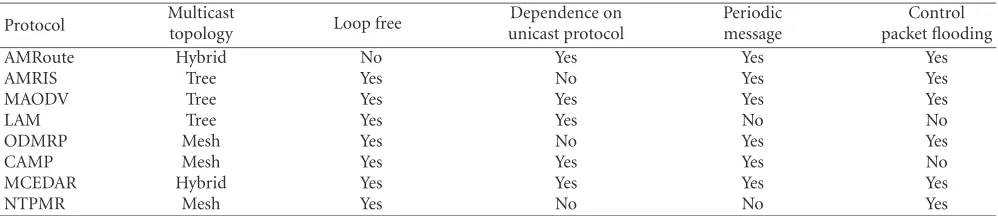
Table1: Comparison of protocols.
Protocol Multicast Loop free Dependence on Periodic Control
topology unicast protocol message packet flooding
AMRoute Hybrid No Yes Yes Yes
AMRIS Tree Yes No Yes Yes
MAODV Tree Yes Yes Yes Yes
LAM Tree Yes Yes No No
ODMRP Mesh Yes No Yes Yes
CAMP Mesh Yes Yes Yes No
MCEDAR Hybrid Yes Yes Yes Yes
NTPMR Mesh Yes No No Yes
and routing information. It classifies nodes in the network as duplex or simplex numbers. It relies on underlying unicast routing protocol, which guarantees correct distances to all destinations within finite time. A new on-demand multicast protocol called node transition probability-based multicast routing (NTPMR) is proposed in [3]. It uses a mesh infras-tructure instead of a tree. It minimizes the frequency of con-trol message broadcasts. The reduction of channel overhead makes NTPMR more attractive in mobile wireless networks. A comparison of different multicast protocols is shown in Table 1.
With routes being decided by these multicasting proto-cols, the transmission of packets is to be performed. For this, a scheduler is used. A scheduler should schedule the pack-ets to reach the destination quickly, which are at the verge of expiry. Scheduling discipline manages the queue of requests awaiting service. Without a scheduler, packets will be pro-cessed in FIFO manner and hence there are more chances that more packets may be dropped and hence the network may not meet the QoS target [8,9,11]. Typical metrics for providing QoS include delay, loss rate, jitter, bandwidth and so forth. In the proposed scheduler, end-to-end delay and packet delivery ratio are considered to analyse the perfor-mance of the network, thus providing QoS.
Ad hoc networks have several features, including possi-ble frequent transmission of control packets due to mobility, the multihop forwarding of packets, and the multiple roles of nodes as routers, sources, and sinks of data, that may pro-duce unique queuing dynamics. The choice of scheduling al-gorithm to determine which queued packet to process next will have a significant effect on the overall end-to-end per-formance when traffic load is high. For this, various schedul-ing algorithms were studied. To experiment and evaluate the scheduler, three multicast protocols, namely, ODMRP, CAMP, and NTPMR, are considered. The protocols are so chosen because they all use mesh configuration but different mechanisms as shown inTable 1.
In this paper, a fuzzy-based priority scheduler is designed and implemented. It schedules the data packets based on its priority index. The priority index is attached to the header of the data packets. Its value is based on the queue length of the node, data rate of the source (which is normalized with respect to channel capacity), and expiry time of the packet. This scheduler favors data packets as compared to control packets. It aims to improve the average throughput
by quickly delivering packets with greater remaining hops or distance. The fuzzy-based scheduling algorithm is coded in C language. The C code is linked with GloMoSim [10] and tested. It is found from the results that the proposed fuzzy scheduler improves the packet delivery ratio and decreases the end-to-end delay.
The rest of the paper is organized as follows.Section 2 deals with details of the various scheduling algorithms. Section 3 gives the details of the fuzzy scheduler.Section 4 describes the simulation environment, methodology, and performance metrics used. The simulation results are also presented inSection 4. FinallySection 5details the conclu-sions of the paper.
2. SCHEDULING ALGORITHMS
Ad hoc networks have several features that may produce unique queuing dynamics. The choice of scheduling algo-rithm has a significant effect on the overall end-to-end per-formance when traffic load is high. This motivated us to eval-uate the existing scheduling algorithms and propose a new fuzzy-based scheduler. The effects of setting priorities to con-trol and data traffic are studied. The study is performed with the three multicast protocols as described in the previous section.
Control packets
Figure1: Priority scheduler for data packets.
When looking onto the effect of setting priorities to data packets and considering the suitability of the different types of scheduling algorithms for MANET, several scheduling schemes were studied in literature. In order to consider the effect of setting priorities to data packets, these schedulers give high priority to control packets [11]. Their differences are in assigning priorities among data queues.Figure 1shows the priority scheduler for data packets. Weighted-hop and weighted-distance scheduling methods use the distance met-rics. Weighted-hop scheduling gives higher weight to data packets that have fewer remaining hops to traverse. If the packet has fewer remaining hops, then it has to reach the des-tination quickly. The data packets can be stored in round-robin fashion. The remaining hops to traverse can be ob-tained from packet headers. Weighted-distance scheduling gives higher weight to data packets which have shorter ge-ographic distances. The remaining distance is the distance between a chosen next hop and a destination. Round-robin scheduling maintains per-flow queues. The flow can be iden-tified by a source and destination pair. Here each flow queue is allowed to send one packet at a time in a round-robin fash-ion. In the greedy scheduling scheme, each node sends its own data packets before forwarding those of other nodes [8]. The data packets of other nodes are serviced in FIFO order.
Two other schedulers are the earliest deadline first (EDF) and the virtual clock (VC) [9]. In EDF, a packet arriving at timetand having delay bounddhas a deadlinet+d. The packets will be scheduled based on this deadline. In VC, a packet with sizeLof a flow, with rater, has a priority index L/rplus the maximum of current timetand priority index of the flow’s previous packet. In these scheduling algorithms, the parameters used to find the priority of data packets are remaining hops to traverse, distance, per-flow queues, greed-iness of nodes, delay bound, and flow rate.
With the thorough study of ad hoc networks, and the above-mentioned scheduling algorithms, it is found that a number of metrics can be combined into a single decision so as to find the crisp value of the priority of packets. Our so-lution to determine the priority index of the packets utilizes the fuzzy logic concept [12,13]. The three input variables,
namely, expiry time of packet, queue length of the node, and data rate of the source, are considered and the application of fuzzy logic to combine these variables and hence find the pri-ority index of the packet is found to be suitable. This led to the design of a fuzzy-based priority scheduler.
3. THE FUZZY SCHEDULER 3.1. Fuzzy logic
Fuzzy logic implements human experiences and preferences via membership functions and fuzzy rules. The application of fuzzy logic to problems of traffic control in networks is more attractive. Since it is difficult for a network to acquire com-plete statistics of the input traffic, it has to make a decision based on incomplete information. Hence the decision pro-cess is full of uncertainty. It is advantageous to use the fuzzy logic in the target system because it is flexible and capable of operating with imprecise data.
Basically the fuzzy system consists of four blocks, namely, fuzzifier, defuzzifier, inference engine, and fuzzy knowledge base. The following section explains the working of the gen-eral fuzzy system.
Fuzzification of inputs and outputs
The first step is to take the inputs and determine the degree to which they belong to each of the appropriate fuzzy sets via membership functions. The input is always a crisp nu-merical value limited to the universe of discourse of the in-put variable and the outin-put is a fuzzy degree of membership in the qualifying linguistic set (always the interval between 0 and 1). A fuzzy setAin the universe of discourseUis a set of ordered pairs{(x1,µA(x1)), (x2,µA(x2)),. . ., (xn,µA(xn))},
where µA : U → [0, 1] is the membership function of the
fuzzy setAandµA(xi) indicates the membership degree ofxi
in the fuzzy setA.
Fuzzy inference process
If a fuzzy system hasninputs and a single output, its fuzzy rulesRjcan be of the following general format.
(Rj) IfX1isA1j,X2isA2j,X3isA3j,. . ., andXmisAm j,
thenY isBj. The variablesXi{i=1, 2, 3,. . .,n}appearing in
the antecedent part of the fuzzy rulesRjare called the input
linguistic variables, the variableYin the consequent part of the fuzzy rulesRjis called the output linguistic variable. The
fuzzy setsAi jare called the input fuzzy sets of the input
lin-guistic variableXiand the fuzzy setsBjare called the output
fuzzy sets of the output linguistic variableYof the fuzzy rules Rj.
Implication method
Inputs
Expiry time
Data rate
Queue length
Fuzzy system Priority index Output
Figure2: Fuzzy priority scheduler.
associated with the antecedent (a single number). The input for the implication process is a single number given by the antecedent, and the output is a membership function, im-plemented for each rule.
Aggregation of all outputs
Since decisions are based on the testing of all of the rules, the rules must be combined in some manner in order to make a decision. Aggregation is the process by which the fuzzy sets that represent the outputs of each rule are combined into a single fuzzy set. Aggregation occurs only once, for each out-put variable, just prior to the final step, defuzzification. The input of the aggregation process is the list of truncated out-put functions returned by the implication process for each rule. The output of the aggregation process is one fuzzy set for each output variable.
Defuzzification
As much as fuzziness helps the rule evaluation during the in-termediate steps, the final desired output for each variable is generally a single number. However, the aggregate of a fuzzy set encompasses a range of output values, and so must be defuzzified in order to resolve a single output value from the set. The most popular defuzzification method is the Centroid calculation, which returns the center of area under the curve. By Centroid method of defuzzification, the crisp outputηis calculated using the formula
η= 1
Σµoutputx1···xn(y)
Σyµoutputx1···xn(y), (1)
where yis the center point of each of the output member-ship function in the output fuzzy setBjandµoutputx1···xn(y) is the
strength of the output membership function [7].
3.2. Fuzzy scheduler
The proposed fuzzy scheduler, with three inputs, namely, ex-piry time (E), data rate (D), and queue length (Q), and one
Low Medium High
1
0.5
0
0 10 20 30 40 50 60
(a)
Low Medium High
1
0.5
0
0 0.1 0.2 0.3 0.4 0.5 0.6 0.7 0.8 0.9 1 (b)
Low Medium High
1
0.5
0
0 10 20 30 40 50 60 70 80 90 100 (c)
Very low Low Medium High Very high 1
0.5
0
0 0.1 0.2 0.3 0.4 0.5 0.6 0.7 0.8 0.9 1 (d)
Figure3: Membership functions: (a) expiry time; (b) normalized data rate; (c) queue length; and (d) priority index.
output, priority index, is shown in the Figure 2. Here, the process is considered as multiple input and single output (MISO) system.
Table2: Fuzzy rule base.
so that they result in optimal value of performance measures. For the output variable, priority index, five linguistic vari-ables are used. Only triangular functions are used for the out-put [12,13].
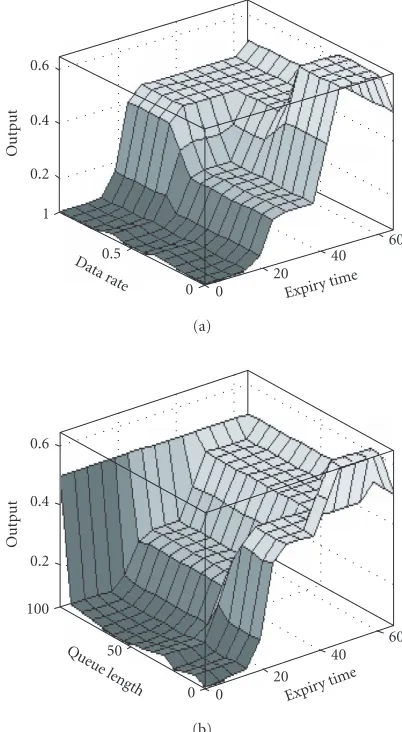
The rules are defined with due care and are shown in Table 2. To illustrate one rule, the first rule can be interpreted as follows:“If expiry time is low, data rate is low, and queue length is low, then priority index is low.” Since in this rule, data rate and queue length are low and packets are associ-ated with low delay, the priority index is set to be low. The ninth rule is interpreted as “If expiry time is low, data rate is high, and queue length is high, then priority index is very low.” In this rule, even though the expiry time remains same, since the data rate and queue length are high, priority index is set to be very low. Similarly, the other rules are framed. The priority index, if very low, indicates that the packets are associated with the highest priority and will be scheduled im-mediately. If the index is very high, then packets are with the lowest priority and will be scheduled only after high prior-ity packets are scheduled. The surface viewer for the fuzzy scheduler is shown in Figures4aand4b.
4. PERFORMANCE EVALUATION
The fuzzy scheduler is tested using the public domain simu-lator, GloMoSim [2,14]. The algorithm is evaluated in terms of packet delivery ratio and end-to-end delay and the results are presented in this section.
4.1. Simulation environment and methodology The simulation for evaluating the fuzzy scheduler was imple-mented within the GloMoSim Library. The simulation pack-age GloMoSim [10] is used to analyze and evaluate the per-formance of the proposed fuzzy scheduler. The GloMoSim (GLObal MObile information system SIMulator) provides a scalable simulation environment for wireless network sys-tems. It is designed using the parallel discrete-event simu-lation capability provided by PARSEC (PARallel Simusimu-lation Environment for Complex Systems) [15]. It is a C-based sim-ulation language developed by the Parallel Computing Labo-ratory at UCLA, for sequential and parallel execution of dis-crete event simulation model.
0.6
Figure4: (a) Surface viewer for the fuzzy scheduler in case of con-stant queue length. (b) Surface viewer for the fuzzy scheduler in case of constant data rate.
In the simulation, a network of mobile nodes placed ran-domly within a 1000×1000 meter area is modeled. Radio propagation range for each node was 250 meters [3,5,16] and a channel capacity of 2 Mbps is chosen. There were no network partitions throughout the simulation.Table 3 indi-cates the simulation environment for analyzing the perfor-mance of the scheduler.
Table3: Simulation environment.
Processor 450 MHz, PIV
Hard disk 40 GB
RAM 128 SDRAM
Operating system Windows 2000
Table4: Simulation parameters.
Frequency of operation 2.4 GHz
Number of nodes 30
Node placement Random, uniform
Mobility model Random way point
Node pause time 0–10 s
Propagation model Free space
Received power threshold −81 dBm
Transmitted power 7.89 dBm
Transport layer UDP, TCP
Network-layer routing protocols NTPMR, ODMRP, CAMP
MAC IEEE 802.11
4.2. Performance metrics
The following metrics are used to evaluate the effect of the modified fuzzy scheduler.
(i) Packet delivery ratio. Packet delivery ratio is the ratio of the number of data packets actually delivered to the destinations to the number of data packets supposed to be received. This number presents the effectiveness of the protocol.
(ii) Average end-to-end delay. This indicates the end-to-end delay experienced by packets from source to des-tination. This includes the route discovery time, the queuing delay at node, the retransmission delay at the MAC layer, and the propagation and transfer time in the wireless channel.
4.3. Performance evaluation using GloMoSim
The simulation for evaluating the proposed fuzzy scheduler is implemented using GloMoSim Library. First the task of identification of input variables used in the fuzzy logic C code is performed. Then the calculated priority index is used for scheduling the packet. By this way of scheduling, the packets, which are about to expire, or the packets in highly congested queues are given first priority for sending. As a result of this, the number of packets delivered to the client node and the end-to-end delay of the packet transmission improve.
The inputs to the fuzzy system are identified by a com-plete search of the GloMoSim environment. The input ex-piry time is the variable TTL, which is present in the network layer of the simulator. TTL stands for time to live and is set a default value of 64 seconds. If the packet suffers excessive delays and undergoes multihop, its TTL falls to zero. As a result of this, the packet is dropped. If this variable is used as an input to the scheduler for finding the priority index, a packet with a very low TTL value is given the highest priority.
Table5: Comparison of FPS with other schedulers.
Pause time (s) Average throughput (packets/s)
NPS PS WHS RR GS FPS
Pause time (s) Delay (s)
NPS PS WHS RR GS FPS
Hence due to this, the dropping of packets experiencing mul-tihops gets reduced.
The next input to the scheduler is the data rate of trans-mission and it is normalized with respect to the channel bandwidth. The third input to the scheduler is the queue length of the node in which the packet is present. If the packet is present in a highly crowded node, it suffers excessive delays and gets lost. So, such a packet is given a higher priority and hence it gets saved.
The priority index is calculated with the inputs obtained from the network layer. This is then added to the header as-sociated with the packet. Hence whenever the packet reaches a node, its priority index is calculated and it is attached with it. The buffer is shared by multiple queues when the sched-uler maintains multiple queues [17]. Here we consider that each node has three queues. Each queue in the node is sorted based on the priority index and the packet with the lowest priority index (i.e., packet with the highest priority) is sched-uled next when the node gets the opportunity to send. By this method of scheduling, the overall performance increases.
4.4. Comparison of FPS with other scheduling algorithms
0
Figure5: PDR versus mobility for NTPMR.
Moreover as also seen from the delay characteristics, FPS reduces delay by 8% compared to WHS under low mobility conditions. With moderate mobility, the reduction in delay is still significant with FPS. Under high mobility conditions, the reduction in delay is negligible. As seen from the simu-lation results, with high mobility, most of the packets in the queue are control packets. So setting priorities in data traf-fic does not change much the servicing order of packets in the queue. Greedy and round-robin scheduling show little difference in performance compared to FPS. In case of greedy scheduling, looking at the performance of individual flows, some flows are severely penalized, although the overall per-formance does not change. In case of round-robin schedul-ing, the small difference in performance is due to source type being CBR. With a bursty source, the effect of RR will be higher. Hence, these results prove that FPS performs better compared to all other scheduling algorithms.
Variations in mobility
In this simulation, each node is moved constantly with a predefined speed. Moving directions of each node were se-lected randomly and when nodes reached the simulation terrain boundary, they bounced back and continued to move. The node movement speed was varied from 0 km/h to 72 km/h. In the mobility experiment, twenty nodes are multicast members and five sources transmit packets. It is evident from the results that NTPMR provides higher packet delivery ratio as compared to ODMRP and CAMP [18]. NTPMR enables packets to travel distant destinations since a packet is sent to different neighbors during re-peated encounters with a node, resulting in high packet de-livery ratio. Lack of periodic updates and updates only un-der conditions of packet drops leads to decrease in PDR
0
Figure6: PDR versus mobility for ODMRP.
0
Figure7: PDR versus mobility for CAMP.
at high mobility. In ODMRP, control packets are trans-mitted periodically, which results in collisions and conges-tion. This causes low PDR even at low mobility rates. In CAMP, due to fewer redundant paths, they are prone to link breaks.
0.3
Figure8: PDR versus group size for NTPMR.
This is due to the fact that the crisp calculation of priority index leads to scheduling of packets in an orderly way. Hence even at higher mobility speeds of nodes, the packets are able to reach the destination and thus improving the PDR. Hence it is verified that even at high mobility speeds, the multicast routing protocols could be used.
Multicast group size
The number of multicast members was varied to investigate the scalability of the protocol. The number of senders is fixed at five, the mobility speed at 1 m/s, network traffic rate at 10 packets/s and the multicast group size is varied from 5 to 20 members. The routing effectiveness of the three protocols as a function of multicast group size is compared [3].
For NTPMR, the packet delivery ratio is found to remain constant with the increase in group size. Here the routing of packets does not depend on any forwarding group. CAMP performs better as the number of groups increases. Since the mesh becomes more massive with the growth of members, more redundant routes are formed. In ODMRP, as the num-ber of receivers increases, the numnum-ber of forwarding group nodes increases; this in turn increases the connectivity.
With these results, the fuzzy scheduler is inserted in-between the MAC layer and the routing agent. The simula-tion is run and the results are presented in Figures8,9, and 10. As seen from the figures, the NTPMR shows an increased performance of 3%. This is again due to the fact that, as the data packet scheduler is added, the packets at the verge of expiry are scheduled immediately, which in turn increases the PDR. For ODMRP, the PDR characteristics with FPS are closer to those without FPS. Again in CAMP, the PDR im-proves by 5% due to the proper selection of the priority in-dex.
Figure9: PDR versus group size for ODMRP.
0.3
Figure10: PDR versus group size for CAMP.
Delay performance
0.005 0.01 0.015 0.02 0.025
End-t
o
-end
dela
y
(s)
20 25 30 35 40 45 50
Number of senders NTPMR
ODMRP CAMP
Figure11: Delay versus senders for all protocols.
mobility, the CDFs of the no-priority and priority schedul-ings are almost the same. So under low mobility, since most of the packets in queue are data packets, giving high priority to control packets only improves delay slightly and does not improve the packet delivery ratio.
We now evaluate the effects of setting priority to data packets, varying the number of senders. The delay curve for all three protocols is shown inFigure 11.
After inclusion of FPS, the delay performance is again evaluated and plotted. FromFigure 12, it is clear that when the number of senders is lesser than 25, NTPMR shows a re-duction in delay by about 20 milliseconds. With low num-ber of senders, setting priorities among data packets has a greater impact. Now the reduction in delay is more signif-icant. For senders up to 30, the performance is better. But as the number increases above 30, it shows a poor perfor-mance due to increase in the number of collisions. ODMRP and CAMP show consistent reduction in delay for increase in the number of senders, as seen from Figures13and14. This is due to the maintenance of redundant paths at high number of senders and scheduling of data packets based on priority index set by FPS.
Variations in mobility
In this simulation, the same mobility conditions are em-ployed. The node movement speed or mobility of nodes is varied from 0 to 18 m/s. The routing protocols are chosen to be NTPMR and ODMRP. As the protocols are run with and without the fuzzy scheduler, the end-to-end delay is mea-sured and plotted in graphs as shown in Figures15and16.
As seen from Figure 15, the inclusion of scheduler for NTPMR definitely reduces the end-to-end delay whereas it increases the delay as far as ODMRP is concerned. In
0.005 0.01 0.015 0.02 0.025
End-t
o
-end
dela
y
(s)
20 25 30 35 40 45 50
Number of senders With FPS
Without FPS
Figure12: Delay versus senders for NTPMR.
NTPMR, the increased delay was the main constraint, which is overcome by the inclusion of the novel fuzzy scheduler. The scheduler, in context of delay performance, is not very supe-rior for ODMRP as seen fromFigure 16and proper modifi-cation could be done in rule bases and membership functions so as to meet with the specifications of the routing protocol.
5. CONCLUSION
In this paper, we have analyzed the performance of the novel fuzzy-based priority scheduler for data traffic and evaluated the effect of inclusion of this scheduler with different under-lying multicast routing protocols, like NTPMR, CAMP, and ODMRP, run over IEEE 802.11 as the MAC protocol. Queu-ing dynamics with different degrees of mobility and routing protocols show that the composition of packets in the queue determines the effect of giving priority to control packets or setting priorities among data packets, for the average delay. During low mobility, the average delay is dominated by net-work congestion due to data traffic. During high mobility, it is dominated by route changes.
0.005 0.01 0.015 0.02
End-t
o
-end
dela
y
(s)
20 25 30 35 40 45 50
Number of senders With FPS
Without FPS
Figure13: Delay versus senders for ODMRP.
0.005 0.01 0.015 0.02 0.025 0.03
End-t
o
-end
dela
y
(s)
20 25 30 35 40 45 50
Number of senders With FPS
Without FPS
Figure14: Delay versus senders for CAMP.
In this paper, the performance of the fuzzy sched-uler is studied for mobile ad hoc networks using Glo-MoSim simulator and results are presented. It is found from the results that priority scheduling helps in effective routing of packets without much loss and with less de-lay. In a real network environment, where timely recep-tion of each packet plays a crucial role, priority
schedul-0 0.002 0.004 0.006 0.008 0.01 0.012 0.014 0.016 0.018
End-t
o
-end
dela
y
(s)
0 2 4 6 8 10 12 14 16 18
Mobility (m/s) With FPS
Without FPS
Figure15: Delay versus mobility for NTPMR.
0 0.002 0.004 0.006 0.008 0.01 0.012 0.014 0.016 0.018
End-t
o
-end
dela
y
(s)
0 2 4 6 8 10 12 14 16 18
Mobility (m/s) With FPS
Without FPS
Figure16: Delay versus mobility for ODMRP.
REFERENCES
[1] E. Bommaiah, M. Liu, A. McAuley, and R. Talpade, “AM-Route: Ad hoc Multicast Routing Protocol,” Internet draft, draft-talpade-manet-amroute.00.txt, August 1998.
[2] J. J. Garcia-Luna-Aceves and E. L. Madruga, “The core-assisted mesh protocol,” IEEE J. Select. Areas Commun., vol. 17, no. 8, pp. 1380–1394, 1999, Special Issue on Ad hoc Networks.
[3] S. Radha and S. Shanmugavel, “Multicasting in ad hoc net-works using NTP protocol,” inProc. 15th International
Con-ference on Computer and Communication (ICCC ’02), pp. 144–
160, Bandra, Mumbai, India, August 2002.
[4] E. Royer and C. E. Perkins, “Multicast ad hoc on demand distance vector routing (MAODV),” inProc. ACM/IEEE In-ternational Conference on Mobile Computing and
Network-ing (MobiCom ’99), pp. 207–218, Seattle, Wash, USA, August
1999.
[5] S.-J. Lee, M. Gerla, and C.-C. Chiang, “On-demand multicast routing protocol,” inProc. IEEE Wireless Communications and
Networking Conference (WCNC ’99), vol. 3, pp. 1298–1302,
New Orleans, La, USA, September 1999.
[6] C. W. Wu, Y. C. Tay, and C. K. Toh, “Ad hoc multicast rout-ing protocols utilizrout-ing increasrout-ing id numbers (AMRIS) func-tional specifications,” Internet draft, draft-ietf-manet-spec-00.txt, November 1998.
[7] http://www.computing.surrey.ac.uk/courses/cs364/Fuzzy LogicFuzzySystems 3.ppt.
[8] H. Luo, S. Lu, and V. Bharghavan, “A new model for packet scheduling in multihop wireless networks,” inProc. 6th An-nual International Conference on Mobile Computing and
Net-working (ACM MOBICOM ’00), pp. 76–86, Boston, Mass,
USA, August 2000.
[9] V. Kanodia, C. Li, A. Sabharwal, B. Sadeghi, and E. Knightly, “Distributed priority scheduling and medium access in ad hoc networks,”Wireless Networks, vol. 8, no. 5, pp. 455–466, 2002. [10] GloMoSim User manual, http://pcl.cs.ucla.edu/projects/
glomosim.
[11] B.-G. Chun and M. Baker, “Evaluation of packet scheduling algorithms in mobile ad hoc networks,”ACM SIGMOBILE
Mobile Computing and Communications Review, vol. 6, no. 3,
pp. 36–49, 2002.
[12] C. Gomathy and S. Shanmugavel, “Performance evaluation of a novel Fuzzy based Priority Scheduler for mobile Ad Hoc net-works and its effect on MAC protocols,” inProc. 12th Interna-tional Conference on Advanced Computing & Communication
(ADCOM ’04), Ahmedabad, Gujarat, India, December 2004,
at IEEE Gujarat section.
[13] C. Gomathy and S. Shanmugavel, “Implementation of mod-ified Fuzzy Priority Scheduler for MANET and performance analysis with mixed traffic,” inProc. 11th National Conference
on Communication (NCC ’05), Indian Institute of Technology,
Kharagpur, India, January 2005.
[14] C. Gomathy and S. Shanmugavel, “Fuzzy based Priority Scheduler for mobile ad hoc networks,” inProc. 3rd
Inter-national Conference on Networking (ICN ’04), Gosier,
Guade-loupe, French Caribbean, February–March 2004.
[15] R. Bagrodia, R. Meyer, M. Takai, et al., “Parsec: a parallel sim-ulation environment for complex systems,”IEEE Computer, vol. 31, no. 10, pp. 77–85, 1998.
[16] S.-J. Lee, W. Su, J. Hsu, M. Gerla, and R. Bagrodia, “A perfor-mance comparison study of ad hoc wireless multicast proto-cols,” inProc. 19th IEEE Annual Joint Conference of the IEEE
Computer and Communications Societies (INFOCOM ’00),
vol. 2, pp. 565–574, Tel Aviv, Israel, March 2000.
[17] C. Gomathy and S. Shanmugavel, “Effect of Packet Scheduling and Evaluation of fuzzy based Priority scheduler on Ad Hoc network Unicast communication,” inProc. IEEE International Conference on Signal Processing and Communications (SPCOM ’04), Indian Institute of Science, Bangalore, India, December 2004.
[18] C. Gomathy and S. Shanmugavel, “An efficient fuzzy based priority scheduler for mobile ad hoc networks and perfor-mance analysis for various mobility models,” inProc. IEEE Wireless Communications and Networking Conference (WCNC ’04), vol. 2, pp. 1087–1092, Atlanta, Ga, USA, March 2004.
C. Gomathy acquired a B.E. (with hon-ors) degree in electronics and communi-cation engineering from Government Col-lege of Engineering, Tirunelveli, in the year 1986, and an M.S. degree in electronics and control engineering from Birla Institute of Technology and Science, Pilani, in 1992. She also obtained an M.S. (by research) degree from Anna University in 2001. She is cur-rently pursuing the Ph.D. in the
Depart-ment of Electronics and Communication Engineering, College of Engineering, Anna University, Chennai, India. She has published over 18 research papers in national and international conferences and journals. Her areas of interest include mobile ad hoc networks, high-speed networks, and digital communication.
S. Shanmugavel graduated from Madras Institute of Technology in electronics and communication engineering in 1978. He obtained his Ph.D. degree in the area of coded communication and spread-spectrum techniques from the Indian In-stitute of Technology (IIT), Kharagpur, in 1989. He joined the faculty of the Depart-ment of Electronics and Communication Engineering at IIT, Kharagpur, as a Lecturer