Design and Development of an Online Computational Framework to Facilitate
Language Comprehension Research on Indian Languages
Manjira Sinha, Tirthankar Dasgupta, Anupam Basu
Indian Institute of Technology KharagpurKharagpur, India
{manjira87, iamtirthankar, anupambas}@gmail.com
Abstract
In this paper we have developed an open-source online computational framework that can be used by different research groups to conduct reading researches on Indian language texts. The framework can be used to develop a large annotated Indian language text comprehension data from different user based experiments. The novelty in this framework lies in the fact that it brings different empirical data-collection techniques for text comprehension under one roof. The framework has been customized specifically to address language particularities for Indian languages. It will also offer many types of automatic analysis on the data at different levels such as full text, sentence and word level. To address the subjectivity of text difficulty perception, the framework allows to capture user background against multiple factors. The assimilated data can be automatically cross referenced against varying strata of readers.
Keywords:language comprehension, text readability, Indian languages, empirical data collection, online computational frame-work
1.
Introduction
Language comprehension or text comprehension generally refers to the ability to understand a particular piece of text by a specific group of people (DuBay, 2004).Comprehend-ing a text is a complex cognitive phenomenon. The first step towards reading a piece of text is to understand the words or phrases in it. A word has a four dimensional measure of complexity: orthography, phonology, morphology and se-mantic. The next step is to comprehend the full sentence. This involves two things: the reader has to first process the syntactic structure of the sentence to understand the rela-tion between different parts and second, to get the semantic meaning by integrating the semantics of the different com-ponents. Finally, the whole text is considered. Therefore, it can be stated that the cognitive load associated with reading a text broadly depends on five factors: lexical complexity
that is the complexity of the different words or phrases used in the text;syntactic complexity: it depends on the syntax and structure of the sentences;semantic complexity: that is the difficulty faced due to unknown or non-familiar word or phrase structure;discourse level complexity:it depends on text properties like cohesion, coherence, rhetorical struc-ture of text. Moreover, the background of the reader: this defines the cognitive ability and perception of the text diffi-culty by a target reader.We will use the termstext compre-hensibilityandtext readabilityinterchangeably.
There is a rich literature on the automatic identification of text readability where research have been done not only for English but also French, German, Dutch, Italian and many other languages (Rabin et al., 1988).These approaches can be broadly classified in three categories(Benjamin, 2012). The classical or traditional methods are those, which were designed and developed during the beginning phase of read-ability research and are based on shallow text characteris-tics. Typically, these yield either an absolute score (Flesch, 1948) or a grade level for which a text is considered ap-propriate (Dale and Chall, 1948; Kincaid and others, 1975;
McLaughlin, 1969).The next in line is the readability met-rics motivated by the progress in the field of cognitive science. This class of methods uses more detail text pa-rameters like cohesion, organization and cognitive aspects of the reader. Proposition and inference model (Kintsch and Van Dijk, 1978), prototype theory (Rosch, 1978), la-tent semantic analysis (Landauer et al., 1998),text leveling methods (Britton and G¨ulg¨oz, 1991) are examples of this category.One distinguished instance of this class is Coh-metrix (Graesser et al., 2004).Owing to the advances in the fields of natural language processing (NLP) and ma-chine learning (ML), readability research has seen a re-vival in the past decade or so. In recent studies, readability has been linked with more complex lexical and syntactic and discourse text characteristics (Petersen and Ostendorf, 2009; Collins-Thompson and Callan, 2005; Si and Callan, 2003; Heilman et al., 2008; Schwarm and Ostendorf, 2005). Several experiments have already established that existing readability measures in English cannot directly be used to compute readability of other languages like, Bangla and Hindi (Sinha et al., 2012b). As compared to the mountain-ous work done in readability research in foreign languages, very few attempts have been taken to develop readability matrices for Indian language texts, which are quite different from many of their Indo-European cousins(refer to (Sinha et al., 2012b) for a detail account). This makes it even more important to develop similar readability measures for dif-ferent languages.
pro-vided evidence for facilitation in verb-nal structures de-crease in activation due to the presence of multiple possible candidates during an integration event. A handful of re-searches have been performed on sentence complexity and word order preference in sentence comprehension (SWIN-NEY, 1998; Kaiser and Trueswell, 2004).The authors have provided novel methods to compute variation of the rela-tive cognirela-tive load associated with sentence comprehension in Bangla depending on the surface forms (Sinha et al., 2013). Recent studies are focusing on how different lan-guages and different cognitive systems have adopted pref-erence for different word orderings (Gibson et al., 2013; Hall et al., 2013).
Another dimension of complexity in text comprehension is visual word recognition. During visual word recog-nition process, orthography and phonology play crucial roles (Grainger and Dufau, 2012). One important aspect of an effective read-out model is to associate the ortho-graphic information of a word to its phonological represen-tation. The literature contains many studies provide differ-ent architectures to deal with this issue (Perry et al., 2010; Grainger and Ziegler, 2011; Seidenberg and Plaut, 2006). Architectures like BIAM (bi-modal interactive-activation model)(Diependaele et al., 2010), MTMM (multi-trace memory model)(Ans et al., 1998), junction model (Kello and Andrews, 2006)have a phonological layer and a ortho-graphic layer and a mapping functions between them. Studying text readability has a long-term impact in the field of education and literacy. Easy to read texts improve comprehension, retention and reading persistence (DuBay, 2004).Despite being attached to such a huge population in India, little has been studied in Indian language text read-ability . The need for specifically focusing on native lies in the fact that people can interpret better, when the doc-uments are in their own languages or mother tongue, i.e. their L1 language (Oakland and Lane, 2004). However, even a native language instruction has to be comprehen-sible by the target reader; many welfare programs fail, as they require people to have a higher reading level than the present. Therefore, texts have to design, customized and presented in a manner that suits the cognitive capacity of target population. In the context of a country like India, where the literacy rate is well below the world average this is the need of the hour in every level of formal or infor-mal addressing.One of the primary bottlenecks in readabil-ity research in any Indian languages are the scarcreadabil-ity of suf-ficiently large readability annotated data sets with satisfac-tory level of inter-annotator agreement. Apart from text-books,there is no annotated corpus of generic texts in Indian languages, that can be used to develop readability predic-tion models. Moreover, readability is not only a funcpredic-tion of textual characteristics. Literacy skills of readers, there cognitive abilities, background knowledge, and other socio-economic factors also play an important role in determining whether a text is readable for a particular group of reader. Therefore, such annotated data sets should also look into the respective readers background level. However, to the best of our knowledge, no such publicly available Indian language datasets with readability annotation is available. Therefore, based on the above discussion, the objective of
this paper is to develop an open-source online computa-tional framework that can be used by different research groups to conduct reading researches on Indian language texts ,to measure different attributes that will contribute to its comprehensibility. The framework will also be used to develop a large annotated Indian language text comprehen-sion corpus from user feedback surveys, which will be suit-able for automatic NLP applications. The novelty in this framework lies in the fact that it brings different empiri-cal data-collection techniques for text comprehension under one roof. The framework has been customized specifically to address language particularities for Indian languages. It will also offer many types of automatic analysis on the data at different levels such as full text, sentence and word level. To address the subjectivity of text difficulty perception, the framework allows to capture user background against mul-tiple factors. The assimilated data can be automatically cross referenced against varying strata of readers. The mea-sures and predictions will incorporate elegant Natural Lan-guage Processing and psycholinguistic methods.
2.
Design and Development of the
Framework
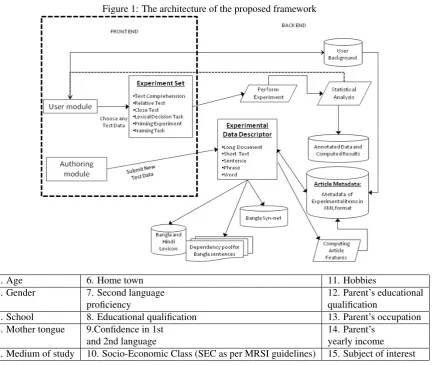
The architecture of the proposed framework is displayed in Figure 1. The framework is primarily classified into the following modules:
a) Author module
b) User module
c) Experimental Data Descriptor and Back-end Re-sources
d) Experiment Set
e) Analysis and Recording of results
In the following subsections, each of these modules is dis-cussed in details.
2.1.
The Author Module
In the author module, an author can submit new experimen-tal data for annotation through the article descriptor inter-face (see EDD for details). Corresponding to each author, a separate account will be maintained where authors can view, submit, edit, and delete their own dataset and test re-sults.
2.2.
The User Module
Figure 1: The architecture of the proposed framework
1. Age 6. Home town 11. Hobbies
2. Gender 7. Second language 12. Parent’s educational
proficiency qualification
3. School 8. Educational qualification 13. Parent’s occupation
4. Mother tongue 9.Confidence in 1st 14. Parent’s
and 2nd language yearly income
5. Medium of study 10. Socio-Economic Class (SEC as per MRSI guidelines) 15. Subject of interest
Table 1: Details of the user attributes
2.3.
The Experimental Data Descriptor
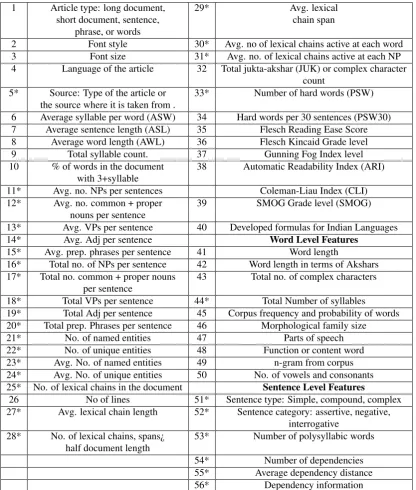
The experimental data descriptor (EDD) contains different attributes, as shown in Table 3, corresponding to each type of data. We define a data item to be any one of the fol-lowing types: Long documents (typically > 500words), short documents (100-500 words), sentence and words. In addition to storing properties against pre-stored data, the EDD can also automatically computes many of these at-tributes if some new data items are uploaded by author. For this, we have created a large lexicon of Hindi and Bangla words from the corpora mentioned below in Table 2. The attributes that are marked by a * are to be provided manu-ally by the author themselves. The data item along with the other associated attributes are stored in the metadata storage unit in XML format. Apart from the article properties and lexicon, the EDD is also linked to a Bangla SynNet (Sinha et al., 2012a) and a dependency information pool for which is a collection of text file where each text file corresponds to a sentence (figure 1).
3.
Experiment Set and Analysis of Results
In the following subsections, we will briefly discuss about these experiments and the different analysis that can be done and recorded using the proposed framework. For each experimental, results are indexed and statistically analyzed
Corpus Domain Total Words
Bangla
CIIL Tourism 798649
Rabindra Rachanaboli Literature 3434877
Anandabazar News 23159022
Bankim Rachanabolie Literature 1041784
Bangla Blog Blogs 1916825
Hindi (taken from Emile corpus)1
IndiaInfo News 600000
Webduniya News 5600000
Ranchi Express News 3200000
CIIL Miscellaneous 3000000
Table 2: Corpus statistics
according to different user category. Users are categorized by their background attributes as stated in table 1. The in-tergroup and intragroup variances are recorded for each ex-periment. Experiment statistics are updated dynamically as new results occur.
3.1.
Discourse Comprehension
1 Article type: long document, 29* Avg. lexical
short document, sentence, chain span
phrase, or words
2 Font style 30* Avg. no of lexical chains active at each word
3 Font size 31* Avg. no. of lexical chains active at each NP
4 Language of the article 32 Total jukta-akshar (JUK) or complex character count
5* Source: Type of the article or 33* Number of hard words (PSW)
the source where it is taken from .
6 Average syllable per word (ASW) 34 Hard words per 30 sentences (PSW30)
7 Average sentence length (ASL) 35 Flesch Reading Ease Score
8 Average word length (AWL) 36 Flesch Kincaid Grade level
9 Total syllable count. 37 Gunning Fog Index level
10 % of words in the document 38 Automatic Readability Index (ARI)
with 3+syllable
11* Avg. no. NPs per sentences Coleman-Liau Index (CLI)
12* Avg. no. common + proper 39 SMOG Grade level (SMOG)
nouns per sentence
13* Avg. VPs per sentence 40 Developed formulas for Indian Languages
14* Avg. Adj per sentence Word Level Features
15* Avg. prep. phrases per sentence 41 Word length
16* Total no. of NPs per sentence 42 Word length in terms of Akshars 17* Total no. common + proper nouns 43 Total no. of complex characters
per sentence
18* Total VPs per sentence 44* Total Number of syllables
19* Total Adj per sentence 45 Corpus frequency and probability of words 20* Total prep. Phrases per sentence 46 Morphological family size
21* No. of named entities 47 Parts of speech
22* No. of unique entities 48 Function or content word
23* Avg. No. of named entities 49 n-gram from corpus
24* Avg. No. of unique entities 50 No. of vowels and consonants
25* No. of lexical chains in the document Sentence Level Features
26 No of lines 51* Sentence type: Simple, compound, complex
27* Avg. lexical chain length 52* Sentence category: assertive, negative, interrogative
28* No. of lexical chains, spans¿ 53* Number of polysyllabic words half document length
54* Number of dependencies
55* Average dependency distance
56* Dependency information
Table 3: The article metadata
to perform the following three tasks (See fig 4. for an illustration):
• Mark all the words that are difficult to read or comprehend.
• Rate the article on a scale of 1-10. 1 being easier and 10 being hard to comprehend.
• Answer some MCQ questions based on that arti-cle. The MCQ questions are evaluated based on the percentage of correct answers.
For each article, average ratings with standard devi-ation are recorded with user details. Hard words are analyzed according the word attributes mentioned and are stored accordingly. For each hard word, clue from
the SynNet (refer to (Sinha et al., 2012a) for organi-zation and description of SynNet) is provided (if the word exists), if the user selects an option, the options are noted as easy and preferred synonyms against a hard word.
II. Relative test: Here, participants are provided with two articles (Baseline and Target) of a given language. The task is to identify which between the two articles is easier to comprehend then the other. The baseline article is primarily from standard textbooks.
The difference of attributes of the target article with the baseline article is stored along with the user re-sponse and user background categories.
par-ticipants were presented with text documents where every 5th word is missing. The task is to fill-up those missing words. Based on the performance of each par-ticipant, a score is generated according to the follow-ing formula:
Score(%) = N umberof correctanswers T otalnumberof blanks ∗100
(1) Wrong words are examined based on three scenar-ios: if they are exact synonyms (from Bangla SynNet), they are treated as equal; if they are related (distance measured by SynNet), they are stored separately ac-cording to their degree of relatedness; if above two conditions do not hold or the word is not present in SynNet, then it is stored separately. For all of the ex-periments, user can view and compare performances over time.
3.2.
Visual Word Recognition
• Lexical decision test: Here, a participant is presented, either visually or auditory, a string of words, non-words or pseudo non-words. Their task is to indicate, through some key-press, whether the presented word (or the stimulus) is a valid word or not(Meyer and Schvaneveldt, 1971). We customize these experiments by changing the inter-stimulus time (typically ranges between 48 and 300ms). The reaction time by each subject is recorded for analysis.
Response time (both correct and wrong decision) against each individual and average response time for each word is calculated. Along with the absolute values, normalizing each user against their respective mean response time standardizes experimental results. The response time statistics are correlated with word attributes.
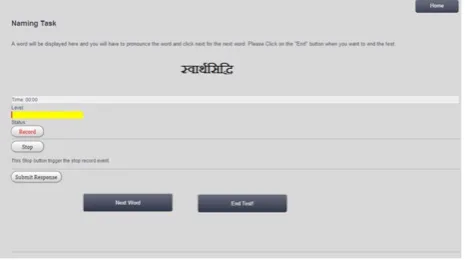
• Naming task: In this test, the user is shown a series of words one by one and he is asked to record the pro-nunciations of the words. The objective is to observe the proficiency and fluency of the user for the given word.
Responses are stored .wav format for downloading and further processing. As our framework does not contain any automatic speech recognition system, au-tomatic detection of wrong responses is not available. The response times are analyzed as has been done in case of lexical decision task.
3.3.
Sentence Comprehension Tests
3.3.1. Self Paced Reading Task (SPRT)
The SPRT experiment uses a moving window paradigm, where each word of a sentence is revealed at a time, while the next and the previous word is kept hidden. The win-dow shifts as user generates a keystroke event. SPRT has been found to be effective in studying how different parts of a sentence affect reader’s on-line processing of the sen-tence(Ferreira and Henderson, 1990). At the end of each sentence, a multiple-choice question is asked based on the
Figure 4: GUI for the lexical decision task
sentence. Among the three options: one is true answer, an-other is false and the third one says ’none of the above.’ The individual and average response times for each word and the sentence as a whole is stored.
For every sentence, the frequency of choices of the answers and the percentage correct answers are recorded. The re-sults can be correlated to the attributes of the different com-ponent words and of the sentence as well as its dependency information. Apart from studying the pattern of user re-sponses against each sentence, the trend of an individual with respect to different types of sentences can also be ex-amined.
Figure 5: GUI of the self paced reading task.
3.3.2. Effect of Surface Forms
As languages like Bangla and Hindi have relatively free word order, sentences can have multiple surface forms, which are grammatically correct. As word ordering strongly affects sentence processing. We have incorporated two types of experiment to record user response w.r.t to dif-ferent surface forms.
• Sentence is correct or false: different surface forms of the same sentence are presented to different users and they are asked to respond whether the given sen-tence is valid or not, as quickly as possible. The varia-tions in response time w.r.t. syntactic and dependency structure can be used to predict the effect of the word ordering on sentence processing.
Figure 2: GUI of the comprehension exercise.
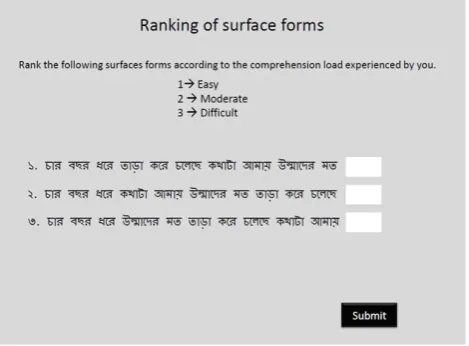
3 according the comprehension difficulty experienced by her. The ranking information can be studied against sentence attributes and dependency description.
Figure 6: GUI for sentence with different surface forms
4.
Creating Data for Bangla and Hindi
Experiments
We have created a pilot dataset to run Bangla and Hindi comprehension experiments. Table 4 summarizes the col-lected dataset. Table 5 contains user details; the age of the subjects varies between 24 to 30 years. Each comprehension experiment has been performed by around 15 participants. Corresponding to each article, we have recorded around 110*15= 3250 annotations, for sentence, 500*15=7500 and for word, 1500*15=22500 annotations.
Mother tongue Hindi Bangla
1st Language 50 80
2nd Language 30 NIL
Graduate 35 58
Post Graduate 15 22
Table 5: User details
5.
Conclusion
This paper presents an on-line integrated computational framework to facilitate language comprehension research on Indian languages. The framework provides seven dif-ferent experiments that are useful for the study of language comprehension. Along with carrying out user experiments it also provide options to analyse and process the experi-mental data. Presently the framework supports only Bangla and Hindi language but other languages can easily be inte-grated.
6.
Acknowledgements
We are thankful to the Society for Natural Language Technology Research for providing us with the necessary Bangla corpus to carry our research. We are also thankful to all those participants who helped us to prepare the Read-ability annotated Bangla and Hindi texts.
7.
References
Figure 3: GUI of the Cloze test
Table 4: Details of collected empirical data
Experiments Total No. of Document Source
Documents (in each language)
Textbooks News Literature
Reading Comprehension 50 25 9 16
Cloze test 50 25 13 12
Relative tests 10 30 -
-Sentence Comprehension Simple Compound Complex
SPRT 250 100 100 50
Surface form 250 70 130 50
Word Recognition High Freq. Average Freq. Low Freq.
Lexical Decision Task 900 300 300 300
Naming Task 600 200 200 200
Bardovi-Harlig, K. (1992). A second look at t-unit anal-ysis: Reconsidering the sentence. TESOL quarterly, 26(2):390–395.
Benjamin, R. (2012). Reconstructing readability: Recent developments and recommendations in the analysis of text difficulty. Educational Psychology Review, 24:1–26.
Britton, B. and G¨ulg¨oz, S. (1991). Using kintsch’s com-putational model to improve instructional text: Effects of repairing inference calls on recall and cognitive struc-tures.Journal of Educational Psychology, 83(3):329.
Collins-Thompson, K. and Callan, J. (2005). Predicting reading difficulty with statistical language models. Jour-nal of the American Society for Information Science and Technology, 56(13):1448–1462.
Dale, E. and Chall, J. (1948). A formula for predicting readability.Educational research bulletin, pages 11–28.
DuBay, W. (2004). The principles of readability. Impact Information, pages 1–76.
Ferreira, F. and Henderson, J. M. (1990). Use of verb in-formation in syntactic parsing: Evidence from eye move-ments and word-by-word self-paced reading. Journal of Experimental Psychology: Learning, Memory, and Cog-nition, 16(4):555.
Flesch, R. (1948). A new readability yardstick. Journal of applied psychology, 32(3):221.
Gibson, E. and Fedorenko, E. (2013). The need for quan-titative methods in syntax and semantics research. Lan-guage and Cognitive Processes, 28(1-2):88–124. Gibson, E., Piantadosi, S. T., Brink, K., Bergen, L., Lim,
E., and Saxe, R. (2013). A noisy-channel account of crosslinguistic word-order variation. Psychological sci-ence.
Gordon, P. C., Hendrick, R., and Johnson, M. (2004). Ef-fects of noun phrase type on sentence complexity. Jour-nal of Memory and Language, 51(1):97–114.
Graesser, A., McNamara, D., Louwerse, M., and Cai, Z. (2004). Coh-metrix: Analysis of text on cohesion and language.Behavior Research Methods, 36(2):193–202. Grainger, J. and Dufau, S. (2012). 8 the front end of visual
word recognition.Visual Word Recognition: Models and Methods, Orthography and Phonology, page 159. Grainger, J. and Ziegler, J. (2011). A dual-route approach
to orthographic processing. Frontiers in psychology, 2. Hall, M. L., Mayberry, R. I., and Ferreira, V. S. (2013).
Cognitive constraints on constituent order: Evidence from elicited pantomime.Cognition, 129(1):1 – 17. Heilman, M., Collins-Thompson, K., and Eskenazi, M.
(2008). An analysis of statistical models and features for reading difficulty prediction. InProceedings of the Third Workshop on Innovative Use of NLP for Building Educational Applications, pages 71–79. Association for Computational Linguistics.
Kaiser, E. and Trueswell, J. C. (2004). The role of dis-course context in the processing of a flexible word-order language.Cognition, 94(2):113 – 147.
Kello, C. and Andrews, S. (2006). Considering the junc-tion model of lexical processing. From inkmarks to ideas: Current issues in lexical processing, pages 50–75. Kincaid, J. et al. (1975). Derivation of new readability for-mulas (automated readability index, fog count and flesch reading ease formula) for navy enlisted personnel. Kintsch, W. and Van Dijk, T. (1978). Toward a model of
text comprehension and production. Psychological re-view, 85(5):363.
Klare, G., SINAIKO, H., and STOLUROW, L. (1972). The cloze procedure: A convenient readability test for training materials and translations. Applied Psychology, 21(2):77–105.
Landauer, T., Foltz, P., and Laham, D. (1998). An intro-duction to latent semantic analysis. Discourse processes, 25(2-3):259–284.
McLaughlin, G. (1969). Smog grading: A new readability formula. Journal of reading, 12(8):639–646.
Meyer, D. E. and Schvaneveldt, R. W. (1971). Facilita-tion in recognizing pairs of words: evidence of a
depen-dence between retrieval operations. Journal of experi-mental psychology, 90(2):227.
Oakland, T. and Lane, H. (2004). Language, reading, and readability formulas: Implications for developing and adapting tests. International Journal of Testing, 4(3):239–252.
Oya, M. (2011). Syntactic dependency distance as sen-tence complexity measure. In Proceedings of The 16th Conference of Pan-P cific Association of Applied Lin-guistics.
Perry, C., Ziegler, J., and Zorzi, M. (2010). Beyond single syllables: Large-scale modeling of reading aloud with the connectionist dual process (cdp++) model. Cognitive Psychology, 61(2):106–151.
Petersen, S. E. and Ostendorf, M. (2009). A machine learning approach to reading level assessment. Com-puter Speech & Language, 23(1):89–106.
Rabin, A., Zakaluk, B., and Samuels, S. (1988). Deter-mining difficulty levels of text written in languages other than english. Readability: Its past, present & future. Newark DE: International Reading Association, pages 46–76.
Rosch, E. (1978). Principles of categorization. Fuzzy grammar: a reader, pages 91–108.
Schwarm, S. and Ostendorf, M. (2005). Reading level as-sessment using support vector machines and statistical language models. In Proceedings of the 43rd Annual Meeting on Association for Computational Linguistics, pages 523–530. Association for Computational Linguis-tics.
Seidenberg, M. S. and Plaut, D. C. (2006). Progress in understanding word reading: Data fitting versus theory building. From inkmarks to ideas: Current issues in lex-ical processing, pages 25–49.
Si, L. and Callan, J. (2003). A semisupervised learning method to merge search engine results. ACM Transac-tions on Information Systems (TOIS), 21(4):457–491. Sinha, M., Jana, A., Dasgupta, T., and Basu, A. (2012a). A
new semantic lexicon and similarity measure in bangla. InProceedings of the 3rd Workshop on Cognitive Aspects of the Lexicon, pages 171–182, Mumbai, India, Decem-ber. The COLING 2012 Organizing Committee.
Sinha, M., Sharma, S., Dasgupta, T., and Basu, A. (2012b). New readability measures for Bangla and Hindi texts. InProceedings of COLING 2012: Posters, pages 1141– 1150, Mumbai, India, December. The COLING 2012 Or-ganizing Committee.
Sinha, M., Rudra, K., Dasgupta, T., and Basu, A. (2013). How word order affects sentence comprehension in bangla: A computational approach to simple sentence. In Mining Intelligence and Knowledge Exploration, pages 769–779. Springer.
SWINNEY, D. A. (1998). The influence of canonical word order on structural processing. Syntax and semantics, 31:153–166.