Semantic Technologies for Querying Linguistic Annotations:
An Experiment Focusing on Graph-Structured Data
Milen Kouylekov
♣, Stephan Oepen
♣♥ ♣University of Oslo, Department of Informatics ♥Potsdam University, Department of Linguistics{ milen|oe }@ifi.uio.no
Abstract
With growing interest in the creation and search of linguistic annotations that form general graphs (in contrast to formally simpler, rooted trees), there also is an increased need for infrastructures that support the exploration of such representations, for example logical-form meaning representations or semantic dependency graphs. In this work, we heavily lean on semantic technologies and in particular the data model of the Resource Description Framework (RDF) to represent, store, and efficiently query very large collections of text annotated with graph-structured representations of sentence meaning.
Keywords:Semantic Dependency Graphs, Treebank Search, Resource Description Framework
1.
Motivation
Much work in the creation and use of language resources has focused on tree-shaped data structures,1 as are com-monly used for the encoding of, for example, syntactic or discourse annotations. Conversely, there has been less fo-cus on supporting generalgraphs until recently, but there is growing interest in graph-structured representations, for example to annotate and process semantic analyses. Even if syntax arguably can be limited to tree structures, this is ob-viously not the case in semantics, where a node will often be the argument of multiple predicates (i.e. have more than one incoming arc), and it will often be desirable to leave some nodes unattached (with no incoming arcs), for seman-tically vacuous classes as, for example, particles, comple-mentizers, or relative pronouns.
Large, semantically annotated resources remain scarce, but several ongoing initiatives promise to deliver graph-structured linguistic annotations in large vol-umes (Flickinger et al., 2010; Rosén et al., 2012). Of these, we will use data from the so-called WikiWoods Treecache of Flickinger et al. (2010) as our motivating example, in part because in recent work Flickinger et al. (2012) have complemented this resource with a collection dubbed DeepBank, a fresh annotation of the venerable Wall Street Journal (WSJ) text from the Penn Treebank (PTB; Marcus et al., 1993), offering the same layers of semantic annotations as WikiWoods. With some 700,000 tokens of (manually annotated) text in DeepBank and some 48 million (automatically parsed) tokens in WikiWoods, general-purpose search over linguistic annotations at this scale is an R&D challenge in its own right, even more so seeing as both resources make central use of general graph-structured data. Figure 1 presents an example of a semantic dependency graph in DeepBank; here, we observe both node re-entrancies and partial connectivity, as technique, for example, is the argument of the determiner (as the quantificational locus), the modifier similar, and
1
Formally, trees are a restricted form of graphs, where every node is reachable from a distinguished root node by exactly one directed path.
the predicate apply. Conversely, the predicative copula, infinitival to, and the preposition marking the deep object of applyhave no semantic contribution of their own. We discuss this example further in §2. below.
In this work, we investigate the use of semantic tech-nologies, and in particular of the data model of the Re-source Description Framework (RDF), to represent, store, and search (very) large-scale linguistic graphs. We demon-strate how different types of semantic dependency graphs can be encoded in RDF and discuss some of the design choices involved; we then summarize a practical experi-ment, using increasing volumes of data from DeepBank and WikiWoods and benchmarking two open-source triple stores. This is in contrast to ongoing work by Meurer (2012), who (to query the annotations of Rosén et al., 2012) approaches the same abstract challenge through a general-ization of the TIGERSearch query language (König & Lez-ius, 2000) and a custom-built indexing and search infras-tructure. Ultimately, it will of course be desirable to com-pare the two candidate solutions with regards to, for exam-ple, efficiency, scalability, flexibility, and implementation cost.
2.
Example: Semantic Dependency Graphs
Semantic annotations in the DeepBank Treebank and the WikiWoods Treecache are couched in the framework of Minimal Recursion Semantics (MRS; Copestake et al., 2005), a designer language for underspecified logical-form meaning representation. In ongoing work, we investigate the embedding of complete MRS graphs into RDF, but in the following we will focus on two ‘reductions’ of MRS for reasons of simplicity and space.
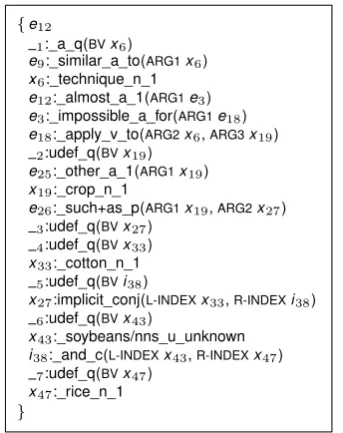
Oepen and Lønning (2006) propose a lossy (i.e. non-reversible) conversion from MRS into a variable-free de-pendency graph, duped Elementary Dede-pendency Structures (EDS). Figure 2 shows the EDS analysis for our running example: graph nodes (one per line) correspond to elemen-tary predications from the underlying logical form and are connected by directed arcs, listed in parentheses, which are labeled with MRS argument roles:ARG1,ARG2, etc. (where
A similar technique is almost impossible to apply to other crops, such as cotton, soybeans and rice.
Figure 1: Example bi-lexical semantic dependencies (DM; taken from DeepBank).
full MRS).2 Note that, while EDS already brings us rel-atively close to ‘classic’ depedency representations, there are graph nodes that do not correspond to individual words from our running example, for example the underspecified quantifiers for the bare noun phrases (udef_q) and the bi-nary conjunctionimplicit_conjthat ties togethercottonwith soybeans and rice; furthermore, just as we saw in Figure 1 already, some words of the underlying sentence are seman-tically empty; and the EDS does not form a tree, as there are re-entrancies in the graph (e.g. at nodex6).
Our original bi-lexical semantic dependency graph from Figure 1 above in fact resulted from a further simplifi-cation step—‘projecting’ predicate–argument information from the EDS onto individual tokens of the underlying utterance—defined by Ivanova et al. (2012) as DELPH-IN MRS-Derived Bi-Lexical Dependencies (DM). Comparing the two graphs, we observe that some argument relations pertaining to covert quantifiers cannot be represented in the pure bi-lexical form, and the coordinate structure has been ‘flattened’ in the spirit of Mel’ˇcuk (1988). Our discussion of RDF embedding in the following section is applicable to both types of dependency graphs (and others, similar in nature), but we will focus on the EDS format, because it is somewhat richer and more general.
{e12
1:_a_q(BVx6)
e9:_similar_a_to(ARG1x6)
x6:_technique_n_1
e12:_almost_a_1(ARG1e3)
e3:_impossible_a_for(ARG1e18)
e18:_apply_v_to(ARG2x6,ARG3x19)
x27:implicit_conj(L-INDEXx33,R-INDEXi38) 6:udef_q(BVx43)
Figure 2: Elementary Dependency Structure (EDS).
3.
Background: RDF and SPARQL
The RDF data model is based upon the idea of mak-ing statements about resources in the form of subject–
2
In the textual rendering of our EDS in Figure 2, nodes are pre-fixed with unique identifiers, which serve to denote node reentracy and the targets of outgoing dependency arcs.
predicate–object triples. The subject denotes the resource, and the predicate denotes traits or aspects of the resource, thus expressing a relationship between the subject and the object. A database that can store such expression and eval-uate queries to them is called a triple store.
The simple data model of RDF and its ability to model disparate, abstract concepts has also led to its increasing use in knowledge management applications unrelated to Semantic Web activity. A collection of RDF statements in-trinsically represents a labeled, directed multi-graph. As such, an RDF-based data model is more naturally suited to certain kinds of knowledge representation than the rela-tional model and other ontological models.
SPARQL is an RDF query language, that is, a formal lan-guage to search triple stores, allowing one to retrieve and manipulate RDF data. It is fully standardized and con-sidered one of the key technologies of the Semantic Web. A SPARQL query can consist of triple patterns, conjunc-tions, disjuncconjunc-tions, and optional patterns. Figure 3 shows an example, searching for an EDS configuration where ap-plytakescropsas itsARG3.
PREFIX ltg:<http://www.uio.no/ltg#> select ?id ?text where {
?x ltg:label "_apply_v_to" .
Figure 3: Example SPARQL query.
In this query each line represents a triple, and elements starting with question mark are variables. The query pro-cessor searches for sets of triples that match the patterns expressed in the query, binding variables in the query to the corresponding parts of each triple. The result of the SPARQL query is a set of instantiations of the variables
?idand?text, the identifiers and surface strings for all matching EDS graphs.
The use of RDF to encode linguistic data is not new. Ar-guably the most popular type of data stored in RDF are lexica, instantiating models like Lemon3 or the W3C Sim-ple Knowledge Organization System (SKOS)4. Chiarcos (2012) discuss the encoding of linguistically annotated cor-pora in RDF, suggesting interoperability and query flexi-bility as key advantages of this approach. Another RDF framework for the representation of linguistic annotations is presented by Rubiera et al. (2012), demonstrating that
3http://lemon-model.net/.
4http://www.w3.org/2006/07/SWD/SKOS/xl/
@prefix eds:
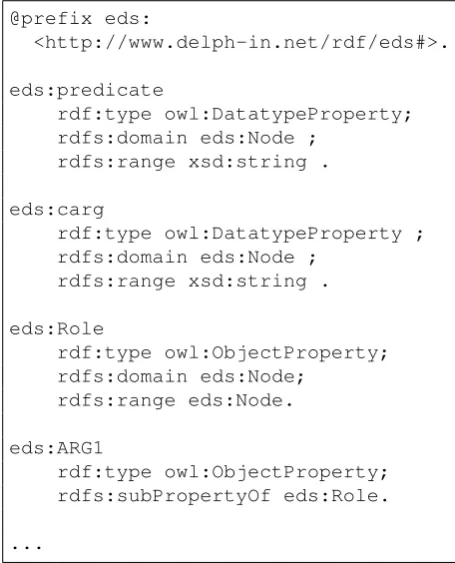
Figure 4: Excerpt from EDS ontology (in Turtle syntax).
RDF is a suitable data model to capture multiple annota-tions on the same text segment, and to integrate multiple layers of annotations. However, both studies are focused on flat or tree-structured linguistic data.
4.
Semantic Dependency Graphs in RDF
To store the MRS, EDS, and DM graphs from DeepBank and WikiWoods in RDF, we created a small ontology to represent the semantics of these data types. In a nutshell, the ontology provides a generic representation of a directed graph with (potentially complex) node and edge labels. The full MRS ontology (not discussed in detail here) distin-guishes different types of nodes, corresponding to full pred-ications vs. individual logical variables vs. hierarchically organized sub-properties of variables. The EDS and DM ontologies, on the other hand, essentially make do with a single type of graph node (corresponding to the vertices in the examples of Figures 1 and 2). The dependencies proper, i.e. labeled arcs of the graph, are encoded as object proper-ties. A fragment of the ontology created for the EDS format is shown in Figure 4.
On thenodeclass, thepredicateproperty holds the node label in EDS.5 In the DM ontology, there are three label-like node properties: form,lemma, andpos(of which the latter record additional lexical information, not shown in
5Predicate names in MRS (and thus EDS) by convention have
internal structure, such that there is a design choice here; one could tease apart separate components as distinct properties, to make the structure explicit at the cost of increased triple counts, or simply rely on SPARQL regular expressions over our current predicatestrings.
<_1> eds:predicate "_a_q"^^xsd:string; rdfs:type eds:Node;
eds:BV <x6>
Figure 5: Example RDF fragment of one EDS node.
Figure 1). We define separate object properties for each ar-gument label,ARG1, . . . ,ARG4,BV,L-INDEX,R-INDEX, etc. To demonstrate this encoding, Figure 5 shows parts of the RDF corresponding to the first EDS node in Figure 2. In general, we have found the RDF and OWL modeling facil-ities a good match for the linguistic properties of our three formats for meaning representation, including the use of multiple inheritance for underspecification in MRS.
5.
A First Experiment: Sesame and Jena
As a first calibration experiment, we converted the EDS graphs from DeepBank and WikiWoods into RDF, yield-ing around12million and4.3billion triples, respectively (for the semantic dependencies of about 37 thousand and 48 million sentences in the two resources, respectively). Judging from experience reports with contemporary triple stores, these are large but not unrealistic counts. We have experimented with two widely used and freely available triple stores and evaluated their potential to store and query the triples generated in the two corpora we have converted in RDF.
One highly flexible triple storage framework is Sesame,6 used in diverse industries such as pharmaceutical, health-care, and manufacturing for integrating disparate data sources. It provides a generic application programming in-terface that allows experimentation with different back-end implementations of a triple store at low adaptation costs. Sesame comes with two built-in triple stores, called Mem-oryStore and NativeStore—keeping data and indexes ei-ther in-core or on-disk—with different space–time trade-offs. Storing all semantic graphs from DeepBank in ei-ther MemoryStore or NativeStore was straightforward, re-quiring about 3 gbyte of memory for in-core storage. Both stores responded to complex SPARQL queries in fractions of a second.
The second triple store we have investigated is Apache Jena.7 It too is an open-source Semantic Web framework for Java. It provides an API to extract data from and write to RDF graphs. In many respects, Jena is quite similar to Sesame; though, unlike Sesame, Jena also provides support for the Web Ontology Language (OWL), including various internal reasoners. Like Sesame, Jena offers two imple-mentations of a triple store, viz. (a) SDB, a store based on a relational database; and (b) TDB, an on-disk implemen-tation of a triple store. We measured the performance of these RDF stores in two types of experiments.
Indexing The first experiment involved the indexing pro-cess. We have measured the indexing time and the disk space occupied by each of the implementations of tripple store in the Sesame and Jena frameworks. For the mem-ory store we measured the (virtual) memmem-ory footprint of the
6
http://www.openrdf.org/.
Sesame Jena
Memory Native SDB TDB
Time 13 sec 25 sec 35 sec 20 sec
Space 1.1GB 800MB 710MB 720MB
Table 1: Indexing time and space for DeepBank.
Sesame Jena
Memory Native SDB TDB
Time (ms) 52 88 122 60
Table 2: Average query repsonse time for DeepBank.
indexing process. The results obtained by this experiment, using the ‘smaller’ DeeepBank corpus, are show in Table 1. As is evident from the table, for this data set indexing times are broadly comparable, and fast enough to store all of the RDF triples from DeepBank in less than a minute for the different implementations. Next we have proceeded to index the RDF triples derived from the WikiWoods corpora. However, our attempts at injecting increasing portions into Sesame turned up technical difficulties from about100 mil-lion triples upwards, well below the total number of triples in the resource. We tried to index the triples in portions of 100 milion triples per file. The indexing time of the first file took than a day to finish. These observations were not encoraging enough to consider Sesame a good option for bigger collections of semantic graphs. The indexing speed of the Jena SDB store was not encoraging either, at about 18hours for the first100million triples. On the other hand, the Jena TDB store succeded in indexing all the triples de-rived from the Wikiwods corpus in42hours. It occupied 750GB of disk space.8
Search In this second experiment, we seek to compar the response times for each of the triple store implementations in Sesame and Jena. The experiment consisted in evalu-ating ten hand-constructed queries with different complex-ity, measuring the average speed with which each imple-mentaion returns the expected result. As we were not able to index the WikiWoods corpus in Sesame or Jena SDB, we compared only the indexes generated for the DeepBank data. The results obtained in this experiment are shown in Table 2.
Although a comparison in terms of artificially constructed queries may not be fully indicative of end user experience, assuming there would potentially be a larger variability in queries posed by actual users, our results for DeepBank suggest that all four RDF triple stores provide a fully vi-able solution to search over a substantive collection of se-mantic graphs. This even more so, as in our ongoing work on building on-line search services (see §6. below) we can at times obtain great reductions in query times by combing the RDF triple store with a family of simple textual in-dexes (hash tables, essentially), to perform query
optimiza-8
There exist triple stores like AllegroGraph (http://www .franz.com/agraph/allegrograph/) with success sto-ries of triple sets counting in the trillions, albeit on fairly high-end hardware. Part of our objective is to see how far current RDF technologies can be pushed on modern commodity equipment.
tion, for example ording the sub-components of a SPARQL query according to ‘specificity’, i.e. the number of matches found for a token string or wildcard. In this benchmark, Jena TDB (using on-disk storage, where in our setup we keep all indexes on a RAID of solid-state drives) performs nearly competitive to the in-memory triple store of Sesame. Combined with its greatly superior scalability to the much larger WikiWoods corpus, we conclude that Jena TDB on balance is the best choice for our needs, among the four solutions benchmarked to date.
6.
For Non-Experts: Query by Example
Using SPARQL to search for potentially complex seman-tic relations in an RDF triple store requires an understand-ing of both (a) the target representations and (b) the inter-nal structures of the embedding RDF model. We believe that RDF technologies score high on expressivity as well as scalability, but obviously a query like the one in Figure 3 will be hard to pose for non-experts. To lower the techno-logical barrier to entry, we are currently experimenting with a query-by-example front-end to the Jena query processor, essentially defining a generalization of the textual EDS rep-resentation to express search patterns over either the MRS, EDS, or DM formats.. For example, thewherecondition of our above SPARQL query could be characterized as fol-lows:
{_apply_v_to(ARG3x),x:_crop_n_1}
With suitable user interface support, a pattern like this can be expanded into a full-blown SPARQL query by a proce-dure similar to the mapping from EDS to RDF triples. In a sense, this technique can be interpreted as a templatic meta-language for (parts of) SPARQL queries, and we anticipate using a similar approach for the incorporation of additional custom (linguistic) query operators (as defined natively in the infrastructure of Meurer, 2012, for example).
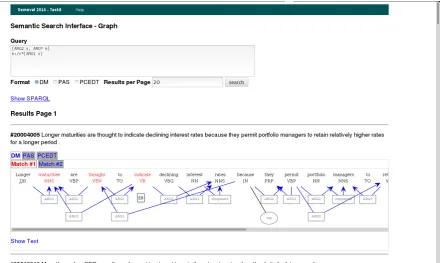
As a first ‘production’ instance of this paradigm, we have built a public search interface to the semantic dependency graphs used in Task 8 of the 2014 Workshop for Semantic Evaluation (SemEval).9 This data combines the DeepBank DM graphs with another two formats for bi-lexical seman-tic dependency graphs (called PAS and PCEDT), over the same set of sentences. With minimal adaptations to the DM ontology, and defining a simple and compact query lan-guage along the lines above, we have been able to import this data into our infrastructure and have the impression that the resulting on-line search service is perceived well. Figure 6 shows a sample session, searching for object equi verbs, i.e. a configuration of two DM nodes (described one per line in the query interface) that both share an argument: the variable ‘x’ in this example identifies the shared argu-ment, which is theARG2(deep object) of one DM node, and
ARG1(deep subject) of another. In addition to the shared ar-gument between the two nodes, the second DM node in the query (identified by the variable ‘e’) is further required to
9http://alt.qcri.org/semeval2014/task8/
Figure 6: DM search interface and result visualization, as used in conjunction with Task 8 of SemEval 2014. .
have a verbalposproperty (indicated by the ‘/’ search op-erator in conjunction with ‘*’ wildcarding), and be any type of argument to the first of the two nodes.
7.
Ongoing & Future Work
This preliminary report on our ongoing efforts to adapt stock RDF technologies to the storage and retrieval of vast volumes of graph-structured linguistic annotations demon-strates the general feasibility of semantic technologies for storing and querying the substantial number of semantic graph in the DeepBank Treebank. In a sense, Jena provided us with a versatile search solution for the relatively complex linguistic annotations in a comparatively large treebank (of some 37,000 sentences) at quite moderate implementation cost.
In future work we seek to analyze more thoroughly the space of possible encodings and storage solutions, with the goal of documenting relevant trade-offs and limits to scal-ability and making available on-line additional search in-terfaces to common (semantic) annotation formats and data sets.10 At the same time, we are working to generalize and parameterize our code base, so as to make it available for re-use and adaptation under an open-source license.
Besides such technical experimentation, we are also keenly interested in the application of additional semantic technologies, in the general realm of reasoning over RDF triple stores. To offer at least an indication of the direction of this work, in our running examplecrops, the third seman-tic argument to theapplypredicate, is related tocotton, soy-beans, and ricethrough a two-place relation introduced by
10Seehttp://wesearch.delph-in.net/for an
up-to-date list of existing semantic search interfaces built on top of our RDF-based infrastructure.
the multi-word prepositionsuch as. In this configuration, it is a common ‘inference’ to interpret the ARG2 of such as as an instance of the broadercropsclass; furthermore, the three-way conjunction allows a distributive reading— informally speaking, multiplying out incoming dependen-cies to all leaf nodes in the coordinate structure, as is for example done in the dependency scheme of de Marneffe and Manning (2008). There are several candidate solutions in the Semantic Web ecosystem that would seem to allow the encoding and processing of such rules of ‘inference’ over the RDF universe, thus in principle making it possi-ble to also allow queries for (a generalized version of) the
ARG3 ofapply to match the nodesx33 (cotton),x43 ( soy-beans), and x47 (rice) from Figure 2. This potential
ca-pability, in our view, further goes to show that semantic technologies—with built-in, general support for ontologi-cal modeling, directed labeled graphs, and (some) tractable reasoning capabilities—warrant more in-depth exploration for problems in language resource creation and use.
Acknowledgements
References
Chiarcos, C. (2012). A generic formalism to represent lin-guistic corpora in RDF and OWL/DL. InProceedings of the 8th International Conference on Language Resources and Evaluation. Istanbul, Turkey.
Copestake, A., Flickinger, D., Pollard, C., & Sag, I. A. (2005). Minimal Recursion Semantics. An introduction. Research on Language and Computation, 3(4), 281 – 332.
de Marneffe, M.-C., & Manning, C. D. (2008). The Stanford typed dependencies representation. In Proceed-ings of the COLING Workshop on Cross-Framework and Cross-Domain Parser Evaluation(p. 1 – 8). Manchester, UK.
Flickinger, D., Oepen, S., & Ytrestøl, G. (2010). WikiWoods. Syntacto-semantic annotation for English Wikipedia. InProceedings of the 7th International Con-ference on Language Resources and Evaluation. Val-letta, Malta.
Flickinger, D., Zhang, Y., & Kordoni, V. (2012). Deep-Bank. A dynamically annotated treebank of the Wall Street Journal. InProceedings of the 11th International Workshop on Treebanks and Linguistic Theories(p. 85 – 96). Lisbon, Portugal: Edições Colibri.
Ivanova, A., Oepen, S., Øvrelid, L., & Flickinger, D. (2012). Who did what to whom? A contrastive study of syntacto-semantic dependencies. InProceedings of the Sixth Linguistic Annotation Workshop (p. 2 – 11). Jeju, Republic of Korea.
König, E., & Lezius, W. (2000). A description language for syntactically annotated corpora. In Proceedings of the 18th International Conference on Computational Lin-guistics(p. 1056 – 1060). Saarbrücken, Germany. Marcus, M., Santorini, B., & Marcinkiewicz, M. A. (1993).
Building a large annotated corpora of English: The Penn Treebank.Computational Linguistics,19, 313 – 330. Mel’ˇcuk, I. (1988). Dependency syntax. Theory and
prac-tice. Albany, NY, USA: SUNY Press.
Meurer, P. (2012). INESS-Search. A search system for LFG and other treebanks. InProceedings of the 17th Interna-tional LFG Conference(p. 404 – 412). Bali, Indonesia. Oepen, S., & Lønning, J. T. (2006).
Discriminant-based MRS banking. InProceedings of the 5th Inter-national Conference on Language Resources and Evalu-ation(p. 1250 – 1255). Genoa, Italy.
Rosén, V., Meurer, P., Losnegaard, G. S., Lyse, G. I., De Smedt, K., Thunes, M., & Dyvik, H. (2012). An integrated web-based treebank annotation system. In Proceedings of the 11th International Workshop on Tree-banks and Linguistic Theories(p. 157 – 167).