R E S E A R C H
Open Access
Clinical implication of the BRAF
V600E
mutation in
papillary thyroid carcinoma
Yong-Seok Kim, Jeong-Soo Kim, Ja-Seong Bae and Woo-Chan Park
*Abstract
Background:The BRAFV600Emutation is the most common genetic alteration in papillary thyroid carcinoma (PTC). In recent studies, the BRAFV600Emutation has been associated with poor clinicopathological characteristics, such as lymph node metastasis, extrathyroidal extension, and advanced stage. However, other studies have failed to establish an association between the BRAFV600Emutation and clinicopathological features. Therefore, we investigated the relationship between the BRAFV600Emutation and its clinicopathological factors at a single institution.
Methods:A total of 327 consecutive patients with PTC were enrolled in this study and underwent thyroid surgery at Yeouido St. Mary’s Hospital between February 2010 and December 2011.
BRAFV600Emutation analysis was performed using polymerase chain reaction (PCR)-based amplification of DNA extracted from paraffin-embedded tumour specimens.
Results:The BRAFV600Emutation was detected in the tumours of 241 (73.7%) patients. Lymph node metastasis, TNM stage, and multifocality were not significantly associated with the BRAFV600Emutation. However, larger tumour size, extrathyroidal extension, histologic type (classic type), and concurrent Hashimoto’s thyroiditis were associated with the BRAFV600Emutation in the univariate analysis, although no clinicopathological features were associated with the BRAFV600Emutation in the multivariate analysis.
Conclusion:There was no idependent prognostic factor associated with BRAFV600Emutation status in this study. The BRAFV600Emutation is unlikely to serve as a prognostic factor for PTC.
Keywords:BRAF mutation, Papillary carcinoma, Thyroid
Background
Papillary thyroid carcinoma (PTC) is the most common endocrine malignancy, accounting for 85% to 90% of all thyroid malignancies [1,2]. PTC is generally treated success-fully with surgery, radioiodine ablation, and levothyroxine suppression therapy. This malignancy typically has a favourable prognosis, with an average 10-year survival rate of over 90%, although up to 35% of patients suffer from dis-ease recurrence during long-term follow up [3].
Several genetic events have been associated with PTC, and the BRAF mutation is the most common genetic alteration detected in patients with PTC [4]. The RAF protein has three isoforms, with BRAF being the most common isoform found in thyroid follicular cells and the
strongest activator of mitogen-activated protein kinase signalling [5]. The most common BRAF mutation in thy-roid cancer, occurring in more than 95% of cases, is the T1799A transversion mutation in exon 15. The thymidine to adenine transversion at position 1,799 results in a valine to glutamic acid substitution at residue 600 (V600E) [4,6] and occurs at a prevalence ranging from 29% to 83% [7,8].
The BRAFV600E mutation in PTC has been
investi-gated at many institutions, but the relationship between the BRAFV600Emutation and the clinicopathological fea-tures of PTC remain controversial. Several studies have reported that the BRAFV600Emutation is associated with a poor prognosis when combined with the aggressive clinicopathological features of PTC [8,9], whereas other studies have failed to demonstrate a statistically signifi-cant association between the BRAFV600E mutation and aggressive clinicopathological features [7,10]. Therefore, * Correspondence:[email protected]
Department of Surgery, College of Medicine, The Catholic University of Korea, Seoul, Korea
the purpose of this study was to evaluate the prevalence of the BRAFV600Emutation in PTC and to analyse the associ-ation between the BRAFV600E mutation and the clinico-pathological features of PTC at a single institution.
Methods
Patients
A total of 327 consecutive patients with PTC were en-rolled in this study and underwent thyroid surgery at Yeouido St Mary’s Hospital of the Catholic University in Seoul, Korea, between February 2010 and December 2011. We routinely performed central lymph node dis-sections in all patients and selectively performed lateral neck lymph node dissections if the preoperative imaging studies (ultrasound and computed tomography) raised suspicions of malignancy and if the fine needle aspir-ation cytology (FNAC) were found to contain atypical cells or metastatic papillary carcinomas. The patients diagnosed with a recurrence of PTC and those who re-fused to be enrolled were excluded. Written informed con-sent was obtained from all patients in advance. This study was reviewed and approved by the institutional review board at Yeouido St Mary’s Hospital (SC13TISI0007).
DNA extraction
DNA was extracted from five paraffin sections with a thickness of 10 μm that contained a representative por-tion of the tumour tissue obtained after thyroidectomy. DNA extraction from formalin-fixed paraffin-embedded (FFPE) tissue was conducted using the QIAamp DNA FFPE Tissue kit (Qiagen, Hilden, Germany) according to the manufacturer’s protocol.
Amplification of BRAFV600E gene
Fifty nanograms of DNA was amplified in a 20-μl reaction solution containing 10μl of 2× concentrated HotStarTaq Master Mix (Qiagen), including PCR buffer with 3 mM MgCl2, 400μM of each dNTP, and 0.3μM of each primer
pair (exon 15, forward: 5′- ATGCTTGCTCTGATAGGA
AAATGA; reverse: 5′- AGCAGCATCTCAGGGCCA).
The amplifications were performed under the following conditions: a 15-minute initial denaturation at 95°C; 35 cycles of 30 s at 94°C, 30 s at 58°C, and 45 s at 72°C; and a 10-minute final extension at 72°C. The PCR products were then 2% gel-purified using a QIAgen gel extraction kit (Qiagen).
Direct sequencing
The DNA templates were processed for the DNA sequen-cing reaction using the ABI-PRISM BigDye Terminator version 3.1 (Applied Biosystems, Foster, CA, USA) with both forward and reverse sequence-specific primers. Twenty nanograms of purified PCR products were used in a 10-μl sequencing reaction solution containing 1 μl of
BigDye Terminator v3.1 and 0.1μM of the same PCR pri-mer. Sequencing reactions were performed using 25 cycles of 10 s at 96°C, 5 s at 50°C, and 4 minutes at 60°C. The se-quence data were generated with the ABI PRISM 3730 DNA Analyzer (Applied Biosystems). The sequences were analysed and compared using Sequencing Analysis 5.1.1. software (Applied Biosystems).
Statistical analysis
Data analyses were performed with SPSS version 18.0 (SPSS Inc., Chicago, IL, USA). The chi-square test and Fisher’s exact test were used for categorical variables, and Student’s t-test for independent samples was used for continuous variables. Continuous variables were presented as the mean ± standard deviation. A multi-variate analysis was performed using logistic regression analysis. Differences were considered statistically signifi-cant whenPwas <0.05.
Results
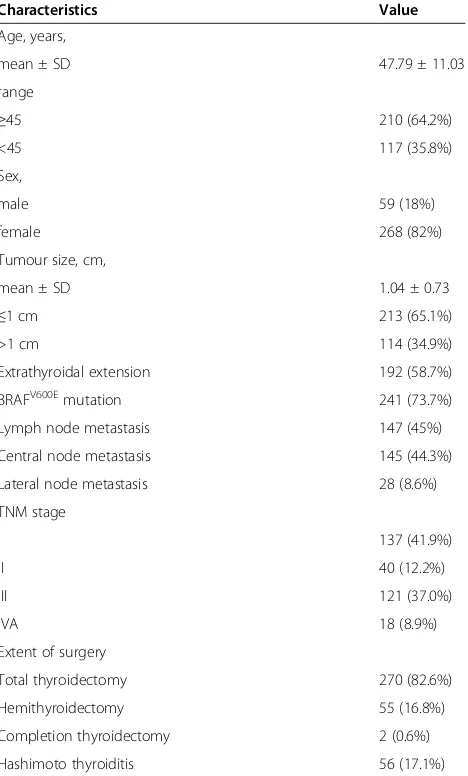
The clinicopathological characteristics of the 327 pa-tients, 268 female (82%) and 59 male (18%), with a mean age of 47.79 ± 11.03 years at the time of surgery, are summarised in Table 1.
The mean tumour size was 1.04 ± 0.73 cm. Extra-thyroidal extensions and lymph node metastases were present in 192 patients (58.7%) and 147 patients (45%), respectively.
Total thyroidectomy was performed in 270 patients (82.6%). Other thyroidectomies, including hemithyroid-ectomies and completion thyroidhemithyroid-ectomies, were performed in 57 (17.4%) patients. Of the 327 patients with PTC, 56 (17.1%) demonstrated pathological features of Hashimoto’s thyroiditis. In total, 137 patients (41.9%) had stage I dis-ease, 40 (12.2%) had stage II disdis-ease, 121 (37.0%) had stage III disease, and 18 (8.9%) had stage IVA disease. The BRAFV600Emutation was detected in the tumours of 241 patients (73.7%).
Table 2 shows the association between BRAFV600E mu-tation status and the clinicopathological characteristics of the patients. Lymph node metastasis, TNM stage, and multifocality were not significantly associated with the BRAFV600Emutation. However, larger tumour size, extra-thyroidal extensions, and histologic type (classic type) concurrent with Hashimoto’s thyroiditis were associated with the BRAFV600Emutation.
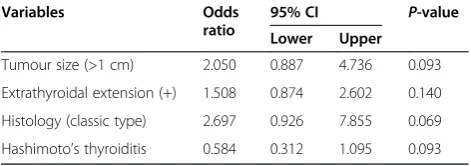
The results of the multivariate analysis are shown in Table 3. The BRAFV600Emutation was not significantly as-sociated with tumour size, extrathyroidal extension, or the histologic type concurrent with Hashimoto’s thyroiditis.
Discussion
In 2003, Kimura et al. initially reported the BRAFV600E mutation in thyroid carcinomas. Since this discovery, additional research has been conducted to understand the tumorigenic role and clinical importance of this
mu-tation [11-13]. The BRAFV600E mutation has been
reported in PTC with a frequency ranging from 29% to 83% in various studies [14], and recent studies have reported differences in the incidence of the BRAFV600E mutation according to region; for example, the incidence of the BRAFV600E mutation was shown to be higher in Korea (range 52% to 87%) in comparison to other coun-tries (range 36% to 65%) [7,8]. The reason for this vari-ation in frequency remains unclear but may be due to geographic factors. For example, some studies have reported higher rates of the BRAFV600Emutation in high iodine intake areas, which may indicate the significance
Table 1 Clinicopathological characteristics of the study population (n = 327)
Characteristics Value
Age, years,
mean ± SD 47.79 ± 11.03
range
≥45 210 (64.2%)
<45 117 (35.8%)
Sex,
male 59 (18%)
female 268 (82%)
Tumour size, cm,
mean ± SD 1.04 ± 0.73
≤1 cm 213 (65.1%)
>1 cm 114 (34.9%)
Extrathyroidal extension 192 (58.7%)
BRAFV600Emutation 241 (73.7%)
Lymph node metastasis 147 (45%)
Central node metastasis 145 (44.3%)
Lateral node metastasis 28 (8.6%)
TNM stage
I 137 (41.9%)
II 40 (12.2%)
III 121 (37.0%)
IVA 18 (8.9%)
Extent of surgery
Total thyroidectomy 270 (82.6%)
Hemithyroidectomy 55 (16.8%)
Completion thyroidectomy 2 (0.6%)
Hashimoto thyroiditis 56 (17.1%)
Results are presented as mean ± SD, or number of patients (%). TNM, classification by tumour, nodes and metastases.
Table 2 Univariate analysis of the association between clinicopathological characteristics and the BRAFV600E mutation
Variables BRAFV600Emutation P-value
Positive (n = 241)
Negative (n = 86)
Age, years,
mean ± SD 47.63 ± 11.26 48.23 ± 10.41 0.665
≥45 85 (35.3%) 32 (37.2%) 0.747
<45 156 (64.7%) 54 (62.8%)
Sex,
male 39 (16.2%) 20 (23.3%) 0.143
female 202 (83.8%) 66 (76.7%)
Tumour size, cm,
mean ± SD, 1.09 ± 0.72 0.89 ± 0.75 0.040
≤1 cm 147 (61%) 66 (76.7%) 0.009
>1 cm 94 (39%) 20 (23.3%)
Extrathyroidal extension,
yes 152 (63.1%) 40 (46.5%) 0.007
no 89 (36.9%) 46 (53.5%)
Lymph node metastasis,
yes 110 (47.6%) 37 (43.5%) 0.518
no 121 (52.4%) 48 (56.5%)
Central node metastasis,
yes 110 (47.6%) 35 (41.2%) 0.308
no 121 (52.4%) 50 (58.8%)
Lateral node metastasis,
yes 19 (8.2%) 9 (10.6%) 0.512
no 212 (91.8%) 76 (89.4%)
TNM stage,
I 96 (41.6%) 41 (48.2%) 0.138
II 33 (14.3%) 7 (8.2%)
III 91 (37.7%) 30 (34.8%)
IVA 11 (6.4%) 7 (8.8%)
Multifocality,
yes 59 (24.5%) 23 (26.7%) 0.678
no 182 (75.5%) 63 (73.3%)
Histology,
classic type 233 (96.7%) 78 (90.7%) 0.027
follicular variant 8 (3.3%) 8 (3.3%)
Concurrent Hashimoto’s thyroiditis,
yes 35 (14.5%) 21 (24.4%) 0.037
no 206 (85.5%) 65 (75.6%)
of iodine as a risk factor for the BRAFV600E mutation in PTC [8,15]. Iodine intake is very high in Korea as com-pared to Western countries, which may explain the high prevalence of the BRAFV600E mutation among Koreans with PTC. The prevalence of the BRAFV600Emutation in PTC patients in our study was 73.7% (241/327), and fur-ther studies will be needed to clarify differences in the
prevalence of the BRAFV600E mutation between
geo-graphic regions.
Many studies have reported the relationship between the BRAFV600E mutation and the clinicopathological characteristics of PTC. However, recent clinical studies have reported controversial results regarding whether the BRAFV600E mutation serves as a prognostic or pre-dictive marker of PTC. Xinget al. [16] first reported that the BRAFV600E mutation was associated with a poorer clinicopathological outcome and independently pre-dicted recurrence. These authors therefore concluded that the BRAFV600Emutation may be a useful marker for risk stratification in PTC. Many studies have found that extrathyroidal extensions, lymph node metastases, and advanced stage are the three most common risk factors consistently associated with the BRAFV600E mutation [17-19]. In addition, several studies have reported signifi-cant associations between the BRAFV600E mutation and clinicopathological characteristics, such as older age, male sex, tumour size, and an aggressive subtype [17-21].
Although all of the above-mentioned studies were conducted in Western countries, some results from studies conducted in Eastern countries have not been consistent, especially those performed in the Korean population. Ito et al. [22] investigated the BRAFV600E mutation in 631 patients with PTC and found that the BRAFV600E mutation was not significantly associated with high-risk biological features, such as lymph node metastasis, extrathyroidal extension, advanced age, dis-tant metastasis at surgery, and advanced stage. Further-more, the disease-free survival of patients with the BRAFV600Emutation did not differ from that of patients without the BRAFV600E mutation. In addition, other study groups have reported that age distribution, tumour size, extrathyroid extension, multifocality, and staging do not differ significantly between patients with and
without the BRAFV600E mutation [7]. Our study found that large tumour size (odds ratio (OR) 2.131, 95% CI 1.266, 3.588) and extrathyroidal extensions (OR 1.964,
95% CI 1.194, 3.232) were associated with the
BRAFV600E mutation in a univariate analysis, although no clinicopathological features were associated with the BRAFV600E mutation in a multivariate analysis. There-fore, our results indicate that there may be differences
between PTC subjects in Eastern and Western
countries.
The prevalence of the BRAFV600E mutation in PTC is distinctly different between subtypes. For example, this mutation is specific to the classic and tall-cell variants of PTC and is rarely found in other types of differentiated thyroid cancer, including follicular variant PTC [13]. We also observed a significant prevalence of the BRAFV600E mutation among patients with classic type PTC311 (95.1%), whereas only 16 patients (4.9%) with the follicu-lar variant PTC harboured the BRAFV600Emutation.
In this study, we found that the BRAFV600E mutation was associated with a lower frequency of concurrent Hashimoto’s thyroiditis in a univariate analysis (P<0.05). The BRAFV600E mutation was present in 21 (24.4%) of 86 patients with PTC without Hashimoto’s thyroiditis and in 35 (14.5%) of 241 patients with both PTC and Hashimoto’s thyroiditis. In a previous Korean study [23], the BRAFV600E mutation was detected at a higher
fre-quency among patients with PTC but without
Hashimoto’s thyroiditis (90%) as compared to those with PTC and Hashimoto’s thyroiditis (64%). Together, these results suggest that the BRAFV600E mutation is associ-ated with the tumourigenesis of most classic type PTCs and that the somatic BRAFV600Emutation likely acts on a component of Hashimoto’s thyroiditis following PTC as cells age. However, the current study had some inher-ent limitation. First, the rate of mirocarcinoma was higher (65.1%) in this study, and this condition is known to be associated with low aggressiveness and a more favourable prognosis in most cases. Second, we were not able to examine disease recurrence and describe the long-term follow up results, and the time period of the present study was too short to identify the prognostic value of the BRAFV600E mutation. Thus, a long-term follow up study is needed to identify the association
between the prognosis of PTC and the BRAFV600E
mutation.
Conclusions
The prevalence of the BRAFV600E mutation in this study was in accordance with that observed in previous stud-ies. This prevalence was related to several clinicopatho-logical factors, including extrathyroidal extension, large tumour size, classic histologic type, and a low frequency of concurrent Hashimoto’s thyroiditis. However, we failed to
Table 3 Multivariate analysis of the association between clinicopathological characteristics and the BRAFV600E mutation
Variables Odds
ratio
95% CI P-value
Lower Upper
Tumour size (>1 cm) 2.050 0.887 4.736 0.093
Extrathyroidal extension (+) 1.508 0.874 2.602 0.140
Histology (classic type) 2.697 0.926 7.855 0.069
establish a correlation with regard to lymph node metasta-sis, advanced stage, sex, and age. Moreover, there were no independent factors associated with BRAFV600E mutation status. However, it will be necessary to perform a long-term follow up study to identify the clinical usefulness of the BRAFV600Emutation in PTC.
Abbreviations
FFPE:Formalin-fixed paraffin-embedded; FNAC: Fine needle aspiration cytology; PTC: Papillary thyroid carcinoma; OR: Odds ratio; PCR: Polymerase chain reaction; TNM: Tumour nodes, metastases.
Competing interests
The authors declare that they have no competing interests.
Authors’contributions
WCP participated in the conception and design of the study and carried out the surgery. YSK participated in the data analysis and interpretation and drafted the manuscript. JSK and JSB participated in the collection of the data. All authors read and approved the final manuscript.
Acknowledgements
This study did not receive grant funding or other subsidies.
Received: 15 January 2013 Accepted: 12 May 2013 Published: 20 May 2013
References
1. Davies L, Welch HG:Increasing incidence of thyroid cancer in the United States, 1973–2002.JAMA2006,295:2164–2167.
2. Hundahl SA, Fleming ID, Fremgen AM, Menck HR:A National Cancer Data Base report on 53,856 cases of thyroid carcinoma treated in the U.S., 1985–1995.Cancer1998,83:2638–2648.
3. Parkin DM, Bray F, Ferlay J, Pisani P:Global cancer statistics, 2002.
CA Cancer J Clin2005,55:74–108.
4. Davies H, Bignell GR, Cox C, Stephens P, Edkins S, Clegg S, Teague J, Woffendin H, Garnett MJ, Bottomley W, Davis N, Dicks E, Ewing R, Floyd Y, Gray K, Hall S, Hawes R, Hughes J, Kosmidou V, Menzies A, Mould C, Parker A, Stevens C, Watt S, Hooper S, Wilson R, Jayatilake H, Gusterson BA, Cooper C, Shipley J,et al:Mutations of the BRAF gene in human cancer.Nature
2002,417:949–954.
5. Fagin JA, Mitsiades N:Molecular pathology of thyroid cancer: diagnostic and clinical implications.Best Pract Res Clin Endocrinol Metab2008, 22:955–969.
6. Dhillon AS, Kolch W:Oncogenic B-Raf mutations: crystal clear at last.
Cancer Cell2004,5:303–304.
7. Kim TY, Kim WB, Song JY, Rhee YS, Gong G, Cho YM, Kim SY, Kim SC, Hong SJ, Shong YK:The BRAF mutation is not associated with poor prognostic factors in Korean patients with conventional papillary thyroid microcarcinoma.Clin Endocrinol (Oxf )2005,63:588–593.
8. Kim KH, Kang DW, Kim SH, Seong IO, Kang DY:Mutations of the BRAF gene in papillary thyroid carcinoma in a Korean population.Yonsei Med J
2004,45:818–821.
9. Kebebew E, Weng J, Bauer J, Ranvier G, Clark OH, Duh QY, Shibru D, Bastian B, Griffin A:The prevalence and prognostic value of BRAF mutation in thyroid cancer.Ann Surg2007,246:466–470.
10. Fugazzola L, Mannavola D, Cirello V, Vannucchi G, Muzza M, Vicentini L, Beck-Peccoz P:BRAF mutations in an Italian cohort of thyroid cancers.
Clin Endocrinol (Oxf )2004,61:239–243.
11. Lee JH, Lee ES, Kim YS:Clinicopathologic significance of BRAF V600E mutation in papillary carcinomas of the thyroid: a meta-analysis.
Cancer2007,110:38–46.
12. Xing M:BRAF mutation in papillary thyroid cancer: pathogenic role, molecular bases, and clinical implications.Endocr Rev2007,28:742–762. 13. Kimura ET, Nikiforova MN, Zhu Z, Knauf JA, Nikiforov YE, Fagin JA:High
prevalence of BRAF mutations in thyroid cancer: genetic evidence for constitutive activation of the RET/PTC-RAS-BRAF signaling pathway in papillary thyroid carcinoma.Cancer Res2003,63:1454–1457.
14. Nucera C, Goldfarb M, Hodin R, Parangi S:Role of B-Raf(V600E) in differentiated thyroid cancer and preclinical validation of compounds against B-Raf(V600E).Biochim Biophys Acta2009,1795:152–161. 15. Guan H, Ji M, Bao R, Yu H, Wang Y, Hou P, Zhang Y, Shan Z, Teng W, Xing
M:Association of high iodine intake with the T1799A BRAF mutation in papillary thyroid cancer.J Clin Endocrinol Metab2009,94:1612–1617. 16. Xing M, Westra WH, Tufano RP, Cohen Y, Rosenbaum E, Rhoden KJ, Carson
KA, Vasko V, Larin A, Tallini G, Tolaney S, Holt EH, Hui P, Umbricht CB, Basaria S, Ewertz M, Tufaro AP, Califano JA, Ringel MD, Zeiger MA, Sidransky D, Ladenson PW:BRAF mutation predicts a poorer clinical prognosis for papillary thyroid cancer.J Clin Endocrinol Metab2005,90:6373–6379. 17. Lupi C, Giannini R, Ugolini C, Proietti A, Berti P, Minuto M, Materazzi G, Elisei
R, Santoro M, Miccoli P, Basolo F:Association of BRAF V600E mutation with poor clinicopathological outcomes in 500 consecutive cases of papillary thyroid carcinoma.J Clin Endocrinol Metab2007,92:4085–4090. 18. Trovisco V, Soares P, Preto A, de Castro IV, Lima J, Castro P, Maximo V,
Botelho T, Moreira S, Meireles AM, Magalhaes J, Abrosimov A, Cameselle-Teijeiro J, Sobrinho-Simoes M:Type and prevalence of BRAF mutations are closely associated with papillary thyroid carcinoma histotype and patients’age but not with tumour aggressiveness.Virchows Arch2005, 446:589–595.
19. Frasca F, Nucera C, Pellegriti G, Gangemi P, Attard M, Stella M, Loda M, Vella V, Giordano C, Trimarchi F, Mazzon E, Belfiore A, Vigneri R:BRAF(V600E) mutation and the biology of papillary thyroid cancer.Endocr Relat Cancer
2008,15:191–205.
20. Powell N, Jeremiah S, Morishita M, Dudley E, Bethel J, Bogdanova T, Tronko M, Thomas G:Frequency of BRAF T1796A mutation in papillary thyroid carcinoma relates to age of patient at diagnosis and not to radiation exposure.J Pathol2005,205:558–564.
21. Xu X, Quiros RM, Gattuso P, Ain KB, Prinz RA:High prevalence of BRAF gene mutation in papillary thyroid carcinomas and thyroid tumor cell lines.Cancer Res2003,63:4561–4567.
22. Ito Y, Yoshida H, Maruo R, Morita S, Takano T, Hirokawa M, Yabuta T, Fukushima M, Inoue H, Tomoda C, Kihara M, Uruno T, Higashiyama T, Takamura Y, Miya A, Kobayashi K, Matsuzuka F, Miyauchi A:BRAF mutation in papillary thyroid carcinoma in a Japanese population: its lack of correlation with high-risk clinicopathological features and disease-free survival of patients.Endocr J2009,56:89–97.
23. Kim KH, Suh KS, Kang DW, Kang DY:Mutations of the BRAF gene in papillary thyroid carcinoma and in Hashimoto’s thyroiditis.Pathol Int
2005,55:540–545.
doi:10.1186/1477-7819-11-99
Cite this article as:Kimet al.:Clinical implication of the BRAFV600E
mutation in papillary thyroid carcinoma.World Journal of Surgical Oncology201311:99.
Submit your next manuscript to BioMed Central and take full advantage of:
• Convenient online submission
• Thorough peer review
• No space constraints or color figure charges
• Immediate publication on acceptance
• Inclusion in PubMed, CAS, Scopus and Google Scholar
• Research which is freely available for redistribution