Other tactical operations cover a wide ran}?;eof special-purpose opera-tions uncfertaken routinely during of-fensive and deof-fensive operations. While these operations are not the main focus ofthe commander at the tactical level of war, smoke may support these operations as welL These operations
include-.
Retrograde operations.Smoke and obscurants integrated throughout the battlefield ana opera-tional continuum provide major con-tributions to comoat power in deep, close, and rear operations. In other operations, the major contributions are the same as those in offensive smoke tactics. See Chapter 3.
Smoke and obscurant use in other tactical operations requires the same careful planning and execu-tion as with the offense and defense. In addition to the general
A retrograde operation is a move-ment to tne rear or away from the enemy.
Retrograde operations gain time, preserve forces, avoid combat under undesirable conditions, or draw the enemy into an unfavorable position. In refrograde
operations-.1Use smoke to support maneuver
by-- Concealing maneuvering forces from enemy observation.
-
C~ncealing disengaging and
movmg forces.42
Chapter 5
Other
Tactical
Operations
.Relief-in-pla~e operations. .Passage of Imes.
. Linkup operations.
.
Breakout from encirclement. .River crossings.. Obstacle breaching.
In addition, there are special con-ditions and environments we must consider:
.
Mountains.Tactics
t~chniqu~s listed in
~0apter. 3,
spe-Clal techmques to mmm11Ze
mter-ference
include
-.
IKnow the limitations of your delivery systems. Smoke munitions do not behavethe
same in all condi-tions or environments (for example,thejungles
of Central Americaver-sus the
woodlands of Europe). Planfor differences
in
coverage. Some munitions combinationssuch
as HE
and WP are not effective under cer-tain environments or conditionsRetrograde
- Providing tactical surprise and
al-lowing the commander to set the terms of combat.
- Allowing the commander to mass
forces unoDserved.
- Defeating enemy surveillance
ef-forts.
- Supporting t~e dec~ption story. -
Slowmg ana dlsruptmg enemy
movemenl-
Isolating attacking echelons.
-Concea1ing engineer operations
defensive preparationsto the
rear.
Jungles..
Urban terrain..
Deserts..
Winter zones..
Nuclear, biological,
and chemical(NBC)
conditions.Finally,because smoke draws
at-tention, we must consider smoke
support for tactical deception.
such as winter zones with deep
snow.
.Use smoke to mask terrain from aerial observation. With the
excep-tion
of
jungles,much
of the terram describedm this
chapter affordsgood aerial observation.
By masking Keyterrain features you reduce yourvulnerability as targets of
op-portunity for high-performance aircraft..
.Use smoke to provide additional
firepower
by-- Defeating enemy
counterrecon-naissance efforts.
- Disrupting enemy command and
controL
-
,Disrupting
enemy maneuver andremforcement.
- Disrupting the enemy'sability to
communicate.
- Forcing the enemy to mass, thus
providing a lucrative target.
- Changmg friendly to enemy force ratios by using thermal imagers
and
millimeter
wave acquisition devices
such as radars to see through visual smokes and using smoke to isolate defending and second-echelon for-ces.-:-Enhancing fri~ndly t~rget acquisi-hon efforts By sllhouettmg enemy vehicles with smoke and using smoke and obscurants we can see through but the enemy cannot.
.
Use smoke to protect the force. (See Chapter3
under Offensive Smoke Tactics.)Delay
In delays, units give ground to gain time. Delayin}; units inflict the greatest possible damage on the enemy wnile preserving their freedom of action.
In the delay, use smoke
to-.
Conceal movement of maneuver and support forces, allowing the commander to mass forces unob-served..Provide tactical surprise, allowing the commander to seize the initia-tive and set the terms of combat.
.
:Defeat enemy reconnaissance and counterreconnalssance efforts..
,Conceal obstacle emplacement, breaching, or crossing.. ~Conceal designated withdrawal
routes.
.
Maintain contact with the enemy but preclude decisive engagement.Smoke emploTITIent tactics in the delay are the following:
t:I Screening smoke. Use screening smoke to conceal maneuver and obstacle emplacement. Use smoke along withdrawal routes and along the flanks to conceal movement. Begin making smoke prior to departmg your existing position to confuse the enemy as to the actual location and size of
In a relief in place, a unit in con-tact is replaced by another that as-sumes the missions of the outgoing unit. Use smoke
to-.
Fix the enemy reconnaissanceforce.
FM 3-50
the force. Use _projected means to deliver smoKe between the delayi1}g unit and the enemy, force. Use smoke to conceal obstacle breaching or crossing. The priority of effort is to mobility operations; therefore, carefuUy control the smoke to prevent slowing or silhouetting your units.
.
:Protecting smoke. Use protectingsmoke as re~uired to defeat enemy A TGMs and air defense systems. Us~ protecting smoke to avoid decisive engagement.
.
Obscuring smoke. Use obscuringsmoke to de1eat enemy reconnais-sance and counterreconnaisreconnais-sance ef-forts. Use projected smoke means to deliver smoke mixed with high-ex-plosive rounds before the enemy can pinpoint your units. Attempt to force the enemy into early depIoy-ment.
.
Marking smoke. Use marking smoke to mark enemy targets for rapid destruction or to reauce the potential for firing on friendly for-ces..
Smoke for deception. Use sup-porting smoke to araw attention to areas of little or no importance. Cre-ate large-area smoke away from the delaying force. Consider using smoke mixed with high-explosive rounds to conduct preparatory fire of dummy objectives.Withdrawal
In withdrawals, a force in contact disengages from the enemy. The force may be assisted by another force or unassisted. In tne withdrawal, use smoke
to-.
Conceal movement of maneuverand support forces, allowing the
Relief
in Place
.
.Mark the enemy reconnaissanceforce for destruction with direct and indirect fire weapons.
.
JDeny the enemy reconnaissance force information about thedisposi-commander to mass security forces unobserved.
.
JDefeat enemy reconnaissance andcounterreconnalssance efforts. .Conceal obstacle emplacement, breaching, or crossing and hinder
pursuit oy the enemy,.
.
Conceal designated withdrawalroutes, traffic control points, and on-order assembly areas.
.I
Create opportunities to disengage the force.Smoke emplo)'!l1ent tactics in the withdrawal include the following:
.
Screening smoke. The tactics are the same as those under Delay. Ad-ditionally, use projected means to deliver smoke between the security force and the enemy force..
Protecting smoke. The tactics arethe same as those under Delay.
.
Obscuring smoke. The taches are the same as those under Delay..
Marking smoke. The tactics are the same as those under Delay..
Supporting smoke for tactical decephon. Use supporting smoke to draw attention to areas 01 little or no importance. Create large-area smoke away from the main body.Retirement
In a retirement, a force not in con-tact moves away from the enemy in an organized manner. In a retire-ment, a heavy rear guard will con-duct delaying actions to slow the advance of tfie enemy and allow the main body to increase the distance between itself and the enemy. In general, use smoke to support the rear ~ard in its delaying opera-tions. The tactics for employment of smoke in support of the rear guard are the same as for the delay.
tion, composition, or intent of friendly forces.
.
Conceal the movement of reliev-ing forces. This is critical as disper-sion of forces in a relief is difficult. The enemy may exploit the massingas a time to attack with NBC weapons.
A special consideration for reliefs
is to maintain the illusion the force has not changed. Obtain the relieved force's smoke annex. In planning the relief, attempt to dupli-cate patterns of employment for a brief period.
SmoKe employment tactics in a relief in place are the following:
.
Screening smoke. Use screeningsmoke to conceal maneuver. Use smoke in the reserve force area and along the flanks to conceal
move-A passage of lines is a coor-dinated movement of one or more units through another unit. Units
conduct passage of lines to continue an attacK or counterattack, envelop an enemy fo!ce, pursue a fl~eing enemy, or withdraw a secunty or main battle force. Synchronization is the overriding imperative. Use smoke
to-.
Conceal movement of maneuverand support forces, allowing the commander to mass forces unob-served.
.Provide tactical surprise, allowing
the commander to seize the initia-tive and set the terms of combat.
.
Defeat enemy reconnaissance andcounterreconnalssance efforts.
Two friendly forces are joined in linkup operations. Units conduct linkup operations to complete an en-circlement of an enemy force, assist in breakout of an encircled friendly force, or to join an attacking force with a force inserted into the enemy rear.
Use smoke
to-.
Mark the coordinated fire linei
CFL) or the restrictive fire line
~FL) to prevent fires being set by nendly forces.
.
Conceal movement of the linkupforce.
44
ment. Use smoke forward of the
FLOT to allow the relieved force to disengage. You must carefully
con-t!ol tfie smo~e to prevent
silliouet-tmg your unitS.
.
Protecting smoke. Use protectingsmokes to defeat enemy antitank and air defense systems.
.
Obscuring smoke. Use projectedsmoke means to deliver smoke
mixed with high-explosive rounds before the enemy can pin])oint your units. Plan obscuring fire oased on
decisionpoints for the enemy,
isolat-ing and confusisolat-ing their
reconnais-Passage
of
Lines
.
Conceal obstacle breaching orbypass.
S'moke emplo~ent tactics in
pas-sage of lines are the following:
.
Screening smoke. Use screeningsmoke to conceal maneuver and
obstacle breaching. Use smoke at the contact point, along passage lanes, and along the flanKs to
con-ceal movement. Use smoke forward
of passage points. You must careful-ly contrOl the smoke to prevent sil-nouetting your units.
.
Protecting smoke. Use smoke todefeat enemy antitank and air
defense systems.
.
Obscuring smoke. Use projectedsmoke means to deliver smoke
mixed with high-explosive rounds
before the enemy can pinpoint your
Linkup
Operations
.
Deny the enemyinformationcon-cerning when
and
where the linkup will occur.Smoke tactics for linkup
opera-tions
are the following:.
.
Obscuring smoke. The tactics arethe same as those for the
exploita-tion phase of offensive operations
(Chapter
3).
.
Screening smoke. Use screeningsmoke to conceal maneuver and sup-port forces and defeat enemy target acquisition and guidance systems. Use self-defense and
generated-smoke means to conceal maneuver
sance forces. Plan obscuring fire
during the relief to allow the
relieved force to disengage and ])ass
through friendly
lines unobservea..1
Marking smoke. Use markingsmoke to mark enemy targets for
rapid destruction or to reauce the potential fo! f~ring on frie~dly for-ces. Use aVlatlOn reconnaissance
as-sets to spotthe enemy
reconnaissance force and mark it with smoke rockets.
.
Supporting smoke for tacticaldeception. The tactics
are the same
as in the withdrawal phase.
units. Plan obscuring fire based
on
decision
points for tfie enemy, isolat-ing and confusisolat-ing their reconnais-sance forces. Plan obscuring fireduring the passage of lines to allow
the force to pass 1hrough friendly
lines unobserved.
.
Marking smoke. The tacticsare
the same as those under Relief in Place.
.
Supporting smoke for tacticaldecephon. USe supporting smoke to
draw attention to areas ot little or
noimportance. Create large-area smoke away from
the
main body. Consider using smoke mixed Withhigh-explosive rounds to conduct preparatory fire of dummy objec-tives.
units as they bypass or harass
enemy forces.
.
Marking smoke. Use markingsmoke to mark the CFL or RFL,
mark targets for destruction,
iden-tify bypass routes, and si~al for
bat-tlefiefcf activities. Use projected
smoke means to deliver smoke onto
identified enemy strongpoints or
larger fonnations and to signal for-ces to consolidate on a particular objective ~r rally .point.
.Protectmg smoKe.If the enemy
has known or suspected nuclear or
directed-energy weapon capability,
concealing your logistics activities in oil smokes may attenuate some of the energy.
A breakout from encircled forces differs from other attacks only in that units must maintain a simul-taneous defense of other areas of the perimeter.
Use smoke
to-.
,Aid in establishing a deception story..
Isolate and segregate enemyfor-ces to create gaps or weaknesses in the encircling force.
.
Conceal movement of maneuver and support, allowing the com-mander to mass the rupture force and main body unobserved..
Defeat enemy reconnaissance and counterreconnaissance efforts..
Conceal obstacle emplacement,breaching, or crossing and hinder
pursuit by the enen:y..
.
.
cCreate opportumhes to disengagethe force.
Smoke employment tactics in breakout from encirclement in-
clude-Units conduct river crossings as part of a higher headquarters scheme of maneuver. The
commander's objective is to project his combat power to the exif side of the river qmckly to maintain the unit's momentum. The overriding imperative is synchronization. Effec-tive command and control are criti-cal f~r .su~cess.Apply all techniques to mmlffilZe the mrerference caused
by
smoke. Use smoketo-.
,Conceal the movement of the ini-tial assault force..
Isolate the exit bank of the riverfor rapid occupation
by
maneuverforces.
.
cConceal emplacement of crossing means such as engineer bridges..
Isolate follow-on objectives to allow the commander to rapidlyFM 3-50
.
Smoke for deception. Use this smoke to keep the enemyoff-Breakout
from Encirclement
.
,Obscuring smoke. Use obsuring smoke to isolate the rupture objec-tive, defeat enemy target acquisition and gui~ance systems, and defeat reconnaissance and counterrecon-naissance efforts. Use projected smoke means to deliver smoke mixed with high-explosive rounds in front of the objective; between enemy formations; and on identified forward observer, A TGM, and tank u~it positions be~ore the enemy can pmpomt your umts as targets..
Screenmg smoke. Use screeningsmoke to conceal maneuver as you bypass, breach, or cross obstacIes or small pockets of resistance, along the flanks to protect the force, and in the rear to conceal disposition and composition of both the reser-ves and rear guard. Use self-defense and generated-smoke means to dehver smoke across danger areas and to the flanks of
River
Crossings
project combat power across the nver.
Smoke emRloyment tactics in river crossings
include-.
Screening smoke. Use screeningsmoke to conceal maneuver and ac-tual river crossing sites. Use smoke in the main body area and along the flanks to conceal movement. You must carefully control the smoke to prevent silhouetting your units. Begm making smoke pnor to conducting the inihal assaurt to con-fuse the enemy as to the actualloca-tion and size of the force. Use Rrojected-smoke means to deliver the initial screening smoke to iso-late the exit bank oDjectives and give other smoke delivery means tlffie to build effective smoke.
balance and to draw attention away from critical sustainment activities.
the force to limit enemy observation and engagement.
.
MarKing smoke. Use markingsmoke to mark enemy targets for rapid destruction or to reduce the potential for firing on friendly for-ces.
.
Protecting smoke. If the enemy has known or suspected directed-energy weapon capability, conceal-ing your force in a blanKet of oil smoke will attenuate some of the enermr..: S'moke for deception. Use this smoke to draw attention away from the main effort to areas of little or no importance. Since the diversion-ary force is critical to the breakout, consider making it the priority for smoke support. Use generatea-smoke means to create small- to large-area smokes away from the mam body.
.
Protecting smoke. Use protecting smoke as required to defeat enemy A TGMs and air defense systems..
Obscuring smoke. The tactics arethe same as in the preparation phase for offensive operations
(Chapter 3).
.
Marking smoke. Use markingsmoke to mark enemy targets for rapid destruction or to reduce the potential for firing on friendly for-ces. Aviation assets can deliver smoke onto identified enemy posi-tions for destruction
by
indirect fire or the follow-on force..
Smoke for deception. The tactics are the same as in the preparation phase for offensive operatlOns(Chapter 3).
Units
breach obstacles when they cannot bypass them at an ad-vantage. The commander's objectiveis to project his combat power to the exit side of the obstacle quickly to maintain the unit's momentum. The overriding imperative is initia-tive. In general, pfatoons and larger formations breach obstacles, willi most smoke planning consisting of immediate fire requests for covert or hasty breaches or detailed plan-ning for all potential smoke assets in deliberate breaches.
Use smoke
to-.
Isolate the exit side objective.Special
Weather and terrain have a sig-nificant impact on smoke employ-ment as previously stated. TIle following paragraphs present special climate considerahons, employment tactics, and technigues to overcome difficulties under tIi.ese conditions:
.
Mountains..
Jungles..
Uroan terrain..
Deserts..
Winter zones..
Nuclear, biological, or chemical (NBC) conditions.Mountains
In combat operations, mountains generally are characterized by rugged, compartmented terrain; steep slopes; and few natural or man-made lines of communication. The weather spans the entire spectrum from extreme cold, with ice and snow during winter, to ex-treme heat in some areas during summer. Although these extremes are important planning considera-tions, the variability of weather over short periods of time, and from area to area, also sigp.ificantly in-fluences maneuver, -fire support, and smoke support operahons.46
Obstacle
Breaching
.,Conceal movementof the
breach-ing, initial assault, and support for-ces.
.
Conceal emplacement of crossingmeans such as engineer bridges or demolitions.
.
Isolate the exit side of the obstacle for rapid occupation by maneuver forces..
Isolate follow-on objectives to allow the commander to rapidly project combat power across tne obstacle.Smoke employIpent tactics for breaching
include-.
Screening smoke. The tactics are the same as those under River Crossings..
Protecting smoke. Use protecting smokes as required to defeat enemy A TGMs and air defense systems..
Obscuring smoke. The tactics are the same as in the preparation phase for offensive operations(Chapter 3).
.
Marking smoke. The tactics are the same as those under River Crossings..
SmoKe for deception. The tacticsare the same as in the preparation phase for offensive operatlOns
(Chapter
3).
Conditions
or
Environments
Delivery Means Mountainous terrain is generally hard and rocky in the summer With intermittent areas of deep
snow.In
the winter, the terrain
is mostly
covered with deep snow.
.
Snow.The phosphorus in WP
can burn undetected in snow for up to four days.
.
Rocky ferrain. Smokeis effective
to
deny
the
enemy the use of nar-row passages, valIeys, roads, and usable terrain..
Winds. Swirling winds makesmoke
emplo~ent very
difficult toadjust
and maintain.Closecoordina-tion is requiredwith
adjacentele-ments to ensure that their vision is
not
obscured or they are not high-lighted..
,Adjusting fire. Distances aredif-ficult
to
jucfge. Observerstendto
undereshmate upslope distances
and overestimate downslope
distan-ces.
Problems
Mortars are ideal because of their
high-angle fire. They can deliver
fire on reverse slopes and over
inter-mediate crests.
Position observers on high ground
and spread
them to
overcometer-rain masks and compartments.
Ob-serv.ers may require mountaineer~g
eqmpment
to get to the best
POSi-tions,or they may be airlifted.
Ter-rain
sketches and visibility diagramsare
essentialto
deliver fast, ac-curate fireandto
identify blind
s2ots.Use ground surveillance radars
and remote sensorsto acquire
tar-gets.
Usesmoketo-.
Deny enemy use of narrow pas-sages, valleys, roads, and usableter-ram.
.
:Isolate enemy formations for piecemeal destruction..
Obscure routes that can be usedby the
enemy to attack, withdraw,andresupply.
.
Obscure likely position areas forindirect fire assets, command and
control elements, CSS assets, and observation posts.
.
,conceal terrain that is subject tosnowslides, flash floods, and rock-slides.
Jungles
Usually, jungle operations are
car-ried out by lightforces that can get
into and out of areas by helicopter. Fire support may be limited to in-direct fire and air support. Because
small-unit operations are
monplace, greater challenges accrue to the chemical officers and fire sup-port coordinators (FSCOORDs) at lower levels such as the company FSO and the battalion chemlCal of-ficer.
Delivery Means
In jungle terrain, mostcontact
with the enemy will be at extremely close ranges. If the friendly force has a substantial advantage
in fire
support, theenemy, will most likely
try to come in as close as possible
and maintainthat close contact
so
that the friendly force cannot
e~ploy ~ei! f~resuppor~ advantage
WithOut mfhctmg casualhes on their
own
trooRs.In the triple-canopy jungle, HC
smoke is ineffective. WP is effective .as a marking round
and in
initialad-lustments. ICM and FASCAM will
hang up in the trees and endanger
friendly forces that later move
through the area. Illumination
rounds are ineffective because
the
chutes get caught in theupper
canopy.
The ~riple-canopy jungle makes
ob-servatlOn beyona
25to 50
metersvery difficult. Thejungle also makes map reading and
self-10cation,tar-get location, and friendly unit
loca-tion determinaloca-tions very difficult.
Problems
Experience from World War IIand -Vietnamshowed that observers
and smoke control officers must be able to adjust smoke and mortar and field artillery (FA)
fireby
sound because tli.ey often cannot
see the rounds to adjust them. This
sound adjustment is very, difficult
and regmres wide experience.
By taKing the recommended
adjust-ments of two or more observers m
different locations, some accuracy
can result. The battery fire
direc-tion center (FDC) can help by
an-nouncing SPLASH to let the
observerKnow when the round
should impact. The observer
then
counts the seconds until he hears the round detonate. Multiplying the
seconds by the speed ofsound, the
FM 3-50
observer can estimate
the
rangeto
impact. The speed of sound is ap-proximately 350 meters per second.The speed of sound vanes
accord-ing to temperature, windspeed
and
direction, relative humidity, and air
density; but 350 metersper second
should be used as a start point.
The observer and smoke control
officer must determine their loca-tions and ensure that the TAC CP
and FDChave them plotted. If the
observer or smoke control officer's
initial position locations
are way off,
the smoke will be way off too. Use the initial smoke to determinethe
observer's own location.
Vietnam and World War II also
showed that the first projected
round in adjustment must be WP
smoke. Because the observers
are
not sure of their own location or
that of other friendly elements, WP
was always fired first to avoid inflict-ing casualties on friendly personnel.
Creeping fire was also used
exten-sively in Vietnam andWorld War II. The observer adds 300
to
400meters to his target location in case his own position 10cation is wrong. Then he makes corrections of no more than 50meters until the fire is on target. In Vietnam, this process sometimes started with an
aerial observer and was taken over
by the ground observer once he was
able to see therounds. The aerial
observer was often required to relay
fire requests from theground
be-cause tne terrainseverely limited
the ranges of radio communications. Because of the close combat, laser range finders may not be of great
use; however, night vision devices are extremely cntical. Avoid using
projected smokes during limited
visibility periods to preClude
degradation of these devices. Aerial obs~rvers help direct CAS assets
agamst enemy targets. Because
ground observers cannot see the
whole battlefield, the aerial
ob-server marks targets for the CAS
sortie (flares, WP, smoke). Radars
are extremely effective in the jungle,
since most indirect fire ishigh-angle
fire. Ground surveillance radars and
remote sensors must be used.
Use
smoke-.
To conceal maneuver to thefront,
flanks,and
rear..
Along roads and trails to denyenemy,
use.
.
At likely ambush sites to obscure enemy observation and fields of fire.Urban Terrain
In urban terrain, rangesare
drasti-cally reduced. There are three
major typ,es of terrain in nearly eve!y bmlt-up area:
.I
Obstructions, such as buildingsand heavily wooded parks.
.Flat, open terrain over water,
such as nvers and lakes.
.Flat, open terrain over concrete
or asphalt, such as _parking lots,
mul-tiple-lane roads and highways, and °Ren lots.
Air currents are unpredictable.
Obstructions tend tooreak up
smoke streamers, which re-form
intoa more uniform cloud.
Convec-tion currentsover open areas cause
smoke torise. There
are many
ob-servation points at multiple levels,
which allows an enemy fo observe from either above or oelow smoke.
Delivery Means
Downwind coverage
is
often lessdue toobstructions breaking
up the
smoke, unpredictability of air
cur-rents, and smoke following street
patterns. The Berlin Brigade ob-served that open areas in cities tend to cause smoke to rise and obscure
key observation points. This is a
par-ticular problem over water, garden
plots,
and
wide expanses of con-crete.Smoke diffuses well at night but
tends to rise
to rooftop level aboutone hour after sunrise until one
hour after sunset. Burning rubble
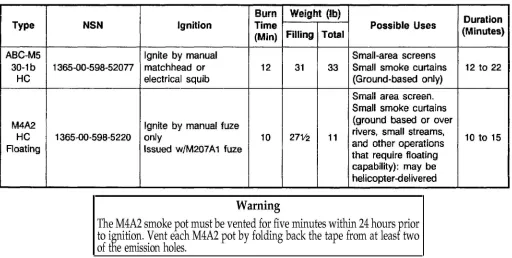
degrades the screening efficiency of smoke. Smoke pots weigh between
27.5 and 33 pounds (M4jM5),
making itdifficult for infantry
sq1;ladsto employ without transpor-tallOn assets fo move them forward
first.
Smoke hand grenades make smoke for only 60 to 150 seconds. Squads need to carry four to six per person for concealment. Be-cause of the height and closeness of buildings and other obstructions, CAS and artillery fire is degraded. Mortars and high-angle artillery are still effective.
Problems
Smoke and obscurant use in military- operations on urbanized ter-r~in (MOUT) re.quires careful plan-nmg and executlOn to prevent interference with movement, assault operations, or target acquisition; to retain the elemenf of surprise; and to avoid silhouetting or cfrawing undue attention to friendly forces.
Time smoke delivery with decision points. Conduct a thorough IPB and time your use of smoke to key decision points in your tactical plan: for example, "When we reach Sec-tor Ai, use grenade launchers to
smokethe
°
r
en area and concealmovement 0
B ComEany as they
emplace smoke pots. ') Ensure you target key terrain to deny the enemy tne use of it.Use unobscured weapons to over-watch. The overwatchmg elements should have target acqUlsition devices such as thermal imagers that can see through our own smoke and engage the enemy. This prevents surpnse and enhances your ability to suppress enemy fire auring the assaull This is particular-ly important for observers m upper floors of buildings, enabling them to observe enemy movements while friendly forces move unobserved.
Limited visibility positions, preplanned and previously
prepared, will mmimize degradation caused by friendly or Threat use of smoke. Rehearsal of displacement under smoke will help you avoid confusion and disorientation. It will also r~pidly restore engagement ca]JabllIty.
The best tactical application of smoke in urban areas is smoke blankets for concealment. Use smoke blankets prior to assaults.
48
Sweep and clear operations to eliminate enemy forces acquiring our soldiers as targets. ThIs is excep-tionally effective in reducing or eliminating sniper activity and in breaching obstacles. However, your soldiers must be careful to aVOId burning debris since this tends to reduce concealment.
Plan for enemy countermeasures. Enemy forces will counter your smoke use. Plan to intensify your counterreconnaissance and aIr defense efforts. The enemy may use countersmoke to confuse our com-mand and control so avoid reliance on visual signals.
The enemy will increase use of in-direct fire weapons when in-direct fire target acquisition is ineffective. Therefore, plan artillery counterbat-tery or countersmoke fire after crossing the LD jLC.
Reconnaissance must verify enemy locations. The enemy can use both our smoke and theirs to conceal movement to alternate positions or to break contact. Aggressive recon-naissance before ana during the engagem~nt .will allow you 10 shoot ana remam m contact.
Understand that smoke compres-ses the battlefield by limiting visibility. Smoke drastically reduces engagement ranges.. Trainmg your sordiers to operate m smoke reduces the aegradation caused by ~moke. It also reduces psychological lffipact on troops such as confuslOn, fear, and isolafion. The Israeli Army successfully used phos-p'horous rounds
m
Beirut to screen their forces and isolate the enemy (enemy forces tended to congregate in the city). The use of smoke produced enemy casualties and generated the psychological effects of fear and isoIatlOn.Urban terrain causes smoke streamers to break up quickly, creat-ing the uniform phase closer to the smoke source. You can place smoke sources closer to target areas.
Ensure the entire squad, section, or platoon uses the smoke simul-taneously- to preclude drawing atten-tion to a lone vehicle or element.
Smoke pots and smoke grenades are effective for concealmg move-ment of small units. An example of an employment scenario follows:
Squid members come under fire from snipers in upper floors. They
use a :<:renadelauncher to fire smoke and HE rounds into upper floors, blinding enemy observation. They emplace HC smoke pots or several smoke hand grenades downwind of and in between themselves and the target area or building. Concealed Q1f the smoke, they maneuver to assauft the target. Upon reaching the target area, they cease to maKe smoke to allow them to operate undegraded.
Start the smoke mission prior to operation start time and continue well beyond the end of the opera-tion. For example, you have
planned a canal crossing for 0500 to D700 hours. Start smoke at 0400. Stop smoke at 0800 to confuse the enemy as to the exact crossing time and SIze of the force.
Built-up areas nearly always have civilians/noncombatants occupying them. When planning the hi'e of smoke weapon system, and you suspect noncomDatants are present, give consideration to the lethality of the system before employIpent. For example, artillery-delivered smoke is usefu1 around tne periphery of a city. However, you should switch to less devastating sy-stems in the cen-ter of the city, such as smoke muni-tions from grenade launchers, smoke pots, and smoke hand grenades.
Smoke units are extremely vul-nerable in urban areas due to smoke generator signature. In addi-tion, stationary smol<e positions need to be closer to the target than over other terrain, bringing smoke generator elements williin range of enemy small arms weapons. Mobile smoke systems are bes£ Stationary smoke systems make large volumes of smoke but require aaditional security support. Employ smoke gen-erator vehIcles in groups of three, with two vehicles making smoke and one vehicle overwatChing.
Deserts
There are three types of deserts:
.
Rocky plateau de<serts..
Sandy or dune deserts..
Mountain deserts. (Munitions ef-fectiveness for mountain deserts is the same as for any mountainous region except that the considera-tions of snow are usually not ap-plicable.)It is important to recognize the specific terrain of each,oecause munitions effects will vary according to desert type. Desert battles tend to be more centralized. Brigade and battalion commanders often
per-sonally coordinate the interaction of maneuver and firepower. Engage-ments are often fought at long ran-ges.
In rockY
l
lateau deserts, projectedsmoke an illumination rounds may be degraded by high winds, but may be used to silliouette the enemy. HE/PO is extremely effective, creat-ing extra shraRnel DY splintercreat-ing rocks. FASCAM is very effective and should be employed with smoke and the natural terrain to force the enemy into unnavigable terrain.
In sandy or dune deserts projected smoke and illumination rounds are effective and can be used to silhouette the enemy. HE, PO, ICM, FASCAM, and delay are smothered by deep sands, making them ineffective.
Location determination is often very difficult in rocky plateau and sandy or dune deserts. Maps are often inaccurate, dunes shift, and heat waves hamper distance estima-tions. The Israehs help forward ele-ments determine their own location by using artillery survey ~eams at two or more pomts, puttmg searchlights on those points, and, upon request, shooting a beam of light into the air. The forward ob-server can then shoot an azimuth to the beams of light and perform a map resection. The beam of light must project straight up, and the ob-server must shoot an azimuth at the lowest visible point on the beam. With this system, pyrotechnics may
FM 3-50
also be shot into the air. The use of marking rounds as discussed for jungle operations also can help
for-ward units self-locate.
Laser range finders must be used, especially when heat waves degrade distance estimating by convenhonal means. Observers can detect targets by observing dust clouds createcfby
moving enemy forces. Employ smoke Dehind the enemy to sil-houette them. The similarity of colors in the desert makes specific targets hard to spot. At nignt, il-lumination rounds burning on the ground behind the enemy nave the same effect.
Usually, air observation is highly produchve; however, the absence of landmarks in some areas degrades this capability. This problem is en-hanced because aerial observers tend to see the battlefield in a two-dimensional perspective.
Lack of trees and hills makes aircraft more vulnerable to enemy air defenses. Use smoke to force enemy aircraft to fly higher, making acguisition easier. Radars are highry effective in the desert. Use them to aid in adjusting smoke onto targets.
Use smoke
to-.
Complement ICM and FASCAM for obstructing and denying enemy use of roads..
Silhouette the enemy, comple-ment illumination fire at nignt, and increase the background contrast for sensors to acquire targets.Priority targets lor HC and WP smoke munitlOns and for generator smoke are likely enemy OPs, ATGM systems, and enemy air defense systems.
Winter
Zones
The extreme weather conditions in arctic and subarctic regions are dramatic and severely lillpact on ob-servation, mobility, and delivery of fire. Specific weather phenomena with which the smoke and fire sUl'-port l'ersonnel must be concerned mclude white out, greyout, and ice fog.
Whiteout. The observer appears to
be in a uniformly white glow.
Neither shadows, horizon, nor clouds are discernible. The sense of depth and orientation is lost. Only very near, dark objects can be seen. Whlteouts occur over an unbroken snow cover and beneath a uniformly overcast sky. Blowing snow can cause the same effect.
Greyout. This is similar to
whiteout except the horizon is distin-guishable under greyout conditions. It occurs over a snow-covered sur-face during twilight conditions or when the snow is close to the horizon. There is an overally;rey-ness to the surroundings. WIlen the sky is overcast with dense clouds, there is an absence of shadows, resulting in a loss of depth percep-tion.
Ice fog. This is common around
in-habited areas during cold weather below 35 degrees Fahrenheit. Water vapor created by humans and vehicle exhausts may appear around soldier and equipment concentra-tions. Ice fog obscures vision and discloses locations by presenting a visible cloud to the enemy.
In winter zones, HC smoke and generator smoke are effective, and colored smoke may be used to sil-houette the enemy. However, some of the canisters may be smothered in the deep snow. WP is effective; however, phosphorus may burn un-detected m the snow for up to three to four days and may be a hazard to friendly troops sub-sequentlyr moving through the area. HE/PO, HE/delay, ICM, and FAS-CAM are ineffechve in deeR snow.
At least
40
percent of the 15last from these munitions is smothered by the snow.Weather and terrain conditions cause disorientation; changing ter-rain and poor maps make self-loca-tion difficult. Use marking rounds or searchlights and pyrotechnics from surveyed positlOns to help ob-servers and smoke control officers orient themselves. Bright sunlight reflecting off snow-covered landscape causes snow blindness. Amber filters on binoculars and
servation devices reduce the in-cidence
of
snow blindness.Use of laser range finders is ex-tremely critical because of lack of dep.th perception due to weather ana terrain conditions. Use limited visibility positions to prevent degrad-ing these systems. Use aerial ob-servers because they can see deep and are not as prone to disorienta-tion as are ground observers. Fre-quent poor weather reduces availability of CAS.Plan smoke use
from
CAS' aircraft during windows
of opportunity for good weather.Employed smoke draws attention to the area it covers. This charac-teristic makes smoke use significant in supporting the deception story. However, never plan to use smoke
by
itself for deception.Tactical deceptlOn draws the enemy's attentlOn from the area of the main attack. The object is to make the enemy commit forces to the deception and not the main at-tack.
Smoke supports tactical deception operations
DY-.
Drawing attention to the decep-tion activity..
:Limiting the enemy' s abili~ to identify tfie deception for wnat it is: a ruse, feint, or demonstration.50
NBC Conditions
The physiological and
psychologi-cal effects
of NBC
conditions im-pact on all elements of combat power. These conditions, docu-mented in FM 3-100, create special problems when either the enemy or friendly force use smoke and obscurants. Encapsulation in full, in-dividual protective equipment sig-nificantly reduces a soldier's abilityto-.
:See. Peripheral vision and visualacuity are restricted. Observers and smoKe control officers are not able to accurately judge smoke on target
Deception
.
Protecting the force performing the deception..
Making two-dimensional decoymaterial rook reaL
Planners must provide enough resources so that smoke support for the decep.tion mission lasts as long as the deliberate mission. The key to a successful smoke deception is to make the enemy believe that the smoke support is for the main ef-fort. However, smoke support for the decep.tion force shouId not be so large that it divides or degrades the effectiveness of support for the main effort.
Plan to attack the deception target just as you would in any other
operation. The standard battlefield applications of smoke-screening,
or to estimate ranges for adjust-ments.
. Hear.Hearing
is degraded. Thisis a significant p'roblem on certain terrain, such as jungles, where fire
and smoke are adjusted
by
Sound..
Communicate. Communication ismore difficult, as speakers and lis-teners often perceive that they can-not enunciate or hear as well. This has significant impact
on
adjusting fire or positioning smok~ units..
.React to stress. Sustamed
opera-tions
are
muchmore
difficult, as en-capsulation severely taxes human bodies. Leaders are at the greatest risk of combat ineffectiveness.obscuring, protecting, or marking-all apply. Use smoke to obscure, screen, protect, or mark a dummy or imagmary tactical smoke tar}?;et area. Ifoth the deliberate and aecep-tion mission should have the same visibility requirement and resources. Plan to use projected smoke exten-sively.
Planningconsiderations
indude-.
Ensure you p'lace smoke onsimilar targets for both the
main
ef-fort and deception. Deception and main effort smoke target areasshould
be Similarin
size..
Shift smoke assets to themain
ef-fortonly when
assaulting theobjec-tive and whenimmediate smoke is
required to protect an element of the
main
effOrt.
Sustainment planning for smoke
use in tactical operations must
focus on the sustainment impera-t~ve~:anticipat~on, integration, con-tmmty, responsiveness, and
improvisahon. There are several critical factors planners must
con-sider to sustain smoke support
in
any_given operation:
.
Number and types of smokedelivery systems and the quantity of available resources.
.
The
commander's priorities forsupport.
.
consumption factors of thedelivery system and large-area
smoke assets for the type of
opera-tion you are planning.
.
Critical smoke delivery systems,whose continuous operation is cru-cialto the battle's success.
.
:Major tactical contingencies suchas exploitation, pursuit, and
withdrawal.
.
:Realestate management(for
ex-ample, the location of delivery sys-tems
and
combat service support [CSS] assets).This involves resolv-ingconflicts in unit/base positionsof several units in the same area or sector.
Commanders and their planners must plan to sustain all smoke
delivery means that are in their tac-tical plan. Planners must consider
the following:
.1Plan for continuous support.
.
JForward positioning of essential CSS, such as ammunition andpetroleum, oil, and lubricants
(POL). Execute
this at
night ifpos-FM 3-50
Chapter 6
Sustainment
Planning
sible. Artillery and mortar basic loads of smoke ammunition are
limited. If your plan calls for
sus-tained projected smoke, you may
need
to pre-position ammunitionforward to sustain the operation. You may also want to pre-position smoke pots
or WP
main gun rounds..
Use preplanned or preconfigured push packages (LOGP AC) ofessen-tial items. For missions where
smoke requirements exceed existing
assets, the commander should
con-sider tailoring the LOGP
AC to
ob-tain
the reqmred itemsof
ammunition or fuel.
.
Planfor rapid resupply. Ifpre-positioning is notpossiDle,
plan to
rapidly resupply artillery and
mor-tar umts. Configure ammunition in
the ammunition supply point (ASP) for rapid sling load
or truck
transport to user units. Coordinate
with Thedivision or corps support
command for dedicated transporta-t~on assets for a specific p~riod of
hme to support
tl1e operatlOn..
Upload asmuch materiel aspos-sible on unit transportation assets.
Use existing assets to carryspecific
mission needs, and down loaa items
that can be brought forward later.
.
Plan real estate management. En-surethe pre-positioned stocks and the terram around these stocks are earmarked for theuser unit.
Thedivision support
command
(DIS-COM), c~rps support command
(COSCOM), or area support group
(ASG) is the focal poin11or resolv-ing conflicts in unit/base positions.
.
.Plan direct delivery from supply
to user. When you expect very high
ratesof ammunition
or
POLcon-sumption, coordinate for direct delivery from the COSCOM CSS asset to the user unit. This requires intensive coordination to ensure
transportation assets are in place at
the critical time, as well as coordina-tion for delivery locations.
Chemical companies, smoke gener-ator companies, and platoons m
par-ticular do not have sufficient organic logistics assets to sustain
combat operations. Because
of this,
chemicalunitsheavilY re!y_upon the
supported unit for CSS.When or-gamzed under a chemical battalion
or brigade, theparent headquarters
acts
as an
intermediary betweenthe
chemical company and the division
or corps support command
for
sus-tainmentsupport.
Both the chemical unit and the
supported unit conduct planning to sustain large-area smoke. Plannmg for smoke operations must ensure the smoke element has the following:
.
Maintenance, supply, andrecovery support (fixing and supply-ing).
.
'Transportation assets available (transporting)..
Tactical resupply of Class III (for example, fog oil; packaged POL, and MOGA'S) (rueling)..
Sufficient personnel (manning)..
Fire support, to include tacticalresupply of Class V, and security
(arming and protecting).
Maintenance,
Supplies,
and
Smoke generators are very, limited
Su pp ortin g Units
in number
on the battlefield. Smokegenerators are also resource-inten- The smoke unit commander sive items of equip'ment. Chemical specifies the items for inclusion into brigades and battalions do not have a "push" package. The CSS unit a support platoon to manage, pick specified m the plan will configure up, and de1iver supplies. Cnemical supplies for rapid distribution to units, and smoke units
in
particular, the smoke unit. Normally, support are very dependent upon the sup- to smoke units is on an area basis. porting CSS structure to configure When providing this support, sup-and de1iver "push" packages 01 sup- port units use varying combinationsplies. Appendix
E
outlines smoke of unit distribution such as long-sustainment planning guidance. range patrol (LRP) and supplyIt is essential that commanders point distribution procedures. and planners consider logistical sup- Unit distribution is the preferred port tor smoke units in tne overall method for resupplying smoke tactical plan for an operation. The units. The supporting unit delivers plan must specify- supplies to tfie smoKe unit's area
.
Support relationship between the usmg preplanned or dedicated sup.ported unit and tne smoke unit. transportation assets. Thesup'port-.
Which activities (TAACOM, ing unit generally arranges tl1is COSCOM, ASG, support group, transportation, although the DSA, BSA, or field trains) provide transportation assets may be dedi-what type(s) of support for the catecf to resupplying the smoke unitsmoke unit: for a particular mission only. The
-
Class I, II, IV, VI, and VII.
supporting unit should plan for
-- Class III package (fog oil and throughput whenever possible. other packaged POL). An alternate means of resupply is
-
Class III Bulk (MOGAS, diesel).
supp'ly point distribution.
Thesup-- Class V (small arms, mines, porting unit issues supplies from a grenades, and explosives). sup])ly point to the smoke unit. The
-
Class VIII and general medical
smOKeunit uses its own limited
sup])ort. transportation assets to move the
-
Oass IX intermediate level main-
sUJ'p1iesto its area of operations.
tenance support, less smoke
Wli.endetermining the type of
dis-generator specific parts. tribution to be used to support
.
Consumption rates for the smoke units, logistics planners at all specified mission such as amount of levels shouldconsider-fog oil and other POL needed to
.
Availability of personnel and sustain smoke operations. equip,ment to deliver and pick up.
' "Push" packages to support com- sUp'p'1ies.mitted units (for example, delivery
.
Missions of the supported forces. times and locations, quantities, and.
Adequacy of road networksin
frequency). the area of operations.
.
Transportation support:.
Priorities for use of the roads.-
A vailaoility of transportation as-
.
Anticipated distances betweensets, supporting and supported forces.
- Preplanned deliveries to provide
.
Locations of the supported forces.the "p'ush" package.
.
Threat to road and rail networks..
] Priorities for support of units orareas.
Basic
Load
Basic load is the amount of
equip-ment and supplies required by a
unit to sustam itself until resupply
52
Logistics
can be
effected. The basic load isapproved by the commander. The basic load is not a fixed quantity; it
may be altered
as
situations dictate. For example, a smoke unitconduct-inga
prolonged smoke oJ'eration may nave its-basic load ot smokepots increased for that particular
operation.
Dne
method ofeasingtheresupp-ly requirements of smol<e units is tailormg of the basic loads. Ex-tended smoke operations away from the main force
canbe givenlarger
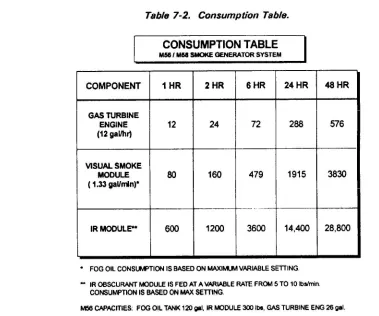
or different basic loads of fuel, parts, or other necessary supplies. Use the consumption tables mAp-pe~dix~ as awide
for preparingumt basic
loadS.
Fog Oil Resupply
Fog oil is a
packagedPOL
procfuct arrivingin
55-gallon drums.Support units
can bulKfog oil by
transferring the fog oil from the 55-gallon drums to fuel pods or tank and pump units. The fog oilused in
smoKeoperations comes through
the corps and division support areas. It may be delivered as far for-ward
as
the'brig?de support area by
the supporting "CSSumt. From here the smOKe unit's fuel supplyele-ments pick
u!' the fog OlL Based on thetype and auration
of the smokemisslOn,the fuel
sup'ply elementeither establishes a forward fuel
sup'ply
point or keeps stocks
uploaded
on
orgamc
vehicles.For
rear areamissionsthe smoke-fuel supply point may be supportedfrom
existingClass III or other
supply activities.
There are two methods for fog oil
resupply on-line resupply
and
off-line
resupply.
On-line resupply. Stationary
smoke points
are resupplied
online
during a smoke mission. This
re-quires
the fog oil and MOGAS
resupply squad to move to each
point as needed. The resupply
squad or section will move tank and pump units (TPUs) to the line,
drop the drums of fog oil at the smOKepoint, or pre-position drums at a follow-on smoke point. This in-creases the vulnerability of the
resupply ~quad or section and the smoke 'pomt.
Off-hne resupply. Mobile units are resupp'lied by rotafing individual sys-tems through a fuel resupply point
1 to 2 kilometers to the rear of the smoke line. You can also resupply stationary units that are displacmg in this manner.
Fire
Support
and
Security
Whenplanning for the use of
for the crewand are lessvulnerable
and FSO.Inte~ratethe smokeunit
smokein support of combatopera-
to indirectfirethan wheeledsmoke
fireplan withthe supportedunit
tions,it is essentialcommanders
systems.
fireplan. Firesupport planning
and operationalplannersrecognize
Lessonslearned at the NTCconsis-
must
consider-the vulnerability of smoke units. tently demonstrate that mechanized
.
Priorities of fire support.Smoke generator units conducting smoKe systems suffer high-loss rates
.
Availabilityof smoKeroundssmoke operations leave a very recog- when they are among tfie lead ele- (mortar and artillery).
nizable si~ature on the battIefield. ments of armored assaults. While
.
Named areas of mterest (NAI)Smoke by its very essence attracts improper emplo~ent at the NTC and target areas of interest (TAl)
attention. An observer only needs serves as a valuable training aid for of the maneuver unit.
to follow the smoke streamer to its commanders, the same mistake in
.
Coordinationwith
firesupportas-sourceto target the individual
combatwill result in the loss of a
sets for the primary,alternate,and
smoke-producing device. Smok~gen- significant and scarce combat multi- supplement~l smoKeoperations
erator operators and smoke umt pITer. areas or pomts.
commanders are acutely aware of Reconstitution of battlefield losses
.
On-carl targets (nominated by thethis and utilize every measure avail- will be slow. They may not occur at smoke unit).
able to reduce this si~ature. all based on the availability and
Some of these steps include - priority of distribution for such a
.
Making maximum use of natural limited asset. In a rapidly movingcover ana concealment. armor assault, the commander may
.
Using reverse slope positioning. wish to plan for additional smoke.
Using self-protecfingsmoke(for
support fromhis
indirectfireartil-example, smOKepots upwind of gen- lery using WP or HC smoke
projec-erator positions). tiles integrated into preparatory
.
Continuously moving mobile sys-fire.Thisfire placed on or in front
temswithindesignatedareasto min-
of the objectivemay accomplishthe
imizeeffectivetargeting.
desiredresultand not expose
.
Staggeringposifionsof generators.
mechanizedsystemsto unnecessary
.
Diggmg in or hardening. risk..
MaKing smoke from flanks andstand-off positions whenever pos-sibIe.
While the above actions will en-hance the smoke unit's survivability, proper employment by' the sup-ported umt is essential. As an ex-ample mechanized smoke systems provide some small-arms protection
Smoke support occurs in many types of terrain under different weather conditions. Operations may
occur in NBC-contammated areas.
Leaders b~lance miss~on requ~re-ments agamst protechon
reqmre-FM 3-50
Fire Support
Supporting smoke assets coor-dinate with the supported unit for fire support.
Fire support is based on artillery availability and the coordination that takes place among the smoke unit, chemical staff office,S3jG3,
Personnel
Sustainment
ments. They consider visibility con-straints and heavy work rates during smoke missions. Specifically, it is diI-ficult to see in smoke. It is more dif-ficult to see in smoke when in full individual protective equipment
Security
Plan for the security for smoke units based upon availabili~ of the supported umt's assets and
pnorities. When security forces are provided for smoke assets, coordination measures include
-.
Determining needed duration ofsecurity s~pport. . .
.
.Determmmg SlZeof secuntyele-ment.
.
Locating overwatch positions forsecurity elements.
.
Determining smoke and securityelement leaders understand the commander' s conc~pt,. fire support p'lan, and commumcahon proce-dures, and are aware of smoke tacti-cal resupply locations.
(IPE). Heat buildup becomes criti-cal to the welfare of the soldier. This is especially true when the operator of the M157 smoke
gener-ator set is "buttoned-up" inside the
M1059 mechanized smoke
ator
in full IPEin support of a
mechanized or armorea division. Smoke generator crews may be dif-ficult to replace in future conflicts. Therefore, you must focus on main-taining the available force at peak combat effectiveness.Leadersnip is the key to maintaining the strength and spirit of the fightmg force. Leaders must assemble, transport,
54
and distribute their units as the commander requires in his task or-ganization, yet conserve their fight-mg strengili. Leaders must give special consideration
to-.
Health services..
Administrative support..
Morale and welfare activities..
Discipline..
Stress management...
Replacement planning.. Limited visibil~ty has a signi~icant lffipact on sustamment operahons. It mcreases the time ana decreases sustainment responsiveness. Support and smoke un!ts should th9~ough~y rehearse sustamment actlVlhes pnor to execution of the plan.
FM 3-50, CI
Chapter 7
VISUAL-INFRARED
Today virtually every nation and non-state organization li.as access
to-.
advanced tactical sensors for target acquisition (thermal imagers) and intelligence gatheringsurveillance systems (ground and air reconnaissance).
.
precision-guided munitions delivered by artillery, missiles, ana aircraft that operate in the IR region of the electromagnetic spectrum.These capabilities are available through internal manufacturing or purchase on the world market. These thermal imaging sights allow them to acquire and engage targets througn visual smoke, at night, and unaer adverse weatner conditions. To counter the increasingly sophisticated sensor threat, the M56 and M58 smoke generator systems provide maneuver commanders the capability to control and dominate the visual through far infrared (IR) portions of the electromagnetic spectrum using visual (fog oil) and infrared (graphite) obscurants.
VISUAL-INFRARED
OBSCURANT
GENERATOR
SYSTEMS
, ...
,',7.7.7.7.7.7.7.7.7.7.7.7.7.7.7.7.7.;.;.;.;.;.;.:';'".;.;.;.;.;.;.;.;.;.;.;.;.;.;.','...
. . . .,. . . .
--."""""'"''''''
,... up '"'''' """,".;.;.;.;.;.;.;.;.;.;.;.;.;.;.;.;.;.;.;.'
Figure7-1. M56 Smoke Generator System.
OBSCURANTS
The M56 Smoke Generator System (Figure 7-1) mounted on an M1113 HMMWV is organic to motorized smoke units and dual-pu!'R°se
smoke/ decontamination units. The N156 can produce
90 minutes of visual/near infrared obscurant and 30
minutes of infrared obscurant without resupply. This system can produce obscurants while mobile or stationary.
The M58 Smoke Generator System (Figure 7-2) mounted on the M113A3 APe is orgamc to mechanized smoke units. The M58 can operate mobile or stationary. It can produce
90
minutes of visual/near infrared obscurant and 30 minutes ofFigure7-2. M58 Smoke Generator System.
infrared obscurant without resupply. Chassis improvements allow the M58 to Keep pace with mechanized and armor units. The systems are equipped with a driver's thermal imager and an NBC contamination particulate filter unit.
Each system can selectively produce visual obscurants (vaporlZed fog oil) to defeat acquisition in the visual, ana near infrared and infrared obscuration (graphite flakes) to defeat target acquisition devices that operate in the mid and far infrared. The two obscurants may be employed simultaneously or separately. If employed simultaneous y, the threat force's capability to acquire targets with day sights and thermal Imagers will De degraded. If employed separately, the visual obscurant will degrade aay sights and tne IR obscurant will degrade the thermal imagers.
OBSCURANT
EFFECTS
ON SENSORS/SEEKERS
Visualand infrared obscurants have distinctly
different effects on friendly and threat force sensors.
FM 3-50,
CI
Therefore, commanders and staffs must understand the opportunities and limitations associated with each. Employtpent of infrared obscurants is a double-edged sword. A maneuver commander may want the adcfed concealment offered by an infrared obscurant
(graphite), but must accept the fact it will also degrade his own systems. Commanders and staffs must identify the threat sensor/seeker systems to be countered, determine the obscurant to De employed, and identify impacts on their own systems. Table 7-1 depicts the types of sensors and seekers found on today's battIeIields and the relative degree of degradation caused by various natural end man-made obscurants.
VISUAL-INFRARED
OBSCURANT
CONCEPTS
Intelligence preparation of the battlefield (IPB) determines now the threat arrays sensors and seekers on the battlefield. After the IPB process has been accomplished, the chemical battre staff develops a
plan to integrate smoke and obscurant assets into the operational rlan. The goal of the obscurant plan is to defeat critical threat sensors and seekers. For example, the IPB process has determined that the threat possesses a si~ificant thermal imagery
capability located with his reconnaissance assets. The
smoke plan would likely focus on employing IR obscurants whenever and wherever tne threat might attempt to utilize his reconnaissance assets. The doctrine for IR obscurants is different from the doctrine for visual obscurants. IR obscurants provide the capability to defeat a significant threat
asset-thermal imagers. Visual obscurants are used primarily to provide force protection from a threat having lImited electro-optical capabilities such as first generation FUR or witli an even lesser capability such as systems that can only operate in tne visual region of the electromagnehc spectrum. Overall, IR obscurants will be employed directly on the threat or between the threat ana friendly forces. Visual obscurants are employed on fnendly forces to provide
Table 7-7. Sensors and Seekers.
Obscurant Effects
I
Fogoil,He TA.Tl02. phosphorus
Graphite Brass
Graphite
MMW Obscurant
Heavy Dust
Heavy Fog
DEGRADATION
Heavy Precipitation
-
MAJORIII
MODERATED
MINOR54-B
IMAGE DAY SIGHT
INTENSIFIER
THERMAl. IMAGERS
protection while still allowing for the ability to maneuver within the obscurant cloud.
Offense
Employment of an infrared obscurant in offensive operations gives the maneuver commander an
aaditional element of combat power.
IR
obscurantsare able to defeat threat sensors and seekers. Two missions should be considered. One is to utilize the IR obscurant as a screen to prevent thermal ground sensors from detecting and identifying friendly forces. Another is to utilize the IR obscurant to obscure threat sensors. In this mission, given favorable weather conditions, the smoke plainer would employ the IR obscurant directly on the threat sensors.
Defense
IR obscurants in the defense will provide protection from smart weapons and prevent those weapons from acquiring their targets. Although the employment of
IRobscurants reduces the friendly ability to
maneuver, the commander may choose this option to increase the survivability of his forces in the event that other resources are unavailable to defeat the threat's smart weapons. For example, IR obscurant would provide considerable protection from smart weapons for rear area operahons such as port facihties, logistical sites, and airfields.
Cloud
Dynamics
Infrared obscurants are subject to the same weather and terrain considerations as visual obscurants. For planning purposes, the IR obscurant cloud will travel approximately the same distances as a visual cloud ana will cover the same size target area. Visibility criteria in terms of haze, blanket, and curtain are not true for IR obscurants. Infrared clouds are defined in terms of transmittance value in relationship to percentage of probability of detection. Given wind speed, source strength, and downwind distance (Annex H), chemical staffs are able to estimate probability of friendly forces being detected when screened or protected by infrared obscurants.
Smoke
Control
Generally, smoke control is the function of the smoke platoon leader or the smoke company commander under the direction of the maneuver commander, a breach or river crossing site commander, or a facility commander. Smoke control procedures will be
FM 3-50,
CI
essentially the same for visual and infrared screens. However, at night, actual observation of the infrared cloud requires a thermal viewer. Without an IR sensor, smoke control officers will rely on the fog oil cloud to adjust target coverage or on information provided by the supported maneuver unit.
Coordination
Measures
Infrared obscurants offer additional options to the commander: visual only, IR only, or visual/IR obscurants. The chemical battle staff must assist the commander in recommending the appropriate type
obscurant based onIPB. Limiting factors may be
based on planned friendly activity, the need to prevent signaling a friendly presence to the threat force, or cfanger inherent to friendly operations that might result m increased fratricide.
Smoke
Control
Graphics
Smoke target numbering systems and graphic control techniques will be increasingly important as
commanders and staffs come to rely more heavily upon digitization. Battle staffs will maintain electromc overlays of planned smoke missions (similar to trafficability overlays) to allow for coordination of mission planning with adjacent and higher organizations. With the fielding of large-area infrared smokes, graphic control aids must be
developed to portray no smoke areas, visual only
smoke targets, visual-infrared smoke targets, and
infrared only targets. Target numbering procedures
should be standardized to enable adjacentunits to
recognize immediately smoke missions that may adversely affect their operations due to wind shifts, the cloua traveling farther than anticipated, or flank
units perhaps being
silhouetted. Although subjectto
local SOPs,visual only smoke target numbers should
begin
with a V followed by five
digits. IR only smoketarget numbers should begin with IR followed by four
digIts.Visual-infrared target numbers should begin
WIth VIR followed by three digits.
Troop
Safety
The same masking requirements and procedures for
fog oilemployment apply for infrared (graphite)
obscurants. Overall, carry the maskwhen
participating inoperations that include the use of
mfrared obscurants.
Mask
when passing through oroperating in a dense cloud. If duration of exposure
will exceed 4 hours or breathing difficulties occur,
masking is required.