An extended abstract of this paper appears in ICICS 2007, S. Qing, H. Imai, and G. Wang (Eds.), volume 4861 of LNCS, pp. 69-82, Sringer-Verlag, 2007.
Short Group Signature without Random Oracles
Xiaohui Liang Zhenfu Cao∗ Jun Shao Huang Lin
[email protected] [email protected] [email protected] [email protected]
Department of Computer Science and Engineering Shanghai Jiao Tong University
December 6, 2007
Abstract
We construct a short group signature which is proven secure without random oracles. By making certain reasonable assumptions and applying the technique of non-interactive proof system, we prove that our scheme is full anonymity and full traceability. Compared with other related works, such as BW06 [9], BW07 [10], ours is more practical due to the short size of both public key and group signature.
Keywords: Group signature, standard model, short signature, non-interactive proof system
1
Introduction
Group signature is a useful cryptographical tool, which is widely discussed in the literature and also has many potential applications, such as network meeting, online business, and software trading. The similar requirement of these applications is to allow a member to sign a message on behalf of the group, and still remain anonymous within the group. Group signature schemes meet this requirement by providing anonymity and traceability at the same time, that is, a group signature can be related with its signer’s identity only by a party who possesses an open authority. In such environment, there exists a group manager to distribute certificates, open authority and other group settings. If one group member generates a group signature, anyone can only verify the signature by using group public parameters. When some dissention happens, an opener finds out the real signer’s identity. In this way, group members could protect their privacy.
In 1991, Chaum and van Heyst [13] firstly proposed group signature. Then, many papers on this subject proposed various of approaches to give a secure and practical group signature scheme. There exist a lot of practical schemes secure in the random oracle model [2,7,19,20,21]. However, Canetti, Goldreich and Halevi [11,12,14] have shown that security in the random oracle model does not imply the security in the real world in that a signature scheme can be secure in the random oracle model and yet be broken without violating any particular intractability assumption, and without breaking the underlying hash functions.
Therefore, to design a secure group signature scheme in the standard model becomes an open and interesting research problem. Bellare et. al. introduced security definitions for group signatures and proposed a scheme based on trapdoor permutation in [6]. Furthermore, Bellare et. [8] strengthened the security model to include dynamic enrollment of members. After that, Groth [15] also gave a group signature scheme based on bilinear groups which is proven CCA secure in the standard model under the decisional-linear assumption. Their scheme was constructed in the BSZ-model [8], but still the size of group signature is enormous.
Ateniese, Camenisch, Hohenberger and de Medeiros [1] designed a practical group signature with high efficiency which is also secure in the standard model. The drawback of their scheme was that if the user’s private key is exposed, it can be used to trace the identity of the user’s past signatures. Unfortunately, this is not according with BSZ-models, and needs to be prevented.
Boyen and Waters [9] suggested group signature schemes that are secure in a restricted version of the BMW-model [6], where the anonymity of the members relies on the adversary can not make any query on the tracing of group signature. The size of both public parameter and group signature are both logarithm of identity and message. Afterwards, they [10] proposed a group signature scheme the signature of which is of constant size (only 6 group elements). However, the size of public parameter is still logarithm of identity. Groth also presented a group signature scheme [16] based on non-interactive witness indistinguishable proof of knowledge and other existing tools, which enhances the security notion of BW [9, 10]. We will compare our scheme with theirs in Section 7, specifically.
Our Contribution
We propose a new group signature scheme secure in the standard model. We use short signature [3] and non-interactive proof system [17] as the foundation to construct ours. Then we prove our scheme is secure in a restricted BMW-model. Furthermore, the sizes of both public parameter and group signature are reduced to two constants, and are shorter than that of both schemes in [10, 16]. To the best of our knowledge, our group signature is the shortest one secure in the standard model. Besides, the overall computational cost of our scheme is low. Therefore, our scheme is more practical compared with the others.
Roadmap
The rest of this paper is arranged as follows. In next section, we provide the preliminaries of our scheme including bilinear groups of composite order and complexity assumptions. In Section 3, we describe the formal models of group signature scheme. Then we propose the two-level signature and group signature schemes in Section 4 & 5, respectively. We give the details of security proofs in Section 6. Finally, we draw comparisons between ours and other related works in Section 7 and summarize our paper in Section 8.
2
Preliminaries
2.1 Bilinear Groups of Composite Order
Recently, a lot of cryptographical schemes are based on bilinear groups of composite order. We briefly review some notions about it from other related works [5,18,17,9,10].
Consider two finite cyclic groups G and GT having the same order n, wheren =pq, p, q are large primes
andp6=q. It is clear that the respective group operation is efficiently computable. Assume that there exists an efficiently computable mappinge:G×G→GT, called a bilinear map or pairing, with the following properties.
• Bilinear: For anyg, h∈G, anda, b∈Zn, we havee(ga, hb) =e(g, h)ab, where the product in the exponent
is defined modulon.
• Non-degenerate: ∃ g ∈ G such that e(g, g) has order n in GT. In other words, e(g, g) is a generator of
GT, whereas g generates G.
• Computable: There is an efficient algorithm to computee(g, h) for allg, h∈G.
2.2 Complexity Assumptions
Subgroup Decision Problem. The subgroup decision problem inGof composite ordern=pq is defined as follows: given a tuple (n, G, GT, e) and an element h selected at random either from G or from Gq as input,
output 1 ifh∈Gq; else output 0.
Definition 1 We say that the subgroup decision assumption holds for generator GBGN if any non-uniform
polynomial time adversary A we have
Pr[(p, q, G, GT, e, g)← GBGN(1k);n=pq;r←Z∗n;h=gr :A(n, G, GT, e, g, h) = 1]
= Pr[(p, q, G, GT, e, g)← GBGN(1k);n=pq;r←Z∗n;h=gpr :A(n, G, GT, e, g, h) = 1]
l-Strong Diffie-Hellman Problem. [3] Thel-SDH problem inGis defined as follows: given a (l+ 1)-tuple (g, gx, g(x2), ..., g(xl)) as input, output a pair (c, gx+1c) wherec∈Z∗
p. An algorithmAhas advantage²in solving
l-SDH in Gif
Pr[A(g, gx, g(x2), ..., g(xl)) = (c, gx+1c)]≥²
Definition 2 We say that the(l, t, ²)-SDH assumption holds inGif not-time algorithm has advantage at least
²in solving the l-SDH problem in G.
Now, we give some new assumptions and observe the relationship between them.
l-One More Strong Diffie-Hellman Problem. (l-OMSDH)Thel-one more strong Diffie-Hellman problem in the prime-order bilinear group G is defined as follows: on input two generators g, gx ∈ G, and l distinct tuples (ci, g
1
x+ci), where c
i ∈ Zn, i ∈ {1,2, ..., l}, outputs another tuple (c, g
1
x+c) distinct of all the others. An algorithmA has advantage²in solving l-OMSDH inG if
Pr[A(g, gx, c1, g 1 x+c1, c
2, g 1 x+c2, ..., c
l, g
1
x+cl) = (c, gx+1c)]≥², where c6=ci,fori= 1,2, ..., l
Definition 3 We say that the (l, t, ²)-OMSDHassumption holds inG if no t-time algorithm has advantage at least ² in solving thel-OMSDH problem in G.
l-Modified One More Strong Diffie-Hellman Problem. (l-MOMSDH)Thel-modified one more strong Diffie-Hellman problem in the prime-order bilinear group G is defined as follows: on input three genera-tors g, gx, u ∈ G, and l distinct tuples (ci, g
1
x+ci), where c
i ∈ Zn, i ∈ {1,2, ..., l}, outputs another tuple
(gc, gx1+c, u 1
c+m, m) where c /∈ {c
1, ..., ci} and m ∈R Z. An algorithm A has advantage ² in solving l-SDH
inGif
Pr[A(g, gx, u, c1, g 1 x+c1, c
2, g 1 x+c2, ..., c
l, g
1
x+cl) = (gc, gx+1c, u 1
c+m, m)]≥², where c6=ci,fori= 1,2, ..., l
Definition 4 We say that the (l, t, ²)-MOMSDH assumption holds in G if not-time algorithm has advantage at least ²in solving the l-MOMSDHproblem in G.
3
Formal Models of Group Signatures
In this section, we introduce some basic models and security issues which have been defined in the papers [9,10]. A group signature scheme consists of the following algorithms: Setup,Join,Sign,Verifyand Trace. 1. Setup: Taking as input the system security parameterλ, this algorithm outputs group’s public parameter PP for verifying signatures, a master key MK for enrolling group members, and a tracing key TK for identifying signers.
2. Join: Taking as input the master key MK and an identity id, and outputs a unique identifier sid and a
private signing keyKid which is to be given to the user. That is: Kid←Join(PP,MK, id).
3. Sign: Taking as input a user’s private keyKidand a messageM, and outputs a group signatureσ. That
isσ ←Sign(PP, Kid, M).
4. Verify: Taking as input a messageM, a signature σ, and the group’s public parameter PP, and outputs valid or invalid. That is ”Valid” or ”Invalid”←Verify(PP, σ, M).
5. Trace: Taking as input a group signatureσ, and a tracing keyTK, and outputs an identitysidor⊥. That
issid or⊥ ←Trace(PP, σ,TK)
Consistency. We require that the following equations hold.
Verify(PP,Sign(PP, Kid, M), M) = Valid
Trace(PP,Sign(PP, Kid, M),TK) =sid
Security.
Bellare, Micciancio, and Warinschi [6] presented the fundamental properties of group signatures, which are considered to be restrictions in the following designs. The most two important properties are:
Full Anonymity which requires that no PPT adversary is able to find the identity of a group signature. The game could be described as follows: the adversaryAcould firstly query some private keys and some valid signatures from the simulatorB, thenAoutputsid1, id2, mand sends them toB. Brandomly chooseb∈ {0,1} and generate σb corresponding with (idb, m). If A has negligible advantage to guess the correct b, our group
signature scheme is full anonymity (CPA). We notice that if we give the trace oracle to the adversary, the full anonymity is enhanced, which is similar with the CCA-secure notion. In this paper, we follow [10] and use non-interactive proof system to design a simple group signature in the CPA-full anonymity notion.
Full Traceability which requires that no forged signatures, even if there exists a coalition of users. The game could be described as follows: the adversary Ais given group public parameters PP and the tracing key TK. Then A could query some private keys and some valid signatures from the simulator B. The validity of signature and identity tracing could be checked byA. At some point, Aoutputs a forged group signature σ∗
with its tracing identity id∗ and message m∗. The restrictions are that the private key of id∗ and (id∗, m∗) should not be queried before. IfAhas only negligible advantage to forge a valid signature, our group signature scheme is full traceability.
4
Hierarchical Signatures
We build a hierarchical signature scheme based on the short signature proposed by BB04 [3]. To implement a group signature scheme, we construct a short two-level hierarchical signature with existential unforgeability against chosen message attacks based on l-MOMSDH assumption. The first level can be seen as a certificate that signed by the group manager, while the second level is a short signature on messagem.
4.1 Two-level Signature Scheme
Letλbe the security parameter. Suppose the user’s identityidand the messageM are chosen from{0,1}λ. We build a groupG with order n=pq and record g, uas two generators of Gp, where Gp is a subgroup ofG
with orderp. There exists a bilinear map efromG×G toGT.
Setup(1λ): It firstly generates the master key MK = z ∈ Zp and calculates the public parameter PP =
{g, Z =gz, u} ∈G3p. Moreover, it generates the public collision-resistant hash functionH :{0,1}λ →Zp. Extract(PP,MK, id): To create a private key for an user, it chooses a secret value sid∈Zp and return:
Kid = (K1, K2) = (sid, g
1
z+sid)∈Z
p×Gp
Note that the value z+sid must lie inZ∗p
Sign(PP, Kid, M): To sign a messageM ∈ {0,1}λ, the algorithm generates and outputs:
σ = (σ1, σ2, σ3) = (gsid, g 1 z+sid, u
1 sid+H(M)) Note that the probability of sid+H(M)≡0 (mod p) is negligible.
Verify(PP, M, σ): To verify whether the signature σ is valid for a messageM, the algorithm checks:
e(Zσ1, σ2) ?
=e(g, g)
e(gH(M)σ1, σ3) ?
=e(g, u)
If the above two equations hold, the verifier outputs valid; else outputs invalid.
Notice that this signature scheme doesn’t reveal the user’s identity, the private key generator could record the mapping fromidtosid. However, the signatures signed by one user can be easily linked with invariant values
σ1, σ2. We modified two-level hierarchical signature scheme to group signature which achieves unlinkability and anonymity by using non-interactive proof system mentioned in G07 [16].
4.2 Existential Unforgeability
The two-level signature scheme proposed above is existential unforgeable against chosen message attacks. We review the short group signature in BB04, and prove the security issues based on the hardness of q-SDH and l-MOMSDH problems.
Theorem 1 Our two-level signature scheme is (t, qe, qs, ²)-secure against existential forgery under a chosen
message attack provided that (t0, q, ²qSDH)-SDH assumption and (t00, l, ²M OM SDH)-MOMSDH assumption hold
in Gp, where
5
Proposed Group Signature
We now present the group signature scheme in details. 5.1 Schemes
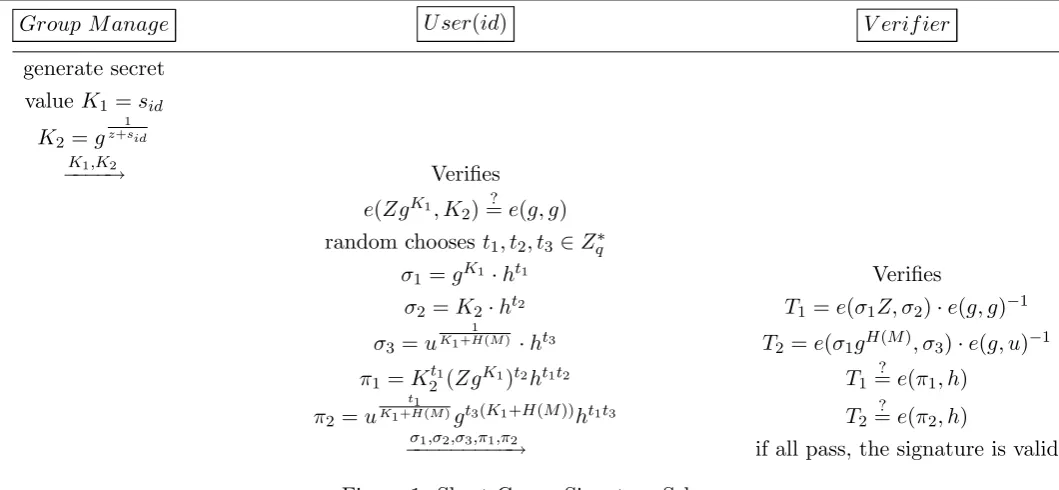
The group signature scheme is described as the following algorithms. Figure 1. presents the scheme executed by three parties: group manager, user and verifier.
Setup(1λ): The input is a security parameter 1λ. Suppose the maximum group members 2kand the signing
message in{0,1}m, where k=O(λ), m=O(λ). It firstly chooses n=pq where p, q are random primes of bit sizedlog2pe,dlog2qe= Θ(λ)> k. We builds a cyclic bilinear groupGand its subgroupGp and Gqof respective
order p and q. Denote g, u a generator of G and h a generator of Gq. Next, The algorithm picks a random
exponents z ∈Z∗n, and defines Z =gz ∈G. Additionally, a public collision-resistant hash function H is from {0,1}m toZn.
The public parameters consist,
PP= (g, h, Z, u)∈G×Gq×G×G
The master key MK and the tracing keyTKare
MK=z∈Z∗n,TK=q ∈Z
Join(PP,MK, id): The input is a user’s identity id. The algorithm assigns a secret unique value sid∈Zn for
tracing purpose. Then the secret key is constructed as:
Kid = (K1, K2) = (sid, g
1 z+sid) The user may verify that the key is well formed by checking
e(ZgK1, K2)=? e(g, g)
Sign(PP, id, Kid, M): To sign a message M ∈ {0,1}m, a user parses Kid = (K1, K2) and computes a two-level signature:
ρ= (ρ1, ρ2, ρ3) = (gK1, K2, u 1 K1+H(M))
Notice that, ρdoes not satisfy the anonymity and unlinkability to anyone, sinceρ1, ρ2 are unchangeable for each signature. So, by adopting the same approaches from BW07 [10] and G07 [16], we let the signer choose
t1, t2, t3 ∈Zn and compute:
σ1 =ρ1·ht1, σ2 =ρ2·ht2, σ3 =ρ3·ht3 Additionally, it computes a proof:
π1 =ρt21(Zρ1)t2ht1t2, π2 =ρt31(gH(M)ρ1)t3ht1t3 The output signature is:
σ = (σ1, σ2, σ3, π1, π2)∈G5
Verify(PP, M,σ): To check the validity of signature σ, the verifier calculates:
Then verifies:
T1 ?
=e(π1, h), T2 ?
=e(π2, h)
If the above equations hold, the verifier outputs valid; else outputs invalid.
Trace(PP,TK, σ): Letσ be a valid signature, the opener parses it and finds the elementσ1. Then, to trace the identity of signer, it calculatesσ1q and tests:
(σ1)q = (gsid·ht1)q= (? gsid)q
Since all the (gsid)q can be pre-calculated firstly and recorded in a list by opener, the time to find the identityid is linearly dependent on the number of initial users.
Group M anage U ser(id) V erif ier
generate secret value K1=sid
K2 =g 1 z+sid
K1,K2
−−−−→ Verifies
e(ZgK1, K 2)
?
=e(g, g) random choosest1, t2, t3∈Zq∗
σ1 =gK1 ·ht1 Verifies
σ2=K2·ht2 T1=e(σ1Z, σ2)·e(g, g)−1
σ3=u 1
K1+H(M) ·ht3 T
2 =e(σ1gH(M), σ3)·e(g, u)−1
π1 =K2t1(ZgK1)t2ht1t2 T1 ?
=e(π1, h)
π2=u t1
K1+H(M)gt3(K1+H(M))ht1t3 T
2 =? e(π2, h)
σ1,σ2,σ3,π1,π2
−−−−−−−−−→ if all pass, the signature is valid Figure 1: Short Group Signature Scheme
6
Security Analysis
We now analyze the security of our group signature scheme. 6.1 Full Anonymity
Since our scheme adopts the same approach from BW06 [9] and BW07 [10], we only prove the security of our group signature scheme in the anonymity game against chosen plaintext attacks. The proof sketch borrows from G07 [16]. That is, if h is chosen from G, we achieve perfect hiding property. Meanwhile, if h is chosen from Gq, we achieve perfect biding property. However, the adversary A can not distinguish these two
different environment, since subgroup decision problem is unsolvable in polynomial time. Therefore, we give the following theorem.
To prove the above theorem, the two lemmas are necessary.
Lemma 1 For all t0-time adversariesA, the probability to distinguish the true environment and the simulated environment is negligible. That is AdvA−AdvA,S <2²sub
Proof. Suppose there is a simulatorBtrying to solve subgroup problem. Upon receiving a tuple (e, G, GT, n, h),
he wants to find out whetherh∈Gq or not. Firstly, he setups the group signature scheme by choosing the
pub-lic parameters exactly as in the group signature scheme. ThenB publishes them to the adversaryA. Whether
h is chosen from Gq or not, B can always answer all queries, since it knows the master key. If h ∈R Gq, then
the simulated environment is identical to the actual one.
At some point, the adversary A chooses a message M and two identities id and id0. The constraints are the secret keys ofid andid0, and (M, id),(M, id0) should not be queried before. Then,B outputs the challenge signature with (M, id∗), whereid∗∈ {id, id0}. After that,A outputs its guess. If it is correct,B outputs 1; else outputs 0. Denote byAdvB the advantage of the simulator B in the subgroup decision game. Assume that
Pr[h∈G] = Pr[h∈Gq] =
1 2 we obtain that,
AdvA−AdvA,S = P r[b= 1|h∈Gq]−P r[b= 1|h∈G]
= 2P r[b= 1, h∈Gq]−2P r[b= 1, h∈G]
= 2AdvB < 2²sub
Thus, under our subgroup decision assumption in Section 2.2, the probability to distinguish the actual
environment and the simulated one is negligible. ¥
Lemma 2 For any adversary A, we haveAdvA,S = 0
Proof. The proof sketch is similar to that of BW07 [10] and G07 [16]. We prove that when h is chosen uniformly from G at random, instead of Gq, the adversary A can not sense the identity from the challenge
signature. Although the tracing value sid may have been used to answer previous signing queries on (id, M)
and (id0, M), the challenge signature is statistically independent of the real identity. To proceed, we write the challenge ciphertext is σ = (σ1, σ2, σ3, π1, π2).
Since the signatureσ1, σ2, σ3 is blinded with random numbert1, t2, t3 ∈G, respectively, they reveal nothing about the identity. Then, we give two signatures: σ with (id, M) and σ0 with (id0, M) and analyze two tuples
π= (π1, π2),π0 = (π10, π02).
If σ1 =σ10, σ2 =σ20, and σ3 =σ03, we show thatπ and π0 do not reveal the identity either.
gsidht1 = gsid0ht01
g
1
z+sidht2 = g 1 z+s
id0ht02
u
1
sid+H(M)ht3 = u 1 sid0+H(M)ht03
Supposeh=gη, h=uξ, ε= z+sid
z+sid0, τ =
sid+H(M)
sid0+H(M), we obtain that
t01 = t1+ sid−ηsid0
t20 = t2+ 1η(z+1sid − z+1s
id0) =t2+ 1−ε η(z+sid)
t03 = t3+ 1ξ(s 1 id+H(M)−
1
sid0+H(M)) =t3+
Now, we need to show that π1, π2 do not reveal any information about the user’s identity. From the adversary’s point of view, we see that π1, π2, π10, π20 satisfy,
π10 = g
t01 z+s
id0g(z+sid0)t02ht01t02
loggπ01 =
t1+sid− s
id0 η
z+sid0 + (z+sid0)(t2+ 1−ε
η(z+sid)) +η(t1+
sid−sid0
η )(t2+
1−ε η(z+sid)) = t1
z+sid0 +
sid−sid0
η(z+sid0)+zt2+sid0t2+
(1−ε)(z+sid0)
η(z+sid) +ηt1t2+sidt2−sid0t2+
t1(1−ε)
z+sid +
(1−ε)(sid−sid0)
η(z+sid) = t1
z+sid + (z+sid)t2+ηt1t2
π10 = g
t1
z+sid+(z+sid)t2+ηt1t2
= g
t1
z+sidg(z+sid)t2ht1t2 = π1
π20 = u
t01
sid0+H(M)g(sid0+H(M))t03ht01t03
loggπ02 = (
t1+sid− sid0 η
sid0+H(M))·
η
ξ + (sid0 +H(M))(t3+
1−τ ξ(sid+H(M))) +η(t1+sid−ηsid0)(t3+ξ(sid+1−Hτ(M)))
= t1
sid0+H(M) ·
η ξ +
sid−sid0
ξ(sid0+H(M))+H(M)t3+sid0t3+
(1−τ)(sid0+H(M))
ξ(sid+H(M)) +ηt1t3+sidt3−sid0t3+sid+t1(1H−(τM)) ·ηξ +(1ξ−(sτid+)(sHid−(Msid))0)
= t1
sid+H(M) ·
η
ξ + (sid+H(M))t3+ηt1t3
π20 = g
t1 sid+H(M)·
η
ξ+(sid+H(M))t3+ηt1t3
= u
t1
sid+H(M)g(sid+H(M))t3ht1t3 = π2
Therefore, π1, π2 is identical to π10, π20. The challenge signature σ does not reveal the identity id, though the simulator uses sid to generate it. Hence, we claim that the adversary A in the anonymity game under the
simulated environment has negligible advantage to guess the correct identity. ¥ 6.2 Full Traceability
We prove that our group signature is existential unforgeability based on the security of two-level signature scheme proposed in Section 4.1.
Theorem 3 If there exists a (t, ²) adversary for the full traceability game against the group signature scheme, then there exists a (t0, ²) chosen message existential unforgeability adversary against the two-level signature scheme, where t≈t0.
Proof. We note that our group signature scheme is an extension form of our two-level signature scheme by adding some random number on the signing and verifying equations. Intuitively, we prove that our group signature is secure against chosen message attack by using two-level signature’s unforgeability.
Suppose there exists a simulator B, who interacts with the adversary A and wants to break two-level signature scheme. Then,B executes the following algorithms and plays a game with A.
In Setup algorithm, B runs two-level signature Setup, generates public parameters and publishes them. Furthermore,B deliveriesTK=q toA, and A is entitled the authority to tracing authority.
A queries a secret key on id toB. To answer this request, B queries the key extraction oracle of two-level signature scheme and obtains the user’s secret keyKid. Then B sends Kid toA.
A queries a signature on (id, M) toB. B directly queries the signing oracle of two-level signature scheme and obtainsσ= (σ?
group signature,
σ= (σ1?·ht1, σ?
2 ·ht2, σ?3·ht3,(σ2?)t1(Zσ?1)t2ht1t2,(σ3?)t1(gH(M)σ1?)t3ht1t3) (1) We could see that this is a valid group signature. After receiving the responding signature. A could check its validity by usingPP and trace its identity by usingTK=q. These verification equations are correct.
At some point, A outputs its forgery signature σ∗ = (σ∗1, σ2∗, σ3∗, π∗1, π2∗) with (id∗, M∗). According to the game’s constraints, id∗ should be excluded from key extraction queries and (id∗, M∗) should not be queried from signing oracle before.
Then,Bgeneratesλwhich satisfiesλ≡1 (modp) andλ≡0 (modq). Then, fromπ1∗, π∗2 and the verification equations, we obtain:
e(σ∗1Z, σ∗2)·e(g, g)−1 = e(π1∗, h)
e(σ1∗gH(M∗), σ3∗)e(g, g)−1 = e(π2∗, h) And we useλto obtain:
e(σ1∗λZ, σ2∗λ) = e(g, g)
e(σ∗1λgH(M∗), σ3∗λ) = e(g, g)
Since (σ1∗λ, σ∗2λ, σ3∗λ) pass the verification equations of two-level signature scheme in Section 4.1, they are a forged two-level signature, which meansBsuccessfully breaks the unforgeability of two-level signature scheme. Thus, Theorem 3 has been proved.
¥
By combining with Theorem 2 and Theorem 3, we prove our scheme to have full anonymity and full traceability in the standard model.
7
Comparison
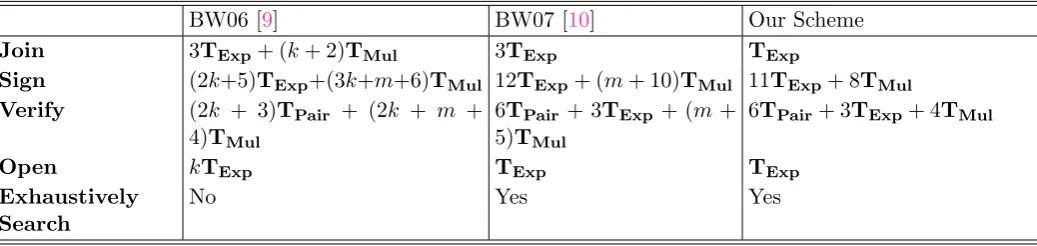
In this section, we compare our group signature with others. Boyen and Waters [9] proposed a nice group signature based on the Waters’s identity-based signature [22]. However, the hierachical identity-based signature in that scheme leads logarithmic size of both group public key and group signature. Then, Boyen and Waters [10] improved the signature to be constant size. Furthermore, we propose a new group signature to achieve constant size of both public key and signature. We could see the details in table 1. (M ∈ {0,1}m,id∈ {0,1}k):
Table 1: Comparisons on size in Group Signatures
BW06 [9] BW07 [10] Our Scheme
Public Key (k+m+ 3)|G| (m+ 4)|G| 3|G|+|Gq|
+|Gq|+|GT| +|Gq|+|GT|
Master Key |G| |G|+|Zn| |Zn|
User Key 3|G| 3|G| |G|+|Zn|
Signature (2k+ 3)|G| 6|G| 5|G|
Table 2: Comparisons on computational cost in Group Signatures
BW06 [9] BW07 [10] Our Scheme
Join 3TExp+ (k+ 2)TMul 3TExp TExp
Sign (2k+5)TExp+(3k+m+6)TMul 12TExp+ (m+ 10)TMul 11TExp+ 8TMul
Verify (2k + 3)TPair + (2k + m + 4)TMul
6TPair + 3TExp + (m + 5)TMul
6TPair+ 3TExp+ 4TMul
Open kTExp TExp TExp
Exhaustively Search
No Yes Yes
Recently, Groth [16] proposed a group signature scheme with full anonymity (CCA) in the standard model. His scheme adopts the existing tools, including certisignature scheme, strong one-time signature scheme, non-interactive proofs system for bilinear groups, selective-tag weakly CCA-secure encryption, but it increases the size and computational cost. The total size of a group signature is 50 group elements in G. In case full anonymity (CPA) is sufficient, the signature is reduced to 30 group elements. Thus, taking efficiency into consideration, our scheme is better.
8
Conclusion
In this paper, we proposed a practical group signature scheme, which has shorter sizes of both public key and signature than that of the other existing schemes. Since we adopted the approach of short signature proposed by BB04 [3] and non-interactive proof system [17], we proved the security of ours without random oracles, including full anonymity and full traceability. Furthermore, our scheme reduces the computational cost on both user and verifier sides. In the future work, we should improve ours on the full anonymity security in the CCA notion without random oracles and develop other practical group signature schemes based on weaker assumptions.
References
[1] Giuseppe Ateniese, Jan Camenisch, Susan Hohenberger, and Breno de Medeiros. Practical group signatures without random oracles. Cryptology ePrint Archieve, Report 2005/385, 2005. http://eprint.iacr.org/. 1
[2] Giuseppe Ateniese, Jan Camenisch, Marc Joye, and Gene Tsudik. A practical and provably secure coalition-resistant group signature scheme. In Proceedings of CRYPTO 2000, volume 1880 of LNCS, pages 255-270. Springer-Verlag, 2000. 1
[3] Dan Boneh and Xavier Boyen. Short Signatures Without Random Oracles. In Proceedings of EURO-CRYPT 2004, volume 3027 ofLNCS, pages 56-73. Springer-Verlag, 2004. 1,2.2,4,8,8
[4] Matt Blaze, Gerrit Bleumer, and Martin Strauss. Divertible protocols and atomic proxy cryptography. In EUROCRYPT 1998, volume 1403 ofLNCS, pages 127-144. Springer-Verlag, 1998.
[6] Mihir Bellare, Daniele Micciancio, and Bogdan Warinschi. Foundations of group signatures: Formal definitions, simplified requirements, and a construction based on general assumptions. In Proceedings of EUROCRYPT 2003, volume 2656 ofLNCS, pages 614-629. Springer-Verlag, 2003. 1,3
[7] Dan Boneh and Hovav Shacham. Group signatures with verifier-local revocation. In Proceedings ofACM CCS 2004, pages 168-177. ACM Press, 2004. 1
[8] Mihir Bellare, Haixia Shi and Chong Zhang. Foundations of group signatures: The case of dynamic groups. In Proceedings ofCT-RSA 2005, volume 3376 of LNCS, pages 136-153. Springer-Verlag, 2005. 1
[9] Xavier Boyen and Brent Waters. Compact Group Signatures Without Random Oracles. In Proceedings of EUROCRYPT 2006, volume 4004 of LNCS, pages 427-444. Springer-Verlag, 2006. (document), 1, 2.1,3,6.1,7,1,2
[10] Xavier Boyen and Brent Waters. Full-Domain Subgroup Hiding and Constant-Size Group Signatures. In Proceedings of PKC 2007, volume 4450 ofLNCS, pages 1-15. Springer-Verlag, 2007. (document),1, 2.1,3,3,5.1,6.1,6.1,7,1,2
[11] Ran Canetti, Oded Goldreich, and Shai Halevi. The random oracle methodology, revisited. In Proceed-ings ofSTOC 1998, pages 209-218, 1998. 1
[12] Ran Canetti, Oded Goldreich, and Shai Halevi. On the random-oracle methodology as applied to length-restricted signature schemes. In Proceedings ofTCC 2004, volume 2951 ofLNCS, , pages 40-57. Springer-Verlag, 2004. 1
[13] David Chaum and Eug`ene van Heyst. Group signatures. In proceedings ofEUROCRYPT 1991, volume 547 of LNCS, pages 257-265. Springer-Verlag, 1991. 1
[14] Jun Furukawa and Hideki Imai. An efficient group signature scheme from bilinear maps. In Proceedings of ACISP 2005, volume 3574 ofLNCS, pages 455-467. Springer-Verlag, 2005. 1
[15] Jens Groth. Simulation-sound nizk proofs for a practical language and constant size group signatures. In Proceedings of ASIACRYPT 2006, volume 4284 ofLNCS, pages 444-459. Springer-Verlag, 2006. 1 [16] Jens Groth. Fully Anonymous Group Signatures without Random Oracles. Cryptology ePrint Archieve,
Report 2007/186, 2004. http://eprint.iacr.org/. 1,4.1,5.1,6.1,6.1,7
[17] Jens Groth and Amit Sahai. Efficient Non-interactive Proof Systems for Bilinear Groups. Cryptology ePrint Archieve, Report 2007/155, 2005. http://eprint.iacr.org/. 1,2.1,2.2,8
[18] Jens Groth, Rafail Ostrovsky, and Amit Sahai. New Techniques for Non-interactive Zero-Knowledge. In Proceedings of CRYPTO 2006, volume 4117 ofLNCS, pages 97-111. Springer-Verlag, 2006. 2.1,2.2 [19] Aggelos Kiayias and Moti Yung. Extracting group signatures from traitor tracing schemes. In
Proceed-ings ofEUROCRYPT 2003, volume 2656 of LNCS, pages 630-648. Springer-Verlag, 2003. 1
[20] Aggelos Kiayias and Moti Yung. Group signatures: Provable security, efficient constructions and anonymity from trapdoor-holders. Cryptology ePrint Archieve, Report 2004/076, 2004. http://eprint.iacr.org/. 1
[22] Brent Waters. Efficient Identity-Based Encryption Without Random Oracles. In Proceedings of EURO-CRYPT 2005, volume 3494 ofLNCS, pages 114-127. Springer-Verlag, 2005. 7
[23] Masayuki Abe and Serge Fehr. Perfect NIZK with Adaptive Soundness. In TCC 2007, volume 4392 of LNCS, pages 118-136. Springer-Verlag, 2007. 8
Appendix A
Proof of Theorem 1.
AssumeAis a forger that (t, qe, qs, ²)-breaks the two-level signature scheme. We construct an algorithmBthat
breaks one of the assumptions mentioned above.
The inputs of B are two instances of the (qs+ 1)-SDH problem and (qe+qs)-MOMSDH problem which
include (g, gα, ..., gαqs+1) and (g, u, gx, sj, g
1
x+sj) forj = 1,2, ..., q
e+qs.
Before any oracle queries, B randomly sets sb = 0 or sb = 1 by coin tossing. A outputs a list of distinct
qs−1 messages m1, ..., mqs−1. • Setup:
– If sb = 0, B tries to solve (qs+ 1)-SDH problem. B randomly chooses a secret key z, k ∈ Zp. By
adopting the same simulating approach from [3], B can generate ¯g,g¯α,g¯α+1z,g¯ 1
α+m1, ...,¯g 1
α+mqs. The public parameter is PP= (¯g, Z= ¯gz,u¯= ¯gk).
– Ifsb= 1, Btries to solve (qe+qs)-MOMSDH problem. The public parameter is PP= (g, Z =gx, u)
• Extractoracle:
– sb = 0: B randomly selects a targetID?. To answer a key extraction query onID,
∗ ifID=ID?,B aborts;
∗ ifID6=ID?,Brandomly selectssID ∈Zpand records (ID, sID) into a listL0. Then, it outputs
(sID,¯g
1 z+sID).
– sb = 1: To answer a key extraction query onID,Brandomly chooses and outputs a tuple (sj, g
1 x+sj) from the instance of (qe+qs)-MOMSDH problem. Then he records (ID, sj) into a listL1.
• Sign oracle:
– sb = 0: To answer a sign query onID, mi, where i∈ {1,2, ..., qs−1},
∗ ifID=ID?,B outputs (¯gα,¯gz+1α,g¯ k
α+mi,(¯gα)k).
∗ ifID6=ID?,Blooks up (ID, sID) from L0, if not exists,B generates a distinct valuesID∈Zp
and adds (ID, sID) into list L0. Then, it outputs the signature (¯gsID,¯g
1 z+sID,¯g
1
sID+mi,g¯ksID).
– sb = 1: To answer a sign query on (ID, m), B looks up (ID, sj) from L1, if not exists, B chooses a distinct value sj from the instance and adds (ID, sj) into listL1. Then, it outputs the signature (gsj, g
1 x+sj, u
1 sj+m).
At some point, letσ∗= (σ1∗, σ2∗, σ3∗) with (ID∗, M∗) be a forgery produced byA. ID∗ should not be queried to the key extraction oracle and (ID∗, M∗) should not be queried to the sign oracle. Then, we distinguish between two cases which are ID∗ have been queried with other messages m except M∗ to the sign oracle or not.
• Case 1: A(A1) has already queried some two-level signatures on targetID∗. If sb = 0,
The forgery should satisfies the verification equations:
e(Zσ1∗, σ2∗) =e(¯g,¯g) and e(¯gH(M)σ1∗, σ3∗) =e(¯g,u¯)
We writes∗ = logg¯σ1∗ and obtain σ2∗= ¯gz+1s∗, σ∗ 3 = ¯g
1 s∗+H(M).
If ID∗ = ID?, (H(M∗), σ3∗) is B’s solution of (qs+ 1)-SDH problem. We note that the probability of
Pr[ID∗ =ID?] = 1/qs
Thus, we conclude:
Pr[solving P(qs+1)−SDH|A1 =succ] = 1
qs
Pr[P(qs+1)−SDH]≥Pr[P(qs+1)−SDH,A1=succ] = Pr[A1=succ]Pr[P(qs+1)−SDH|A1 =succ] =
1
qs
Pr[A1 =succ]
AdvA1 ≤qs²(qs+1)−SDH
• Case 2: A(A2) has not queried any signature related with targetID∗. Ifsb = 1,
The forgery should satisfies the verification equations:
e(Zσ1∗, σ2∗) =e(g, g) and e(gH(M)σ1∗, σ3∗) =e(g, u)
We writes∗ = loggσ1∗ and obtain σ2∗=gz+1s∗, σ∗ 3 =u
1 s∗+H(M).
By given the inputs of (qs+qe)-MOMSDH problem,Bcould easily respond on all ofA’s queries correctly.
We consider the worst case is that A has queried for qe distinct IDs and qs signatures with other IDs.
Thus, the forgery (σ1∗, σ2∗, σ∗3, H(M∗)) isB’s solution to the (qs+qe)-MOMSDH problem.
Therefore, we conclude:
AdvA2 ≤²M OM SDH
Now, the simulatorS runs either case with the same probability 12, denoted asS1,S2. The adversaryAcan not distinguish either simulator from his view since both simulations are perfect.Therefore, we obtain:
²=AdvA ≤ Pr[A1 =succ|S1] + Pr[A2=succ|S2] = Pr[A1=succ,S1]
Pr[S1] +
Pr[A2=succ,S2] Pr[S1]
= 2Pr[A1 =succ, S1] + 2Pr[A2=succ, S2] ≤ 2qs²OM SDH+ 2²M OM SDH
¥
Appendix B
To provide more confidence in the l-M OM SDH assumption, we give an argument on it and will finish the complete proof in the full paper.
Review the previous paper [23], it presents a Knowledge Exponent Assumption in a bilinear group.
Assumption 1 (KEA). For every non-uniform poly-time algorithm A there exists a non-uniform poly-time algorithmXA, the extractor, such that
P[pub← BGG, x←Zq,(A,Aˆ;a)←(A||XA)(pub, gx) : ˆA=Ax∧A6=ga]≤negl
Recall that (A,Aˆ;a) ← (A||XA)(pub, gx) means that A and XA are executed on the same input (pub, gx) and the same random tape, andA outputs (A,Aˆ) whereas XA outputs a.
Similarly, we define knowledge exponent inversion assumption in a bilinear group with composite order.
Assumption 2 (KEIA). For every non-uniform poly-time algorithm A there exists a non-uniform poly-time algorithmXA, the extractor, such that
P[pub← BGG, x←Zq,(A,Aˆ;a)←(A||XA)(pub, gx) :e(A,Aˆ) =e(g, gx)∧A6=ga]≤negl
Recall that (A,Aˆ;a) ← (A||XA)(pub, gx) means that A and XA are executed on the same input (pub, gx) and the same random tape, andA outputs (A,Aˆ) whereas XA outputs a.
Now, under the knowledge exponent inversion assumption, we prove that l-MOMSDH assumption is equal withl-OMSDH assumption. First, we prove that givenl-MOMSDH oracle,l-OMSDH problem is solved under KEIA.
Given the input from l-OMSDH problem: (g, gx, c1, g
1 x+c1, c2, g
1
x+c2, ..., cl, g 1 x+cl) Then we randomly chooses u ∈ G, and inputs (g, gx, u, c1, g
1 x+c1, c
2, g 1
x+c2, ..., c
l, g
1
x+cl) into l-MOMSDH oracle. Now, we have the outputs from this oracle:
(gc, gx+1c, u 1
c+m, m), wherec6={c1, ..., cl} Note that
e(gcgm, uc+1m) =e(g, u)
Since the inputs has no information related with element u, by using KEIA we have an extractor which outputsa=c+m. Thus, (a−m, gx+1c) is a solution to thel-OMSDH problem.