Influence of temperature and cheatgrass
seedling development of two bunchgrasses
LUCRECIA AGUIRRE AND DOUGLAS A. JOHNSON
Abstract
Rapid seedling growth and ability to compete against cheatgrass (Bromus tectorzun L.) are 2 characteristics that perennial grasses must have for successful establishment on semiarid western range- lands. This study was conducted to determine the effects of temperature and competition from cheatgrass on seedling root and shoot growth of ‘Hycrest’crested wheatgrass [Agropyron deserfo- rum (Fisch. ex Link) Schult. X A. cristuruur (L.) Gaert.] and ‘Whitmar’bluebunch wheatgrass (Pseudoroegneriaspicata(Pursh) Eve]. For the temperature study, seedlings were grown in growth chambers with alternate 12-h day/night temperatures of 10/5, 15/5, and 20/S’ C. Seedlings were destructively harvested on 6 dates and evaluated for 14 root and shoot characteristics. Leaf development, leaf area, total root length, and number and length of the second group of seminal roots were greater (P<O.OS)for cheat- grass than Hycrest and Whitmar at all dates and temperatures. Cheatgrass elongated adventitious roots earlier and at colder temperatures (lo/50 C) than Hycrest, and Whitmar did not pro- duce adventitious roots at low temperatures. This would favor the establishment of cheatgrass at low temperatures. For the competi- tion study, seedlings were established in pots in a greenhouse with planting ratios of Hycrest to cheatgrass and Whitmar to cheatgrass of l:O, 2:0, and 5:O (32,64, and 159 plants me2, respectively) and compared with planting ratios of 1:l and 1:4. Fourteen shoot and root characteristics were evaluated 15,30, and 50 days after seed- ling emergence. Hycrest had greater shoot and root development than Whitmar for all seedling characteristics. Competition from cheatgrass reduced growth of Hycrest and Whitmar seedlings. At a planting ratio of 1:4, Hycrest-cheatgrass mixtures depleted soil moisture to lower soil water potentials than Whitmar-cheatgrass mixtures. These results indicate that Hycrest seedlings are more effective competitors with cheatgrass than Whitmar seedlings. Key Words: Hycrest, crested wheatgrass, Agropyron desertorum x A. nistatum, bluebunch wheatgrass, Pseudoroegneria SPiCotO, cheatgrass, downy brome, Bromus tectorum, seedling establish- ment, root morphology
Bluebunch wheatgrass [ Pseudoroegneriu spicata (Pursh) Love] is a perennial bunchgrass that is native to western North America. It was a dominant species in the Intermountain Region of the United States; however, the distribution and dominance of blue- bunch wheatgrass have been reduced, and it has been almost eliminated in some areas by its susceptibility to grazing and exten- sive invasion by cheatgrass (Bromus tectorum L.) (Daubenmire
1942, Harris 1967, Caldwell et al. 1981). Cheatgrass is an intro- duced species from Eurasia (Klomp and Hull 1972), and its seeds germinate in the fall or early spring over a wide range of moisture and temperature conditions (Thill et al. 1979). Despite its wide distribution, competitive growth, and forage production (Young et al. 1987), cheatgrass has many undesirable characteristics includ- ing: a short growth period, marked yearly fluctuation in forage production, and a high fire hazard (Klomp and Hull 1972).
Authors are former research assistant, Dept. Range Science, Utah State University, Logan 84322-5230, plant physiologist, USDA-ARS, Forage and Range Research, Utah State University, Logan 84322-6300. Reprint requests should be sent to D.A. Johnson.
Cooperative investigations of the USDA-ARS and the Utah Agricultural Experi- ment Station. Journal Paper 4010.
Manuscript accepted 10 December 1990.
competition on
Seedings of perennial grasses often fail because of the competi- tive ability of cheatgrass. Evans et al. (1970) proposed using a perennial grass species with vigorous seedling growth to overcome the competitive ability of cheatgrass. ‘Hycrest’ is a cultivar of hybrid crested wheatgrass [Agropyron cristatum (L.) Gaert. X A. desertorum (Fisch. ex Link) Schult.] that may be able to success- fully compete against cheatgrass (Asay et al. 1985). Hycrest is a palatable forage that has rapid root development and excellent seedling vigor, produces 20% more seed, and is more robust than either of the 2 parent species (Asay et al. 1985). In addition, Hycrest has temperature requirements for germination similar to those for cheatgrass (Buman and Abernethy 1988).
Range plants compete for light, water, and nutrients and have morphological, physiological, and phenological adaptations that enable them to persist in their environment (Harris 1967). Below- ground competition in plants may be more important than above- ground competition (Snaydon and Howe 1986, King 1971). Roots of plants differ in the speed and efficiency in which they deplete soil resources (Tillman 1982). Generally, morphological characteristics of the root influence nutrient and water uptake rates more than physiological absorption capacities of the root (Clarkson 1985). Results of Johnson and Aguirre (1991) showed that root morpho- logical development of 3 range grasses was influenced by water application and that the ability of cheatgrass seedlings to grow with little water was related to their order of branching of seminal roots, branching density on the main axis, and length of lateral roots and external-external links. Consequently, rooting characteristics are important for competitive effectiveness in range plants.
Root initiation and root growth rates usually increase with soil moisture and nutrient availability when temperatures are adequate for root growth (Barber 1984). Although grasses vary in their optimum temperature for root and shoot growth (Rosenquist and Gates 1961, Harris 1967), temperatures for optimum root growth are generally lower than temperatures for optimum shoot growth (Daubenmire 1942). Rapid seedling root growth at low tempera- tures may be important in arid environments because more mois- ture is generally available in the cool, early spring than in the hot, dry summer (Ellern and Tadmor 1967, Keller and Bleak 1969, Wilson et al. 1974). Consequently, the sooner roots penetrate the soil, the greater the probability of successful establishment. As a result, rapid root penetration at low temperatures may be essential in successfully establishing perennial grasses such as bluebunch wheatgrass or crested wheatgrass where the winter annual cheat- grass is abundant (Dewitt 1969).
The objective of this study was to determine the influence of temperature and cheatgrass competition at 3 planting densities on seedling root and shoot development in Hycrest and ‘Whitmar’(a cultivar of bluebunch wheatgrass).
Materials and Methods
10/s c 4
A-A Cheotgross
l --•Hycrest O-O Whitmor 3-
04
1
10 17 24 31’ 36’ 45,
Days after emergence 20/5 C
A-A Cheatgross 5 l -•ttycrest
0-OWhitmor
6-
3-
2-
l-
0.
10 1; 24 31 30 ‘r.5
Days after emergence
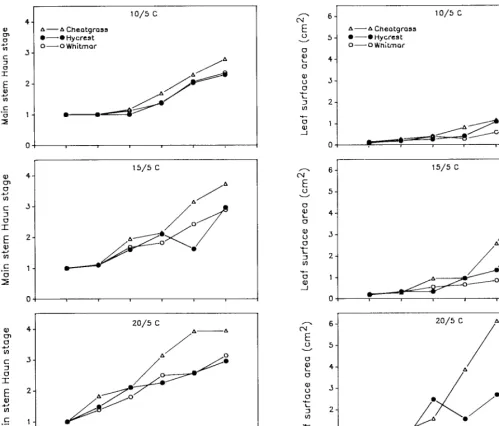
Fig. 1. Main stem Haun stage (SD = 0.16) and leaf surface area (SD = 0.64) for cheatgrass, Hycrest, and Whitmar as a function of days after emergence at 3 temperatures. Each point represents the mean of 10 seedlings.
mm in length, germinated seeds were transplanted I-cm deep in pots that had been previously watered to field capacity.
Temperature Experiment
Five germinated seeds of each species were transplanted into the pots and were placed in controlled-environment growth chambers with alternate 12-h day/night temperatures maintained at 10/S,
15/S, and 20/5’ C. Photosynthetic photon flux density was
approximately 190 micro-Einsteins mm2 sir, and daytime relative humidity ranged from 60 to 70%. Seedlings were maintained near field capacity by watering the pots every 2 days with deionized water during the first 2 weeks of growth and with 0.25 strength Hoagland solution thereafter. Seedlings were thinned to 1 seedling per container when the main stem had 2 fully developed leaves.
Shoots and roots were harvested 10, 17,24,3 1, 38, and 45 days after seedling emergence. Leaf and tiller development was evalu- ated using the system of Klepper et al. (1982) and root develop- ment was quantified using the method of Klepper et al. (1984). A more detailed discussion of how the root classification system of
‘Mention ofa trademark, proprietary product, or vendor does not constitute guaran- tee or warrantv of the moducts bv the U.S. Deoartment of Aericulture and Utah State University, anh does n’ot m~plya~proval to th<exclusion of Gher products or vendors that may also be suitable.
Klepper et al. (1984) was applied to seedlings of Hycrest, Whitmar,
and cheatgrass is contained in Aguirre and Johnson (1991).
Although the root classification system of Klepper et al. (1984) uses a naming system that identifies roots by their relationship to spe- cific nodes rather than designating roots as seminal or adventitious roots. In this paper we also indicate roots by these traditional names, although these names are subject to various definitions and misinterpretation, as discussed by Klepper et al. (1984). At each sampling date, root systems were washed free of soil and then dissected under a low magnification (x10 to x50) microscope to determine the relationship among leaves, tillers, and roots. Char- acteristics examined included: main stem Haun stage (Haun 1973), leaf area (Licor LI-3 100 area meter’), length and order of branch- ing of the primary root, length and order of branching of second group of seminal roots (roots associated with the epiblast node, node- I), number and order of branching of first group of adventi- tious roots (roots associated with the first foliar node, node 1), total root length (Comair root scanner’), and root and shoot dry weight (oven-dried at 60” C for 48 h).
A split-plot experimental design was used with temperature regimes as main plots, species as subplots, and dates as sub-sub plots with 5 replications per treatment combination. Main effects
Table 1. Influence of temperature on root and shoot developmental characteristics of Whitmrr, Hycrest, and cheatgrass averaged across species and 6 harvests.
Temperature
Leaf area
Plant height
Main stem Haun
Total root length
Root: total dry weight
ratio
Order of Length Order of
branching of branching Length of
Primary of seminal of Adven- adven-
root primary Seminal root seminal titious titious
length root rootsb axesb rootsb rootsb axes’
OC 2
02
cm
21?a
%
IO/S 72 1.5a 30.la 7”.Z 0.6a
1515 1.2ab 9.0b 2.0b 43.0b 33.la 9.lb 0.8b
2015 1.7b 11.3c 2.3~ 59.3c 31.8a 9.6b l.lc
‘Means within columns followed by the same letter are not significantly (P<O.OS) different by LSD. bSecond group of seminal roots (roots associated with the epiblast node, node -1).
‘Roots associated with the first foliar node (node 1).
o?k 0.8b l.lc
l?a 2.7b 4.2b
O.Oa O.la 0.2b
o?k O.lb 0.2c
t-z-i 0.2b 0.5b
and interactions were considered significant if
P<O.O5.
Competition Experiment
Monocultures of Hycrest or Whitmar were established by trans- planting 1,2, or 5 germinated seeds into pots with equal spacing, giving ratios of Hycrest to cheatgrass or Whitmar to cheatgrass of
l:O, 2:0, and 5:0, representing plant densities of 32, 64, and 159 plants mm2, respectively. Mixtures were established by transplant- ing 1 or 4 germinated seeds of cheatgrass into the pots containing
10/s c 24. 10/5 c
A-AChAotgroaa A-AChOOtQrOss
l -•liycrest 2. _ l -•Hycrest
0-OWhitmor o-ownkmor
20/5 C A/ /
O-l I
10 17 24 31 36 45
Days after emergence
either 1 Hycrest seedling or 1 Whitmar seedling, resulting in wheatgrass:cheatgrass ratios of 1: 1 and 1:4, respectively. This experiment was conducted in a greenhouse during October and November in 1988. No artificial lighting was provided, and air temperatures were maintained between 17 to 25O C. Deionized water was used for irrigating the pots during the first 15 days after transplanting; thereafter, a 0.25 strength Hoagland solution was used.
24 1
15/5 c
A
24 20/5 c
O-l
10 17 24 31 30 4s
Days after emergence
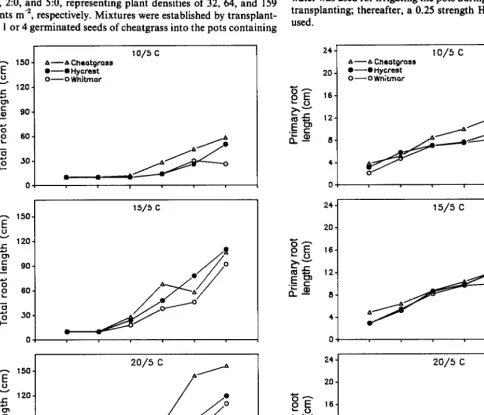
Fig. 2. Total root length (SD q 10.1) and primary root length (SD q 1.3) for cheatgrass, Hycrest, and Whitmnr as a function of days after emergence at 3
4- A-A Chaotgross 10/s c 0-O Hycrest
O-O Whitmor
2- AAA
0
l- /
/A
/L
/
A :
0
0,
4- 15/5 c
J-
A----A
2-
/
l-
0, 1
4 20/5 C
10 17 24 31 38 45
Days after emergence
16
I
10/5 c A-A Cheotgross
l -•Hycrest 0-OWhitmor
I
20/5 C16
A-A
12-
a-
4-
10 17 24 31 36 45
Days a tter emergence
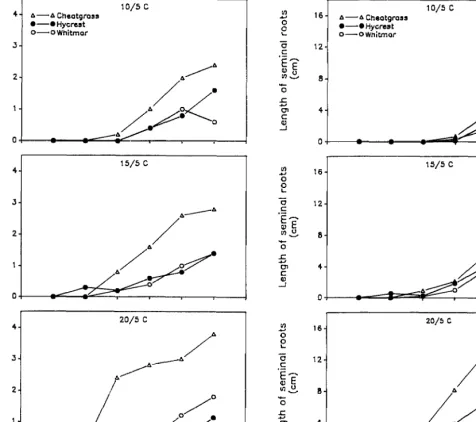
Fig. 3. Number of seminal roots (roots associated with the epiblast node, node -1) (SD = 1.29) and length of seminal roots (SD = 1.3) for cheatgrass, Hycrest, and Whitmar as a function of days after emergence at 3 temperatures. Each point represents the mean of 10 seedlings.
Seedlings were harvested at 15, 30, and 50 days after seedling emergence. Root and shoot characteristics were evaluated as above. Soil samples (18-cm deep) were obtained at the last harvest and oven-dried at 120’ C for 48 hr, and soil water content was determined. The relationship between soil water content and soil water potential was obtained by mixing various amounts of water with dried soil, and then measuring soil water potential with screen-cage psychrometers.
seedlings was generally greater than that of Hycrest and Whitmar seedlings, but species did not differ in root to total dry weight ratio, order of branching of the primary root, and number and length of adventitious roots (roots associated with the first foliar node, node 1).
A split-plot design with an incomplete factorial arrangement with 8 replications was used for the experiment. Analysis of var- iance and Least Square Difference (LSD) multiple comparison tests were used to identify significant differences among treatment means. Main effects and interactions were considered to be signifi- cant if
P<O.OS.
Results Temperature Experiment
Temperature significantly affected all shoot and root parame- ters, except for the ratio of root to total dry weight (Table 1). Shoot and root growth increased with temperature. Whitmar and Hy- crest had similar responses to temperature, which generally dif- fered from the responses of cheatgrass (Table 2). Growth of cheatgrass
Although there was no significant temperature X species X harvest date interaction, cheatgrass seedlings generally developed faster than Hycrest and Whitmar seedlings, regardless of tempera- ture and harvest date. Leaf development and leaf area (Fig. 1) as well as total root length (Fig. 2) of cheatgrass generally exceeded those of Hycrest and Whitmar, particularly at harvests beyond 24 days after emergence. However, root lengths of cheatgrass and Hycrest were similar at IS/S’ C (Fig. 2). The primary root of cheatgrass was longer than that of Hycrest and Whitmar at lO/ 5” C; however, primary root lengths of the 3 grasses were similar at 15/S and 20/5’ C (Fig. 2). The primary root of cheatgrass branched first followed by Hycrest and Whitmar (data not shown). Cheatgrass had a greater number (after 24 days) and length (after 38 days) of second group of seminal roots (those associated with the epiblast node, node -1) than Hycrest and Whitmar seedlings at all 3 temperatures (Fig. 3).
Leaf development was similar in Hycrest and Whitmar (Fig. I),
Table 2. Root and shoot development characteristics for Whitmar, Hycrest, and cheatgrass averaged 8cross 3 temperatures and 6 harvests.
Species
Leaf Plant
area height
Main Total
stem root
Haun length
Root: Order of Length Order of
total branching of branching Length of
dry Primary of seminal of Adven- adven-
weight root primary Seminal root seminal titious titious
ratio length root root& axesb rootsb roots’ axes’
Whitmar Hycrest Cheatgrass
7. OZ l.lab
1.9b
Ea 1.8a 3?
10.9a 1.8a 4O.lab
7.4b 2.2b 50.3b
% cm
35.la 7.aa
28.5a 8.3a
30.9a lO.Ob
0.7a o?z I% O.Oa zl LE
0.8a 0.5a 2.4a 0. la O.la 0.3a
0.9a 1.4b 3.9b 0.2b O.Za 0.4a ‘Means within a column followed by the same letter arc not significantly (X0.05) different by LSD.
%cond PTOUD of seminal roots (roots associated with the cniblast node. node -1). ‘Roots a&ci~tcd with the first folk node (node 1). a
although leaf area (Fig. l), total root length and primary root length (Fig. 2), and number and length of seminal roots associated with the epiblast node (Fig. 3) were greater in Hycrest than Whit- mar as days after emergence increased. Whitmar allocated a larger proportion of carbon to roots than Hycrest and cheatgrass beyond 31 d after emergence at all 3 temperatures (data not shown). Cheatgrass elongated adventitious roots earlier and at colder temperatures (lo/ 5’ C) than Hycrest, and Whitmar did not elongate
OWhitmor
a
6
LSD 0.05 1
6-
4-
I I
2- I
0 n n nn
601
30-
20-
lo- I
O- 123123123123123 - 1' _n
2:o 1:l 5:o
Planting ratio
1:4
adventitious roots at any temperature (data not shown).
Competition Experiment
Generally, the main effects of planting ratio, species, and harvest dates were significant for all seedling characteristics. The 3-way (treatment X species X harvest dates) and 2-way (treatment X species) interactions were not significant for length and order of branching of the primary root, order of branching of the second group of seminal roots. number of roots from the first foliar node,
250
200
150
100
50
0
OWhitmar IHycrest
LsL
I
2.5
2.0
1.5
1.0
0.5
0.0
1°m
6-
O- n I a n l-l
123123123123123
l:o 2:o 1:l 5:o
Planting ratio
1:4
Fig. 4. Seedling root and shoot ehrlracteristks for Hycrest and Whitmar seedlings grown at various planting ratios in monocultures (l:O, 2~0, and 5:O)
Table 3. Mean length and order of branching (OB) of the primary root, order of branching of the second group of seminal roots (node -l), number of roots asaoeiated with the first foiiar node (node l), and root dry weight for Hycrest and Whitmar in the competition experiment.
Species
Primary root
length OB
OB of Advcnti-
seminal titious Root
roots roots dry
(node -I) (node 1) weight
Hycrest Whitmar
IzI 16.0b
1.6a 1.4b
0.8a OSb
1%
I.lb
I?.&
11Sb ‘Means within the same column followed by the same letter are not significantly (P<O.OS) different by LSD.
and root dry weight. Consequently, only species means will be considered for these 5 characteristics (Table 3). Hycrest seedlings had greater order of branching of the primary root, order of branching of the second group of seminal roots, number of adven- titious roots (roots associated with the first foliar node), and root dry weight than Whitmar, whether they were growing in monocul- tures or in mixtures with cheatgrass.
Significant 3-way (treatment X species X harvest date) and 2-way (treatment X species) interactions were observed for main stem Haun stage, number of tillers, leaf area, shoot dry weight, total root length, and order of branching of roots associated with the first foliar node. Except for order of branching of roots asso- ciated with the first foliar node, root and shoot characteristics did not differ among the planting ratios until 50 days after seedling emergence (Fig. 4). At 50 days after emergence, seedlings growing in the 1:0 planting ratio (Hycrest:cheatgrass) had the highest main stem Haun stage, whereas leaf development was the lowest for the 1:4planting mixture (Fig. 4). Hycrest seedlings did not differ in leaf development between monoculture or mixture plantings when grown at the same planting densities, such as between 1:4 and 50 planting ratios (159 plants m”) and between 1: 1 and 2:0 planting ratios (64 plants mm2). Whitmar seedlings had greater leaf develop- ment when grown at planting ratios of 1:0 (Whitmar:cheatgrass) than when grown at ratios of 1: 1 and 1:4 at 50 days after seedling emergence. Whitmar seedlings had a lower main stem Haun stage when grown at a 1:4 than a 5:0 planting ratio.
At 50 days after seedling emergence, Hycrest seedlings grown at a 1:4 ratio had fewer tillers than those grown at a 5:0 ratio (Fig. 4). Hycrest seedlings grown at a I:1 planting ratio had fewer tillers than those grown at a 2:0 ratio. Whitmar seedlings grown at a 1:4 planting ratio (Whitmar:cheatgrass) had fewer tillers than seed- lings grown at 5:0, 1: 1,2:0, and 1:0 ratios at 50 days after seedling emergence.
At 50 days after seedling emergence, Hycrest seedlings grown at a 1:4 planting ratio (Hycrest:cheatgrass) had a smaller leaf area than seedlings grown at a 5:0 planting ratio (Fig. 4). At the 1:l planting ratio Hycrest seedlings had a smaller leaf area than seed- lings grown at a 2:0 and 1:0 planting ratio. Whitmar seedlings grown at a 1:4 planting ratio had a smaller leaf area than those grown at 5:0, l:l, 2:0, and 1:0 planting ratios at 50 days after seedling emergence.
At 50 days after seedling emergence, shoot weights were lower for Hycrest seedlings grown at a 1:4 planting ratio (Hycrest:cheat- grass) than those grown at a 5:0 planting ratio (Fig. 4). Shoot dry weights were lower for Hycrest seedlings grown at a 1: 1 planting ratio than those grown at a 2:0 and 1:0 planting ratio. Whitmar seedlings had a lower shoot dry weight when grown at a 1:4 ratio (Whitmar:cheatgrass) than those grown at 5:0, l:l, 2:0, and 1:0 planting ratios.
Hycrest seedlings grown at a 1:4 planting ratio (Hycrest:cheat- grass) had less branching development of adventitious roots than those grown at 5:0,1: 1,2:0, and 1:0 planting ratios at 30 days after
352 JOURNAL OF RANGE MANAGEMENT 44(4), July 1991
-1.5
0
OWhitmar : cheatgrass
EYHycrest : cheatgrass
Lso%
’
1 :o 210 1:l 510
Planting ratios
1:4
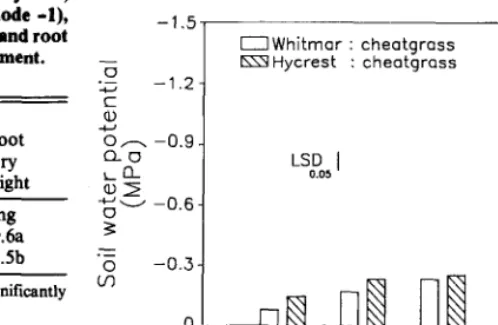
Fig. 5. Soil water potential (MPa) for Whitmar and Hycrest at 50 days after aeediing emergence grown in monocuiturcs (l:O, 2:0, and 5* 32,64, and 159 plants m-‘, respectively) and in mixtures with cheatgrass (1:l and 1~4). Each bar represents the mean of 8 vaiues.
emergence (Fig. 4). At 50 days after seedling emergence, Hycrest seedlings grown at a 1:4 and 5:0 planting ratio did not differ in order of branching; however, seedlings grown at a 1:l planting ratio were less branched than those grown at planting ratios of 20 or l:O. For Whitmar, order of branching did not vary during the study.
At 50 days after seedling emergence, Hycrest seedlings grown at a. 1:4 planting ratio (Hycrest:cheatgrass) had a smaller total root length than those grown at a 5:0, l:l, 2:0, and 1:0 planting ratio (Fig. 4). For Whitmar, total root length did not differ among the planting ratios at any of the harvest dates. Soil water was depleted to a greater extent in treatments with cheatgrass (1:l and 1:4 planting ratios) compared with monoculture treatments (2:0 and 5:0 planting ratios, respectively) (Fig. 5). Hycrest-cheatgrass plant- ing mixtures depleted soil moisture to lower soil water potentials than Whitmarcheatgrass mixtures.
Discussion Temperature
Rapid germination and seedling growth at low temperature is critical for successful establishment in arid or semiarid environ- ments (Plummer 1943). Rapid root penetration under these condi- tions is essential if bluebunch and crested wheatgrasses are to become established in areas where cheatgrass is abundant (Dewitt 1969). Shoot growth rates of forage grasses typically decrease as temperatures decline. For example, McWilliam et al. (1970) found that growth rate declined as temperature decreased from 24/ 19 to 15/10” C for tall fescue (Festuca arundinacea Schreber) and Ital- ian ryegrass (L.&urn multiflorum Lam.) (McWilliam et al. 1970). Ellern and Tadmor (1966) also observed that temperatures in the range of 4 to 10’ C delayed germination and early seedling growth
in several range plants, including crested wheatgrass. Hsu et al. (1985) reported that seedling growth of perennial warm-season grasses was reduced considerably at 20’ C, compared with growth at 25 and 30° C. In the present study, the seedling growth of cheatgrass, Hycrest, and Whitmar declined as temperature de- creased. Seedling growth for all 3 species decreased markedly at
10/5O C compared with the 15/S and 20/5” C temperatures. Rates of leaf expansion and frequency of leaf appearance were greatly influenced by temperature in perennial ryegrass (L&urn
that seedlings of annual warm-season grasses developed faster than warm-season perennial species, regardless of temperature. In the present study, cheatgrass had greater leaf development and leaf area production than Hycrest and Whitmar, although differences were small at the 10/Y C treatment.
Extension and development of seminal roots are extremely important in seedling establishment, although plant establishment depends ultimately on the extension of adventitious roots (Esau 1960). The longevity of seedlings restricted to seminal roots might be critical to seedling success where the soil profile remains exposed to low temperatures. Van Der Sluijs and Hyder (1974) reported that seminal primary roots of blue grama seedlings grew actively in the greenhouse for 22 weeks when restricted only to seminal roots. In the present study, adventitious roots did not elongate in Whitmar seedlings so that seedling growth was sup- ported entirely by seminal roots during the 45 d of the study.
Harris (1977) reported that rapid elongation of primary roots combined with well-developed adventitious roots enabled cheat- grass to exploit a greater volume of soil, allowing cheatgrass to outcompete bluebunch wheatgrass. Wilson and Briske (1979) observed that if adventitious rooting in blue grama seedlings was not initiated, blue grama seedlings died during winter. They also found that blue grama seedlings required temperatures between 15 and 30’ C for elongation of adventitious roots. In the present study, cheatgrass initiated adventitious roots earlier and at colder temperatures (lo/ 5’ C) than either Hycrest and Whitmar. Adven- titious roots are extremely important for seedling establishment because they eventually replace the seminal roots. Seminal roots can only provide short-term support to the young seedling because the vascular system connects tillers with adventitious roots but not with the seminal roots (Esau 1960). The earlier elongation of adventitious roots in cheatgrass and the absence of adventitious roots in Whitmar would favor establishment of cheatgrass, partic- ularly at low temperatures.
Svejcar (1990) compared accumulated root length, leaf area, and biomass of cheatgrass and Agropyron desertorum under well- watered conditions at 28/4’ C day/ night temperatures in a green- house. He found that cheatgrass was more efficient (per unit of biomass) in producing leaf area and root length than A. deserto- rum and suggested that this difference in efficiency was probably one of the factors contributing to the competitive advantage of cheatgrass seedlings compared to seedlings of perennial bunch- grasses. Svejcar (1990) expressed root/ shoot relationships in terms of root length per unit leaf area and found values ranging from about 40 to 160 cm cm-’ for cheatgrass and A. desertorum. Calcu- lating these ratios from data in Table 2, values were 6,36, and 26 cm cmm2 for Whitmar, Hycrest, and cheatgrass, respectively. This suggests that Hycrest would have the greatest ability to produce root length per unit leaf area followed by cheatgrass and Whitmar. Our ratios were probably lower than those of Svejcar (1990) because of the earlier, more frequent harvests in our study. Although Hycrest had the greatest ratios in our study, absolute root and shoot growth was still the greatest for cheatgrass.
Further studies should be conducted to elucidate the role of seminal roots and their longevity in bluebunch wheatgrass at low temperature regimes to better understand their influence on seed- ling establishment. Understanding seedling ability to elongate adventitious roots at low temperatures could help in selecting competive cultivars of bluebunch wheatgrass for rangeland seedings.
Competition
Previous research has also shown that shoot growth of crested and bluebunch wheatgrass were reduced when growing in mixtures with cheatgrass. Romo and Eddleman (1987) observed that with- out competition seedlings of bluebunch wheatgrass, Junegrass [ Koeleriu cristata (L.) Pers.], and squirreltail [ Sitanion hystrix
(Nutt.) J.G. Smith) produced more tillers and leaves than those grown with competition from Japanese brome (Bromus japonicus Thumb. ex Murray) at 50,100,200, and 400 plants rne2. Rummel (1946) and Hull (1963) found that increasing cheatgrass densities reduced crested wheatgrass shoot weight. Similarly, Harris (1967) reported that forage yield of bluebunch wheatgrass was reduced as density of cheatgrass increased. However, Buman et al. (1988) grew Hycrest crested wheatgrass in a 1: 1 planting ratio with cheatgrass and found that these 2 grasses had similar leaf areas and shoot dry weight.
Root dry weight (Rummel 1946) and root growth (Hull 1963) in crested wheatgrass decreased as density of cheatgrass increased. Harris (1967) observed that depth of root penetration of bluebunch wheatgrass seedlings was reduced as density of cheatgrass increased. Buman et al. (1988) observed that Hycrest and cheatgrass had similar maximum root lengths and root dry weights when grown in a 1: 1 planting ratio. Although long-term survival was not evalu- ated in the present study, seedling survival would ultimately be influenced by reduced root growth. Seedling survival and estab- lishment of crested wheatgrass (Rummel 1946) and bluebunch wheatgrass (Nelson et al. 1970, Harris 1967) were reduced by cheatgrass competition. Romo and Eddleman (1987) observed that survival of seedlings of bluebunch wheatgrass was not reduced by Japanese brome competition; however, survival of squirreltail seed- lings was greater when grown without competition.
Little information is available on the effect of competition on root pattern development. The present study indicated that order of branching of the primary root, ordering of branching of the second group of seminal roots, and number of adventitious roots associated with the first foliar node were not affected in either Hycrest or Whitmar when they were grown with cheatgrass. How- ever, branching of adventitious roots associated with the first foliar node was reduced to a greater extent when grown in mixtures with cheatgrass (1: 1 and 1:4 planting ratios, 64 and 159 seedlings mm2, respectively). Order of branching of adventitious roots is a charac- teristic that probably greatly influences total root surface of the mature plant. Consequently, a reduced order of branching of adventitious roots may decrease a plant’s ability to extract both water and nutrients.
Hycrest seedlings grown in competition with cheatgrass at plant- ing ratios of 1: 1 and 1:4 had reductions in leaf area of 46 and 76%, while Whitmar only showed reductions of 3 1 and 50% for the same densities, respectively. Similarly, total root length for Hycrest was reduced 10 and 56% for the same plant densities, respectively, while total root length for Whitmar declined only 20 and 22%, respec- tively. Although Hycrest had a large percentage reduction for most seedling characteristics when competing with cheatgrass, Hycrest had greater absolute growth than Whitmar. Because seedlings of Hycrest maintain greater growth than seedlings of Whitmar, Hy- crest seedlings would occupy a larger soil volume and aerial space than Whitmar seedlings. Consequently, seedlings of Hycrest would compete earlier and more effectively than Whitmar seedlings.
The reduced growth for Whitmar seedlings resulted in sign& cantly higher soil water potentials for Whitmar than Hycrest treatments. This lowered soil water acquisition by Whitmar seed- lings would result in greater soil water available for cheatgrass growth. This coupled with greater root growth rates for mature plants of A. desertorum compared with P. spicata (Eissenstat and Caldwell 1987) and the large stature of mature plants of Hycrest (Asay et al. 1985) suggest that Hycrest would be a more effective competitor with cheatgrass than Whitmar.
Literature Cited
Asay, K.H., DR. Dewey, F.B. Gomm, D.A. Johnson, and J.R. Carlson. 1985. Registration of ‘Hycrest’crested wheatgrass. Crop Sci. 25368-369.
Barber, S.A. 1984. Soil nutrient availability. A mechanistic approach. John Wiley and Sons, Inc., New York.
Bumm, R.A., and R.H. Abemethy. 1988. Temperature requirements for
mountain rye, ‘Hycrest’crested wheatgrass, and downy brome germina- tion. J. Range Manage. 41:35-39.
Buman, R.A., S.B. Monsen, and R.H. Abernethy. 1988. Seedling competi-
tion between mountain rye, ‘Hycrest’ crested wheatgrass, and downy brome. J. Range Manage. 41:30-34.
Caldwell, M.M., J.H. Richards, D.A. Johnson, R.S. Nowak, and R.S.
Dzurec. 1981. Coping with herbivory: photosynthetic capacity and resource allocation in two semiarid Agropyron bunchgrasses. Gccologia 50: M-24.
Clarkson, D.T. 1985. Factors affecting mineral nutrient acquisition by plants. Annu. Rev. Plant Physiol. 3677-l 15.
Cooper, J.P. 1964. Climatic variation in forage grasses. I. Leaf develop-
ment in climatic races of Lolium and Dactylis. J. Appl. Ecol. 1:45-61.
Daubenmire, R. 1942. An ecological study of the vegetation of southeast- em Washmgton and adjacent Idaho. Ecol. Monogr. 1253-79.
Dewitt, P.F. 1969. Environmental response to low temperature in Agro- pyron spicatum collected from native stands in western North America.
M.S. Thesis, Washington State Univ., Pullman.
Eissenstat, D.M., and M.M. Caldwell. 1987. Characteristics of successful competitiors: an evaluation of potential growth rate in two cold desert tussock grasses. Gecologia 71:167-173.
Ellern, S.J., and N.H. Tadmor. 1966. Germination of range plant seeds at fixed temperatures. J. Range Manage. 19341-345.
Ellern, S.J., and N.H. Tadmor. 1967. Germination of range seeds at alter-
nating temperatures. J. Range Manage. 20~72-77.
K~F~,$L 1960. Anatomy of seed plants. John Wiley and Sons, Inc., New
Evans, R.A., H.R. Holbo, R.E. Eekert, Jr., and J A. Young. 1970. Func-
tional environment of downy brome communi;ies in relation to weed control and revegetation. Weed Sci. 18:154-162.
Harris, G.A. 1967. Some competitive relationships between Agropyron spicatum and Bromus tectorum. Ecol. Monogr. 37:89-l 11.
Harris, GA. 1977. Root phenology as a factor of competition among grass seedlings. J. Range Manage. 30~172-177.
Harm, J.R. 1973. Visual quantification of wheat development. Agron. J. 65116119.
Hsu, F.H., C.J. Nelson, and A.G. Matehes. 1985. Temperature effects on
seedling development of perennial warm-season forage grasses. Crop Sci. 25249-255.
Hull, A.C. 1963. Competition and water requirements of cheatgrass and wheatgrasses in the greenhouse. J. Range Manage. 16: 199-204.
Johnson, D.A., and L. Aguirre. 1991. Effect of water on morphological
development in seedlings of three range grasses: Root branching patt- ems. J. Range Manage. 44~355-360.
Keller, W., and A.T. Bleak. 1969. Root and shoot growth following pre-
planting treatment of grass seed. J. Range Manage. 22:4346.
King, J. 1971. Competition between established and newly sown grass species. J. Brit. Grass]. Sot. 26221-229.
Klepper, B., R.K. Belford, and R.W. Rickman. 1984. Root and shoot development in winter wheat. Agron. J. 76: 117-122.
Klepper, B., R.W. Rickman, and C.M. Peterson. 1982. Quantitative char- acterization of vegetative development in small cereal grains. Agron. J. 74789-792.
Klomp, G.J., and A.C. Hull, Jr. 1972. Methods for seeding three perennial wheatgrasses on cheatgrass ranges in southern Idaho. J. Range Manage. 25:266-268.
MeWilliam, J.R., RJ. Clements, and P.M. Dowling. 1970. Some factors influencing the germination and early seedling development of pasture plants. Aust. J. Agr. Res. 21:19-32.
Nelson, J.R., A.M. Wilson, and C.J. Goebel. 1970. Factors influencing broadcast seeding in bunchgrass range. J. Range Manage. 23:163-170.
Peacock, J.M. 1976. Temperature and leaf growth in four grass species. J. Appl. Ecol. 13:225-232.
Plummer, A.P. 1943. The germination and early seedling development of twelve range grasses. Amer. Sot. Agron. J. 35: 19-34.
Romo, J.T., and L.E. Eddleman. 1987. Effects of Japanese brome on
growth of bluebunch wheatgrass, Junegrass and squureltail seedlings. Reclam. and Reveg. Res. 6207-218.
nosenqmst, D.W., and D.H. Gates. 1961. Responses of four grasses at
different stages of growth to various temperature regimes. J. Range Manage. 14: 198-202.
Rummel, R.S. 1946. Some effects of competition from cheatgrass brome
on crested wheatgrass and bluestem wheatgrass. Ecology 27: 159-167.
Snaydon, R.W., and C.D. Howe. 1986. Root and shoot competition
between established ryegrass and invading grass seedlings. J. Appl. Ecol.
23~667-674.
Svejear, T. 1990. Root length, leaf area, and biomass of crested wheatgrass
and cheatgrass seedlings. J. Range Manage. 43446448.
ThiU, D.C., R.D. Sehirman, and A.P. Appleby. 1979. Influence of soil
moisture, temperature, and compaction on the germination and emer- gence of downy brome (Bromus tectorum). Weed Sci. 271625-630. Tillman, D. 1982. Resource competition and community structure. Prince-
ton Univ. Press, Princeton, N.J.
Van Der Sluijs, D.H., and D.N. Hyder. 1974. Growth and longevity of blue
grama seedlings restricted to seminal roots. J. Range Manage. 27: 117-I 19.
Wilson, A.M., and D.D. Briske. 1979. Seminal and adventitious root growth of blue grama seedlings on the Central Plains. J. Range Manage. 32:209-213.
Wilson, A.M., D.E. Wondereheck, and C.J. Goebel. 1974. Responses of
range grass seeds to winter environments. J. Range Manage. 27: 120-I 22.
Young, J.A., R.A. Evans, R.E. Eckert, Jr.,and B.L. Kay. 1987. Cheatgrass.
Rangelands 9~266-270.