Clinical Review
Bariatric surgery
A primer
Shahzeer Karmali
MD FRCSCCarlene Johnson Stoklossa Arya Sharma
MD PhD FRCPCJanet Stadnyk Sandra Christiansen Danielle Cottreau Daniel W. Birch
MD FRCSCAbstract
OBJECTIVE To review the management of bariatric surgical patients.
QUALITY OF EVIDENCE MEDLINE, EMBASE, and Cochrane Library databases were searched, as well as PubMed US National Library, from January 1950 to December 2009. Evidence was levels I, II, and III.
MAIN MESSAGE Bariatric surgery should be considered for obese patients at high risk of morbidity and mortality who have not achieved adequate weight loss with lifestyle and medical management and who are suffering from the complications of obesity. Bariatric surgery can result in substantial weight loss, resolution of comorbid conditions, and improved quality of life. The patient’s weight-loss history; his or her personal accountability, responsibility, and comprehension; and the acceptable level of risk must be taken into account. Complications include technical failure, bleeding, abdominal pain, nausea or vomiting, excess loose skin, bowel obstruction, ulcers, and anastomotic stricture. Lifelong monitoring by a multidisciplinary team is essential.
CONCLUSION Limited long-term success of behavioural and pharmacologic therapies in severe obesity has led to renewed interest in bariatric surgery. Success with bariatric surgery is more likely when multidisciplinary care providers, in conjunction with primary care providers, assess, treat, monitor, and evaluate patients before and after surgery. Family physicians will play a critical role in counseling patients about bariatric surgery and will need to develop skills in managing these patients in the long-term.
Résumé
OBJECTIF Revoir le traitement des patients ayant subi une chirurgie bariatrique.
QUALITÉ DES PREUVES On a consulté les bases de données MEDLINE, EMBASE et Cochrane Library, de même que PubMed US National Library, entre janvier 1950 et décembre 2010. Le preuves étaient de niveaux I, II et III.
PRINCIPAL MESSAGE Une intervention bariatrique doit être envisagée chez tout obèse présentant un risque élevé de morbidité et de mortalité, qui n’a pas perdu assez de poids malgré un changement du mode de vie et un traitement médical, et qui souffre de complications de l’obésité. La chirurgie bariatrique peut entraîner une importante perte de poids, une disparition de l’état de comorbidité et une meilleure qualité de vie. On doit tenir compte des antécédents de pertes de poids du patient, de sa compréhension, de sa responsabilité et de sa fiabilité, mais aussi d’un niveau acceptable de risque. Parmi les complications, mentionnons les erreurs techniques, saignements, douleurs abdominales, nausées ou vomissements, excès de peau lâche, obstruction, ulcères et sténoses anastomotiques de l’intestin. Une surveillance par une équipe multidisciplinaire est requise pendant toute la vie du patient.
CONCLUSION Le succès mitigé du traitement comportemental et pharmacologique de l’obésité sévère a entraîné un renouveau d’intérêt pour la chirurgie bariatrique. La chirurgie bariatrique est plus susceptible de réussir lorsque les soignants de première ligne et une équipe
multidisciplinaire agissent conjointement pour évaluer, traiter, et suivre les patients avant et après la chirurgie. Le médecin de famille aura un rôle crucial à jouer pour conseiller les patients au sujet de cette intervention et devra développer sa capacité à traiter ces patients à long terme.
R
ecent estimates from the 2004 Canadian Community Health Survey show that 59% of the adult popula-tion is overweight and 1 in 4 (23%) adults is obese.1 The obesity rate has increaseddramatically in the past 15 years: between 2% and 10% among boys and between 2% and 9% among girls.2,3 Moreover, it is
esti-mated that 1 in 10 premature deaths among Canadian adults aged 20 to 64 years is directly attributable to obesity.4
The limited long-term success of behav-ioural and pharmacological therapies in patients with severe obesity has led to a renewed interest in bariatric (obesity) sur-gery in Canada.5 Currently, several provinces
are attempting to improve access to bariat-ric surgery programs. In the near future it is anticipated that more than 4000 to 5000 patients will undergo bariatric surgery in Canada; as such, family physicians will play a critical role in counseling patients regarding the need for bariatric surgery and will need to develop skills in managing these patients in the long-term.
The aim of this review is to inform family doctors about some of the key issues rel-evant to the management of bariatric sur-gical patients.
Quality of evidence
We performed an electronic literature search of MEDLINE, EMBASE, and Cochrane Library databases, as well as the PubMed US National Library, from January 1950 to December 2010. We used the search terms
bariatric surgery, obesity surgery, gastric band, gastric bypass, sleeve gastrectomy, and gas-troplasty in combination with weight gain or
weight loss or nutrition. Studies were limited to the English language, adult populations, and human subjects. Google was also used to search for gray literature. We defined our inclusion criteria as randomized controlled
This article has been peer reviewed.
Cet article a fait l’objet d’une révision par des pairs.
trials, meta-analyses, case reports, non-randomized control trials, reviews, and retrospective and prospec-tive case series. Studies only reporting surgical tech-niques or without follow-up outcomes were excluded. Evidence was levels I, II, and III.
Indications for bariatric surgery
In 1991, the National Institutes of Health published specific indications for the appropriateness of bariatric surgery6-8:
Surgical intervention is an option for carefully select-ed patients with clinically severe obesity (BMI [body mass index] ≥ 40 or ≥ 35 kg/m2 with comorbid con-ditions) when less invasive methods of weight loss have failed and the patient is at high risk for obesity-associated morbidity or mortality.
Gastrointestinal surgery … can result in substan-tial weight loss, and therefore is an available weight loss option for well-informed and motivated patients with a BMI ≥ 40 or ≥ 35, who have comorbid condi-tions and acceptable operative risks.
Patients opting for surgical intervention should be followed by a multidisciplinary team ….
Lifelong medical surveillance after surgical therapy is a necessity.8
Based upon the National Institutes of Health criteria, many adults might meet the criteria for assessment for bariatric surgery. In addition to these recommendations, the following factors need to be taken into account when considering bariatric surgery:
Weight-loss history. It must be documented that con-ventional weight-loss attempts have been tried and have not been successful over time. Medical necessity for bariatric surgery should be documented.9
Accountability and responsibility. The individual needs to demonstrate adherence to recommendations by attending appointments, practising self-monitoring with record-keeping, making time for healthy eating and activity, taking medication, and completing bloodwork.
Comprehension and understanding. The individual must have an understanding of the benefits and limita-tions of a surgical procedure to assist with management of his or her obesity.
Acceptable level of risk. The risks of surgical interven-tion must not be excessive and must be lower than the risks of not providing the treatment.7,9,10
Box 16-9 shows exclusion criteria for patients who
should not be offered bariatric surgery.
Options for bariatric surgery
There are 3 main types of bariatric surgical procedures categorized by function: restrictive; combined (restrict-ive and malabsorpt(restrict-ive), and primarily malabsorpt(restrict-ive. All procedures are considered permanent. The following is a brief overview of bariatric surgeries:
Restrictive procedures
Laparoscopic adjustable gastric banding (LAGB) (Figure 1A): Laparoscopic adjustable gastric banding employs laparoscopic insertion of a silicone gastric band at the upper end of the stomach, creating a small proximal gastric pouch with a volume of approximately 30 mL. This band is connected via a tube to a subcutaneously placed injection port. The band is inflated with a saline solution to achieve an appropriate narrowing to effect sufficient early satiety, which will sustain moderate weight reduction. The degree of inflation is customized to each individual.11
Vertical banded gastroplasty (Figure 1B): This opera-tion involves stapling the stomach, front to back, below the This article is eligible for Mainpro-M1 credits. To earn
credits, go to www.cfp.ca and click on the Mainpro link.
Levels of evidence
Level I:
At least one properly conducted randomized controlled trial, systematic review, or meta-analysisLevel II:
Other comparison trials, non-randomized, cohort, case-control, or epidemiologic studies, and preferably more than one studyLevel III
:
Expert opinion or consensus statementsBox 1. Exclusion criteria for bariatric surgery
Patients who are or have any of the following should not be offered bariatric surgery:
• BMI < 35 kg/m2
• age < 18 y or > 65 y
• a medical condition that makes surgery too risky • clinically significant or unstable mental health concerns • an unrealistic postsurgical target weight
• unrealistic expectations of a surgical treatment • not tried or optimized lifestyle or medical treatments
• a history of poor compliance with lifestyle, medical, or
mental health interventions
• pregnant, lactating, or plan for pregnancy within 2 y of
potential surgical treatment9
• lack of safe access to abdominal cavity or gastrointestinal tract
• smokers (All smokers, regardless of their weight status,
should quit smoking [for at least 8 weeks before surgery] as a goal of risk-factor management.8 All patients should be encouraged to remain non-smokers and participate in smoking cessation programs.9)
BMI—body mass index.
gastroesophageal junction and 1 cm from the lesser curva-ture. A vertical staple line is then made from the opening to the left side of the gastroesophageal junction, and the out-let stoma is restricted with a 1-cm diameter polypropylene band.12 The band mechanically restricts food intake,
creat-ing an early sense of satiety that limits intake. Because of the higher-than-expected complication rate, vertical banded gastroplasty is no longer routinely performed.
Laparoscopic sleeve gastrectomy (LSG) (Figure 1C): Rather than a pouch, this procedure creates a “sleeve” of the stomach, extending from the esopha-gus to the duodenum. The size of the gastric sleeve is approximately 60 to 120 mL. The gastric rem-nant, approximately 80% of the stomach, is removed. Production of ghrelin, a hormone involved in appetite, is reduced, resulting in decreased hunger and improved satiety.13 Sleeve gastrectomy remains an investigational
procedure in our institute (ie, University of Alberta) to determine safety and long-term outcomes.
Combined restrictive and malabsorptive procedures
Roux-en-Y gastric bypass (RYGB) (Figure 1D): Roux-en-Y gastric bypassinvolves construction of a small (30 mL) proximal gastric pouch by stapling and dividing the stom-ach. The pouch empties into a segment of the jejunum that is brought up to the gastric pouch as a Roux-en-Y limb.
Although the gastric bypass is considered a restrictive pro-cedure, it causes some malabsorption as a consequence of the bypassed stomach, duodenum, and upper jejunum.
Biliopancreatic diversion with or without duodenal switch (Figure 1E): This procedure combines removal of a small section of stomach with alterations to the path of the small intestine. Complication rates are higher and include malabsorption, protein malnutrition, vitamin and mineral deficiencies, anemia, osteoporosis, and anastomotic ulceration.14
Malabsorptive procedures. Malabsorptive proce-dures decrease absorption of nutrients by decreasing the length of small intestine that is exposed to food. Malabsorptive procedures produce substantial weight loss but also have the highest complication rates.
Jejunoileal bypass (Figure 1F): The upper small intes-tine is joined to the distal small intesintes-tine, effectively removing a large segment of the absorptive circuit, while retaining only about 35 cm of normal absorptive small intestine. Malabsorption of both macronutrients and micronutrients can contribute to severe malnutri-tion and related complicamalnutri-tions including organ (eg, liver, kidney) failure and mortality. This procedure is no lon-ger recommended owing to high complication rates and poor long-term outcomes.9,14
Figure 1. Bariatric surgical procedures: A) Laparoscopic adjustable gastric banding; B) vertical banded gastroplasty;
C) laparoscopic sleeve gastrectomy; D) Roux-en-Y gastric bypass; E) biliopancreatic diversion; F) jejunoileal bypass.
A
B
C
Complications
Mortality rates are less than 1% for patients with BMIs less than 50 kg/m2 who are younger than 55 years of
age.14 For patients with BMIs greater than 60 kg/m2,
who also have comorbid conditions, the mortality rate is 2% to 4%. Lower risk of morbidity and mortality are positively correlated with surgical volume at the clinic (> 100 cases per year), surgeon experience, surgery at a tertiary care facility, sex of patient (female), age of patient (< 55 years), and respiratory status.10
Average bariatric surgical complication rates are less than 10%.15 A bariatric surgical patient differs from the
average general surgery patient in that complications might present with minimal physical signs and symp-toms, the patient is difficult to evaluate owing to his or her body habitus and inability to fit on many diagnostic examination tables, and the patient deteriorates rapidly and has very little reserve to weather a catastrophic ill-ness. The best opportunity to improve outcomes is in the first 6 to 12 hours, and after 24 hours the risk of morbidity and mortality escalate rapidly.16
Early complications
Anastomotic or staple line leak. The overall inci-dence of an anastomotic leak after RYGB is 1.2% to 3%.17 The clinical presentation can be quite insidious
and a high degree of suspicion is required by the phy-sician. Sustained tachycardia (especially a sustained heart rate of >120 beats per minute), tachypnea, and fever raise the suspicion. Diagnostic tests such as upper gastrointestinal series and computed tomography detect only 22% of anastomotic leaks and tend to be very oper-ator-dependent.17 The key diagnostic or therapeutic
maneuver is prompt surgical intervention with a second look with diagnostic laparoscopy or laparotomy.17
Postoperative bleeding. There is approximately a 3.1% incidence of bleeding after bariatric surgery.18
Twenty-two percent of bleeds stop spontaneously, 55% neces-sitate blood transfusion, and 22% require operative intervention.18 Active bleeding often presents within 6
hours of the operative intervention and manifests with bright red bleeding orally, rectally, or abdominally, with possible hypotension and tachycardia. Prompt surgical or endoscopic intervention is required. Delayed bleeding often presents several days postoperatively with dark blood either within surgical drains or passed orally or rectally. Delayed bleeding often does not present with symptoms of hemodynamic instability, and the physi-cian can pursue diagnostic maneuvers such as radio-logic, hematoradio-logic, and endoscopic evaluation.
Late complications
All procedures
Nausea or vomiting: Nausea or vomiting can be improved for most patients with education regarding
food selection and eating behaviour. Patients with protracted vomiting should be assessed for strictures, obstructions, overinflated LAGB, or other differential diagnoses (eg, pregnancy). Patients with persistent or protracted vomiting should be screened for thiamine deficiency and given supplements if neurologic symp-toms present.9
Excess or loose skin: Excess or loose skin is a common, unwanted side effect of substantial weight loss. Mobility and self-care might be impaired. Infection and ulcerations might develop. Referral to a bariatric physician or occupa-tional or physical therapist is recommended.
Small bowel obstruction: Small bowel obstruction might present as abdominal bloating, cramping, or pain and nausea to severe pain and emesis. It might be due to adhesions, internal hernias, or severe constipation.
Ulcers: Ulcers of the stomach or anastomosis (mar-ginal ulcers) might present as upper epigastric pain or burning that can radiate to the back, with symptoms of nausea or vomiting and food intolerances. Iron deficiency anemia is commonly associated with chronic ulcers.19
Restrictive procedures
Erosion or slippage of the band: Erosion or slippage of the band might occur. Patients might present with symptoms of proximal gastric outlet obstruction (eg, dysphagia, nausea, vomiting, inability to tolerate solid food, or abdominal pain or discomfort) with possible excessive weight loss. Referral to a bariatric surgeon is recommended.
L ea ka ge from port or band tubing ( wi th LAGB): Patients report feelings of fullness or satiety ini-tially after a fill, but complete loss of this sensation and a substantial increase in volume of solid food tolerated occurs within a few days. Weight regain or poor weight-loss outcome might occur.
Combined procedures
Anastomotic stricture: Anastomotic stricture might occur during healing as scar tissue develops. Strictures might be suspected if a recent surgical patient (ie, RYGB) who had previously been tolerating oral intake now reports consistent and progressive nausea and vomit-ing with solid foods and is able to tolerate only small amounts of liquids at a time. Referral to a registered dietitian and bariatric surgeon is recommended.
Gastrogastric fistulae: Gastrogastric fistulae might develop owing to failure or incomplete staple partition of the pouch.14 Patients might present with tolerance of
high volumes of solid food, lack of restriction, lack of satiety, tolerance to textures commonly difficult after bariatric procedures (eg, sticky, doughy, stringy, tough), and either weight regain or poor weight-loss outcome. Referral to a bariatric surgeon is recommended.
Dumping syndrome can occur after bariatric surgery for combined or primary malabsorptive procedures. Early symptoms (within 30 minutes after eating) occur when food and fluid pass into the small intestine too fast. Symptoms might include nausea, vomiting, stomach pain or cramping, diarrhea, feelings of fullness or bloating, or increased heart rate. Late symptoms (1 to 3 hours after eating) occur when there are changes in the amounts of insulin and sugar in the blood (ie, reactive hypoglycemia). Late symptoms might also include flushing or sweating, intense need to lie down, feeling weak or dizzy, feeling nervous or shaky, or a drop in blood pressure.
Outcomes after surgery
Weight loss. Outcomes after bariatric surgery are often reported as the percentage of excess weight lost (EWL). Excess weight is the total amount of weight above a ref-erence standard for “ideal” weight (ie, BMI of 24.9 kg/m2).
Table 115,20-25 summarizes the literature reports on weight
loss after each option for bariatric surgery. Weight-loss outcomes (ie, percentage of EWL) might not be signifi-cantly different at 5 years or more after surgery, regard-less of the procedure. The weight-loss targets after bariatric surgery are not to achieve a “normal” weight based on height and weight reference tables or BMI ranges. The most important outcomes are resolution of comorbid conditions and improvement in quality of life.
Inadequate weight loss (< 30% EWL) or weight regain (> 10% EWL) might be an indication of surgical or tech-nical failure (ie, loss of integrity of gastric pouch), lack of proper adjustment to an LAGB, maladaptive eating behaviour, or psychological complications. Investigations and referral to the bariatric team are recommended.9
Up to 30% of people who have bariatric surgery might experience substantial weight regain. Box 2 presents several factors that can contribute to weight increase. It is important to continue interventions including nutri-tion and activity counseling, behaviour modificanutri-tion, and medical management, as surgical treatment alone is not successful. Weight regain might be related to technical failures of the surgery and should be reassessed by the bariatric surgeon.
Comorbidity resolution. Successful treatment of obesity dramatically ameliorates the comorbidities associated
with obesity. Type 2 diabetes, for example, was eliminated by gastric bypass in 82% of obese patients.26 Similarly,
gastric bypass surgery effectively controls sleep apnea in many patients.27-29 Hypertension has shown an excellent
response to gastric restrictive surgery (LAGB), disappear-ing in half to two-thirds of patients with obesity-related hypertension.27,30 Similarly in both meta-analysis and by
weighted means, hyperlipidemia, hypercholesterolemia, and hypertriglyceridemia were significantly improved across all surgical procedures (P< .01).25,27 In studies of
patients with class 1 or class 3 obesity who had symp-toms of gastroesophageal reflux disease, gastric bypass
Table 1. Weight loss after bariatric surgery
PROCEDuRE MAxIMuM tOtAL WEIght LOSS AFtER 1-2 y, % AvERAgE tOtAL WEIght LOSS AFtER 10 y,30 % ExCESS WEIght LOSS AFtER 8-12 MO, %
Vertical banded gastroplasty 25 32 61.6
Laparoscopic adjustable gastric banding 20 35 47.5
Roux-en-Y gastric bypass 32 42 NA
Sleeve gastrectomy NA NA 40-46
NA—not available.
Data from Sjöström et al,15 Lim et al,20 Foster,21 Cummings et al,22 Micucci et al,23 and Seagle et al,24 and Gleysteen and Barboriak.25
Box 2. Factors contributing to weight regain
Factors contributing to weight regain include the following:
• increased caloric intake • selection of calorie-dense foods
• eating a meal or snack > 5 times a day (ie, grazing intake
pattern)
• consuming caloric beverages and not including them in
total caloric intake or goals
• decrease in or discontinuation of activity • decrease in or discontinuation of self-monitoring • maintenance of caloric intake but a decrease in energy
expenditure (eg, injury)
• decreased metabolic rate (eg, advancing age, decreased
muscle mass, medication, disease, endocrine factors)
• changes to physical or mental health, affecting lifestyle
behaviour
Factors contributing to tolerance of an increased volume of solid food, which might lead to weight regain, include the following:
• consuming liquids within 30 min of a solid meal or snack
• rate of eating is too slow (ie, grazing pattern; > 30 min
for a meal)
• adapting to feelings of fullness or satiety over time;
requires increased portion to achieve same feeling
• consuming carbonated beverages after surgery; this contributes to increased compliance of the pouch (ie, “pouch stretch”)
• leak of saline from appliance (ie, LAGB) • gastrogastric fistula (complication of RYGB)
operations consistently improved both symptoms and monitoring values.31,32
Finally, although data on the effect of LSG on comorbidity resolution are limited, short-term data dem-onstrating a beneficial effect on the metabolic syndrome have been published.33
Postsurgery follow-up
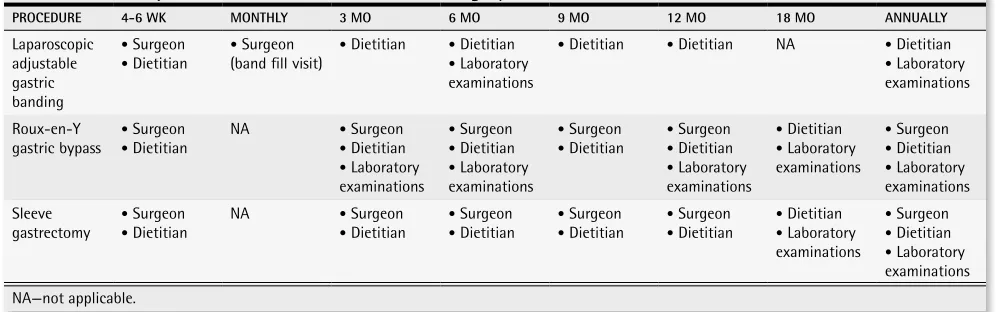
All bariatric patients are assessed by the surgeon 3 weeks after surgery to assess surgical wound healing and to rule out immediate postoperative complications (eg, abscess, infection, hernia). Thereafter, surgeon vis-its are scheduled every month for LAGB patients for band fills and every 3 months for RYGB and LSG patients (Table 2). Each visit focuses on weight loss and comor-bidity resolution. Furthermore, close attention is paid to determining changes in blood pressure, blood glucose levels, and mental health.
The registered dietitian sees all patients at 6 weeks, 3 months, and then every 3 months for the first year. Each visit includes a thorough assessment of caloric and pro-tein intake and an overall nutritional assessment.
Bloodwork (ie, complete blood count with differ-ential, electrolytes, fasting blood glucose, hemoglobin A1c, fasting lipid panel, creatinine, urea, albumin,
alan-ine aminotransferase, bilirubin, ferritin, vitamin B12, 25-hydroxyvitamin D, parathyroid hormone, calcium) is ordered at 3 months, 6 months, 1 year, and 18 months for RYGB and LSG patients. Laparoscopic adjustable gas-tric bandingpatients have the same bloodwork drawn at 6 months and 1 year. Annual bloodwork is then ordered on all patients thereafter.
Follow-up in our centre is lifelong, but visits with the surgeon and the registered dietitian are spread out to every 6 months after the first year.
Nutrition and supplementation
Patients should follow a well-balanced, calorie-reduced diet as part of a comprehensive weight man-agement strategy. Box 334 shows some nutritional
recommendations after bariatric surgery.
Vitamin and mineral supplementation is recommended for all restrictive procedures and is a lifelong requirement for combined or malabsorptive procedures. Bloodwork is recommended to detect and monitor for vitamin and mineral deficiencies with attention to iron (ie, complete blood count with differential, ferritin, iron, total iron-binding capacity, and percent of oxygen saturation), folic acid (folate), bone health (25-hydroxyvitamin D, calcium, and parathyroid hormone), and vitamin B12. Referral to a registered dietitian for nutrition counseling and supple-mentation is recommended.
Conclusion
The commonly held belief that obese individuals can lose weight by simply “eating less and moving more” is flawed and not supported by the literature.6 Bariatric
surgery should be considered for patients who have not achieved adequate weight loss with lifestyle and medi-cal management who are at high risk of morbidity and mortality, and who are suffering from the complica-tions of obesity. Success with bariatric surgery is more likely when multidisciplinary health care providers, in conjunction with primary health care providers, assess,
Box 3. Nutrition recommendations after bariatric
surgery
• Eat 4 to 5 times a day (3 small meals plus 1 to 2 small
snacks)
• Choose mostly solid food for meals and snacks • Limit intake of solid food to approximately 1 cup • Make time for meals and snacks to eat slowly
(15 to 30 minutes) and chew food well
• Avoid textures that are difficult to chew (eg, tough meats, stringy vegetables, soft breads)
• Avoid consuming fluids within 30 min of eating any solid
foods
• Consume beverages between meals and snacks • Avoid carbonated beverages
• Avoid higher-sugar foods
Adapted from Aills et al.34
Table 2. Follow-up recommendations after bariatric surgery
PROCEDuRE 4-6 WK MONthLy 3 MO 6 MO 9 MO 12 MO 18 MO ANNuALLy
Laparoscopic adjustable gastric banding
• Surgeon
• Dietitian
• Surgeon (band fill visit)
• Dietitian • Dietitian
• Laboratory examinations
• Dietitian • Dietitian NA • Dietitian
• Laboratory examinations Roux-en-Y
gastric bypass
• Surgeon
• Dietitian
NA • Surgeon
• Dietitian
• Laboratory examinations
• Surgeon
• Dietitian
• Laboratory examinations
• Surgeon
• Dietitian
• Surgeon
• Dietitian
• Laboratory examinations
• Dietitian
• Laboratory examinations
• Surgeon
• Dietitian
• Laboratory examinations Sleeve
gastrectomy
• Surgeon
• Dietitian NA
• Surgeon
• Dietitian
• Surgeon
• Dietitian
• Surgeon
• Dietitian
• Surgeon
• Dietitian
• Dietitian
• Laboratory examinations
• Surgeon
• Dietitian
treat, monitor, and evaluate individuals both before and after surgery.4,6,7,9 Family physicians should use the
expertise of their multidisciplinary care team to pro-mote and manage the health of their bariatric surgical patients. Further information that outlines procedures offered and referral methods can be obtained from the Canadian Obesity Network (www.obesitynetwork.ca) and the Canadian Association of Bariatric Physicians and Surgeons (www.cabps.ca).
Dr Karmali is an Assistant Professor of Surgery in the Department of Surgery at the University of Alberta in Edmonton. Mrs Johnson Stoklossa is a regis-tered dietitian in the Adult Weight Management Program and Bariatric Surgery Clinic at Capital Health in Edmonton. Dr Sharma is Professor of Medicine at the University of Alberta. Mrs Stadnyk is Program Leader of Primary Care, Nutrition and Food Service at Capital Health. Mrs Christiansen and Mrs Cottreau are registered dietitians at Capital Health. Dr Birch is an Associate Professor of Surgery in the Department of Surgery at the University of Alberta.
Contributors
All authors contributed to the literature search and preparation of the article for submission.
Competing interests
None declared
Correspondence
Dr Shahzeer Karmali, Department of Surgery, University of Alberta, 405 CSC, 10240 Kingsway Ave, Edmonton, AB T5H 3V9; e-mail [email protected]
references
1. Shields M. Measured obesity. Overweight Canadian children and adolescents. In: Statistics Canada. Nutrition: findings from the Canadian Community Health Survey. Catalogue No. 82-620-MWE2005001. Ottawa, ON: Statistics Canada; 2005. Available from: www.statcan.ca/english/research/82-620-MIE/2005001/pdf/cobesity. pdf. Accessed 2010 Jul 26.
2. Tremblay MS, Katzmarzyk PT, Willms JD. Temporal trends in overweight and obesity in Canada, 1981-1996. Int J Obes Relat Metab Disord 2002;26(4):538-43.
3. Canning PM, Courage ML, Frizzell LM. Prevalence of overweight and obesity in provincial population of Canadian preschool children. CMAJ 2004;171(3):240-2. 4. Lau DC, Douketis JD, Morrison KM, Hramiak IM, Sharma AM, Ur E. 2006 Canadian
clinical practice guidelines on the management and prevention of obesity in adults and children. CMAJ 2007;176(8):S1-13.
5. Padwal RS. Characteristics of patients undergoing bariatric surgery in Canada. Obes Res 2005;13(12):2052-4.
6. Gastrointestinal surgery for severe obesity: National Institutes of Health consensus development conference statement. Am J Clin Nutr 1992;55(2 Suppl):615S-9. 7. National Institutes of Health. Gastrointestinal surgery for severe obesity. Consensus
development conference panel. Ann Intern Med 1991;115(12):956-61. 8. National Institutes of Health; National Heart, Lung, and Blood Institute; National
Institute of Diabetes and Digestive and Kidney Diseases. Clinical guidelines on the identification, evaluation, and treatment of overweight and obesity in adults. The evi-dence report. Bethesda, MD: National Institutes of Health; 1998. Available from:
www.nhlbi.nih.gov/guidelines/obesity/ob_gdlns.pdf. Accessed 2010 Jul 26. 9. Mechanick JI, Kushner RF, Sugerman HJ, Gonzalez-Campoy JM, Collazo-Clavell
ML, Guven S, et al. American Association of Clinical Endocrinologists, The Obesity Society, and American Society for Metabolic & Bariatric Surgery medical guidelines for the clinical practice for the perioperative nutritional, metabolic and nonsurgical support of the bariatric surgery patient. Surg Obes Relat Dis 2008;4(5 Suppl):S109-84. 10. Flum DR, Salem L, Elrod JA, Dellinger EP, Cheadle A, Chan L. Early
mortal-ity among Medicare beneficiaries undergoing bariatric surgical procedures. JAMA
2005;294(15):1903-8.
11. Kral JG. Surgical treatment of obesity. In: Bray GH, Bouchard C, James WP editors.
Handbook of obesity. New York, NY: Marcel Dekker; 1997. p. 977-85.
12. Mason EE. Vertical banded gastroplasty for obesity. Arch Surg 1982;117(5):701-6. 13. Arias E, Martínez PR, Ka Ming Li V, Szomstein S, Rosenthal RJ. Mid-term
follow-up after sleeve gastrectomy as a final approach for morbid obesity. Obes Surg
2009;19(5):544-8. Epub 2009 Mar 12.
14. Colquitt J, Clegg A, Loveman E, Royle P, Sidhu MK. Surgery for morbid obesity.
Cochrane Database Syst Rev 2005;(4):CD003641. DOI:10.1002/14651858.CD003641. pub2.
15. Sjöström L, Lindroos AK, Peltonen M, Torgerson J, Bouchard C, Carlsson B, et al. Lifestyle, diabetes, and cardiovascular risk factors 10 years after bariatric surgery. N Engl J Med 2004;351(26):2683-93.
16. Champion JK, Williams M. Small bowel obstruction and internal hernias after laparoscopic Roux-en-Y gastric bypass. Obes Surg 2003;13(4):596-600.
17. Papasavas PK, Caushaj PF, McCormick JT, Quinlin RF, Hayetian FD, Maurer J, et al. Laparoscopic management of complications following laparoscopic Roux-en-Y gas-tric bypass for morbid obesity. Surg Endosc 2003;17(4):610-4. Epub 2003 Feb 17. 18. Spaw AT, Husted JD. Bleeding after laparoscopic gastric bypass: case report and
lit-erature review. Surg Obes Relat Dis 2005;1(2):99-103.
19. De Jong JR, van Ramshorst B, Gooszen HG, Smout AJ, Tiel-Van Buul MM. Weight loss after laparoscopic adjustable gastric banding is not caused by altered gastric emptying. Obes Surg 2009;19(3):287-92. Epub 2008 Oct 21.
20. Lim CS, Liew V, Talbot ML, Jorgensen JO, Loi KW. Revisional bariatric surgery. Obes Surg 2009;19(7):827-32. Epub 2008 Oct 30.
21. Foster G. Managing obesity. A clinical guide. Chicago, IL: American Dietetic Association; 2004.
22. Cummings S, Apovian CM, Khaodhiar L. Obesity surgery: evidence for diabetes prevention/management. J Am Diet Assoc 2008;108(4 Suppl 1):S40-4.
23. Micucci K, Kaye G, Miller M, Fernandez S. Predictors of weight loss in bariatric patients at the Ohio State University. J Am Diet Assoc 2007;107(8 Suppl 3):A84. 24. Seagle HM, Strain GW, Makris A, Reeves RS; American Dietetic Association.
Position of the American Dietetic Association: weight management. J Am Diet Assoc
2009;109(2):330-46.
25. Gleysteen JJ, Barboriak JJ. Improvement in heart disease risk factors after gastric bypass. Arch Surg 1983;118(6):681-4.
26. Pories WJ, Swanson MS, MacDonald KG, Long SB, Morris PG, Brown BM, et al. Who would have thought it? An operation proves to be the most effective therapy for adult-onset diabetes mellitus. Ann Surg 1995;222(3):339-50.
27. Buchwald H, Avidor Y, Braunwald E, Jensen MD, Pories W, Fahrbach K, et al. Bariatric surgery: a systematic review and meta-analysis. JAMA 2004;292(14):1724-37. 28. Charuzi I, Ovnat A, Peiser J, Saltz H, Weitzman S, Lavie P. The effect of surgical
weight reduction on sleep quality in obesity-related sleep apnea syndrome. Surgery
1985;97(5):535-8.
29. Sugerman HJ, Baron PL, Fairman RP, Evans CR, Vetrovec GW. Hemodynamic dys-function in obesity hypoventilation syndrome and the effects of treatment with sur-gically induced weight loss. Ann Surg 1988;207(5):604-13.
30. Carson JL, Ruddy ME, Duff AE, Holmes NJ, Cody RP, Brolin RE. The effect of gas-tric bypass surgery on hypertension in morbidly obese patients. Arch Intern Med
1994;154(2):193-200.
31. Jones KB Jr, Allen TV, Manas KJ, McGuinty DP, Wilder WM, Wadsworth ED. Roux-Y gastric bypass: an effective anti-reflux procedure. Obes Surg 1991;1(3):295-8. 32. Smith SC, Edwards CB, Goodman GN. Symptomatic and clinical improvement in
morbidly obese patients with gastroesophageal reflux disease following Roux-en-Y gastric bypass. Obes Surg 1997;7(6):479-84.
33. Vidal J, Ibarzabal A, Nicolau J, Vidov M, Delgado S, Martinez G, et al. Short-term effects of sleeve gastrectomy on type 2 diabetes mellitus in severely obese subjects.
Obes Surg 2007;17(8):1069-74.
34. Aills L, Blankenship J, Buffington C, Furtado M, Parrott J. ASMBS guidelines: ASMBS Allied Health nutritional guidelines for the surgical weight loss patient. Surg Obes Relat Dis 2008;4(5 Suppl):S73-108. Epub 2008 May 19.
EDITOR’S kEY POINTS
•
The rising incidence of obesity, as well as the
increasing number of those who have undergone
bariatric procedures, will lead to more family
phys-icians seeing more patients with questions about
bariatric surgery.
•
Lifestyle change is critical to success following
sur-gery, and patients will require lifelong support to
achieve this.
•
A high index of suspicion is essential when
abdom-inal pain, nausea, or vomiting occur in patients who
have had bariatric surgery. Referral to an obesity
clinic is recommended.
•
Patients must remain on the recommended
supple-ments for a lifetime. Routine laboratory assessment
is essential to determine nutritional status.
POINTS DE REPèRE DU RÉDACTEUR
•
Compte tenu de l’augmentation de l’incidence de
l’obésité et du nombre croissant de personnes ayant
subi une intervention bariatrique, les médecins de
famille auront de plus en plus à répondre à des
questions au sujet de ces interventions.
•
Un changement du mode de vie est essentiel pour
que ces interventions réussissent, et les patients
auront besoin de support toute leur vie pour y
arriver.
•
Il y a lieu d’être extrêmement attentif chez un
patient qui présente douleur abdominale, nausées
ou vomissements après une intervention bariatrique.
Un tel patient devra être dirigé à une clinique
d’obésité.
•