ABSTRACT
JANI, ARUN DILIPKUMAR. Winter Annual Legume Cover Crop Root Decomposition as a Function of Spring Termination Approach and Root Morphology. (Under the direction of Dr. Julie Grossman).
Winter annual legume cover crops have traditionally not been viewed as a major contributor to long-term soil organic carbon (SOC) due to their rapid rate of shoot decomposition. However, there is evidence that legume cover crop root residues decompose at a slower rate relative to shoots and estimates of legume cover crop-derived SOC based solely on shoot decomposition have led to an incomplete understanding of total legume cover crop contribution to long-term SOC. The objectives of this study were to (i) determine how traditional and novel legume cover crop termination approaches affect root decomposition rate (ii) gain greater understanding about the influential role of soil inorganic N in root decomposition (iii) characterize root morphological properties relevant to decomposition for Austrian winter pea (AWP) (Pisum sativum), crimson clover (CC) (Trifolium incarnatum) and hairy vetch (HV) (Vicia villosa Roth) and (iv) investigate decomposition rate of cover crop coarse and fine root fractions. To determine the effect of cover crop termination
decomposition rate at either site; neither did percent root N, root lignin/N and root C/N ratio improve the prediction of decomposition rate for cover crop species. Root decomposition was best characterized at both sites by a double exponential, four parameter model. In Goldsboro, roots from all species decomposed at similar rates, while in Kinston CC
decomposed faster than other species. To determine root morphological characteristics, two greenhouse studies were conducted in which plants were grown in PVC cylinders in a
completely randomized design. Roots were harvested and root morphological characteristics were determined. Cover crop species did not differ in root morphological properties.
However, in both studies, all cover crop species had greater than 70% fine roots (< 1-mm), which have been reported to have high turnover. A 12-week temperature, light, and
humidity-controlled incubation study with soil from the Goldsboro field site was conducted to better understand decomposition dynamics of coarse and fine root fractions of CC and HV. Half of treatments received urea (CH4N2O) at a rate of 133 µg/cm3 (200 kg N/ha). Samples were collected at 1, 2, 3, 4, 8, and 12 weeks after root litterbag burial. Fine roots
decomposed faster than coarse roots for both species and after 12 weeks greater HV root mass remained compared to CC when averaged across root size fractions and N treatments. Root C/N and lignin/N ratios served as valuable predictors for root decomposition as fine roots (lower C/N) decomposed faster than coarse roots (higher C/N). There was no evidence that soil inorganic N addition affected root decomposition. Incubation studies are an
Winter Annual Legume Cover Crop Root Decomposition as a Function of Spring Termination Approach and Root Morphology
by
Arun Dilipkumar Jani
A thesis submitted to the Graduate Faculty of North Carolina State University
in partial fulfillment of the requirements for the degree of
Master of Science
Soil Science
Raleigh, North Carolina 2013
APPROVED BY:
_______________________________ ______________________________
DEDICATION
In loving memory of my mentors, Captain Thomas Sankara and Amilcar Cabral, fearless champions of the voiceless and men whose courage was surpassed only by their
BIOGRAPHY
ACKNOWLEDGMENTS
I would like to thank the following people for the help and support on this work, without them this work would not have been possible
Julie Grossman Shuijin Hu Thomas Jot Smyth Consuelo Arrelano
Lisa Lentz Guillermo Ramirez
Sarah Seehaver Grossman Lab group
TABLE OF CONTENTS
LIST OF TABLES ... viii
LIST OF FIGURES ... ix
CHAPTER 1: WINTER ANNUAL LEGUME COVER CROP ROOT DECOMPOSITION UNDER TRADITIONAL AND NOVEL TERMINATION APPROACHES: A REVIEW ... 1
Winter Annual Legume Cover Crops in Sustainable Agriculture ... 1
Benefits of incorporating legume cover crops into farming systems ... 1
Factors Affecting Legume Cover Crop-Derived SOC Retention in Soils ... 3
Climatic controls on SOC decomposition... 3
Plant litter biochemical composition and decomposition ... 4
Rate of plant litter decomposition ... 6
Soil physical properties and decomposition ... 8
Soil inorganic N status and decomposition ... 10
Decomposition Dynamics of Root Material ... 11
Historical bias toward only quantifying shoot material ... 11
Root contributions to long-term SOC ... 12
Drivers of long-term root-derived C storage in soil... 13
Decomposition dynamics of coarse and fine roots ... 15
Winter Annual Legume Cover Crop Spring Termination ... 17
Traditional and novel termination methods in sustainable cropping systems ... 17
Conclusions ... 19
References ... 21
CHAPTER 2: WINTER ANNUAL LEGUME COVER CROP DECOMPOSITION DYNAMICS UNDER TRADITIONAL AND NOVEL TERMINATION APPROACHES ... 28
Introduction ... 28
Materials and Methods ... 31
Field site and experimental setup ... 31
Root litter collection and burial ... 32
Root litter chemical analysis ... 33
Statistical analysis ... 35
Results ... 37
Root decomposition dynamics ... 37
Root chemistry ... 38
Soil inorganic N ... 39
Discussion... 40
Root decomposition ... 40
Root litter chemistry ... 44
Soil inorganic N content ... 45
Conclusions ... 48
Acknowledgements ... 48
References ... 49
CHAPTER 3: WINTER ANNUAL LEGUME COVER CROP COARSE AND FINE ROOT DECOMPOSITON AS A FUNCTION OF SOIL INORGANIC NITROGEN ... ...69
Introduction ... 69
Materials and Methods ... 72
Root morphology analysis ... 72
Root collection and initial chemistry analysis for incubation study ... 73
Soil collection ... 74
Soil water container capacity determination ... 74
Experimental setup... 75
Root processing and soil analysis ... 75
Soil inorganic N measurements ... 76
Environmental conditions and statistical analysis ... 77
Results ... 77
Root morphological analysis... 77
Root decomposition and chemistry ... 78
Soil inorganic N measurements ... 79
Discussion... 80
Root litter chemistry and decomposition ... 80
Soil inorganic N measurements ... 84
Conclusions ... 84
Acknowledgements ... 85
LIST OF TABLES
Table 2-1: Field activities for root decomposition study ... 66 Table 2-2: Factors investigated at Goldsboro and Kinston, NC study sites ... 67 Table 2-3: Initial chemical characteristics and final root N mass remaining for Austrian
winter pea (AWP), crimson clover (CC), and hairy vetch (HV) root biomass used in Goldsboro and Kinston field sites ... 68 Table 3-1: Root morphology and incubation study activities ... 101 Table 3-2: Legume cover crop root morphology characteristics relevant to decomposition ...
...102 Table 3-3: Initial root litter chemical characteristics and root mass N dynamics for crimson
LIST OF FIGURES
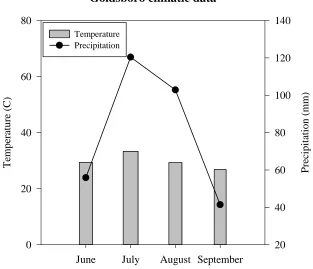
Figure 2-1: Monthly means of daily maximum air temperature (C°) and total monthly precipitation for CEFS study site in Goldsboro, NC site. Data from May 25-31 were added to June. September 13, 2012 was the last sampling date ... 54 Figure 2-2: Monthly means of daily maximum air temperature (C°) and total monthly
precipitation for Caswell Research Farm study site in Kinston, NC. Data were taken May 2 to August 23 ... 55 Figure 2-3: Root decomposition in cover crop fertility and bare, control (N00) plots as a
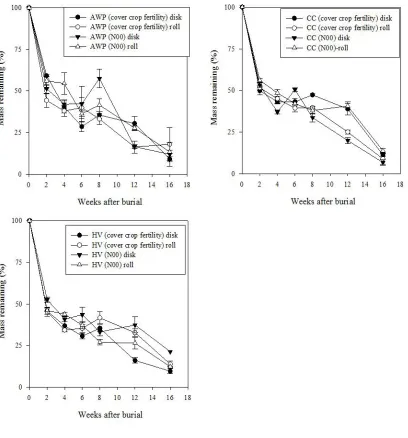
function of termination method at Goldsboro site. Error bars represent one standard error of the mean ... 56 Figure 2-4: Austrian winter pea (AWP), crimson clover (CC), and hairy vetch (HV) root
decomposition in Goldsboro (top) and Kinston (bottom) cover crop fertility plots averaged across termination methods ... 57 Figure 2-5: Austrian winter pea (AWP), crimson clover (CC), and hairy vetch (HV) root
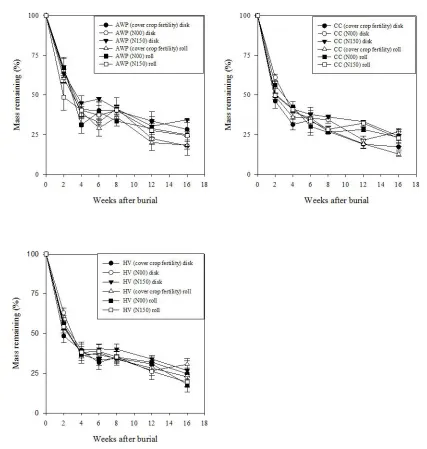
decomposition in cover crop fertility and control (N00, N150) plots, Kinston site. Error bars represent one standard error of the mean ... 58
Figure 2-6: Root decomposition in cover crop fertility and bare, control plots as a function of termination method at Kinston site. Error bars represent one standard error of the mean ... 59 Figure 2-7: Percent root mass remaining over time averaged across termination method in
Goldsboro and Kinston cover crop fertility plots. Symbols correspond to means fit to a double exponential four term parameter model. Error bars represent one standard error of the mean ... 60 Figure 2-8: Austrian (AWP), crimson clover (CC), and hairy vetch (HV) root C/N ratio
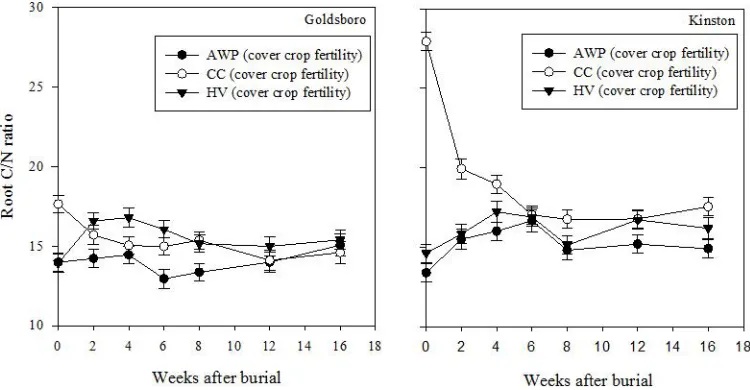
dynamics from cover crop fertility plots and averaged over kill methods in Goldsboro (left) and Kinston (right). Error bars represent one standard error of the mean ... 61 Figure 2-9: Root N remaining in Austrian winter pea (AWP), crimson clover (CC), and hairy
vetch (HV) cover crop fertility treatment plots averaged over termination
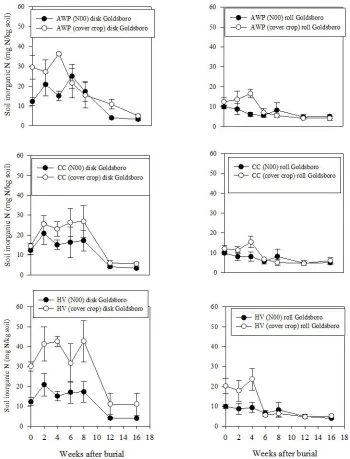
Figure 2-10: Soil inorganic N (NH4+ + NO3-) change over time as a function of termination method in control and treatment plots for Austrian winter pea (AWP), crimson clover (CC), and hairy vetch (HV) at Goldsboro site. Zero-N (N00) plots were bare without a cover crop, while cover crop plots had cover crop residue. Error bars represent one standard error of the mean ... 63 Figure 2-11: Austrian winter pea (AWP), crimson clover (CC), and hairy vetch (HV) soil
inorganic N (mg N/kg soil) change over time as a function of termination method in cover crop fertility plots in Goldsboro. Error bars represent one standard error of the mean ... 64 Figure 2-12: Soil inorganic N (mg N/kg soil) fluctuation over time as a function of cover
crop fertility treatment and termination method in Kinston. Error bars represent one standard error of the mean... 65
Figure 3-1: Volumetric soil water content as a function of cylinder depth for Wickham loamy sand (sieved to pass 2-mm) used in incubation study ... 91 Figure 3-2: Decomposition of crimson clover (CC) and hairy vetch (HV) coarse and fine root
fractions averaged over N treatments. Error bars represent one standard error of
the mean ... 92 Figure 3-3: Effect of initial soil inorganic N addition (200 kg/ha) on decomposition of
crimson clover (CC) and hairy vetch (HV) coarse and fine root fractions. Error bars represent one standard error of the mean ... 93
Figure 3-4: Relationship between soil inorganic N content and root mass decomposition reported as percent of original mass remaining for crimson clover (CC) and hairy vetch (HV) coarse and fine root fractions with (+ N) and without (- N) initial N additions over 12-week study period ... 94 Figure 3-5: Root C/N ratio fluctuation over time for crimson clover (CC) and hairy vetch
(HV) coarse and fine root fractions. Error bars represent one standard error of the mean ... 95 Figure 3-6: Coarse and fine root C/N dynamics averaged across species and N treatments as a function of time. Error bars represent one standard error of the mean... 96
Figure 3-8: Root N release (mg) from crimson clover (CC) and hairy vetch (HV) coarse and fine root fractions averaged over N treatments. Error bars represent one standard error of the mean ... 98 Figure 3-9: Soil inorganic N fluctuation over time for treatments with and without initial N
addition. Error bars represent one standard error of the mean ... 99
CHAPTER 1: WINTER ANNUAL LEGUME COVER CROP ROOT
DECOMPOSITION UNDER TRADITIONAL AND NOVEL TERMINATION APPROACHES: A REVIEW
Winter Annual Legume Cover Crops in Sustainable Agriculture
Benefits of incorporating legume cover crops into farming systems
Winter annual legume cover crops are an integral component of soil fertility management programs in organic cropping systems. Producers depend on these cover crops, which include Austrian winter pea (Pisum sativum), crimson clover (Trifolium incarnatum), and hairy vetch (Vicia villosa Roth), to furnish essential plant nutrients, particularly nitrogen (N), for subsequent cash crops (Ranells and Wagger 1993; Wagger et al. 1998). Integration of legume cover crops into farming systems enhances long-term agronomic productivity, decreases reliance on mineral fertilizers, contributes sequestration of atmospheric CO2, and improves farmer livelihood (Puget and Drinkwater 2001; Kong and Six 2010).
Estimates of legume cover crop contribution to soil organic carbon (SOC) have generally not included roots, which have led to an incomplete understanding of total legume cover crop contribution to long-term SOC. Roots have been reported to account for at least 30% of total legume cover crop biomass (Puget and Drinkwater 2001), and it is also widely reported that roots decompose at a slower rate than shoots across several plant functional groups (Balesdent and Balabane 1996; Lu et al. 2003; Abiven et al. 2005; Williams et al. 2006). It is, therefore, crucial to include roots into estimates of legume cover crop residue contribution to soil in order to gain greater insight into the potential of legume cover crops to build long-term SOC.
Soil organic carbon is critical to ensuring high levels of agricultural productivity due to its positive effect on soil physical and chemical properties (Sullivan 2003). SOC is associated with greater soil biodiversity, increased soil water and nutrient holding capacity, decreased crusting and erosion, and improved soil aggregate stability, which leads to deeper and more prolific root systems and greater agricultural production (Sullivan 2003; Lal 2008; Alcàntara 2011). The objective of this literature review is to discuss root decomposition dynamics of winter annual legume cover crops common in Southeastern US farming systems. Specifically, it will discuss factors contributing to legume cover crop
Factors Affecting Legume Cover Crop-Derived SOC Retention in Soils
Climatic controls on SOM decomposition
Residence time of cover crop-derived SOC is influenced by several abiotic and biotic factors including climate and soil environmental conditions (Schmidt et al. 2011; Dungait et al. 2012), plant litter biochemical composition (Fujimaki et al. 2008), soil physical and chemical properties (Sanaullah et al. 2011; Rasse et al. 2005), decomposer organism and catalytic enzyme accessibility to plant biomass (Georgieva et al. 2005), and soil nutrient status, particularly N (Fog 1988; Mary et al. 1996). Models of SOC decomposition dynamics, such as the CENTURY model, suggest that climate, particularly temperature and moisture, is the single best predictor of crop residue decomposition across large geographical regions
(Gijsman et al. 1997; Berg and McClaugherty 2008; Fujimaki et al. 2008; Wang et al. 2010). For example, constant freezing temperatures in permafrost regions lead to low plant residue decomposer activity, which explains why permafrost soils store as much SOC as that
It is likely that relative importance of moisture and temperature on crop residue decomposition depends on existing climatic conditions. In humid regions, for example, decomposition responds to elevated temperature, while in arid or semi-arid regions decomposition responds primarily to moisture (Gill and Burke 2002). This temperature effect could potentially accelerate legume cover crop decomposition in the very humid Southeastern US.
The significance of this climatic effect on litter decomposition is more pronounced at the soil surface than within the soil profile (Fujii and Takeda 2010). Within the confines of a specific climatic zone, variables such as temperature and moisture, have a greater effect on decomposing surface litter compared to roots since decomposer communities within the soil are buffered from extremes in temperature and precipitation relative to surface litter (Silver and Miya 2001; Fornara et al. 2009). Climatic factors, especially temperature and moisture, play a crucial role in controlling rate of plant litter decomposition and must be considered when investigating plant litter decomposition dynamics.
Plant litter biochemical composition and decomposition
(Paul and Clark 2007; Sylvia et al. 2004; Abiven et al. 2005). There is great variability in decomposition rates of different carbohydrate components ranging from a few hours (simple sugars and fructans) to several weeks (cellulose) with hemicelluloses having intermediate decomposition rates (Berg et al. 1987; Gunnarsson and Marstorp 2002). Generally, higher concentrations of soluble cell components (simple sugars), hemicelluloses, and protein favor more rapid decomposition rate of plant materials, while elevated lignin decreases
decomposition rates (Herman et al. 1977; Sylvia et al. 2004). Plant biochemical composition helps to explain why shoot and root residues from legume cover crops such as white clover and crimson clover (high protein, low lignin) decompose more rapidly than ryegrass (low protein, high lignin) (Buchanan and King 1993; Rasmussen et al. 2010). Variation in
decomposability of different carbohydrate components is an important factor to consider as it may influence N mineralization in plant proteins (Gunnarsson and Marstorp 2002).
The importance of initial C, N, and lignin content on plant biomass decomposition has long been recognized (Urquiaga et al. 1998; Abiven et al. 2005; Soto et al. 2005). Measurements of C/N and lignin/N ratios can predict cover crop residue decomposition (Puget and Drinkwater 2001; Berg and McClaugherty 2008; Fujii and Takeda 2010) whereas plant litter decomposition has been positively correlated with tissue N status across a plethora of species (Fornara et al. 2009; Dodd and Mackay 2011). Lignin, however, is hydrophobic and has a nonspecific structure, which makes it difficult for catalytic enzymes to attack (Metting, Jr. 1993; Paul 2007). It is usually chemically-connected to carbohydrates such as cellulose and hemicelluloses and it provides resistance to decomposition of these
Lignin has traditionally been viewed as a major component of plant-derived SOC, influencing both its pool size and its turnover, although recent findings suggest this lignin effect may be over-estimated (Thevenot et al. 2010). During decomposition of plant litter, lignin concentration generally increases as readily decomposable carbohydrates are
consumed (Berg et al. 1987; Abiven et al. 2005). Generally as lignin/N and C/N ratio increases, plant litter rate of decomposition and nutrient mineralization decreases. However, Palm and Sanchez (1991) reported that polyphenol and polyphenol/N ratio served as the best predictors of tropical legume shoot N mineralization. Decomposition and N mineralization is typically predicted if C/N < 25/1 (Soto et al. 2005). For example, white clover roots (C/N = 15) have been shown to decompose twice as fast as rye grass roots (C/N = 38) under field conditions (Rasmussen et al. 2010). Buchanan and King (1993), however, have reported significantly greater decomposition rates for crimson clover shoots (C/N = 14) compared to roots (C/N = 17), which may be explained by roots significantly higher lignin/N ratio compared to shoots, 5.3 and 2.5, respectively. Lu et al. (2003) reported similar results with rice straw and root residues. Plant biochemical composition, therefore, serves as a valuable aid in predicting and explaining decomposition patterns in cover crop biomass, especially when root biochemical composition is included in the model.
Rate of plant litter decomposition
as an initial exponential decomposition rate followed by a much slower phase (Andrén et al. 1992; Lu et al. 2003). For example, Berg et al. (1987) reported an initial rate (first two weeks) of red clover root decomposition that was 40 times greater than decomposition at later stages. During this initial rapid decomposition period, the easily decomposable materials including simple carbohydrates, some hemicelluloses, and proteins are easily metabolized by soil microorganisms (Metting, Jr. 1993; Paul and Clark 2007).
Decomposition then slows considerably after this period as the proportion of lignin and lignin-complexes increases (Berg et al. 1987; Abiven et al. 2005). In fact, C/N ratio, which is a good predictor of early rates of decomposition, is often not correlated with
decomposition rates during later stages (Mary 1996; Gorissen and Cotrufo 2000; Schmidt et al. 2011; Creamer et al. 2013). Plant lignin concentration plays a more pivotal role than litter C/N ratio during later stages of decomposition (Herman et al. 1977; Mary et al. 1996). In terms of litter biochemical properties, lignin likely plays a greater role in controlling decomposition during these later stages because easily decomposable C sources have been consumed by decomposer communities.
Soil physical properties and decomposition
Soil physical properties such as texture and structure can have a profound effect on decomposition both directly and through their interactions with other drivers of
decomposition. Soil texture and structure are unlikely to significantly affect surface litter decomposition due to limited surface litter-soil contact, but decomposition of belowground plant biomass is likely to be heavily influenced by these soil physical properties (Gijsman et al. 1997). Soil texture directly influences soil water holding capacity and drainage, soil surface area, and overall surface charge (Coyne 1999; Schmidt et al. 2011). Furthermore, these properties vary with depth within the soil profile leading to site-specific rates of decomposition (Gill and Burke 2002; Sanaullah et al. 2011). Finer textured soils have smaller average pore size and have higher water content for a given soil water potential, which is conducive to high cover crop biomass productivity and subsequent SOC
does not readily complex to the coarse mineral fraction due to its low surface charge (Creamer et al. 2012).
Soil inorganic N status and decomposition
Legume cover crops deposit large quantities of N into the soil as they decompose and evidence suggests a positive relationship between soil inorganic N status and plant litter decomposition rate (Herman et al. 1977; Fog 1988; Mary 1996). This fertility effect, however, has not always been empirically supported (Recous et al. 1995; Gorissen and Cotrufo 2000; Dodd and Mackay 2011). Nitrogen additions to soil are known to stimulate microbial activity and subsequent plant litter decomposition (Dignac 2002). Soil inorganic N is utilized by soil microorganisms in decomposition of residues, but if soil inorganic N is insufficient, catabolized litter will be inefficiently assimilated into microbial biomass (Paul and Clark 2007; Sylvia et al. 2004; Williams et al. 2006). This principle of soil inorganic N limitation on plant litter decomposition is observed across plant functional groups. In both grass and legume systems, for example, C/N ratio of soil has been shown to be positively related to total living root biomass and negatively related to root biomass loss (Fornara et al. 2009). Soil inorganic N status must be taken into account when seeking to predict or explain decomposition of plant litter.
Soil inorganic N concentration varies considerably during plant litter decomposition due to constant N flux between organic and inorganic forms. Plant-derived N is mineralized, immobilized, and remineralized concurrently by microorganisms and the rate of these
processes depends partly on the quality of residue and stage of litter decomposition
decreases leading to remineralization of plant-derived immobilized N into the soil (Malpassi et al. 2000). Remineralization of immobilized NO3- is most rapid when soil inorganic N is not a limiting factor to microbial growth (Zagal and Persson 1994). In other words, under high soil inorganic N conditions, immobilized N is quickly released back into the soil inorganic N pool. This pattern does not hold true under low soil N conditions. Under low soil inorganic N concentration, decomposition rate of plant residues decreases, but doesn’t stop and immobilization intensity is reduced leading to delay in N remineralization (Mary et al. 1996). Through an understanding of leguminous cover crop residue quality and its
associated changes on a temporal scale as well as soil inorganic N status, it is possible to gain better insight into the decomposition dynamics of plant litter.
Decomposition Dynamics of Root Material
Historical bias toward only quantifying shoot material
rates (Fornara et al. 2009; Wang et al. 2010) which could lead to underestimates of total root production at sampling.
Apart from these logistical difficulties in collecting roots, the historical perception has also been that leguminous cover crop roots represent only a small fraction (5-15%) of total plant N and that shoot N can provide a reasonable estimate of total cover crop N (Peoples et al. 2009). Recent evidence, however, suggests that this perception of roots has been
erroneous and roots can furnish large quantities of N agro-ecosystems (Silver and Miya 2001; Kähkölä et al. 2012). Peoples et al. (2009) report that total N inputs associated with or derived from nodulated roots can account for 30-50% of total plant N in pasture and crop legumes. Despite this evidence for leguminous cover crop root relevance from a nutrient cycling perspective, understanding of leguminous cover crop root detritus N dynamics is still very limited.
Root contributions to long-term SOC
roots have been reported to contribute 1.5 times that of stalks and leaves to SOC and this is attributed to relatively high rhizo-deposition and slower rates of root decay (Balesdent and Balabane 1996).
Drivers of long-term root-derived C storage in soil
The primary drivers responsible for greater root contributions to long-term SOC, relative to shoots are the rhizosphere environment and differences in root biochemical composition compared to shoots. Plant litter physical properties such as particle size (root thickness and mean straw length) have traditionally not been included in decomposition models (Andrén et al. 1992). This exclusion has been especially problematic for predicting root decomposition since this process correlates very strongly to root particle size (Hobbie et al. 2008;
Rasmussen et al 2010). Models that simply rely on initial C/N ratio to predict decomposition have proven inadequate in predicting root decomposition for not considering unique
chemical characteristics of root tissue (Abiven et al. 2005). Silver and Miya (2001) assert that models utilized to describe aboveground biomass decomposition may not accurately describe root decomposition dynamics due to the different environments these two plant components occupy. These two unique environments generate different physicochemical conditions and associated decomposer communities (Fujii and Takeda 2010). Root-derived SOC is preferentially stored within soil aggregates due to root-soil contact during aggregate formation (Sanaullah 2011). The unique physicochemical characteristics of the soil
Longer-term residence time of root-derived SOC compared to shoot-derived SOC is most often attributed to greater recalcitrance of root litter compared to shoot litter (Buchanan and King 1993; Lu et al. 2003). Roots exist in a very different environment from shoots and they perform fundamentally different physiological functions, which could explain some of these differences in chemical composition (Silver and Miya, 2001; Horwath et al., 2007). Roots contain a high concentration of suberin, for example, which complexes with lignin to create structurally dynamic, impermeable barriers that protect the plant from harmful
substances diffused from the soil (Abiven et al. 2005). This suberin-lignin complex is highly resistant to decomposition. Results of a legume cover crop decomposition study by Kong and Six (2010) reveal the importance root recalcitrance. In the investigation, 52% of hairy vetch-derived SOC remaining at the end of the maize growing season compared to just 4% of shoot-derived residue using 13C tracers. Root biomass, if considered across all particle sizes, generally has biochemical properties that lend it more relevant in determining long-term SOC pools (Balesdent and Balabane 1996; Abiven et al. 2005; Fujii and Takeda 2010).
Thorough analysis of rhizosphere ecology provides greater insight into the significance of root litter biochemistry in determining SOC pools. Roots death and
decomposition occurs continuously in the rhizosphere. The rhizosphere has an abundance of readily available C-rich substrates through sloughed off plant cells and compounds released by plant roots (Sylvia et al. 2004; Paul and Clark 2007; Cardon and Whitbeck 2007). Van der Krift et al. (2002) found that living roots of grass species accelerated dead root
decomposition through the former’s stimulation of decomposer microbial biomass via C
decomposer microbial community, which creates an environment conducive to rapid decomposition. Root biomass, however, contributes greater amounts to SOC than shoots, which underscores the importance of root biochemical composition in controlling
decomposition.
Considering that root and shoot materials have different biochemical properties, it is within reason to expect that they would contribute differently to the long-term biochemical composition of SOC. Abiven et al. (2005) reported different C and N mineralization dynamics for leaf, stem, and root decomposition across a wide range of species, but did not investigate how these plant components affected SOC composition. In forest systems, fine root components have been shown to contribute more than foliar material to specific protein markers during initial stages of decomposition (Mambelli et al. 2011). Clemente et al. (2012) found that changes in SOC composition over time relates to plant biochemical
composition and that maize roots contributed greater quantities of microbe-derived SOC than maize leaf and stem materials. These investigations provide insight into the role that root and shoot components have in influencing the composition of SOC.
Decomposition dynamics of coarse and fine roots
et al. 2010). Strict definitions, however, should be avoided due to heterogeneity between species (Berg 2008). Fine roots, for example, have also been reported as < 1-mm (Berg et al. 1987).
Fine roots often have quick turnover rates and play a pivotal role in nutrient cycling (Silver and Miya 2001; Fornara et al. 2009). Rasmussen et al. (2010) asserts that in ryegrass and clover mixes, coarse roots determine SOC pool build-up, while fine roots determine soil N pool build-up. Decomposition behavior of coarse and fine roots is often explained by reference to tissue biochemistry. Fine roots have biochemical composition that is more conducive to decomposition than coarse roots. Legume cover crops have been reported to contain 1.1 – 1.3% and 3.4 – 3.7% N in coarse and fine roots, respectively (Gardner and Sarrantonio 2012). Fine roots of several forest species have also been reported to have significantly higher % N and lower C/N than corresponding coarse roots (Fujimaki et al. 2008). Wang et al. (2010) and Hobbie et al. (2010) have reported correlations between fine roots and leaf litter in nutrient content as well as specific root length and specific leaf area in forest systems, but similar correlations of leaf and fine root decomposition have been
inconsistent.
reaches its peak, but the effect that higher soil inorganic N content has on decomposition of legume cover crop roots is poorly understood.
Winter Annual Legume Cover Crop Spring Termination
Traditional and novel termination methods in sustainable cropping systems
In organic farming systems of the Southeastern US, producers use traditional and novel methods to terminate winter annual leguminous crops. Disking is a traditional cover crop termination strategy common in organic cropping systems in which a mechanical disk incorporates shoot residues into the soil. This method leads to stimulation of microbial activity due to improved soil aeration and an infusion of cover crop substrate materials (Georgieva et al. 2005; Paul and Clark 2007) and results in rapid residue decomposition (Buchanan and King 1993). Termination methods such as herbicide spraying or flailing produce surface mulch that decomposes slower due to less residue soil contact. During residue decomposition in disked systems, larger quantities of cover crop N are mineralized and at a faster rate compared to traditional herbicide spray systems (Sullivan 2003).
The end result is greater uniformity in pore size distribution with a dominance of medium sized pores and the absence of smaller pores that are most effective at sequestering long-term SOC (Ananyeva et al. 2013).
Terminating cover crops with a tractor-mounted implement called a roller-crimper is a novel approach that has been gaining popularity due to its proven effectiveness in weed suppression (Ashford and Reeves 2003; Mirsky et al 2011). The implement is a cylindrical drum with chevron shaped blades that rolls over and crimps cover crop stems when the crop is in full bloom leaving plants flattened on the soil surface as protective mulch (Davis 2010; Parr et al. 2011). Mulching correlates strongly with improved soil water holding capacity, enhanced soil aggregate stability, and long persistence of SOC (Buchanan and King 1993; Metting, Jr. 1993; Kornecki et al. 2009). Small grains or other horticultural crops can be directly planted into crimped fields. Crimping reduces or eliminates herbicide usage (Mirsky et al. 2009; Mirsky et al. 2011) offering the possibility of no-till organic farming systems. If the roller-crimper is going to be utilized as a cover crop termination strategy, it is crucial to ensure that cover crops are not left standing, which may entail multiple passages over a field. Persistence of leguminous cover crops such as hairy vetch in improperly crimped systems has led to reduced maize stand counts and yields (Mirsky et al. 2009; Parr et al. 2011).
217 kg ha-1) furnished by different legume cover crops in roller-crimped systems (Parr et al. 2011). Considering the different soil physical and environmental conditions that are
generated in disked and roller-crimped systems in addition to potential variability in soil N cycling within each system, it is within reason to expect that legume cover crop root residues would decompose differently under these different management strategies.
Conclusions
Winter annual legume cover crops such Austrian winter pea (Pisum sativum), crimson clover (Trifolium incarnatum), and hairy vetch (Vicia villosa Roth) are known to improve both short-term and long-term agricultural productivity through provision of essential crop nutrients, particularly N, and abundant crop residues which potentially contribute to long-term SOC depending on decomposition dynamics. It is likely that estimates of legume cover crop residue contribution to long-term SOC pools has been significantly underestimated due to an incomplete understanding of root biomass contributions in legume cover crop systems (Rasmussen et al. 2010; Ranells and Wagger 1993). While numerous factors influence legume cover crop root litter decomposition, it is crucial to realize interactions of such factors and that root system decomposition is an intrinsic ecosystem property (Schmidt et al 2011; Dungait et al. 2012).
Differences in biochemical composition between root size fractions have been attributed to their different decomposition characteristics (Kong and Six 2010; Rasmussen et al. 2010). Despite their importance in organic farming systems, decomposition of
has occurred (Berg et al. 1987) has not considered the relevance of soil inorganic N status on root decomposition. Considering that the soil environment in the weeks following kill may be N-rich after input of legume biomass, rates of decomposition are expected to vary.
References
Abiven S, Recous S, Reyes V, Oliver R. Mineralisation of C and N from root, stem and leaf residues in soil and role of their biochemical quality. Biol Fertility Soils.
2005;42(2):119-128. doi: 10.1007/s00374-005-0006-0.
Alcantara C, Pujadas A, Saavedra M. Management of cruciferous cover crops by mowing for soil and water conservation in southern spain. Agric Water Manage.
2011;98(6):1071-1080. doi: 10.1016/j.agwat.2011.01.016.
Ananyeva K, Wang W, Smucker AJM, Rivers ML, Kravchenko AN. Can intra-aggregate pore structures affect the aggregate's effectiveness in protecting carbon? Soil Biology & Biochemistry. 2013;57:868-875. doi: 10.1016/j.soilbio.2012.10.019.
Andren O, Steen E, Rajkai K. Modeling the effects of moisture on barley straw and root decomposition in the field. Soil Biology & Biochemistry. 1992;24(8):727-736. doi: 10.1016/0038-0717(92)90246-T.
Ashford DL, Reeves D. Use of a mechanical roller-crimper as an alternative kill method for cover crops. Am J Alternative Agric. 2003;18(1):37-37.
Balesdent J, Balabane M. Major contribution of roots to soil carbon storage inferred from maize cultivated soils. Soil Biology & Biochemistry. 1996;28(9):1261-1263. doi: 10.1016/0038-0717(96)00112-5.
Berg B, Muller M, Wessen B. Decomposition of red-clover (trifolium-pratense) roots. Soil Biology & Biochemistry. 1987;19(5):589-593. doi: 10.1016/0038-0717(87)90103-9.
Berg B, McClaugherty C. Plant litter: decomposition, humus formation, carbon sequestration 2nd edition. Springer. 2008.
Bocock KL, Gilbert OJW. The disappearance of leaf litter under different woodland conditions. Plant Soil. 1957;9(2):179-185. doi: 10.1007/BF01398924.
Buchanan M, King L. Carbon and phosphorus losses from decomposing crop residues in no-till and conventional no-till agroecosystems. Agron J. 1993;85(3):631-638.
Cardon ZG, Whitbeck JL. The Rhizosphere: an ecological perspective 3rd edition. Academic Press, 2007.
Coyne MS. Soil Microbiology: an exploratory approach. Delmar, 1999.
Craine J, Fierer N, McLauchlan K. Widespread coupling between the rate and temperature sensitivity of organic matter decay. Nature Geoscience. 2010;3(12):854-857. doi: 10.1038/NGEO1009.
Creamer CA, Filley TR, Boutton TW. Long-term incubations of size and density separated soil fractions to inform soil organic carbon decay dynamics. Soil Biology &
Biochemistry. 2013;57:496-503. doi: 10.1016/j.soilbio.2012.09.007.
Davis AS. Cover-crop roller-crimper contributes to weed management in no-till soybean. Weed Sci. 2010;58(3):300-309. doi: 10.1614/WS-D-09-00040.1.
Daynes CN, Field DJ, Saleeba JA, Cole MA, McGee PA. Development and stabilisation of soil structure via interactions between organic matter, arbuscular mycorrhizal fungi and plant roots. Soil Biology & Biochemistry. 2013;57:683-694. doi:
10.1016/j.soilbio.2012.09.020.
Dodd MB, Mackay AD. Effects of contrasting soil fertility on root mass, root growth, root decomposition and soil carbon under a new zealand perennial ryegrass/white clover pasture. Plant Soil. 2011;349(1-2):291-302. doi: 10.1007/s11104-011-0873-0. Dungait JAJ, Hopkins DW, Gregory AS, Whitmore AP. Soil organic matter turnover is
governed by accessibility not recalcitrance. Global Change Biol. 2012;18(6):1781-1796. doi: 10.1111/j.1365-2486.2012.02665.x.
DuPont ST, Culman SW, Ferris H, Buckley DH, Glover JD. No-tillage conversion of harvested perennial grassland to annual cropland reduces root biomass, decreases active carbon stocks, and impacts soil biota. Agriculture Ecosystems & Environment. 2010;137(1-2):25-32. doi: 10.1016/j.agee.2009.12.021.
Fog K. The effect of added nitrogen on the rate of decomposition of organic matter.
Biological Reviews. 1988;63(3):433-462. doi: 10.1111/j.1469-185X.1988.tb00725.x.
Fornara DA, Tilman D, Hobbie SE. Linkages between plant functional composition, fine root processes and potential soil N mineralization rates. J Ecol. 2009;97(1):48-56. doi: 10.1111/j.1365-2745.2008.01453.x.
Fujii S, Takeda H. Dominant effects of litter substrate quality on the difference between leaf and root decomposition process above- and belowground. Soil Biology &
Fujimaki R, Takeda H, Wiwatiwitaya D. Fine root decomposition in tropical dry evergreen and dry deciduous forests in Thailand. Journal of Forest Research. 2008;13(6):338-346. doi: 10.1007/s10310-008-0087-3.
Gaskell M, Mitchell J, Smith R, Koike S, Fouche C. Soil fertility management for organic crops. University of California Agriculture and Natural Resources. 2007; Publication 7249.
Gardner M, Sarrantonio M. Cover crop root composition and density in a long-term vegetable cropping system trial. J Sustainable Agric. 2012;36(6):719-737. http://dx.doi.org/10.1080/10440046.2012.672548. doi:
10.1080/10440046.2012.672548.
Georgieva S, Christensen S, Stevnbak K. Nematode succession and microfauna-microorganism interactions during root residue decomposition. Soil Biology & Biochemistry. 2005;37(10):1763-1774. doi: 10.1016/j.soilbio.2005.02.010.
Gijsman A, Alarcon H, Thomas R. Root decomposition in tropical grasses and legumes, as affected by soil texture and season. Soil Biology & Biochemistry.
1997;29(9-10):1443-1450. doi: 10.1016/S0038-0717(97)00039-4.
Gill R, Burke I. Influence of soil depth on the decomposition of bouteloua gracilis roots in the shortgrass steppe. Plant Soil. 2002;241(2):233-242. doi:
10.1023/A:1016146805542.
Gorissen A, Cotrufo M. Decomposition of leaf and root tissue of three perennial grass species grown at two levels of atmospheric CO2 and N supply. Plant Soil. 2000;224(1):75-84. doi: 10.1023/A:1004744914998.
Gunnarsson S, Marstorp H. Carbohydrate composition of plant materials determines N mineralisation. Nutr Cycling Agroecosyst. 2002;62(2):175-183. doi:
10.1023/A:1015512106336.
Herman W, McGill W, Dormaar J. Effects of initial chemical composition on decomposition of roots of 3 grass species. Can J Soil Sci. 1977;57(2):205-215.
Hobbie SE, Oleksyn J, Eissenstat DM, Reich PB. Fine root decomposition rates do not mirror those of leaf litter among temperate tree species. Oecologia. 2010;162(2):505-513. doi: 10.1007/s00442-009-1479-6.
Kahkola A, Nygren P, Leblanc HA, Pennanen T, Pietikainen J. Leaf and root litter of a legume tree as nitrogen sources for cacaos with different root colonization by arbuscular mycorrhizae. Nutr Cycling Agroecosyst. 2012;92(1):51-65. doi: 10.1007/s10705-011-9471-z.
Kong AYY, Six J. Tracing root vs. residue carbon into soils from conventional and alternative cropping systems. Soil Sci Soc Am J. 2010;74(4):1201-1210. doi: 10.2136/sssaj2009.0346.
Kornecki T, Price A, Raper R, Arriaga F. New roller crimper concepts for mechanical termination of cover crops in conservation agriculture. Renewable Agriculture and Food Systems. 2009;24(3):165-173. doi: 10.1017/S1742170509002580.
Lal R. Carbon sequestration. Philosophical Transactions of the Royal Society B-Biological Sciences. 2008;363(1492):815-830. doi: 10.1098/rstb.2007.2185.
Lu Y, Watanabe A, Kimura M. Carbon dynamics of rhizodeposits, root- and shoot-residues in a rice soil. Soil Biology & Biochemistry. 2003;35(9):1223-1230. doi:
10.1016/S0038-0717(03)00184-6.
Luna-Orea P, Wagger MG, Gumpertz ML. Decomposition and nutrient release dynamics of two tropical legume cover crops. Agron J. 1996;88(5):758. doi:
10.2134/agronj1996.00021962008800050013x.
Magalhaes PC, de Souza TC, Cantao FRO. Early evaluation of root morphology of maize genotypes under phosphorus deficiency. Plant Soil and Environment.
2011;57(3):135-138.
Malpassi R, Kaspar T, Parkin T, Cambardella C, Nubel N. Oat and rye root decomposition effects on nitrogen mineralization. Soil Sci Soc Am J. 2000;64(1):208-215.
Mambelli S, Bird JA, Gleixner G, Dawson TE, Torn MS. Relative contribution of foliar and fine root pine litter to the molecular composition of soil organic matter after in situ degradation. Org Geochem. 2011;42(9):1099-1108. doi:
10.1016/j.orggeochem.2011.06.008.
Mary B, Recous S, Darwis D, Robin D. Interactions between decomposition of plant residues and nitrogen cycling in soil. Plant Soil. 1996;181(1):71-82. doi:
10.1007/BF00011294.
soils. Commun Soil Sci Plant Anal. 2008;39(1-2):187-201. doi: 10.1080/00103620701759137.
Metting, Jr. FB. (Ed.) Soil Microbial Ecology Applications in Agricultural and Environmental Management. CRC Press. 1993.
Mirsky SB, Curran WS, Mortensen DA, Ryan MR, Shumway DL. Control of cereal rye with a Roller/Crimper as influenced by cover crop phenology. Agron J. 2009;101(6):1589-1596. doi: 10.2134/agronj2009.0130.
Mirsky S, Curran W, Mortensen D, Ryan M, Shumway D. Timing of cover-crop
management effects on weed suppression in no-till planted soybean using a roller-crimper. Weed Sci. 2011;59(3):380-389. doi: 10.1614/WS-D-10-00101.1.
Nichols SN, Crush JR, Woodfield DR. Effects of inbreeding on nodal root system morphology and architecture of white clover (trifolium repens L.). Euphytica. 2007;156(3):365-373. doi: 10.1007/s10681-007-9386-6.
Palm CA, Sanchez PA. Nitrogen release from the leaves of some tropical legumes as affected by their lignin and polyphenolic contents. Soil Biol Biochem. 1991;23(1):83-88. doi: 10.1016/0038-0717(91)90166-H.
Parr M, Grossman JM, S C Reberg-Horton, C Brinton, C Crozier. Nitrogen delivery from legume cover crops in no-till organic corn production. Agron J. 2011;103(6):1578. Parr, M., Grossman, J.M., Reberg-Horton, C.; Crozier, C, Brinton, C. Nitrogen cycling under
roller-crimper-terminated legume cover crops in North Carolina organic corn production, In Press. Communications in Soil Science and Plant Analysis. 2013. Paul EA. Soil Microbiology, Ecology, and Biochemistry 3rd Edition. Academic Press. 2007. Paul EA, Clark FE. Soil Microbiology and Biochemistry 3rd edition. Academic Press. 2007. Peoples M, Unkovich M, Herridge D. Measuring symbiotic nitrogen fixation by legumes.
Annual Review of Plant Physiology. 2009;Vol. 31: 29-49:29-49.
Puget P, Drinkwater L. Short-term dynamics of root- and shoot-derived carbon from a leguminous green manure. Soil Sci Soc Am J. 2001;65(3):771-779.
Ranells NN. Nitrogen release from crimson clover in relation to plant growth stage and composition. Agron J. 1992;84(3):424. doi:
Ranells N, Wagger M. Crimson clover management to enhance reseeding and no-till corn grain production. Agron J. 1993;85(1):62-67. doi:
10.2134/agronj1993.00021962008500010014x.
Ranells N, Wagger M. Nitrogen release from grass and legume cover crop monocultures and bicultures. AGRONOMY JOURNAL. 1996;88(5):777-782. doi:
10.2134/agronj1996.00021962008800050015x.
Rasmussen J, Eriksen J, Jensen ES, Hogh-Jensen H. Root size fractions of ryegrass and clover contribute differently to C and N inclusion in SOM. Biol Fertility Soils. 2010;46(3):293-297. doi: 10.1007/s00374-009-0430-7.
Rasse DP, Rumpel C, Dignac M. Is soil carbon mostly root carbon? mechanisms for a specific stabilisation. Plant Soil. 2005;269(1):341-356. doi: 10.1007/s11104-004-0907-y.
Sanaullah M, Chabbi A, Leifeld J, Bardoux G, Billou D, Rumpel C. Decomposition and stabilization of root litter in top- and subsoil horizons: What is the difference? Plant Soil. 2011;338(1-2):127-141. doi: 10.1007/s11104-010-0554-4.
Sanford GR, Posner JL, Jackson RD, Kucharik CJ, Hedtcke JL, Lin T. Soil carbon lost from mollisols of the north central USA with 20 years of agricultural best management practices. Agriculture Ecosystems & Environment. 2012;162:68-76. doi:
10.1016/j.agee.2012.08.011.
Schmidt MWI, Manning DAC, Nannipieri P, et al. Persistence of soil organic matter as an ecosystem property. Nature. 2011;478(7367):49-56. doi: 10.1038/nature10386. Silver W, Miya R. Global patterns in root decomposition: Comparisons of climate and litter
quality effects. Oecologia. 2001;129(3):407-419.
Smith, J. L., and Collins, H. P. Management of Organisms and Their Processes in Soils. Microbiology, Ecology, and Biochemistry. 2007:471-502.
Soto G, Luna-Orea P, Wagger M, Smyth T, Alvarado A. Foliage residue decomposition and nutrient release in peach palm (bactris gasipaes kunth) plantations for heart-of-palm production in costa rica. Agron J. 2005;97(5):1396-1402. doi:
10.2134/agronj2004.0250.
Sullivan P. Sustainable soil management: AATRA-National Sustainable Agriculture Information Service N.p., 2004. Web 21 May 2013.
Sylvia DH, Fuhrmann JJ, Hartel PG, Zuberer DA. Principles and Applications of Soil Microbiology. 2nd Edition. Prentice Hall. 2004.
Thevenot M, Dignac M, Rumpel C. Fate of lignins in soils: A review. Soil Biol Biochem. 2010;42(8):1200-1211. doi: 10.1016/j.soilbio.2010.03.017.
Urquiaga S, Cadisch G, Alves B, Boddey R, Giller K. Influence of decomposition of roots of tropical forage species on the availability of soil nitrogen. Soil Biology &
Biochemistry. 1998;30(14):2099-2106. doi: 10.1016/S0038-0717(98)00086-8.
Van der Krift T, Kuikman P, Berendse F. The effect of living plants on root decomposition of four grass species. Oikos. 2002;96(1):36-45. doi:
10.1034/j.1600-0706.2002.10978.x.
Wagger M. Time of desiccation effects on plant composition and subsequent nitrogen release from several winter annual cover crops. Agron J. 1989;81(2):236-241. doi:
10.2134/agronj1989.00021962008100020020x.
Wagger M, Cabrera M, Ranells N. Nitrogen and carbon cycling in relation to cover crop residue quality. J Soil Water Conserv. 1998;53(3):214-218.
Wang H, Liu S, Mo J. Correlation between leaf litter and fine root decomposition among subtropical tree species. Plant Soil. 2010;335(1-2):289-298. doi: 10.1007/s11104-010-0415-1.
Williams MA, Myrold DD, Bottomley PJ. Distribution and fate of C-13-labeled root and straw residues from ryegrass and crimson clover in soil under western Oregon field conditions. Biol Fertility Soils. 2006;42(6):523-531. doi: 10.1007/s00374-005-0046-5.
White PA, Rice CW. Tillage effects on microbial and carbon dynamics during plant residue decomposition. Soil Sci Soc Am J. 2009;73(1):138-145. doi: 10.2136/sssaj2007.0384. Zagal E, Persson J. Immobilization and remineralization of nitrate during glucose
CHAPTER 2: WINTER ANNUAL LEGUME COVER CROP DECOMPOSITION DYNAMICS UNDER TRADITIONAL AND NOVEL TERMINATION
APPROACHES
Introduction
Winter annual legume cover crops furnish essential plant nutrients, particularly N, to subsequent cash crops as well as plant residues, which can contribute to long-term soil organic carbon (SOC) in the form of soil organic matter (SOM) (Ranells and Wagger 1993; Wagger et al. 1998). Mineralization and decomposition dynamics of aboveground legume cover crop residues have been investigated extensively (Ranells 1992; Buchanan and King 1993; Kong and Six 2010). Legume cover crops are generally used to furnish N for
subsequent cash crops and have not traditionally been viewed as a source of long-term SOC (Sullivan 2003). However, estimates of legume cover crop contribution to SOC have generally not included roots, which have led to an incomplete understanding of total legume cover crop contribution to long-term SOC. Roots have been reported to account for at least 30% of total legume cover crop biomass (Puget and Drinkwater 2001), and it is also widely reported that roots decompose at a slower rate than shoots across several plant functional groups (Balesdent and Balabane 1996; Lu et al. 2003; Abiven et al. 2005; Williams et al. 2006). Including roots into estimates of legume cover crop contribution to SOC will provide new insight into the potential of legume cover crops to build long-term SOM.
Georgieva et al. 2005; Schmidt et al. 2011; Dungait et al. 2012). The observed longer residence time of root-derived SOC compared to aboveground litter is influenced by soil climatic conditions and root biochemical composition (Kong and Six 2010). For example, the soil environment generates different physiochemical conditions and associated
decomposer communities compared to the soil surface (Silver and Miya 2001; Fujii and Takeda 2010). Smaller roots also penetrate developing soil aggregates and become occluded, which confers physical protection from decomposer communities (Kong and Six 2010; Sanaullah et al. 2011). The importance of initial C, N and lignin content on plant residue decomposition has also long been recognized (Urquiaga et al. 1998; Abiven et al. 2005; Soto et al. 2005). Roots generally have lower N content, higher C/N ratios, and greater amounts of recalcitrant materials such as lignin and suberin compared to aboveground residues leading to slower rates of root decomposition (Puget and Drinkwater 2001; Abiven et al.
2005; Berg and McClaugherty 2008; Lindedam et al. 2009; Fujii and Takeda 2010). Disking is a common legume cover crop termination method that results in rapid
Termination of legume cover crops with a roller-crimper, a tractor-mounted
cylindrical drum with chevron-shaped blades is a novel approach that is gaining popularity due to its effectiveness in weed suppression (Ashford and Reeves 2003; Sullivan 2003). Roller-crimping affords farmers the opportunity to implement no-tillage practices without use of herbicides (Mirsky et al. 2009; Mirsky et al. 2011). The implement rolls over cover crops disrupting vascular flow and leaving aboveground litter as surface mulch, which
correlates strongly with improved soil water holding capacity (Kornecki et al. 2009). Surface mulching in no-tillage systems is associated with greater soil aggregate stability and longer persistence of SOC (Buchanan and King 1993; Metting, Jr. 1993; Smith et al. 2007). Such benefits have not been investigated extensively in roller-crimped systems, but it is reasonable to speculate surface mulch in this system provides similar benefits.
Puget and Drinkwater (2001) and Kong and Six (2010) followed hairy vetch root decomposition dynamics in traditional disked systems, but the effect of roller-crimped approaches on legume cover crop root decomposition is poorly understood. In the present study, we investigated the effect of termination method (disking vs. roller-crimping) on decomposition of Austrian winter pea, crimson clover, and hairy vetch root litter over 16-weeks at two locations (Goldsboro and Kinston, North Carolina) planted to corn after cover crop termination. The objectives of this study were to: (i) compare the decomposition rate of Austrian winter pea, crimson clover, and hairy vetch roots after termination (ii) follow cover crop root litter C and N dynamics over time and relate changes to observed patterns in root decomposition and (iii) determine the relationship between soil inorganic N status and rate of cover crop root decomposition. We hypothesized that cover crop roots would decompose fastest in disked plots due to the soil’s higher inorganic N content compared to rolled plots.
Materials and Methods
Field Site and experimental setup
Typic Umbraquult). Treatments included three cover crop species of Austrian winter pea (AWP) (Pisum sativum), crimson clover (CC) (Trifolium incarnatum), hairy vetch (HV) (Vicia villosa Roth) and termination treatments of roller-crimped, disked, flail mowed and herbicide sprayed. For this study only two of the four termination treatments (roller-crimped and disked) were used. All cover crops were planted at both sites in a randomized complete block split-plot design. Main plots (termination method) were 12 x 27 m2 in Goldsboro and 18 x 30.5 m2 in Kinston, while split plots (cover crop species) measured 6 x 14 m2 in Goldsboroand 6 x 15 m2 in Kinston. Within each main plot, one (Goldsboro) and two (Kinston) split plots were not planted to cover crops and served as bare controls. A schedule of field activities is presented in Table 2-1. In Goldsboro, certified organic plots prohibited application of mineral fertilizers, thus, only negative controls without N addition (N00) were established. In Kinston, mineral fertilizer was used and bare plots served as zero-N or positive N bare controls. Positive bare controls received 150 kg N ha-1 as urea-ammonium nitrate immediately preceding corn planting. Plots where cover crops were grown are
collectively referred to as “cover crop fertility plots”, while controls are designated as N00 or N150 plots (Table 2-2). Monthly means of daily maximum air temperature as well as total precipitation during the study period for Goldsboro and Kinston are presented in Figs. 2-1 and 2-2.
Root litter collection and burial
both sites and processed separately. Roots were soaked and washed thoroughly using tap water, air-dried at room temperature on greenhouse benches until constant weight was achieved, and cut into 3-5 cm pieces (Berg et al. 1987). The litterbag method (Bocock and Gilbert 1957) was used to determine the effect of termination treatment on rate of root decomposition in the field. Root litter was placed in nylon bags (9 x 9 cm2, 1 mm mesh) in the following quantities: 0.8 g bag-1 for AWP and CC, 0.7 g bag-1 for hairy vetch as less hairy vetch roots were available than AWP and CC. Root litterbags were then buried between rows to 15-cm depth in plots terminated by disking or roller-crimping. Roots were buried in each of their corresponding cover crop fertility plots, and roots from all species were buried in N00 and N150 control plots. In Kinston, for example, hairy vetch roots were buried in disked and roller-crimped plots where hairy vetch was previously sown, plus separate litterbags for roots of AWP, CC, and HV were buried in N00 and N150 control plots. Litterbags were retrieved 2, 4, 6, 8, 12, and 16 weeks after burial (Table 2-1) and were oven-dried at 70⁰C for 48 hours. Oven-dried roots were removed from litterbags and a brush was
used to remove adhering soil, capturing all material for further analysis. Forceps were used to retrieve displaced roots (Wang et al. 2010). Oven-dried root weight was recorded.
Root litter chemical analysis
Subsamples of root litter were collected prior to placement in litterbags and ground in a laboratory mill (Cyclotec 1093 Sample Mill) equipped with a 1-mm mesh screen to
and Analytical Testing Service (EATS) facility at North Carolina State University (NCSU). Lignin was measured by Dairy One (Ithaca, NY). At each litterbag retrieval date during the study, root subsamples were taken from the bags to determine ash, C and N content after litterbag content oven-dried weight was determined. Remaining ash represented the soil mineral contaminant of root litterbag contents and was determined through combustion in a muffle furnace. To determine root mass loss at each collection date, subsample weight used for ash determination was recorded before and after combustion. It was assumed that
differences in weight resulting from combustion were due to root organic C loss as CO₂. The
percent root in subsamples is equal to the root subsample weight before combustion minus root subsample weight after combustion divided by the root subsample weight before combustion. The proportion of originally buried root mass remaining in retrieved litterbags at time (t) is equal to the collected oven-dried litterbag content weight multiplied by the percent root mass of the subsample and divided by the original weight of the buried root mass.
To determine root N mass in litterbags, corrections were made for litterbag soil contamination. Root litterbag content mass was multiplied by percent N obtained from litterbag subsamples to determine litterbag content N mass. Subsample percent ash was multiplied by litterbag content to determine soil contaminant. Four random soil samples were collected 15 cm depth using a 2.54 cm (one-inch) diameter soil probe from each site and averaged within site to determine percent total soil N. Percent total soil N was
Soil inorganic N analysis
At each root litterbag retrieval date, soil samples were collected from each corresponding treatment plot to 15 cm depth using a 2.54 cm (one-inch) diameter soil probe. Ten
subsamples were taken per plot and homogenized manually then bulked. Soils were dried at 40°C to constant mass, then ground to pass 1 mm mesh screen. Samples were extracted with 1 M KCl with shaking for 1 hour. Samples were then allowed to settle for 20 minutes before filtration through #42 Whatman filter paper. Extracts were refrigerated at 4°C until analysis for NH4+ and NO3- on a QuikChem 2000 flow injection autoanalyzer (Lachat Instruments, Loveland CO) (Parr et al. 2013).
Statistical analyses
In this study, analysis of variance with the PROC MIXED procedure (SAS Institute Inc., Cary, NC) was used to measure the following response variables: percent root mass remaining, root C and N mass and percent remaining, and soil inorganic N content. Termination method, cover crop fertility, and time were fixed effects, while block was treated as a random effect. Multiple comparisons between treatment means were made with Tukey-Kramer HSD (P < 0.05) on least squared means.
Plant litter decomposition is often best described by first order decomposition kinetics characterized by initial rapid mass loss followed by a slower rate of decay (Gill and Burke 2002; Paul and Clark 2007). Buchanan and King (1993) have reported that CC root
expected for AWP and HV. Percent root mass remaining was regressed with time from all treatment plots using nonlinear regression procedures of SigmaPlot 12.5 (Systat Software, Inc., San Jose, CA) to find the most suitable exponential model to describe decomposition. The following exponential models were fit to root mass loss: i) single, two-parameter model (Eq. [1]); ii) single, three-parameter model (Eq. [2]); and iii) double, four-parameter model (Eq. [3]). The single, two-parameter model assumes an equal rate of residue decomposition throughout the experimental period, while the single, three-parameter model assumes a portion of litter does not decompose during the experimental period. The double, four-parameter model assumes that litter decomposes at two different rates during the
experimental period (Lopp and Guillard 2004; Soto et al. 2005). Model selection to best describe decomposition was based on adjusted coefficient of determination values (adjusted R2) produced using nonlinear regression. The exponential models used are as follows:
f = ae-kx + ɛ [1]
f = a + be-kx + ɛ [2]
f = ae-k₁x + be -k₂x+ ɛ [3]
Results
Root decomposition dynamics
In Goldsboro, there was a three-way interaction of termination method x cover crop fertility x time effect on root decomposition rate. However, termination method, cover crop fertility, and time as well as interactions of termination method x cover crop fertility and cover crop fertility x time did not affect root decomposition during the study (Fig. 2-3). As expected, a strong effect of time was observed in Goldsboro across all treatments and was characterized by an initial rapid rate of mass loss (weeks 0-2), followed by a slow decomposition period (weeks 2-8), and concluded by another accelerated rate of decay (weeks 12-16). This decomposition pattern is presented for root litter in AWP, CC, and HV cover crop fertility plots averaged across termination methods in Fig. 2-4.
It also was observed that CC roots buried in CC fertility plots decomposed faster than CC roots buried in bare N00 and N150 plots averaged across termination methods, but this phenomenon was not consistently observed for other species (Fig. 2-5). Like Goldsboro, there also was no evidence to support the effect of termination method on root decomposition in Kinston (Fig. 2-6). At both locations, it was found that the rate of decomposition across all treatments was best described by a double exponential four parameter model (Fig. 2-7).
Root chemistry
The initial C/N ratio of roots prior to litterbag burial was significantly higher for CC
compared to AWP and HV at both sites (Table 2-3). Due to insufficient root biomass at both locations, only single initial lignin measurements were taken and multiple comparisons were not possible. At each litterbag collection, C/N ratio of root litter from treatment plots was determined to provide insight into observed root decomposition dynamics. Nitrogen mass loss from root biomass was also determined to gain a greater understanding of root N
mineralization dynamics. In both Goldsboro and Kinston, CC root C/N ratio from both cover crop fertility and control plots decreased over time across termination methods, while C/N ratio did not fluctuate for AWP and HV (Fig. 2-8). Although CC root C/N ratio was initially higher than AWP and HV at both sites, all three root types had similar C/N ratios by the end of the study. In Goldsboro, cover crop fertility treatments affected root N mass loss with HV roots releasing inorganic N at a faster rate than other species through week 8 across
Kinston, root N mass loss varied considerably between species across termination methods (Fig. 2-9). No termination effect on N mineralization was observed in Kinston. In cover crop fertility plots, N mass loss was most rapid through week two and was insignificant from weeks 4 to 12 (AWP, CC, N00),weeks 4 to 16 (HV), and weeks 4 to 8 (N150). Within N00 and N150 plots, N mass loss was similar between species.
Soil inorganic N content
At both Goldsboro and Kinston sites, there was no evidence to support a relationship between soil inorganic N status and root decomposition rate. In Goldsboro, the effects of termination method, cover crop fertility, and time as well as the two-way interactions of termination method x cover crop fertility, termination method x time, and cover crop fertility x time affected soil inorganic N status throughout the root decomposition period. Disked cover crop plots generally had higher soil inorganic N content than corresponding rolled plots and cover crop fertility plots also had higher soil inorganic N content than N00 plots (Fig. 2-10). In Goldsboro, although soil inorganic N fluctuation was highly variable, AWP and HV plots generally contained greater soil inorganic N than CC plots under both rolled and disked termination methods throughout the decomposition period (Fig. 2-11). Rolled cover crop fertility plots in Goldsboro peaked in soil inorganic N content at week four, while results varied with disked treatments.
N150 plots had significantly higher soil inorganic N concentrations at litterbag burial (week 0), but at subsequent soil sampling dates soil inorganic N from N150 plots content decreased to similar levels of other fertility plots (data not shown). Soil inorganic N content in Kinston did not differ between cover crop species significantly in cover crop fertility plots, except for week 0 (Fig. 2-12) when cover crop fertility plots peaked in soil inorganic N approximately 10 to 14 days after termination. A second smaller peak occurred at week 8. Bare (N00) control plots peaked in soil inorganic N at week 8 and had smaller peaks at week 0 and 16. Bare (N150) positive control plots peaked in N content at cover crop burial (week 0), which corresponded to mineral fertilizer application (Table 2-1). Positive control plots contributed heavily to the fertility effect on soil N concentration. It is also evident that soil inorganic N was greater in Goldsboro than in Kinston throughout the 16-week study (Fig. 2-11 and 2-12).
Discussion
Root decomposition
plots in Kinston did not appear to be limited by soil moisture, and weed pressure also was generally low in both disked and rolled plots. Soil temperature, although not recorded, may have been initially higher in disked plots due to a lack of mulching effect. However, after corn canopy development temperature differences likely were minimal. These similar soil environmental conditions in both disked and rolled cover crop treatment plots likely led to the indistinguishable decomposition rates that were observed in Kinston.
The double exponential four parameter model provided an excellent fit for all treatments at both sites indicating that root litter decomposed at different rates at different times during the study. Weider and Lang (1982) have also suggested that in litterbag decomposition studies, double exponential models best describe root mass loss. However, Soto et al. (2005) and McGrath et al. (2000) found single three-term exponential and single two-term exponential models, respectively, to provide the best fit for aboveground peach palm residue decomposition. Observed differences in best model fits may relate to frequency of decomposition measurements, cropping systems (i.e. monocultures vs. intercropping, agroforestry systems, among others), and criteria used in model selection (Soto et al. 2005).
reported on decomposition rates of several plant litter types that ranged from as little as a few hours (simple sugars and fructans) to several weeks (cellulose) with hemicelluloses having intermediate decomposition rates. The much slower rate of mass loss observed in Kinston over the final 12-weeks of the study is possibly due to the predominance of recalcitrant materials (lignin, suberin, and cutin) and holocellulose-lignin complexes in root biomass after the liberation of easily and moderately decomposable materials (Andrén et al. 1992; Fujimaki et al. 2008; Fujii and Takeda 2010). Although recalcitrant materials,
hemicelluloses, and cellulose were not measured throughout this experiment, Berg et al. (1987) followed decomposition for red clover and found a similar pattern of decomposition, which was attributed to high initial concentration of water soluble substances (31%) and potentially higher concentrations of lignin-carbohydrate complexes at later stages of the decomposition process.