Concurrent Blind Signatures without Random Oracles
∗Aggelos Kiayias† Hong-Sheng Zhou†
Abstract
We present a blind signature scheme that is efficient and provably secure without random oracles under concurrent attacks utilizing only four moves of short communication. The scheme is based on elliptic curve groups for which a bilinear map exists and on extractable and equivocable commitments. The unforgeability of the employed signature scheme is guaranteed by the LRSW assumption while the blindness property of our scheme is guaranteed by the Decisional Linear Diffie-Hellman assumption.
We prove our construction secure under the above assumptions as well as Paillier’s DCR assumption in the concurrent attack model of Juels, Luby and Ostrovsky from Crypto ’97 using a common reference string. Our construction is the first efficient construction for blind signatures in such a concurrent model without random oracles. We present two variants of our basic protocol: first, a blind signature scheme where blindness still holds even if the public-key generation is maliciously controlled; second, a blind signature scheme that incorporates a “public-tagging” mechanism. This latter variant of our scheme gives rise to a partially blind signature with essentially the same efficiency and security properties as our basic scheme.
1
Introduction
Blind signatures were introduced by Chaum in [Cha82] and proved to be a most useful cryptographic scheme that has been the basis of many complex cryptographic constructions including e-cash systems and e-voting schemes. Informally, a blind signature is a signature scheme that incorporates a signing protocol that allows the signer to sign a document submitted by a user blindly, i.e., without obtaining any information about the document itself.
It was observed early on (at least as early as [Dam88], see also [PW91]) that blind signatures contain an instance of a secure function evaluation protocol in the following sense: the user possesses a private inputm
and a public-inputpkwhich is the verification key of a digital signature algorithm, and the signer possesses a private inputskwhich is the signing-key of the digital signature algorithm; with this setup the user and the signer should execute a probabilistic secure function evaluation protocol that will allow the user to compute
σ, a signature on m under pk, without revealing m to the signer and without the signer revealing sk to the user. Given the complexity of general secure function evaluation though, [Yao86, GMW87], in early work on blind signatures this paradigm was not very motivating. A more motivating paradigm was found in divertible zero-knowledge proofs [OO89,Oka92,CDP94] and many blind signatures were subsequently designed in this line of reasoning [PS96,PS97,Poi98,AO00,AO01,Abe01] as well as the first attempt to give provably secure constructions (in the random oracle model) was due to [PS96].
Regarding provably secure constructions, Pointcheval and Stern [PS96], presented secure blind sig-natures with three communication moves that were proven secure in the random oracle model under the
∗
An earlier version of this paper was titled “Two-round Concurrent Blind Signatures without Random Oracles” with each round meant to include two moves; this proved to be confusing with respect to the use of the term “round” in previous works and thus the “two-round” was removed from the title. The protocols presented in all versions of the present work have always been 4-move protocols.
†
discrete-logarithm assumption assuming only logarithmically many messages were transmitted by the user. This result was later improved to polynomially many messages but five communication moves [Poi98] and the round complexity was finally decreased to three moves and polynomially many messages in [AO01, Abe01]. A two moves protocol was presented in [BNPS01] assuming the RSA inversion oracle assumption. We stress that all these results were proven secure in the random oracle model.
Concurrency in the context of blind signatures was put forth by Juels, Luby and Ostrovsky [JLO97] who presented the first security model for blind signatures that takes into account that the adversary may launch many concurrent sessions of the blind signing protocol (operating as either the user or the signer). Concurrency is particularly important since in implementations of blind signatures in e-voting and e-cash schemes, see e.g., [Cha82,FOO92,Kim04], the signer is a multi-threaded server that accepts many concur-rent sessions of users that are executing the signing protocol. Thus, it is of crucial importance to consider the security of blind signatures, when (1) a malicious signer attempts to defeat the blindness of many concur-rently joining users, and (2) a coalition of malicious users attempts to extract information about the signing key of the multi-threaded signer server. Still, the design of schemes that satisfied such stronger models proved elusive. In fact, Lindell [Lin03] showed that concurrent security for blind signatures is impossible in the bare model (i.e., without any setup assumption). On the other hand, in the CRS model, Canetti et al. [CLOS02] gave a generic construction for multi-party secure function evaluation that achieves an even stronger notion of security than concurrency (universal composition) and can be used to solve (generically) the blind signature problem using a CRS. Note that this construction is not efficient and some trusted setup assumption such as using a CRS is necessary for a blind signature given the result of Lindell [Lin03]. More recently, Camenisch et al. [CKW04] using a weaker model than that of [JLO97] that only allowed sequential attacks presented an eight-move blind signature scheme that is based on the Strong-RSA assumption leaving as open problem the possibility of achieving concurrent security in an efficient scheme.
Our Contribution. In this paper, we give the first efficient construction for blind signatures to achieve con-current security in the sense of [JLO97] assuming a common reference string. The four-move interactions between the user and the signer in the signing protocol requires overall communication not exceeding 2 Kbytes (about 10.2 Kbits to be precise) for a full signature generation. Achieving this level of efficiency while simultaneously maintaining provability in a concurrency model required the careful composition of a number of cryptographic primitives. As our underlying digital signature scheme (i.e., the type of signature that is obtained by users) we use the elliptic curve based signature scheme of Camenisch and Lysyanskaya [CL04] (henceforth called a CL signature). We also employ a variant of Linear Encryption, an encryption scheme that was originally introduced in the context of group signatures by Boneh, Boyen and Shacham [BBS04]. Here we find a novel use of this primitive in the context of blind signatures. In addition to these primitives, our construction makes essential use of discrete-logarithm equivocal commitments based on Pedersen commitments [Ped91] and extractable commitments based on Paillier encryption [Pai99].
The central idea of our construction is to use a variant of Linear Encryption to produce a very efficient secure function evaluation protocol for CL signatures that proceeds roughly as follows: the user selects on the fly a key for the encryption scheme and encrypts her message with it. The signer upon receiving this encryption takes advantage of the homomorphic properties of the encryption to blindly transform the cipher-text into a randomized encryption of a CL signature and then transmits the resulting rerandomized ciphercipher-text back to the user. We make an essential use of the homomorphic properties of the underlying encryption in the efficient generation of non-adversarial randomness between the mutually distrustful players.
equivocable commitment is used for ensuring that no information leakage occurs from the user to the signer or vice versa. Finally, the signer, proves to the user that he is following the protocol specifications and is applying his signing key to the user’s ciphertext whereas the user has to prove that he is consistent across his commitments.
The construction is proven to satisfy the two properties of the [JLO97] model as follows: the blindness property is ensured under the Decisional Composite Residuosity assumption of [Pai99] and the Decision Linear Diffie-Hellman assumption of [BBS04]. The unforgeability property is proven under the LRSW assumption of [LRSW99]. Note that the resulting signature from the signing protocol is about half the size of an RSA based Chaum blind signature.
Stronger blindness property. We consider a stronger adversarial model for blindness where the public-key is
adversarially controlled; we show how it is possible to modify our basic protocol in a straightforward way to achieve this stronger blindness property.
Public-tagging and partial blindness. We finally provide an extension of our scheme that allows the
public-tagging of blindly signed messages, i.e., all messages that are obtained by the users also contain a publicly known tag that is decided prior to the signing protocol execution. This extension is essentially equivalent to a partially blind signature construction, a notion that was formalized in [AF96]. In a partially blind signature every message is tagged with a public-string that is produced jointly by the user and the signer. The blindness property is then restricted to hold only for blind signatures with same tag. Partial blindness is important as it allows the signer to reuse the same public-key for a variety of different blind signature functions.
2
Preliminaries
Bilinear Groups. LetG=hgibe a cyclic group of prime orderpsuch thate:G×G→GT is a bilinear
map, i.e., for allt, v∈Ganda, b∈Z, it holds thate(ta, vb) =e(t, v)abandeis non-trivial, i.e.,e(g, g)6= 1. Note that|GT|=p.
Camenisch-Lysyanskaya Signature. Camenisch and Lysyanskaya [CL04] proposed a digital signature scheme (which we will call it CL-signature for short) that was adaptively chosen message secure in the standard model. Our blind signature will be based on this signature scheme and we describe it below:
- The key generation algorithmgenCL: generate the bilinear group parameter(p,G,GT, g, e); then
choosex, y ←r Z∗
p, and computeX = gx andY = gy; set secret key assk = (x, y)and public
key aspk= (p,G,GT, g, e;X, Y).
- The signing algorithmsignCL: on input messagem, secret keysk= (x, y), and public keypk= (p,G,GT, g, e;X, Y), choose a randoma∈G, and output the signatureσ = (a, ay, ax+mxy). - The verification algorithmverifyCL: on input public keypk = (p,G,GT, g, e;X, Y), message
m, and signatureσ = (a, b, c), check whether the verification equationse(a, Y) = e(g, b) and
e(X, a)e(X, b)m=e(g, c)hold.
The underlying assumption of CL-signatures is called the LRSW assumption, which was introduced by Lysyanskaya et al. [LRSW99]. Note that in this paper it was also shown that this assumption holds for generic groups.
Assumption 2.1 (LRSW Assumption). Given the bilinear group parameters(p, g,G,GT, e). LetX, Y ∈
G, X = gx, Y = gy and defineOX,Y()to be an oracle that, on input a valuem ∈ Zp, it outputs a triple
Pr
x, y∈Zp;X =gx;Y =gy; (m, a, b, c)← AOX,Y :
m /∈Q∧m∈Zp∧m6= 0∧a∈G∧b=ay∧c=ax+mxy
≤
whereis a negligible function in security parameterλ, andQis the set of queries thatAmade toOX,Y().
Linear Encryption. Boneh et al. [BBS04] proposed a variant of ElGamal encryption, called, Linear En-cryption that is suitable for groups over which the DDH assumption fails. We call it LE for short.
- The key generation algorithmgenLE: the public keypkis a triple of generatorst, v, w ∈Gand the secret keyskis the exponentsx, y∈Z∗psuch thattx =vy =w.
- The encryption algorithmencLE: to encrypt a messagem ∈G, choose random valuesa, b∈Zp,
and output the triple(ta, vb, m·wa+b).
- The decryption algorithmdecLE: given an encryption (T, V, W), we recover the plaintextmas followsm=decLEsk (T, V, W) = TxW·Vy.
The Linear encryption is based on the Decision Linear Diffie-Hellman assumption, which was first introduced by Boneh et al. [BBS04]. Withg∈Gas above, along with arbitrary generatorst,v, andwofG, consider the following problem:
Definition 2.2 (Decision Linear Diffie-Hellman Problem inG). Givent, v, w, tα, vβ, wγ ∈ Gas input, output1ifα+β=γand0otherwise.
It is believed that DLDH is a hard problem even in bilinear groups where DDH is easy. Now we define the advantage of an algorithmAin deciding the DLDH problem inGas
AdvADLDH=
Pr[1← A(t, v, w, tα, vβ, wα+β) :t, v, w∈
G, α, β∈Zp]
−Pr[1← A(t, v, w, tα, vβ, χ) :t, v, w, χ,∈G, α, β ∈Zp]
Assumption 2.3 (Decision Linear Hellman Assumption). We say that the Decision Linear Diffie-Hellman assumption holds inGif for all PPT algorithmsAit holds thatAdvADLDHis negligible in the security
parameterλ.
Paillier-Encryption. In our scheme we will employ the public-key encryption introduced by Paillier [Pai99]:
- The key generation algorithm genPai: letp andq be random primes for which it holdsp 6= q, |p|=|q|and gcd(pq,(p−1)(q−1)) = 1; letn=pq,π=lcm(p−1,q−1),K=π−1 modn, andg= (1 +n); the public key ispk= (n,g)while the secret key issk= (p,q).
- The encryption algorithmencPai: the plaintext set isZn; given a plaintextm, choose a random
ζ ∈Z∗
n, and let the ciphertext beEm=encPaipk (m, ζ) =gmζnmodn2.
- The decryption algorithmdecPai: given a ciphertextEm, letK = π−1 modnand now observe
that(Em)πK = gm·πK ·ζn·πK = gm·πKmodn·ζn·πKmodnπ = gmmodn·ζ0 modnπ = gm =
1 +mnmodn2. Thus, it is possible to recoverm= ((Em)πKmodn2)−1
n modn.
The cryptosystem above has been proven semantically secure if and only if the Decisional Composite Residuosity (DCR) assumption [Pai99] is true. The advantage of an algorithm A in deciding the DCR problem is defined as follows:
AdvADCR= Pr[1← A(z) :z∈Zn∗2]−Pr[1← A(z) :z∈HRnn2]
whereHRnn2 is the subgroup ofn-th residues modulon2.
Commitment Schemes. A commitment scheme is a protocol with two stages, the commit stage and the decommit stage, between two parties, the committer and the receiver. A commitment scheme consists of a key generation algorithmgenwhich can be used to produce a public keypk, a commitment algorithm
comwhich is used by the committer to produce a commitment to the message mand the decommitment informationζ, i.e.,(c, ζ)←compk(m), and a decommitment verification algorithmdecwhich can be used
by the receiver to verify the decommitment informationζand the messagemwith respect to the commitment
c, i.e.,dec(c, m, ζ)∈ {0,1}. Frequently the decommitment informationζ is the random coins used by the commitment algorithm and we will writec←compk(m, ζ).
A commitment scheme will satisfy two properties: hiding, the receiver can not obtain any information about m givencompk(m, ζ); and binding, the committer cannot change his mind about m later, i.e. he
cannot change the decommitment verification information(m, ζ)into some(m0, ζ0)wherem6=m0, so that
c←compk(m, ζ)anddec(c, m0, ζ0) = 1.
In an extractable commitment, there is a trapdoor informationxkassociated to each public keypkthat allows the trapdoor owner to computemfrom anycompk(m, ζ). In an equivocable commitment on the other
hand, there is a trapdoor informationekassociated to each public keypkthat allows a committer who is a trapdoor owner to computeζ0given anym, ζ, m0, c←compk(m, ζ)so thatdec(c, m0, ζ0) = 1.
Common Reference String Model. In the common reference string (CRS) model, we assume that each player can access a common string that is guaranteed to come from a prescribed distribution. Furthermore, no players (including the adversaries) will know the trapdoor information related to the procedure of choos-ing the strchoos-ing. The trapdoor will be known to the simulator in the proof of security. In practice, a trusted third party can generate the CRS by running the CRS generatorK, i.e.(crs, τ)←K(1λ), and discarding the trapdoorτ. The stringcrsis published, and all parties receive it as additional input.
3
Formal Model for Blind Signatures
In this section, we revisit in detail the formal model for blind signatures as introduced in [JLO97] and we reformulate it to the common reference string (CRS) model. We stress again that some trusted setup assumption is necessary in the light of Lindell’s negative result for blind signatures [Lin03] in the “bare” concurrent model.
3.1 Blind Signature Scheme
Definition 3.1 (Blind Signature Scheme). A blind digital signature scheme is a four-tuple, consisting of two interactive Turing machines (S,U) and two algorithms (gen,verify). HereSdenotes the signer, andU
the user.
- gen(1λ) is a probabilistic polynomial time key-generation algorithm which takes as an input a security parameter1λ and outputs a pair(pk, sk)of public and secret keys.
- S(pk, sk) andU(pk, m) is a pair of polynomially time bounded probabilistic interactive Turing machines, where both machines have the following tapes: read-only input tape, write-only output tape, a read/write work tape, a read-only random tape, and two communication tapes, a read-only and a write-only tape. They are both given on their input tapes as a common input apkproduced by the key generation algorithm. Additionally S is given on his input tape the corresponding secret keysk andUis given on his input tape a message m, where the length of all inputs must be polynomial in the security parameter1λ. Both UandSengage in an interactive protocol for some polynomial inλnumber of moves. At the end of this protocolSoutputs either completed or
not-completed andUoutputs eitherσor⊥.
The correctness requirement for the above is that for any messagem, and for all random choices of the key generation algorithm, if bothSandUfollow the protocol thenSalways outputs completed, and if the output of the user isσthenverify(m, σ, pk) = 1.
Note that in the CRS model, bothS,Ureceive as additional input thecrsstring.
3.2 Blindness and Unforgeability
The security properties for blind signatures defined in [JLO97] are blindness and unforgeability. Below we revisit their modelling and we give detailed definitions for these properties in the CRS model.
Definition 3.2 (Blindness). Assume (crs, τ) ← K(1λ), (pk, sk) ← gen(1λ). We define an oracle Iφ
with public input(1λ,crs, pk)which simulates two user instantiationsULandUR, whereφ∈ {0,1}. The adversaryAwill be communicating with this oracle trying to predictφgiven input(1λ,crs, pk, sk). The oracleIφoperates as follows:
- Given hchallenge, m0, m1i, the oracle Iφ simulates two user instantiations UL and UR with
input the public-key pk and the messages mφ and m1−φ respectively. The oracle Iφ keeps a
database with the state of each user instantiation; the state includes all coin tosses of the user instantiation and the contents of all tapes including the communication tape. The oracle usesstL
(resp.stR) to record the state ofUL(resp.UR).
- Givenhadvance, ρ,msgi, whereρ∈ {L, R}, the oracleIφrecovers the state ofstρ, and simulates
the user instantiationUρwithmsg tillUρeither terminates or returns a response to the signer. If
Uρreturns a response, thenIφreturns this toA. The oracle will record the current state st, i.e.
stρ=stρ||st. Note that this kind of query can be executed several times depending on the number of moves of the blind signature protocol.
- Givenhterminate,msgL,msgRi, the oracleIφrecovers the statestL(resp.stR), and simulates
the user instantiationUL (resp. UR) withmsgL (resp. msgR) till UL (resp. UR) terminates or
fails. If both user instantiations terminate successfully and output two signatures, then the oracle returns these signatures toA, otherwise returns(⊥,⊥).
Given any probabilistic polynomial timeA, we define its advantage against blindness as:
AdvAblind(λ) =
Pr
"
φ← AIφ(1λ,crs,pk)
(1λ,crs, pk, sk) :
φ← {0r ,1},(crs, τ)←K(1λ),(pk, sk)←gen(1λ)
#
− 1 2
and say that the blind signature scheme satisfies the blindness property ifAdvAblind(λ)is negligible inλ.
Definition 3.3 (Unforgeability). We define an oracleI that is simulating concurrently an arbitrary number of signer instantiations. The oracle accepts two types of queries defined as follows:
- hstart,msgi. The oracleIselects a session identifiersid, and simulates the signer instantiation
SwithmsgtillSeither terminates or returns a response. If the signer instance returns a response to the user,I returns this with the session identifiersid as an answer to the oracle query. The oracleI keeps a database with the state of Sfor the session identifiersid; the state includes all coin tosses ofS, and the contents of all tapes including the communication tape.
The oracleImaintains a counter`that counts the number of times that the oracle has successfully terminated a signer session. Each time thatIsuccessfully terminates a signer session it increases the counter`by 1. A “one-more forgery” adversary against the blind signature is a polynomial-time probabilistic machineAthat is given as input(1λ,crs, pk)where(crs, τ)←K(1λ)and(pk, sk)←gen(1λ). The adversaryAinteracts withI(crs, pk, sk)and terminates by returning a sequence of(m1, σ1), ...,(m`0, σ`0)wheremi 6=mj for
alli, j : 1≤i6=j≤`0. We define the advantage ofAin the above attack by
AdvAunforge(λ) = Pr[∧`i=10 (1←verify(pk, mi, σi))∧(`0 > `)]
and say that the blind signature scheme is unforgeable ifAdvAunforge(λ)is negligible inλ.
4
The Proposed Scheme
4.1 Setup and Generation of Keys
We start the description of our construction by describing the setup definition as well as the way that the involved parties, the user and the signer generate their keys.
Public Parameters. The public parameterpubcontains general information about all protocol executions as well as a specific bilinear group parameter(p,G,GT, g, e)appropriately selected.
Common Reference String. Next we describe how the common reference stringcrsis selected. It includes two parts,crs1 andcrs2. First, we generate parameters for a Pedersen-like [Ped91] commitment scheme
over an elliptic curve group: letG=hgibe a cyclic elliptic curve group of prime orderQ; selectr ←r Z∗Q
and computeh = gr; setcrs1 =hQ,g,h,G,Hi, whereH : {0,1}∗ → ZQis a collision resistant hash
function and set the trapdoor to beτ1 =r. Then we generate parameters for the Paillier encryption: let p
andqbe random primes for which it holdsp 6=q,|p|=|q|and gcd(pq,(p−1)(q−1)) = 1; letn =pq, andg = (1 +n); setcrs2 = hn,giand the trapdoorτ2 = hp,qi. Now we havecrs= (crs1,crs2); the
two trapdoorsτ1, τ2as well as any random coins used for the generation ofcrsare discarded.
Signer Parameters. The signerSuses the algorithmgento generate his public and secret parameters based onpub. The signer selectsx, y←r Z∗pand computesX =gx andY =gy. Then it setsP KS =hX, Yiand
SKS=hx, yi; this is the key pair ofS.
We note that the parameters selected above are assumed to be long-lived, i.e., they will be used for many executions of the signing protocol. On the other hand, the user has no long-lived parameters. Still, as part of each signing protocol the user will select some public and secret key that will have the lifetime of one signing protocol execution. We stress that this is not a necessity and each user may also keep his public-key parameters the same across signing protocol executions; in fact these parameters can be part of a PKI that all users are members of. This will make the protocol’s time-complexity somewhat more efficient on the side of the user (but will have the cost of maintaining a user PKI).
User Parameters. Each userUgenerates his key pair on the fly: he selectsw←r G\{1}andδ, ξ←r Z∗
p, and
sett, v ∈Gsuch thattδ =vξ =w. SetP KU=ht, v, wias his public key and keep secretlySKU=hδ, ξi
as his secret key.
Choice of Parameter Lengths. The length of each parameterp,n,Qisνp,νn,νQrespectively and should
be selected so that the following are satisfied: (i) The DLDH assumption holds over the bilinear group pa-rameter(p,G,GT, g, e), (ii) The LSRW assumption holds over the bilinear group parameter(p,G,GT, g, e),
4.2 Signing Protocol
We give a high-level description of our protocol before presenting in detail.
(1) First, both the user and the signer obtain the public inputspub,crs, andP KS, the signer gets the private
inputSKS, and the user gets the private input messagem.
(2) Then the user generates his key pair(P KU, SKU) for Linear Encryption, and keepsSKUsecret; the
user generates a Paillier ciphertext for messagem which is used as an extractable commitment; the user generates a special Linear Encryption ciphertext formwhich will be signed by the signer.
(3) To guarantee that the Linear Encryption ciphertext and the Paillier ciphertext are consistent, the user interleaves within the protocol execution a 3-move Σ-protocol that shows the consistency of the com-mitment and the encryption. This protocol employs an equivocal Pedersen comcom-mitment scheme to allow zero-knowledge in the concurrent setting (cf. [Dam00]). When the signer successfully verifies the 3-move protocol which was initialized by the user, he will transform the Linear Encryption ciphertext by using his signing key SKS and appropriately rerandomize it. This will result in the encryption of a CL-signature
which will be recovered by the user using his secret keySKU.
(4) To guarantee that the signer follows the protocol specifications, the signer is required to interleave a 3-moveΣ-protocol as well in order to show that he is applying his secret-key appropriately on the Linear Encryption ciphertext that is provided by the user. Again we employ an equivocal Pedersen commitment to allow for concurrent zero-knowledge.
(5) When the user verifies successfully the final step of the signing protocol computation, he decrypts the CL-signature from the signer’s ciphertext using his secret-keySKUand obtains a CL-signature for the message
m. Then he refreshes the randomness of the signature taking advantage of the randomness homomorphic property of CL-signatures.
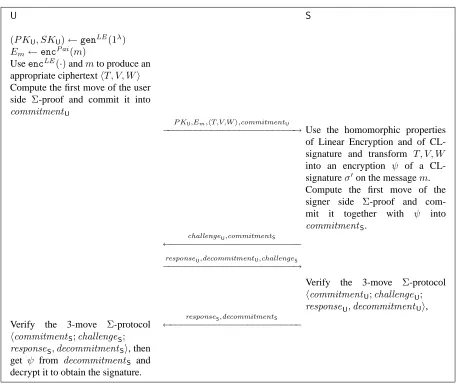
Σ-protocols and Round-complexity. In our signing protocol we employ twoΣ-protocols from both sides of the interaction. Both these protocols have the formhcommitment;challenge;response,decommitmenti. A subtle difficulty in the design of our protocol is that if the twoΣ-protocols are executed sequentially they will result in an overall round complexity of six moves. In order to maintain the four-move protocol com-plexity we want to “start” the Σ-protocol for the signer side before the user side Σ-protocol terminates. Nevertheless this will violate the security property of our scheme, so, in order to allow an early start of the signer sideΣ-protocol we have the signer commit to the value he will prove a statement about and open the commitment only in case the user’s sideΣ-protocol verifies.
We outline the high-level description of our signing protocol in Figure 1. In the first step, the userU
prepares two different encryptions of his private inputm, calledEmandhT, V, Wi. Moreover, it computes
the first move of aΣ-protocol that shows the consistency of the two encryptions and commits to it into
commitmentU. In the second step, the signer prepares an encryptionψthat can be decrypted by the user
into a CL-signature but does not transmit yet this value to the user. Instead, it prepares the first move of a Σ-protocol that shows that he computed ψ correctly and commits to ψ as well as the first move into
commitmentS. In the third step, the user, given the challenge of the signer, completes theΣ-protocol that
shows he computed the two encryptionsEmandhT, V, Wiin a consistent way and transmits to the signer
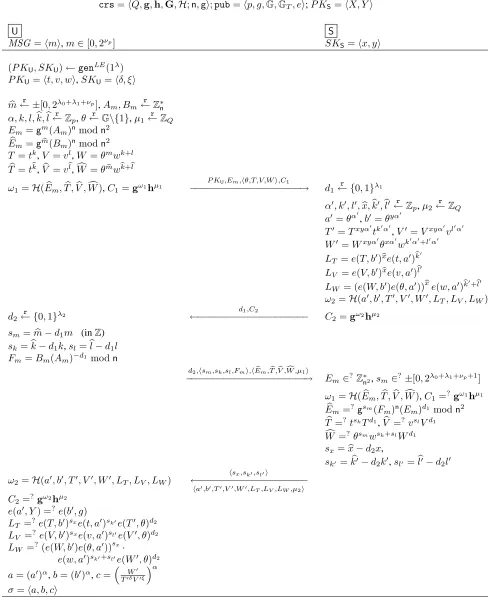
the decommitment information necessary to verify the consistency of the ciphertexts. In the fourth step, the signer verifies theΣ-protocol of the user and if it is accepted, the signer completes hisΣ-protocol and transmits to the user the encryptionψas well as the decommitment information necessary to verify the claim thatψis correctly computed based on the signer’s public-key. Finally the user verifies theΣ-protocol and if accepted it outputs the computed blind signature.
The detailed description of the protocol is shown inFigure 2. Note thatd1 < p,d2 < p, i.e. λ1 < νp,
U S
(P KU, SKU)←genLE(1λ)
Em←encPai(m)
UseencLE(·)andmto produce an appropriate ciphertexthT, V, Wi
Compute the first move of the user side Σ-proof and commit it into
commitmentU
P KU,Em,hT ,V,Wi,commitmentU
−−−−−−−−−−−−−−−−−−−−−−−−→Use the homomorphic properties of Linear Encryption and of CL-signature and transform T, V, W into an encryption ψ of a CL-signatureσ0on the messagem. Compute the first move of the signer side Σ-proof and com-mit it together with ψ into
commitmentS.
challengeU,commitmentS
←−−−−−−−−−−−−−−−−−−−−−−−−
responseU,decommitmentU,challengeS
−−−−−−−−−−−−−−−−−−−−−−−−→
Verify the 3-move Σ-protocol
hcommitmentU;challengeU; responseU,decommitmentUi,
Verify the 3-move Σ-protocol
hcommitmentS;challengeS; responseS,decommitmentSi, then
get ψ from decommitmentS and
decrypt it to obtain the signature.
responseS,decommitmentS
←−−−−−−−−−−−−−−−−−−−−−−−−
Figure 1: Overview of our blind signature generation protocol.
4.3 Signature Verification
Given a message-signature pair(m;σ), whereσ =ha, b, ci, the verification algorithm is based on the two verification equations below:e(a, Y) =e(g, b)ande(X, a)e(X, b)m =e(g, c).
4.4 Correctness and Security
The correctness and security of our scheme is captured by Theorem 4.1, Theorem 4.3, Theorem 4.5as described here.
4.4.1 Correctness
Theorem 4.1 (Correctness). If the signer and the user follow the signing protocol, the resulting signature
satisfies the verification with provability 1.
crs=hQ,g,h,G,H;n,gi;pub=hp, g,G,GT, ei;P KS=hX, Yi
U S
MSG =hmi,m∈[0,2νp] SK
S=hx, yi
(P KU, SKU)←genLE(1λ)
P KU=ht, v, wi,SKU=hδ, ξi
b
m← ±[0r ,2λ0+λ1+νp],A
m, Bm
r
←Z∗n
α, k, l,bk,bl r
←Zp,θ
r
←G\{1},µ1
r
←ZQ
Em=gm(Am)nmodn2
b
Em=gmb(Bm)nmodn2
T =tk,V =vl,W =θmwk+l
b T =tbk,
b V =vbl,
c
W =θmbwbk+bl
ω1=H(Ebm,T ,b V ,b cW),C1=gω1hµ1
P KU,Em,hθ,T ,V,Wi,C1
−−−−−−−−−−−−−−−−−−−−→ d1
r
← {0,1}λ1 α0, k0, l0,x,b bk0,bl0
r
←Zp,µ2
r
←ZQ
a0 =θα0,b0 =θyα0
T0 =Txyα0tk0α0,V0=Vxyα0vl0α0
W0=Wxyα0θxα0wk0α0+l0α0 LT =e(T, b0)bxe(t, a0)bk
0
LV =e(V, b0)xbe(v, a0)bl
0
LW = (e(W, b0)e(θ, a0))bxe(w, a0)bk
0+bl0 ω2=H(a0, b0, T0, V0, W0, LT, LV, LW)
d2
r
← {0,1}λ2
d1,C2
←−−−−−−−−−−−−−−−−−−−− C2=gω2hµ2
sm=mb −d1m (inZ) sk=bk−d1k,sl=bl−d1l
Fm=Bm(Am)−d1 modn
d2,hsm,sk,sl,Fmi,hEbm,T ,bV ,bW ,µc 1i
−−−−−−−−−−−−−−−−−−−−−−→ Em∈?Z∗n2,sm∈?±[0,2λ0+λ1+νp+1]
ω1=H(Ebm,T ,b V ,b Wc),C1=?gω1hµ1
b
Em=?gsm(Fm)n(Em)d1 modn2
b
T =?tskTd1, b
V =?vslVd1 c
W =?θsmwsk+slWd1 sx=bx−d2x,
sk0 =kb0−d2k0,sl0 =lb0−d2l0
ω2=H(a0, b0, T0, V0, W0, LT, LV, LW)
hsx,sk0,sl0i
←−−−−−−−−−−−−−−−−−−−−
ha0,b0,T0,V0,W0,L
T,LV,LW,µ2i
C2=?gω2hµ2
e(a0, Y) =?e(b0, g)
LT =?e(T, b0)sxe(t, a0)sk0e(T0, θ)d2
LV =?e(V, b0)sxe(v, a0)sl0e(V0, θ)d2
LW =?(e(W, b0)e(θ, a0)) sx·
e(w, a0)sk0+sl0e(W0, θ)d2 a= (a0)α,b= (b0)α,c= W0
T0δV0ξ
α σ=ha, b, ci
output(m;σ)
b
Em =gmb(Bm)nmodn2 =gsm+d1·m(Fm·(Am)d1)nmodn2
= (gsm(F
m)n)·(gm(Am)n)d1 modn2=gsm(Fm)n(Em)d1 modn2,
c
W =θmbwbk+bl=θsm+d1·mw(sk+sl)+d1·(k+l)= (θsmwsk+sl)·(θmwk+l)d1 =θsmwsk+slWd1,
b
T =tbk=tsk+d1·k =tsk·(tk)d1 =tskTd1,
b
V =vbl=vsl+d1·l =vsl·(vl)d1 =vslVd1;
LT =e(T, b0)bxe(t, a0)bk
0
=e(T, b0)sx+d2xe(t, a0)sk0+d2k0 =e(T, b0)sxe(t, a0)sk0
e(T, θyα0)xe(t, θα0)k0d2
=e(T, b0)sxe(t, a0)sk0
e(T, b0)xe(t, a0)k0d2 =e(T, b0)sxe(t, a0)sk0
e(Txyα0, θ)e(tk0α0, θ)d2
=e(T, b0)sxe(t, a0)sk0e(Txyα0tk0α0, θ)d2 =e(T, b0)sxe(t, a0)sk0e(T0, θ)d2,
LV =e(V, b0)xbe(v, a0)bl
0
=e(V, b0)sx+d2xe(v, a0)sl0+d2l0 =e(V, b0)sxe(v, a0)sl0
e(V, θyα0)xe(v, θα0)l0d2
=e(V, b0)sxe(v, a0)sl0
e(V, b0)xe(v, a0)l0d2 =e(V, b0)sxe(v, a0)sl0
e(Vxyα0, θ)e(vl0α0, θ)d2
=e(V, b0)sxe(v, a0)sl0e(Vxyα0vl0α0, θ)d2 =e(V, b0)sxe(v, a0)sl0e(V0, θ)d2,
LW = (e(W, b0)e(θ, a0))bxe(w, a0)bk
0+bl0
= (e(W, b0)e(θ, a0))sx+d2xe(w, a0)(sk0+sl0)+d2(k0+l0)
= (e(W, b0)e(θ, a0))sxe(w, a0)sk0+sl0
(e(W, b0)e(θ, a0))xe(w, a0)k0+l0d2
= (e(W, b0)e(θ, a0))sxe(w, a0)sk0+sl0
e(W, θyα0)e(θ, θα0)xe(w, θα0)k0+l0d2
= (e(W, b0)e(θ, a0))sxe(w, a0)sk0+sl0e(Wxyα0θxα0w(k0+l0)α0, θ)d2 = (e(W, b0)e(θ, a0))sx
e(w, a0)sk0+sl0e(W0, θ)d2.
Then we check the correctness of the CL-signature.
a = (a0)α =θαα0,
b = (b0)α= (θy)αα0 = (θαα0)y =ay,
c = (W0/(T0δV0ξ))α= ((Wxyθxwk0+l0)/((Txytk0)δ(Vxyvl0)ξ))αα0 = ((W/(TδVξ))xy ·θx·(wk0+l0/(tδk0vξl0)))αα0
= ((θm)xy·θx·1)αα0 = (θαα0)mxy+x=amxy+x
So,e(a, Y) =e(g, b)ande(X, a)e(X, b)m =e(g, c).
4.4.2 Unforgeability
In this subsection, we prove the unforgeability of our scheme. Before proving the unforgeability of our scheme, we first build a useful lemma which guarantees that the user will use the same plaintext in the Linear Encryption and in the Paillier encryption based on the three-move proof in the blind signature generation protocol. Based on the lemma, then we can simulate the signer successfully and reduce the unforgeability to the unforgeability of the CL-signature.
Lemma 4.2. In the blind signature generation protocol, under the DLOG assumption, a PPT adversary can
generate a valid proof with the signer such that
logθ decLE(T, V, W) 6=decP ai(Em) mod p
only with probability2−λ1.
Proof. Define m = decP ai(Em). Paillier encryption is 1-1 over Z∗n2, so it is well-defined andm ∈ Zn.
AlsoEm ∈ Z∗n2 can be written as Em = gm(Am)nmodn2 for someAm ∈ Z∗n. Similarly, definem0 =
logθ decLE(T, V, W)
. Recall thatθ∈G\{1}and the order ofGis primep. Soθis a generator ofG, and we can getθm0 =decLE(T, V, W)andm0 ∈
written asT =tk,V =vlfor somek, l ∈Zp. Note thatdecLE(T, V, W) = TδW·Vξ. SoW =θm
0
TδVξ =
θm0tkδvlξ =θm0wk+l.
Now we assume that there is a PPT adversary who can generate a valid proof with the signer such that
m6=m0modp. Up to now we have equations:
m6=m0 modp m∈Zn, m0 ∈Zp (1)
Em =gm(Am)nmodn2 Am∈Z∗n (2)
W =θm0wk+l k, l∈Zp (3)
T =tk (4)
V =vl (5)
We have assumed that the proof is valid. So all verification equations hold:
b
Em =gsm(Fm)n(Em)d1 modn2 (6)
c
W =θsmwsk+slWd1 (7)
b
T =tskTd1 (8)
b
V =vslVd1 (9)
From equations (2) and (6), we have
Em =gsm(Fm)n(Em)d1 modn2 =gsm(Fm)n(gm(Am)n)d1 modn2 =gsm+d1m(Fm(Am)d1)nmodn2
By the similar way, we can getTb=tsk+d1k,Vb =vsl+d1l, andcW =θsm+d1m
0
w(sk+d1k)+(sl+d1l). Now we
call
b
mdef= sm+d1mmodn (10)
Bm
def
= Fm(Am)d1 modn (11)
b
kdef= sk+d1kmodp (12)
b
ldef= sl+d1lmodp (13)
b
m0def= sm+d1m0modp (14)
Consider thatgcd(n, p) = 1. From the equation (10), we can letmb =sm+d1m+An, whereA∈Z. Somb −sm−d1m =An. Recall thatsm ∈ ±[0,2
λ0+λ1+νp+1], and
b
m ∈ ±[0,2λ0+λ1+νp],d
1 ∈ {0,1}λ1,
andm∈[0,2νp]. So
b
m−sm−d1m∈ ±[0,2λ0+λ1+νp+2], andA= 0because`nνp+λ0+λ1+ 3. So
b
m=sm+d1m.
From the equation (14), we can let mb
0 = s
m +d1m0 +Bp whereB ∈ Z. Somb −mb
0 = d
1(m−
m0)−Bp. Recall that p - (m−m0). We can find such B only in the case ofp | (mb −mb
0)−d
1(m−
m0). Note that hm, m0,m,b mb0i is determined before receiving the challenge d1 from the signer because
ht, v, w, Em, θ, T, V, W;C1i is sent before receiving d1 andhEbm,T ,b V ,b cWi is bound by the commitment
C1under the DLOG assumption. So we have only probability2−λ1 to findB. Therefore, under the DLOG
assumption, the adversary cannot develop a valid proof withm 6=m0modpexcept negligible probability 2−λ1.
Theorem 4.3 (Unforgeability). The proposed scheme is unforgeable under the LRSW assumption.
Proof. In this part, we will show under LRSW assumption, no PPT adversary user Acan achieve
“one-more” forgery with non-negligible probability. Let(p, g,G,GT, e;X, Y) be the input instance of LRSW
1. The oracle setspub=hp, g,G,GT, eiandP KS=hX, Yi. The oracle generatescrs1=hQ,g,h,G,Hi
andτ1 =rfor the equivocal Pedersen commitment scheme; generatescrs2 =hn,giandτ2 =hp,qi
for the Paillier encryption; sets crs = (crs1,crs2). Now the oracle supplies the adversary with
hpub,crs, P KSi, keepshτ1, τ2i.
2. The oracleIwill be queried byAwhich operates like that in one of the two cases below:
Case 1: AqueriesIwithhstart,msgi, wheremsg ={P KU, Em,hθ, T, V, Wi, C1}. The oracleIwill
create a session identitysidand set the corresponding statest=⊥; the oracleIwill simulates the signerSwithmsgtillSeither terminates or returns a responserspto the user; the oracleI records the current state inst. IfSreturnsrspthenIreturns this with the session identity toA, i.e.Ireturns{sid, d1, C2}toA, whered1
r
← {0,1}λ1 andC
2 =gγ2,γ2
r ←ZQ.
Case 2: AqueriesIwithhadvance, sid,msgi, wheremsg={d2,hsm, sk, sl, Fmi,hEbm,T ,b V ,b cW , µ1i}.
The oracleIwill simulate the signerSwithmsgand previous statest. TheSchecks whether all equations hold:C1 =? gω1hµ1 whereω1 =H(Ebm,T ,b V ,b Wc),Ebm =? gsm(Fm)n(Em)d1 mod n2,Tb=? tskTd1,Vb =? vslVd1,cW =? θsmwsk+slWd1. If not true, terminates. Otherwise, the
oracleIgenerates an identically distributed response toA.
Consider the Pedersen commitment scheme is involved. From Lemma 4.2above, under the DLOG assumption, except negligible error probability2−λ1, the oracleIcan obtain them un-der{θ, T, V, W}by decrypting m fromEm, and then obtainha0, b0, T0, V0, W0ibased on this
m: the oracleI simulatesS to decryptEm into m = decPaiτ2 (Em) by using the trapdoor in-formationτ2 = hp,qi; then the oracle I simulatesOX,Y with input mmodp which returns
ha, b, ci, and computesa0=a,b0 =b,W0 =cwk00+l00,T0=tk00,V0 =vl00, wherek00, l00←r Zp. Note that here hT0, V0, W0i is in fact the ciphertext of c over the public key ht, v, wi. The simulated{a0, b0, T0, V0, W0}is indistinguishable from the protocol answer consider the error probability2−λ1 is negligible. In fact, without the error probability, the two distribution is iden-tical, i.e. {a, b, cwk00+l00, tk00, vl00} ≈ {(θ)α0,(θy)α0,(Wxyθxwk0+l0)α0,(Txytk0)α0,(Vxyvl0)α0,
for random hk00, l00i and hα0, k0, l0i. Note that ha, b, ci is the response from OX,Y. So, a is
a random element in G, b = ay, c = ax+mxy. We know W = θmwk+l, T = tk, V = vl, for some k, l ∈ Zp. We can compute (Wxyθxwk0+l0)α0 = ((θmwk+l)xyθxwk0+l0)α0 = ((θ)α0)x+mxyw(kxy+k0)α0+(lxy+l0)α0, (Txytk0)α0 = ((tk)xytk0)α0 = t(kxy+k0)α0, (Vxyvl0)α0 = ((vl)xyvl0)α0 =v(lxy+l0)α0. Replaceθα0,(kxy+k0)α0,(lxy+l0)α0witha, k00, l00, we will know the two probability distributions are identical.
Next, the oracleIrandomly selectssx, sk0, sl0 ←r Zp, and letLT =e(T, b0)sxe(t, a0)sk0e(T0, θ)d2, LV =e(V, b0)sxe(v, a0)sl0e(V0, θ)d2,LW = (e(W, b0)e(θ, a0))sxe(w, a0)sk0+sl0e(W0, θ)d2;
com-putesω2 = H(a0, b0, T0, V0, W0, LT, LV, LW); uses the trapdoorτ1 = r to compute µ2 such
thatC2 =gω2hµ2, i.e.µ2 = γ2−rω2. Consider the 3-move proof is zero-knowledge [Dam00], the
simulated distribution{a0, b0, T0, V0, W0, LT, LV, LW, µ2;sx, sk0, sl0}is indistinguishable from
that in the protocol answer.
3. Aoutputs message-signature pairs.
Now assume that A can break the scheme, which meansA can generate `0 message-signature pairs (m∗1;σ1∗),(m∗2;σ2∗), . . . ,(m∗`0;σ`∗0)withmi 6= mj and`0 > `. Since`0 −`≥ 1, at least one message, say m∗O, is not queried to oracleOX,Y, though(m∗O;σO∗)is a valid pair. In other word, we can construct a valid
4.4.3 Blindness
In this subsection, we show the blindness of our scheme. Before going to the proof of the blindness of our scheme, we first build a useful lemma which guarantee that the signer will use the correct ciphertext hθ, T, V, Wiand his secret keyhx, yito generateha0, b0, T0, V0, W0ibased on the three-move proof.
Lemma 4.4. In the blind signature generation protocol, under the DLOG assumption, a PPT adversary can
generate a valid proof with the user such that
loggY 6= loga0b0 mod p
or
loggX+ loggX·loggY ·logθ decLE(T, V, W)6= loga0 decLE(T0, V0, W0)
modp
only with probability2−λ2.
Proof. Based on the verification equation e(a0, Y) = e(b0, y) it is very easy to prove the first part of the lemma. Next we focus on the second part. Now we have Y = gy, X = gx, b0 = (a0)y. Define m = logθ decLE(T, V, W)
, and we haveT =tk,V =vl,W =θmwk+lfor somek, l∈Zp by using the same argument in the proof ofLemma 4.2. Note thatGT is also order primep. There existx,b bk
0,
b
l0,η, kb
0, l0, η∈ Zp
such that,
LT =e(T, b0)bxe(t, a0)bk
0
(15)
LV =e(V, b0)bxe(v, a0)bl
0
(16)
LW = (e(W, b0)e(θ, a0))bxe(w, a0)ηb (17)
e(T0, θ) =e(T, b0)xe(t, a0)k0 (18)
e(V0, θ) =e(V, b0)xe(v, a0)l0 (19)
e(W0, θ) = (e(W, b0)e(θ, a0))xe(w, a0)η (20)
Assume there is a PPT can generate valid proof such thatloggX+loggX·loggY·logθ decLE(T, V, W)6= loga0 decLE(T0, V0, W0)
mod p; the verification equations are
LT =e(T, b0)sxe(t, a0)sk0e(T0, θ)d2 (21)
LV =e(V, b0)sxe(v, a0)sl0e(V0, θ)d2 (22)
LW = (e(W, b0)e(θ, a0))sxe(w, a0)sk0+sl0e(W0, θ)d2 (23)
From equations (15,16,18,19,21,22), we can obtain
sx=bx+d2x mod p (24)
sk0 =bk0+d2k0 modp (25)
sl0 =bl0+d2l0 mod p (26)
From equations (17, 20, 23, 24), we can obtain
sk0+sl0 =
b
η+d2η mod p (27)
From equations (25-27), we can obtain
b
k0+bl0− b
η=−d2(k0+l0−η) modp (28)
Note thatha0, b0, T0, V0, W0;LT, LV, LWi is bound by commitmentC2 which is sent before the challenge
d2; and hk0, l0, η,bk0,bl0,ηbi is determined before receiving d2 from the user. So, except probability2−λ2,
the signer cannot get d2 before receiving it from the user. Now the equation η = k0 +l0 modp holds;
otherwise the signer can compute such d2 = −(bk0 +bl0 −ηb)/(k0+l0 −η) before he receives the value.
Put the equation η = k0 +l0modp into equation (28), we can also get ηb = bk
0 +
bl0 modp. Assume
a0 = θα0 and recall that b0 = (a0)y, we can obtain T0 = Txyα0tk0α0 from equation (18); similarly we can obtain V0 = Vxyα0vl0α0 andW0 = Wxyα0θxα0wk0α0+l0α0. Define c0 = decLE(T0, V0, W0). Then
c0 = (T0)Wδ(V0 0)ξ = θ(x+xym)α
0
= (a0)x+xym. Andloga0 decLE(T0, V0, W0)
loggX+ loggX ·loggY ·logθ decLE(T, V, W)
mod pwhich contradicts the assumption. So, based on a secure commitment scheme, except the probability2−λ2, no PPT adversary can develop a valid proof such thatloggX+ loggX·loggY ·logθ decLE(T, V, W)
6= loga0 decLE(T0, V0, W0)
mod p. This completes the proof.
Theorem 4.5 (Blindness). The proposed scheme is blind under the DLDH assumption and the DCR
as-sumption.
We start from the blindness model, and define it as Game 0; we slightly change Game 0 by simulating the left user instantiation by Damg˚ard’s trick in Game 1; and then we slightly change Game 1 again and do the similar simulation for the right user instantiation in Game 2. The statistical distance of the probability distribution of Game 0 and Game 1, and of Game 1 and Game 2 are negligible. Now we slightly change Game 2 into Game 3 when two user instantiations verify the verification equations successfully: instead of generatingσbased onha0, b0, T0, V0, W0iin Game 2, generateσby using the signing key(x, y)onm. Based onLemma 4.4, we show the statistical distance between Game 2 and Game 3 is negligible. Next we slightly change Game 3 by simulating the left user instantiation with inputting a random message (not one of the messages selected by the adversary) to the Paillier encryption in Game 4; then do the similar simulation for the right user instantiation in Game 5. Both distances between Game 3 and Game 4, and Game 4 and Game 5 are negligible under the DCR assumption. Similarly, we slightly change Game 5 into Game 6 by simulating the left user instantiation with inputting a random message to the linear encryption; then change Game 6 into Game 7 by similar way for the right user instantiation. Again the distances between Game 5 and Game 6, and Game 6 and Game 7 are negligible under the DLDH assumption. Therefore, the probability distribution in Game 0 is indistinguishable from that in Game 7. Consider in Game 7, the two messages(m0, m1)have
never been involved in the communications between the user instantiations and the adversary signer, which means the adversary has no advantage to win the game (with just probability 12 to predictφ). So, in Game 0, the adversary has at most negligible advantage to win the game under the assumptions.
Proof. We use the sequential games technique to prove this part, and define gamesGAj between the adversary Aand the oracleIjφwhich simulates two user instantiation: the left oneUL and the right oneUR, where
j= 0,1, . . . ,7. Also we defineEj to be the event thatφ=φ0 inGAj .
Game 0:
Follow the blindness model, we can define Game 0 as below:
GA0(1λ)
1. φ← {0r ,1};
2. (pub,crs, P KS, SKS)←gen(1λ);
3. φ0← AI0φ(1 λ,
pub,crs,P KS)(1λ,pub,crs, P K
S, SKS);
4. ifφ=φ0then1;
HereI0φis defined as:
- Given hchallenge, m0, m1i, the oracle I0φ simulatesUL(resp. UR) with mφ (resp. m1−φ). The
oracleI0φkeeps a database with the state of each user instantiation; the state includes all coin tosses of the user instantiation and the contents of all tapes including the communication tape. Here the oracle usesstL(resp.stR) to record the state ofUL(resp.UR).
– Ifmsg = ⊥, thenI0φrecovers the state ofstρ, and simulates the user instantiationUρtillUρ
either terminates or returns a response to the signer. IfUρreturns a responsersp, thenI0φreturns rsptoA. The oracle will record the current statest, i.e.stρ=stρ||st. Letmbe the simulated message forUρ, i.e.m=mφforρ=Landm=m1−φforρ=R, we have,
(a) (P KUρ, SKUρ)←genLE(1λ) (b) mb ← ±[0r ,2λ0+λ1+νp],A
m, Bm ←r Z∗n,α, k, l,bk,bl
r
←Zp,θ←r G\{1},µ1 ←r ZQ.
(c) Em←encPaicrs2(m, Am)
(d) hT, V, Wi ←encLEpub,P Kρ
U(m, θ,
b
k,bl)
(e) Ebm←encPaicrs
2(m, Bb m)
(f) hT ,b V ,b Wci ←encLE
pub,P KUρ(m, θ,b bk,bl)
(g) ω1=H(Ebm,T ,b V ,b Wc),C1=gω1hµ1
(h) rsp={P KU, Em,hθ, T, V, Wi, C1}
– Ifmsg = {d1, C2}, then I0φrecovers the state of stρ, and simulates the user instantiationUρ
withmsgtillUρeither terminates or returns a responserspto the signer. IfUρreturns a response rsp, thenI0φreturnsrsptoA. The oracle will record the current statest, i.e.stρ=stρ||st.
Hererspis in the form of{d2,hsm, sk, sl, Fmi,hEbm,T ,b V ,b W , µc 1i}, wherehEbm,T ,b V ,b cW , µ1i
is recovered from the previous state ofstρ, andhsm, sk, sl, Fmiis generated as:sm =mb−d1·m
inZ,sk=bk−d1·kmodp,sl =bl−d1·lmodp,Fm=Bm(Am)−d1 modn,d2
r
← {0,1}λ2.
- Givenhterminate,msgL,msgRi, the oracleI0φrecovers the statestL(resp.stR), and simulates the user instantiationUL (resp. UR) with msgL (resp. msgR) till UL (resp. UR) either terminates or returns an output, wheremsgρis in form of{sx, sk0, sl0;a0, b0, T0, V0, W0, LT, LV, LW, µ2i}. Each Uρwill verify all equations:
C2=gω2hµ2 whereω2 =H(a0, b0, T0, V0, W0, LT, LV, LW),
e(a0, Y) =e(b0, g),
LT =e(T, b0)sxe(t, a0)sk0e(T0, θ)d2,
LV =e(V, b0)sxe(v, a0)sl0e(V0, θ)d2,
LW = (e(W, b0)e(θ, a0))sxe(w, a0)sk0+sl0e(W0, θ)d2
If the two user instantiations verify the verification equations successfully, each of them generates
σ = (a, b, c)bya = (a0)α,b = (b0)α,c = (W0/(T0δV0ξ))α. Let the generated signatures from the two user instantiations beσ0, σ1 for messagem0, m1 respectively. The oracle set rsp = (σ0, σ1).
Otherwise setrsp= (⊥,⊥). The oracle returnsrsptoA.
Game 1:
We modifyGA0 intoGA1 by changing step 2 into:
2. (pub,crs2, P KS, SKS)←gen(1λ); generatescrs1 =hQ,g,h,G,Hiandτ1 =rfor the equivocal
Pedersen commitment scheme; setcrs= (crs1,crs2).
and changingI0φintoI1φ. Note thatI1φis same asI0φexcept that
– Ifmsg =⊥, thenI1φ recovers the state ofstL, and simulates the user instantiationULtillUL
either terminates or returns a response to the signer. IfULreturns a responsersp, thenI1φreturns rsptoA. The oracle will record the current statest, i.e. stL=stL||st. Letm=mφ, we have,
(a) (P KUL, SKUL)←genLE(1λ) (b) Am
r ←Z∗
n,α, k, l
r
←Zp,θ←r G\{1}.
(c) Em←encPaicrs2(m, Am) (d) hT, V, Wi ←encLE
pub,P KL
U
(m, θ, k, l)
(e) γ1
r
←ZQ,C1 =gγ1
(f) rsp={P KUL, Em,hθ, T, V, Wi, C1}
– Ifmsg = {d1, C2}, thenI1φrecovers the state ofstL, and simulates the user instantiationUL
withmsgtillULeither terminates or returns a responserspto the signer. IfULreturns a response rsp, thenI1φreturnsrsptoA. The oracle will record the current statest, i.e.stL=stL||st.
(a) sm
r
← ±[0,2λ0+λ1+νp],F
m
r ←Z∗
n,sk, sl
r ←Zp
(b) Ebm=gsm(Fm)n(Em)d mod n2
(c) cW =θsmwsk+slWd1,Tb=tskTd1,Vb =vslVd1
(d) use τ1 = r to compute µ1 such that C1 = gω1hµ1 whereω1 = H(Ebm,T ,b V ,b Wc), i.e.
µ1 = γ1−rω1 modQ
(e) rsp={d2,hsm, sk, sl, Fmi,hEbm,T ,b V ,b W , µc 1i}
Game 2:
We modifyGA1 intoGA2 by changingI1φintoI2φ. Note thatI2φis same asI1φexcept that :
- Givenhadvance, ρ,msgi, whereρ ∈ {L, R}. Ifρ=L,I2φoperates identically asI1φ; but ifρ =R, I2φoperates similarly as the caseρ =Lwithm= m1−φ, i.e. runs the same operations for the right
user instantiationUR.
Game 3:
We modifyGA2 intoGA3 by changingI2φintoI3φ. Note thatI3φis same asI2φexcept that
- Givenhterminate,msgL,msgRi, the oracleI3φrecovers the statestL(resp.stR), and simulates the user instantiationUL (resp. UR) with msgL (resp. msgR) till UL (resp. UR) either terminates or returns an output.
If the two user instantiations verify the verification equations successfully, now the oracle generates two signaturesσ0, σ1 form0, m1 by using the signing key: σ = (a, ay, ax+xym)wherea
r
← G. The oracle setrsp = (σ0, σ1). Otherwise setrsp= (⊥,⊥). The oracle returnsrsptoA.
Game 4:
We modifyGA3 intoGA4 by changingI3φintoI4φ. Note thatI4φis same asI3φexcept that
- Given hchallenge, m0, m1i, the oracle I4φ randomly selectsme0, me1 from the message space and
simulatesUL(resp.UR) withmφorme0(resp.m1−φorme1).
– Ifmsg =⊥, thenI4φ recovers the state ofstL, and simulates the user instantiationULtillUL
either terminates or returns a response to the signer. IfULreturns a responsersp, thenI4φreturns rsptoA. The oracle will record the current statest, i.e. stL=stL||st. Letme =me0,m=mφ,
we have,
(a) (P KL
U, SKUL)←genLE(1λ)
(b) Am
r
←Z∗n,α, k, l
r ←Zp,θ
r
←G\{1}. (c) Eme ←encPaicrs2(m, Ae m)
(d) hT, V, Wi ←encLE
pub,P KL
U
(m, θ, k, l)
(e) γ1
r
←ZQ,C1 =gγ1
(f) rsp={P KUL, Eme,hθ, T, V, Wi, C1}
– Ifmsg = {d1, C2}, thenI4φrecovers the state ofstL, and simulates the user instantiationUL
withmsgtillULeither terminates or returns a responserspto the signer. IfULreturns a response rsp, thenI4φreturnsrsptoA. The oracle will record the current statest, i.e.stL=stL||st.
(a) sm ← ±[0r ,2λ0+λ1+νp],Fm ←r Z∗n,sk, sl
r ←Zp
(b) Ebme =gsm(Fm)n(Eme)d1 mod n2
(c) cW =θsmwsk+slWd1,Tb=tskTd1,Vb =vslVd1
(d) use τ1 = r to compute µ1 such that C1 = gω1hµ1 whereω1 = H(Ebme,T ,b V ,b Wc), i.e.
µ1 = γ1−rω1 modQ
(e) rsp={d2,hsm, sk, sl, Fmi,hEbme,T ,b V ,b W , µc 1i}
Game 5:
We modifyGA4 intoGA5 by changingI4φintoI5φ. Note thatI5φis same asI4φexcept that
- Givenhadvance, ρ,msgi, whereρ ∈ {L, R}. Ifρ=L,I5φoperates identically asI4φ; but ifρ =R, I5φoperates similarly as the caseρ =Lwithme =me1,m=m1−φ, i.e. runs the same operations for
the right user instantiationUR.
Game 6:
We modifyGA5 intoGA6 by changingI5φintoI6φ. Note thatI6φis same asI5φexcept that
- Givenhadvance, ρ,msgi, whereρ ∈ {L, R}. Ifρ=R,I6φoperates identically asI5φ; but ifρ=L, I6φworks as follows:
– Ifmsg = ⊥, thenI6φrecovers the state of stρ, and simulates the user instantiationULtillUL
either terminates or returns a response to the signer. IfULreturns a responsersp, thenIφ 6 returns
rsptoA. The oracle will record the current statest, i.e. stL=stL||st. Letme =me0, we have,
(a) (P KUL, SKUL)←genLE(1λ) (b) Am
r ←Z∗
n,α, k, l
r
←Zp,θ←r G\{1}.
(c) Eme ←encPaicrs2(m, Ae m)
(d) hT ,e V ,e Wfi ←encLE
pub,P KL
U
(m, θ, k, le )
(e) γ1
r
←ZQ,C1 =gγ1
– Ifmsg = {d1, C2}, thenI6φrecovers the state ofstL, and simulates the user instantiationUL
withmsgtillULeither terminates or returns a responserspto the signer. IfULreturns a response
rsp, thenI6φreturnsrsptoA. The oracle will record the current statest, i.e.stL=stL||st.
(a) sm
r
← ±[0,2λ0+λ1+νp],F
m
r
←Z∗n,sk, sl
r ←Zp
(b) Ebme =gsm(Fm)n(Eme)d1 mod n2
(c) c f
W =θsmwsk+slWfd1,Tbe=tskTed1,Veb =vslVed1
(d) use τ1 = r to compute µ1 such that C1 = gω1hµ1 whereω1 = H(Ebme,T ,be V ,be Wcf), i.e.
µ1 = γ1−rω1 modQ
(e) rsp={d2,hsm, sk, sl, Fmi,hEbme,T ,be V ,be W , µcf 1i}
Game 7:
We modifyGA6 intoGA7 by changingI6φintoI7φ. Note thatI7φis same asI6φexcept that
- Givenhadvance, ρ,msgi, whereρ ∈ {L, R}. Ifρ=L,I7φoperates identically asI6φ; but ifρ =R, I7φoperates similarly as the caseρ=Lwithme =me1, i.e. runs the same operations for the right user
instantiationUR.
Compute the Statistical Distance:
We prove in Game 0 and Game 1,|Pr[E0]−Pr[E1]|is negligible. Observe that, for the probability
dis-tributions of the right user instantiations[UR]0,[UR]1 are identical. We still need to show for the left user
instantiations [UL]0, [UL]1, the statistical distance of the probability distributions is negligible. First, we
prove the statistical distance of [sm]0 and[sm]1 are negligible. Observe that in both gamesm ∈ [0,2νp],
b
m ∈ ±[0,2λ0+λ1+νp],d
1
r
← {0,1}λ1. We can obtain that the statistical distance of the random variables [sm]0=mb −d1·mand[sm]1
r
← ±[0,2λ0+λ1+νp]is less than2−λ0−1. Then we can observe that[F
m]0and
[Fm]1,[sk]0and[sk]1,[sl]0and[sl]1are identically distributed. So the statistical distance of[sm, sk, sl, Fm]0
and[sm, sk, sl, Fm]1is2−λ0−1. From the equivocal property of the Pedersen commitment scheme, we know
the distribution of{Ebm,T ,b V ,b W , µc 1}in Game 1 is identical to that in Game 0. So the statistical distance
of the two games is2−λ0−1, i.e. |Pr[E
0]−Pr[E1]| ≤2−λ0−1. Use the similar argument, we can show in
Game 1 and Game 2,|Pr[E1]−Pr[E2]| ≤2−λ0−1.
Now we prove in Game 2 and Game 3, under the DLOG assumption,|Pr[E2]−Pr[E3]|is negligible.
From Lemma 4.4, in Game 2, if the user instantiation can verify the verification equations successfully, then the generated signature is σ = (a, b = ay, c = ax+mxy) except probability2−λ2. And in Game 3, signatureσis generated as above without any error probability. Consider there are two user instantiations. So,|Pr[E2]−Pr[E3]| ≤2−λ2+1.
We prove in Game 3 and Game 4, under the DCR assumption,|Pr[E3]−Pr[E4]|is negligible. Observe
that, the probability distributions of the right user instantiations [UR]
3, [UR]4 are identical. For the left
user instantiations[UL]3, [UL]4, under the DCR assumption,[Em]3 and[Eme]4 are indistinguishable. So,
|Pr[E3]−Pr[E4]| ≤AdvDCR. By the similar argument, we can obtain|Pr[E4]−Pr[E5]| ≤AdvDCR.
Next we prove in Game 5 and Game 6, under the DLDH assumption,|Pr[E5]−Pr[E6]|is negligible.
Observe that, for the probability distributions of the right user instantiations[UR]5,[UR]6are identical, and
for the left user instantiations[UL]5, [UL]6, under the DLDH assumption, [T, V, W]5 and[T ,e V ,e Wf]6 are
indistinguishable. So, |Pr[E5]−Pr[E6]| ≤ AdvDLDH. By the similar argument, we can get |Pr[E6]−
In Game 7,φis not used, so the adversaryAhas only probability 12 to win the game, i.e. Pr[E7] = 12.
Based on the argument above, we can get
Pr[E0]−12
=|Pr[E0]−Pr[E7]|=| 6 P
j=0
Pr[Ej]−Pr[Ej+1]| ≤ 6 P
j=0
|Pr[Ej]−Pr[Ej+1]|
= 2−λ0−1+ 2−λ0−1+ 2−λ2+1+Adv
DCR+AdvDCR+AdvDLDH+AdvDLDH
= 2−λ0+ 2−λ2+1+ 2Adv
DCR+ 2AdvDLDH
which is negligible. This completes the proof of blindness.
Remark 4.6. Both unforgeability and blindness depend on the DLOG assumption as well. InTheorem 4.3 andTheorem 4.5, we do not include the DLOG assumption, because the DLOG assumption can be implied from the LRSW assumption or the DLDH assumption. Note that in our scheme, the size of elliptic curve groupsGandGis same.
5
Extensions and Variants
Stronger Blindness Property. The formal model of Section 3 can be strengthened with respect to the blindness property by allowing to the malicious signer to select the public/secret-key pairP KS, SKSinstead
of selecting these values honestly as in [JLO97]. It is simple to modifyDefinition 3.2to include such stronger adversaries; this strengthening of the [JLO97] model has been observed recently in [Oka06,ANN06] as well. Our scheme can be easily modified to achieve such stronger blindness as follows: we have the signer make an extractable commitment on the signing keySKS =hx, yi(using the same public-parameters employed
for the users’ extractable commitment) and prove that such commitment is consistent with the computation of the encryptionψ. In the blindness proof, the oracleIφcan extract the signing key and the security proof
remains essentially unchanged; note though that unforgeability as argued inTheorem 4.3will also rely on the DCR assumption.
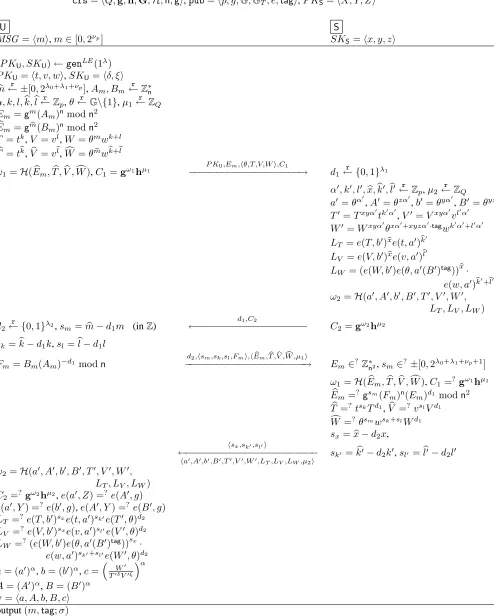
Public-Tagging and Partial Blindness. We construct an extension of our blind signature that allows the “public-tagging” of a message that is blindly signed. Public-tagging of blindly signed messages gives rise to what is called a partially blind signature [AF96]: the signer knows a portion of the message that he is about to sign. Public-tagging is useful as it allows the signer to keep the same public-key and issue blind signatures for different purposes (e.g., a bank may issue e-coins that are publicly-tagged blind signatures, and the tagging will correspond to the denomination, i.e., there will be a different tag for each coin denomination). It should be stressed that in a blind signature with public tagging the blindness property is only enforced within blind signatures with the same public-tag. The unforgeability property on the other hand remains identical. We develop a public-tagging mechanism for our basic scheme. The key idea is the following: we replace the underlying digital signature of [CL04] with the two message-block extended version (Scheme C for two messages in [CL04]). In the modified blind signature the messages will be of the formhm,tagi. The public information tagis included into pub. Heretag ∈ [0,2νp]. Note that the exact choice for the value oftagis negotiated by the signer and the user outside of the signing protocol.
In the modified signature that we use, the public and secret-key of the signer are modified and the values
P KS = hX, Yi andSKS = hx, yithey are substituted withP KS = hX, Y, Zi,SKS = hx, y, zi, where
The detailed partially signing protocol is similar to our basic signing protocol (i.e., it retains the four-move structure with short communication) and is shown in detail inFigure 3. We can obtain the security theorem below:
Theorem 5.1. Under the LRSW assumption the proposed partially blind signature scheme is unforgeable
even if the public-tag is adversarially selected for each signature; Under the DLDH assumption and the DCR assumption, the proposed scheme is blind for signatures with the same public-tag.
To prove the unforgeability property in the theorem above, we can use the similar proof idea in Theo-rem 4.3. Consider that the scheme above is based on Camenisch-Lysyanskaya two message-block signature [CL04], we reduce the unfogerability to the security of the Camenisch-Lysyanskaya two message-block signature which is also based on the LRSW assumption. Considertagis fixed across protocol executions, we can also use the similar proof idea inTheorem 4.5to show the blindness of the above scheme is based on the DLDH and the DCR assumptions.
Acknowledgement
crs=hQ,g,h,G,H;n,gi;pub=hp, g,G,GT, e;tagi;P KS=hX, Y, Zi
U S
MSG =hmi,m∈[0,2νp] SK
S=hx, y, zi
(P KU, SKU)←genLE(1λ)
P KU=ht, v, wi,SKU=hδ, ξi
b
m← ±[0r ,2λ0+λ1+νp],A
m, Bm
r
←Z∗n
α, k, l,bk,bl r
←Zp,θ
r
←G\{1},µ1
r
←ZQ
Em=gm(Am)nmodn2
b
Em=gmb(Bm)nmodn2
T =tk,V =vl,W =θmwk+l
b T =tbk,
b V =vbl,
c
W =θmbwbk+bl
ω1=H(Ebm,T ,b V ,b cW),C1=gω1hµ1
P KU,Em,hθ,T ,V,Wi,C1
−−−−−−−−−−−−−−−−−−−−→ d1
r
← {0,1}λ1 α0, k0, l0,bx,bk0,bl0
r
←Zp,µ2←r ZQ
a0 =θα0,A0=θzα0,b0 =θyα0,B0 =θyzα0 T0 =Txyα0tk0α0,V0=Vxyα0vl0α0
W0=Wxyα0θxα0+xyzα0·tagwk0α0+l0α0
LT =e(T, b0)bxe(t, a0)bk
0
LV =e(V, b0)xbe(v, a0)bl
0
LW = (e(W, b0)e(θ, a0(B0)tag))b x
·
e(w, a0)bk0+bl0
ω2=H(a0, A0, b0, B0, T0, V0, W0,
LT, LV, LW)
d2
r
← {0,1}λ2,s
m=mb −d1m (inZ)
d1,C2
←−−−−−−−−−−−−−−−−−−−− C2=gω2hµ2
sk=bk−d1k,sl=bl−d1l
Fm=Bm(Am)−d1 modn
d2,hsm,sk,sl,Fmi,hEbm,T ,bV ,bW ,µc 1i
−−−−−−−−−−−−−−−−−−−−−−→ Em∈?Z∗n2,sm∈?±[0,2λ0+λ1+νp+1]
ω1=H(Ebm,T ,b V ,b Wc),C1=?gω1hµ1
b
Em=?gsm(Fm)n(Em)d1 modn2
b
T =?tskTd1,Vb =?vslVd1 c
W =?θsmwsk+slWd1 sx=bx−d2x, hsx,sk0,sl0i
←−−−−−−−−−−−−−−−−−−−−−−−−
ha0,A0,b0,B0,T0,V0,W0,L
T,LV,LW,µ2i
sk0 =kb0−d2k0,sl0 =lb0−d2l0
ω2=H(a0, A0, b0, B0, T0, V0, W0,
LT, LV, LW)
C2=?gω2hµ2,e(a0, Z) =?e(A0, g)
e(a0, Y) =?e(b0, g),e(A0, Y) =?e(B0, g)
LT =?e(T, b0)sxe(t, a0)sk0e(T0, θ)d2
LV =?e(V, b0)sxe(v, a0)sl0e(V0, θ)d2
LW =?(e(W, b0)e(θ, a0(B0)tag)) sx·
e(w, a0)sk0+sl0e(W0, θ)d2 a= (a0)α,b= (b0)α,c= W0
T0δV0ξ
α A= (A0)α,B= (B0)α
σ=ha, A, b, B, ci
output(m,tag;σ)