https://doi.org/10.1177/2158244017697152 SAGE Open
January-March 2017: 1 –9 © The Author(s) 2017 DOI: 10.1177/2158244017697152 journals.sagepub.com/home/sgo
Creative Commons CC BY: This article is distributed under the terms of the Creative Commons Attribution 3.0 License (http://www.creativecommons.org/licenses/by/3.0/) which permits any use, reproduction and distribution of
the work without further permission provided the original work is attributed as specified on the SAGE and Open Access pages (https://us.sagepub.com/en-us/nam/open-access-at-sage).
Article
Introduction
Small and medium-sized enterprises (SMEs) provide crucial industrial linkages to set off a chain reaction of broad-based industrial development. Without SMEs as subcontractors and suppliers of intermediate inputs to multinational enter-prises (MNEs) and domestic large scale enterenter-prises (LSEs), industrial growth in developing countries may not be able to sustain increasing domestic value, employment, productiv-ity, and industrial linkages. Hence, growing competitiveness of SMEs becomes a critical issue. Competitiveness also increases the scope for success to reach global markets. It has been recognized in most of the Asian nations that SMEs play a crucial role in the support of development in the regional economy because it offers a way for the resources of a coun-try to be mobilized which results in creating employment opportunities and income for the overall national economy (United Nations Industrial Development Organization [UNIDO], 2003).
Given the current era of a globalized and borderless world that is complemented by liberalization and regionalization, small and medium enterprises (SMEs) offer an essential source of local employment opportunities, control over the
present economic turmoil, and the tool for domestic capacity development. As such, SMEs have a critical function in the development of a country’s economy (Lim, 2008). In the past decade, remarkable development in clusters has been linked to regional growth. SMEs in the global economy are being identified as having a critical function in the growth and sus-tainability of regional economy; however, research that inves-tigates the SMEs’ process of clustering in Asian nations is still quite scarce (Braun, McRae-Williams, & Lowe, 2005).
Research shows the significance of clustering in the growth of SMEs (Hagen, Zucchella, Cerchiello, & De Giovanni, 2012; Nadvi & Barrientos, 2004; Smyth, 1992; Tambunan, 2008). According to Smyth (1992, 1990), the clustering of producers of rattan furniture had resulted in a whole village being absorbed and created many small-scaled satellite industries in nearby locations in Tegal Wangi, West
1Universiti Teknologi Malaysia, Kuala Lumpur, Malaysia
Corresponding Author:
Sara Foghani, International Business School, Universiti Teknologi Malaysia, Kuala Lumpur 54100, Malaysia.
Email: [email protected]
Promoting Clusters and Networks
for Small and Medium Enterprises
to Economic Development in the
Globalization Era
Sara Foghani
1, Batiah Mahadi
1, and Rosmini Omar
1Abstract
This research attempts to explore the importance of cluster-based systems in preparation for small and medium enterprises (SMEs) to go global, and it is an ongoing research. The findings of this research are aimed at providing insights to policy makers, academicians, and practitioners with the objective of creating initiatives, strategies, and policies, which reflect the primary aim of supporting SMEs in managing global challenges. SMEs that are cluster-based have the potential to facilitate the successful inclusion of SMEs in the growth of productivity and networks of global distribution. Most Asian developing countries are in the dark when it comes to this matter. The main purpose of this study is to investigate the relations between the capabilities of the networks and clusters in developing SMEs’ preparedness in facing business players in the global arena. This study’s scope includes specific Asian developing countries. Even though the issue of clusters in SMEs has been well researched in developed countries, such empirical studies are still lacking in the Asian region despite its prevalent collectivism practice. In the concluding analysis, the study intends to develop a model emphasizing the cluster-based industrial SMEs toward globalization.
Keywords
Java. Likewise, Schiller and Martin-Schiller (1997) offered proof of a similar occurrence in Jepara in Central Java among producers of wood furniture. Research by Zeinalnezhad, Mukhtar, and Sahran (2011) pointed out the significance of the development of policies for clusters among the SMEs and the way in which these could be introduced into Malaysian industries. Another example is that of the industry of local garment and knitwear in a small regionalized area involving knitting companies, dyeing, cloth finishing, print-ing, garment producers, exporters and buyers, and special-ized producers including manufacturers of thread, zips, buttons, and even chemical treatments (Tambunan, 2005). Sato (2000) proposed a successful case of developing SME clusters in metal and iron industry having no government support. She presents case of 300 SMEs in Ceper and indi-cated that subcontracting and combination with high market diversification were the main keys for clustering.
This article aims to observe cluster-based approach as one of the SME development policies, strategies, or tools in Asian countries regarding globalization. With the aim of pro-viding a clear image of the effect of networking that facili-tates SMEs in the process of globalization, this article finds it imperative to present brief overview of the SMEs’ defini-tion, networks, and cluster description and globalization (Ghanatabadi, 2005).
Small and Medium-Sized Enterprises
In the literature review on definitions of SMEs, Loecher (2000) pointed out two sets of measures taken by most stud-ies, namely, qualitative and quantitative.
The qualitative approach normally offers information about the nature of the SMEs based on the characteristic attributes. The relations between the “owner” and the “orga-nization” in the “personal principal” and the “unity of the leadership and capital” models are advocated as the qualita-tive measures to distinguish between large organizations and SMEs. The “personal principal” refers to organization’s manager who carries out a central function in decision mak-ing in the business. The manager has a fundamental over-view of all the organizational, administrative, and technical processes in the organization. The “unity of the leaderships and capital” refers to the fact that organization’s manager and the owner is the same person. The owner-manager is more independent and self-sufficient compared with the management team of large organizations who are usually contracted (Loecher, 2000).
The terminology of SMEs based on a quantitative vie refers to organizations from all the sectors provided the set standard and criteria are not surpassed. Economy researchers have suggested indicators to be used in this context, includ-ing profits, total balance sheet, total capital, invested capital, earnings, market position, equity, production, sales volume, turnover, and number of employees. The “number of employ-ees” and “turnover” are highly proposed as the most suitable
quantitative measures given the simplicity, practical applica-tion, and compatibility. Quantitative measures are very applicable for identifying the SME as confirmed by research-ers (Loecher, 2000).
In line with the measures suggested above, the European Union (EU) in 1996 established a ranked measurement for the definition of SME as follows: (a) lower than 250 employees, (b) annual turnover of 40 million Euros maximum, (c) annual total balance sheet of 27 million Euros maximum, (d) 75% minimum of company assets owned by the management, and (e) owner-managers or related families personally manage the business. Even though these criteria vary based on countries, they do offer a systematic approach to define SME. This study also utilized two main quantitative and qualitative criteria as basis for defining SMEs in Asian nations context.
It is essential to identify SMEs’ integral characteristics to elucidate their strategic roles in global economics. The com-pany structure of SME is usually organic in comparison with the bureaucratic structure in large companies (Rao, Toledo, & Metts, 2003). Rao et al. suggest that SMEs are mainly identi-fied based on the lack of standardized and formal working relation; they normally function based on a flat company structure with limited employees and development. However, these attributes enable SMEs to be more flexible to the changes in the environment, and studies show that smaller companies are normally regarded as being prominently more “flexible” compared with larger companies (Rao et al., 2003).
Clusters and Networks
Even though clusters and networks vary, however, both are observable and connected. The term “network” in this study is defined as the alliances belonging to group of companies that function together to achieve an economic objective and coop-erate based on joint development projects while complement-ing one another and specializcomplement-ing to solve common challenges and reaching a collective efficient goal while conquering mar-kets that would have been too difficult to reach on their own. These can be set among clustering firms and those that are present outside of these clusters. These networks can function vertically or horizontally (Ceglie & Dini, 1999).
•
• Networks that are horizontal are established among companies that are in competition for a similar market including groups of producers setting up joint retail shops.
•
• Networks that are vertical, on the contrary, specifi-cally schemes on the development of suppliers, are allied between companies that belong to various lev-els of a similar value chain; for example, a buyer help-ing its suppliers to upgrade (http://www.unido.org/ index.php?id=o4297).
a geographical and a sectoral focus of firms which produce and sell a range of related or complementary goods and ser-vices, and normally experience the same challenges as well as opportunities. The clusters are assisted by a spectrum of supportive institutions situated within spatial proximity including business-related associations or technical or train-ing service providers. Robust clusters are the home for com-panies focused on innovation that benefit from the integrated support system and a robust range of business networks (Ceglie & Dini, 1999).
First, these clusters facilitate the development of external economies such as the existence of unique raw materials and components, suppliers, or the growth of skill-sets, which are particularly needed in a sector. Second, they influence the development of unique services in administrational, finan-cial, and technical processes. Clusters are suitable grounds for the growth of a network for private and public domestic institutions that support the local economy’s growth which promotes group learning and innovative behavior via coordi-nation carried out both implicitly and explicitly (Humphrey & Schmitz, 1995).
Finally, the idea of networking is related to the general action of setting up of relationships that characterize clusters and the networks. Therefore, this study defines network development services to show services that are targeted at promoting the growth of networks and clusters (Ceglie & Dini, 1999).
Business networks and clusters are now important buzz-words in policy discussions in the area of development and industrialization among Asian nations. They are recognized as being methods of promoting poverty elimination and the growth of competing industries. Nevertheless, there are cer-tain drawbacks that could hinder their success (http://www. unido.org/index.php?id=o4297).
Globalization
Globalization (n.d.) is a
worldwide movement toward economic, financial, trade, and communications integration. Globalization implies the opening of local and nationalistic perspectives to a broader outlook of an interconnected and interdependent world with free transfer of capital, goods and services across national frontiers. However, it does not include unhindered movement of labor and, as suggested by some economists, may hurt smaller or fragile economies if applied indiscriminately.
The term globalization in this study is referred to the widely accepted Hollensen (2013) definition that globalization reflects Globalization reflects the trend of firms buying, sell-ing and distributsell-ing products and services in most countries and regions of the world. (Hollensen, 2013), to create com-petitive advantage and increase their market share (Zohari, 2008).
SMEs Globalization Challenges and
Impacts
There are two main ways in which SMEs have been affected by globalization. First, globalization has facilitated the SME activities that are transnational in nature. These activities include exports, foreign direct investment, and participation in worldwide value chains that have become less compli-cated due to globalization. Second, the effect of globalization has shifted the competitive source to a more knowledge-based form of economic activity thus increasing the func-tions of the SMEs (Audretsch, 2003).
For SMEs in the Asian countries, economic globalization has created new opportunities for them as some of the Asian countries have become a hub for large enterprises (LEs), especially in low labor cost regions. If given sufficient incen-tives and opportunities, SMEs could better involve in innova-tions as well as access various markets and knowledge sources that could lead to sustainable competitive advantage. Competitiveness is one of the main factors in the process of SMEs globalization, and it has a key role in development of SMEs and facilitates the process of globalization. Both scale economies and research and development (R&D) have become more important instruments for competitiveness in the global economy. As SMEs find difficulty in achieving both these factors, it has been predicted failure of SME com-petitiveness as globalization increases. While many SMEs have indeed given way to decline of competitiveness, others have found ways to actually enhance their positions in the global markets. Therefore, for preventing SMEs fall as victim to globalization, like their larger counterparts, they should deploy strategies to maintain and enhance their competitive-ness in a globalizing economy. Most Asian countries begin to realize that the comparative advantage in the 21st century relies on knowledge-based economic activities rather than traditional factors of mass production (Organisation for Economic Co-Operation and Development [OECD], 2000).
The Conceptual Framework of the
Development of Clusters and Its Effects
on SME Globalization
Clustering Approach
ground and complementary products and services. Given this definition, a cluster would encompass product suppliers as well as moving downstream to the common buyers or even exporters. This also involves business associations, govern-ment agencies, business service providers, and supporting agencies that offer services to the companies in the clusters in areas such as product development, process enhance-ments, technology improvement, marketing (new marketing concepts and designs), training, and so on.
The Effects of Developing Clusters on the Growth
of SMEs
There are five key factors in the growth route of clusters among companies: (a) market size and nature of products, (b) economy of scale and scope, (c) upgrading rates, (d) sup-porting institutions and the roles they play, and (e) forms of collective success.
The market size is represented by the amount of partici-pants and their location spread. The size of the market is a critical factor in the development of clusters as the scale of the demand for products establishes the producers’ rate of growth.
The product quality given to the end users has an impor-tant effect on the development of a cluster of SMEs. The con-ventional standard of measuring product quality is by using the value of the characteristics of the product. This means the functionality, reliability, and conforming to the specifica-tions and products’ safety standards are regarded as critical standards. At present, this issue has moved from ensuring end-product quality to verifying the control process quality that is utilized as well as the value of quality engaged at every production stage.
It is essential for the dynamics of the SME clusters to be able to penetrate the wider market. The ability to reach a wider market will spur a similar growth in productivity and cause higher returns as well. The increase of returns is the effects of the economy of scales.
How Have SMEs in Developing Nations
Strategically Encountered This New
Reality?
Asian SMEs’ ability to develop, access, and market their knowledge in a global platform will be a crucial source of new area of competition in the globalized markets. In fact, the most drastic transformation in the economic outlook in the 21st century is the transfer of activities in the economy from a domestic or local arena to an international or global field. This is facilitated by the minimum cost and speed through which the transmission of information occurs glob-ally, these days through the Internet, fax, and other electronic communications. The concept of “The Death of Distance” (Cairncross, 1995) critically challenges the global economic landscape (OECD, 2000).
Hollensen (2013) has listed “insufficient knowledge” as one of the number of primarily internal barriers that may dis-courage internationalization of SMEs (Zohari, 2008). One of the arguably complementary perspectives of the low export involvement of SMEs in Asian countries is the problem of environmental complexity. The power of SMEs’ managerial and technical ability becomes relatively weak, including internal shortcomings in technological capabilities, SMEs-specific learning, productivity, technical efficiency, and entrepreneurial skills (Ibeh, 2004). Thus, SMEs’ readiness to absorb specific learning and knowledge appears vital if SMEs were to engage in globalization.
Cluster Benefits—Implementation in
Asian Countries
Iran
The preparedness of Iran for the globalized era can be observed through its implementation of the Business Information Networks. SME clusters’ development, design, execution, and guidance in several sectors of industry reveal the efforts that Iran has taken in overcoming the critical issues of transparency in competition, the rights of intellectual prop-erty, assessments, commitment, and social responsibility of organizations based on globalization (UNIDO, 2003).
Vietnam
Economies in transition such as Vietnam has to utilize resources efficiently and undertake several critical steps to develop conditions that are encouraging to entrepreneurs and for SMEs to seek out opportunities to improve and develop in various economic sectors and to form industrial clusters that would use these resources efficiently. This means that given the lack of strong forces of market in the economy of Vietnam that is at a transitional phase, the nation has to take on a decisive role to develop these conditions. Moreover, the culture is also an influential factor in creating entrepreneurs and related activities particularly in developing an industrial cluster, links, and networks for utilization of resources and cooperation.
Failing to identify these essential factors would be detri-mental to the development of SME growth and the formation of clusters for industries in Vietnam (Nguyen, Alam, & Prajogo, 2008).
Indonesia
the lack of attention on the linkage of clusters to markets. A prerequisite for the establishment of a successful cluster is the potential for the cluster to have access to growing mar-kets both locally and internationally (Tambunan, 2005).
Japan and Korea
Promoting the innovation-diffusion of knowledge. The establish-ment of industry clusters is the most highly effective approach to foster innovation. Knowledge diffusion is a spe-cifically essential determinant. Governments are required to set up a group of companies and systems that are able to speed up the diffusion and development of knowledge, while promoting healthy interactions among industries, research institutions, and universities at the same time. Japan and Korea have both concentrated on promoting the relationship between the individual regional innovation systems’ mem-bers to change the innovation systems into a holistic, com-prehensive, and operational block. This will in turn speed up the effect of knowledge diffusion by offering support toward innovation and assisting in motivating value-added creations (Small and Medium Enterprise Administration, Ministry of Economic Affairs, 2008).
Japan: Virtuous circle. The industry cluster development plan-ning of Japan depends on the allocation of clarified roles to the industries, governments, and universities and the distri-bution of the required resources so as to allow the industry cluster systems to develop outside the government’s direct control. The cooperation and mutually supportive roles between the regional clusters assist in ensuring efficient usage of human talent, technology, and other resources simultaneously. Finally, the relations between large compa-nies and SMEs require strengthening as well as working to motivate the setup of new start-ups and branching out of new companies from current companies. Through this approach, a “virtuous circle” of business development is set in motion (Small and Medium Enterprise Administration, Ministry of Economic Affairs, 2008).
South Korea: Strengthening the innovation role. The main deter-minant in the South Korean development strategy of industry clusters has been the effective development of open networks related to industries, governments, universities, and research institutions, and the setting up of “micro-clusters” that inte-grate these various sectors for the purpose of strengthening innovation. These micro-clusters result in a glaring gap between the successful clusters and the other not as success-ful industry clusters (Small and Medium Enterprise Admin-istration, Ministry of Economic Affairs, 2008).
Taiwan
Improving competences and creating competitive advantages. Tai-wan’s industry clusters are mainly represented by SMEs. In
this regard, Taiwan is quite similar to South Korea and Japan. Even though several of these clusters continuously experi-ence a competitive advantage, however, in most situations, the effect of severe price rivalry resulting from the emerging nations has pushed manufacturers to re-locate their produc-tions overseas or to lower their operational scale resulting in the fall of their profit margins. In addition, the SME Admin-istration under the Ministry of Economic Affairs has started to introduce the strategy for provisioning integrated services to support the SME sector clusters’ innovation to induce cluster development of major industries, by promoting the integration of industry cluster innovation and by building up a service network of an industry cluster. This has resulted in 1,800 SMEs transforming into service providers that are knowledge-intensive, with 40 examples of successful inte-gration of resources and investment boosts (Small and Medium Enterprise Administration, Ministry of Economic Affairs, 2008).
There are several other advantages and benefits that can be derived from networks and clusters including obtaining knowledge, trust, national and regional economic develop-ment, supply pool for raw materials and equipdevelop-ment, special-ized labor forces and services, and reduced transaction and production costs as observed in many Asian nations involved in networking (Lin & Wei, 2009).
The previous studies (Ramayah et al., 2016; Tambunan 2005, 2008; Zhang, Ma, Wang, Li, & Huo, 2016) demon-strated benefits of establishing clusters as an efficient tool for improvement, as there is strong evidence that joining forces into clusters brings additional advantages for SMEs. The benefits of clustering in improving SMEs efficiency are sum-marized by Zeinalnezhad (2011) as follows:
•
• Access knowledge and information resource and cre-ation of knowledge
•
• Enhance competences and create competitive advan-tages, create synergies, and lower production cost
•
• Enhancing organizational performance and innova-tion, regional and national economic development
•
• A pool of suppliers of raw material, equipment, and specialized services, a pool of specialized labor
•
• Low-transaction costs, formation of local supporting institutions
•
• Establish co-operative linkages between companies, higher specialization
Discussion
all part of the responsibilities of the private sector as well as the government. The government would need to focus on the formation of policies that create a conducive environment for the development of businesses while the private sector would be required to grow and reinforce the capacities of the SMEs to improve their level of competitiveness which could lead to the development of their organizations, improve exports of their products, and globalize their reach (UNIDO, 2003).
The growth of new and present export markets is viewed as strong strategic mechanism to promote globalization among SMEs. Moreover, SMEs have been proven to have flexibility and are innovative. SMEs in many sectors possess quite a lot of comparative advantages compared with larger companies that allows them to react effectively and fast to increasing changes in global trends (UNIDO, 2003). Hence, developing a group of diverse and competitive SMEs is a central theme toward achieving sustainable economic growth in Asian countries.
Owing to the increased competition in the worldwide market (Villa & Taurino, 2011), SMEs competitiveness becomes a central issue for economic developments of Asian countries. But SMEs face many barriers in terms of competi-tiveness and be globalized. Many of those barriers influence SMEs because of the size of companies. They often find it more difficult to gather adequate resources to allocate to the various tasks required for expansion into a new market (Zohari, 2008). Nevertheless, SMEs can greatly benefit by being associated with networks and value chains of compa-nies locally, regionally, and globally. This will allow them to solve the problem of the inherent limitation related to the economies of scope and scale caused by their usual isolation and size (UNIDO, 2003). Some SMEs that operate in similar industries have reached an understanding to collaborate on their strategies for marketing in both the procurement of raw materials and in the delivery of their final products. Thus, being a partner in a cluster or SME network would be benefi-cial to the respective companies (Villa & Taurino, 2011). In addition, networks that are diverse geographically are able to contribute to performance that is much superior (Musteen, Francis, & Datta, 2010).
In addition, to overcome the constraint of credit, invest-ment cost in the production technology may be less costly than that claimed in related literatures due in part to the effect of the production clustering. Clustering is able to reduce the entry barriers caused by the lack of capital by dividing related processes of production into several gradually increasing steps thus allowing a higher number of entrepreneurs to take part in nonfarming productions. A higher labor division reduces the entry barriers caused by capital within the clus-ters in the industry. Having a close distance is also an added advantage for companies in a cluster that allows the provi-sion of trade credit among the companies less complicated with more inter-company credits which in turn lowers the requirement for the working capital. These two methods assist in reducing the entry barriers into certain industries
thus spurring a healthy level of competition and improving the productivity levels. In addition, with a lower dependence on external finances, smaller companies are able to develop within the clusters resulting in higher export levels as well as higher total productivity levels due to the strong competition levels (Long & Zhang, 2011).
Therefore, clusters and networks have essential role in generating SMEs competitiveness in global markets (Audretsch, 2003). Main input to improve the enabling envi-ronment for developing competitiveness, that is a require-ment for globalization, are clusters and networks because they create a conducive economic climate for SMEs. Benefits of cluster development enhance SME competitiveness. In addition to the three main determinants of human capital, partnership networks, and innovative technology, an effec-tive industry cluster development needs facilitators who can properly manage the generation of incentives and distribu-tion of shared resources (Small and Medium Enterprise Administration, Ministry of Economic Affairs, 2008).
In today’s globalization era, more firms are striving to have an international presence, even though they face many challenges. Liability of smallness and newness would be decreased partly by suitable strategies such as local network-ing and global networknetwork-ing. SMEs must invest in global net-working activities to ensure that the appropriate resources and knowledge are accumulated to provide a suitable plat-form for globalization. This marks a shift in R&D policy from the one that focuses on transactions into the one that focuses on global collaboration, as needed for joint develop-ment in the global marketplace. Besides, the competitive conditions of creative products push SMEs to choose an early entry into the developed market even from the time business starts (Lee, 2014).
Therefore, SMEs can work on their process of going international by utilizing their relationships in their works. The process of internalization of companies in a net-work is triggered and motivated by the relationships in the network that have an effect on their market election decision and the decisions on mode of entry, assisting in gaining cred-ibility to conduct business initially, allowing access to more relations and reputable channels, assisting in reducing risk and cost, and affecting their pace and pattern of internaliza-tion (Zain & Ng, 2006).
In the same way, creative economy and economic devel-opment require globalization of SMEs to grow beyond cur-rent levels. One of key drivers for realizing the creative economy and economic development is innovative, competi-tive, and global market–oriented SMEs (Lee, 2014).
being involved in networks and clusters is recognized as an effective approach for SMEs to maintain their competitive-ness particularly in times of busicompetitive-ness turmoil and to improve innovation in the SMEs. Likewise, clusters in industries are largely regarded as industrial systems that are based on net-works that assist companies to adapt to the rapidly develop-ing technologies and markets in a holistic and organized manner (Niu, 2010; Saxenian, 1994).
Recommendation and Future Research
Several studies have covered research on issues related to clusters and many of them focus on issues of industrialized nations where clusters have been proven to bring about posi-tive impacts. In reality, for transitioning countries, there are not many strong empirical proofs showing that clusters bring about added positive effects to current SME policies (Karaev, Koh, & Szamosi, 2007). Many studies only propose the use of cluster strategy as a beneficial tool or policy. These effects have not been studied from the perspective of the SMEs that are major players in the process of cluster development par-ticularly based on whether participation in clusters results in the improvement of performance. A related gap in literature is that even though the competition among clusters and its members has been researched widely, the competition among enterprises that have decided to maintain outside of any clus-ter, or the noncluster members, has not been researched in the mentioned literature. It is yet to be proven whether SMEs experience any drawback by remaining outside of specific cluster or whether there are any types of “knock-on” effects. Given the lack of evidence in the relationship between clus-ters and competitiveness, particularly based on the viewpoint of the major cluster players, namely, the SMEs, who are apparently the key beneficiaries of clusters, academic research is required to study this matter further (Karaev, Koh, & Szamosi, 2007).
In this study, we have reviewed several definitions of SMEs, clusters, and globalization. It was identified that the benefits of involving clusters is the one of the main sources of SMEs’ competitiveness. In an era where globalization
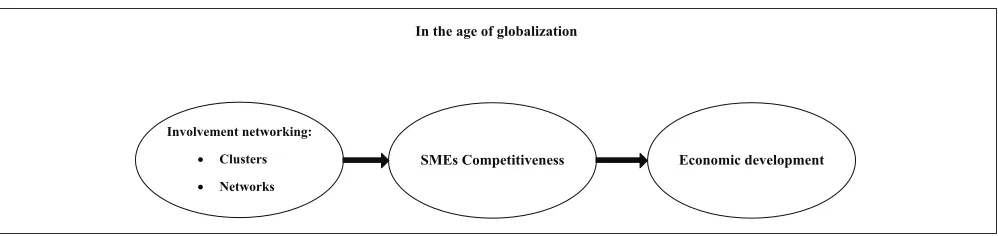
affects the world and local economy, for SMEs to sustain competitive advantage, clusters are very important for SMEs. Therefore, a benchmarking framework focusing on clusters needs to be developed to aid in the increment of improve-ment, to strengthen the competitive positions of SMEs in general. This study presented discussion on foundation for an empirical research in these matters (Lin & Wei, 2009) and proposed a conceptual model called “influence of cluster and network involvement on SMEs competitiveness and devel-opment economic in the age of globalization” for SMEs in developing countries to utilize and benefit from clusters, while achieving SMEs development in terms of globaliza-tion based on competitiveness. Policy makers, managers, and executives may appreciate creating and managing healthy networks that serve global market requirements in the major industrial sectors. This would enable SMEs to increase net-work performance and get the opportunity for further devel-opment (Villa & Taurino, 2011). Future research could carry out the case study and apply interview techniques and survey selected SMEs that are already in cluster to investigate based on proposed conceptual model (Chung & Tibben, 2006).
Declaration of Conflicting Interests
The author(s) declared no potential conflicts of interest with respect to the research, authorship, and/or publication of this article.
Funding
The author(s) received no financial support for the research and/or authorship of this article.
References
Audretsch, D. B. (2003). SMEs in the Age of Globlization, part of serie: The Globalization of the World Economy. UK: Edgard Elgar.
Braun, P., McRae-Williams, P., & Lowe, J. (2005, June 30-July 1). Small business clustering: Accessing knowledge through local networks. In CRIC Cluster Conference 2005. Ballarat, Australia: CRIC. Retrieved from http://www.cric.com.au Cairncross, F. (1995). Telecommunications: The death of distance.
The Economist, 30, 5-28.
In the age of globalization
Involvement networking:
• Clusters
• Networks
SMEs Competitiveness Economic development
Figure 1. Influence of cluster and network involvement on SMEs competitiveness and development economic in the age of
Ceglie, G., & Dini, M. (1999). SME cluster and network devel-opment in developing countries: The experience of UNIDO. Geneva, Switzerland: United Nations Industrial Development Organization.
Chung, Y., & Tibben, W. (2006, June). Understanding the adoption of clusters by SMEs using innovation theory. In Y. Ryung, K. Chung, & W. Tibben (Eds.), Management of Innovation and Technology, 2006 IEEE International Conference (vol. 1, pp. 389-393). Institute of Electrical and Electronics Engineers. Ghanatabadi, F. (2005). Internationalization of small and
medium-sized enterprises in Iran (Unpublished Doctoral thesis). Luleå University of Technology, Department of Business Administration and Social Sciences, Division of Industrial Marketing and E-Commerce.
Globalization. (n.d.). In BusinessDictionary.com. Retrieved from http://www.businessdictionary.com/definition/globalization.html Hagen, B., Zucchella, A., Cerchiello, P., & De Giovanni, N. (2012).
International strategy and performance—Clustering strategic types of SMEs. International Business Review, 21, 369-382. Hollensen, S. (2013). Global marketing (6th ed.). Harlow, UK:
Pearson Education.
Humphrey, J., & Schmitz, H. (1995). Principles for promoting clus-ters & networks of SMEs. Vienna, Switzerland: United Nations Industrial Development Organization.
Ibeh, K. (2004). Furthering export participation in less performing developing countries: The effects of entrepreneurial orienta-tion and managerial capacity factors. Internaorienta-tional Journal of Social Economics, 31, 94-110.
Karaev, A., Koh, S. C. L., & Szamosi, L. T. (2007). The cluster approach and SME competitiveness: A review. Journal of Manufacturing Technology Management, 18, 818-835. Lee, Y. J. (2014). Policy considerations for SME globalization in
the creative economy. KIET Industrial Economic Review, 19, 48-61.
Lim, H. (2008). SMEs in Asia and globalization. Retrieved from http://www.eria.org/publications/research_project_reports/ smes-in-asia-and-globalization.html
Lin, C., & Wei, T. (2009). The mutual relation between industrial cluster and the independent innovation of SME. In Enterprise grows in sustaining efficiency and effectiveness (pp. 91-96). Beijing: CHEN Lin, Beijing Union University.
Loecher, U. (2000). Small and medium-sized enterprises— Delimitation and the European definition in the area of industrial business. European Business Review, 12, 261-264. doi:10.1108/09555340010373537
Long, C., & Zhang, X. (2011). Cluster-based industrialization in China: Financing and performance. Journal of International Economics, 84, 112-123. doi:10.1016/j.jinteco.2011.03.002 Musteen, M., Francis, J., & Datta, D. K. (2010). The influence of
international networks on internationalization speed and per-formance: A study of Czech SMEs. Journal of World Business, 45, 197-205. doi:10.1016/j.jwb.2009.12.003
Nadvi, K., & Barrientos, S. (2004). Industrial clusters and pov-erty reduction: Towards a methodology for povpov-erty and social impact assessment of cluster development initiatives. Vienna, Switzerland: United Nations Industrial Development Organization.
Nguyen, T., Alam, Q., & Prajogo, D. (2008, June 30-July 2). The impact of government policy and land accessibility to
the development of SMEs: Do industrial cluster and network models work in Vietnam? In Service Systems and Service Management, 2008 International Conference (pp. 1-8). Melbourne, Australia: Institute of Electrical and Electronics Engineers.
Niu, K.-H. (2010). Organizational trust and knowledge obtaining in industrial clusters. Journal of Knowledge Management, 14, 141-155.
Organisation for Economic Co-Operation and Development. (2000, June). Enhancing the competitiveness of SMEs in the global economy: Strategies and policies. In N. Classifie (Ed.), Conference for Ministers responsible for SMEs and Industry Ministers (pp. 14-15). Bologna, Italy.
Porter, M. (2000). Location, competition and economic devel-opment: Local clusters in a global economy. Economic Development Quarterly, 14, 7-20.
Ramayah, T., Ling, N. S., Taghizadeh, S. K., & Rahman, S. A. (2016). Factors influencing SMEs website continuance inten-tion in Malaysia. Telematics and Informatics, 33(1), 150-164. Rao, S. S., Toledo, O., & Metts, G. (2003). Electronic commerce
development in small and medium sized enterprises: A stage model and its implications. Business Process Management Journal, 9, 11-32. doi:10.1108/14637150310461378
Sato, Y. (2000). Linkage formation by small firms: The case of a rural cluster in Indonesia. Bulletin of Indonesian Economic Studies, 36, 137-166.
Saxenian, A. (1994). Regional advantage: Cluster and competi-tion in silicon valley and route 128. Cambridge, MA: Harvard University Press.
Schiller, J., & Martin-Schiller, B. (1997). Market, culture and state in the emergence of an Indonesian export furniture industry. Journal of Asian Business, 13(1), 33-55.
Small and Medium Enterprise Administration, Ministry of Economic Affairs. (2008). SME industry clusters-cluster inno-vation and strategic development. Retrieved from http://www. moeasmea.gov.tw/ct.asp?xItem=7461&;ctNode=307&mp=2 Smyth, I. A. (1990, December). Collective efficiency and
selec-tive benefits: The growth of the rattan industry of Tegalwangi (Working Paper Series: B-1). Bandung, Indonesia: AKATIGA. Smyth, I. A. (1992). The effects of a development project on handi-crafts production in a Sundanese village. PRISMA, 52, 12-30. Tambunan, T. (2005). Promoting Small and Medium Enterprises
with a clustering approach: A policy experience from Indonesia. Journal of Small Business Management, 43, 138-154.
Tambunan, T. (2008). Development of rural manufacturing SME clusters in a developing country: The Indonesian case. Journal of Rural development, 31, 123-146.
United Nations Industrial Development Organization. (2003). Strategy document to enhance the contribution of an effi-cient and competitive SME sector to industrial and economic development in the Islamic republic of Iran. Retrieved from https://www.unido.org/uploads/tx_templavoila/Strategy_doc- ument_to_enhance_contribution_of_efficient_and_competi-tive_SME_sector__in_Iran.pdf
Zain, M., & Ng, S. I. (2006). The impacts of network relationships on SMEs’ internationalization process. Thunderbird International Business Review, 48, 183-205. doi:10.1002/tie.20092
Zeinalnezhad, M., Mukhtar, M., & Sahran, S. (2011). The roll of clusters and networks in development of Industrial SMEs.
In International Conference on Business and Economics
Research (vol. 1, pp. 76-80). Kuala Lumpur, Malaysia: IACSIT Press.
Zhang, X., Ma, X., Wang, Y., Li, X., & Huo, D. (2016). What drives the internationalization of Chinese SMEs? The joint effects of international entrepreneurship characteristics, net-work ties, and firm ownership. International Business Review, 25, 522-534.
Zohari, T. (2008). Iranian government globalization policy impacts on SMEs and the corresponding effect on Iranian-Swedish trade. Retrieved from http://www.digitpro.co.uk/2012/06/21/ iranian-government-globalization-policy-impacts-on-smes-and-the-corresponding-effect-on-iranian-swedish-trade
Author Biographies
Sara Foghani, PhD, International Business School(IBS)-(UTM) MBA, Strategic Management, University Teknologi Malaysia (UTM)BSc, Economics Lecturer at IAU.
Batiah Mahadi, PhD in Technology Management, University of Western Australia. Senior lecturer/researcher Department of Business Administration Faculty Management Universiti Teknologi Malaysia.