MALAYSIAN ANNUAL REPORT
Article
CITATIONS
0
READS
82
4 authors, including:
Some of the authors of this publication are also working on these related projects:
Internet Financial Reporting, Integrated Reporting, Language Usage in Financial StatementView project
Mohd Noor Azli Ali Khan Universiti Teknologi Malaysia
45PUBLICATIONS 97CITATIONS
SEE PROFILE
All content following this page was uploaded by Mohd Noor Azli Ali Khan on 21 May 2015.
A STUDY OF MALAY LANGUAGE USAGE IN MALAYSIAN ANNUAL REPORT
Mohd Noor Azli Ali Khan Shatira Mohd Zaini
Faculty of Management and Human Resource Development Universiti Teknologi Malaysia
ABSTRACT
This study seeks to identify the use of Malay language in the annual reports of listed companies on Bursa Malaysia. The study was conducted in accordance with the Financial Reporting Standard (FRS) 101 for the Presentation of Financial Statements. The study was made to a company for ten years beginning in 2001 until 2010. Samples of 234 from a total population of companies listed on Bursa Malaysia which totaled 844 companies in 2010. All samples must have a complete financial data from year 2001 until 2010 and also samples of the Malay language in the annual report. This study found that 4.19 percent (2001), 3.74 percent (2002), 3.43 percent (2003), 11.3 percent (2004), 2.84 percent (2005), 1.78 percent (2006), 1.62 percent (2007), 2.34 percent (2008 ), 13.2 percent (2009) and 1.90 percent (2010) companies that have downloaded the annual report using the Malay language in the company's corporate website. The study also revealed that the use of Malay language for reporting financial information and business is lower among companies listed on Bursa Malaysia. This study is very important as a continuation of further studies relating to the presentation of financial statements and the use of Malay language as a medium of information delivery.
Keywords: Malay language, Standards, Annual Report, Bursa Malaysia
---
1. INTRODUCTION
also lead to increased comparability and relevance of any information reported on the financial statements (Mohd Nasir & Abdullah, 2004). The objective of this standard was introduced for reporting of financial statements in Malaysia received globally (Yen, Hirst & Hopkins, 2007).
Based on the statement Thoouin et al. (2009), the pattern of presentation of financial statements vary due to differences in the standards adopted in the annual report of the respective countries. Therefore, in ensuring best practice in corporate governance in Malaysia, the MASB has introduced new standards for the preparation of financial statements, in the early stages of the period given in the next four years, before the review standards are made. MASB has issued accounting standards in the Malay Language to public companies in preparing their annual reports. However, MASB not require these companies to adopt the terms proposed. Award of NACRA (National Annual Corporate Awards) was held to improve the quality of reporting of information by public and private companies. The condition for participating in this award is a company must prepare an annual report in the Malay Language and one other language (Hashim & Jaffar, 2006). An annual report should be presented with a language that is easily understood and accepted by consumers in Malaysia. Most of the annual reports of companies in Malaysia use English in their presentation of the annual report from the national language (Asmah, 1993).
Based on previous studies, most annual reports around the world have been able to change the standards set out by IFRS. To achieve the objectives of IFRS, the standards set overall financial statement presentation considerations as guidelines, structure and minimum content of financial statements (Botoson, 2004). This will improve efficiency and non-intrusive audit the effectiveness of the audit process (Booth & Schulz, 1995). In agency theory, there are relation between shareholders and corporate management. This is known as an employment contract which means that corporate management must report their activities in a timely and fair (Scott, 1997). One of the company's medium to communicate with stakeholders is an annual report (Alexander, 1993). Thus, the annual report must be provided in a transparent, accurate, complete and easily understood (Epstein, Barry & Eva, 2008). Previous research has found that the two components in the annual report or financial report are terms and numbers (Aisbitt & Nobes, 2001). Accounting using the number has become a tradition for deliver information. This means that the number is more important than the term because the number may reflect the purpose to be described (Barth, 2008). The management must provide financial statements containing relevant information to enable consumers of information to make decisions (Barth, 2008). In addition, it is 'neutral', which is not in favor of any party and adequate and complete information (Porter & Norton, 2010).
Commission to send a representative to attend workshops organized by the Dewan Bahasa dan Pustaka (DBP) to discuss, validate and standardize the use of related terms of economic, accounting, banking, insurance, business, taxation, trade and investment (Awang, 2000). However, during the development of FRS in Malaysia, found only a handful of researchers who focus on the standards of this annual report. The study found, the time given to the company to accept this standard is limited (Yen, Hirst & Hopkins, 2007).
This study was done because in Malaysia until now still does not have a standard accounting term in the Malay Language that may be applicable in public. In addition, the use of this term has no legal enforcement accordingly. In addition, studies concerning in the use of accounting terms in the Malay Language is still not carried out by the responsible parties in Malaysia. Results from this study will hopefully be the start of the companies that produce annual reports using the accounting terminology, especially in the Malay Language. These terms are also expected to be adopted by the makers of accounting standards in Malaysia. The objective of this study was to investigate whether the use of accounting terminology is consistent with those put forward by the FRS 101.
This article is organized as follows: the next section will discuss the background of the study; followed by a comprehensive literature review. The next section discusses the research methodology and findings. Finally, this article ends with the conclusion of investigations conducted the study.
2. BACKGROUND OF THE STUDY
According to research, presentation skills can improve the process of transferring ideas, but can determine the method of one party can dominate the other and also to ensure the continuous two-way communication (Maines & McDaniel, 2000). Presentation of financial statements is one of the alternative companies to disclose financial reporting purposes (Richardson, Tuna & Wu, 2002). Each component of the financial statements must be clearly identified. In addition, important information to be displayed and repeated when necessary, for the purpose of providing accurate understanding of information presented (Van, 1993). MASB 1 was developed based on IFRS or International Accounting Standards (IAS) 1, which has been revised. Presentation of financial statements issued by the International Accounting Standards Board (IASB) (Hassan & Salleh, 2010).
The conversion to IFRS as the basis for financial reporting system in Malaysia, the influence and impact the company. Under FRS 101 Paragraph 46 states of each component of the financial statements must be clearly identified. According to FRS 101 Paragraph 13, the annual report should present a reasonable position to improve financial performance and cash flows of the entity. Fair presentations of annual reports require the accuracy of statements that can give effect to the transactions, events and other conditions. The purpose of the annual report is to provide information about the financial position, performance and changes in financial position that is useful for users to make any decision (Feltham, Indjejikian & Nanda, 2006).
Guidelines on Offer Documentation of the Malaysian Code on Take-overs and Mergers, which is currently reinforced (Holthausen & Watts, 2001). The next section describes the performance and convergence of previous studies that form the basis of guidance to this ongoing study.
3. PREVIOUS STUDIES
Based on previous studies, most researchers do research on a number of countries on the annual report provided to countries like China (Belkaoui & Picur, 1991), Jordan (Bartov, Goldberg & Kim, 2005), Europe (Baldwin, Dull & Graham, 2003), United States (Hjarvard, 2003), Asia (Globerman, Peng & Shapiro, 2011), France and Netherlands (Parker, 1994), and Japan (Okada, 2008). The study conducted a comprehensive discussion of the acceptance of different countries of the annual report of the review. In terms of annual report and also the most important interest contains tables, diagrams, graphs, narrative, the number and terms (Courtis, 1995), facilitate the audit process (Booth & Schulz, 1995), the medium of communication (Alexander, 1993), achievement company (Courtis, 1998), annual reports difficult to understand (Archer & McLeay, 1991), the effect of communication with the provider annual report annual report users (Hopkins, 1996) and also the presentation of annual reports (Botoson, 2004). The annual report is an important function because it has to do with the interested parties (Ashbaugh & Pincus, 2001), a contract of employment (Scott, 1997), readability (Epstein, Barry & Eva, 2008), means of communication (Young, 2003), making company decisions (Ball, Robin & Wu, 2003) and monitoring of company resources (Barker, 1998). The next component of the financial statements is discussed in the study (Aisbitt & Nobes, 2001; Barth, Landsman & Lang, 2007; Ali, Chen & Radhakrishnan, 2007). Legal requirements are essential in the preparation of annual reports. Many previous studies are discussed on methods of presentation annual report (Hirst & Hopkins, 1998), compliance with the standard basis (Parker, 1994; Jeanjean & Stolowy, 2008; Benston, 1982; Bartov, Goldberg & Kim, 2005; Geoff, 2004), ethics in accounting (Belkaoui & Picur, 1991), complete information (Porter & Norton, 2010), ICAEW and IASB (Baldwin, Dull & Graham, 2003), and information systems (Beretta & Bozzolan, 2004; Carter & Van, 2006; Baldwin, Dull & Graham, 2003).
Presentation of financial statements are divided into language (Mills, 1989; Parker, 1994; Benston, 1982; Hassan & Salleh, 2010; Geoff, 2004; Globerman, Peng & Shapiro, 2011; Hjarvard, 2003), the findings from previous studies showed the acceptance of IFRS (Tan, Jane & Othman, 2007), the importance of presentation format (Smith, 1971; Laswad, Gary & Tooley, 2008), the profit and loss statement and statement of comprehensive income (Melis & Chart, 2010; Beattie, Brown & Ewers, 1994), the balance sheet , statement of changes in equity, cash flow statement and relevance (Lander & Auger, 2008; Taylor, 2009; Kosmala, 2003; Lau, Chee & Kwong, 2008; Scott, 2006). Annual report appears should easy to read and understand. An annual report must have a level of high readability and understanding in order to enable users to obtain information needed. However, there are some changes on the revised FRS 101 of which are changing the title of each component of the financial statements and changes to the components of the financial statements. These changes are intended to present financial statements more relevant. Based on the previous studies, several issues need to be addressed is concerned with the use of language, standards, titles and terms used in the annual reports of companies in Malaysia should be studied further.
4. METHODOLOGY
The methodology used in this study is to discuss methods to obtain data. Overall, this section aims to explain how the data obtained and how the necessary data is analyzed. Aspects will be covered include population and sample, research design, research instruments, data collection methods as well as how data is analyzed. This study population is through the annual report for the limited companies listed on Bursa Malaysia. In accordance with the objectives of the study, researchers made observations on the annual report for ten years starting in 2001 until 2010. The population of this study is to report the Malay Language or dual language provided by public companies listed on the Main Market Kuala Lumpur Stock Exchange (KLSE). Number of population in 2011 found that there were 844 companies from all different backgrounds are listed on the Main Market of Bursa Malaysia. Out of this, our initial survey of 234 companies in 2001 until the year 2010, which publishes an annual report in both languages, namely Malay and English. The focus of the study will only be given to all accounting terms used in the balance sheet, including the notes to the accounts of an annual report prepared in Malay. Use of the term only is taken from the balance sheet because the balance sheet presentation format more shows similarities than profit and loss statements.
The research instrument used printed checklist to collect data. Questions are structured, designed, and the information provided are derived from the FRS 101 issued by MASB. Form of questions designed in the form of closed item is a form of research questions that need answers the question mark response options were provided (Sekaran, 2003). Data collection methods used to see whether this terminology as proposed in accordance with FRS 101, the test frequency used in this study for achieving their stated objectives. This test will show evidence that the use of a uniform terminology is used in industry (Golafshani, 2003) is a quantitative data will be analyzed using the Statistical Package for the Social Science (SPSS) version 17.0. During the process of data analysts, researchers using the method of frequency analysis to find the frequency of the data. In addition, the researchers also used the percentage method to evaluate the results more easily understood. Furthermore, a checklist is one of the quantitative methods used to collect information from those with experience. Weber (1990) states that checklists could increase the validity of the facts. This study uses a checklist survey method because it is a method to obtain information from entities who are more experienced. In this context, the entity that experienced refers to acts and standards used as guidance in the preparation of financial statements. Estimated that more than 95% of questions designed based on existing standards to meet the objectives set.
5. FINDINGS AND DISCUSSION
Table 1 shows the number of companies using the Malay Language in the annual report. All this research samples of 234 companies representing 100% of the Malay Language in the preparation of annual reports. However, the findings obtained in accordance with the total list of companies on Bursa Malaysia found that in the year 2001 of 4.19%, followed by 3.74% in 2002, 3.43% in 2003, then 3.11% in 2004, 2.84% in 2005, 1.78% in 2006 and 1.62% only in 2007. The findings of this study showed a decrease from 2001 until 2007. Started in 2008, there were slightly increased by 2.34%, but decreased by the year 2009, by 2.13% followed by 1.90% in 2010. These findings support the study by Parker (2004) who showed that the Malay Language utilized by companies in Malaysia because English has become the lingua franca used for business and English is also used as a business language.
Table 1: The use of Malay Language in the Annual Report
Malay Language
2001 2002 2003 2004 2005 2006 2007 2008 2009 2010
f % f % f % f % f % f % f % f % f % f % Yes 34 100 32 100 30 100 28 100 26 100 16 100 14 100 20 100 18 100 16 100
No - - - - - - - -
Total Samples
34 100 32 100 30 100 28 100 26 100 16 100 14 100 20 100 18 100 16 100
Total 812 4.19 856 3.74 874 3.43 900 3.11 914 2.84 899 1.78 863 1.62 855 2.34 844 2.13 844 1.90
Table 2: Use of Language in the Annual Report
Language 2001 2002 2003 2004 2005 2006 2007 2008 2009 2010
f % f % f % f % F % f % f % f % f % f %
Malay 34 100 32 100 30 100 28 100 26 100 16 100 14 100 20 100 18 100 16 100 English 34 100 32 100 30 100 28 100 26 100 16 100 14 100 20 100 18 100 16 100
Mandarin 7 20.6 5 15.6 - - - -
Table 3 shows the strategy used by companies reporting in the annual report. In the context of information dissemination, ritualism is interpreted as a static reporting, and reporting means that dynamic opportunism (Trabelsi, Labelle & Laurin, 2004). The results showed that 2001 of three companies, namely 8.82% using the strategy of opportunism and ritualism of 31 which is 91.18%. Reporting strategy using high-ritualism is most often used by companies in the sample in this study. The study also shows that companies in Malaysia still lagging far behind developed countries in preparing annual reports such as those reported in studies (Ashbaugh & Pincus, 2001). Therefore, the efforts of Bursa Malaysia are important to ensure complete reporting of annual reports and quality can be produced.
Table 3: Reporting Strategy
Strategy 2001 2002 2003 2004 2005 2006 2007 2008 2009 2010
f % f % F % f % f % f % f % f % f % f %
Opportunism 3 8.82 2 6.25 3 10.0 2 7.14 4 15.38 1 6.25 4 28.6 6 30 3 16.6 8 50 Ritualism 31 91.18 30 93.75 27 90.0 26 92.86 22 84.62 15 93.75 10 71.4 14 70 15 83.3 8 50
Total 34 100 32 100 30 100 28 100 26 100 16 100 14 100 20 100 18 100 16 100
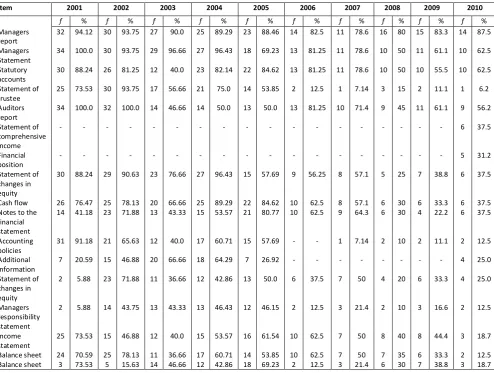
Table 4 explains the title of financial statements set out earlier in the sequence. In 2001, statement by the manager and the auditor's report highest first exposed in the financial statements of 34 companies which represent 100%, followed by a title report disclosed previously manager of 32 representing 94.12% and least reported first is a statement of responsibility manager and the statement of changes in equity are of two companies representing only 5.88%. The year 2003 was the highest title is a statement by the manager revealed that a total of 29 representing 96.66%, followed by the title of changes in equity and balance sheet is the title of the most under-reported previous record number of 11 representing 36.66% only.
Table 4: Financial Statements Item Presented Title (First Sequence)
Item 2001 2002 2003 2004 2005 2006 2007 2008 2009 2010
f % f % f % f % f % f % f % f % f % f %
Managers
report
32 94.12 30 93.75 27 90.0 25 89.29 23 88.46 14 82.5 11 78.6 16 80 15 83.3 14 87.5
Managers
Statement
34 100.0 30 93.75 29 96.66 27 96.43 18 69.23 13 81.25 11 78.6 10 50 11 61.1 10 62.5
Statutory
accounts
30 88.24 26 81.25 12 40.0 23 82.14 22 84.62 13 81.25 11 78.6 10 50 10 55.5 10 62.5
Statement of
trustee
25 73.53 30 93.75 17 56.66 21 75.0 14 53.85 2 12.5 1 7.14 3 15 2 11.1 1 6.2
Auditors
report
34 100.0 32 100.0 14 46.66 14 50.0 13 50.0 13 81.25 10 71.4 9 45 11 61.1 9 56.2
Statement of comprehensive income
- - - 6 37.5
Financial position
- - - 5 31.2
Statement of changes in
equity
30 88.24 29 90.63 23 76.66 27 96.43 15 57.69 9 56.25 8 57.1 5 25 7 38.8 6 37.5
Cash flow 26 76.47 25 78.13 20 66.66 25 89.29 22 84.62 10 62.5 8 57.1 6 30 6 33.3 6 37.5 Notes to the
financial
statement
14 41.18 23 71.88 13 43.33 15 53.57 21 80.77 10 62.5 9 64.3 6 30 4 22.2 6 37.5
Accounting
policies
31 91.18 21 65.63 12 40.0 17 60.71 15 57.69 - - 1 7.14 2 10 2 11.1 2 12.5
Additional
information
7 20.59 15 46.88 20 66.66 18 64.29 7 26.92 - - - 4 25.0
Statement of changes in equity
2 5.88 23 71.88 11 36.66 12 42.86 13 50.0 6 37.5 7 50 4 20 6 33.3 4 25.0
Managers responsibility statement
2 5.88 14 43.75 13 43.33 13 46.43 12 46.15 2 12.5 3 21.4 2 10 3 16.6 2 12.5
Income
statement
25 73.53 15 46.88 12 40.0 15 53.57 16 61.54 10 62.5 7 50 8 40 8 44.4 3 18.7
Balance sheet 24 70.59 25 78.13 11 36.66 17 60.71 14 53.85 10 62.5 7 50 7 35 6 33.3 2 12.5 Balance sheet 3 73.53 5 15.63 14 46.66 12 42.86 18 69.23 2 12.5 3 21.4 6 30 7 38.8 3 18.7
Table 5: Term Receivables / Receivables Trade
Term 2001 2002 2003 2004 2005 2006 2007 2008 2009 2010
f % f % f % f % f % f % f % f % f % f %
Term receivables 30 88.24 30 93.75 28 93.33 26 92.86 18 69.23 13 81.25 13 92.9 14 70 14 77.7 11 68.7 Accounts
receivable
- - 2 6.25 - - 2 7.14 3 11.54 - - - - 4 20 2 11.1 2 12.5
Trade receivable 4 11.76 - - 2 6.66 - - 2 7.69 3 18.75 - - 2 10 2 11.1 3 18.7 Turnover - - - 3 11.54 - - 1 7.1 - - - -
Total 34 100 32 100 30 100 28 100 26 100 16 100 14 100 20 100 18 100 16 100
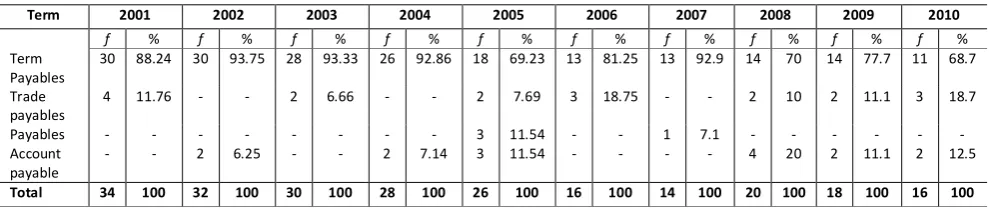
Table 6 shows the term creditor or trade payables. Term payables of the highest reported in 2002, 30 represent 93.75% of the companies followed by the year 2003, 28 represent 93.33% while the lowest was in 2010 that 11 accounted for 68.7%. For the terms of trade payables is the highest reported in 2001 that 4 represents 11.76% followed by 3 represents 18.75% in 2006 and the lowest was in 2003 that 2 represents 6.66%. Next for the payables of the highest trade in 2005, the 3 represents the 11.54% while the accounts payable were highest in 2008, 4 represents 20% followed by 3 represents the 11.54% in 2005 and lowest in 2002, 2 represents 6.25 % only.
Table 6: Term Payables / Trade Payables
Term 2001 2002 2003 2004 2005 2006 2007 2008 2009 2010
f % f % f % f % f % f % f % f % f % f %
Term Payables
30 88.24 30 93.75 28 93.33 26 92.86 18 69.23 13 81.25 13 92.9 14 70 14 77.7 11 68.7
Trade
payables
4 11.76 - - 2 6.66 - - 2 7.69 3 18.75 - - 2 10 2 11.1 3 18.7
Payables - - - 3 11.54 - - 1 7.1 - - - -
Account
payable
- - 2 6.25 - - 2 7.14 3 11.54 - - - - 4 20 2 11.1 2 12.5
Total 34 100 32 100 30 100 28 100 26 100 16 100 14 100 20 100 18 100 16 100
Table 7 shows the stock terms used in financial statements. Highest number of company’s use the term stock is in 2003 of about 3 represents 10% followed by 2 represents 5.88% in 2001. Next to the company using the term inventory peaked in 2002, a total of 30 representing 93.75% followed by 22 representing 84.62% in 2005 while the lowest was in 2007 that 8 represents only 57.1%.
Table 7: Term Stock
Term 2001 2002 2003 2004 2005 2006 2007 2008 2009 2010
f % f % f % f % f % f % f % f % f % f %
Stock 2 5.88 - - 3 10.0 - - - -
Inventory 17 50.0 30 93.75 21 70.0 18 64.29 22 84.62 10 62.5 8 57.1 12 60 9 50 11 68.7
differences in the arrangement of titles in the financial statements. The terms used are also sub-standard FRS 101. Studies should be developed by studying the factors that cause change and improve the quality of annual reports of companies in Malaysia.
6. CONCLUSION
Conclusion regarding the study done to achieve the objectives of the study examines the disclosure and presentation of financial reports in accordance with FRS 101 on the companies listed on Bursa Malaysia. The study found that the sample of the group and company financial statements have been prepared in accordance with the provisions of the Companies Act 1965 and the adoption of FRS 101. In fact, this standard was adopted in part by the sample companies. This study reports the findings related to accounting practices among companies listed on the Main Board and Second Board of Bursa Malaysia based on guidelines set by MASB 1.
Results showed that the use of English as the language used in the annual reports of very high (above 90%). Only a few companies surveyed who took the initiative to present their annual report in a combination of two or three languages. Use of English is encouraged by the government, but from one other aspect of whether the information conveyed by the company through their annual reports can best be understood by consumers who are not proficient in English raises other (Lander & Auger, 2008). Therefore, it is proposed accounting standard-setting to look into the matter whether or not to the companies to provide their company's annual report in at least two languages for enhanced usability and understanding among the users.
Based on the differences in terms of layout, use of the term and the method of accounting is used, it implies that the objective of MASB 1 to set the basic presentation of the general purpose financial statements to ensure comparability with the financial statements of the enterprise itself prior to the financial statements of other enterprises, is difficult to achieve (Jones, 1996). For the adoption of FRS 101, the interest groups in jointly controlled entities are included in the consolidated financial statements in accordance with the entity's accounting methods. The analysis found that there is uniformity in the presentation title in the financial statements for industries such as disclosure of balance sheet, income statement, cash flow statements, changes in equity statement, and disclosure notes to financial statements. The findings showed that most of the samples revealed the following information to comply with the requirements provided by FRS 101 (Adelberg & Farrelly, 1989). However, as Parker (1994) stated that there are differences of several aspects such as terminology and methods presented in the annual reports.
study the effect of the presentation of the revised FRS 101 for financial statements in the case in question to the entities annual report to the classification of comparative information. The financial statements also show the results of monitoring of the resources entrusted to it. However, there is a possibility that the statement of financial position and statement of comprehensive income will be presented as performance standards (Feltham, Indjejikian & Nanda, 2006). Such studies will increase the supporting evidence on the impact of FRS 101 full shift in the financial report until the year 2012.
In addition, the proposal to be considered is to boost the population and sample survey. Sufficient number of samples and balanced study is necessary to obtain more accurate data and representative of the population sample. This study can also be done by making a comparison between the sizes of the company by way of adoption FRS 101. In addition, these findings could be an alternative for companies to increase the level of knowledge in the implementation of FRS 101 in the preparation of financial statements in accordance with MASB first step to implementing IFRS. In addition, issues of language use and understanding of accounting terms used in the annual reports can also be considered for future research to determine whether the use of language limiting the applicability of the company's annual report among the users. Given the present Malay given less attention and are often overlooked and miss-use of the Malay language itself (Awang, 2000). Consistency of accounting methods used can also be an issue in future studies through the study of time travel.
Therefore, it is concluded that this study provides initial evidence that the use of financial reporting standards in the first stage was introduced, implemented in practice overall financial statement presentation among a limited company in Malaysia. However, this level is still too early to see the actual progress of the adoption of MFRS 101 limited companies in Malaysia as a full transition to IFRS by 2012. Finally, hopefully this study and ongoing research in accounting practices is expected to make a useful contribution and input to the parties involved in the accounting profession to improve accounting practices in Malaysia.
ACKNOWLEDGEMENT
The financial support for the authors’ research from Ministry of Higher Education (MOHE), Malaysia and Research Management Center (RMC), Universiti Teknologi Malaysia, Johor Bahru, Johor, Malaysia vote no. Q.130000.2629.02J80 by Research University Grant (RUG) also appreciated.
REFERENCES
Adelberg, A.H., & Farrelly, G.E. (1989). Measuring the Meaning of Financial Statement Terminology: A Psycholinguistics Approach. Journal of Accounting and Finance. 127(6), 33-40.
Aisbitt, S., & Nobes, C. (2001). The True and Fair View Requirement in Recent National Implementation. Accounting and Business Research. 31(2), 83-90.
Ali, A., Chen, T., & Radhakrishnan, S. (2007). Corporate disclosures by family Firms. Journal of Accounting and Economics. 44(12), 238-286.
Archer, S., & McLeay, S. (1991). Issues in transnational financial reporting: A linguistic analysis. Journal of Multi-Lingual and Multicultural Development. 12(5), 61-347.
Ashbaugh, H., & Pincus, M. (2001). Domestic accounting standards, international accounting standards, and the predictability of earnings. Journal of Accounting Research. 39(3), 34-417.
Asmah Omar. (1993). Perancangan Bahasa dengan Rujukan Khusus kepadaPerancangan Bahasa Melayu. Kuala Lumpur: Dewan Bahasa dan Pustaka.
Awang Sariyan. (1995). Ceritera Bahasa. Kuala Lumpur: Dewan Bahasa dan Pustaka.
Awang Sariyan. (2000). Warna dan Suasana Perancangan Bahasa Melayu di Malaysia. Kuala Lumpur: Dewan Bahasa dan Pustaka.
Baldwin, A.A., Dull, R.B., & Graham, A.W. (2003). Web-based Financial Statements: Hyperlink to Footnotes and their Effect on Decision. International Journal of Accounting Information System. 4(2), 185-203.
Ball, R., Robin, A., & Wu, J. (2003). Incentives versus standards: Properties of accounting income in four East Asian countries. Journal of Accounting and Economics. 36(1), 70-235.
Barker, R.G. (1998). The market for information: Evidence from finance directors, analysts and fund managers. Accounting and Business Research. 29(1), 3-20.
Barth, M.E. (2008). Global financial reporting: implications for US academics. The Accounting Review. 83(15), 1159-1179.
Barth, M., Landsman, W., & Lang, M. (2007). International accounting standards and accounting quality. Journal of Accounting Research. 46(3), 98-467.
Bartov, E., Goldberg, S.R., & Kim, M. (2005). Comparative value relevance among German, US, and international accounting standards: A German stock market perspective. Journal of Accounting, Auditing and Finance. 20(2), 95-119.
Beattie, V., Brown, S., Ewers, D., John, B., Manson, S., Thomas, D., & Turner, M. (1994). Extraordinary item and income smoothing: a positive accounting approach. Journal of a Business Finance and Accounting. 21(6), 811-848.
Belkaoui, A.R., & Picur, R.D. (1991). Cultural determinism and the perception of accounting concepts. The International Journal of Accounting. 26(2), 30-118.
Beretta, S., & Bozzolan, S. (2004). A framework for the analysis of firm risk communication. The International Journal of Accounting. 21(6), 811-991.
Booth, P. & Schulz A.K. (1995). The Effects of Presentation Format on The Effectiveness and Efficiency of Auditor’s Analytical Review Judgements. Journal of Accounting and Finance. 12(3), 107-137. Botoson, C. (2004). Discussion of a Framework for the Analysis of Risk Communication. The International
Journal of Accounting. 39, 289-295.
Bradshaw, M., Bushee, B., & Miller, G. (2004). Accounting choice, home bias, and US investment in non-US firms. Journal of Accounting Research. 42(5), 795-841.
Brennan, N., Guillamon-Saorin, E., & Pierce, A. (2009). Impression Management: Developing and Illustrating a Scheme of Analysis for Narrative Disclosures: A Methodological Note. Accounting, Auditing & Accountability Journal. 22(5), 789-832.
Brown, C. (1995). Translation and Law: American Translators Association Scholarly Monograph Series. Riding the Waves of Fortune: Translating Legislation of the Successor Soviet Republics, in Morris. (6th ed.) Amsterdam/Philadelphia: John Benjamins Publishing Company.
Bursa Malaysia. 2010. Main market listing. Retrieved August 17, 2011, from http://www.bursamalaysia.com/website/bm/regulation/rules/listing/
Carter, R., & Van Auken, H. (2006). Small Firm Bankruptcy. Journal of Small Business Management. 44(4), 493-512.
Chan, K.C., & Seow, G.S. (1996). The association between stock return and foreign GAAP earnings versus earnings adjusted to US GAAP. Journal of Accounting Research. 96(2), 83-116.
Chen, L.H., & Sami, H. (2008). Trading volume reaction to the earnings reconciliation from IAS to US GAAP. Contemporary Accounting Research. 25(1), 15-53.
Courtis, John K. (1995). Readability of Annual Reports: Western versus Asian Evidence. Accounting, Auditing and Accountability Journal. 8(2), 4-17.
Courtis, John K. (1998). Annual Report Readability Variability: Test of the Obfuscation Hypothesis. Accounting, Auditing and Accountability Journal. 11(4), 34-57.
Covrig, V.M., DeFond, M.L., & Hung, M. (2007). Home bias, foreign mutual fund holdings, and the voluntary adoption of international accounting standards. Journal of Accounting Research. 45(1), 41-70.
Cuijpers, R., & Buijink, W. (2005). Voluntary adoption of non-local GAAP in the European Union: A study of determinants and consequences. European Accounting Review. 14(3), 487-524.
Daske, H., Hail, L., Leuz, C., & Verdi, R. (2008). Mandatory IFRS Reporting Around the World: Early Evidence on the Economic Consequences. Journal of Accounting Research. 46, 1085-1142.
Davidson, R.A., & Chrisman, H.H. (1993). Interlinguistic comparison of international accounting standards: The case of uncertainty expressions. International Journal of Accounting. 28(1), 1-16. Epstein, Barry J., & Eva K.J. (2008). Global Financial Reporting. The growing Prominence of IFRS:
Implication for Transactional Attorneys. Business Law International. 9(1), 16-27.
Evans, L. (2004). Language, Translation and the Problem of International Accounting Communication. Accounting, Auditing and Accountability Journal. 17(2), 210-248.
Feltham, G., Indjejikian, R., & Nanda, D. (2006). Dynamic Incentives and Dual-Purpose Accounting. Journal of Accounting and Economics. 42, 37-417.
Fulkerson, C.L., & Meek, G.K. (1998). Analysts’ earnings forecast and the value relevance of 20F reconciliations from non-US GAAP. Journal of International Financial Management and Accounting. 9(1), 1-15.
Geoff, M. (2004). Principle and Practices. Journal of Accounting and Ecomonics. Retrieved Okt 9, 2010 from http://www.oup.com.uk
Gerard, S. (2011). Let's Talk: Adapting Accountants' Communications to Small Business Managers Objectives and Preferences. Accounting, Auditing & Accountability Journal. 24(6), 781-809. Globerman, S., Peng, M.W., & Shapiro, D.M. (2011). Corporate governance and Asian companies. Asia
Pasific Journal of Management. 28(2), 1-14.
Golafshani, N. (2003). Understanding Reliability and Validity in Qualitative Research. The Qualitative Report. 8(4), 597-607.
Hashim, F. & Jaffar, R. (2006). Memperteguh Keyakinan Terhadap Kemampuan Bahasa Kebangsaan. Kuala Lumpur: Pelita Bahasa.
Hassan, M.S., & Mohd Salleh, N. (2010). The Value Relevance of Financial Instruments Disclosure in Malaysia Firms Listed in the Main Board of Bursa Malaysia. International Journal of Economics and Management. 4(2), 243-270.
Healy, M., & Perry, C. (2000). Comprehensive Criteria to Judge Validity and Reliability of Qualitative Research within the Realism Paradigm. Qualitative Market Research. 3(3), 118-126.
Hirst, D., & Hopkins, P. (1998). Comprehensive Income Reporting and Analysts’ Valuation Judgement. Journal of Accounting Research. 36, 47-75.
Hjarvard, S. (2003). The Globalization of Language: How the media contribute to the spread to English and the emergency of medialects. Media, Globalization and Identity. 23, 14-78.
Holthausen, R., & Watts, R. (2001). The Relevance of the Value-Relevance Literature for Financial Accounting Standard Setting. Journal of Accounting and Economics. 31(1-3), 3-75.
Hooi, L.W., Tee, K.W., & Lim, Y.K. (2003). Fokus Ungu Masteri: SPM Prinsip Perakaunan. Kuala Lumpur: Pelangi.
Hopkins, P.E. (1996). The effect of financial statement classification of Hybrid financial instrumentation on financial analysts’ stock price judgments. Journal of Accounting Research. 34, 33-50.
IASC. (1999). IASC Publisher Study of Business Reporting on the Internet. Press Release: International Accounting Standards Committee, 15 November 1999.
Iselin, E.R. (1989). The Effects of Format on the Extraction of Information From Accounting Statement. Journal of Accounting and Finance. 32, 73-79.
Jeanjean, T., & Stolowy, H. (2008). Do accounting standards matter: An exploratory analysis of earnings management before and after IFRS adoption. Journal of Accounting and Public Policy. 27(6), 480– 494.
Jones, M.J. (1996), Readability of annual reports: Western versus Asian evidence. Comment to contexualize. Accounting, Auditing and Accountability Journal. 9(2), 4-17.
Kosmala, M.K. (2003). The true and fair view construct in the context of the Polish transition economy: some local insights. European Accounting Review. 12(3), 87-465.
Lander, G.L. & Auger, A.K. (2008). The need for transparency in financial reporting Implications of off-balance-sheet financing and inferences for the future. Journal of Accounting & Organizational Change. 4(1), 27-46.
Laswad, F., Ghani, E.K., & Tooley, S. (2008). Do Digital Reporting Formats Assist Professional Users in Overcoming Functional Fixation in Recognition vs. Disclosure. BAA 2008 Conference. 15-19 April. Blackpool, 331-348.
Lau Chee Kwong (2008). Financial Reporting of Intangible Assets: The Realibility of Measurement Methods. Doctor Philosophy, Universiti Putra Malaysia,
Melis, A., & Carta, S. (2010). Does accounting regulation enhance corporate governance: Evidence from the disclosure of share-based remuneration. Journal of Management and Governance. 14, 435– 446.
Mills, P.A. (1989). Words and the study of accounting history. Accounting, Auditing, and Accountability Journal. 2(1), 34-78.
Mohd Iskandar, T., & Basnan, N. (2002). Perakaunan Kewangan Prinsip dan Amalan di Malaysia. (2nd ed.) Kuala Lumpur: Cerdik Publication.
Mohd Nasir, N., & Abdullah, S.N. (2004). Information provided by accrual and cash flow measures in determining firms’ performance: Malaysian evidence. Journal of Applied Sciences. 1(2), 64-70. Morais, A. (2010). Actuarial gains and losses: the determinants of the accounting method. Pasific
Accounting Review. 22 (1), 42-56.
Neumann, F.L. (2000). Auditor reporting decisions. Journal of Accounting & Economics. 12(1), 78-114. Okada. H. (2008). The assets and liability view and the income concepts in Japan. Malaysian Accounting
Review. 7(1), 87-115.
Parker, R.H. (1994). Finding English words to talk about accounting concepts. Accounting, Auditing and Accountability Journal. 7(2), 47-82.
Parker, R.H. (2004). Finding English words to talk about accounting concepts. Accounting, Auditing and Accountability Journal. 12(4), 115-36.
Peng, S., & Bewley, K. (2010). Adaptability to fair value accounting in an emerging economy: A case study of China’s IFRS convergence. Accounting, Auditing & Accountability Journal. 28(8), 982– 1011.
Porter, G.A., & Norton, C.L. (2010). Financial Accounting: The impact on decision makers. South Western Cergage Learning. 7, 62-64.
Power, M. (2003). Auditing and the Production of Legitimacy. Accounting, Organizations and Society. 28, 379-394.
Richardson, S.A., Tuna, A.I., & Wu, M. (2002). Predicting Earnings Management. The Case of Earnings Restatements. Retrieved August 3, 2011, from http://ssrn.com/
Sekaran, U. (2003). Research Methods For Business A Skill Building Approach (4th ed.). USA: John Wiley & Sons, Inc.
Scott, W.R. (1997). Financial Accounting Theory. London: Prentice-Hall
Smith, J., & Smith, N. (1971). Readability: A Measure of the Performance of The Communication Function of Financial Reporting. Accounting Review. 13, 352-361.
Sun, M. (2007). An Exploratory Study of the Understandability of Listed Companies’ Annual Reports. Frontiers of Business Research in China. 1(1), 39-49.
Tan, L.L., Jane L., & Othman, R. (2007). Adoption of Financial Reporting Standards (FRSs): Impact on Malaysia Companies. Doctor Philosophy, Universiti Teknologi MARA, Shah Alam.
Taylor, D.W. (2009). Costs-benefits of adoption of IFRSs in countries with different harmonization histories. Asian Review of Accounting. 17(1), 40-58.
Thompson, J.C. (2008). When accounting finally becomes global. The CP Accounting Journal. 78(9), 115-241.
Thouin, M.F., Hoffman. J.J., & Ford, E.W. (2009). IT outsourcing and firm-level performance: A transaction cost perspective. Information & Management. 46, 463-469.
Trabelsi, S., Labelle, R., & Laurin, C. (2004). CAP Forum on E-Business: The Management of Financial Disclosure on Corporate Websites: A Conceptual Model. Canada Accounting Perspectives. 3(2), 235-259.
Van Hulle, K. (1993). Truth and untruth about true and fair: A commentary on European true and fair view. The European Accounting Review. 2(1), 99-104.
Weber, R.P. (1990). Basic Content Analysis. (2nd ed.). Newbury Park, CA: Sage.
Yen, A., Hirst, D.E., & Hopkins, P. (2007). A Content Analysis of the Comprehensive Income Exposure Draft Comment Letters. Research in Accounting Regulation. 19, 53-79.
Young, J. (2003). Constructing, Persuading and Silencing: The Rhetoric of Accounting Standards. Accounting, Organizations and Society. 28, 621-638.