A United States-Russian Federation Collaborative Research Program on Advanced
Structural Analysis to Enhance Nuclear Safety
R. F. Kulak1) and S. Boutorin2)
1) Reactor Analysis and Engineering Division, Argonne National Laboratory, Argonne, IL 60439 2) Energy Division, VNIPIET, St. Petersburg, Russian Federation
ABSTRACT
In the early 1990s the US Department of Energy (DOE) initiated programs to improve safety at Soviet-designed nuclear power plants. In 1995 the US Secretary of Energy, Hazel O’Leary, proposed the establishment of the International Nuclear Safety Centers. The USDOE established the US center at Argonne National Laboratory in October 1995. In July 1996, the Russian Federation’s (RF) Minatom established the Russian center (RINSC) at the Research and Development Institute of Power Engineering in Moscow. The mission of the INSCs is to preserve, enhance and share safety and reactor technology relevant to nuclear power plants world-wide and through international collaboration, to assist in development and maintenance of safety and reactor technology and a healthy safety culture through the world. This mission is founded in the belief that safety requires continuous improvement and that everyone benefits when safety technology is made freely available to all countries participating in the nuclear enterprise. This paper describes the accomplishments of the Advanced Structural Analysis collaborative project, which was one of over ten safety projects that were developed between the two centers.
INTRODUCTION
In the early 1990s the US Department of Energy (DOE) initiated programs to improve safety at Soviet-designed nuclear power plants [1]. In 1995 the US Secretary of Energy, Hazel O’Leary, proposed the establishment of the International Nuclear Safety Centers. The USDOE established the US center at Argonne National Laboratory in October 1995. In July 1996, the Russian Minatom established the Russian center (RINSC) at the Research and Development Institute of Power Engineering in Moscow. The mission of the INSCs is to preserve, enhance and share safety and reactor technology relevant to nuclear power plants world-wide and through international collaboration, to assist in development and maintenance of safety and reactor technology and a healthy safety culture through the world. This mission is founded in the belief that safety requires continuous improvement and that everyone benefits when safety technology is made freely available to all countries participating in the nuclear enterprise. The overall program deals with key core competencies in disciplines that underpin nuclear safety research such as structural analysis, severe accident studies, materials issues, thermal hydraulics and reactor physics. These disciplines form the foundation for the internal collaborations and domestic research undertaken by the INSCs.
Specialists from the US and Russia are working jointly to develop validated, three-dimensional structural analysis software and models for the evaluation of Russian (VVER, RBMK) and US (LWR) Nuclear Power Plant structures subjected to design-basis and beyond-design-design-basis loadings. Existing structural analysis software on both sides has been enhanced to treat the uniqueness in nonlinear static and transient behavior of metals, reinforced concrete and prestressed concrete associated with nuclear power plants. The NEPTUNE computer code is the flagship structural analysis code developed at Argonne for the US side and the DANCO computer code is the flagship code on the Russian side. This software is generic in nature so that it can be used for Russian-designed reactors including the Russian Federation (RF), other former Soviet countries, Eastern Europe and US reactor designs. One of the most important aspects of the collaboration is the validation basis of the software. The basis includes a materials database, a geometry database, and a problem database.
The problem database was developed that contains benchmark problems for use in verifying and validating structural analysis computer codes. Initial exercises were performed for the simple problems in the database, which tested single code features. Results for these simple problems were deposited in the database. The Russian collaborators identified relevant Russia experiments that were added to database and the US collaborators did likewise. Key problems from the database are presented in the paper.
Both sides participate in the International Round Robin Analysis Activity for Containment Structures, which included a suite of scale-size experiments on different types of containments. The experimental program is cosponsored by the Nuclear Power Engineering Corporation of Japan (NUPEC) and the US Nuclear Regulatory Commission (NRC). The first phase was focused on the analysis of a steel containment vessel (i.e., a prototype BWR Mark-II containment) and the second phase was focused on
the simulation of a prestressed concrete containment vessel (PCCV) that is subjected to internal pressure. Results and comparison to the experiments are given in the paper.
In an effort to foster an open exchange in this safety technology, it has been decided to make each sides analysis tools available to the other side through a widely accessible medium, such as the Internet. Details are presented in the paper on how this was accomplished as well as lessons learned in doing remote international computing.
ACCOMPLISHMENTS
This multi year project is aimed at developing validated, three-dimensional structural analysis software and models for the evaluation of Nuclear Power Plant (NPP) structures (such as, containments, steam generators, steam separators, drum separators, etc.) subjected to design and beyond design basis loadings. The following loadings will be included: seismic, thermal, aircraft crash, external and internal shock waves, and hydrodynamic. Structural analysis software was developed to treat the nonlinear static and transient behavior of metals, reinforced concrete, prestressed concrete and liquids. This software was designed to be generic in nature so that it can be used for Soviet-designed reactors including the Russian Federation (RF), other former Soviet countries, Eastern Europe and US reactor designs. The accomplishments to-date of the joint project are described below..
Databases
Physical and Mechanical Properties Database
The RINSC and USINSC jointly defined safety critical structural components and the materials from which they are made and then identified the mechanical properties needed for finite element analysis of equipment, pipes and civil structures. A data format was agreed upon. Experts from the RINSC collected data from design and regulatory documents and, after review by the experts from the USINSC, deposited them in the database. Missing data was identified.
The data base includes the physical and mechanical properties of construction materials at low temperatures (maximum temperature is 450 deg C for corrosion resistant steels, 350 deg C for carbon steels and 250 deg C for zirconium alloys) and include the properties used in the construction of VVER NPPs. In addition, the database has been extended to include the properties of construction materials at high temperatures (long-term strength, plasticity and creep) and include the material properties used in the construction of RBMKs, VVERs, etc.
Structures Geometric Database
Knowledge of the geometric dimensions (diameters, lengths, widths, thicknesses, etc.) of the various designed reactor structures is needed to construct generic finite element models for safety assessments. The RINSC and USINSC jointly defined the geometric dimension needed to do finite element analysis. Experts from the RINSC collected all available data and, after review by the experts from the USINSC, deposited them in the database. In particular, data was collected for Leningrad NPP Unit 3 and Ignalina NPP Unit.
Structural Design Characteristics Database
A compilation was assembled of the major structural design characteristics of Soviet-designed reactors (440, VVER-1000, RBMK-1000) including critical details of potential failure sites for the main structural components. A representative design for each reactor type was collected. The compilation included (1) a listing of the types of reactors, (2) a listing of all critical structures or components along with illustrative figures and details, and (3) a listing of the type of loads that are of concern for each structure/component. This information will be used to define needed analysis capability and as input to the structural analysis codes.
Structural Code Verification/Validation Database
Figure 2. RINSC Numerical
Model for the Physical
PCCV Model
Figure 1. 1:4-Scale Model of a Pre-stressed
Concrete Containment Vessel Located at Sandia
National Laboratory
The first validation problem was a prestressed concrete containment vessel (PCCV) test. The Nuclear Power Engineering Corporation of Japan (NUPEC) and the US Regulatory Commission (NRC) cosponsored internal pressurization tests of scale-size containment structures. In addition, they are conducted a round robin analysis activity for international participants to perform pretest and posttest numerical simulations of the tests. The current test is for a prestressed concrete containment vessel (PCCV) subjected to static internal pressurization (Fig. 1). This PCCV test has been chosen as a validation problem for the US and RF structural analysis codes. Computer models for the PCCV were developed by the USINSC and the RINSC and computer simulations were performed for the pretest phase. The numerical model developed by RINSC is shown in Fig. 2. Both sides are currently conducting posttest analyses, which will be reported at the SMiRT Post Seminar on Containment.
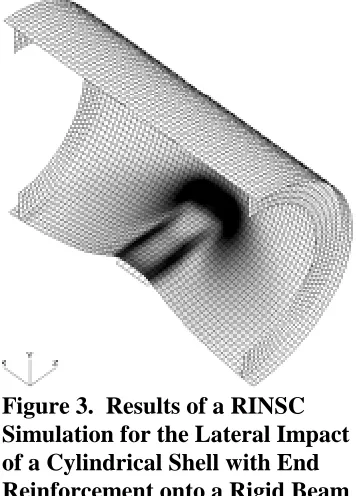
As an example of a verification problem, the lateral impact of a cylindrical shell, with end reinforcement, against a rigid block was computed and compared to results previously computed by Lovejoy and Whirley [2]. The cylindrical shell has an initial velocity of 16.74 m/s and deforms elasto-plastically upon impact. The deformed configuration, as computed by the RINSC is shown in Figure 3.
Figure 4. Results of a USINSC
Simulation of a Whipping Pipe
Impacting Against a Rigid Surface
Figure 3. Results of a RINSC
Simulation for the Lateral Impact
of a Cylindrical Shell with End
Reinforcement onto a Rigid Beam
Piping Code Verification/Validation Database
One class of NPP equipment that the computer codes need to be validated for are two- and three-dimensional pipelines with constrained and intermediate supports. The major objective of this joint effort was to conduct a comparative analysis of Russian computer codes used for strength calculations in the design of pipeline systems for nuclear power facilities in Russia. The following three Russian-developed computer codes, which are used for strength calculations of pipeline systems, were reviewed: CANPIPE, TP-95PC and dPIPE.
The CANPIPE code (version 2.0) has been developed by SEC of Minatom RF (Moscow). The code employs the finite element method (FEM) for strength calculations of pipelines. The code was licensed by GAN RF, which is the regulatory agency of the Russian Federation, to be used for static loading calculations. The code section for linear-spectral dynamic impact calculation technique has been submitted to GAN RF for certification and is currently in the review process.
The TP-95PC software package has been developed by GI “VNIPIET” (Saint-Petersburg). It is designed for comprehensive strength calculations of pipeline systems /1/. The software package also allows performing calculations to select springs for elastic supports with regard to both low-temperature and high-temperature pipelines. TP-95PC software package has been submitted to GAN RF for certification and is the review process.
The dPIPE software package (version 2.3) has been developed by JSC “CKTI-Vibroseism” (Saint-Petersburg) and designed for static and dynamic strength analysis of NPP pipeline systems. The dPIPE code is based on the finite element method. dPIPE features a capability of performing calculations using dynamic analysis technique with regard to non-linear support constraint systems. Such types of constraints include damper supports (there are several models for taking such supports into account, including disproportionate damping), mechanical and hydraulic shock absorbers, and supports with supplementary constraints (stops with gaps). This software package was successfully used for calculations of the pipeline systems of NPP built under Russian designs in other countries (Armenia, Hungary, Finland, Chec Republic, etc.).
A benchmark problem set was created for comparing the computational results of the above codes. The basic criteria for selection of the benchmark problems were: (1) each problem would contribute to verifying one or more features needed to analyze a piping system, and (2) each problem would be verified/validated against known analytical solutions, verified benchmark problems or experimental data. There are nine problems in this set. The basic loads considered were weight, temperature, internal pressure and seismic impacts. The loads and impacts were considered separately for the purposes of comparing results.
Analytical Methods and Failure Criteria Reviews
and reported. Second, a review of the failure criteria used to determine the ultimate loading conditions (strength assessment) for reactor structures and components was compiled. This review addressed all relevant structural materials: metals, reinforced concrete, prestressed concrete, etc. This compilation now provides a single source of information that is available to all the organizations.
RF Structural Analysis Computer Programs
A survey of RF computer programs, which would be applicable to structural analysis, was compiled along with an evaluation of their capabilities. The computer codes to be surveyed will cover the following areas: purpose (e.g., transient analysis, fluid-structure interaction), type (e.g., finite element), dimension (e.g., 3-D), coding language (e.g., FORTRAN), integration scheme (e.g., explicit central difference), element library (e.g., beams, plates), materials library (e.g., elastoplastic), application (e.g., containment, piping).
Fracture Mechanics Survey
Based on current production technology, operations and non-destructive testing of structural components for nuclear power plants, it is impossible to completely rule out the existence of crack-type defects. Therefore, the determination of the strength of reactor structures must take these defects into account. When evaluating the strength of NPP structural components, there always exist a level of ambiguity. The use of probabilistic methods helps to solve some of the problems connected with ambiguity. The validation of the strength in the presence of crack-type defects is part of the assessment of the operability of structures. A survey of codes and criteria was completed to assess the state-of-the-art of fracture mechanics, including probabilistic methods of fracture mechanics, as applied to the evaluation of NPP equipment and vessel integrity. The survey, however, was limited to equipment/vessels made from metals.
SUMMARY
International Nuclear Safety Centers have been established in the US in 1995 and in the RF in 1996. The mission of the INSCs is to preserve, enhance and share safety and reactor technology relevant to nuclear power plants world-wide and through international collaboration, to assist in development and maintenance of safety and reactor technology and a healthy safety culture through the world. The Joint Project on Advanced Structural Analysis has made significant progress in establishing databases that contain information needed for the modeling and simulation of Russian built NPPs: physical and mechanical properties, structures geometry and structural design characteristics. In addition, two databases were set up that contain verification and validation benchmark problems that are used to verify/validate both RF and US structural analysis software. The first database relates to general structural analysis software and the second database relates to piping analysis software. Reviews of RF analytical methods and failure criteria were conducted, and a survey of fracture mechanics was performed. The work performed by the INSCs has collected necessary data for input to structural simulation applications and developed a verification/validation basis for the structural analysis computer codes.
ACKNOWLEDGMENT
The Russian Federation work was performed under the auspices of the Russian MINATOM, Russian International Nuclear Safety Center. The US work was performed under the auspices of the US Department of Energy, Office of International Nuclear Safety and Cooperation, under Contract W-31-109-Eng-38.
REFERENCES
1. Klickman, A., “Working Together for Safety,” Nuclear Engineering International, May 2000, pp. 28-29.
2. Lovejoy, S. C. and Whirley, R. G., “ DYNA3D Example Problem Manual,” University of California, Lawrence Livermore National Laboratory, Report UCRL-MA-105259, October 1990.
3. Hsu L. C., Kuo A. Y., Tang H. T., “Nonlinear Analysis of Pipe Whip,” SMiRT 8, Paper F1 4/6, 1985.
4. Luk, V. K., “Pretest Round Robin Analysis of a Prestressed Concrete Containment Model.’ NUREG/CR-6678, SAND 00-1535, Sandia National Laboratory, August 2000.
5. Norms for strength calculations of equipment and pipelines of nuclear power facilities. PNAE G-7-002-86. 6. RTM108.020.01-75. Strength calculations of NPP pipelines.