MALAYSIA MY SECOND HOME PROGRAMME
SIOW GYEN WIN
MALAYSIA M Y SECOND HOME PROGRAMME
SIOW GYEN WIN
A thesis submitted in fulfillment o f the requirements for the award o f the degree of
Master o f Science (Real Estate)
Faculty o f Geoinformation and Real Estate Universiti Teknologi Malaysia
D ED IC A TIO N
"To my beloved parents, siblings and cousins, thank you for all your support in terms o f spiritual, motivation and encouragement"
"To all my fellow friends, thank you for all your support."
A C K N O W LE D G E M E N T
First and foremost, I would like to deliver my highest appreciation to my supervisor, Sr. Dr Mohd Nadzri bin Jaafar who has continuously supported me with guidance and suggestion throughout the course o f this study. His patient, knowledge and advice have assisted me greatly into completing this study.
I also would like thank my panels, coordinators and lecturers especially, PM Dr. Ahmad Ariffian Bujang, Dr. Haji Ibrahim @ Atan Sipan, Sr. Dr Janice Lee, and Dr Muhammad Najib Razali for their opinions and suggestions in improving my study. W ithout their guidance, I am sure that this study and research would not be completed as it is now.
I also deeply indebted to my fellow friends, namely, Lee Siew Mei, Neo Sau Mei, and Tsau Kar Yen for helping me through rain and shine to gather information and constantly contacting me to give moral support for this study. W ithout them, this study would not be completed as it is now and this has made me realise the meaning of friendship.
A BSTRA CT
A BSTR A K
TA BLE O F CO N TEN TS
C H A P T E R T IT L E PA G ES
TH E SIS STATUS D EC LA R A TIO N SU PE R V ISO R 'S D EC LA R A TIO N
T IT L E PA G E i
D EC LA R A TIO N PA G E ii
D ED IC A TIO N PA G E iii
A C K N O W LE D G E M E N T iv
A B STR A C T v
A B STR A K vi
TA BLE O F C O N TEN TS vii
L IS T O F TA BLES xiii
L IS T O F F IG U R ES xvi
L IS T O F A BBREV IA TIO N S xviii
L IS T O F A PPEN D IX xix
1 IN T R O D U C TIO N
1.1 Background o f Study 1
1.2 Problem Statement 7
1.3 Research Questions 10
1.4 Objectives o f the Study 11
1.6 Significance o f Study 11
1.7 Structure o f Dissertation 13
1.7.1 Chapter 1: Introduction 13
1.7.2 Chapter 2: Literature Review on Second Home 13 1.7.3 Chapter 3: Literature Review on Residential
Satisfaction 13
1.7.4 Chapter 4: Research Methodology 14
1.7.5 Chapter 5: Case Study 14
1.7.6 Chapter 6: Data Analysis and Findings 14 1.7.7 Chapter 7: Conclusion and Recommendation 14
2 L IT E R A T U R E R E V IE W ON SECOND H O M E
2.1 Introduction 16
2.2 Definition o f Second Home 16
2.2.1 Second Home Practice 17
2.2.2 M alaysia My Second Home (MM2H ) Programme 18 2.2.3 M alaysia My Second Home (MM2H) Agents 22 2.2.4 Application Procedure for Malaysia My Second
Home (MM2H) Programme 24
2.2.5 Guidelines on Acquisition o f Properties by Foreign
Interests 27
2.2.6 Acquisition Procedure o f Residential Unit under M alaysia My Second Home (MM2H) Programme 34 2.2.7 Incentives o f Tax Free Car under Malaysia My
Second Home (MM2H) Programme 35
2.2.8 Guidelines for Bringing Foreign Domestic Helper 37
2.2.9 Second Home Purposes 39
2.2.10 Reason for Choosing Malaysia as My Second
Home 43
3 L IT E R A T U R E R E V IE W ON R E SID EN TIA L SA TISFA C TIO N
3.1 Introduction 45
3.2 Definition o f Residential Satisfaction 45 3.2.1 Determinants o f Residential Satisfaction on Second
Home Motivators 47
3.3 Conclusion 60
4 R E SE A R C H M E T H O D O L O G Y
4.1 Introduction 61
4.2 Research Design 61
4.2.1 First Stage: Background o f the Study and Identify
the Statement o f the Problem 64
4.2.2 Second Stage: Literature Review 64 4.2.3 Third Stage: Data Collection 65
4.2.3.1 Research Instrument 66
4 .2 .3 2 Face Validity 69
4.2.3.3 Research Sampling 70
4.2.3.4 Pilot Survey 72
4.2.3.5 Distribution o f Questionnaire 73
4.2.4 Fourth Stage: Data Analysis 74
4.2.4.1 Reliability Analysis 75
4.2.4.2 Frequency Analysis 76
4.2.43 Descriptive Analysis 76
4 .2 .4 4 Multidimensional Scaling Analysis (MDS) 78
4.2.45 Chi-square Tests 79
4.2.5 Fifth Stage: Conclusion and Recommendation 80
5 CASE STUDY A REA
5.1 Introduction 82
5.2 Greater Kuala Lumpur (KL) 82
5.3 Multi-cultural Living Environment o f Greater KL 85
5.4 Public Transportation at Greater KL 92
5.5 Entertainment at Greater KL 95
5.6 Residential Property in Greater KL 98
5.7 Conclusion 101
6 DATA ANALYSIS AND FIND IN GS
6.1 Introduction 102
6.2 Questionnaire Survey Analysis for First Objective 103 6.2.1 Section A: Demographic Information 103 6.2.2 Main Purpose to join MM2H Programme 108 6.3 Questionnaire Survey Analysis for Second Objective 111
6.3.1 Satisfaction Level on Political and Legal Status
Factor 111
6.3.2 Satisfaction Level on Social Environment Factor 116 6.3.3 Satisfaction Level on Economy Environment
Factor 121
6.3.4 Satisfaction Level on Physical Environment
Factor 126
6.3.5 Satisfaction Level on Attraction Factor 132 6.4 Questionnaire Survey Analysis for Third Objective 136
6.4.1 The Relationship between the Purposes to Join MM2H Programme and satisfaction level on
Political and Legal Status Factor 136 6.4.2 The Relationship between the Purposes to Join
MM2H Programme and satisfaction level
on Social Environment Factor 140
MM2H Programme and satisfaction level on
Economy Environment F actor 143
6.4.4 The Relationship between the Purposes to Join MM2H Programme and satisfaction level on
Physical Environment Factor 145
6.4.5 The Relationship between the Purposes to Join MM2H Programme and satisfaction level on
Attraction Factor 149
6.5 Conclusion 152
7 CO N C LU SIO N AND R EC O M M EN D A TIO N S
7.1 Introduction 153
7.2 Research Findings 153
7.2.1 Objective 1: To Identify the M ain Purpose to
Join M M2H Programme by MM2H Participants 154 7.2.2 Objective 2: To Determine the Satisfaction Level on
Second Home Motivators by MM2H Participants 155 7.2.3 Objective 3: To Examine the Relationship between
the Purposes to Join MM2H Programme and
Satisfaction Level on Second Home Motivators. 159
7.3 Contribution to the Research 162
7.3.1 Contribution to the Knowledge 162
7.3.2 Contribution to the Stakeholder 162
7.3.3 Contribution to the Industry 163
7.4 Research Limitation 164
7.4.1 Difficulties in Getting Information from
Respondents 164
7.4.2 Time Consume 165
7.5 Recommendation for Further Study 165
7.5.1 Study on Different Area 165
R E FE R E N C E S 170
L IS T O F TABLES
TA BLE N O . T IT L E PA G ES
1.1 MM2H Participant Approvals from 2002-Nov 2014 3
1.2 Volume and Value o f Foreigner Transaction (2002-2012) 4 1.3 Volume o f Foreigner Transaction according to the State
(2002-2012) 5
1.4 Volume o f Foreigner Transaction according to the
types o f Residential (2002-2012) 5
2.1 Location o f Second Home Outside Great Britian 17
2.2 Registered Agents under MM2H Programme 22
2.3 Guideline on Acquisition Properties by Foreign Interest 28 2.4 Property Purchase o f MM2H Participants as at 22nd
September 2014 33
2.5 Applicant Qualifying Wage According to the Country of
Origin 38
3. 1 Classification o f the Origin and Development o f the
Second Home 47
3.2 Summary o f the Factor that Influenced Residents'
Satisfaction under Second Home Motivators 58
4.1 Design o f Questionnaire 67
4.2 Face Validation o f Questionnaire 69
4.3 Sampling Method for Distribution Questionnaire 71
4.4 Response Rate of Questionnaires Distribution 73
4.5 Research Planning to Achieve Research Objectives 74
4.6 Cronbach's Alpha on second home motivators 75
74 75 77 84 85 89 96 104 108 111 117 121 127 132 137 141 144 Research Planning to Achieve Research Objectives
Cronbach's Alpha on second home motivators Likert Scale on Satisfaction Level
The Goal o f Greater KL under the Economic Transformation Programme
Population Size and Composition o f Malaysian citizensof Greater KL
Cultural Events & Festivals 2014
Shopping Mall located at Kuala Lumpur and Selangor
Demographic Profile o f MM2H Respondents Main Purpose to Join MM2H Programme of MM2H Respondents
Satisfaction Level o f MM2H Participants on Political and Legal Status Factor
Satisfaction Level o f M M2H Respondents on Social Environment Factor
Satisfaction Level o f MM2H Respondents on Economy Environment Factor
Satisfaction Level o f MM2H Respondents on Physical Environment Factor
Satisfaction Level o f MM2H Respondents on Attraction Factor
The Relationship between the Purposes to Join MM2H Programme and Satisfaction Level on Political and Legal Status Factor
The Relationship between the Purposes to Join MM2H Programme and Satisfaction Level on
Social Environment Factor
The Relationship between the Purposes to Join MM2H Programme and Satisfaction Level on Economy Environment Factor
Physical Environment Factor
6.12 The Relationship between the Purposes to Join MM2H Programme and Satisfaction Level on
Social Environment Factor
7.1 Main Purpose to Join MM2H Programme o f MM2H respondents
7.2 Comparison between Satisfaction Index and MDS Result on Satisfaction Level o f MM2H Respondents on Political and Legal Status Factor
7.3 Comparison between Satisfaction Index and MDS Result on Satisfaction Level o f MM2H Respondents on Social Environment Factor
7.4 Comparison between Satisfaction Index and MDS Result on Satisfaction Level o f MM2H Respondents on Economy Environment Factor
7.5 Comparison between Satisfaction Index and MDS Result on Satisfaction Level o f MM2H Respondents
on Physical Environment Factor
7.6 Comparison between Satisfaction Index and MDS Result on Satisfaction Level o f MM2H Respondents on Attraction Factor
7.7 Summary o f the Relationship between the Purposes to Join MM2H Programme and Satisfaction Level on Second Home Motivators.
146
150
154
156
156
157
158
158
FIG U R E.N O 1.1 1.2 1.3 2.1 2.2 2.3 4.1 5.1 5.2 5.3 5.4 6.1 6.2 6.3 6.4 6.5
L IS T O F FIG U R ES
T IT L E PA G ES
Property Restrictions in Asia Pacific 2
MM2H Participant Approvals from 2002-Nov 2014 4
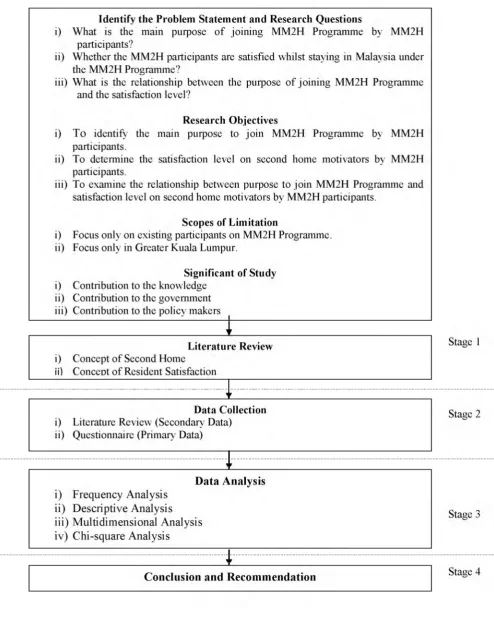
Research M ethodology Flow Chart 15
Procedures for Application o f MM2H Programme 25 Procedures for Acquisition o f Properties under MM2H
Programme 34
Procedures for Import Tax Free Car from Oversea under
M M2H Programme 35
Research Process 62
Local Authorities and Population Size o f Greater KL 83
Rail System around Greater KL 94
Greater KL Residential Supply 100
High-end Condominium Supply in Greater KL 100 M ain Purpose to join MM2H Programme o f MM2H
Respondents 108
Percentage o f Satisfaction Level on Political and Legal
Status Factor 112
MDS Analysis: Satisfaction Level on Political and Legal
Status Factor 113
Percentage o f Satisfaction Level on Social Environment
Factor 118
MDS Analysis: Satisfaction Level on Social Environment
6.6 Percentage o f Satisfaction Level on Economy
Environment Factor 122
6.7 MDS Analysis: Satisfaction Level on Economy
Environment Factor 123
6.8 Percentage o f Satisfaction on Physical Environment
Factor 128
6.9 MDS Analysis: Satisfaction on Physical Environment
Factor 129
L IS T O F A BBREV IA TIO N S
EPU - Economic Planning Unit
FIC - Foreign Investment Committee KLCC - Kuala Lumpur City Center MDS - Multidimensional Scaling M M2H - Malaysia My Second Home UKM - Univesiti Kebangsaan Malaysia
UM - Universiti Malaya
UPM - Universiti Putra Malaysia UTM - Universiti Teknologi Malaysia UUM - Universiti Utara Malaysia
L IS T O F A PPEN D IX
A PPEN D IX T IT L E PA G ES
A MM2H Car Price List 185
B Questionnaire 190
C The New Name o f Variables 195
D Dummy Coding for Variables 197
E1 Likert Scaling Analysis to Determine the Satisfaction
Level on Political Status Factor 199
E2 Likert Scaling Analysis to Determine the Satisfaction
Level on Social Environment Factor 201
E3 Likert Scaling Analysis to Determine the Satisfaction
Level on Economy Environment Factor 203
E4 Likert Scaling Analysis to Determine the Satisfaction
Level on Physical Environment Factor 205 E5 Likert Scaling Analysis to Determine the Satisfaction
IN T R O D U C TIO N
1.1 B ackground of Study
Second homes have been a popular trend since the mid 1950's (Gallent, 2005). Buying a house is one o f the largest purchases for people that will ever commit and buying in foreign currency only adds to the complexity. The demand for second homes has risen dramatically as a result o f globalization (Hall and Muller, 2004). According to Clark (1992), most second homers are aged above 35 years old and married. Francese (2001) stated that most second home buyers are those who are above 55 years old. M ost second homers purchase second homes for the purpose of retirement, investment and enjoyment (Norris and Winston, 2010). With increased international travel and trade, investing in property abroad is more popular than ever. This is because the price o f foreign property seems especially attractive when exchange rates favour the currency o f the prospective buyer. For others, buying overseas property is seen as an investment as undervalued property which carries the potentiality to appreciate substantially over time.
Property Consultant from Henry Butcher (Penang), the challenge for key players in M alaysia is to convince the international investors that properties in Malaysia offer better values than those in other countries. Therefore, to sustain the growth of economy in the real estate sector as well as tourism, M alaysia My Second Home (MM2H) Programme evolved from the Silver Hair Programme was able to draw attention from foreigners which the government had introduced during 1996 to convince foreign retirees above 50 years o f age into making Malaysia their second home.
Some countries prevent or limit property buying by foreigners, so it's critical to ensure that they choose a country that gives them the legal rights to buy. According to the Knight Frank Research (2013), the general view o f property restriction in Asia Pacific is displayed on Figure1.1. Countries like Singapore and Indonesia for example, employ a series o f stringent cooling measures to control foreign investments such as increasing the Additional Buyer Stamp Duty (ABSD) and limiting their purchases to specific type o f properties. Besides, foreign investors are allowed to purchase freehold properties and impose lower stamp duty in Malaysia.
The second home ownership market in Malaysia has significant prospective to enhance property development, economic growth and tourist industry. The government o f Malaysia is aspiring to gain economic benefits from second home practices by introducing the MM2H Programme (Wee, 2006). Starting from second o f the Silver Hair Programme followed by the M M2H Programme, restrictions have been loosened by the Tourism Ministry in order to attract 100,000 expatriates to stay in Malaysia by 2010 (Ramli, 2006). Table 1.1 and Figure 1.2 show the number of participant approval from 2002-Nov 2014 on Malaysia My Second Home (MM2H) Programme. The number o f participants in M M 2H Programme kept increasing from 2002 to 2005 but has dropped during the period o f 2006 to 2007. In year 2008 to 2009, the number o f participants increased slightly but dropped again in year 2010. In year 2011 to 2013, the demand o f staying in Malaysia gradually increased. However, from year 2013 to Nov 2014, the number o f participants dropped quite substantially in percentage which comprised o f a negative 22.40%. Although this period was just an evaluation in Nov 2014 but the drop in number o f participants was rather obvious.
Table 1.1: MM2H Participant Approvals from 2002-Nov 2014 Y ear No. of P articip an ts
A pproved
T otal No. O f P articip an ts A pproved
Y-0-Y C hange (% )
2002 818 818
-2003 1,645 2,463 101.1
2004 1,917 4,380 16.5
2005 2,615 6,995 36.4
2006 1,729 8,724 -33.9
2007 1,503 10,227 -13.1
2008 1,512 11,739 0.6
2009 1,578 13,317 4.4
2010 1,499 14,816 -5.0
2011 2,387 17,203 59.2
2012 3,227 20,430 35.2
2013 3,675 24,105 13.9
2014 (Nov) 2,853 26,958 -22.4
MM2H Participant Approvais from
2002-Nov 2014
2002 2003 2004 2005 2006 2007 2008 2009 2010 2011 2012 2013 2014
(Nov}
Figure 1.2: MM2H Participant Approvals from 2002-Nov 2014
Source: Ministry o f Tourism Malaysia, Malaysia My Second Home Centre (2014)
Table 1.2 shows all foreigners transaction volume and value from 2002 to 2012 in Malaysia. From the data obtained from NAPIC (2013), it shows foreign buyers include non-MM2H participants and MM2H participants contribution towards the real estate factor and also tourism economy at average RM 11 billion of each year. For a period o f 11 years, it had contributed around RM 120.62 billion to the real estate sector. Besides this, Table 1.3 shows the volume o f foreigner transaction according to the States in Malaysia from the period o f 2002 to 2012. Kuala Lumpur has the highest transaction volume which recorded 43.62%, following therewith was Selangor, Johor, Pulau Pinang. On the other hand, Perak, Pahang, WP Labuan, WP Putrajaya and Terengganu have the lower transaction volume which recorded not more than 1.00%. Volume o f foreigner transaction according to the type of residential (2002-2012) was shown on Table 1.4. The foreigners' preference was condominium or apartment as shown on the chart which occupies the highest percentage o f 65.66%.
Table 1.2: Volume and Value o f Foreigner Transaction (2002-2012)
Year Transaction Volume Value (RM billion)
2002 429 11.17
2003 548 11.13
2005 1,053 11.03
2006 1,009 10.99
2007 1,818 10.99
2008 1,960 10.93
2009 1,687 10.86
2010 1,185 10.82
2011 1,406 10.81
2012 1,180 10.81
Total 13,106 120.62
Source: NAPIC, Valuation and Property Service Department, Ministry o f Finance (2013)
Table 1.3: Volume o f Foreigner Transaction according to the States (2002 2012)
State Transaction Volume Percentage (%)
Johor 1,888 14.41
Kedah 185 1.41
Kuala Lumpur 5,717 43.62
Melaka 184 1.4
Negeri Sembilan 153 1.17
Pahang 91 0.69
Perak 107 0.82
Pulau Pinang 1,568 11.96
Sabah 413 3.15
Sarawak 146 1.11
Selangor 2,571 19.62
Terengganu 4 0.03
WP Labuan 12 0.09
WP Putrajaya 67 0.51
Total 13,106 100.00
Source: NAPIC, Valuation and Property Service Department, Ministry o f Finance (2013)
Table 1.4: Volume o f Foreigner Transaction according to the type o f Residential (2002-2012)
Types o f Residential Transaction Volume Percentage (%)
1-1 1/2 storey semi-detached 63 0.48
2-2 1/2 storey semi-detached 840 6.41
2-2 1/2 storey semi-terraced 1,710 13.05
Cluster House 104 0.79
Condominium/Apartment 8,606 65.66
Detached 860 6.56
Townhouse 211 1.61
Vacant Plot 519 3.96
Flat 70 0.53
Others 34 0.26
Total 13,106 100.00
Source: NAPIC, Valuation and Property Service Department, Ministry o f Finance (2013)
The MM2H Programme catered for house purchases was the governm ent's main target towards second homers from foreign countries. Other developing countries like Myanmar, Indonesia and Philippines have also well risen. In order to maintain its competitive positioning, the SwhengTee Property World Tour introduced to the world M alaysia's true potentiality as a property investment destination in Southeast Asia. An international property consultant from International Real Estate Investors (REI) Club (2013) said "the authorities from Iskandar, Greater Kuala Lumpur (KL), Penang and even Kota Kinabalu have been trying their best to secure foreign investment. Thus, Malaysia has shown to the world it is the best choice for property investment especially in terms o f its open policy by inviting foreigners to share the economic growth so as to maintain the growth."
1.2 Problem Statem ent
A second home or vacation home can be an asset to home owners who can generate additional income by renting out a property. This trend towards vacation type o f property is increasing (Mclntyre et al, 2006). Second homers sometimes consider moving to their second home permanently upon retirement. According to Norris and W inston (2010) stated that the purpose o f second homes are mostly for retirement, investment and enjoyment.
The new pattern o f tourism and migration has induced the demand for second homes (Lew et al, 2004). Second homes have become a developing trend aided by flexible accessibility and increasing personal income, notably in Western countries (Shaw and Willians, 2001). Countries such as China, Taiwan, Hong Kong, due to various reasons including the imposed cooling measures by their government and economic changes are considering investing out o f their country. The trend for Malaysians investing overseas is also very encouraging with strong investment notably in London, China, Melbourne, Indonesia and Singapore. This can stimulate the economy growth if Malaysia can balance it out by bringing in foreign investment.
M ost second homers purchase second homes for the purpose o f retirement, investment and enjoyment (Norris and Winston, 2010). However, majority o f the researches were performed in European countries as European countries were the earlier regions to perform the second home practice. Apart from that, Asian counties conducted fewer studies compared to European counties as the second home industry was still at a premature stage. Malaysia is one o f the Asian counties as well developing country that still has lots o f weakness to improvise and needs to produce better policy to stimulate the economy growth to be included in the promotion of second home programme (Yeoh, 2008).
Ramli (2006) stated that the Ministry o f Tourism has loosened the rule and conditions as well as restriction for joining the MM2H Programme which is evaluated from Silver Hair Programme. The purpose o f this evaluation to MM2H Programme from Silver Hair Programme (1996) is estimated to attract 100,000 expatriates to stay in Malaysia by 2010. However, based on the statistics o f Malaysia My Second Home Center (2014), the total o f approved applicants comprised o f only 26,958. According to Ho and Khor (2008), the expectation was low and MM2H programme has only enjoyed in moderate level o f success. Meanwhile, the neighboring countries such as Thailand, Singapore and Indonesia also offered a slightly different second home programme to boost up their counties' economy. The response rate will increase to attract foreigner to stay in Malaysia if the MM2H programme can offer and meet the requirement o f foreigner. Hence, it is worthwhile to find out the intention to join the MM2H Programme in order to provide concrete policy to enhance the quality o f MM2H Programme.
There have been many researches carried out in Malaysia to measure the level of satisfaction such as low income group with public housing, high-rise residential, Bumiputera lots and so forth but there was no research to identify the satisfaction level o f foreign owners o f second home in Malaysia. Besides this, there were many studies conducted focusing on second home impact but only a few studied on the satisfaction level o f second home programme. Since Malaysia was voted as the 'Best Place in the World to Retire' in Southeast Asia and ranked at number 19 in the world, in order to avoid the MM2H participant from surrendering their MM2H status because o f dissatisfaction on this second home programme, this research helps to create an awareness on the need to understand the determinants o f satisfaction with second home environment. Therefore, improvement can be initiated to attract more foreigners to join the second home programme in Malaysia.
The MM2H Programme was promoted via media, newspaper as well as website to attract more potential foreigners to become second homers in Malaysia. Many applicants for the MM2H Programme, particularly those from developed countries, are retirees who want to take advantage o f the country's combination of good service and infrastructure and relatively low cost o f living (MM2H Center, 2013). Certainly Malaysia offers foreigners with a high standard o f living at a very reasonable price. The expenses costs are affordable by the foreigners to enjoy a satisfactory lifestyle in Malaysia. Those people especially retirees who have chosen Malaysia as their second home seem to be very satisfied with the decision and very few o f them have changed their mind and decided to return to their native countries (Davinson, 2013). Yeoh (2008) also stated that Japanese ranked Malaysia as the top choice for long-stay programme for 5 consecutive years from 2006 to 2010 in the polls conducted.
second home programme is enormous (Natasha & Husrul Nizam, 2009). Satisfied participants will usually have positive recommendations; this in turn will generate more foreigners to the programme. For example, the existing Japanese MM2H participant feels satisfied with this programme and will be willing to introduce M alaysia to their fellow country citizen (Yeoh, 2008). Therefore, it is important for the government o f Malaysia and the related parties to find out what is the main objective to attract them to come and join this programme, as well as understand the satisfaction level o f existing MM2H participants in order to explore their perception on this second home programme and examine the relationship between the purpose and satisfaction level. Based on their feedback and opinions, the government will be able to find out which o f the aspect needs to be improved in order to enhance the quality o f second home programme.
1.3 R esearch Q uestions
Based on the problems raised in this research, the following research questions are formulated for this study:
a) W hat is the main purpose o f joining MM2H Programme by MM2H participants?
b) W hether the MM2H participants are satisfied whilst staying in M alaysia under the MM2H Programme?
1.4 O bjectives of th e Study
The problem statement led to the formulation o f the objectives o f this study as follows
i) To identify the main purpose to join M M 2H Programme by MM2H participants.
ii) To determine the satisfaction level on second home motivators by MM2H participants.
iii) To examine the relationship between purpose to join MM2H Programme and satisfaction level on second home motivators by MM2H participants.
1.5 Scope of the Study
This study will focus mainly on Greater Kuala Lumpur as this region is a well developed area, which is also the key towards improving M alaysia's economy. Furthermore, the respondents o f this study will focus on existing participants in MM2H Programme who stayed or traveled in Greater KL region.
1.6 Significance of the Study
a) Contribution towards the knowledge
This research is to help enhance as well as create a new guideline for assessment satisfaction level with second home in Malaysia. The second home is a global trend all over the world as a retirement place, investment, business shelter as well as vacation home. This becomes a new lifestyle for certain people especially people who come from overseas all around the world. The satisfaction o f foreigners is very important to provide a clear picture to communities in Malaysia on what M alaysia can provide them and also based on the point, what can be improvised to enhance the reputation o f our country as well as what aspects o f the economy should be increased.
b) Government
Foreign investment helps to maintain the growth and provide more investment opportunities in some markets such as manufacturing, business, tourism or real estate sector. Government can control the stamp duty or other legal fees to attract more foreigners to invest in this country. Besides this, based on the feedback or opinions from foreigners, the government can build more infrastructures or enhance the environment to attract them.
c) Policy makers
1.7 S tru ctu re of D issertation
Generally, this study has been divided into 7 chapters. The chapter layout is presented as follows:
1.7.1 C h a p te r 1: In tro d u ctio n
This chapter briefly describes an overview o f study topics including an introduction o f study. It continues with the problem statement that explains about the problems that occur in the study, followed by the objectives o f the study and scope of the study. In addition, significance o f the study and the study methodology are also contained here.
1.7.2 C h a p te r 2: L ite ra tu re Review on Second Hom e
This chapter basically discusses the definition o f second home, second home practice, and procedure and guideline o f MM2H Programme. The source o f this study is to complete the literature review derived from academic books, journals, internet and articles that have been done by previous researchers.
1.7.3 C h a p te r 3: L ite ra tu re Review on R esidential Satisfaction
1.7.4 C h a p te r 4: R esearch M ethodology
This chapter presents the research methodology such as explanations on techniques o f data collecting and analyzing data. The methodology that has been chosen to collect and analyze data must be able to achieve the objectives o f the study.
1.7.5 C h a p te r 5: C ase Study A rea
This chapter shows the case study area which is located at the Greater Kuala Lumpur. The cultural and features such as population o f Greater KL and multi cultural living environment o f Greater Kuala Lumpur will be discussed in this chapter.
1.7.6 C h a p te r 6: D ata Analysis an d Findings
This chapter will cover the analysis on the data that have been collected. Research methodology and the aforementioned in Chapter 3 are being applied on the data analysis to achieve the objectives o f this study. After the data have been analyzed, findings and results o f the study are being previewed in this chapter.
1.7.7 C h a p te r 7: C onclusion and R ecom m endation
REFERENCES
Anderson, G. (1998). F^szcs /or FJMc%fzo^%/ ^ese^rcA. Montreal: Solar Publishing.
Aschauer, W., (2010). Percepfzo^s o/ ToMrzsfs ^zsAy Desfm^zoMs. ^ woJe/ o/
PsycAo/ogzc^/ i/M e^ces Factors. Tourism Review, 65 (2), 4-20.
Awotona, A. (1991). Nzgerz%^ gover^we^f p^rfzczp^fzo^ z^ AoMsz^g/ 7970-79^0.
Mzgerz^. Social Indicators Research 25, 63-98.
Ball, M., (2005). TAe Seco^J Nowe Foow. The Appraisal Journal, 240-248.
Barness, S.J. (2005). ^ssessmg fAe v^/Me o/ iS yoMr^^/s. Communications of the
ACM, 48(1), 110-112.
Belsky, E.S., and Prakken, J.L. (2004). NoM-swg
NoM^z'ng'^
on
we%/fA ^ccMWM/^fzo^, we^/fA Jzsfrz^Mfzo^ ^^J co^sMwer spe^Jz^g. Cambridge,
Mass.: Joint Center for Housing Studies, Graduate School of Design and john
F. Kennedy School of Government, Harvard University.
Blaxter, L., C. Hughes & M. Tight. (2006). Now fo ^ese%rcA. Berkshire: Open
University Press.
Bulter, E. W., Chapin, Jr., F.S., Hemmens, G.C., Kaiser, E.J., Stegman, M.A., &
Weiss, S.F., (1969). Mwmg FeA%vzoMr %^J ^eszJeM%%/ CAozce.
Burby, R. J. and Rohe, W. M. (1989). Deco^ce^mfzo^ o/PM^/zc NoMsz^g/ F//ecfs o^
^eszJe^fs, S^zs/acfo wzYA TAezr Lzvz^g F^vzro^we^fs %^J TAezr Fe^r O/
Campbell, A., Converse, P.E., Rodgers, W.L., (1976). TAe gMa/zfy o/^werz'ca^ Lz/e/
Percepfz'o^s Fva/Mafz'o^s a^J Safzs/acfzo^s. New York, Russell Stage
Foundation.
Carrie Chan (2006, April 10). Ma/aysza My Seco^J Nowe Prograwwe/ Ma/aysza
FecAo^s Forezg^ ^efz'rees. Asia Times Online. Retrieved from http://m-m-2-
h.com/malaysia-beckons-foregin-retirees.html
Carver, R.H. & Nash, J.g., (2009). Doing Jafa a^a/ysz's wzYA SPSS versz'o^ 7d.
Canada: Brooks/ Cole Cengage Learning.
CBRE Research (2013). Greyer XMa/a LM^Mr. MarketView.
Charles Stangor. (2011). ^esearcA MefAoJs /or fAe FeAavzora/ Scz'e^ces. (4th Edition)
United States of America.: Wadsworth Cengage Learning.
Chin, Y., (1990). ^esz'Je^ NoMsmg Safzs/acfzo^ m MM/fz-Fawz/y NoMsz^g
F^vzro^we^fs z^ Xorea. Unpublished Doctoral Dissertation, University of
Illinois.
Clark, P.A. (1992). Seco^J Nowe Ow^ersAzp/ TAe case o/^Azsf/er ^esorf FrzYzsA
Co/Mw^za. Master of Arts. Department of Geography, Simon Fraser
University.
Coakes, S. J., Steed, L., & Ong, C. (2006). SPSS version 7J.0 ^fz^Jows/ ^^a/yszs
wzYAoMf a^gMzsA. John Wiley & Sons Australia.
Cooper Marcus, C. and Sarkissan, W (1986). NoMsmg as 7/* Peop/e MaffereJ.
Berkeley, CA: University of California Press.
Coppock, J. T. (1977). Seco^J Aowes/ cMrse or ^/essz^g?.Oxford:Pergamon Press.
David de Vaus. (2001). ^esearcA Deszg^ 7% Socza/ ^esearcA. London.: Stage
Publications Ltd.
Davinson (2013). TAe MMZN GMzJe. Kuala Lumpur. The Expat Group.
Denzin, N. K. (1978). Soczo/ogzca/ MefAoJs, Berkshire, McGraw-Hill.
Department for Communities and Local Government (2014). L ocafo / Seco^J
Nowe.
F^g/z'sA
NoMsmg
SMrvey.
Retrieved
from
https://www.gov.uk/government/statistical-data-sets/owner-occupiers-recent-
first-time-buyers-and-second-homes
Dijst, M., Lanzendorf, M., Barendregt, A. and Smit,L., (2004). Seco^J Nowes z'^
Gerwa^y a^J fAe MefAer/a^Js/ Ow^ersAzp a^J Trave/ iwpacf Fxp/oreJ.
Tijdschrift voor Economische en Sociale Geografie, 96 (2), 139-152.
Djebarni, R. and Al-Abed, A. (2000). Safz's/acfo Leve/ ^Fz'fA Mez'gA^oMrAooJs z'^
Lowz'^cowe PM^/z'c NoMsz'^g z'^yewe^, Property Management, 18(4): 230-239.
Fateh Iskandar Mohamed Mansor (2006). SecMrmg More Forez'g^ FMyers /or
Ma/aysza Properfzes/ Ma/aysza My Seco^J Nowe Prograwwe-MaAmg if
More ^ffracfzve. National Property & Housing Conference. 12-13 September
2006.
Fox, W. & Bayatt, M.S.,(2007). ^ GMzJe fo Ma^agmg ^esearcA. Cap down: Juta &
Cp Ltd.
Francescato, G.B., Weidemann, S., Anderson, J., & Chenoweth, R., (1979).
^es/'Jen^s' &%s/ac?/on /n N^D-^ssz'ssfeJ NoMsmg/ Desz'g^ a^J Ma^agewe^f
Facfors. Washington, DC: Office of Policy Development and Research, U.S.,
Department of Housing and Urban Development.
Francescato, G.B., Weidemann, s., & Anderson, J., (1990). Fva/Mafmg fAe FMz/f
Fw'ro^we^f /row fAe User's Po/'n^ o/ F/'ew/ ^n
.MoJe/ o/
^esz'Je^fz'a/ Safzs/acfzo^. In Preiser, W. F., (Ed), Building Evaluation, New
York: Plenum Press.
Francese, P. (2001). TAe Cowmg Foow m Seco^J Nowe Ow^ersAzp. ^werz'ca^
DewograpAzcs. US: Media Central Inc. Retrieved from
http://findarticle.com/p/articles/mi_m4021/is_2001_Oct_1/ai_79052841/
Fritz, R, G., (1982). ToMrzsw, F acafo Nowe Deve/opwe^f a^J ^esz'Je^fz'a/ Tax
FMrJe^. American Journal of Economics and Sociology, 41 (4), 376-385.
Gallent, N. (2005). ^egz'o^a/ NoMsmg FzgMres 7^ F^g/a^J/ Po/zcy, Po/zfzcs ^^J
Ow^ersAzp. Housing Studies. 20 (6): 973-988.
Galster, G.; Hesser, C. (1981). ^esz'Je^fz'a/ safzs/acfzo^/ Cowposzfo^a/ a^J
co^fexfMa/ corre/afes. Environment and Behavior, 13(6), 735-758.
Gibler, K.M., Casado-Diaz, J.M., Casado-Riaz, M. A., Rodriguez, V., & Taltavull, P.
(2009). Lafe Lz/e Seco^J Move NoMsmg CAozces o/ i^fer^afz'o^a/ ^efz'res
Mzgra^fs. International Journal of Housing Markets and Analysis, 2(2), 190
210.
Giddens, A. (1990). Soczo/ogy. (2nd ed). UK: Blackwell Publishing.
Hafner, A. W. (1998). Descrzpfzve Sfafz'sfz'ca/ TecA^Mes /or Lz'^rarz'a^s
eJ).
Chicago: American Library Association.
Hall, CM. & Muller, D.K. (2002). ToMrzsw, Mo^z'/z'fy a^J Seco^J Nowes, ^specfs O/
ToMrzsw, Clevedon, UK: Channel View Publications.
Hall, C. M., and Muller, D.K., (2004). Seco^J Aowes, cMrse or Nessmg ? Revisited,
in Hall, CM. and Muller D.K. (Eds.) Tourism, Mobility and Second Homes.
Between Elite Landscape and Common Ground, pp. 244-258. Clevedon.
Channel View.
Hart, C. (1998). Domg ^ LzferafMre ^evz'ew/ ^e/easmg TAe Socza/ Scz'e^ce ^esearcA
iwagmafz'o^. London. UK: Sage Publications.
fromhttp://www.henrybutcher.com.my/uploadfile/News_and_Updates/ez230
60912457277163.pdf
Ho, R., (2006). Na^J^ooA o/ ^^z'varz'afe a^J MM/fzvarzafe Dafa ^^a/ysz's a^J
i^ferprefafzo^ wzfA SPSS. USA: Chapman & Hall/ CRC.
Ho, R., & Khor, H. T., (2008). Ma/aysza My Seco^J Nowe ^MM2N)/ ^ ^evz'ew o/
CMrre^f iwp/ewe^fafz'o^ & GrowfA Pofe^fz'a/. Socio-economic &
Environmental Research Institution. Penang: Penang Economic Monthly.
Hoggart, K. and Buller, H., (1994). GeograpAzca/ Jz/ere^ces z'^ Frz'fz'sA properfy
^c^Mz'sz'fz'o^s z'^ ^Mra/ France. The Geographical Journal, 161 (1), 69-78.
Hoggart, K., & Buller, H. (1995). Frz'fz'sA Nowe Owners a^J NoMsz'^g CAa^ge 7^
^Mra/ France. Housing Studies. 10 (2): 179-198.
Huang, Youqin and Yi, Chengdong (2011). Second Nowe Ow^ersAzp m Tra^szfz'o^a/
^r^a^ CAz'^a. Housing Studio. 26 (3): 423-447. Retrieved at
http://www.informaworld.com/smpp/title-content=t713424129
International Real Estate Investors (REI) Club. (2013, January 18). FOC^S /Greafer
XL 7/ppeJ Yo ^e ^for/J's ^/'s/'ng- SYar ^F/'YA/'n 3 Tears. New Strait Times.
Retrieved from http://www.nst.com.my/red/focus-greater-kl-tipped-to-be-
world-s-rising-star-within-3-years-1.203565
Khu, S. Y., (2012). Facfors 7^/7Me^cz'^g fAe i^fe^fzo^ fo MaAe Ma/aysza ^ Seco^J
Nowe/ ^ SfMJy o^ Japanese a^J i^Jo^esz'a. Master of Business
Administration (MBA). Universiti Sains Malaysia.
Kim, S., (1995). OMfJoor F^vz'ro^we^f Safzs/acfzo^; Co^frz'^Mfzo^s o / La^Jscape
Deszg^ fo MM/fz'-/am;'/y NoMs/'ng- ^es/'JenYs' SaY/s/acY/on. Master's Thesis for
Department of Landscape Architecture, University of Illinois.
from http://www.nst.com.my/red/cover-story-malaysian-properties-take-on-
the-world-1.355013
Lee, E., & Gibler, K., (2004). Pre/ere^ces /or Xorea^ Seizors NoMsz^g. Journal of
Property Investment & Finance, 22(1), 112-135.
Lee, J.H., (2006). Posf-OccMpa^cy Fva/Mafo / ^sszsfeJ Lzvmg Facz/zfy. Illinois
Institute of Technology, Chicago.
Lee, L. S., (2013). Preferred Housing Attributes by Participants of Malaysia My
Second Home. Master of Real Estate. Univesity Teknologi Malaysia.
Lew, A.A., Hall, CM., & Williams, A.M. (2004). ^ Cowparzso^ fo ToMrzsw. Uk:
Blackwell Publishing Ltd.
Lord, J. D. and Rent, G. S. (1987). ^eszJe^fza/ Safzs/acfo m ScaffereJ-Szfe PM^/zc
NoMsmg Pro/ecfs. Science Journal 24(3), 287-3
Malaysia Immigration Department (2009). Ma/aysza My Seco^J Nowe Prograwwe.
Kuala Lumpur. Kementerian Hal Ehwal Dalam Negeri.
Malaysia My Second Home Centre (2010). ^c^Mzszfo o/Properfzes M^Jer Ma/aysza
My Seco^J Nowe Prograwwe. Ministry of Tourism and Cultural Malaysia.
https://www.google.com.my/url?sa=t&rct=j&q=&esrc=s&source=web&cd=
1&ved=0CCYQFjAA&url=http%3A%2F%2Fwww.mm2h.gov.my%2Fpdf
%2Fmm2h3.pdf&ei=7yonU8ftK4WqrAed3YGYDA&usg=AFQjCNHBi6e9
mCzHneis5oegsatEg2yr4Q&bvm=bv.62922401,d.bmk&cad=rja
Malaysia My Second Home Centre (2010). Sfep fo ^pp/y. Ministry of Tourism and
Cultural
Malaysia.
Retrieved
from
http://www.mm2h.gov.my/index.php/en/apply-now/where-to-apply/steps-to-
apply
Malaysia My Second Home Centre (2014).GMz'Je/mes /or ^rmgmg /orez'g^ Dowesfzc
Ne/per. Ministry of Tourism and Cultural Malaysia.
Malaysia My Second Home Centre (2014). Lzsf o/ ^egzsfereJ ^ge^fs. Ministry of
Tourism and Cultural Malaysia.
Malaysia My Second Home Centre (2014). Properfy PMrcAase /or MM2N
Parfzczpa^fs ^s af
Sepfew^er 2074 . Ministry of Tourism and Cultural
Malaysia.
Malaysia My Second Home Centre (2014). Sfafzsfzcs. Ministry of Tourism and
Cultural Malaysia. Retrieved from http://www.mm2h.gov.my/statistic.php
Malaysia My Second Home Centre (2014). ^Ay CAoose Ma/aysza. Ministry of
Tourism and Cultural Malaysia.
Marans, R.W., & Rodgers, W., (1975). TowarJs a^ M^Jersfa^Jmg / CowwM^zfy
Safz's/acfz'o^. In Hawley, A. H., Rock, V.P., and U.S. National Research
Council (Eds), Metropolitan America in Contemporary Perspective,pp. 299
352. Beverly Hills; New York: Sage Publications.
Marjavaara, R., (2007). ^oMfe fo DesfrMcfzo^? Seco^J Nowe ToMrzsw m Swa// 7s/a^J
CoM^frz'es. Island Studies Journal, 2(1),27-46.
Marjavaara, R., (2008). Seco^J Nowe ToMrzsw. TAe ^oof fo Dzsp/acewe^f z^ SweJe^.
Doctoral Dissertation, Department of Social and Economic Geography, Umea
University, Sweden, pp1-67.
Mark L. Mitchell and Janina M.Jolley. (2004). ^esearcA Deszg^ Fxp/az^eJ. Canada.:
Thomson Wadsworth.
McHugh, Kevin E., Patricia Gober, and Neil Reid., (1990). Deferwmma^fs o/ SAorf-
a^J i^Jzcafors o/NoMsz^g MeeJs. Home Economics, Vol.5 No.4, pp. 244-54.
Ministry of Federal Territories (2014). Greafer XLXF cowprzses 70 Loca/
^MfAorz'fz'es. Retrived from http://app.kwpkb.gov.my/greaterklkv/overview/
Ministry of Federal Territories (2014). TAe Goa/ / Greafer XL M^Jer fAe Fco^owz'c
Tra^s/orwafz'o^ Prograwwe
Ministry of Tourism and Cultural, Malaysia (2014). SAoppmg & Dmmg. Tourism
Malaysia.
Ministry of Tourism and Cultura, Malaysial (2014). Ma/aysza CM/fMra/ Fve^fs &
Fesfzva/s 2074. Tourism Malaysia.
MM2N Car Przce Lzsf wzfA MerceJes MoJes/. (2014). Ministry of Finance (MOF),
Malaysia.
MM2N Car Przce Lzsf wzfA Toyofa MoJe/s. (2014). Ministry of Finance (MOF),
Malaysia.
MM2N Car Przce Lzsf wzfA No^Ja MoJe/s. (2014). Ministry of Finance (MOF),
Malaysia.
MM2N Car Przce Lzsf wzfA Po/o MoJe/s. (2014). Ministry of Finance (MOF),
Malaysia.
MM2N Car Przce Lzsf wzfA Fo/vo MoJe/s. (2014). Ministry of Finance (MOF),
Malaysia.
MM2N Car Przce Lzsf wzfA F M ^ MoJe/s. (2014). Ministry of Finance (MOF),
Malaysia.
MM2N Car Przce Lzsf wzfA Mz'ssa^ MoJe/s. (2014). Ministry of Finance (MOF),
Malaysia.
Mohd. Zulfa Awang (2000). Xa/z'a^ XepMasa^ Pe^gAM^z' Ja^ PerseAzfara^^ya;
Xa/z'a^ Xes/ Tawa^ PerMwaAa^ Perwz^ Jaya, Ce^Jermg, XMa/a Tere^gga^M:
Thesis Ijazah Sarjana Sains (Perumahan), Universiti Sains Malaysia: Pusat
Pengajian Perumahan, Bangunan dan Perancangan.
Morris, E.W., & winter, M. (1978). NoMsmg, Fawz/y a^J Soczefy. New York, NY:
John Wiley & Sons, Inc.
Muller, D.K., (1999). Gerwa^ Seco^J Nowe Owners z'^ fAe SweJzsA coM^frysz'Je.
Umea University Department of Social and Economic Geography, Sweden.
Muller, D. K.,(2001). Seco^J Nowe Ow^ersAzp a^J SMsfaz'^a^/e Deve/opwe^f z'^
MorfAer^ SweJe. Tourism and Hospitality Research, 3(4), 343-355.
Muller, D.K., (2002). ^emve^fmg fAe CoM^frysz'Je/ Gerwa^ Seco^J-Aowe Owners z'^
SoMfAer^ SweJe^. Current Issues in Tourism, 5(5), 426-445.
Muller, D.K., (2004). Seco^J Nowe m SweJe^/ Paffer^s a^J issMes. InC.M.Hall,
D.K. Muller (eds ), Tourism, mobility and second homes: between elite
landscape and common group, pp. 244-258. Clevedon, Buffalo, Toronto:
Channel View Publications.
Muoghalu, L.N.(1984). SM^/ecfz've T^Jz'ces / NoMsmg Safz's/acfz'o^ ^s Socza/
i^Jz'cafors /or P/a^^z'^g PM^/z'c NoMsz'^g z'^ Mzgerza. Social Indicators
Research 15,145-164.
Naoum, S.G. (2007). Dz'sserfafo ^esearcA a^J ^rz'fz^g /or Co^sfrMcfz'o^ SfMJe^fs.
Second Edition. USA: Butterworth-Heinemann.
NAPIC, Valuation and Property Service Department (2013). TTa^sacfz'oM Dafa.
Ministry of Finance.
Natasha, K., & Husrul Nizam, H. (2009). Posf OccMpa^cy Fva/Mafz'o^ fowarJs
TnJoor Env/ronwenY TwprovewenY /n ^a/ays/'a's Q/Zce ^M/VJ/'ng. Journal of
Sustainable Development, 186-191.
Norris, M., & Winston, n. (2010). Seco^J-Aowe Owners/ Fscapz'^g, iwesfmg or
^efzrz^g?. Tourism Geographies. 12 (4): 546-567. Taylor & Francis Group.
Office of Population Censuses and Surveys (OPCS) (1992). 7997 Ce^sMs/ Greaf
Frz'fam. National Monitor. London: HMSO.
Omar, F., T.K. Lau, Y.N.Phang, and Awang. Z, (2011), Ox/orJ Fa/ar Po/yfecA^z'c
Serzes/ SYaYz'sYz'cs. pp. 6 and 15-16.
Ogu, V I (2002). Lr^a% ^esz'Je^fz'a/ Safz's/acfz'o^ a%J fAe P/a^^z'^g iwp/z'cafz'o^s z% a
Deve/opz'^g ^or/J Co^fexf/ TAe F x a ^ /e o/ Fe%z% Czfy, Mzgerza. International
Planning Studies, 7(1): 37-53.
Oh, J. H., (2003). Socza/ Fo%Js a%J fAe Mz'grafo i^fe^fzo^ o / F/Jer/y Lr^a%
^esz'Je^fs / fAe MeJz'afz'^g F//ecf / ^esz'Je^f Safz's/acfz'o^. Population
Research and Policy Review, No.22(2), pp. 127-46.
One Million Klang Valley Residents to Face Water Supply Disruption Next Week
(2013 December 2012). The Star. Retrieved from
O%e M z'//o X/a%g FaZ/ey ^esz'Je^fs fo Face ^afer SMpp/y Dz'srMpfz'o^ Mexf ^eeA
(2013 December 12). The star. Retrieved from
http://www.thestar.com.my/News/Nation/2013/12/12/water-disruption-1mil/
Onyekwere, M.U and Julia O. B (1997). ^ssesswenY o/^es/'JenYs' SaY/'s/acY/'on w/YA
PM^/z'c NoMsz'^g z% ^^M/'a, Mzgerza. Habitat International Vol. 21, no. 4, pp.
445-460
Opacis, V.T., (2010). Mofz'vafo MoJe/s /or Ow^z'^g Seco^J Nowes o% TAe Croafzo%
Lz'ffora// TAe F x a ^ /e o / Ma/z'^sAa o% fAe 7s/a%J o / XRX. Acta Turistica Nova,
4(10), 81-113.
Ozo, A. O. (1986). PM^/z'c NoMsmg Po/zczes ^%J TAe Lr^a% Poor 7% TAe TAzrJ
^or/J. ^ Case SfMJy /row Mzgerza. Third Worm Planning Review 8(1), 51 67.
Parris,C., (2006). MM/Y/p/e "Nowes", Dwe/Z/'ng- ^ n J Nyper-Mo^z'/z'fy ^%J Fwerge%f
Tra%s%afzo%a/ Seco%J Nowe Ow%ersAzp, NoMsz%g m Fxpa%Jz%g FMrope/
TAeory, Po/zcy, Parfzczpafzo^ a%J 7^/ewe%fafz'o%. ENHR conference,
Ljubljana, Slovenia, 2-5 July 2006.
Patrick, L., Huili, H., James, K., Beverly,W., Tetiana,L., (2009). iwpacf o/ ToMrzsw
o% CowwM%zfy Lz/e z% Dare CoM%fry. Center for Sustainable Tourism and
Bureau of Business Research. East Carolina University.
Patterson, I. (2007). Growz%g O/Jer/ ToMrzsw a%J LezsMre FeAavzor o/ O/Jer ^JM/fs.
UK: Cabi Pub.
Perkins, D. D., Wandersman, A., Rich, R.C., & Taylor, R.B., (1993). TAe PAyszca/
F%vzro%we%f o / Sfreef Crzwe / De/e%sz'^/e Space, Terrzrorza/z'fy a%J
7%cz'vz7'Yz'es. Journal of Environment Psychology, 13, 29-49.
Portney., Walkin., (1993). 7% MefoJo/ogz' Xa/za%. Retrieved from
http://images.leeen184.multiply.multiplycontent.com/.../b
Prime Minister's Department (2014). GMzJe/z%e o% ^c^Mz'szYz'o% o/ Properfy.
Economic
Planning
Unit.
Retrieved
from
http://www.epu.gov.my/documents/10124/1c80080a-aeb1-4535-b0b2-
56a5e7dbfd5a
Ramli, J. (2006). Seco%J Nowe Prograwwe Targefs 700,000 Fxpafrzafes. Mew
Sfrazfs Tzwes. Retrieved from UTM PSZSKD NPC N10079082,
http://opac.psz.utm.my:8000/WebZ/GeacFETCH?sessionid=01-58766-
164989383&recno=1&resultset=2&format=F&next=html/geacnfull.html&ba
d=error/badfetch.html&&entitytoprecno= 1&entitycurrecno= 1, dated 18
October 2013.
Paul, W.L., & Taylor, P.A., (2008). ^ Cowparz'so% / OccMpa%f Cow/orf a%J
Safz's/acfz'o% Fefwee% ^ Gree% FMz/Jz%g a%J ^ Co%ve%fzo%a/ FMz/Jz%g.
Building and environment, Vol. 43 pp 1858-1870.
Rogerson, C,M., & Visser, G. (2007). Lr^a% ToMrzsw z% TAe Deve/opz%g ^or/J/ TAe
SoMfA ^/rz'ca% Fxperze%ce. New Brunswick: Transaction Publishers.
Ross, Chuck (2010). Seco%J Aowe, Fzrsf C/ass. Residential Design & Build
Magazine, 2010. Retrieved from http://www.rdbmagazine.com, dated 16
March 2014.
Rubin, A. (2007). Sfafzsfzcs /or FvzJe%ce-FaseJ Pracfzce a%J Fva/Mafzo%. Belmont,
CA: Brooks/ Cole.
Rukwaro, R.W., and Olima, W.H.A., (2003). Deve/oper Pro/zfs L%Jerwz%e
^es/'JenY's SaY/'s/acY/'on /n Ma/'ro^/'s ^eszJe%f MezgA^oMAooJ/ 7^/zcafzo% For
Loca/ Gover%we%f 7% Xe%ya. Habitat International, Vol 27,pp.143-157.
Saidon, I. (2006, December 21). Xera/aa% Lo%ggar Syaraf ^arga ^sz%g Fe/z ^MwaA /
XeJzawa% Fer%z/az ^M2J0,000 ^o/eA Dzwz/zAz T a^a Xe/M/Msa% F7C. Berita
Harian. UTM PSZSKD NPC N10092300.
Schachter, Jason., (2001). ^Ay Peop/e Move/ Fxp/orz%g fAe MarcA 2000 CMrre%f
PopM/afzo% SMrvey. Washington, DC.: U.S. Census Bureau.
Schiffman. S. S.. Reynolds, M. L., and Young. F. W. (1981). 7%froJMcfzo% fo
MM/fzJzwe%szo%a/ Sca/z%g. Academic Press, New York
Shaw, G. and Willians A. M. (2001). Crzfzca/ 7ssMes z% ToMrzsw/ ^ GeograpAzca/
Perspecfzve. Uk: Blackwell Publishers Ltd.
Sekaran, U., & Bougie, R. (2010). ^esearcA MefAoJ /or FMsz%ess- ^ SAz// FMz/Jz%g
^pproacA. (3fA, FJ). Lnited Kingdom: John Wiley & sons Ltd.
Shucksmith, DM. (1983). Seco%J Nowes/ ^ FraweworA /or Po/zcy. Town Planning
Review. 54 (2): 174-193. UK: Liverpool University Press.
Sz%gapore Naze Nzfs ^ecorJ NzgA /row 7%Jo%esza Fzres (2013 June 21), BBC News.
Retrieved on http://www.bbc.com/news/world-asia-22998592
Svension, S., (2004). TAe Coffage a%J TAe Czfy/ 7%YerpreYaYz'o% o/TAe Ca%aJza%
Seco%J Nowe F%perz'e%ce. In: C. M. Hall, D.K. Muller (eds), Tourism,
mobility and second homes: between elite landscape and common group, pp.
55-74. Clevedon, Buffalo, Toronto: Channel View Publications.
Thorn, K., (2009). TAe ^e/afz've 7wporfa%ce o/ Mofzves /or 7%fer%afzo%a/ Se//-
7%zYz'aYeJ Mo^z'/z'fy . 14-(5), 441-464.
Townshend, K. (2007). TAe Socza/ a%J Fco%owzc 7wpacfs o/ Seco%J Nowe
Ow%ersAzp z% ^esfer% SweJe%/ ^ Case sfMJy z% SM%%a%a. Rhode University.
Tress, G, 2002. Deve/opwe%f o/ Seco%J Nowe ToMrzsw z% De%warA. Sca%Jz%avza%.
Journal of Hospitality and Tourism. 2 (2):: 09-121.
Turkoglu, H.D., (1997). ^esz'Je%fz'a/ Safz's/acfz'o% o / NoMsz%g F%vzro%we%fs / TAe
Case O/7sfa%^M/. TMrAey. Journal of Landscape and Urban Planning. Vol.39,
pp-55-67.
Vagner, J., Muller, D.K., Fialova, D., (2011). Seco%J Nowe ToMrzsw 7% LzgAf o/TAe
Nz'sYorz'ca/-Po/zYz'ca/ a%J Soczo-GeograpAzca/ Deve/opwe%f O / CzecAza ^%J
SweJe%. Geografie, 116(2), 191-210.
Venturoni, L., Long, P., & Purdue, R., (2005). TAe Fco%owy a%J Socza/ 7wpacfs o/
Seco%J Nowes z% FoMr MoM%faz% ^esorfs CoM%frzes o/ Ca/oraJo. Annual
Meeting of the Association of America Geographers. Denver.
Visser, A. (2002). TAe 7wpacf / Crzwe o% ToMrzsw. Thesis. Master of Arts. South
Africa: Potchefstroom University for Christian Higher Education.
Walliman, N.,2006. Socza/ ^esearcA MefAoJs. London: Sage publications.
Webster, J., & Watson,R.T. (2002). ^%a/yzz'%g TAe Pasf To Prepare For TAe FMfMre/
^rz'fz'%g ^ LzferafMre ^evz'ew. MIS Quarterly, 26(2), 13-23.
Weidemann, S., Anderson, J. R., Butterfield, D. I. and O'Donnell, P. A. (1982)
^esz'Je%fs' Percepfzo%s / Safzs/acfzo% a%J Sa/efy. ^ Faszs /or CAa%ge z%
MM/fz/awz'/y NoMsz%g. Environment and Behavior 14(6), 695 724.
Weidemann, S. And Anderson, J., (1985). ^ Co%cepfMa/ FraweworA /or ^esz'Je%fz'a/
Safz's/acfz'o%. Home Environment, pp. 153-182. Plenum Press, New York.
Wee, V. (2006). SecMrz%g More Forezg% ^Myers /or Ma/aysza% Properfzes/ Ma/aysza
My Seco%J Nowe. National property and housing summit 2006. 12-13
September. Grand Bahams, Level 12, Sunway Lagoon Resort Hotel, REHDA
and Asian Strategy & Leadership Institude (ASLI)
Wildemuth, B.M. (2009). ^pp/z'cafz'o%s / Socza/ ^esearcA MefAoJs fo gMesfz'o%s z%
7%/orwafzo% a%J Lz'^rary Scze%ce. United States of America: Libraries
Unlimited.
Williams, A.M., King, R., Warnes, T., (2004). FrzfzsA Seco%J Nowes z% SoMfAer%
FMrope/ SAz/?z'%g MoJes z% TAe Scapes a%J F/ows O / Mzgrafzo% a%J ToMrzsw.
In C M. Hall, D.K. Muller (eds ), Tourism, mobility and second homes:
between elite landscape and common ground, pp. 97-112. Clevedon, Buffalo,
Toronto: Channel View Publications.
Yamane, T.1976. Sfafz'sfz'cs,
7%froJMcfory ^%a/ysz's. Third Edition. New York:
Harper & Row.
Yang. L., (2004). Mez'gA^oMrAooJ PAyszca/ Forw a%J ^esz'Je%fz'a/ Safz's/acfz'o%/ Do
Mew Lr^a%z'sf Mez'gA^oMrAooJ PAyszca/ ^ffrz^Mfes F%Aa%ce ^esz'Je%fz'a/
Safz's/acfz'o%? Retrieved from the internet http://www.oup.org.Yang.html.
Yockey, R. D. (2008). ^ Sfep-^y-sfep gMzJe fo sMccess/M/ Jafa a%a/yszs. Fresno,
Pearson Prentice Hall.
Young. F. W. and Hamer. R. M. (1994). TAeorv a%J ^pp/z'cafz'o%s o/
MM/fz'Jz'we%sz'o%a/ Sca/z%g. Eribaum Associates. Hillsdale, NJ
Zhu, X. D., McArdle, N., & Masnick, G.S. (2001). Seco%J Nowes/ ^Aaf, Now Ma%y,
^Aere a%J ^Ao. Cambridge, MA: Joint Center for Housing Studies, Harvard
University.
http://www.malaysiavacationguide.com/kuala-lumpur-public-transport.html