TRANSFORMATION OF DELIVERING SYSTEM:
COMPARISON STUDY BETWEEN CERTIFICATE OF FITNESS FOR OCCUPATION (CFO) AND CERTIFICATE OF COMPLETION AND
COMPLIANCE (CCC)
‘ADILA BINTI ZAKARIA
TRANSFORMATION OF DELIVERING SYSTEM:
COMPARISON STUDY BETWEEN CERTIFICATE OF FITNESS FOR OCCUPATION (CFO) TO CERTIFICATE OF COMPLETION AND
COMPLIANCE (CCC)
’ADILA BINTI ZAKARIA
A thesis submitted in fulfilment of the requirements for the award of the degree of Master of Construction Contract Management
Faculty of Built Environment Universiti Teknologi Malaysia
iii
DEDICATION
ACKNOWLEDGEMENT
In the name of Allah, the Most Gracious and the Most Merciful
Alhamdulillah, all praises to Allah for the strengths and His blessing in completing this thesis. I wish to express my sincere appreciation to my thesis supervisor, Dr. Nur Emma binti Mustaffa, for her encouragement, guidance, critics and friendship. I am also very thankful to all Construction Contract Management lecturers for their guidance, advices and motivation. Without their continued support and interest, this thesis would not have been the same as presented here.
My fellow postgraduate students 2010/2011 should also be recognized for their support. My sincere appreciation also extends to all my colleagues and others who have provided assistance at various occasions. Their views and tips are useful indeed.
v
ABSTRACT
Delivering system in construction industry in Malaysia has been transformed from a Local Authority certification based (Certificate of Fitness for Occupation; CFO) to self-certification by a qualified person (Certificate of Completion and Compliance; CCC) starting from April 2007. The purpose of this study is to identify differences between CFO and CCC delivering system in terms of procedures such as the process, and technical requirements, and also in terms of professional liabilities such as duty of care, biasness, and delay. Will the CCC be merely an ad hoc and simplistic solution to improve and speed up the delivering system? The findings of the study show the most preferable delivering system. The study has been done based on primary and secondary data. Data collections have been analyzed using qualitative and quantitative method. Ten (10) respondents participated in the survey and twenty (20) construction projects were chosen for case studies in this research. In the end, the following results were sought. Of the ten (10) respondents, nine (9) of respondents prefer CCC delivering system because the principles of CCC system improve the weakness of CFO system. Most of respondents state that CFO limits the professional liabilities while CCC extends the liabilities. As a conclusion, all related parties in construction project especially PSP must clearly understand with the procedures of delivering system and know their roles and liabilities to improve the system better.
Keywords : Certificate of Fitness for Occupation (CFO), Certificate of
vi
ABSTRAK
Sistem penyampaian dalam industri pembinaan di Malaysia telah berubah dari sijil perakuan oleh Pihak Berkuasa Tempatan (PBT) iaitu Sijil Kelayakan Menduduki (CFO) kepada pensijilan sendiri oleh orang yang berkelayakan (PSP) iaitu Perakuan Siap dan Pematuhan (CCC) bermula April 2007. Matlamat kajian ini adalah untuk mengenalpasti perbezaan antara sistem CFO dan sistem CCC dari aspek prosedur seperti proses, dan keperluan teknikal, dan juga aspek liabiliti profesional yang meliputi tanggungjawab, kelewatan dan isu berat sebelah. Adakah CCC boleh menjadi penyelesaian yang mudah untuk menambahbaik dan mempercepatkan kaedah penyampaian ini. Hasil kajian ini akan menunjukkan sistem manakah yang lebih menjadi pilihan di kalangan pihak yang terlibat. Kajian perbandingan ini dibuat berdasarkan data primer dan data sekunder. Kutipan data akan dianalisis menggunakan kaedah kualitatif dan kuantitatif. Sepuluh (10) responden terlibat dalam soal selidik dan dua puluh (20) projek pembinaan dipilih sebagai kajian kes untuk kajian ini. Di akhir kajian, keputusan yang diperolehi adalah seperti berikut. Sembilan (9) responden memilih sistem CCC kerana prinsip dalam sistem CCC memperbaiki kelemahan dari sistem CFO. Responden juga berpendapat CFO menghadkan liabiliti professional manakala CCC meluaskan lagi liabiliti professional mereka. Kesimpulannya, semua pihak yang terlibat dalam projek pembinaan terutama PSP perlulah memahami prosedur sistem dan tahu tanggungjawab mereka supaya sistem ini dapat menjadi lebih baik dan berkesan.
Kata kunci : Sijil Kelayakan Menduduki (CFO), Perakuan Siap dan Pematuhan
vii
TABLE OF CONTENT
CHAPTER TITLE PAGE
DECLARATION ii
DEDICATION iii
ACKNOWLEDGEMENT iv
ABSTRACT v
ABSTRAK vi
TABLE OF CONTENT vii
LIST OF FIGURES xi
LIST OF TABLES xii
LIST OF ABBREVIATION xiii
1 INTRODUCTION 1
1.1 Introduction of Study 2
1.2 Background of Thesis 3 – 4
1.3 Statement of Issues 4 – 7
1.4 Objective of Thesis 8
1.5 Scope of Thesis 8
1.6 Significant of Thesis 8
1.7 Research Methodology 9 – 10
viii
2 CERTIFICATE OF FITNESS FOR
OCCUPATION (CFO) & CERTIFICATE OF COMPLETION AND COMPLIANCE (CCC)
11
2.0 Introduction 12
2.1 Certificate of Fitness for Occupation (CFO)
2.2 Certificate of Completion and Compliance (CCC)
2.3 Significant of Final Certificate
13 – 15
15 – 17
17 - 18 2.3.1 Issuing of Vacant Possession
2.3.2 Control of Building Safety
18 -19 19 – 20 2.4 Person Who Involved in Issuing CFO and
CCC
2.4.1 Professionals / PSP 2.4.2 Local Authority
20
21 – 24 25 2.5 Technical Departments
2.5.1 Internal Technical Departments 2.5.2 External Technical Departments
26 26 – 28 28 – 33
2.6 Conclusion 33
3 PROCEDURES & LIABILITIES 34
3.0 Introduction 35 - 36
3.1 Procedure of CFO & CCC
3.1.1 Qualified Person to Issued CFO & CCC
3.1.2 Documents Needed along the Procedure of CFO & CCC
37 37 – 38
38
3.2 Procedure of CFO
3.2.1 Qualified Person to Issue CFO 3.2.2 Time Entailment to Issue CFO 3.2.3 Requirement to be Fulfilled When
Issuing CFO
38 – 41 42 – 44 44 – 45
ix
3.2.4 Documents of CFO Pprocedure 3.3 Procedure of CCC
3.3.1 Qualified Person to Issue CCC 3.3.2 Time Entailment to Issue CCC 3.3.3 Requirement to be Fulfilled When
Issuing CCC
3.3.4 Documents of CCC procedure 3.4 Conclusion of Procedure of CFO and
CCC
3.5 Roles and Liabilities of Person In-charged under CFO and CCC
3.5.1 Roles and Liabilities of Local Authority and Professional under CFO System 3.5.2 Roles and Liabilities of Local Authority
and Professional under CCC System 3.5.3 Negligent under CFO and CCC
3.5.4 Duty of Care under CFO and CCC system 3.5.5 Conflict of Interest under CFO and CCC
System
3.5.6 Civil Action under CFO and CCC system 3.5.7 Delay under CFO and CCC system
3.5.8 Death of PSP under CFO and CCC system 3.5.9 Conclusion of Liabilities for CFO and
CCC system
46 - 47 48 – 51 52 – 53 54 – 55 55 – 56
56 – 57 58
59
59 – 61
61 – 63
63 – 65 65 – 66 67 – 68
68 69 69 – 70 70 – 71
4 ANALYSIS AND FINDINGS 72
4.1 Introduction 73 – 74
4.2 Analysis of Questionnaire
4.2.1 Respondent’s Background and References Project
4.2.2 Analysis of Comparison Study Between CFO and CCC Procedure
74 74 – 77
x
4.2.3 Analysis of Comparison on Duration of Time for CFO and CCC
4.2.4 Analysis of Comparison Study on Liabilities Between CFO and CCC 4.2.5 Conflict of Interest Between Parties
Involved under CFO and CCC 4.2.6 Duty of Care under CFO and CCC 4.2.7 Worst Case Scenario under CFO
and CCC
4.2.8 Delay of Final Certificate Issuance under CFO and CCC
4.2.9 Analysis of Transformation from CFO to CCC Improve the
Delivering System
4.2.10 Analysis of Biasness Issue and How to Handle Biasness
4.2.11 Most Preferable Delivering System
80 – 82
83 – 84
84 – 85
86 87 – 88
88 – 91
91 – 93
93 – 94
94 - 95 4.3 Conclusion of Comparison Analysis 96
5 CONCLUSION & RECOMMENDATION 97
5.0 Introduction 98
5.2 Research Finding 99
5.3 Study Constraint 99
5.4 Suggestion for Future Study 100
5.5 Conclusion 101
REFERENCES 102
APPENDIX
xi
LIST OF FIGURES
FIGURE TITLE PAGE
1.1 Methodology of Thesis 10
3.1 Process of CFO Delivering System 41
3.2 Timeline for CFO Delivering System 44
3.3 Process of CCC Delivering System 51
3.4 Timeline for CCC Delivering System 54
4.1 Liabilities of Professionalism under CFO and CCC System
83
4.2 Percentage of Conflict Happened Between Parties under CFO and CCC
84
4.3 Common Causes of Delay under CFO System 88
4.4 Common Causes of Delay under CCC System 90
4.5 Respondent’s Opinion on Transformation of Delivering System Improve the System
91
xii
LIST OF TABLES
TABLE TITLE PAGE
3.1 Forms That Has Been Used Under CFO Delivering System
39-40
3.2 Qualified Person under CFO Delivering System 42 3.3 Documents to Be Submitted under CFO System 47 3.4 Forms That Has Been Used Under CCC Delivering
System
49 – 50
3.5 Qualified Person under CCC Delivering System 52 3.6 Documents to Be Submitted under CCC System 57 3.7 Summary of Comparison in term of Procedure between
CFO and CCC
58
3.8 Summary of Comparison in term of Liabilities between CFO and CCC
70 – 71
4.1 Background of the Respondents 75
4.2 References Project by Respondents 76 – 77
4.3 Comparison Findings between CFO and CCC in Procedure Aspect
78 – 80
xiii
LIST OF ABBREVIATION
MEANING BP Building Plan
CCC Certificate of Completion and Compliance CFO Certificate of Fitness for Occupation
CIDB Construction Industrial Development Board IEM Institution of Engineer Malaysia
IWK Indah Water Konsortium
JBPM Jabatan Bomba dan Penyelamat Malaysia
JPS Jabatan Pengairan dan Saliran
LA Local Authority
LAM Lembaga Arkitek Malaysia
OSC One Stop Centre
PSP Principal Submitting Person SP Submitting Person
TCF Temporary Certificate of Fitness for Occupation
TNB Tenaga Nasional Berhad
2
CHAPTER 1
INTRODUCTION
1.1 Introduction
According to the legal dictionary, Certificate of Occupancy is a document issued by a Local Authority (LA) to the owner of premises attesting that the premises have been built and maintained according to the provisions of building regulations. It is an evidence that the building complies substantially with the plans and specifications that have been submitted to, and approved by, the local authority. It complements a building permit – a document that must be filed by the applicant with the local authority before construction to indicate that the proposed construction will adhere to zoning laws.1 The procedure and requirements for the certificate vary widely from jurisdiction to jurisdiction and on the type of structure.
Uniform Building By-Laws (UBBL) 1984 states that final certificate issued under by-law 25 for Certificate of Fitness for Occupation (CFO), CFO shall be given when a qualified person during the course of work have certified in Form E (Second Schedule) that they have supervised the erection of building and accept full
3
responsibility for those portions which they are respectively concerned with and local authority authorized by it in writing for the purpose that the building has been inspected. By-law 25A for Certificate of Completion and Compliance (CCC) stated that a qualified person has supervised the erection and completion of the building in the conditions imposed by local authority also have been satisfied and he/she accepts full responsibility for the portions that he/she in concerned with. The Qualified person shall forward copy of certificate of completion and compliance in Form F (Second Schedule) to authority and Lembaga Arkitek Malaysia.
1.2 Background of The Thesis
On 13th April 2007, the issuance of the Certificate of Completion and Compliance (CCC) by professionals with the objectives to improve the development processes was launched by The Hon. Malaysia 5th Prime Minister, Datuk Seri Abdullah Ahmad Badawi.2 The CCC replaces the Certificate of Fitness for Occupation (CFO) previously issued by the local authority (LA) under the Uniform By-Laws of the Street, Drainage and Building Act 1974 (Act 133). The CCC is issued by the project’s Principal Submitting Person (PSP) who is a Professional Architect, Professional Engineer or a Registered Building Draughtsman (allowed by the Architects Act) from the 12th April 2007. CCC is meant to replace the CFO. With reference to the statement above, this study is all about the roles transformation in the context of the changes of procedures and liabilities of the parties involved for the issuance of CFO to CCC.
This thesis will explain in detail about CFO, CCC and its related issues in construction. With the aim of removing the perennial complaints of the delays in the Certificate of Fitness for Occupation (CFO), government makes a radical change in
4
the building industry. The CFO is now abolished and replaced by the Certificate of Completion and Compliance (CCC). Local Authority certification is now replaced by self-certification by Principal Submitting Person (PSP) like Professional Architect, Professional Engineer or Registered Building Draughtsman supported by another 21 certificates from other building participants under a matrix of responsibility. The Street and Drainage Act has been amended as of April 2007 to impose increased fines (up to RM250,000) and jail sentences (up to 10 years) for offences arising contravention of the Act in issuing or failing to issue the CCC.3
Some building professionals have welcomed this change and have been actively promoting it. Others have voiced reservations as regards to its wide-ranging implications in the building industry. It is not clear whether further entrenchment of the local authorities’ non-liability will improve the building industry delivery system. Similarly, it is not clear whether this shifting of responsibilities between LA to building professionals will the rising plethora of claims and complaints.
The study will examine the principal legal implications arising from the implementation of the CCC including possible areas of contention. It will also attempt to offer possible solutions, which various players in the building industry may adopt to ensure that their positions are protected. The issue is to improve the building industry delivery system and ameliorate probable liabilities and avoid incarceration.
1.3 Problem Statement
Final Certificates of completion and compliance with building standard and regulations for building which is subject as a Building Warrant should only occupy if
3
5
the building has been granted a Temporary Occupation Certificate or a Completion Certificate by LA. There are standard forms prescribed by Act of Parliament that certify that the project has been completed in accordance with Building Standard Regulations. Only LA will issue them, not architects or contractors. Traditionally architects and contractors make an application and LA will inspect and issue “Certificate of Completion”. However, starting 2007 there are new arrangements under Building Act will apply, making it necessary for the developer or owner as appropriate, to certify that the building complies with the regulations. The certifier may enclose with their certificate, certificates from approved certifiers of construction that shall be conclusive as to what they are certifying.
The government sees it fit for professionals to undertake the CCC system because there is a check-and-balance being introduced in the system in the form of “Matrix of Responsibility”. A total of 21 Certification Forms will be endorsed along the entire constructional process. These forms are gazetted as Schedules (Form G1 – G21) under the revised Uniform Building By-Laws, 1984 – Amendment 2007. Matrix of Responsibility is lays out the major activities in the project and precisely details the responsibilities of each stakeholder involved in a project. It is an important project communication tool because all stakeholders can see clearly who to contact for each responsibility.
The relevant sub-contractors and/or licensed trade contractors and the PSP shall certify each of the 21 Form Gs that each stage of the works has been completed in accordance with the Approved Building Plans. Thus, the Matrix of Responsibility with the implementation of the 21 Forms Gs will make everyone accountable for their respective scope of work. Nonetheless, the Local Authorities are empowered to stop the issuance of the CCC in the event of non-compliance with the conditions of the building plans approval and/or the relevant Acts.
6
of the main issues is about the weakness of CFO system where it takes long time for inspections especially on the hidden part like structural elements, electrical conducting, materials used and others because they do not know about the constructions progress and quality for the materials because local authorities’ representatives come during the completion of works for site inspections.
Another problem that has been identified in CFO system is late issuing of Vacant Possession (VP) that make the owner cannot move in quickly.4 In CCC system, VP can be issued together with final certificate so owner can use the building as soon as the building was certified by professionals. For developers, issuing VP is very important to them to avoid loss especially when they build houses. So, buyers can move in to the houses earlier if the VP was issued earlier.
Transformation of final certificate issuance from CFO to CCC also transferred the responsibility from Local Authority to Professionals. Under former system, CFO, Local Authority will issuing building certificate but under CCC, Professionals are responsible in issuing the building certificate. The CCC system replaces the weakness of CFO system. Other issue is Professionals’ role in achieving CCC and his liability afterwards where Professionals need to get approvals and recommendation from all the relevant technical agencies (L.A, Fire Department, TNB, etc). A complete project under CCC is no longer under the liability of L.A but Professional is fully responsible for it (issuance of CCC from the professionals)
According to Street, Drainage and Building (Amendment) Act 2007, this is an act to amend the Street, Drainage and Building Act 1974. No certificate of completion and compliance shall be issued except by a Principal Submitting Person in accordance with the time, manner and procedure for the issuance thereof as prescribed by this Act or any by-laws made thereunder. Before the issuance of a certificate of completion
4
7
and compliance, it shall be the duties and responsibilities of the Principal Submitting Person to:
(a) Supervise the erection of the building to ensure that the erection is in conformity with the approved plans and the requirements of the provisions of this Act or any by-laws made thereunder;
(b) ensure that the building has been duly constructed and completed in conformity with the approved plans and the requirements of this Act or any by-laws made thereunder and that all technical conditions imposed by the local authority has been duly complied with;
(c) ensure that the building is safe and fit for occupation
Street, Drainage and Building Act 1974 has been amended to fit with CCC system. However, there still have problems and conflict arise in new format of CCC like conflict of procedure in issuance CCC at different Local Authority and offences if the Professional have negligence and unfair when issue a certificate. These issues have been discussed in these research based on project cases analysis.
Questions arise:
1) Will the CCC via the self-certification doctrine be merely an ad hoc and simplistic solution to speed up the delivery system?
2) How independent are the PSPs entrusted in the issuance the CCC? Will the CCC self-certified by PSPs who are not independent reflect the true state of completion, compliance, quality of building works and value for money of the finished products?
8
1.4 Objectives of The Thesis
The objective of the thesis is to do a comparison study of delivering system between CFO and CCC in two major aspect; procedure and professional liabilities.
1.5 Scopes of The Thesis
The main thrust of this dissertation is on determining the issues arise in two different delivering systems CFO and CCC. The scope of this study will be confined to the comparison study of issuing final certificate between CFO and CCC including;
i) Procedures of CFO and CCC delivering system
ii) Liabilities of Local Authority and Professionals in final certificate issuance under CFO system and CCC system
1.6 Significant of The Thesis
9
This research also gives some information about professionals’ roles and liabilities. Responsibility for professionals in each project they involved are very complicated and from the preliminary stage until issuance of final certificate CFO or CCC where they need to get approvals and recommendation from all the relevant technical agencies.
As a comparison study, the findings show the differences between CFO and CCC in two major aspects; procedures and liabilities.The persons who are involved in building project under CFO or CCC system are clear with the procedures and liabilities for the portions which they are respectively concerned.
1.7 Methodology of The Thesis
In pursuance of the aim or objective as stipulated above, the primarily methods that have used to complete this project are research by literature review. Sources for literature review are from books, journals, newspaper article, notes and magazines. These sources provide a lot of data that can help to determine the background of the research, about the CFO system and CCC system.
10
After data collection stage, the following stage is the data analysis stage and will be elaborated in Chapter 4. In this, analysis has been founded focus on the feedback from respondents regarding liabilities and procedures of CFO and CCC. Methods of this study include questionnaire and interviews with several Professionals and Local Authority officers. All questions are related to procedure and liabilities under CFO and CCC. Case study for this research is project that has been in-charged by respondent. Finally as in Chapter 5, present the conclusion of research and recommendation.
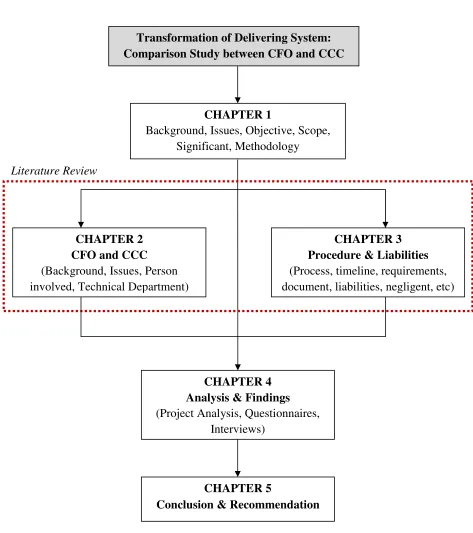
Transformation of Delivering System: Comparison Study between CFO and CCC
CHAPTER 1
Background, Issues, Objective, Scope, Significant, Methodology
CHAPTER 2 CFO and CCC (Background, Issues, Person involved, Technical Department)
CHAPTER 3 Procedure & Liabilities (Process, timeline, requirements, document, liabilities, negligent, etc) Literature Review
CHAPTER 4 Analysis & Findings (Project Analysis, Questionnaires,
Interviews)
CHAPTER 5
Conclusion & Recommendation
102
REFERENCES
Books / Journals / Thesis
1. Buku Panduan Pelaksanaan Kaedah Pengeluaran Perakuan Siap dan
Pematuhan oleh Para Professional
By; Ministry of Housing and Local Governemt, 2nd Edition
2. Tesis “Masalah Kelewatan Pengeluaran Sijil Layak Menduduki oleh Pihak
Berkuasa Tempatan”
By; Rosaidi bin Ibrahim, UTM, 2004/05
3. Uniform Building By Law, 1984
4. Act 133, Street and Drainage & Building Act 1974
5. Architects Act 1967
6. Journal of Building Appraisal (2008) By; Assoc. Prof. Dr Kamaruddin Mohd Nor
7. Langkah 70(d) Strategi Baru Merancang Pertumbuhan Ekonomi Negara,
Kementerian Perumahan dan Kerajaan Tempatanan By; Ministry of Housing and Local Government
103
9. The Architect in Practise : Blackwell at pg 7 By: David Chappel & Andrew Willis (2006)
10. Rimmers Law Relating To The Architect : London Sweet & Maxwell, pg 1 By; E.J. Rimmer (1952)
11. Jackson & Power on Professional Negligence
4th edition of Cardy v Taylor (1994) 38 Con.L.R. 79
12. Halsbury's Laws of England, 4th edition, volume 4(2), paragraph 525.
13. Winfield & Jolowiez on The Law of Tort, pages 59 & 66
14. Clerke & Lindsell on Tort, 17th edition. paragraph 4-54
Newspapers / Articles
1. Patten B (2003) Professional Negligence in Construction Spon Press : London Page 1
2. Howard (2000), Professional Ethics and Rules of Conduct for the Royal Institution of Chartered Surveyors (RICS), United Kingdom
By; College of Estate Management
3. "Engineers".Occupational Outlook Handbook, 2006-07 Edition. Retrieved 2006-09-21.
By; Bureau of Labor Statistics, U.S. Department of Labor (2006)
4. The Starspecial, 2007 'Bold local initiatives — one-stop centre mechanism', pp. ss4–ss5, Public Service, Tuesday, 22nd May, 2007
104
Websites
1. Legal Dictionary,
http://legal-dictionary.thefreedictionary.com
2. John L. Powell. Professional Negligence The Changing Coastline Of Liability http://www.4newsquare.com/Files/PDF/Article/JP%20article.doc
3. Jabatan Bomba dan Penyelamat Malaysia official website www.bomba.gov.my
4. http://www.answers.com/topic/liability
5. http://en.wikipedia.org/wiki/Highland_Towers_collapse
6. http://en.wikipedia.org/wiki/Sultan_Mizan_Zainal_Abidin_Stadium
7. Official website of Pertubuhan Akitek Malaysia www.pam.org.my
8. http://www.wordiq.com/definition/Bureaucracy
9. Law of Malaysia – Highland Tower Judgement
http://www.lawyerment.com.my/library/doc/laws/casecode/jdgm/11082000
10. National Home Buyers Association
http://www.hba.org.my/laws/CourtCases/L/lim_teck_kong_v.htm
11. Official blog of Badrul Hisham Architect [email protected]
12. The Malaysian Bar