70:7 (2014) 1–7 | www.jurnalteknologi.utm.my | eISSN 2180–3722 |
Full paper
Jurnal
Teknologi
Cloud Computing as a Construction Collaboration Tool for Precast Supply
Chain Management
Mohammad Abedia, Norshakila Muhamad Rawaia, Mohamad Syazli Fathib,c*, Abdul Karim Mirasad
aFaculty of Civil Engineering, Universiti Teknologi Malaysia, 81310 UTM Johor Bahru, Johor, Malaysia b
Construction Quality & Maintenance Research Group, Construction Research Alliance, Universiti Teknologi Malaysia, Kuala Lumpur, Malaysia c
UTM Razak School of Engineering & Advanced Technology, Universiti Teknologi Malaysia, Kuala Lumpur, Malaysia
dSchool of Engineering & Information Technology, Universiti Malaysia Sabah, Locked Bag 2073, Kota Kinabalu, Sabah, Malaysia
*Corresponding author: [email protected]
Article history
Received :1 May 2014 Received in revised form : 14 September 2014 Accepted :1 Oktober 2014
Graphical abstract
Abstract
Precast construction projects are characterized by many activities, the involvement of numerous parties, a lot of effort and enormous processes. Precast supply chain phases are classified as: planning, design, manufacturing, transportation, installation and construction. Achieving integrated construction requires the parties within the precast supply chain phases to have efficient communication and effective collaboration to deliver proper and up-to-date information. The aim of this research is to explore cloud computing technology as the construction collaboration tool and to propose the cloud system architecture for precast supply chain management. The findings in this research are based on a comprehensive review of supply chain management, cloud computing and the precast industry. Findings illustrate that the major obstacles to precast construction are: poor planning and scheduling, less flexibility in design, production lead time, heavy precast components and poor on-site coordination. These obstacles could contribute to the negative consequences for the efficiency and effectiveness of precast project delivery. Therefore, cloud computing technology has valuable potential to mitigate these obstacles and deliver an effective collaboration system within the precast construction industry.
Keywords: Precast construction; collaboration; cloud computing; collaboration tool; supply chain management; coordination
© 2014 Penerbit UTM Press. All rights reserved.
1.0 INTRODUCTION
A supply chain is a network that seeks to integrate diverse business divisions in order to produce and dispense the products to the consumer [1]. For 150 years the off-site precast construction industry has been one of the core elements of the construction supply chain which is a network of multiple activities including the physical flow of materials, services and products [2]
between the clients, architects/engineers, developers,
manufacturers, general contractors, subcontractors, suppliers and consultants [2-4]. Precast construction is an efficient method whereby concrete is cast in reusable moulds within a controlled environment (commonly off-site) and then transported and assembled to form the precast structure [5].
On the other hand, for enhancing the competitive advantages and achieving the successful delivery of efficient and effective prefabrication systems, such as precast construction systems, we should consider the involvement of customers/clients [6] and also the skills and knowledge of the professional parties involved within the precast supply chain [7]. Furthermore, precast concrete structures are resistant to fires, winds, hurricanes, floods,
earthquakes, wind-driven rain and moisture damage [8]. However, Cheong et al. [9] stated that precast construction requires high capital investment in the manufacturing factory where uniform and repetitive processes should achieve greater cost effectiveness for the precast construction projects. Moreover, the crew allocation is important in the precast supply chain phases since it could be a major cause contributing to delays in the precast construction projects and the precast supply chain phases [2]. It should be noted that Green Supply Chain Management (GSCM) could be applied to the precast supply chain phases in order to achieve successful environmental sustainability [10].
Therefore, the aim of this research is to explore and propose the cloud computing technology which will eventually enhance the success of precast construction.
Supply chain parties within the precast construction industry have many relationships with numerous other parties including the owners/clients, architects/engineers, manufacturers, general contractors [20], consultants, subcontractors, construction managers and suppliers [5]. This requires efficient collaboration [5] and effective communication. Therefore, efficiently and effectively controlling, monitoring and managing the precast construction projects associated with the involvement of various participants within the precast supply chain is indeed difficult and often extremely challenging since there is much information [21] which needs to be effectively accessed at the right time and in the appropriate location, such as the drawings, specifications, checklists and daily reports. However, this research will not discuss the detailed application of Information Technologies (IT) in the precast construction industry, since, in brief, internet technology, web-based information management solutions [22], information systems [23] and applications, such as the real-time monitoring and control of the precast project and precast supply chain management, may facilitate the successful achievement of precast projects according to the pre-determined project objectives [22-23].
This research is classified into 5 sections. The next section will identify the definitions, phases and the problems of precast supply chain phases. In section 3, the cloud computing definitions, models and types will be explored. The system architecture of cloud computing within the precast supply chain management is proposed in section 4. Lastly, in section 5, the major points and potential opportunities to enhance the efficiencies and improve the effectiveness of precast supply chain management will be discussed.
2.0 PRECAST SUPPLY CHAIN MANAGEMENT
Precast construction is a construction system in which the concrete will be cast in the molds and then cured in a controlled environment, transported and assembled to produce the structure [24-25]. The off-site precast industry (client/owner, consultant, designer, manufacturers, transporters, general contractor, sub-contractor, warehousers, retailers, customers and suppliers) has existed since 1850 [2]. As stated by Tatum et al. [26], achieving precast construction success requires major consideration of the appropriate implementation within the precast supply chain phases that will also improve precast construction efficiency. Waste is one of the major problems within the construction industry [27] which could be significantly reduced by minimizing on-site activities and through the promotion of the off-site production of components, such as precast components [21, 28-33].
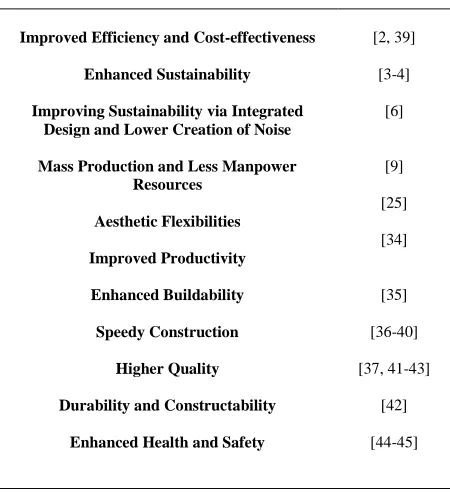
In the 1960s and 1970s there was a significant improvement in research on effective planning and efficient scheduling in precast plants [24]. Other major benefits of precast systems are shown in Table 1.
According to Table 1, the various benefits of precast systems could be applied to the implementation of precast elements particularly for building [3-5, 9, 24, 40, 46-51] such as the precast hollow-core wall [52] especially since heavy civil engineering projects (infrastructure developments) are increasing in number [2, 24, 43, 53-54]. The following part of this research will explain the phases within the precast construction industry.
Table 1 Major benefits of precast construction
Improved Efficiency and Cost-effectiveness
Enhanced Sustainability
Improving Sustainability via Integrated Design and Lower Creation of Noise
Mass Production and Less Manpower Resources
Aesthetic Flexibilities
Improved Productivity
[2, 39]
[3-4]
[6]
[9]
[25]
[34]
Enhanced Buildability
Speedy Construction
[35]
[36-40]
Higher Quality
Durability and Constructability
[37, 41-43]
[42]
Enhanced Health and Safety [44-45]
2.1 Precast Supply Chain Phases
Supply chain phases within the precast construction industry as illustrated in Figure 1, include: planning [2, 55-57], design [9, 49-50, 58], manufacturing/production [39, 43, 48, 59-60-62],
transportation [2, 40, 45, 63-64] and, lastly, the
installation/assembly and construction [21, 38, 49, 64-65]. On the other hand, generally, and in case of any issues arising, all of the parties within the precast supply chain phases will refer to the technical (planning) office where the planning (financial plan of costs and time scheduling) and resource management will be created [41].
Figure 1 The diagram of the precast supply chain phases, adapted after [9, 39, 41, 49, 51, 55, 60, 65-66]
In the manufacturing phase, precast components production is categorized into several significant sections consisting of the selection of raw materials [39, 60], batching plant, casting and molding zone, demolding and finishing zone, packaging, transportation and, ultimately, the storage yard [9, 59, 69]. In recent years the implementation of the precast system within the construction industry has been significantly enhanced [40]. Consequently, improved performance and reliability in the precast supply chain will be achieved based on the appropriate delivery schedule, quantities, arrival orders [2], unloading sequences and inspections of the precast components produced from the factory or intermediate warehouse which will be transported to the precast construction site [35-36, 70]. Another limitation of component transportation is the acceptable and suitable weight and size of components which are restricted by the load capacities of bridges and pavements and also the horizontal and vertical authorizations for the tunnels, roads, highways, overpasses and underpasses [21, 47].
In the installation and construction phase, all the precast
components based on the installation drawings
(assembly/montage), time scheduling and instructions which are
produced within the precast planning phase will be
installed/assembled [67]. A tower crane [9] and mobile crane will be used for the site storage and installation of precast components [71]. In addition, proper site-coordination [49] and appropriate selection of the loading capacity of hoists and tower cranes for the installation of precast components based on their weight and size should be considered [9, 34-36]. The next part of this research will briefly clarify the problems within the precast construction industry.
2.2 Precast Supply Chain Problems
There are various problems within the precast construction industry, as shown in Table 2, that may have adverse consequences for the project objectives causing delays, quality and safety issues and overrun costs. Nevertheless, these identified problems cannot be totally rectified by the construction
collaboration tools, such as cloud computing implementation. It should be noted that cloud computing implementation will facilitate and bring up to date the delivery of enormous quantities of information within the precast supply chain phases. Consequently, it is expected that these precast supply chain problems such as the poor planning and scheduling, poor design, production lead time, incorrect deliveries, wrong (inaccurate) components delivered and poor on-site coordination could be improved by utilizing cloud computing.
Table 2 Major problems in precast supply chain phases
Planning (P) Poor planning and scheduling [2, 49, 57]. Expensive precast components [21].
Design (D) Less flexibility in design [9].
Size/weight restrictions on truck loads [45]. Poor design [50].
Manufacturing (M)
Hard constraints (mould-element relationship and mould production capacity) and soft constraints (delivery requirements and inventory stock requirements) [24].
Production lead time [34].
Incompetent employees and damage to raw materials [39, 60].
Transportation (T)
Bulky and extremely heavy precast components [3, 9, 21, 34-35, 45-47, 72-73].
Poor capability of lorry cranes for size/weight of components and expensive usage of trailers [34] Incorrect deliveries [39].
Installation and Construction
(I&C)
High cost of cranes for component installations and contractor order changes [34-36].
Wrong (inaccurate) components delivered [35-36, 74].
Poor on-site coordination [49]. E) Precast
Installation & Construction
D) Precast Transportation
C) Precast Manufacturing
B) Precast Design A) Precast
The following part of this research will reveal the concepts of cloud computing and its development.
3.0 CLOUD COMPUTING
Cloud computing consists of information technologies that can be implemented globally using a network and the Internet anywhere, at any time, and with no concern about having a new infrastructure, employee training and software licenses [18, 75-81]. Different cloud computing definitions will be presented in the next section of this research.
3.1 Definitions of Cloud Computing
The main benefits of cloud computing implementation are: less infrastructure investment, convenience, flexibility, enhanced performance and cost reduction [81-82]. For better and clearer understandings of cloud computing technology, Table 3 explores the different definitions of cloud computing.
Table 3 Cloud computing definitions
Author(s) Definition
[83] A cost-effective paradigm which assists in the application of data-intensive computing processes.
[84] An approach to outsource data with the aim of decreasing the data storage and reducing the management issues.
[85] A convenient means that has evolved for implementing various computing resources including the servers, networks, applications, storage, and services.
[86] A group of distributed computers such as data centres and servers providing services and resources via the Internet.
According to the diverse definitions of Table 3, cloud computing is the distribution and implementation of services, resources and applications anywhere and at any time through only the Internet without any concerns about the management, maintenance and ownership.
Cloud computing comprises: public [87], private [88], community [89] and hybrid [90] delivery (deployment) models. Consequently, Ranjan and Zhao [77], Cohen et al. [87], Goscinski and Brock [91], You and Huang [92] and Abrishami et al. [93] classified the three types of cloud computing as: Infrastructure as a Service (IaaS), such as Salesforce and Amazon web services; Platform as a Service (PaaS), such as IBM and Amazon’s EC2 offerings; and lastly, Software as a Service (SaaS), such as Amazon and Google Apps including Google Calendar, Gmail and Google Docs. The following section of this research will propose the architectural system by describing its components within the precast construction industry.
4.0 ARCHITECTURAL SYSTEM OF CLOUD COMPUTING WITHIN THE PRECAST CONSTRUCTION INDUSTRY
Cloud computing is the valuable technology which sends and retrieves the data and various applications by utilizing the internet and central remote servers including the application servers and the database server. The integration of cloud computing, mobile clients (such as the smart mobile devices including the smartphones and tablets), servers and data centers [18-19, 77-79, 92, 94] and logistics management [95] could be applied for the precast supply chain management.
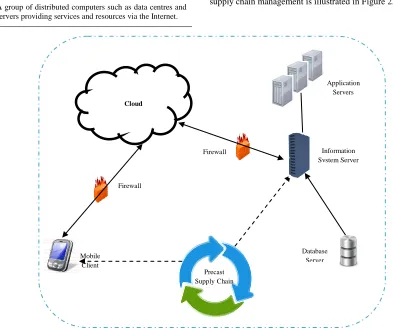
The architectural system of cloud computing for the precast supply chain management is illustrated in Figure 2.
Figure 2 Cloud Computing Information System (CCIS) architecture for precast supply chain management
Firewall
Firewall
Application Servers
Cloud
Precast SupplyChain
Phases Mobile
Client
Information System Server
Engine
Figure 2 illustrates that firstly, through the precast supply chain phases, the data will be delivered to the database server and the application servers and secondly, it will be transferred to the Information System server engine (IS server engine). Fundamentally, the Cloud Computing Information System (CCIS) architecture comprises four core components:
(1) The Mobile Client: A smart mobile device-including the smartphones, mobile computers and tablets-that is capable of sending the data and information to the Information System server engine by utilising the cloud. Besides, the mobile client will attain the information from the cloud;
(2) The Firewall: Two firewalls are positioned. The first firewall is between the mobile client and the cloud and the second between the cloud and the IS server engine. The main purpose of these firewalls is for the security of information which will be transferred and delivered to the devices;
(3) IS Server Engine: The data that is delivered by the mobile clients, database server and application servers will be processed via the IS server engine; and
(4) The Cloud Server: The information that is created by the IS server engine, with the firewall authorization will be delivered to the cloud. Moreover, the information from the cloud will be distributed to the mobile client.
The next part of this research will briefly overview the significant points discussed within the research and develop the conclusions which could enhance the collaboration and improve efficiencies and integration along with increasing the productivity of the precast construction industry.
5.0 CONCLUSION
The expanding complexity of precast supply chain phases necessitates the exchanging of increasing amounts of data and information. There are various problems within the precast construction industry that may have adverse consequences for the project objectives causing delays, quality and safety issues and overrun costs. These precast supply chain problems such as the poor planning and scheduling, poor design, production lead time, incorrect deliveries, wrong (inaccurate) components delivered and poor on-site coordination could be improved by using cloud computing. Therefore, in order to achieve successfully the precast project goals using a timely, cost-effective, high quality, and efficient operative approach, the selection and implementation of the proper construction collaboration tools for the precast supply chain parties and project stakeholders is vital. Moreover, cloud computing will significantly impact on how efficiently and effectively the information systems can be utilised in order to create the services and applications. This collaborative technology could be applied anytime and anywhere globally with not much concern about needing new infrastructure, software licenses and employee training.
Overall, this paper has proposed an intelligent collaborative tool via the cloud computing implementation in order to mitigate the negative consequences of the identified problems within the management of the precast supply chain. Furthermore, the cloud computing implementation within the
precast construction industry, will deliver significant
opportunities for improving the effectiveness and enhancing the appropriate information flow along with access to data, information and services. This paper is part of an on-going study
that finally aims to enhance the evaluation, implementation and applications of cloud computing as one of the core construction collaboration tools.
Acknowledgement
This publication was financially supported by Institut Penilaian Negara (INSPEN) and Universiti Teknologi Malaysia, under research grant 4B086.
References
[1] Sadeghiamirshahidi, N., Afshar, J., Firouzi, A.R. and Hassan, S. A. H.
S. 2014. Improving the Efficiency of Manufacturing Supply Chain
Using System Dynamic Simulation. Jurnal Teknologi. 69(2): 123–
125.
[2] Al-Bazi, A. F., Dawood, N. and Dean, J. T. 2010. Improving
Performance and the Reliability of Off-Site Precast Concrete
Production Operations Using Simulation Optimisation. Journal of
Information Technology in Construction (ITcon). 15: 335–356.
Retrieved 28 July 2014, from http://www.itcon.org/2010/25.
[3] Chen, Y., Okudan, G. E. and Riley, D. R. 2010. Sustainable
Performance Criteria for Construction Method Selection in Concrete
Buildings. Automation in Construction. 19(2): 235–244.
[4] Chen, Y., Okudan, G. E. and Riley, D. R. 2010. Decision Support for
Construction Method Selection in Concrete Buildings: Prefabrication
Adoption and Optimization. Automation in Construction. 19(6): 665–
675.
[5] Kaner, I., Sacks, R., Kassian, W. and Quitt, T. 2008. Case Studies of
BIM Adoption for Precast Concrete Design by Midsized Structural
Engineering Firms. Journal of Information Technology in
Construction (ITcon), Special Issue Case studies of BIM use. 13: 303– 323. Retrieved 28 July 2014, from http://www.itcon.org/2008/21.
[6] Linner, T. and Bock, T. 2012. Evolution of Large-Scale
Industrialisation and Service Innovation in Japanese Prefabrication
Industry. Construction Innovation: Information, Process,
Management. 12(2): 156–178.
[7] Blismas, N. and Wakefield, R. 2009. Drivers, Constraints and the
Future of Offsite Manufacture in Australia. Construction Innovation:
Information, Process, Management. 9(1): 72–83.
[8] VanGeem, M. 2006. Achieving Sustainability with Precast Concrete.
Journal of the Precast/Prestressed Concrete Institute (PCI
JOURNAL). 51: 42–61.
[9] Cheong, Y. W., Kwan, H. P. and Hariyanto, A. D. 2005. Quality
Control in Precast Production: A Case Study on Tunnel Segment
Manufacture. DIMENSI, Journal of Architecture and Built
Environment. 33(2): 153–164.
[10] Wan Mahmood, W. H., Ab Rahman, M. N. and Deros, B. M. 2012.
Green Supply Chain Management in Malaysian Aero Composite
Industry. Jurnal Teknologi. 59(2): 13–17.
[11] Nourbakhsh, M., Zin, R. M., Irizarry, J., Zolfagharian, S. and
Gheisari, M. 2012. Mobile Application Prototype for On-Site
Information Management in Construction Industry. Engineering,
Construction and Architectural Management. 19(5): 474–494.
[12] Rawai, N. M., Fathi, M. S., Abedi, M. and Khalid, C. M. L. 2013. A
Fundamental Review On Mobile Information System For Sustainable
Project Management. Proceedings of the 9th International Conference
of Geotechnical & Transportation Engineering (GEOTROPIKA) and The 1st International Conference on Construction and Building
Engineering (ICONBUILD)–GEOCON2013, Persada Johor
International Convention Centre, Malaysia. 292–298.
[13] Irizarry, J., Zolfagharian, S., Nourbakhsh, M., Zin, R. M., Jusoff, K.
and Zakaria, R. 2012. The Development of a Sustainable-Construction
Planning System. Journal of Information Technology in Construction
(ITcon). 17: 162–178. Retrieved 12 August 2014, from
http://www.itcon.org/2012/10.
[14] Abd Majid, M. Z., Zakaria, W. Z., Lamit, H., Keyvanfar, A.,
Shafaghat, A. and Bakti, E. S. 2012. Construction Information Systems for Executive Management in Monitoring Work Progress. Advanced Science Letters. 15(1): 169–171.
[15] Zakaria, W. Z., Abd. Majid, M. Z. and Nourbakhsh, M. 2012.
Developing an Executive Information Site Monitoring System.
Advanced Materials Research. 446–449: 1002–1005.
[16] Chi, H. L., Kang, S. C. and Wang, X. 2013. Research Trends and
Engineering, and Construction. Automation in Construction. 33: 116– 122.
[17] Redondo, E., Fonseca, D., Sánchez, A. and Navarro, I. 2013. New
Strategies Using Handheld Augmented Reality and Mobile Learning-Teaching Methodologies, in Architecture and Building Engineering
Degrees. Procedia Computer Science. 25: 52–61.
[18] Abedi, M., Rawai, N.M., Fathi, M.S. and Mirasa, A.K. 2013.
Construction Collaboration Tools for Precast Supply Chain
Management. Proceedings of the 9th International Conference of
Geotechnical & Transportation Engineering (GEOTROPIKA) and The 1st International Conference on Construction and Building
Engineering (ICONBUILD)–GEOCON2013, Persada Johor
International Convention Centre, Malaysia. 282–291.
[19] Abedi, M., Fathi, M.S. and Rawai, N. M. 2013. The Impact of Cloud
Computing Technology to Precast Supply Chain Management. International Journal of Construction Engineering and Management. 2(4A): 13–16.
[20] Karhu, V. 1997. Product Model Based Design of Precast Facades.
Journal of Information Technology in Construction (ITcon). 2: 1–31.
Retrieved 28 July 2014, from http://www.itcon.org/1997/1.
[21] Polat, G. 2010. Precast Concrete Systems in Developing vs.
Industrialized Countries. Journal of Civil Engineering and
Management. 16(1): 85–94.
[22] Wang, L. C., Lin, Y. C. and Lin, P. H. 2007. Dynamic Mobile
RFID-Based Supply Chain Control and Management System in
Construction. Advanced Engineering Informatics. 21(4): 377–390.
[23] Harsha, N., Punith, M. Y. R. and Nagendra, G. C. K. 2013.
Importance of Information Sharing in Construction Supply Chain
Management: A Review. Tenth AIMS International Conference on
Management, Bangalore, India, 6–9 January. 3719–3722.
[24] Chan, W. T. and Hu, H. 2002. Constraint Programming Approach to
Precast Production Scheduling. Journal of Construction Engineering
and Management. 128(6): 513–521.
[25] Precast/Prestressed Concrete Institute. 2010. A Guide to Designing
with Precast/Prestressed Concrete. Precast/Prestressed Concrete
Institute (PCI), Chicago.
[26] Tatum, C. B., Vanegas, J. M. and Williams, J. M. 1987.
Constructability Improvement Using Prefabrication, Preassembly, and Modulization. Source Document No. 25, Construction Industry Institute, Austin, Texas.
[27] London, K. A. and Kenley, R. 2001. An Industrial Organisation
Economic Supply Chain Approach for the Construction Industry: A
Review. Construction Management and Economics. 19(8): 777–788.
[28] Koskela, L. and Leikas, J. 1997. Lean Manufacturing of Construction
Components. In: Alarcon, L. (Ed.), Lean Construction, A. A. Balkema Publishers, Rotterdam, Netherlands. 263–271.
[29] Crowley, A. 1998. Construction as a Manufacturing Process: Lessons
from the Automotive Industry. Computers & Structures. 67(5): 389–
400.
[30] Egan, S. J. 1998. Rethinking Construction: The Report of the
Construction Industry Task Force. Department of the Environment, Transport and the Regions, HMSO, London. 1–37. Retrieved 12
August 2014, from
http://www.architecture.com/files/RIBAHoldings/PolicyAndInternatio nalRelations/Policy/PublicAffairs/RethinkingConstruction.pdf.
[31] Gibb, A. G. F. 1999. Off-site Fabrication: Prefabrication,
Pre-assembly and Modularisation. Whittles Publishing Services,
Caithness, UK.
[32] Vrijhoef, R. and Koskela, L. 2000. The Four Roles of Supply Chain
Management in Construction. European Journal of Purchasing and
Supply Management. 6(3–4): 169–178.
[33] Polat, G. 2009. Simulation-Based Efficiency Assessment Approach
for Rebar Supply Chains in Turkey. Construction Innovation:
Information, Process, Management. 9(1): 101–121.
[34] Pheng, L. S. and Chuan, C. J. 2001. A Study of the Readiness of
Precasters for Just-In-Time Construction. Work Study. 50(4): 131–
140.
[35] Pheng, L. S. and Chuan, C. J. 2001. Just-in-Time Management of
Precast Concrete Components. Journal of Construction Engineering
and Management. 127(6): 494–501.
[36] Pheng, L. S. and Chuan, C .J. 2001. Just-in-Time Management in
Precast Concrete Construction: A Survey of the Readiness of Main
Contractors in Singapore. Integrated Manufacturing Systems. 12(6):
416–429.
[37] Sacks, R., Eastman, C. M. and Lee, G. 2004. Process Model
Perspectives on Management and Engineering Procedures in the
Precast/Prestressed Concrete Industry. Journal of Construction
Engineering and Management. 130(2): 206–215.
[38] Jianguo, C., Jian, F., Zan, W., Yao, C. and Yafei, L. 2008.
Investigation of a Precast Concrete Structure System. Proceedings of
the International Conference on Information Management, Innovation
Management and Industrial Engineering (ICIII’08), 19–21 December,
Nanjing, China. 3: 449–452.
[39] Wu, P. and Low, S. P. 2011. Lean Production, Value Chain and
Sustainability in Precast Concrete Factory-A Case Study in Singapore. Lean Construction Journal. 2011: 19–36.
[40] Rahim, A. A., Hamid, Z. A., Zen, I. H., Ismail, Z. and Kamar, K. A.
M. 2012. Adaptable Housing of Precast Panel System in Malaysia.
Procedia–Social and Behavioral Sciences. 50: 369–382.
[41] Dassori, E. and Frasani, M. 2002. Support System for Project
Management and Production of Concrete Precast Elements. Proceedings of the International Conference on Advances in Building
Technology, 4–6 December, Hong Kong, China.2: 1689–1696.
[42] Hamill, P., Bertolini, M., Biebighauser, M., Bechara, C. H. and
Wilden, H. 2006. Precast Concrete Value Engineering Accommodates
Difficult Site. Journal of the Precast/Prestressed Concrete Institute
(PCI JOURNAL). 51(4): 18–33.
[43] Dawood, N. and Al-Bazi, A. 2008. Development of An Intelligent
Manufacturing Management Simulation Model: An Application to the
Precast Concrete Industry. Proceedings of the Intelligent Computing
in Engineering (ICE08). Plymouth, UK, 2–4 Jul. 1–11.
[44] Gibb, A., and Isack, F. 2003. Reengineering Through Preassembly:
Client Expectations and Drivers. Building Research & Information.
31(2): 146–160.
[45] Polat, G. 2008. Factors Affecting the Use of Precast Concrete Systems
in the United States. Journal of Construction Engineering and
Management. 134(3): 169–178.
[46] Dawood, N. N. and Marasini, R. 1999. Optimization of Stockyard
Layout for the Precast Building Products Industry. In: Hughes, W
(Ed.), 15th Annual ARCOM Conference, 15-17 September, Liverpool
John Moores University, Association of Researchers in Construction Management. 2: 445–454.
[47] Arditi, D., Ergin, U. and Gunhan, S. 2000. Factors Affecting the Use
of Precast Concrete Systems. Journal of Architectural Engineering.
6(3): 79–86.
[48] Benjaoran, V. and Dawood, N. 2006. Intelligence Approach to
Production Planning System for Bespoke Precast Concrete Products. Automation in Construction. 15(6): 737–745.
[49] Mlinarić, V. and Sigmund. Z. 2009. Problems in Large Scale Precast
Construction Projects. CIB Joint International Symposium 2009:
Construction Facing Worldwide Challenges, Dubrovnik, Croatia, 27 September–1 October. 182–188.
[50] Kiong, N. B. and Akasah, Z. A. 2011. Maintenance Factor for Precast
Concrete in IBS: A Review. National Postgraduate Conference
(NPC), 19–20 Sep, Universiti Teknologi PETRONAS, Malaysia. 1–6.
[51] Ikonen, J., Knutas, A., Hämäläinen, H., Ihonen, M., Porras, J. and
Kallonen, T. 2013. Use of Embedded RFID Tags in Concrete Element
Supply Chains. Journal of Information Technology in Construction
(ITcon). 18: 119–147. Retrieved 28 July 2014, from
http://www.itcon.org/2013/7.
[52] Abdul Hamid, N. H. 2006. In–Plane and Biaxial Performance Of
Seismic Precast Hollow Core Wall With Different Types Of Energy
Dissipators. Jurnal Teknologi. 44(B): 47–62.
[53] Lee, J. H. 2012. Behavior of Precast Prestressed Concrete Bridge
Girders Involving Thermal Effects and Initial Imperfections During
Construction. Engineering Structures. 42: 1–8.
[54] Martí, J.V., Gonzalez-Vidosa, F., Yepes, V. and Alcalá, J. 2013.
Design of Prestressed Concrete Precast Road Bridges with Hybrid
Simulated Annealing. Engineering Structures. 48: 342–352.
[55] Persson, S. 2006. Information Management Regarding the Production
of Precast Concrete Structures. Joint International Conference on
Computing and Decision Making in Civil and Building Engineering, Montréal, Canada, 14–16 June. 955–964.
[56] Al-Bazi, A. and Dawood, N. 2009. A Decision Support System for
Precast Concrete Manufacturing Planning: An Innovative Crew
Allocation Optimiser. CSCE 2009 Annual General Meeting &
Conference, Canada, 27–30 May. 1–12.
[57] Al-Bazi, A. and Dawood, N. 2010. Developing Crew Allocation
System for the Precast Industry Using Genetic Algorithms.
Computer-Aided Civil and Infrastructure Engineering. 25(8): 581–595.
[58] Sousa, H., Sousa, C., Neves, A. S., Bento, J. and Figueiras, J. 2013.
Long-Term Monitoring and Assessment of a Precast Continuous
Viaduct. Structure and Infrastructure Engineering: Maintenance,
Management, Life-Cycle Design and Performance. 9(8): 777–793.
[59] Ko, C. H. and Wang, S. F. 2011. Precast Production Scheduling Using
Multi-Objective Genetic Algorithms. Expert Systems with
[60] Wu, P. and Low, S. P. 2012. Lean Management and Low Carbon
Emissions in Precast Concrete Factories in Singapore. Journal of
Architectural Engineering. 18(2): 176–186.
[61] Soutsos, M. N., Tang, K. and Millard, S. G. 2012. The Use of
Recycled Demolition Aggregate in Precast Concrete Products–Phase
III: Concrete Pavement Flags. Construction and Building Materials.
36(1): 674–680.
[62] Aram, S., Eastman, C. and Sacks, R. 2013. Requirements for BIM
Platforms in the Concrete Reinforcement Supply Chain. Automation
in Construction. 35: 1–17.
[63] Alinaitwe, H. M., Mwakali, J. and Hansson, B. 2006. Assessing the
Degree of Industrialisation in Construction-A case of Uganda. Journal
of Civil Engineering and Management. 12(3): 221–229.
[64] Fang, Y. and Ng, S.T. 2008. Optimising Time and Cost in
Construction Material Logistics. Proceedings of the BuHu 8th
International Postgraduate Research Conference, The Czech
Technical University in Prague, Prague, Czech Republic, 26–27 June.
389–400. Retrieved 12 August 2014, from
http://www.irb.fraunhofer.de/CIBlibrary/search-quick-result-list.jsp?A&idSuche=CIB+DC14635.
[65] Persson, S., Malmgren, L. and Johnsson, H. 2009. Information
Management in Industrial Housing Design and Manufacture. Journal
of Information Technology in Construction (ITcon). 14: 110–122. Retrieved 12 August 2014, from http://www.itcon.org/2009/11.
[66] Nawari, N. O. 2012. BIM Standard in Off-Site Construction. Journal
of Architectural Engineering. 18(2): 107–113.
[67] Rönneblad, A. and Olofsson, T. 2003. Application of IFC in Design
and Production of Precast Concrete Constructions. Journal of
Information Technology in Construction (ITcon), Special Issue
IFC-Product models for the AEC arena. 8: 167–180. Retrieved 12 August
2014, from http://www.itcon.org/2003/13.
[68] Sacks, R., Eastman, C. M., Lee, G., and Orndorff, D. 2005. A Target
Benchmark of the Impact of Three-Dimensional Parametric Modelling
in Precast Construction. Journal of the Precast/Prestressed Concrete
Institute. 50(4): 126–139.
[69] Senaratne, S. And Ekanayake, S. 2012. Evaluation of Application of
Lean Principles to Precast Concrete Bridge Beam Production Process. Journal of Architectural Engineering. 18(2): 94–106.
[70] Lim, L. Y. and Low, S. P. 1992. Just-In-Time Productivity in
Construction. SNP Publishers, Singapore.
[71] Fang, Y. and Ng, S.T. 2011. Applying Activity-Based Costing
Approach for Construction Logistics Cost Analysis. Construction
Innovation: Information, Process, Management. 11(3): 259–281.
[72] Dawood, N. and Marasini, R. 2001. Stockyard layout Planning and
Management for the Precast Concrete Products Industry. Logistics
Information Management. 14(5–6): 328–337.
[73] Jang, W. S. and Skibniewski, M. J. 2008. A Wireless Network System
for Automated Tracking of Construction Materials on Project Sites.
Journal of Civil Engineering and Management. 14(1): 11–19.
[74] Marasini, R. and Dawood, N. 2002. Simulation Modelling and
Optimization of Stockyard Layouts for Precast Concrete Products. Proceedings of the 34th Conference on Winter Simulation: Exploring
New Frontiers, San Diego, CA, USA, 8–11 Dec. 2: 1731–1736.
[75] Mohammed, F. and Ibrahim, O. 2013. Refining E-government
Readiness Index by Cloud Computing. Jurnal Teknologi. 65(1): 23–
34.
[76] Abedi, M., Fathi, M.S. and Rawai, N.M. 2012. Cloud Computing
Technology for Collaborative Information System in Construction
Industry. 18th International Business Information Management
Association (IBIMA), Istanbul, Turkey, 9 & 10 May. 593–602.
[77] Ranjan, R. and Zhao, L. 2013. Peer-to-Peer Service Provisioning in
Cloud Computing Environments. The Journal of Supercomputing.
65(1): 154–184.
[78] Fathi, M. S., Abedi, M., Rambat, S., Rawai, S. and Zakiyudin, M. Z.
2012. Context-Aware Cloud Computing for Construction
Collaboration. Journal of Cloud Computing. 2012(2012): 1–11.
[79] Fathi, M. S., Abedi, M. and Rawai, S. 2012. The Potential of Cloud
Computing Technology for Construction Collaboration. International
Journal of Applied Mechanics and Materials. 174–177: 1931–1934.
[80] Rawai, N. M., Fathi, M. S., Abedi, M. and Rambat, S. 2013. Cloud
Computing for Green Construction Management. Third International
Conference on Intelligent System Design and Engineering
Applications (ISDEA), China, Hong Kong, 16–18 Jan. 432–435.
Retrieved 28 July 2014, from
http://ieeexplore.ieee.org/xpls/abs_all.jsp?arnumber=6456660&tag=1.
[81] Lee, J., Cho, J., Seo, J., Shon, T. and Won, D. 2013. A Novel
Approach to Analyzing for Detecting Malicious Network Activity
Using a Cloud Computing Testbed. Mobile Networks and
Applications. 18(1): 122–128.
[82] Rabai, L. B. A., Jouini, M., Aissa, A. B. and Mili, A. 2013. A
Cybersecurity Model in Cloud Computing Environments. Journal of
King Saud University–Computer and Information Sciences. 25(1): 63–
75.
[83] Rezguia, A., Malik, Z., Xia, J., Liu, K. and Yang, C. 2013.
Data-Intensive Spatial Indexing on the Clouds. Procedia Computer Science.
18: 2615–2618.
[84] Liu, C., Zhu, L., Wang, M. and Tan, Y.A. 2014. Search Pattern
Leakage in Searchable Encryption: Attacks and New Construction. Information Sciences. 265: 176–188.
[85] Cui, Y., Ma, X., Wang, H., Stojmenovic, I. and Liu, J. 2013. A Survey
of Energy Efficient Wireless Transmission and Modeling in Mobile
Cloud Computing. Mobile Networks and Application. 18(1): 148–155.
[86] Sultan, N. and Bunt-Kokhuis, S. V. D. 2012. Organisational Culture
and Cloud Computing: Coping with a Disruptive Innovation. Technology Analysis & Strategic Management. 24(2): 167–179.
[87] Cohen, J., Filippis, I., Woodbridge, M., Bauer, D., Hong, N.C.,
Jackson, M., Butcher, S., Colling, D., Darlington, J., Fuchs, B. and Harvey, M. 2013. RAPPORT: Running Scientific High-Performance
Computing Applications on the Cloud. Philosophical Transactions of
the Royal Society of London Series A, Mathematical Physical & Engineering Sciences. 371(1983): 1–15.
[88] Zhang, L. and Issa, R. R. A. 2012. Comparison of BIM Cloud
Computing Frameworks. Proceedings of Computing in Civil
Engineering, Reston, Florida, USA. 389–396.
[89] Karamouz, M., Zahmatkesh, Z. and Saad, T. 2013. Cloud Computing
in Urban Flood Disaster Management. Proceedings of World
Environmental and Water Resources Congress 2013: Showcasing the Future, Ohio. 2747–2757.
[90] Mell, P. and Grance, T. 2011. The NIST Definition of Cloud
Computing, National Institute of Standards and Technology. Special Publication. 800–145: 1–7.
[91] Goscinski, A. and Brock, M. 2010. Toward Dynamic and Attribute
Based Publication, Discovery and Selection for Cloud Computing.
Future Generation Computer Systems. 26(7): 947–970.
[92] You, P. and Huang, Z. 2013. Towards an Extensible and Secure Cloud
Architecture Model for Sensor Information System. International
Journal of Distributed Sensor Networks. 2013: 1–12.
[93] Abrishami, S., Naghibzadeh, M. and Epema, D.H.J. 2013.
Deadline-Constrained Work Flow Scheduling Algorithms for Infrastructure as a
Service Clouds. Future Generation Computer Systems. 29(1): 158–
169.
[94] Lin, X. and Zheng, X. 2013. A Cloud-Enhanced System Architecture
for Logistics Tracking Services. Proceedings of International
Conference on Computer, Networks and Communication Engineering
(ICCNCE 2013), Beijing, China. 545–548.
[95] Lin, B. P., Tsai, W., Wu, C. C., Hsu, P. H., Huang, J. Y. and Liu, T.
2013. The Design of Cloud-based 4G/LTE for Mobile Augmented
Reality with Smart Mobile Devices. Proceedings of 7th International
![Figure 1 The diagram of the precast supply chain phases, adapted after [9, 39, 41, 49, 51, 55, 60, 65-66]](https://thumb-us.123doks.com/thumbv2/123dok_us/1191547.1149634/3.612.322.563.464.735/figure-diagram-precast-supply-chain-phases-adapted.webp)