KNOWLEDGE QUALITY EFFECT ON SMALL AND MEDIUM-SIZED ENTERPRISES’ COMPETITIVENESS THROUGH IMPROVISATIONAL
CREATIVITY, COMPOSITIONAL CREATIVITY AND INNOVATION
NASER VALAEI
A thesis submitted in fulfilment of the requirements for the award of degree of
Doctor of Philosophy
International Business School Universiti Teknologi Malaysia
DEDICATION
ACKNOWLEDGEMENT
Many people and academicians have helped me to accomplish this thesis. I wish to express my sincere appreciation to my main supervisor, Professor Dr. Wan Khairuzzaman Wan Ismail for encouragement, guidance, and friendship. I am also very thankful to my previous supervisors Professor Nor Shahriza Abdul Karim and Associate Professor Norshidah Mohamed for their guidance and advices. Without their support, this thesis would not have been the same as presented here.
ABSTRACT
ABSTRAK
TABLE OF CONTENTS
CHAPTER TITLE PAGE
DECLARATION ii
DEDICATION iii
ACKNOWLEDGEMENT iv
ABSTRACT v
ABSTRAK vi
TABLE OF CONTENTS vii
LIST OF TABLES xii
LIST OF FIGURES xv
LIST OF ABBREVIATIONS xvi
LIST OF APPENDICES xviii
1 INTRODUCTION 1
1.1 Introduction 1
1.2 Role of SMEs in Competitive Landscape 2
1.3 Malaysian SMEs’ Competitiveness 3
1.4 Statement of the Problem 4
1.4.1 Challenges Facing Malaysian SMEs 5
1.5 Research Questions 7
1.6 Research Objectives 8
1.7 Significance of Study 8
1.8 Scope of Study 9
1.9 The Structure of the Thesis 10
1.10Definitions of the Terms 11
1.11Summary 12
2 LITERATURE REVIEW 13
2.2 Overview of Total Quality 13 2.2.1 Costs of Poor Quality Information and Knowledge 14 2.2.2 The Purpose of Total Information Quality
Management 15
2.2.3 TIQM Principles 17
2.2.3.1Universal Principles of Quality Management 17
2.2.4 TIQM Processes 23
2.2.5 Evaluating IQ Methodologies 24
2.3 Data Quality 25
2.3.1 Dimensions of Data Quality 26
2.4 Information Quality 28
2.4.1 Dimensions of Information Quality 29
2.5 Knowledge Quality 30
2.5.1 TKQM 31
2.5.2 Dimensions of KQ 33
2.5.2.1Intrinsic KQ 33
2.5.2.2Contextual KQ 35
2.5.2.3Actionable KQ 36
2.5.2.4Accessibility KQ 36
2.6 Determinants of KQ and Related Theories 37
2.6.1 Functional Diversity 37
2.6.2 Absorptive Capacity 39
2.6.3 Knowledge Network 40
2.6.4 Organizational Structure 42
2.6.5 Organizational Culture 44
2.6.6 Technology Utilization 46
2.7 SMEs 47
2.7.1 Malaysian SMEs 49
2.7.2 Competitiveness in SMEs 50
2.8 Creativity 51
2.8.1 Improvisational Creativity and Related Theories 52 2.8.1.1History of Organizational Improvisation 53 2.8.1.2Definition of Organizational Improvisation 54
2.8.1.4Required Settings for Improvisation 59 2.8.1.5Elements Impacting Quality of Improvisation 60
2.8.2 Compositional Creativity 63
2.9 Innovation 67
2.10Summary 70
3 METHODOLOGY 71
3.1 Introduction 71
3.2 Research Process 71
3.3 Research Design 72
3.3.1 Type of Investigation 73
3.3.2 Study Setting: Contrived Vs. Non-contrived 74
3.3.3 Time Horizon 74
3.4 Previous Theoretical Models 74
3.5 Theoretical Model of this Study 79
3.5.1 Dependent, Mediating and Independent Variables 81
3.5.2 Hypotheses 81
3.6 Sampling Procedures 90
3.6.1 Probability Sampling 91
3.6.2 Population 91
3.6.3 Unit of Study 92
3.6.4 Sample Size 92
3.7 Data Collection Methods 93
3.8 Sources of Data 93
3.8.1 Primary Data 94
3.8.2 Secondary Data 98
3.9 Questionnaire Development 98
3.9.1 Reliability and Validity 100
3.9.2 Pre-Test and Pilot Test 101
3.10Data Analysis 104
3.10.1 Partial Least Square-Structural Equation Modeling
(PLS-SEM) 105
4 ANALYSIS 107
4.1 Introduction 107
4.2 Demographics 107
4.3 Case Screening 108
4.3.1 Missing Data in Rows 108
4.3.2 Unengaged Responses 109
4.4 Variable Screening 109
4.4.1 Missing Data in Columns 109
4.4.2 Outliers 110
4.4.3 Normality 111
4.4.4 Common Method Bias 111
4.4.5 Non-Response Bias 113
4.5 Reliability and Validity of Formative Constructs 114
4.5.1 Indicator Significance 114
4.5.2 Test of Collinearity 115
4.5.3 Indicator Relevance 118
4.6 Sample Size 121
4.7 Detecting Multi-Collinearity of Reflective Measurement
Items 122
4.8 Reliability and Validity of Measurement Model 125
4.9 Structural Model Assessment 128
4.9.1 Results of Bootstrapping 129
4.9.2 R2 Values, f2Effect Size, q 2,and Q2 131
4.9.3 Goodness of Fit in PLS-SEM (SRMR) 134
4.10Mediation Analysis 134
4.11Importance-Performance Map Analysis (IPMA) 141
4.12PLS Multi-Group Analysis (PLS-MGA) 144
4.13Post-Hoc Power Analysis 146
4.14Conclusion 147
5 CONCLUSION 149
5.1 Introduction 149
5.2.1 Findings on the Discrepancies of Demographic
Variables 149
5.2.2 Structural Model Assessment 151
5.2.3 Discussion on Test of Hypotheses 151
5.2.4 Mediation Hypotheses 158
5.2.5 Predictive Accuracy 160
5.3 Contribution of the Study 161
5.3.1 Theoretical Contribution 161
5.3.2 Practical Contribution 163
5.3.3 Managerial Implications 164
5.4 Addressing Research Questions 165
5.5 Limitations 166
5.6 Future Research 166
5.7 Conclusion 167
REFERENCES 169
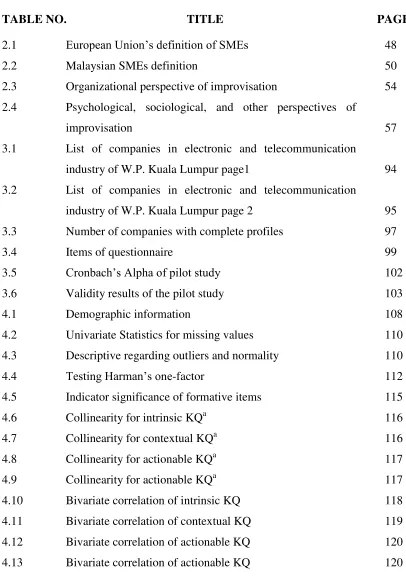
LIST OF TABLES
TABLE NO. TITLE PAGE
2.1 European Union’s definition of SMEs 48
2.2 Malaysian SMEs definition 50
2.3 Organizational perspective of improvisation 54 2.4 Psychological, sociological, and other perspectives of
improvisation 57
3.1 List of companies in electronic and telecommunication
industry of W.P. Kuala Lumpur page1 94
3.2 List of companies in electronic and telecommunication
industry of W.P. Kuala Lumpur page 2 95
3.3 Number of companies with complete profiles 97
3.4 Items of questionnaire 99
3.5 Cronbach’s Alpha of pilot study 102
3.6 Validity results of the pilot study 103
4.1 Demographic information 108
4.2 Univariate Statistics for missing values 110
4.3 Descriptive regarding outliers and normality 110
4.4 Testing Harman’s one-factor 112
4.5 Indicator significance of formative items 115
4.6 Collinearity for intrinsic KQa 116
4.7 Collinearity for contextual KQa 116
4.8 Collinearity for actionable KQa 117
4.9 Collinearity for actionable KQa 117
4.10 Bivariate correlation of intrinsic KQ 118
4.11 Bivariate correlation of contextual KQ 119
4.12 Bivariate correlation of actionable KQ 120
4.14 AVE, composite reliability (CR), and Cronbach’s Alpha
(CA), and discriminant validity 125
4.15 Item loadings, cross loadings, and VIF for each item 126
4.16 Heterotrait-Monotrait Ratio (HTMT) 127
4.17 HTMT confidence intervals 127
4.18 Results of bootstrapping 129
4.19 Significance testing results of the total effects of exogenous
constructs on target constructs 131
4.20 R2 and Q2 values 132
4.21 f2 effect size 133
4.22 q2 effect size 133
4.23 SRMR value and bootstrapping result 134
4.24 Mediation analysis of contextual KQ for the relationship
between intrinsic KQ and improvisational creativity 135 4.25 Mediation analysis of contextual KQ for the relationship
between intrinsic KQ and compositional creativity 136 4.26 Mediation analysis of actionable KQ for the relationship
between intrinsic KQ and improvisational creativity 136 4.27 Mediation analysis of actionable KQ for the relationship
between intrinsic KQ and compositional creativity 137 4.28 Mediation analysis of accessibility KQ for the relationship
between intrinsic KQ and improvisational creativity 138 4.29 Mediation analysis of accessibility KQ for the relationship
between intrinsic KQ and compositional creativity 138 4.30 Mediation analysis of actionable KQ for the relationship
between contextual KQ and improvisational creativity 139 4.31 Mediation analysis of actionable KQ for the relationship
between contextual KQ and compositional creativity 139 4.32 Mediation analysis of accessibility KQ for the relationship
between contextual KQ and improvisational creativity 140 4.33 Mediation analysis of accessibility KQ for the relationship
4.35 Result of IPMA for improvisational creativity as a target
construct 143
4.36 Results of IPMA for compositional creativity as a target
construct 144
4.37 PLS-MGA results for two ethnic groups 145
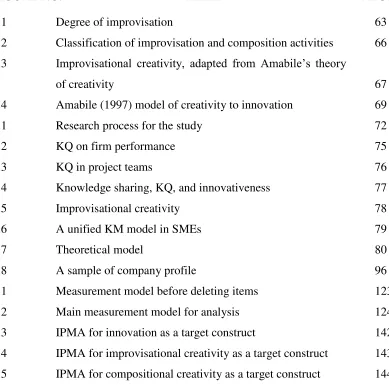
LIST OF FIGURES
FIGURE NO. TITLE PAGE
2.1 Degree of improvisation 63
2.2 Classification of improvisation and composition activities 66 2.3 Improvisational creativity, adapted from Amabile’s theory
of creativity 67
2.4 Amabile (1997) model of creativity to innovation 69
3.1 Research process for the study 72
3.2 KQ on firm performance 75
3.3 KQ in project teams 76
3.4 Knowledge sharing, KQ, and innovativeness 77
3.5 Improvisational creativity 78
3.6 A unified KM model in SMEs 79
3.7 Theoretical model 80
3.8 A sample of company profile 96
4.1 Measurement model before deleting items 123
4.2 Main measurement model for analysis 124
4.3 IPMA for innovation as a target construct 142
LIST OF ABBREVIATIONS
AC - Absorptive capacity
AccKQ - Accessibility KQ
AKQ - Actionable KQ
AVE - Average variance extracted
CC - Compositional creativity
CKQ - Contextual KQ
EFQM - European Foundation of Quality Management
FD - Functional diversity
HTMT - Heterotrait-monotrait
IC - Improvisational creativity
IKQ - Intrinsic KQ
IPMA - Importance-performance map analysis
IS - Information systems
ISO - International organization of standardization
IQ - Information quality
IT - Information technology
KN - Knowledge network
KM - Knowledge management
KQ - Knowledge quality
MGA - Multi group analysis
MNCs - Multinational companies
OC - Organizational culture
OS - Organizational structure
PLS - Partial least square
SMEs - Small and medium-sized enterprises SRMR - Standardized root mean square residual TIQM - Total information quality management TKQM - Total knowledge quality management
TQC - Total quality control
TU - Technology utilization
VAF - Variance accounted for
LIST OF APPENDICES
APPENDIX TITLE PAGE
A Questionnaire 200
B Items’ normality and outlier descriptive statistics 205
C PLS-MGA results for Malay ethnicity 211
CHAPTER 1
INTRODUCTION
1.1 Introduction
Quality is not a new concept and obtaining high quality goods and services has been an issue for all companies. In recent years, the concept of quality was synthesized with data and information. In addition, advancements in knowledge management (KM) concepts have made it necessary to consider knowledge quality (KQ) as well. It is argued that the mere utilization of KM and its systems is not sufficient to becoming creative and prosperous in this turbulent market. Instead, it is the quality or high standard of knowledge that is essential for the survival of businesses. KQ is referred to the usefulness and innovativeness of acquired knowledge (Soo et al., 2004). In addition, Yoo et al. (2011) defined KQ as “the extent to which the awareness and understanding of ideas, logics, relationships, and circumstances are fit for use, relevant and valuable to context, and easy to adapt”.
Charan, 2008) as more innovative companies enjoy higher profits resulted from their product and service innovations (Hamel, 2008).
Nevertheless, the importance of being creative and innovative is stated and it is believed that KQ has a significant role in the competitive capability of SME. Therefore, the role of KQ in SMEs’ competitiveness has to be studied and its determinants and dimensions have to be pinpointed. This study shows the extent to which Malaysian SMEs can leverage their competitiveness capability through KQ to boost their success in this post-modern society.
1.2 Role of SMEs in Competitive Landscape
SMEs have a remarkable role in world economy and in global context as more than 99% of companies are SMEs (Cornell, 2012). SMEs produce between 40% and 50% of global GDP (Wurzer and DiGammarino, 2008) and they participate in 80% of worldwide economic growth (Jutla et al., 2002; Singh et al., 2009). In addition, the R&D expenditure of SMEs has increased by 10 times more than big enterprises over the past two decades (Chesbrough, 2010). Compared to big enterprises, SMEs have limited resources (Chesbrough and Garman, 2009) and they encounter higher risks (Bianchi et al., 2010) but they can outperform big enterprises due to their agile and flexible capabilities.
Several theories are used in this study to underpin SMEs’ competitiveness, KQ, and its determinants. KQ and its dimensions can be evaluated through sense-making theory proposed byDervin (1998). Organizational knowledge creation theory introduced byNonaka and Takeuchi (1995) is evaluated to understand the organizational enabling conditions that lead to knowledge creation and fuel the process of innovation. Moreover, Amabile’s theory of creativity(Amabile, 1996), and organizational improvisation theory are evaluated to understand competitiveness and the factors related to creativity and the consideration of innovation as a result of creativity. These theories will be elaborated in chapter 2 and chapter 3 of this thesis.
1.3 Malaysian SMEs’ Competitiveness
SMEs as small knowledge groups play a significant role in creative processes. Flexible and agile capabilities of SMEs facilitate creative processes. SMEs make up more than 92 percent of companies in Malaysia and there are 645,136 companies registered under SMEs in Malaysia (Malaysia, 2012). According to Malaysia and Ekonomi (2006), with best practices in SME sector, companies can elevate their performance and competitiveness. By doing so, they can increase SMEs’ growth and have positive impact on Malaysia’s economic development (Unit, 2006). Anuar and Mohd Yusuff (2011) claimed that Malaysian SMEs can increase their degree of competitiveness through monitoring their current practices and benchmarking it with the best practices.
According to Singh et al. (2009), global competition has endangered Asian domestic SMEs whose products and services are localized. Trade liberalization has enabled foreign companies to easily enter remote and underdeveloped markets in Asia. On the other hand, the number of multinational companies (MNCs) is growing in Malaysia and the country has been the recipient of foreign direct investments since the 1960s (Giroud, 2007) hence the need for Malaysian SMEs to consider their competitive capabilities in order to not lag behind MNCs and foreign manufacturers and retailers. It is crucial to study KQ in SMEs since it is the source of creativity and innovativeness. Competitiveness in SMEs is gauged through the degree of creativity and innovation.
1.4 Statement of the Problem
Previous researches on SMEs have focused on data quality (Ballou et al., 1993; Ballou and Pazer, 1982, 1985; Ballou and Tayi, 1989; Batini et al., 2004; Batini et al., 1986; DeLone and McLean, 1992; Demeter et al., 2007; Goodhue and Thompson, 1995; Jarke and Vassiliou, 1997; Liu et al., 2008; Redman, 2001; Wand and Wang, 1996; Wang et al., 1995; Wang and Strong, 1996) and information quality (Batini et al., 2004; Benjelloun et al., 2009; Berti-Equille and Moussouni, 2005; Bilenko and Mooney, 2003; Breunig et al., 2000; Dasu et al., 2002; English, 1999; Fellegi and Sunter, 1969; Fox et al., 1994; Little and Rubin, 2014; Liu and Chi, 2002; McCallum et al., 2000; Missier and Batini, 2003; Monge, 2000) and the body of literature lacks research on KQ in SME context. Furthermore, Soo et al. (2004) studied the role of KQ infirm performance of large firms. Yoo et al. (2011) studied KQ in project teams. Yoo (2012b, 2014) studied KQ in large firms as well. Therefore, this thesis focuses on KQ in SME context.
of KQ (its dimensions, determinants, and consequences) that result in SMEs’ competitiveness.
Little is known about KQ and this study is amongst the few that considers a broad view toward the determinants and dimensions of KQ and pioneers the examination of the role of KQ increativity among SMEs. Previous research (Soo et al., 2004; Yoo et al., 2011) only examined several determinants of KQ. They
considered absorptive capacity, functional diversity, and knowledge network as the determinants of KQ. This thesis takes a meticulous approach toward the determinants of KQ and intends to study organizational culture, organizational structure, and technology as other determinants of KQ. In addition, previous research (Yoo, 2012b, 2014; Yoo et al., 2011) considered dimensions of KQ as intrinsic KQ, contextual KQ, and actionable KQ. By virtue of sense-making theory (Dervin, 1998), this study examines another dimension of KQ as accessibility KQ and it considers KQ as a progression of four dimensions i.e. intrinsic KQ, contextual KQ, and actionable KQ, and accessibility KQ.
Many recent studies mainly focus on innovation capabilities in big enterprises (Van de Vrande et al., 2009). Other researchers (Lee et al., 2010; Madrid‐Guijarro et al., 2009) stated the importance of understanding and evaluating the SMEs’
competitiveness. The concept of competitiveness in SMEs is still vague in management literature due to the lack of research conducted on this topic. To address this research gap, this thesis introduces a holistic model of competitiveness for SMEs with the premise that competitiveness in SMEs is achieved directly through KQ.
1.4.1 Challenges Facing Malaysian SMEs
Bhatiasevi (2009) indicated that the concept of globalization is forcing the Malaysian companies to move toward a knowledge-based economy.
According to Bhatiasevi (2009), Malaysian companies need to be knowledge-driven to tackle the potential issues and be on track towards its2020 vision plan. There are several challenges faced by SMEs such as the lack of technology (Muhammad et al., 2010) and the lack of access to social networks (Teoh and Chong, 2008). Alam (2010) indicated that social barriers are the locus of control restraining Malaysian SMEs from achieving a core competency. Khalique et al. (2011) concluded that intellectual capital is one of the main challenges of Malaysian SMEs. On the other hand, several researchers considered intellectual capital as the main factor for being competitive in SMEs (Bataineh and Al Zoabi, 2011; Leitner, 2011). Therefore, it can be observed that KQ in SMEs is important and it need to be addressed properly. In addition, organizational factors that can influence KQ in SMEs are of great significance.
Mahmud and Hilmi (2014) found a positive relationship between organizational learning and SME performance of Malaysian SMEs. In addition, they showed that organizational learning mediates the relationship between total quality management and Malaysian SMEs’ performance. Idar et al. (2012) found a positive relationship between strategic planning practices and Malaysian SMEs’ performance. In addition, they found market orientation to be a mediating factor between strategic planning practices and performance as well. They defined market orientation as the firm’s culture that produces value for the customers. Chin et al. (2014) developed a conceptual framework hypothesizing the positive role of external integration and Malaysian SMEs’ performance.
1.5 Research Questions
In order to boost growth, SMEs have to be creative. Considering Malaysia as a developing country, low level of creativity would affect the performance and overall output of businesses. The country has plans in creating a private sector-led economy. The 10th Malaysia Plan (Malaysia, 2012)clearly stated that the creativity of SMEs will be harnessed as the primary drivers of Malaysia’s growth. The creativity process in SMEs is facilitated by the high standard of KQ. However, acknowledging perceived KQ and its substructures that shape employees’ sense-making processes is critical.
i. What are the substructures of perceived KQ amongst Malaysian SMEs?
Understanding the infrastructure capabilities/factors that influence perceived KQ is important as well. Specifying those factors participative to KQ can help SMEs to configure a better business setting for employees. However, it is critical to recognize which organizational factors have higher impact on perceived KQ and if they are indirectly participative to SMEs’ creativity and innovation or not.
ii. What are the determinants of perceived KQ amongst Malaysian SMEs?
KQ can have several consequences (Yoo, 2014). It is substantial to understand which dimensions of KQ result in creativity and innovativeness. In other words, in which stage of the sense-making activity, the entities come out with novel ideas, processes, products, and services. In this study, SMEs’ competitiveness is gauged through their degree of creativity and innovation from which creativity is divided into improvisational creativity and compositional creativity.
iii. Is there any relationship between perceived KQ and Malaysian SMEs’ competitiveness?
- Is there any relationship between perceived KQ and compositional creativity of Malaysian SMEs?
- Is there any relationship between perceived KQ and Malaysian SMEs’ innovativeness?
1.6 Research Objectives
Research objectives are designed to address the research questions. In this manner, this study tries to shed light on the concept of KQ by determining the substructures of KQ and the organizational factors participative to KQ. Furthermore, in terms of possible results KQ might have in SMEs, this study examines its possible impact on improvisational creativity, compositional creativity, and innovation. Therefore, the research objectives are:
i. To determine the substructures of perceived KQ amongst Malaysian SMEs. ii. To identify the determinants of perceived KQ amongst Malaysian SMEs. iii. To examine whether there is a relationship between KQ and Malaysian
SMEs’ competitiveness in terms of improvisational creativity, compositional creativity and innovativeness.
1.7 Significance of Study
By virtue of this research, SMEs can observe where they are now and what they lack from among these factors (substructures of KQ) and what plans they should develop to reside in the path of creativity. This thesis takes a new approach towards the process of creativity through examining improvisational and compositional creativity by virtue of KQ.
terms of dimensions of KQ, accessibility KQ is considered as another dimension of KQ and three new organizational factors (organizational structure, organizational culture, and technology) are examined as substructures of KQ. In addition, this is the first study that examines the role of KQ in creativity in terms of improvisational creativity and compositional creativity.
This study provides critical information for the government to come up with an ideal standard for Malaysian SMEs that motivates growth and boosts performance (both innovative and financial performance). The results also guides towards practical ways to improve KQ in SMEs. Large enterprises can benefit from the results of this study as well. Furthermore, this research indicates the extent and the areas in which the government could assist and support SMEs and the policies to make in order to generate the best settings for knowledge in SMEs (Malaysia, 2012).
The result of this study will provide the government with an understanding of KQ and guide in evaluating appropriate business settings for SMEs thereby aiding policy makers to guide and support SMEs in the right way. The 6% sustaining growth rate needed to achieve the 2020 plan will require Malaysia to incite internal competitiveness and unleash creativity-led growth and innovation (Malaysia, 2012). Finally, based on the results of this study, managers can observe what the sources of creativity are and how it leads to innovation.
1.8 Scope of Study
managing SME (Bjerke, 2000; Wu and Leung, 2005), there are few empirical investigations that examined the notion of SME competitiveness in Malaysia.
The scope of this study is Malaysian companies from both manufacturing and service industries. Only those companies that are registered under small and medium sized enterprises are the focus of this study while micro companies, i.e. those companies with the number of employees of less than 5, are omitted.
1.9 The Structure of the Thesis
The first chapter of this thesis provides a brief background about KQ and its importance. In addition, SMEs’ competitiveness and its importance in Malaysian context are emphasized. The challenges facing Malaysian SMEs, research gap as well as research questions and objectives are stated.
The second chapter of this study provides a broad review of the literature and previous studies that had been conducted about KQ and empirical studies that have examined determinants and substructures of KQ are reviewed. Relevant theories of sense-making and its relevance to KQ along with theories of creativity and improvisation are briefly examined. This chapter also presents the theoretical framework and the research hypothesis that will be tested in the study.
Chapter 3 as the methodological chapter of this study provides necessary information about the type of study, research design and all other related information about the procedure of the study such as sampling strategy, data collection methods, and the development of the survey questionnaire. Pre-test and pilot test are addressed as well.
measurement model. To examine the structural model, the results of bootstrapping for hypothesis testing, indirect effects, model’s predictive accuracy, and multi-group analysis are considered.
Chapter 5 as the final chapter of this study summarizes the results that have been generated in the findings chapter. It provides the insights about the findings and shows the implication of the study. Discussions and recommendations are made and the chapter finishes by stating the limitation of the study and suggestions for future research.
1.10 Definitions of the Terms
Knowledge Management: it is a set of practices used by organizations to identify, create, represent, and distribute knowledge.
Knowledge Quality: knowledge quality is the high standard of knowledge that helps firms work better, develop novel and useful products or services, reduce costs, and increase sales.
Intrinsic Knowledge Quality: it is defined as the knowledge that has quality by virtue of itself.
Contextual Knowledge Quality: it is defined as the knowledge that is associated with the context of the task at hand.
Actionable Knowledge Quality: it is defined as the extent to which knowledge is expandable, adaptable, or simply applied to tasks.
Accessibility Knowledge Quality: it is referred to the degree of system availability, degree of flexibility, ease of use, and ease of access.
Functional Diversity: it is defined as the degree of hiring employees with different skills and expertise.
Knowledge Network: it is defined as the capability to take advantage of external knowledge from external environment such as customers, competitors, suppliers, and so forth.
Organizational Culture: it is defined as the behaviour of humans within an organization and the meaning that people attach to those behaviours.
Organizational Structure: it is defined as how activities such as task allocation, coordination and supervision are directed towards the achievement of organizational aims.
Improvisational Creativity: it is defined as ideas that surface in a novel and creative way without planning/preparation.
Compositional Creativity: it is defined as lower degree of creativity that results in variations and embellishments in products, processes, services, and ideas.
1.11 Summary
REFERENCES
Aaker, D. A., and Lawley, M. (2007). Marketing Research: The Second Pacific Rim Edition: John Wiley & Sons Australia, Limited.
Adams, M. J., Tenney, Y. J., and Pew, R. W. (1995). Situation awareness and the cognitive management of complex systems. Human Factors: The Journal of the Human Factors and Ergonomics Society, 37(1), 85-104.
Ahituv, N. (1980). A systematic approach toward assessing the value of an information system. MIS Quarterly, 61-75.
Ahmad, N. H., and Seet, P.-S. (2009). Dissecting behaviours associated with business failure: A qualitative study of SME owners in Malaysia and Australia. Asian Social Science, 5(9), p98.
Akgün, A. E., Byrne, J., Keskin, H., Lynn, G. S., and Imamoglu, S. Z. (2005). Knowledge networks in new product development projects: A transactive memory perspective. Information & management, 42(8), 1105-1120.
Al-Hakim, L. (2007). Information quality management: theory and applications: IGI Global.
Alam, S. S. (2010). Assessing barriers of growth of food processing SMIs in Malaysia: a factor analysis. International Business Research, 4(1), p252. Amabile, T. (1996). Creativity in context: Westview press.
Amabile, T. M. (1988). A model of creativity and innovation in organizations. Research in organizational behavior, 10(1), 123-167.
Amabile, T. M. (1997). Entrepreneurial creativity through motivational synergy. The Journal of Creative Behavior, 31(1), 18-26.
Amabile, T. M., Hadley, C. N., and Kramer, S. J. (2002). Creativity under the gun. Harvard business review, 80(8), 52-61, 147.
Ancona, D. G., and Caldwell, D. F. (1992). Demography and design: Predictors of new product team performance. Organization science, 3(3), 321-341.
Anuar, A., and Mohd Yusuff, R. (2011). Manufacturing best practices in Malaysian small and medium enterprises (SMEs). Benchmarking: An International Journal, 18(3), 324-341.
Aris, N. M. (2007). SMEs: Building blocks for economic growth. Department of National Statistics, Malaysia.
Bagozzi, R. P., Yi, Y., and Phillips, L. W. (1991). Assessing construct validity in organizational research. Administrative science quarterly, 421-458.
Bailey, J. E., and Pearson, S. W. (1983). Development of a tool for measuring and analyzing computer user satisfaction. Management science, 29(5), 530-545. Ballou, D., Wang, R., Pazer, H., and Tayi, K. (1993). Modeling data manufacturing
systems to determine data product quality. Total Data Quality Management Research Program, MIT Sloan School of Management,(No. TDQM-93-09).
Ballou, D. P., and Pazer, H. L. (1982). The impact of inspector fallibility on the inspection policy in serial production systems. Management Science, 28(4), 387-399.
Ballou, D. P., and Pazer, H. L. (1985). Modeling data and process quality in multi-input, multi-output information systems. Management science, 31(2), 150-162.
Ballou, D. P., and Pazer, H. L. (1987). Cost/quality tradeoffs for control procedures in information systems. Omega, 15(6), 509-521.
Ballou, D. P., and Tayi, G. K. (1989). Methodology for allocating resources for data quality enhancement. Communications of the ACM, 32(3), 320-329.
Bansler, J., and Havn, E. (2004). Sensemaking in technology-use mediation: Adapting groupware technology in the context of use: Center for
Tele-Information, Technical University of Denmark Kongens Lyngbyo.
Bantel, K. A., and Jackson, S. E. (1989). Top management and innovations in banking: does the composition of the top team make a difference? Strategic Management Journal, 10, 107.
Barclay, D., Higgins, C., and Thompson, R. (1995). The partial least squares (PLS) approach to causal modeling: Personal computer adoption and use as an illustration. Technology studies, 2(2), 285-309.
Barrett, F. J. (1998). Coda—creativity and improvisation in jazz and organizations: Implications for organizational learning. Organization science, 9(5), 605-622. Barrett, F. J., and Peplowski, K. (1998). Minimal structures within a song: An
analysis of “All of Me”. Organization Science, 9(5), 558-560.
Bassett‐Jones, N. (2005). The paradox of diversity management, creativity and innovation. Creativity and innovation management, 14(2), 169-175.
Bastien, D. T., and Hostager, T. J. (1988). Jazz as a process of organizational innovation. Communication Research, 15(5), 582-602.
Bataineh, M., and Al Zoabi, M. (2011). The effect of intellectual capital on organizational competitive advantage: Jordanian Commercial Banks (Irbid District) An empirical study. International Bulletin of Business Administration, 10(10), 15-24.
Batini, C., Catarci, T., and Scannapiceco, M. (2004). A survey of data quality issues in cooperative information systems. Paper presented at the Pre-conference ER
tutorial.
Batini, C., Lenzerini, M., and Navathe, S. B. (1986). A comparative analysis of methodologies for database schema integration. ACM computing surveys (CSUR), 18(4), 323-364.
Batini, C., and Scannapieca, M. (2006). Data Quality Dimensions. Data Quality: Concepts, Methodologies and Techniques, 19-49.
Baumol, W. J. (2002). The free-market innovation machine: Analyzing the growth miracle of capitalism: Princeton university press.
Beckmann, M. J. (1995). Economic models of knowledge networks. In Networks in Action (pp. 159-174): Springer.
Benjelloun, O., Garcia-Molina, H., Menestrina, D., Su, Q., Whang, S. E., and Widom, J. (2009). Swoosh: a generic approach to entity resolution. The VLDB Journal—The International Journal on Very Large Data Bases, 18(1),
255-276.
Berniker, E. (1998). Working the jazz metaphor: musings driving down I-5 past midnight. Organization Science, 9(5), 583-585.
Berry, J. W., and Irvine, S. H. (1986). Bricolage: Savages do it daily.
Berti-Équille, L. (2007). Data quality awareness: a case study for cost optimal association rule mining. Knowledge and information Systems, 11(2), 191-215. Berti-Equille, L., and Moussouni, F. (2005). Quality-Aware Integration and
Warehousing of Genomic Data. Paper presented at the IQ.
Bjerke, B. (2000), A Typified, Culture-Based, Interpretation of Management of SMEs in Southeast Asia, Asia Pacific Journal of Management, 17(1), 103-132.
Bhatiasevi, V. (2009). The Race towards a Knowledge Based Economy: A Comparative Study between Malaysia and Thailand. International Journal of Business and Management, 5(1), p114.
Bianchi, M., Campodall'Orto, S., Frattini, F., and Vercesi, P. (2010). Enabling open innovation in small‐and medium‐sized enterprises: how to find alternative applications for your technologies. R&d Management, 40(4), 414-431.
Bilenko, M., and Mooney, R. J. (2003). Adaptive duplicate detection using learnable string similarity measures. Paper presented at the Proceedings of the ninth
ACM SIGKDD international conference on Knowledge discovery and data mining, 39-48.
Birkinshaw, J., Morrison, A., and Hulland, J. (1995). Structural and competitive determinants of a global integration strategy. Strategic Management Journal, 16(8), 637-655.
Boone, C., and Hendriks, W. (2009). Top management team diversity and firm performance: Moderators of functional-background and locus-of-control diversity. Management Science, 55(2), 165-180.
Boyle, S. (1992). Quality, Speed, Customer Involvement and the New Look of Organizations" seminar. Unpublished manuscript.
Breunig, M. M., Kriegel, H.-P., Ng, R. T., and Sander, J. (2000). LOF: identifying density-based local outliers. Paper presented at the ACM sigmod record,
93-104.
Brown, S. L., and Eisenhardt, K. M. (1997). The art of continuous change: Linking complexity theory and time-paced evolution in relentlessly shifting organizations. Administrative science quarterly, 1-34.
Bunderson, J. S., and Sutcliffe, K. M. (2002). Comparing alternative conceptualizations of functional diversity in management teams: Process and performance effects. Academy of management journal, 45(5), 875-893. Burns, A. C., and Bush, R. F. (2003). Marketing research: Online research
applications: Prentice Hall.
Burns, T. E., and Stalker, G. M. (1961). The management of innovation. University of Illinois at Urbana-Champaign's Academy for Entrepreneurial Leadership
Historical Research Reference in Entrepreneurship.
Cagan, J., and Vogel, C. M. (2002). Creating breakthrough products: Innovation from product planning to program approval: Ft Press.
Campion, M. A., Medsker, G. J., and Higgs, A. C. (1993). Relations between work group characteristics and effectiveness: Implications for designing effective work groups. Personnel psychology, 46(4), 823-850.
Cappiello, C., Francalanci, C., and Pernici, B. (2003). Time-related factors of data quality in multichannel information systems. Journal of Management Information Systems, 20(3), 71-92.
Cardinal, L. B. (2001). Technological innovation in the pharmaceutical industry: The use of organizational control in managing research and development. Organization science, 12(1), 19-36.
Carnabuci, G., and Bruggeman, J. (2009). Knowledge specialization, knowledge brokerage and the uneven growth of technology domains. Social forces, 88(2), 607-641.
Carr, L. P. (2012). Applying the cost of quality to a service business. Image.
Cattell, R. (2012). The scientific use of factor analysis in behavioral and life sciences: Springer Science & Business Media.
Celko, J., and McDonald, J. (1995). Don't warehouse dirty data. Datamation-Highlands Ranch, 41(19), 42-55.
Chan, I., and Chao, C.-K. (2008). Knowledge management in small and medium-sized enterprises. Communications of the ACM, 51(4), 83-88.
human resource management practices on firm performance. The International Journal of Human Resource Management, 15(1), 17-35.
Charoensukmongkol, P. (2015). Cultural intelligence of entrepreneurs and international network ties: the case of small and medium manufacturing firms in Thailand, Management Research Review, 38(4), 421-436.
Chen, C.-J., Huang, J.-W., and Hsiao, Y.-C. (2010). Knowledge management and innovativeness: The role of organizational climate and structure. International Journal of Manpower, 31(8), 848-870.
Chesbrough, H. (2010). 3 How Smaller Companies Can Benefit from Open Innovation. Economy, Culture and History Japan Spotlight Bimonthly, 29(1), 13.
Chesbrough, H. W. (2006). Open innovation: The new imperative for creating and profiting from technology: Harvard Business Press.
Chesbrough, H. W., and Garman, A. R. (2009). How open innovation can help you cope in lean times. Harvard business review, 87(12), 68-76, 128.
Chin, T. A., Hamid, A. B. A., Rasli, A., and Tat, H. H. (2014). A Literature Analysis on the Relationship between External Integration, Environmental Uncertainty and Firm Performance in Malaysian SMEs. Procedia-Social and Behavioral Sciences, 130, 75-84.
Chin, W. W., and Newsted, P. R. (1999). Structural equation modeling analysis with small samples using partial least squares.
Christakis, N. A., and Fowler, J. H. (2009). Connected: The surprising power of our social networks and how they shape our lives: Little, Brown.
Ciborra, C. U. (1996). The platform organization: Recombining strategies, structures, and surprises. Organization science, 7(2), 103-118.
Clark, H. H., and Clark, E. V. (1980). Psychology and language. An introduction to psycholinguistics.
Claver-Cortés, E., Pertusa-Ortega, E. M., and Molina-Azorín, J. F. (2012). Characteristics of organizational structure relating to hybrid competitive strategy: Implications for performance. Journal of Business Research, 65(7), 993-1002.
Cooper, D. R., and Schindler, P. S. (2003). Business research methods.
Cooper, R. B. (1983). Decision production: a step toward a theory of managerial information requirements. Paper presented at the Proceedings of the Fourth
International Conference on Information Systems, 15-17.
Cornell, B. T. (2012). Open Innovation Strategies for Overcoming Competitive Challenges Facing Small and Mid-Sized Enterprises: University of Maryland
University College.
Cowan, R., and Jonard, N. (2004). Network structure and the diffusion of knowledge. Journal of economic Dynamics and Control, 28(8), 1557-1575. Craig, A., and Hart, S. (1992). Where to now in new product development research?
European Journal of Marketing, 26(11), 2-49.
Crosby, P. B. (1980). Quality is free: The art of making quality certain: Signet. Cross, R., and Sproull, L. (2004). More than an answer: Information relationships for
actionable knowledge. Organization Science, 15(4), 446-462.
Crossan, M., Cunha, M. P. E., Vera, D., and Cunha, J. (2005). Time and organizational improvisation. Academy of Management Review, 30(1), 129-145.
Crossan, M., and Sorrenti, M. (1997). Making sense of improvisation. Advances in strategic management, 14, 155-180.
Crossan, M. M. (1997). Improvise to Innovate: Continued business success may depend on enhancing one's ability to be spontaneous and innovative... key components of the craft of improvisation. Ivey Business Quarterly, 62, 36-43. Crossan, M. M. (1998). Improvisation in action. Organization Science, 9(5),
593-599.
Crossan, M. M., Lane, H. W., White, R. E., and Klus, L. (1996). The improvising organization: Where planning meets opportunity. Organizational Dynamics, 24(4), 20-35.
Cunha, M. P. E., and Kamoche, K. (2003). Organizational improvisation: Routledge. Cunha, M. P. e., Vieira da Cunha, J., and Kamoche, K. (1999). Organizational Improvisation: What, When, How and Why. International Journal of Management Reviews, 1(3), 299-341.
Damanpour, F. (1991). Organizational innovation: A meta-analysis of effects of determinants and moderators. Academy of management journal, 34(3), 555-590.
Damanpour, F., and Aravind, D. (2012). Organizational structure and innovation revisited: From organic to ambidextrous structure. Handbook of Organizational creativity, 502-503.
Damanpour, F., and Schneider, M. (2006). Phases of the adoption of innovation in organizations: Effects of environment, organization and top Managers1. British Journal of Management, 17(3), 215-236.
Damanpour, F., and Wischnevsky, J. D. (2006). Research on innovation in organizations: Distinguishing generating from innovation-adopting organizations. Journal of engineering and technology management, 23(4), 269-291.
Dasu, T., and Johnson, T. (2003). Exploratory data mining and data cleaning (Vol. 479): John Wiley & Sons.
Dasu, T., Johnson, T., Muthukrishnan, S., and Shkapenyuk, V. (2002). Mining database structure; or, how to build a data quality browser. Paper presented
at the Proceedings of the 2002 ACM SIGMOD international conference on Management of data, 240-251.
Datta, A., and Jessup, L. M. (2013). Looking beyond the focal industry and existing technologies for radical innovations. Technovation, 33(10), 355-367.
Daugherty, P. J., Chen, H., and Ferrin, B. G. (2011). Organizational structure and logistics service innovation. The International Journal of Logistics Management, 22(1), 26-51.
Davenport, T. H. (1993). Need radical innovation and continuous improvement? Integrate process reengineering and TQM. Planning Review, 21(3), 6-12. Davenport, T. H., De Long, D. W., and Beers, M. C. (1998). Successful knowledge
management projects. Sloan management review, 39(2), 43-57.
De Giacomo, G., Lembo, D., Lenzerini, M., and Rosati, R. (2004). Tackling inconsistencies in data integration through source preferences. Paper
presented at the Proceedings of the 2004 international workshop on Information quality in information systems, 27-34.
DeLone, W. H., and McLean, E. R. (1992). Information systems success: The quest for the dependent variable. Information systems research, 3(1), 60-95.
Demeter, K., Forslund, H., and Jonsson, P. (2007). The impact of forecast information quality on supply chain performance. International journal of operations & production management, 27(1), 90-107.
Deming, W. E. (1986). Out of the Crisis: Quality. Productivity and Competitive Position, Cambridge Mass.
Demming, W. E. (1986). Out of the crisis: Quality productivity and competitive position: Cambrige, MA: Cambridge University Press.
Denison, D. R. (1990). Corporate culture and organizational effectiveness: John Wiley & Sons.
Dervin, B. (1992). From the mind’s eye of the user: The sense-making qualitative-quantitative methodology. Qualitative research in information management, 61, 84.
Dervin, B. (1998). Sense-making theory and practice: an overview of user interests in knowledge seeking and use. Journal of knowledge management, 2(2), 36-46.
Dervin, B., Foreman-Wernet, L., and Lauterbach, E. (2003). Sense-making methodology reader: Selected writings of Brenda Dervin: Hampton Pr.
Dervitsiotis, K. N. (2010). Developing full-spectrum innovation capability for survival and success in the global economy. Total Quality Management, 21(2), 159-170.
Dewar, R. D., and Dutton, J. E. (1986). The adoption of radical and incremental innovations: An empirical analysis. Management science, 32(11), 1422-1433. Diamantopoulos, A., and Winklhofer, H. M. (2001). Index construction with formative indicators: An alternative to scale development. Journal of marketing research, 38(2), 269-277.
Dillman, D. A., Phelps, G., Tortora, R., Swift, K., Kohrell, J., Berck, J., et al. (2009). Response rate and measurement differences in mixed-mode surveys using mail, telephone, interactive voice response (IVR) and the Internet. Social Science Research, 38(1), 1-18.
Dougherty, D. (1999). Organizing for innovation. Managing organizations: Current issues, 174-189.
Døving, E., and Gooderham, P. N. (2008). Dynamic capabilities as antecedents of the scope of related diversification: the case of small firm accountancy practices. Strategic Management Journal, 29(8), 841-857.
Drucker, P. (2014). Innovation and entrepreneurship: Routledge.
Drucker, P. F. (2007). Management challenges for the 21st century: Routledge. Drucker, P. F., Drucker, P. F., and Drucker, P. F. (1967). The effective executive
(Vol. 967): Heinemann London.
Duffy, M. (1995a). Sensemaking in classroom conversations. Openness in research: The tension between self and other, 119-132.
Duffy, M. (1995b). Sensemaking: A collaborative inquiry approach to" doing" learning. The Qualitative Report, 2(2), 1-6.
Durst, S., and Runar Edvardsson, I. (2012). Knowledge management in SMEs: a literature review. Journal of Knowledge Management, 16(6), 879-903.
Eisenberg, E. M. (1990). Jamming transcendence through organizing. Communication Research, 17(2), 139-164.
Eisenhardt, K. M. (1998). Strategic decision making as improvisation. In Strategic decisions (pp. 251-257): Springer.
Eisenhardt, K. M., and Tabrizi, B. N. (1995). Accelerating adaptive processes: Product innovation in the global computer industry. Administrative science quarterly, 84-110.
Ekvall, G. (1997). Organizational conditions and levels of creativity. Creativity and innovation Management, 6(4), 195-205.
Ellis, R. J. (1982). Improving management response in turbulent times. Sloan Management Review, 23(2), 3-12.
Emery, J. C. (1969). Organizational planning and control systems: Theory and technology: Macmillan New York.
English, L. (1996). Information Quality: Meeting Customer need. Information Impact Newsletter, 2.
English, L. P. (1999). Improving data warehouse and business information quality: methods for reducing costs and increasing profits: John Wiley & Sons, Inc.
Erden, Z., Von Krogh, G., and Nonaka, I. (2008). The quality of group tacit knowledge. The Journal of Strategic Information Systems, 17(1), 4-18.
Erickson, F. (1982). Classroom discourse as improvisation: Relationships between academic task structure and social participation structure in lessons. Communicating in the classroom, 153-181.
Fellegi, I. P., and Sunter, A. B. (1969). A theory for record linkage. Journal of the American Statistical Association, 64(328), 1183-1210.
Feltham, G. A. (1968). The value of information. Accounting Review, 684-696. FERNANDES, V. (2012). (Re) discovering the PLS approach in management
science. M@ n@ gement, 15(1).
Ferris, G. R., Arthur, M. M., Berkson, H. M., Kaplan, D. M., Harrell-Cook, G., and Frink, D. D. (1998). Toward a social context theory of the human resource management-organization effectiveness relationship. Human resource management review, 8(3), 235-264.
Fey, C. F., and Denison, D. R. (2003). Organizational culture and effectiveness: can American theory be applied in Russia? Organization science, 14(6), 686-706. Fisher, C. M., and Amabile, T. (2009). Creativity, improvisation and organizations.
The Routledge companion to creativity, 13-24.
Fisher, C. W., and Kingma, B. R. (2001). Criticality of data quality as exemplified in two disasters. Information & Management, 39(2), 109-116.
Ford, C. M. (1996). A theory of individual creative action in multiple social domains. Academy of Management review, 21(4), 1112-1142.
Fornell, C., and Bookstein, F. L. (1982). Two structural equation models: LISREL and PLS applied to consumer exit-voice theory. Journal of Marketing research, 440-452.
Fox, C., Levitin, A., and Redman, T. (1994). The notion of data and its quality dimensions. Information processing & management, 30(1), 9-19.
Fredrickson, J. W. (1986). The strategic decision process and organizational structure. Academy of management review, 11(2), 280-297.
Gardner, W., and Rogoff, B. (1990). Children's deliberateness of planning according to task circumstances. Developmental Psychology, 26(3), 480.
Gardyn, E. (1997). A Data Quality Handbook for a Data Warehouse. Paper presented at the IQ, 267-290.
George, J. M., and Zhou, J. (2001). When openness to experience and conscientiousness are related to creative behavior: an interactional approach. Journal of applied psychology, 86(3), 513.
Ghani, K. A., Jayabalan, V., and Sugumar, M. (2002). Impact of advanced manufacturing technology on organizational structure. The Journal of High Technology Management Research, 13(2), 157-175.
Gilson, L. L., and Madjar, N. (2011). Radical and incremental creativity: Antecedents and processes. Psychology of Aesthetics, Creativity, and the Arts, 5(1), 21.
Giorgi, S., Lockwood, C., and Glynn, M. A. (2015). The Many Faces of Culture: Making Sense of 30 Years of Research on Culture in Organization Studies. The Academy of Management Annals, 9(1), 1-54.
Giroud, A. (2007). MNEs vertical linkages: The experience of Vietnam after Malaysia. International Business Review, 16(2), 159-176.
Glynn, M. A. (1996). Innovative genius: A framework for relating individual and organizational intelligences to innovation. Academy of management review, 21(4), 1081-1111.
Goh, S. C. (2003). Improving organizational learning capability: lessons from two case studies. The learning organization, 10(4), 216-227.
Goodhue, D. L. (1995). Understanding user evaluations of information systems. Management science, 41(12), 1827-1844.
Goodhue, D. L., Lewis, W., and Thompson, R. (2012). Does PLS have advantages for small sample size or non-normal data? Mis Quarterly, 36(3), 891-1001. Goodhue, D. L., and Thompson, R. L. (1995). Task-technology fit and individual
performance. MIS quarterly, 213-236.
Gordon, S. R., and Tarafdar, M. (2007). How do a company's information technology competences influence its ability to innovate? Journal of Enterprise Information Management, 20(3), 271-290.
Gorsuch, R. L. (1990). Common factor analysis versus component analysis: Some well and little known facts. Multivariate Behavioral Research, 25(1), 33-39. Gregory, B. T., Harris, S. G., Armenakis, A. A., and Shook, C. L. (2009).
Griffith, T. L. (1999). Technology features as triggers for sensemaking. Academy of Management review, 24(3), 472-488.
Gronum, S., Verreynne, M. L., and Kastelle, T. (2012). The Role of Networks in Small and Medium‐Sized Enterprise Innovation and Firm Performance. Journal of Small Business Management, 50(2), 257-282.
Grover, V., and Goslar, M. D. (1993). The initiation, adoption, and implementation of telecommunications technologies in US organizations. Journal of Management Information Systems, 141-163.
Gudergan, S. P., Ringle, C. M., Wende, S., and Will, A. (2008). Confirmatory tetrad analysis in PLS path modeling. Journal of Business Research, 61(12), 1238-1249.
Gunasekaran, A., and Ngai, E. (2003). The successful management of a small logistics company. International Journal of Physical Distribution & Logistics Management, 33(9), 825-842.
Gunasekaran, A., and Ngai, E. W. (2004). Information systems in supply chain integration and management. European Journal of Operational Research, 159(2), 269-295.
Gurrieri, A. R. (2008). Knowledge network dissemination in a family-firm sector. The Journal of Socio-Economics, 37(6), 2380-2389.
Habaradas, R. B. (2009). The Challenges of SME Innovation and Technology Upgrading in Developing Economies: Insights from Malaysia, Thailand and the Philippines. Journal of International Business Research, 8.
Hair, J. F., Hult, G. T. M., Ringle, C., and Sarstedt, M. (2013). A primer on partial least squares structural equation modeling (PLS-SEM): Sage Publications.
Hair, J. F., Ringle, C. M., and Sarstedt, M. (2011). PLS-SEM: Indeed a silver bullet. Journal of Marketing Theory and Practice, 19(2), 139-152.
Hair, J. F., Sarstedt, M., Pieper, T. M., and Ringle, C. M. (2012a). Applications of partial least squares path modeling in management journals: A review of past practices and recommendations for future applications. Long Range Planning, 45(5-6), 320-340.
Halloran, D., Manchester, S., Moriarty, J., Riley, R., Rohrman, J., and Skramstad, T. (1978). Systems development quality control. MIS Quarterly, 1-13.
Hambrick, D. C., Cho, T. S., and Chen, M.-J. (1996). The influence of top management team heterogeneity on firms' competitive moves. Administrative science quarterly, 659-684.
Hamel, G. (2008). The future of management. Human Resource Management International Digest, 16(6).
Harman, H. H. (1976). Modern factor analysis: University of Chicago Press.
Hatch, M. J. (1997). Commentary: Jazzing up the theory of organizational improvisation. Advances in strategic management, 14, 181-192.
Hatch, M. J. (1998). The Vancouver Academy of Management Jazz Symposium— Jazz as a Metaphor for Organizing in the 21st Century. Organization Science, 9(5), 556-568.
Hatch, M. J. (1999). Exploring the empty spaces of organizing: How improvisational jazz helps redescribe organizational structure. Organization Studies, 20(1), 75-100.
Henseler, J. (2010). On the convergence of the partial least squares path modeling algorithm. Computational Statistics, 25(1), 107-120.
Henseler, J., Ringle, C. M., and Sinkovics, R. R. (2009). The use of partial least squares path modeling in international marketing. Advances in International Marketing (AIM), 20, 277-320.
Hjørland, B. (2007). Information: Objective or subjective/situational? Journal of the American Society for Information Science and Technology, 58(10),
1448-1456.
Hoegl, M., Parboteeah, K. P., and Munson, C. L. (2003). Team‐Level Antecedents of Individuals' Knowledge Networks*. Decision Sciences, 34(4), 741-770. Hogan, S. J., and Coote, L. V. (2014). Organizational culture, innovation, and
performance: A test of Schein's model. Journal of Business Research, 67(8), 1609-1621.
Hsiao, J., Weng, M.-C., and Su, S.-C. (2008). The relationship between organizational structure, supply chain management, and organizational performance: a study on the semiconductor industry. Journal of Information and Optimization Sciences, 29(2), 217-240.
Huang, K.-T., Lee, Y. W., and Wang, R. Y. (1998). Quality information and knowledge: Prentice Hall PTR.
Hutchins, E. (1991). Organizing work by adaptation. Organization Science, 2(1), 14-39.
Idar, R., Yusoff, Y., and Mahmood, R. (2012). The Effect of Market Orientation as Mediator to Strategic Planning Practices and Performance Relationship: Evidence from Malaysian SMEs. Procedia Economics and Finance, 4, 68-75. Irma Becerra-Fernandez, R. S. (2001). Organizational knowledge management: A contingency perspective. Journal of management information systems, 18(1), 23-55.
Ishikawa, K. (1982). Guide to quality control (Vol. 2): Asian Productivity Organization Tokyo.
Jackson, S. E., and Schuler, R. S. (1995). Understanding human resource management in the context of organizations and their environments. Strategic Human Resource Management, 46, 237-264.
Jansen, J. J., Van Den Bosch, F. A., and Volberda, H. W. (2006). Exploratory innovation, exploitative innovation, and performance: Effects of organizational antecedents and environmental moderators. Management science, 52(11), 1661-1674.
Janson, M. (1988). Data quality: the Achilles heel of end-user computing. Omega, 16(5), 491-502.
Jarke, M., and Vassiliou, Y. (1997). Data Warehouse Quality: A Review of the DWQ Project. Paper presented at the IQ, 299-313.
Jarvenpaa, S. L., and Tanriverdi, H. (2003). Leading virtual knowledge networks. Organizational dynamics, 31(4), 403-412.
Johansson, F. (2004). The Medici effect: Breakthrough insights at the intersection of ideas, concepts, and cultures: Harvard Business Press.
Johnson, B. M., and Rice, R. E. (1984). Reinvention in the innovation process: The case of word processing. The new media, 157-183.
Johnson, J. D. (2012). Knowledge networks: Dilemmas and paradoxes. International Journal of Information Management, 32(4), 347-353.
Jones, O., and Tilley, F. (2003). Competitive advantage in SMEs: Organising for innovation and entrepreneurship: Chichester: Wiley.
Julian, C. C., Rezaei, S. and Amin, M. (2014), The impact of knowledge management, brand orientation and global marketing strategy on performance, Research Handbook on Export Marketing, 'Edward Elgar Publishing, Inc.', Cheltenham, UK.
Juran, J. M. (1988). Juran on planning for quality: Free Press New York. Juran, J. M. (1999). Quality and Income: McGraw-Hill.
Jutla, D., Bodorik, P., and Dhaliwal, J. (2002). Supporting the e-business readiness of small and medium-sized enterprises: approaches and metrics. Internet Research, 12(2), 139-164.
Kamoche, K., and Cunha, M. (1998). From jazz improvisation to product innovation. Unpublished manuscript. City University of Hong Kong.
Kamoche, K., and Pina E. Cunha, M. (2008). Improvisation and knowledge: the challenge of appropriation. Management Research: Journal of the Iberoamerican Academy of Management, 6(2), 93-106.
Kaplan, R. S., and Norton, D. P. (2004). Strategy maps: Converting intangible assets into tangible outcomes: Harvard Business Press.
Kazanjian, R. K., and Drazin, R. (2012). Organizational learning, knowledge management and creativity. Handbook of Organizational Creativity, 547-568. Kelley, D. J., and Nakosteen, R. (2005). Technology resources, alliances, and sustained growth in new, technology-based firms. Engineering Management, IEEE Transactions on, 52(3), 292-300.
Khalique, M., Isa, A. H. B. M., Shaari, N., Abdul, J., and Ageel, A. (2011). Challenges faced by the small and medium enterprises (SMEs) in Malaysia: an intellectual capital perspective.
Klein, M., and Dellarocas, C. (2000). A knowledge-based approach to handling exceptions in workflow systems. Computer Supported Cooperative Work (CSCW), 9(3-4), 399-412.
Ko, S., and Butler, J. E. (2006). Prior knowledge, bisociative mode of thinking and entrepreneurial opportunity identification. International Journal of Entrepreneurship and Small Business, 3(1), 3-16.
Ko, S., and Butler, J. E. (2007). Creativity: A key link to entrepreneurial behavior. Business Horizons, 50(5), 365-372.
Koellinger, P. (2008). The relationship between technology, innovation, and firm performance—Empirical evidence from e-business in Europe. Research policy, 37(8), 1317-1328.
Koestler, A. (1964). The act of creation.
Koh, A.-T. (2000). Linking learning, knowledge creation, and business creativity: A preliminary assessment of the East Asian quest for creativity. Technological Forecasting and Social Change, 64(1), 85-100.
Kriebel, C. (1979). Evaluating the quality of information systems. design and implementation of computer based information systems, 29-43.
Kurnia, S., Choudrie, J., Mahbubur, R. M. and Alzougool, B. (2015). E-commerce technology adoption: A Malaysian grocery SME retail sector study, Journal of Business Research.
Lafley, A. G., and Charan, R. (2008). The game-changer: How you can drive revenue and profit growth with innovation: Crown Business.
Lane, P. J., Koka, B. R., and Pathak, S. (2006). The reification of absorptive capacity: A critical review and rejuvenation of the construct. Academy of management review, 31(4), 833-863.
Lau, C. M., and Ngo, H. Y. (2004). The HR system, organizational culture, and product innovation. International business review, 13(6), 685-703.
Leavitt, N. (2009). Is cloud computing really ready for prime time? Computer(1), 15-20.
Lee, L., Petter, S., Fayard, D., and Robinson, S. (2011). On the use of partial least squares path modeling in accounting research. International Journal of Accounting Information Systems, 12(4), 305-328.
Lee, S., Park, G., Yoon, B., and Park, J. (2010). Open innovation in SMEs—An intermediated network model. Research policy, 39(2), 290-300.
Lee, Y. W. (2003). Crafting rules: context-reflective data quality problem solving. Journal of Management Information Systems, 20(3), 93-119.
Lee, Y. W., Strong, D. M., Kahn, B. K., and Wang, R. Y. (2002). AIMQ: a methodology for information quality assessment. Information & management, 40(2), 133-146.
Leinhardt, G., and Greeno, J. G. (1986). The cognitive skill of teaching. Journal of educational psychology, 78(2), 75.
Leitner, K.-H. (2011). The effect of intellectual capital on product innovativeness in SMEs. International Journal of Technology Management, 53(1), 1-18.
Lemon, M., and Sahota, P. S. (2004). Organizational culture as a knowledge repository for increased innovative capacity. Technovation, 24(6), 483-498. Li, D., YU, Z.-c., and FAN, Z.-p. (2002). The analysis for construction processes of
knowledge networks [J]. Studies In Science of Science, 6, 011.
Liepins, G. E., and Uppuluri, V. (1990). Data Quality Control: theory and pragmatics (Vol. 112): CRC Press.
Lin, A., and Chen, N.-C. (2012). Cloud computing as an innovation: Percepetion, attitude, and adoption. International Journal of Information Management, 32(6), 533-540.
Little, R. J., and Rubin, D. B. (2014). Statistical analysis with missing data: John Wiley & Sons.
Liu, L., and Chi, L. (2002). Evolutionary data quality. Paper presented at the Proceedings of the 7th international conference on information quality (IQ), MIT, Cambridge, USA.
Liu, X., He, M., Gao, F., and Xie, P. (2008). An empirical study of online shopping customer satisfaction in China: a holistic perspective. International Journal of Retail & Distribution Management, 36(11), 919-940.
Madrid‐Guijarro, A., Garcia, D., and Van Auken, H. (2009). Barriers to innovation among Spanish manufacturing SMEs. Journal of Small Business Management, 47(4), 465-488.
Mahmud, N., and Hilmi, M. F. (2014). TQM and Malaysian SMEs performance: The mediating roles of organization learning. Procedia-Social and Behavioral Sciences, 130, 216-225.
Maitlis, S., and Christianson, M. (2014). Sensemaking in organizations: Taking stock and moving forward. The Academy of Management Annals, 8(1), 57-125. Malaysia, P. M. (2012). Tenth Malaysia Plan: 2011-2015(No. id: 4921).
Man, T. W., Lau, T., and Chan, K. (2002). The competitiveness of small and medium enterprises: A conceptualization with focus on entrepreneurial competencies. Journal of Business Venturing, 17(2), 123-142.
Maranto-Vargas, D., and Rangel, R. G.-T. (2007). Development of internal resources and capabilities as sources of differentiation of SME under increased global competition: A field study in Mexico. Technological Forecasting and Social Change, 74(1), 90-99.
March, J. G. (1991). Exploration and exploitation in organizational learning. Organization science, 2(1), 71-87.
Marcoulides, G. A., and Heck, R. H. (1993). Organizational culture and performance: Proposing and testing a model. Organization science, 4(2), 209-225.
Martín-de Castro, G. (2015). Knowledge management and innovation in knowledge-based and high-tech industrial markets: The role of openness and absorptive capacity. Industrial Marketing Management, 47, 143-146.
Masaaki, I. (1986). Kaizen: The key to Japan's competitive success. NY: McGraw-Hill/Irwin.
Mason, D., and Pauleen, D. J. (2003). Perceptions of knowledge management: a qualitative analysis. Journal of knowledge management, 7(4), 38-48.
McCallum, A., Nigam, K., and Ungar, L. H. (2000). Efficient clustering of high-dimensional data sets with application to reference matching. Paper
McDermott, C. M., and Stock, G. N. (1999). Organizational culture and advanced manufacturing technology implementation. Journal of Operations Management, 17(5), 521-533.
McKnight, B., and Bontis, N. (2002). E‐improvisation: collaborative groupware technology expands the reach and effectiveness