Alien Revolt
(2005-2007):
A Case Study of the
First Location-Based
Mobile Game in Brazil
ADRIANA DE SOUZA E SILVAL
ocation-aware tech-nology and Internet connectivity embed-ded in mobile phones allow users to navigate physical spaces and be connected to other users, bringing many activi-ties formerly performed “online” to physical hybrid spaces. Among such activities are location-basedmobile games (LBMGs), which use urban spaces as the game sce-nario. This article is a case study of
Alien Revolt (2005-2007), the fi rst Brazilian LBMG, released in 2005 by the company M1nd Corporation
and the operator Oi in Rio de Ja-neiro. The game uses Java-enabled cell phones equipped with location awareness to transform the city into a battlefi eld. Following much of the Swedish game Botfi ghters’
(2001-2005) idea, the fi rst LBMG,
Alien Revolt’s goal involves virtu-ally shooting other players within a specifi c radius in the city space.
Alien Revolt exemplifi es how cell phones strengthen users’ connec-tions to physical space, because they are used as collective commu-nication devices, rather than per-sonal private technologies. More-over, when used for location-based activities, the cell phone plays the Digital Object Identifier 10.1109/MTS.2008.918036
role of a location aware technology, rather than a mobile telephone used for two-way voice communication. LBMGs already developed in Sweden (Botfighters) and Japan
(Mogi Mogi) exemplify how an “imaginary” layer on top of physi-cal space might change the ways of interacting with the city, as well as with other users [1]. However, de-spite their availability, features like GPRS1 Internet connection and
location awareness are expensive for the major part of the Brazil-ian population. Even in large me-tropolises such as Rio de Janeiro, the number of subscribers who can afford playing such a game is still very restricted. Consequently, the reduced number of players in a multiplayer game occupying a geographical area that encompass-es six million people2 becomes a
problem, since there are large un-inhabited game areas. How does
Alien Revolt change the concept of what a mobile game is? What does it mean to release a location-based mobile game in a country where most of the population still uses mobile phones as mere voice com-munication devices? How do loca-tion-based services (LBS) redefine our ways of using the cell phone and of communicating with other users? How might the development of fourth generation (4G) networks
contribute to the popularization of location-based services and social mobile networks in places such as Brazil, where the service is con-sidered expensive, and therefore unavailable for a great part of the population?
We focus on three key issues to answer these questions. First, we explore how LBMGs change the concept of what a mobile game is, relocating the game space from the traditional tiny screen to include the urban space around it. This part contextualizes Alien Revolt among existing LBMGs, focusing on two main issues: 1) game design and narrative, and 2) game community and collaboration. Secondly, this article contextualizes Alien Revolt
within the Brazilian reality of mo-bile technologies usage. We explore some problems faced by the game developers due to the price and availability of mobile services and handset devices in Brazil. What is found is that many of the issues de-laying the popularity of the game are in fact related to the broader socioeconomic reality of the coun-try. Lastly, this article envisions how 4G networks, instead of 2.5G3
and 3G4 technologies, might be
a real solution for the develop-ment of location-based services and Internet access leading to the development of mobile communi-ties in developing countries such as Brazil.
This essay contributes to the on-going explorations of the evolution of location-based mobile applica-tions by examining three signifi-cant arenas: 1) the emergence of the first location-based game (and the first location-based application) in Brazil, 2) the contextualization of a LBMG in a developing country, in which cell phones are still mostly thought as mobile telephones, and 3) the possibilities that the develop-ment of 4G networks might bring to the implementation of LBS and the creation of social mobile net-works in developing countries.
The empirical work draws on a series of in-depth interviews with two game developers, who have been working on the game concept for the past three years, and two beta test players, who had played actively for over a year and a half, plus the analysis of the game web-site and discussion list.
Alien Revolt: Changing the Concept of a Mobile Game
Game Design and Narrative
Alien Revolt is the first location-based mobile game commercially launched in Rio de Janeiro, Brazil. Released in May 2005, the game was the result of a combined effort among the company M1nd Corpo-ration, which gathered the develop-ment team together, the Brazilian operator Oi, who provided the cell phone service, the engineers of the German company Siemens in Bra-zil, who developed the algorithms
1General Packet Radio Service (GPRS) is a
“sys-tem that can be implemented as a layer over Glob-al System for Mobile Communication (GSM) systems. GPRS allows data services without the need of establishing a connection. It is considered an intermediary step (2.5G) to the third genera-tion of cellular systems (3G).” See: http://www. teleco.com.br/glossario.asp?termo=gprs&Submi t=OK. Different from earlier GSM (2G) connec-tions, in which the user had to pay for the con-nection time (circuit switched), on GPRS phones users pay for the amount of data they download to their cell phones (packet switched).
2The population of the entire metropolitan area
of Rio de Janeiro is around 12 million. Six mil-lion corresponds to the population inside the city limits according to the Brazilian Institute of Ge-ography and Statistics (IBGE), 2005. See: http:// www.ibge.gov.br/home/estatistica/populacao/es-timativa2005/estimativa.shtm?c=1.
32.5G wireless networks use a GPRS Internet
connection that runs on top of second generation (2G) digital wireless networks, also Global Sys-tem for Mobile Communication (GSM).
43G also stands for UMTS (Universal Mobile
Telecommunication System). “UMTS allows many more applications to be introduced to a worldwide base of users and provides a vital link between today’s multiple GSM systems and IMT-2000. The new network also addresses the grow-ing demand of mobile and Internet applications. UMTS increases transmission speed to 2 Mbps per mobile user and establishes a global roaming standard”. Available from the International Engi-neering Consortium: http://www.iec.org/online/ tutorials/umts/topic01.html.
for the first mobile-location-aware platform in the country, and Nokia, which opened the application pro-gramming interface (API) for its Series 60 mobile phones for the game’s development.
Around 2002, the game devel-opers started thinking about cre-ating a game that would challenge the traditional concept of mobile games, generally single-player games played on the cell phone screen. Mobile games can some-times include multiple players via Bluetooth connectivity, which al-lows players to connect to one an-other within a 1-100 meters range. However, using Internet GPRS con-nection and location aware mobile phones, Alien Revolt’s players can connect to any other player within a three-kilometer range.
Alien Revolt belongs to an on-going trend in mobile gaming that seeks to expand the gameplay beyond the screen, bringing the game out of the traditional com-puter monitor into the city space. In 2001, Botfighters adapted the first
person shooter video game design, such as Wolfenstein 3D and Doom, to urban spaces. In its first version, the game used simple technology: short message service (SMS), and location aware 2G cell phones. The game website was used for creating the player’s robot and to arm it with guns and shields. This avatar5 was
then downloaded to the player’s cell phone. While moving through the streets, if another player was nearby, the player received SMS messages such as “[bot nickname] within [x] meters.” If the other ro-bot were within 200 meters, there was a chance that the player could hit it (with basic weaponry). Each type of weapon allowed a differ-ent range of attack. Sending the “shot [bot nickname]” command produced a reply that told wheth-er or not the shot was successful. Often the user who shot could get shots back from the attacked ro-bot. The one who had the better
equipment (weapons and shields) eventually won, unless the weaker robot ran away. A successful shot could cause the death or injury of the opposed robot. The winner got credits in the form of “robucks” with which she could buy armor, radar, and weapons for her “bot” in the game website, making it more powerful. Players could also send a “search [bot nickname]” message that informed her of the distance and direction in relation to the oth-er “bot.” Tom Södoth-erlund, one of It’s Alive’s co-founders, explains that shots are more accurate at a close range, “so when two players come within a half kilometer of each oth-er, a chase often ensues” [2].
In 2004 a new version of Bot-fighters was released by the compa-ny Daydream to java cell phones. In this new version, besides being able to actually see the opponents on the cell phone screen radar, players could engage in specific missions posted by the developers on the game website. (See Figs. 1 and 2.)
After learning about Botfighters,
Alien Revolt’s developers decided to go beyond the idea of the first person shooter and develop a com-plete role-playing game. Moreover, instead of starting with the basic SMS technology, M1nd Corpora-tion developed the first version of the game for the expensive6 Nokia
S60 java mobile phones, which al-low players to create their charac-ters on the cell phones, instead of having to go to the game website. Everything is done using the mo-bile platform.
Currently, it is possible to ob-serve two trends in location-based mobile games. One, following Bot-fighters and Alien Revolt, tends to eliminate the desktop computer from the game interface, trans-forming the mobile phone into the only necessary tool for playing the
5An avatar is the representation of a user’s body
in digital space.
Fig. 1. Botfighters - SMS version (2001-2004). © It’s Alive!
Fig. 2. Botfighters - Java version (2005). © It’s Alive!
6Nokia series 60 phones cost in Brazil from 1399
game. The game, therefore, takes place in two differentiated spaces: the cell phone screen and the city space. The second trend involves games such as the Japanese Mogi Mogi (2003-2007) and Blast The-ory’s performances like Uncle Roy All Around You (2003) and Can You See Me Now? (2001-2007) which, besides using the city space as the game scenario and employ-ing mobile technologies, also in-clude a fixed web component. In
Can You See Me Now?, for exam-ple, the street players’ mission is to chase online players. Street players run on the streets equipped with a Global Positioning System (GPS) device, a walkie-talkie, and a hand-held computer, which shows a 2D map of the city, and the position of online players. Online players are at remote computer terminals and can “walk” through a 3D represen-tation of the same city, in which they can see their own avatar, as well as the position/avatar of the street players. Both types of play-ers, although occupying differen-tiated spaces (physical city space and digital 3D modeled city), can meet in the same hybrid space cre-ated by the game, which includes both physical and digital spaces. The game happens simultaneously in both spaces [3].
To start playing Alien Revolt, the user connects to the GPRS network with the cell phone, downloads the game and logs in with a user-name and a password. Alien Revolt
tells the story of a group of alien creatures who try to take over the Earth. Players can decide to join the human forces or the alien army, and choose between three classes of characters: Magus, Hacker, or Warrior, each of which has differ-ent attributes and abilities.
Players up to three kilometers apart can see each other on their cell phone screen radar. The closer the opponent, the larger the char-acter appears on the screen. Like in Botfighters, shots are more ac-curate at a close range. Players can
then invite each other for a duel by aiming at the target and pressing “5” to attack. Attacks to the limbs and body produce less damage than a headshot. A successful attack also depends on the types of weapons, armors, and magic potions one has. If targeted, a player has the option to use a blackout mode in order to become invisible in the enemy’s ra-dar, which gives her three seconds to shoot back while hidden.
Once a player kills an enemy, the character has 10 seconds to steal her belongings, such as weapons and armors. However, if the player’s backpack is full, she will not have space to carry anything and will need to give up on the equipment. The player gains experience points for each combat she wins. The amount of points given depends on the distance and level of the killed enemy, and they help the player to upgrade to the next level of the game. For each new level achieved, the player receives five points to be distributed among her character’s basic attributes: strength, dexterity, vitality, and magic.
To avoid having characters occu-pying a higher skill level inevitably kill inexperienced characters, the experienced player is only allowed to challenge another character no more than five levels apart. For ex-ample, a player in level 16 can only
battle with players in levels 11 and up. Nevertheless, lower level char-acters might challenge any charac-ter in the game, if they want to take the risk.
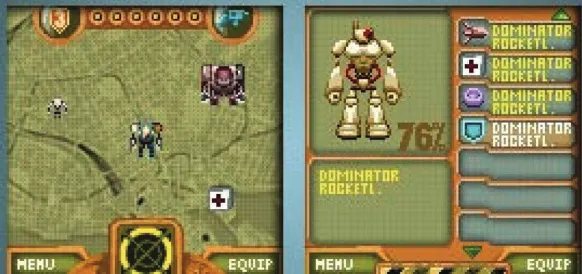
Finally, if there is no other real player around, it is possible to fight against Non-Playable Characters (NPCs), which are virtual creatures displayed in the radar by the server. NPCs have a real position in physi-cal space and every time a player logs in, she is able to see four of them. If another player is around, she is able to see the same NPCs. These virtual creatures, besides being a good source of weapons and armors once killed, also fill in empty players’ areas in the game. (See Figs. 3, 4, and 5.)
Alien Revolt’s virtual creatures resemble those of Mogi Mogi. How-ever, Mogi’s creatures inhabit spe-cific locations in the city space and sometimes just show up at certain times of the day. Moreover, unlike
Alien Revolt, Mogi’s players do not fight against each other - they trade found virtual objects and creatures in order to complete their collec-tion. Collaboration among players is also a main theme in the hybrid reality game Uncle Roy All Around You. In this game, online players might collaborate with street play-ers in order to help them find Uncle Roy’s office [4]. Online players
Figs. 3, 4, and 5. Character selection screen, game radar and combat mode. © M1nd Corporation.
inhabit a 3D map of the city where they can see the positions of street players. On the other hand, street players walk around the city and are able to see the online players’ avatars on maps representing the city on their Personal Digital As-sistants (PDAs). By inhabiting a digital environment, online play-ers have access to postcards of the city containing specific informa-tion that might help street players. Online players, however, cannot walk on the city and physically find Uncle Roy’s office. Therefore, to accomplish the game’s mission, both kinds of players should work together by sharing information that is space specific [5].
Collaboration and Community
One of the main goals of LBMGs is the creation of social mobile net-works and communities. Although
Alien Revolt is based on competi-tion among players, collaboracompeti-tion is also an important factor of the game dynamics. As generally hap-pens with massively multiplayer online role-playing game (MMOR-PGs), there are two main factions fighting against each other, but players inside these factions can (and should) act together in order to win the battles.
From this point of view, Alien Revolt, being a MMORPG, is also a collaborative game. As there are currently very few beta-testers (11), one problem faced by them is the lack of random encounters. Licoppe & Inada [1] refer to the type of encounter in which two players see each other on the screen without necessarily seeing each other physically as ”on-screen encounters.” One beta tester tells that as they all live far away from each other, the only opportunity they have to really play against real people (instead of the virtual NPCs) occurs when they schedule group meetings or one-to-one battles. Group meetings are not a foreign practice in the world of MMORPG. Games like
Everquest and Star Wars Galaxies
organize conventions and fan fests, in which players can meet face-to-face. However, apart from these or-ganized meetings, MMORPGs are generally played from home on a desktop computer. Moreover, their meetings do not belong to the cat-egory of on-screen encounter, be-cause the players actually see each other and are not only encountering other participants on their screen, depending on their position in physical space.
Some on-screen expected en-counters in Alien Revolt occur as a consequence of daily displace-ment routes through the city. For example, one beta tester tells that he studies in Copacabana (a neighborhood in Rio de Janeiro) and there is another beta tester who lives in Copacabana. There-fore, every day in the bus on the way to school he can see the other player on his radar. However, he does not choose to play while on the move, because moving targets change their size, and are there-fore more difficult to hit. He waits until the break time at school and then both have 30 minutes to bat-tle: one from home, and another one from school.
Although scheduled encounters go along with the mechanics of traditional MMORPGs, random encounters are what really encour-age gameplay in a location-based mobile game. As these games are played on the city streets, an on-screen encounter means that the players are physically close in real space, even if often both can-not see each other. In traditional MMORPGs, conversely, proximity on the screen does not mean physi-cal proximity. Random on-screen encounters are unexpected and exciting for players because they include what Lehtonen & Mäen-pää call “street sociability,” which is “the particular public form of sociality, of being at once both interested and yet indifferent and anonymous” [6, p. 156]. While
in the city, one cannot foresee whom one is going to meet or what is going to happen. “It is a question of a similar anticipa-tory expectation as in games of change: something might hap-pen” [6, p. 159].
The unexpected side of street sociability was experienced by one beta-tester, who wrote on the beta email discussion list:
“On Wednesday, before the holiday, I was playing in-side the bus in Gávea.7 I
found another player, called Maget lvl 6. At the moment the player showed up on the radar, 8 NPCs appeared as well.8 I tried to attack the
player, but the system didn’t allow me.9 I was frustrated.
After about 15 seconds, how-ever, I was in the combat screen together with Maget lvl 6, and we were fighting. I don’t know exactly what hap-pened; she must have attacked me. I killed her with three shots and I was merciful not stealing anything (there was also nothing that interested me). After the combat, every-thing went back to normal. I killed some more NPCs and they killed me, I lost a lot of experience points, which is nothing out of ordinary. It was one of the most excit-ing game experiences I’ve ever had. Beautiful!” [Mage Perereca. Sep. 10, 2006].
7Gávea is a neighborhood in Rio de Janeiro.
8As formerly explained, each player triggers the
appearance of 4 NPCs. However, if two players are close-by, their NPC’s are added. That’s why he could see 8 of them.
9The system didn’t allow the beta-tester to attack
After reading this message, the attacked player explained what happened on the email list:
“I met the alien Mage Perere-ca on Wednesday. Although I am in level 6 and he is level 13, I called him for a combat just for the sake of playing with a real player, and not with a bot. The funny thing is that he showed up on my radar unexpectedly. I was in Downtown Rio.” [Maget lvl 6. Sep. 11, 2006].
Such comments show how play-ers get excited about interacting with other real players on their screens, instead of fighting with virtual creatures. This attitude em-phasizes that location-based games are indeed about developing social relations, and not only about inter-acting with physical space. How-ever, these encounters, although exciting, are still rare in Alien Re-volt, because, as explained, there are few beta testers, and because the city of Rio de Janeiro is indeed very large,10 so people tend to live
far away from each other. A possi-ble solution to deal with the lack of on-screen encounters suggested by the game developers is to increase the radar area. In a future version, instead of showing a three-kilome-ter range, the players’ radar will show the five closest players, even if they are 1000 kilometers apart. This strategy is very similar to what happens in Mogi Mogi. In or-der to facilitate on-screen encoun-ters, the game developers included a feature that always shows the closest player on the cell phone ra-dar, even if she is outside the regu-lar radar area [1]. Increasing Alien Revolt’s radar will be especially useful because the game, as of October 2006, was released by the operator Brasil Telecom in all
fed-eration states, except in São Paulo, transforming the whole country into the game space.
Another aspect that motivates collaboration is the sense of com-munity of a game. Very early on,
Alien Revolt’s players created dis-cussion forums to connect players and share game experiences. One is the already mentioned beta-testers discussion list. The game also has a community in the so-cial network website Orkut [7], and a forum on the website, all of them created by the players. Alien Master players in Alien Re-volt also have the ability to create missions, gathering players with common interests. In this aspect,
Alien Revolt is different from Bot-fighters 2, in which the missions were placed on the game website by the game developers. Creating content for the game is a criti-cal feature of multiplayer games. Otherwise, either the game creators are forced to apply more resources to developing the game or they need to constrain the game world to a simple linear sequence of epi-sodes. To date, all beta testers per-sonally know each other, but in the future, when the number of players increases, these combat missions might contribute to strengthen the game sense of community.
Contextualizing Alien Revolt in Brazil
Although Alien Revolt was care-fully designed and programmed, the game developers face many issues when trying to increase the game’s popularity. Such issues are strictly connected to the use of mobile technologies in Brazil, and to existing socio-economic differences in the country. Bra-zil is well known for being one of the countries in the world with the greatest socioeconomic diver-sity.11 A report from the Brazilian
Institute of Applied Economic Research [8, p. 52] shows that 10% of the population owns 46% of the country’s overall income, while 50% holds only 13.3% of this amount. Moreover, the wealthiest 1% of the population (around 1.7 million people) owns the same amount as the poorest 50% of the population (about 85 million). These economic differ-ences influence the diverse use of communication technologies across the country, specifically of mobile telephones [9].
Three issues influence the pat-tern of cell phone use in Brazil. First, the large number of pre-paid phones. The majority of cell phones in the country (ca. 80%) [10] are pre-paid; that is, the user does not need to pay a monthly subscription and has the option to buy a pre-paid calling card in or-der to place calls. As Brazil adopts the calling party pays (CPP) pol-icy, by which a user only pays for the calls she places, several users only use their phones to receive calls, having therefore a type of “free phone”: a device that cannot place calls, but allows them to be always available to others. In the CPP mode, users can still receive calls, even if they choose not to buy a prepaid card.
This fact allows us to conclude that, although high-end services like Alien Revolt are available on pre-paid phones as well, the majority of users are not willing to pay for them, because they are mostly concerned about control-ling costs. One consequence of this fact is that cell phones in Brazil, unlike countries such as Finland and Japan, in which the use of SMS and mobile In-ternet is high (see [11]-[16]), are still mostly used for voice communication.
The second major influ-ence on how customers use cell phones is related to the price of the service. Although Brazil is the fifth country in the world in
10According to the Brazilian Institute of
Geogra-phy and Statistics (IBGE) (www.ibge.gov.br) Rio de Janeiro has an area of 1182 square kilometers, which corresponds to roughly 456 square miles.
11IPEA attested that according to the Gini index
absolute number of cell phones12
[17], the number of monthly minutes spoken on the mobile (Minutes of Use, MOU) is actu-ally very low compared to other Latin American countries. A financial report developed by América Móvil for the second quarter of 2006 [18] states that while Brazilians speak on aver-age 66 minutes per month on a mobile phone, Chileans talk as much as 126 minutes, Argentin-eans, 135, Mexicans, 111, and Colombians, 107.
Two reasons are potential causes of this fact. One is related to the large number of pre-paid phones, as pre-paid phone own-ers tend to speak less on their cell phones than regular subscribers, since the air minute on a pre-paid phone is more expensive. Also, as mentioned earlier, often pre-paid phone owners just use their phones to receive calls. A second cause is associated with the price of the service. Countries with higher price per wireless minutes are also those with fewer monthly spoken minutes. For example, Argentina has a relatively low price per wire-less minute (0.07 USD) and the country has one of the highest MOU in Latin America (135 min-utes). On the other hand, the cost per minute in Brazil is three times as expensive, around 0.26 USD [19], which leads to a low MOU. The high cost is not only connect-ed to spoken minutes. Services such as text messaging (SMS) and GPRS Internet connection also represent additional costs.
To play Alien Revolt, users are charged for 1) the SMS messages they send for each combat (around 0.07 real), 2) the chat messages they send to each other (around 0.15 real) and 3) the GPRS Internet con-nection from the operator (around
7 reais per MB).13 Because users
must pay for each message they send, plus the price of the GPRS connection, some players admit they gave up playing because it was becoming too expensive. A future solution to this problem includes changing the connection technol-ogy, so that the operator charges a flat rate of 9.90 reais (4.5 USD) for unlimited Internet monthly access. According to the game developers, the operators, however, are still reluctant in adopting this flat fee, fearing to loose profits.
Finally, the price of the hand-sets is another major issue that in-fluences cell phone use in Brazil. As an example, Nokia’s website [21],14 the major cell phone
pro-ducer in the country [21], does not offer a single device for less than 182 USD,15 which is just
about an entire month’s earnings for the majority of the population [9]. The IPEA report [8] shows that more than 50% of the Bra-zilean population lives with less than one minimum salary16 per
month (162 USD). As previously mentioned, as of August 2006
Alien Revolt only worked on the Nokia series 60 phones, which cost between 1399 and 2199 reais (642 and 1000 USD). The conclu-sion that necessarily comes from this fact is that the game is only available to a very small percent-age of the population. In fact, fewer than three million people in
the whole country earn more than 1700 reais a month.17
The game developers invested in at least three solutions to make the game available to a larger segment of the population. The first effort, as previously mentioned, was the re-lease of the game in other federation states, allowing high income people from other states to play as well. A second solution was the development of the game for the Nokia series 40 phones, which are substantially cheaper than the Series 60. Series 40 phones cost between 49 and 3000 reais (23 and 1380 USD), but most devices are under 200 reais (90 USD). The new game version for the Nokia series 40 phones was released in September 2006.
Finally, in an inverted Botfight-ers strategy, the developers de-cided to create an SMS version of the game, released in December 2006. The current Java version is complex and requires high-end cell phones able to run Java applica-tions. The phones must have color screens and a minimum screen resolution able to display detailed graphics. The SMS version, on the other hand, works on standard cell phones, since the only technologi-cal requirement is the capacity to send text messages and the embed-ded location aware platform.
4G: A Way of Popularizing LBS in Developing
Countries?
Development of Location Awareness
Location-based services were launched in the late 1990s, but just came to the Brazilian market in 2006. The same platform used
13One real converts to 0.56 USD (January 18,
2008).
14Like in the U.S., operators sometimes have
spe-cial deals and promotions, which include a free phone together with the purchase of a specific plan.
15The minimum salary was created in Brazil in
1936 by President Getúlio Vargas. At its incep-tion, the minimum salary was supposed to cover the basic monthly needs of a 4-person family (food and housing).
16According to the Brazilian Institute of Geography
and Statistics (IBGE), Brazil has roughly 190 mil-lion inhabitants; http://www.ibge.gov.br/home/dis-seminacao/online/popclock/popclock.php.
17“ImaHima is the Japanese expression for “are
you free now?” It is a mobile, location-integrated, community, and instant messaging service allow-ing users to share their current personal status (location, activity, mood) publicly and privately with their buddies and send picture and instant messages to them.” (1999-2004, ImaHima, Inc.) http://www.imahima.com/ihcorpv3/portfolio/ imahima.html
12As of December 2007, Brazil had roughly 121
for Alien Revolt has been used in the development of other com-mercial applications, such as Oi Encontra (Oi Encounter), a ser-vice that allows users to find each other. By typing a cell phone num-ber on the mobile screen, users can see on a 2D map the location of the requested cell phone. The service, however, does not allow the tracking of ALL cell phones. In order to be tracked, each user must register and authorize being tracked by certain numbers, at specific times.
Perhaps location awareness is the most relevant feature of the cell phone in defining how mobile interfaces can influence our inter-action with other users and with the space we inhabit. When a mo-bile interface knows where it is in physical space it automatically ac-quires a different meaning from a fixed telephone and from a desktop computer, since one of its key func-tions becomes navigation in physi-cal space. Internet capability added to location awareness, as it happens in applications such as Alien Revolt
and Oi Encontra, allows users to develop a unique relationship to physical space, as well as to the Internet, since digital information can be linked to physical locations. Location-based services are likely to change what is understood by a mobile phone, since users will no longer employ their phones only to talk, but also to locate things in physical space, including oth-er people. Consequently, mobile phones start to be used as social networking devices.
Currently location-based ser-vices are being developed for ap-plications oriented in two comple-mentary directions: 1) linking information to places, and 2) the creation of social mobile networks and interpersonal communication.
The first trend involves what Barkhuus and Dey [22] call posi-tion-aware applications, by which the device knows where it is in public spaces and is therefore
able to receive geo-localized in-formation. Examples of position aware applications are Siemen’s
Digital Graffito and GeoVector applications. Digital Graffitto is a service for the mobile phone that allows SMS messages to be sent to places, instead of people. When messages are attached to coordinates in physical space, us-ers can receive them when enter-ing a specific geographical area. Possible uses for this software include, for example, sending a message to an area in a shopping mall to announce to passersby who subscribed to the “shopping mode” that some stores are having sales, as well as tourism applica-tions. The use of location-aware SMS might expand the audio-tour concept, currently restricted to closed museum spaces, to larger outdoor spaces. For instance, tourists visiting old ruins might receive site-specific historical in-formation about monuments just by approaching them. GeoVector is a local search technology that allows users to use their mobile phones as pointing devices in physical space, in order to check and get directions to nearby res-taurants and movie theaters. Lo-cation-aware services have been growing since NTT DoCoMo launched DoCo-Navi in 1999 in Japan, providing real-time maps and directions on handheld de-vices [23, p. 97].
The second trend includes what Licoppe and Inada call an engi-neering of traffic encounters, by which “the terminal projects a digi-tal “aura” over a short distance, so that when the terminal projecting a compatible profile passes close by, information can be exchanged [1, p.
40]. Such applications fall within Barkhuss and Dey’s [22] concept of location-tracking, since they allow other parties to be aware of somebody else’s mobile technology physical position. They include in-terpersonal awareness devices, like the Japanese LoveGetty [24].
Also included in this category are applications that mix mobility in physical space with mobility on the mobile screen. Such applications represent an area of activity acces-sible on mobile screens, where the users’ positions are directly related to their real position in space [1, p. 40], as it occurs with software such as ImaHima18 in Japan, a type of
location-based instant messenger (LBIM), and LBMGs, such as Mogi Mogi [1], Can You See Me Now?
[3], Uncle Roy All Around You [4],
Botfighters and Alien Revolt. Such games and applications allow people to find each other and to connect to each other according to their move-ment in physical space.
Location-based applications are be-coming popular around the world, especially in Japan and Scandina-vian countries, and many believe they will constitute a critical com-ponent in the future of advanced mobile services [1, p. 39], especial-ly in the development of collabora-tive applications and mobile social networks. However, it is worth ask-ing how LBS will become popular in developing countries such as Brazil, given the afore-mentioned difficulties with price of the ser-vice, handsets, and access to the mobile network.
Other examples of Flash Mobs are
public pillow fights, and the worship
of a gigantic Tyranosaurus Rex in
Toys “R” Us.
18Other examples of Flash Mobs are public pillow
Envisioning 4G in Developing Countries
Location awareness by itself is not very useful for creating social mo-bile networks without the proper ability to connect to the Internet and to develop peer-to-peer net-works. Investments on 4G mobile networks in developing countries might represent a two-fold solu-tion to the popularizasolu-tion of mo-bile social networks, such as the ones found in LBMGs, via 1) the inclusion of location awareness in a large number of mobile devices, and 2) the increasing access to Internet connection and P2P net-works through diverse interfaces.
As formerly stated, the main problem in Brazil is not a lack of availability of high-end services, but rather their price and accessi-bility. We have seen that Alien Re-volt faced many issues due to the status of mobile technologies in the country, especially due to prices of the service and handsets. Likewise, services like Oi Encontra will only be largely used when devices enabled to run it become more af-fordable, along with the price of the Internet connection.
Short-term solutions to these problems, as proposed by Alien Re-volt’s developers, include 1) a lower price GPRS Internet connection, and 2) the development of simpler versions of location-based applica-tions for low-end users. Negotiaapplica-tions with cell phone operators are under-way in order to charge customers a flat monthly fee for Internet access. This solution would lower the price of the service and motivate com-mon users to try location-based ap-plications. The second solution pro-posed by M1nd Corporation is the development of two versions of the same product, one targeting high-end consumers and another one for simple devices. For example, M1nd Corporation and Oi developed an application that allows customers to log in to the website of the Municipal Agency for Traffic Management in Rio de Janeiro (CET-Rio) and check
out the traffic during rush hours through live videos of street cameras spread out the city. Simultaneously, they also developed a low-end ver-sion for simpler cell phones, in which instead of checking live videos, the user downloads snapshots. Similar solutions can be developed for LBS, as is the case of the SMS version of
Alien Revolt and the new version for the Nokia Series 40 cell phones.
However, a long-term solution will most likely include invest-ments in 4G networks. We have seen that LBS in Brazil have been developed on a 2.5G network over a GPRS Internet connection. Vivo, the major operator in the country, has been announcing the release of 3G services for more than two years as of July 2007, but the pro-posed high-speed network, be-sides only working in extremely expensive cell phones, is restrict-ed to few areas in Rio de Janeiro and São Paulo. This difficulty in both developing the technology and popularizing the service in-dicates that the future of mobile social communities and location-based applications is not tied to the development of 3G systems related to cellular structures.
According to Frattasi et al., “it was originally expected that the fourth generation (4G) would follow sequen-tially after 3G and emerge between 2010 and 2015 as an ultra-high-speed broad-band wireless network” [25, p. 35].
However, this linear 4G vision
is being replaced by what the Euro-pean Commission calls a concur-rent 4G vision. This type of sys-tem will “ensure seamless service provisioning across a multitude of wireless systems and provide an optimum delivery via the most ap-propriate (i.e., efficient) network available” [25, p. 35].
The diversity of networks and connection technologies might
represent a real chance for develop-ing countries to finally introduce popular high-end services. Among many envisioned advantages of 4G networks (see [25] –[27]), four might be specifically relevant for countries such as Brazil:
1) Cost:
“4G systems will prove far cheaper than 3G, since they can be built atop existing networks. (…) Also an open system IP wireless environ-ment would probably further reduce costs for service pro-viders by ushering in an era of real equipment interoper-ability” [27, pp. 2317-2318]. Currently, the cost of the ser-vice is one of the main reasons why high-end location-based applica-tions are not popular in Brazil.
2) Network availability: 4G will combine existing 2G wireless net-works, local area networks (LANs), Wi-Fi, Wi-Max, and P2P networks, like Bluetooth, taking advantage of the infrastructure that is already developed, rather than creating an entirely new standard, as is the case of 3G UMTS. The use of diverse net-work connections will most likely include more users in the connection network, which will not depend sole-ly on the expensive GPRS or UMTS standards. Consequently, more users will have access to the Internet and to other users.
3) Terminal heterogeneity: Ac-cording to Frattasi et al.,
“terminal heterogeneity refers to the different types of termi-nals in terms of display size, energy consumption, portabil-ity / weight, complexportabil-ity and so forth” [25, p. 37].
phones, computers, Personal Digi-tal Assistants (PDAs), and cars. We have seen that one of the main prob-lems for the popularization of high-end services in Brazil is the price of the cell phone. Furthermore, as is the case with Alien Revolt, only specific expensive cell phones can be used for certain high-end ap-plications. The availability of more types of devices able to access the network increases the chances that users own at least one of these in-terfaces. However, as Frattasi et al. point out, the mobile phone is still expected to be one of the most popular devices to access the net-work [25, p. 40]. Currently, the prices of handsets in Brazil are dropping and many operators, as it occurs in the United States, offer devices for free with a subscription plan. Furthermore, some initiatives are being taken to fill in this gap. For instance, Philips is negotiating with mobile phone producers for the release of a device for less than 20 dollars, directly targeting the low-income population [28].
4) Finally, location awareness can be accomplished in three dif-ferent ways in 4G networks: IP location, outdoor location, and in-door location. According to Santhi
et al.,
“In 4G-style mobile IP, each cell phone is assigned a per-manent “home” address, along with a “care-of” ad-dress that represents its ac-tual location” [27, p. 2319]. Outdoor location awareness might be accomplished by embed-ding a GPS receiver in the user ter-minal. Additionally, indoor local-ization “which is important in order to provide, for instance, the guided tour in a museum, requires the coop-eration of short range wireless net-works” [25, p. 40], like Bluetooth, or Wi-Fi. The combination of these three types of location awareness will turn LBS in an integral part of 4G services and applications.
Frattasi et al. [26, pp. 60-61] point out that 4G services have strong social dimensions allow-ing enhanced services with P2P networks, and cooperative ser-vices, such as group building, social networks, and cooperative resource sharing. Besides helping to popularize LMBG, the devel-opment of 4G might prove helpful for fostering other types of social mobile networks in developing countries. For example, the phe-nomenon known as Flash Mobs, in which groups of people coor-dinate an innocuous and pointless public demonstration via SMS, also took place in Brazil. In 2004, a group of people suddenly gath-ered in Avenida Paulista, one of the main avenues in São Paulo. While crossing the street, they took out their shoes and repeated-ly beat them on the ground [29]. The manifestation, however, was an isolated act, with no follow-ups. Moreover, the gathering was mostly organized via Internet, not cell phones, as it generally occurs. With 4G networks, mobile de-vices might start playing a more relevant role in organizing people in public spaces, as in Flash and Smart Mobs [23].
A second example where the development of 4G services might motivate the creation of location-aware social networks is based on the popularity of social networking websites in the country. Following the trend of online communities such as MySpace and Facebook, Orkut became the most popular so-cial networking website in Brazil. More than half Orkut’s user profiles belong to Brazilians. Although the website appeals mostly to teenagers and young adults, the phenomena
in the country is not restricted to these segments of the population; and it includes people from all ages — as long as they have access to an Internet connection [30]. How-ever, Internet connections are even scarcer than the number of cell phones in the country, a fact that will always exclude a large segment of the population from belonging to such communities. Given this sce-nario, we might suggest that the de-ployment of 4G technologies, with terminal heterogeneity and net-work availability, might contribute to transform social online networks into mobile communities, such as the afore-mentioned ImaHima. Such communities would not only help people to meet online, but also to use their cell phones to organize themselves in public spaces.
Location-Based Services, 4G, and Hybrid Spaces
LBS might be an important part of the future of mobile technologies by linking information to spaces and connecting people in physical spaces. However, when consider-ing the development of mobile so-cial networks in developing coun-tries, a broader perspective should be addressed, which includes LBS in the context of 4G networks. This approach focuses not only on the creation of new LBS, but ad-dresses the main issues that inhibit popularity of mobile communities in developing countries: price of the service, price of the handset, and network availability. Through the case study of the first Brazilian LBMG, Alien Revolt, we have seen that in countries like Brazil, price policies speak louder than tech-nological issues. Nevertheless, the development of Alien Revolt
shows that Brazil is included in a new trend of mobile technologies development, which involves geo-localized information attached to the mobile device, and the develop-ment of 3G networks. However, this paper proposed that a real change in the way technology is used will possibly come with the develop-ment of 4G networks.
By its increasing ability to connect groups of people across the networks, 4G communication technologies (in-cluding cell phones) will be regarded as more than private two-way voice communication devices. The con-cept of social collective interfaces will come from the users’ ability to interact with each other in physical spaces. As multi-user games, LB-MGs relocate previous MMORPGs to be played in urban hybrid spaces, creating a hybrid communication space that includes physical and on-line spaces. I refer to this new spatial perception as hybrid spaces.
Author Information
Adriana de Souza e Silva is an As-sistant Professor in the Department of Communication, North Caro-lina State University, 201 Winston Hall, Campus Box 8104, Raleigh, NC 27695-8104. She is also direc-tor of the Mobile Gaming Reseach Lab, and a faculty member of the Science, Technology and Society Program at NCSU. Email: [email protected].
References
[1] C. Licoppe, and Y. Inada, “Emergent uses of a multiplayer location-aware mobile game: The interactional consequences of mediated encounters,” Mobilities, vol. 1, pp. 39-61, Mar. 2006.
[2] T. Söderlund, “It’s alive,” Wireless Rev.
Nov. 2001; http://wirelessreview.com/data-apps/wireless_tom_sderlund/.
[3] S. Benford, R. Anastasi, A. Flintham, A. Dozd, A. Crabtree, C. Greenhalgh, et al.,
“Coping with uncertainty in a location-based game,” IEEE Pervasive Computing, vol. 2, pp. 34-41, Jul.-Sep. 2003.
[4] S. Benford, M. Flintham, A. Drozd, R. Anastasi, D. Rowland, N. Tandavanitj, M.
Adams, J. Row-Farr, A. Oldroyd, and J. Sut-ton, “Uncle Roy all around you: Implicating the city in a location-based performance,”
Proc. ACM Advanced Computer Entertain-ment (ACE 2004). Singapore: ACM, Jul 2004; http://www.amutualfriend.co.uk/papers/3. Uncle_Roy_at_ACE.pdf.
[5] A. de Souza e Silva and G. Delacruz, “Hy-brid reality games reframed: Potential uses in educational contexts,” Games and Culture,
vol. 1, pp. 231-251. Jul. 2006.
[6] T. K. Lehtonen, and P. Mäenpää, “Shop-ping in the East Centre Mall,” in The Shop-ping Experience, P. Falk and C. Campbell, Eds. London, U.K.: Thousand Oaks, and New Delhi: Sage, 1997, pp. 136-165.
[7] Orkut, Google, 2008; http://www.orkut. com.
[8] IPEA (Brazilian Institute of Applied Eco-nomic Research), Radar Social 2005. Brasí-lia, Brazil, 2005; http://www.ipea.gov.br/De-staques/livroradar/03.renda.pdf.
[9] A. de Souza e Silva, “Cell phones and places: The use of mobile technologies in Brazil,” in Societies and Cities in the Age of Instant Access, H. Miller, Ed. New York, NY: Springer-Verlag, pp. 295-310.
[10] Teleco: Informação em Telecomunica-ções, “Por que se fala pouco no celular no Brasil,” Seção: Comentários Teleco, Sept. 2006; http://www.teleco.com.br/comentario/ com174.asp.
[11] R. Ling, The Mobile Connection: The Cell Phone’s Impact on Society. San Fran-cisco, CA: Morgan Kaufmann, 2004.
[12] E.L. Kasesniemi, and P. Rautiainen, “Mo-bile culture of children and teenagers in Fin-land,” in Perpetual Contact: Mobile Commu-nication, Private talk, Public Performance, J. Katz and M. Aakhus, Eds., Cambridge, U.K.: Cambridge Univ. Press, 2002, pp. 170-192.
[13] R. Ling, and B. Yttri, “Hyper-coordina-tion via mobile phones in Norway,” in Per-petual Contact: Mobile Communication, Pri-vate Talk, Public Performance, J. Katz and M. Aakhus, Eds. Cambridge, U.K.: Cambridge Univ. Press, 2002, pp. 139-169.
[14] C.A. Rivière, and C. Licoppe, “From voice to text: Continuity and change in the use of mobile phones in France and in Japan,” in
The Inside Text: Social, Cultural and Design Perspectives on SMS, R. Harper, L. Palen, and A. Taylor, Eds. The Netherlands: Springer, 2005, pp. 103-126.
[15] M. Ito, and D. Okabe, “Intimate con-nections: Contextualizing Japanese youth and mobile messaging,” in The Inside Text: Social, Cultural and Design Perspectives on SMS, R. Harper, L. Palen, and A. Taylor, Eds. Netherlands: Springer, 2005, pp. 127-146.
[16] T. Kopomaa, “The breakthrough of text messaging in Finland,” in The Inside Text: Social, Cultural and Design Perspectives on SMS, R. Harper, L. Palen, and A. Taylor Eds. Netherlands: Springer, 2005, pp. 147-160.
[17] Teleco: Informação em Telecomuni-cações, “Estatísticas de celular no mundo,”
Seção: Telefonia celular, Sept. 2006; http:// www.teleco.com.br/pais/celular.asp.
[18] C. Garcia-Moreno and P. A. Gérard, “América Móvil’s second quarter of 2006 fi-nancial and operating report,” América Móvil, S.A. de C.V. (“America Móvil”) [BMV: AMX] [NYSE: AMX] [NASDAQ: AMOV] [LATI-BEX: XAMXL], Mexico City, Jul. 2006; http://www.americamovil.com.
[19] Teleco: Informação em Telecomunica-ções, “Preços e tarifas do cellular,” Seção: Telefonia celular, Aug. 2006; http://www. teleco.com.br/tarifacel2.asp.
[20] Nokia-submarino; http://nokia.subma-rino.com.br/nokia/.
[21] Teleco: Informação em Telecomunica-ções, (2006c, Jan. 25). “Celular cresce 20,6 milhões e tem produção recorde em 2005,” Jan. 2006; http://www.teleco.com.br/impri-mir.asp?pagina=/comentario/com140.asp.
[22] L. Barkhuus and A. Dey, “Location-based services for mobile telephony: A study of users’ privacy concerns,” in Proc. IN-TERACT 2003, 9TH IFIP TC13 Int. Conf. Human-Computer Interaction, July 2003; http://intel-research.net/Publications/Berke-ley/072920031046_154.pdf.
[23] H. Rheingold, Smart mobs: The next social revolution. Cambridge, MA: Perseus, 2002. [24] Y. Iwatani, “Love: Japanese style,” Wired News, Nov. 1998; http://www.wired.com/ news/culture/0,1284,12899,00.html.
[25] S. Frattasi, S., H. Fathi, F. Fitzek, R. Prasad, and M. Katz, “Defining 4G technol-ogy from the user’s perspective,” IEEE Net-work, vol. 20, pp. 35-41, Jan.-Feb. 2006. [26] S. Frattasi, H. Fathi, A. Gimmler, F. Fitzek, and R. Prasad, “Designing socially robust 4G wireless services,” IEEE Technology & Society Mag., vol. 25 pp. 51-64, Sum. 2006.
[27] K. Santhi, V. Srivastava, G. SenthilKuma-ran, and A. Butare, “Goals of true broadband’s wireless next wave (4G-5G),” in Proc.IEEE 58th Vehicular Technology Conf. (VTC), vol. 4, pp. 2317-2321.
[28] O Globo. “Celulares a menos de US$ 20?,” Informática, Nov. 2005.
[29] Internet Group, “Primeiro “flash mob” do Brasil tem pés descalços e ode ao MP3,”
Último Segundo; http://ultimosegundo. ig.com.br/materias/mundovirtual/1302501-1303000/1302842/1302842_1.xml.
[30] S. Fragoso, “Eu odeio quem odeia... Consideraçoões sobre o comportamento dos usuarios brasileiros na `tomada’ do Orkut,”