COMPARATIVE ASSESSMENT OF ROAD NETWORK TRIP
DISTRIBUTION USING GROWTH FACTOR AND GRAVITY MODELING TECHNIQUES
AMIR HOSSEIN PAKSHIR
A project report submitted in partial fulfillment of the requirements for the award of the degree of Master of Engineering (Transportation and Highway)
Faculty of Civil Engineering Universiti Teknologi Malaysia
iii
DEDICATION
To my beloved mother and father
iv
ACKNOWLEDGEMENTS
I would like to express my deep gratitude for the constant guidance and support from my supervisor, Professor Johnnie Ben-Edigbe, during the course of my graduate study. His insight, suggestions and criticism contributed in large measure to the success of this research.
v
ABSTRACT
Growth factor and gravity model techniques are useful in sequential forecasting of ravel demand on any road network. Both have commonalities in terms of independent parameters, however, growth factors relies on historic growth rate for prediction while gravity model relies on socio-economic variables or friction factor. Trip distribution is an iterative procedure. Based on the data from recent trip generation study in Skudai town, Malaysia, the number of trips generated by one zone and attracted to another zone would be computed using both the growth factor and gravity model techniques. The outcomes would then be compared and contrasted. It is hoped that the project would shed light on the advantages and disadvantages of these technique, in essence point to the appropriate method employable in a given situation.
vi
ABSTRAK
Faktor Pertumbuhan dan teknik graviti model yang berguna dalam meramalkan berurutan permintaan berlepasan pada setiap rangkaian jalan. Keduanya mempunyai persamaan dalam hal parameter bebas, bagaimanapun, faktor pertumbuhan bergantung pada laju pertumbuhan bersejarah bagi ramalan sedangkan model graviti bergantung pada pembolehubah-pembolehubah sosial-ekonomi atau faktor gesekan. Trip edaran merupakan prosedur iterasi. Berdasarkan data dari generasi perjalanan kajian baru-baru ini di bandar Skudai, Malaysia, jumlah perjalanan yang dihasilkan oleh satu zon dan zon lain yang tertarik akan dikira menggunakan kedua-dua faktor pertumbuhan dan teknik graviti model. Keputusan kemudian akan dibandingkan dan perbezaan. Diharapkan bahawa projek akan menjelaskan keuntungan dan kerugian dari teknik ini, di titik intinya dengan kaedah yang tepat dipekerjakan dalam suatu situasi tertentu.
vii
TABLE OF CONTENTS
CHAPTER TITLE PAGE
DECLARATION OF THE STATUS OF THESIS
SUPERVISOR’S DECLARATION
TITLE PAGE i
DECLARATION ii
DEDICATION iii
ACKNOWLEDGEMENTS iv
ABSTRACT v
ABSTRAK vi
TABLE OF CONTENTS vii
LIST OF TABLES xii
viii
LIST OF APPENDICES xvi
1 INTRODUCTION 1
1.1.Background 1
1.2.Need Of the Study 3
1.3.Purpose Of the Study 4
1.4.Objectives Of the .Study 5
1.5.Scope Of the Study 5
1.6.Significance Of the Study 6
1.7.Proposed Research Methodology 6
2 LITERATURE REVIEW 7
2.1Introduction 7
2.2Transportation Planning Process 8
2.2.1 Sketch Tool 11
2.2.2 Traditional Tools 11
2.2.3 Micro-Analysis Tools 12
ix
2.3.1 Trip Matrix 18
2.3.2 Growth Factor Technique 20
2.3.2.1 Uniform Growth Factor 20
2.3.2.2 Average Factor Method 21
2.3.2.3 Fratar Method 22
2.3.3 Gravity Model 23
2.4Vehicle Growth in Malaysia 26
2.5Summary 29
3 RESEARCH METHODOLOGY 30
3.1Introduction 30
3.2Study Area 31
3.3Data Collection 32
3.3.1 Existing Inventories 33
3.3.2 Zoning System 33
3.4Survey Procedure 37
x
3.4.2 Origin and Destination Interview Survey
39
3.4.3 Household Survey 39
3.4.4 Questionnaire Design 42
3.5 Analysis of Data 42
3.6 Methodology in Trip Distribution Estimation 43
3.6. 1 Growth factor 44
3.6.1.1 Trip Matrix 44
3.6.1.2 Relative Growth Rate 45
3.6.1.3 Fratar Technique 45
3.6. 2 Gravity Model 48
4 RESULT AND DISCUSSION 52
4.1 Introduction 52
4.2 Trip Distribution 54
4.3 Trip Distribution based on Growth Factor 56
4.3. 1 Population Growth 56
4.3.1.1 Relative Population Growth among 2000-2005
xi
4.3.1.2 Relative Population Growth among 2005-2009
58
4.3.1.3 Relative Population Growth among 2009-2014
59
4.3.1.4 Average Relative Population Growth
60
4.3. 2 Fratar Technique 61
4.4 Gravity Model 66
4.4.1 Travel Time 66
4.4.2 Friction Factor 67
4.4.3 Socio-Economic Factor 68
4.5. Discussion 74
4.6. The Way Forward 77
5 CONCLUSION 80
xii
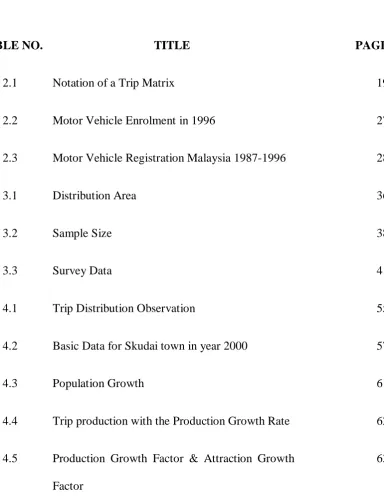
LIST OF TABLES
TABLE NO. TITLE PAGE
2.1 Notation of a Trip Matrix 19
2.2 Motor Vehicle Enrolment in 1996 27
2.3 Motor Vehicle Registration Malaysia 1987-1996 28
3.1 Distribution Area 36
3.2 Sample Size 38
3.3 Survey Data 41
4.1 Trip Distribution Observation 55
4.2 Basic Data for Skudai town in year 2000 57
4.3 Population Growth 61
4.4 Trip production with the Production Growth Rate 62
4.5 Production Growth Factor & Attraction Growth
Factor
xiii
4.6 Trip Distribution with the Growth Factor of
Production and Attraction
64
4.7 Multiple of Attraction Growth in each cell 64
4.8 Multiple of Production Growth Factor in each cell 65
4.9 Trip Distribution based on Fratar Technique in
2014
65
4.10 Travel Time 67
4.11 Friction Factors versus Travel 68
4.12 Friction Factors among Zones 69
4.13 Production and Attraction 69
4.14 Multiply of each Attraction cell to Friction Factor
and Socioeconomic Factor of each cell
70
4.15 Gravity model for the first iteration 70
4.16 Modify Attraction Value 71
4.17 Multiply of each Attraction cell to Friction Factor
and Socioeconomic Factor of each cell
xiv
4.18 Gravity Model for Second Iteration 73
4.19 Number of Trips Distribution Zonal Interchange
based on Gravity Model in 2014
xv
LIST OF FIGURES
FIGURE NO. TITLE PAGE
2.1 Transportation Planning Process 10
2.2 Planning Tools Relationship 12
2.3 Four Steps of Transportation Planning
Process
14
3.1 Fratar Method 47
xvi
LIST OF APPENDICES
APPENDIX TITLE PAGE
A Study Area 85
B Number of Houses 87
C Sample Size 93
D Survey Data 116
E Residential Household Survey Form 142
F Trip Generation 144
G
Trip Distribution based on Singly Uniform
Growth 152
H Trip Distribution based on Average Growth
Factor
1
CHAPTER 1
INTRODUCTION
1.1. Background
Urban congestion is one of the most significant and critical problems that is happened in most of large cities especially in developing countries. This may include the high urbanization and increase in the number of vehicles, quickly population growth, enhancing income, inefficient public transportation, and etc especially in most Asian developing countries that is lead to affect of increasing urbanization and motorization. Delay, congestion, environmental pollution and vibration are some of the problems.
Transportation has played a major function in the human race. The first
necessary for transportation has been financial, travel to search food or work, travel for exchange of goods, exploration, personal fulfillment, and to make better of a populace or a country.
2
with all relevant groups, and struggle to identify and implement a suitable plan to meet these needs.
Two important factors which influence the Modern Civilization are urbanization and industrialization. Urbanization attracts the extra labor from rural
areas and uses it runs the various services which are critical for the living of city.
With the development of cities, the need for a sufficient and adequate transport network also increases. The responsibility of transport network to the high demand goes to shifting of activities at the edges of the city where load is still favorable and transportation capacity is available for any movement of people and goods. Therefore, the performance of transportation can be distinguished, but as mentioned above, it develops worried about over congestion, physical deteriorating, accident and etc. current raise momentous issues for transportation planners.
Accordingly, urban transportation planning is a series of acts that drive to the future of the region travel in the terms of environmental resources, policy and program that is directly dependent on the prediction of future of travel demand. Transportation planning process can be lead to arrange supply for the long-range transportation pattern and transportation planning is used to all area that has the population over 50,000. By focusing travel characteristics, exactly identify to forecast how many trips will be produced, where they will attract, with which mode of transport system and also by which specific route. Therefore, travel demand
determines quantity of travel on transportation system and provides useful information on the amount and location of future activity. In addition travel demand could say the amount of the reduction in car use which would happen in response to a new taxation policy of Central Parking Area. On the whole, transportation planning can be affected by population, land use, travel, economic activity, financial and transportation system value.
3
if the condition also remains expanding in progression as before. In addition, increased accordingly, as a developing country, the growth of the economy of the country in terms of technology, engineering and other developments, requirements of experts are necessary in the direction of population, facilities, equipment and infrastructures that including transport and transport networks.
However, proportionately attentions to parking and transportation issues were placed in Skudai town. Such issues are necessary as future guideline in transportation are exposed to and affected by these transport systems. Therefore, in this study, Skudai town is selected because it is one of the fastest growth cities in Malaysia.
1.2. Need Of the Study
The critical affects of developing urbanization and increasing traffic, is congestion on street. The requirement results in focus traffic demand, both in time and space. Space is unbearable in some areas of city. Congestion results in delay and time losses which lead to driver stresses. In fact, the need for transport planning largely taken for granted.
4
distribution is depended on trip production, trip attraction, travel time, travel time factors, socio-economic variables and growth rate.
As mentioned above, trip distribution model is used to predict where the trip will be attracted. Modeling trip distribution is a challenging task, because Different
modeling technique often results in different outcomes, so it is important to assess the merits and demerits of the two well established modeling techniques for trip distribution (average growth factor and gravity model) and one that is required for rational planning and evaluation of transportation systems in the area of study. Without a proper planning of distribution trips among the zones will cause of a lot unwanted transport issues such as delay, lack of parking space and green zones, environmental pollution might be raised.
This study focuses on two techniques of analyzing trip distribution: growth factor which is related to historic growth rate to prediction and gravity model that is depended on socio-economic variables and friction factor.
1.3. Purpose Of the Study
The purpose of the study is to compare average growth factor and gravity
5
1.4. Objectives Of the Study
The purpose of the study is to assess comparatively growth factor and gravity modeling methods based on trip generation data from Skudai Town Malaysia. In other to achieve that, the following objectives are set:
1. Determine Trip Distribution Matrix of Skudai town based on Growth Factor using historic growth rate from previous studies.
2. Determine Trip Distribution matrix of Skudai town based on Gravity Model Method.
3. Compare Outcomes from both Methods
1.5. Scope Of the Study
The main focus of this study is on the considering of distribution production and attraction of Skudai town based on the growth factor technique and gravity model. Furthermore to accomplish the foregoing objectives, the scope of the study is defined to include following:
To provide valid knowledge of land use and number of population growth; To provide current traffic and transport system available and policy
establishment;
To verify trip distribution among the zoning areas within the boundary of
study area based on the growth factor that is depended on the historical growth rate and origin-destination trip matrix;
To verify trip distribution among the zoning area based on the gravity model
6
1.6. Significance Of the Study
Trip distribution is one of the important parts in transportation planning process. It can be used to forecast the land use, economic, travels, growth rate, travel time, socio-economic variable and impedance factor. By forecasting trip distribution
can forecast the modal choice and trip assignment.
1.7. Proposed Research Methodology
This proposed study intends to consider the distribution of trips that are produced in one area (origin zone) and attracted to another zone (destination zone) in the terms of trip production, trip attractions, population growth, travel time, accessibility, travel times factors and socioeconomic variables.
Methodology of this study based on the four fundamental steps which consist of data collection, survey, analysis and model building phase; a forecasting phase, and an estimation phase. In order to form of a transportation model, there is a usual fundamental approach which can be implemented to all forms of transportation planning, involving planning for local transport policy.
82
References
Alan, M. Voorhees (1956). A General Theory of Traffic Movement, 1955 Proceedings. Institute of Traffic Engineers, New Haven, Connecticut.
Allen, B. (1984). Trip Distribution Using Composite Impedance. Transportation Research Record 944 pp. 118–127.
Ben-Akiva M. and Lerman S. (1985). Discrete Choice Analysis. MIT Press, Cambridge MA.
Burton, M. J. (1985). Introduction to Transportation Planning. Third ed. London: Hutchinson & CO.Ltd.
Cochran, W.G (1977). Sampling Techniques. Third ed. Canada: John Willey & Sons.
Coombe, D. (1996). Induced Traffic: What Do Transportation Models Tell Us? Transportation.23. 83-99.
Hansen, W. G. (1959). How accessibility shapes land use. Journal of the American Institute of Planners, 25(2), 73–76.
Heanue, Kevin E. and Pyers, Clyde E. (1966). A Comparative Evaluation of Trip Distribution Procedures.
Highway Capacity Manual (2000). National Research Council Washington, D.C. United State Customary Units.
Institute of Transportation Engineering (1991). Trip Distribution. fifth ed.
Washington D.C.: Institute of Transportation Engineering.
83
Johnnie Ben-Edigbe (2009). Traffic and Transport Planning, MAP 1043 Department of Geotechnics and Transportation, Faculty of Civil Engineering, Universiti Teknologi Malaysia.
John W. Dickey (1975). Metropolitan Transportation Planning. second edition.USA
Lane, R., Powell, T. J. and Smith, P. P. (1971). Analytical Transport Planning. London: Gerald Duckworth and Company Limited.
Levinson, D. and A. Kumar (1994). The Rational Locator: Why Travel Times Have Remained Stable, Journal of the American Planning Association, 60:3 319–332.
Levinson, D. and Kumar A. (1995). A Multi-modal Trip Distribution Model. Transportation Research Record. 1466: 124–131.
Martin Rogers, (2003). Highway engineering “trip distribution” first ed. USA
Mc Graw- Hill (2004). Handbook of Transportation Engineering. USA
Meyer, M. D. and Miller E. J. (2001). Urban Transportation Planning. Second Edition. Singapore: McGraw-Hill.
Nicolas J. Garber, Lester A. Hoel (2009). Traffic and Highway Engineering, Trip Distribution. fourth edition, USA: Thomson Learning Academic resource centre.
Oppenheim, N. (1995). Urban Travel Demand Modeling. Canada: John Willey and Sons.
Reilly, W.J. (1929). Methods for the Study of Retail Relationships. University of Texas Bulletin No 2944, Nov. 1929.
84
Stewart, J.Q. (1948). Demographic Gravitation: Evidence and Application. Sociometry Vol. XI Feb.–May 1948 pp 31–58.
Transportation Planning Handbook (1992). Institute of Transportation Engineers, Prentice-Hall.
U.S. Department of Transportation (1977). Federal Highway Administration Urban Mass Transportation Administration.
Wells, G. R. (1975). Comprehensive Transport Planning. London: Charles Griffin and Company Ltd.