ORGANIZATIONAL MEMORY INFORMATION SYSTEM CASE STUDY IN FACULTY OF COMPUTER SCIENCE &
INFORMATION SYSTEM, UTM
Azizah Abdul Rahman Saidatul Rahah Hamidi
University Technology of Malaysia, Malaysia. [email protected]
The paper’s purposes IS to evaluate the need for organizational memory information system (OMIS) in Faculty of Computer Science and Information System to improve academic management. Approach adopted in this research is to implement OMIS characteristics. After examining few models of organizational memory in literature review, OMIS characteristics is identified for implementation and success factor model to assess the OMIS. There are three possible forms of OMIS, namely paper documents, computer documents and self-memory. IT-based memory is quasi-permanent; knowledge is logged, indexed, secured and organized in such a way that it becomes accessible. IT contributes to organizational memory in at least two ways; by making accumulated knowledge accessible to organization members or by making individuals with knowledge known. OMIS could be achieved by effectively applying framework of OMIS, which include elements of individual, culture, transformation, structure, ecology, external environment, computer based information system and non-IT record and files. This paper indicates that there are 5 blocks of success factor to evaluate OMIS implementation; system quality, information quality, success measure in terms of usage, individual impact and organizational impact. The research is proposed as a prototype to be implemented for the whole module of FSKSM in order to protect their intellectual capital and optimizing the efficiency by managing organizational memory. The paper provides details of solution to academic management on the approach to making organizational memory information system work in practice. The approaches to manage memories in the model have yielded a number of benefits as demonstrated by a case study. This work will be beneficial to researchers and practitioner who are interested in applying OMIS in organization.
Which is inefficient organization will re-do process and research to the same area for the same problem or situation. Besides, this lack of memories due to staff replacement can cause a “corporate amnesia” (Borghoff and Pareschi, 1998; Kransdorff, 1998). As a result, we need to construct an Organizational Memory (OM).
OM is defined as a method for acquisition, retention, retrieval and knowledge accessible for organizational purposes (Walsh and Ungson, 1991). OM also called “corporate knowledge” or “corporate genetic” by Pralahad and Hamel (1994) and “corporate memory” by Annie (1999). Rose et al. (1998) also use the term “corporate memory” for knowledge repository that being used as a knowledge management tool.
In this paper, we will discuss about OMIS background and its’
implementation towards a case study in FSKSM. The case study will focus to Unit of Academic Management. As a year past by, data, information and knowledge had increased, then became wasted memories due to retired staff, died or replace to another department. This could give great impact when intellectual property did not being used wisely especially as competitive
advantage element. Therefore, there is a need to manage memories accordingly. Otherwise, time, money and energy are wasted when the same task, research and findings need to be done repeatedly.
Literature Review Organizational Memory
Organizational memory (OM) is one of main component in organizational learning environment but limited to it’s’ concept. Basically, OM is organized from two artifacts which is mental and structure. Data, information and knowledge will perform as mental. Otherwise structure involves process or knowledge creation. However, OM can be assign as repositories of knowledge for future use. Besides that, it can store not only raw data or information but also the meaning of it. Then, because of this benefit awareness, information technology (IT) had been seen as a mechanism for better utilization in OM. Computer base system can give information automatically in shorter time and precisely.
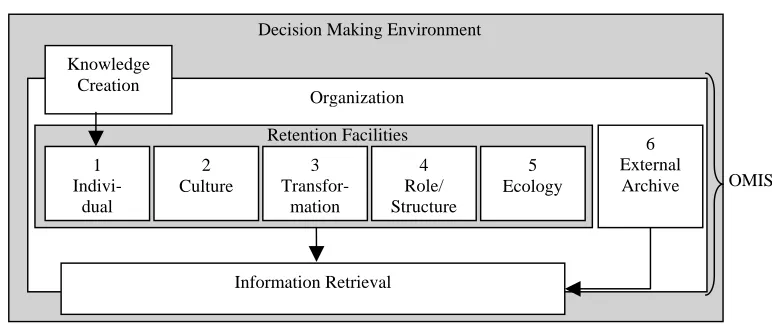
Figure 1: OM Framework (Walsh and Ungson, 1991)
Decision Making Environment
Information Retrieval
6 External
Archive 1
Indivi-dual
2 Culture
3
Transfor-mation
4 Role/ Structure
5 Ecology Knowledge
Creation
Retention Facilities Organization
OMIS
The memories can be stored separately based on requirements and is not compulsory to be in centralized manner. Walsh and Ungson also introduced six “bins” that can be use as retrieval components that construct the OM
framework. The components are (I) individuals and their corresponding files, notes, records, etc.; (2) culture, a learned way of perceiving, thinking, and feeling about problems, (3) transformations, or the logic that guides the transformation of inputs (e.g., raw materials, new recruits, insurance claims) into outputs (e.g., finished products, company veterans, insurance payments); (4) structures, described as roles and expected behaviors; and (5) ecology, the layout of the physical workplace. (6) external archives (e.g., memories of former employees, knowledge of competitors, records of financial service firms,).
Non-IT base memory usually lies in individual mental which it will be an advantage if can be accessed and connected in understandable context. Otherwise, it becomes loss as the individual leaves the organization (Nonaka, 1995) with the knowledge resides in their brains. Memories will damage in terms as a whole and its’ accuracy across time.
organizational memory. OM with technology support is called Organizational Memory Information System (OMIS) by Wijnhoven (1999).
Introduction to Organizational Memory Information System (OMIS)
An OMIS is defined as “a system that functions to provide a means by which knowledge from the past is brought to bear on present activities, thus resulting in increased levels of effectiveness for the organization” (Stein and Zwass, 1995). Some authors use the terms Organizational Memory System (OMS). OMS can be define as a system which (a) realizes parts of the organizational knowledge base with the help of information and communications technologies and/or (b) realizes and supports tasks, functions and procedures that are
connected to the use of the organizational knowledge base (Lehner et al., 1998).
Ackerman (1994) describes that OMS offer the possibility that computer system can better serve the information storage and retrieval needs of an
organization’s memory can present technical and social methods. In essence, some researchers view an OMIS or OMS as a component of organizational memory.
OMIS Model
Wijnhoven had improved Walsh and Ungson (1991) organizational memory framework. Wijnhoven (1999) suggest computer based information system and non-IT record and files elements should be include supporting OMIS besides individual, culture, transformation, structure, ecology and external
environment. In our case study, this model had been selected. We will discuss this further in implementation part.
knowledge acquisition, retention, maintenance, search, and retrieval. These two layers can be either IT-based or non-IT-based.
Component of OMIS
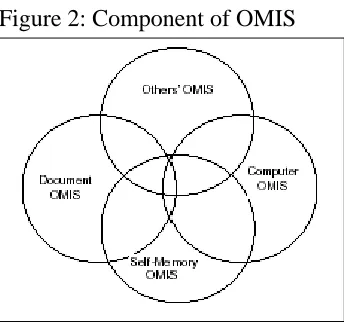
Three forms of OMIS are possible: paper documents, computer documents, and self-memory (Jennex, 1997). See figure 2 for the illustration.
• Paper documents are organization-wide references that reside in central repositories such as a corporate library. Examples of paper documents include reports, procedures, and technical standards. An important part of this memory is in the chronological histories of changes and revisions to these paper documents as they reflect the evolution of the
organization’s culture and decision making processes.
• Computer documents include all computer-based information that is maintained at the work group level or beyond. These may be made available through downloads to individual workstations, may reside in central databases or file systems. Additionally, there are the processes and protocols built into the information systems that are reflected in the interface between the system and the user, by who has access to the data, and by the formats structured system inputs and outputs. • Self-memory includes all paper and computer documents that are
maintained by an individual. Typical components include files,
notebooks, written recollections, and other archives. These typically do not have an official basis or format. Each person’s self-memory is determined by what is important to that person and reflects that person’s experience with the organization.
OMIS Success Model
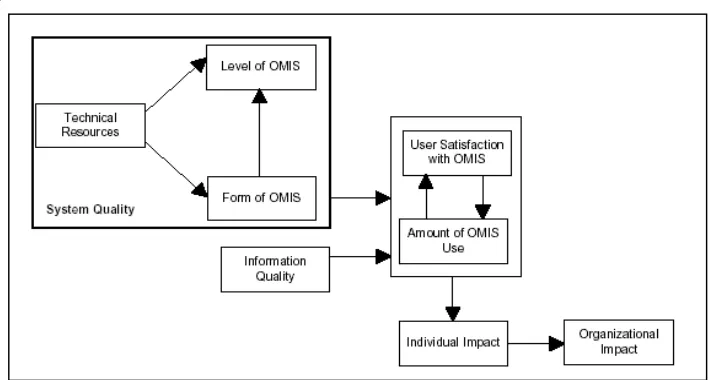
Jennex et al. (1998) had come out with success model customization towards OMIS context from the former De Lone and McLean’s (1992) I/S Success Model (see Figure 3). The model is a block-recursive one that includes 5 blocks. The description of each block can be found inTable 1. This new model has separate system quality and information quality into different block. This is because the system quality block has been expanded to include the
characteristics of the OMIS.
Figure 3: OMIS Success Model (Jennnex et al.,1998)
Table 1: Description of OMIS Success Factors Success
Factor (block)
Description
System Quality Determine how good the system is in terms of its operational characteristics. It contains three constructs: the technical capabilities of the organization, the form of the OMIS, and the level of the OMIS. Technical resources define the capability of an organization to develop and maintain an OMIS.
Information Quality
Success Measure in Terms of Usage
Information use refers to the utilization of the system’s outputs. It measured OMIS components with the usage on five
dimensions: number of tasks performed, actual daily usage, frequency of use (e.g., hourly, daily, etc.), number of application packages used, and level of sophistication of usage.
Individual Impact
The impact of an OMIS on an individual is rooted in
performance changes, but has other facets. It will be measured in terms of productivity.
Organizational Impact
Organizational impacts relate to the effectiveness of the organization as a whole. These measures relate to assessments performed by external organizations, as well as those performed internally.
Practitioner and researcher may use this model to justify the success factors in implementation of OMIS in an organization. Begin with system quality block to determine in terms of operational characteristics. Then will lead to measure information quality for its output. The third block will measure in terms of usage of OMIS components. Individual impact is to identify
individual performance due to productivity. Lastly, organizational impact of the overall OMIS implementation will be assessing by internally and externally.
Case Study
Problem in Organizational Context
Faculty of Computer Science and Information System (FSKSM) is one of an organization in University of Technology Malaysia. Core business of FSKSM is learning and service. Many information need to be manage wisely, especially in academic sector; thesis, curriculum, subject registration, and many other academic artifacts. This study is about data, information and knowledge management which is faculty’s intellectual property. Every year, there are replacement and increment in terms of students and staffs. As a result,
intellectual property became overload and the changes done without control. In fact, without our knowledge, faculty lost their property (treasure) when it cannot be retrieved. Next, the lost can give impact towards faculty performance and quality.
facing problem intracking the curriculums for all the programmes. Furthermore each semester, the lecturers are allowed to update the sylibus according to the current technology and concepts. Several similar programmes and changes in syllabus make some students and lecturers confused. This occurs when different code for same subject but for different course. Besides that, the curriculum information also hard to collect, and retrieved back. Other than that, thesis became overloaded as the semester and year past by. This intangible asset is the most powerful assets in faculty but yet to be lost without notice. The suggestion here is to have a memory or some kind of repository to store and manage all academic information. We called the OMIS solution for FSKSM as
“MemorIS”. Hope with the repository or storage bin provided in MemorIS can protect our intellectual property and besides it can be retrieve to improve excellent learning environment.
Implementation of OMIS Model
Element of OMIS
OMIS framework/model selected is proposed by Wijnhoven (1999) which had been improved from Walsh and Ungson (1991) OM framework (See figure 1 for the illustration). The overall principal of this OMIS starts from the first storage bin which is individual whom responsible to their own knowledge. In order to retrieve back the information or knowledge, some kind of culture need to be embedded. So the whole story of this information will play its role.
Besides that, third bin consists of process and procedure in
transformation of knowledge creation also takes part in this OMIS. However, individual roles that responsible to this OM will be instructed in the structure. Some changes had been made in order to meet the case study implementation, whereby ecology bin was turn to be a “Meta-Memory”. This Meta-memory will be a computer based knowledge repository. All IT based files and records will stored here as suggested by Wijnhoven (1999). Last but not least, external bin as non-IT resource such as paper document that store physically distributed (example: Academic Guideline or “Buku Panduan Akademik”).
above OM (for Walsh and Ungson, 1991) and OMIS model (for Wijnhoven, 1999) sub topic.
Staff Characteristics
In order to perform this OMIS, some of the staff characteristics need to be clarifies. Begin with top management of faculty which consists of dean, deputy deans, registrar assistant and all head of departments. They should have the initiatives of knowledge importance as intellectual property. Implementing knowledge sharing culture will help to reduce the knowledge gap. Besides, training given to the staffs shall increase their skills and knowledge.
Work Culture
Organizational Memory will be valuable and gives meaning if learning environment can be implemented. Work culture is also one of element the effect this OM implementation. Knowledge sharing culture and learning will create not only effective working culture but also have competitive advantage. In order to encourage knowledge sharing among the FSKSM community, the log system is introduced to keep track of the academic artifact contributors and the viewers of the artifact
.
Meta-Memory as Repository
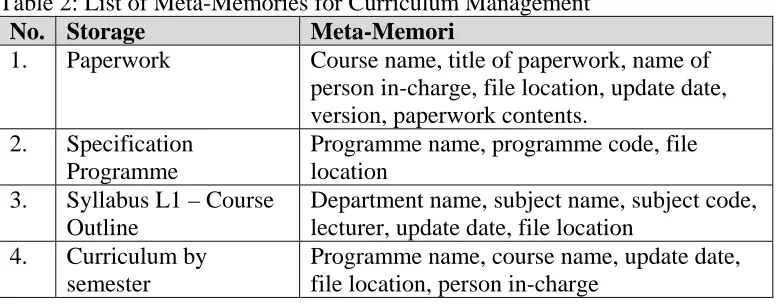
In this research, meta-memory is a critical knowledge which contents of faculty curriculum. This is because; meta-memory can give data about the requested curriculum memory. From our findings, academic management really needs a knowledge repository for them to emphasize their work besides solving
problem. Below is the suggested list of academic management meta-memories:
Table 2: List of Meta-Memories for Curriculum Management
No. Storage Meta-Memori
1. Paperwork Course name, title of paperwork, name of person in-charge, file location, update date, version, paperwork contents.
2. Specification Programme
Programme name, programme code, file location
3. Syllabus L1 – Course Outline
Department name, subject name, subject code, lecturer, update date, file location
4. Curriculum by semester
5. Check list Checking date, person in-charge, list of checking, notes
However there is several alternatives storage that will focus on IT-based documents whereby files are kept in repository for easy in access. Besides that, will provide the facilities for end-user to download and upload the documents to MemorIS. Then, the hardcopy documents such as paperwork will be stored distributed to responsible individual; head of department. Academic guideline will provide to all students and master copy of it will be stored in Academic Management office while the MemorIS will have the location information provided to all.
OM Flow in FSKSM
This topic will show the flow of OM in FSKSM curriculum management. • Stakeholder : Unit of Academic Management
• Object : Curriculum
• Artifacts : Paperwork, Syllibus L1 and Course Planning Outline • Output: Checklist and programme assessment.
• Personal: Registrar Assistant, Head of Department and lecturer. • Resource: Documents (paperwork and academic guideline)
Overall flow in MemorIS, in academic management (mainly curriculum) will act differently. Assistant of Registrar will perform as system administrator to assist in checklist for contents of faculty programmes. If there is some missing point, then he/she will notify to responsible head of department for inquiry.
Academic Management
Assistant of Registrar
Head of Department
Lecturer
Academic Guideline Booklet
Paperwork Programme
Programme Evaluation
Syllabus L1 – Course Outline
Checklist Responsible
for Construct
Revise Complete for Consequence
to
Verify
Documentation
Prepare for
In order to complete the task, some lecturers will be appointed by head of department via email with job task to be done. The process will help head of department in managing the task and perform effectively. Besides that,
MemorIS also provide facilities for lecturer to interact and head of department virtually by directly uploading and sharing the documents on-line. This is actually to adopt the sharing culture to all members of FSKSM. However, the above activities have to be supported by below utilities:
• Repository Backup – all documentation will have backup and stored in other server. This is to ensure the data integrity and security.
• Checklist – is a list of repository content. To track the complete modules in MemorIS.Head of department and system administrator can do
checking easily and identify incomplete contents and the steps to be taken,
• Forum – place to voice out opinion and discussion on particular topics. It is open discussion between lecturers and head of departments to get better ideas and decisions. Besides to share opinion among members. • Individual Diary – extra utility for better enhancement in private notes
Conclusion
In this paper, we have addressed the use of information technology to obviate the problems involved in the use of organizational memory. Then, we explored OMIS components and development strategies in terms of information types and mnemonic processes which is OMIS framework. Through literature
analysis, insight has been gained into the different types of information that can be incorporated into an OMIS. Finally, we have pointed out a model of OMIS success with 5 blocks and different success factors. This model enables the assessment of the extent to which an implemented OMIS in MemorIS will achieve its potential with respect to enhancing organizational effectiveness and competitive advantage. The result of the assessment will be reported in separate article.
In our case study, there are several constraints that limit the scope of this research especially in MemorIS development. For example, due to distributed and unorganized information storage, some of this intellectual property had been lost. However, MemorIS is a good start for unit of academic management in FSKSM to protect their intellectual property. In conclusion, the implementation of OMIS is very challenging since it involved dealing with soft and hard issues such as technology and human factors. IT contributes as a core element for knowledge management system then towards an organizational learning. This initiative is parallel with UTM’s aspiration to adapt lifelong learning.
As a result, we hope this article will contribute and guide the
practitioner as well as the researcher in implementing OMIS. Therefore, for future research, we encourage further in implementation process and empirical study in selected Malaysian organizations to justify and test the implementation of OMIS model in Malaysian context. Furthermore, OMIS success model will be the tools to self assess of the organization’s OMIS implementation.
References
Organizational Memory with Collaborative Help. In M. S.Ackerman (Ed.) Proceedings of ACM CSCW'96 Conference on Computer-Supported Cooperative Work, ACM Press, New York
Ackerman, M. S.(1994). Definitional and Contextual Issues in Organizational and Group Memories, in: Proceedings of the 27rh Hawaii International Conference of System Sciences (HICSS).” Organizational Memory minitrack
Annie Brooking (1999). Corporate Memory: Strategies for Knowledge Management. International Thomson Business Press.
Baird, L. andCross, R. (2000). Technology is Not Enough: Improving
Performance by Building Organizational Memory Sloan Management Review, Cambridge, 41(3) p.69-78.
Borgoff and Pareschi (1998). Information technology for knowledge management. Berlin: Springer Verlag.
DeLone, W.H., and McLean, E.R (1992). Information Systems Success: The Quest for the Dependent Variable. Information Systems Research,3 p. 60-95
Dodgson, M. (1993).Organizational learning: A review of some literatures. Organization Studies, 14/3: 375-394
Jennex M. E., (1997). Organizational Memory Effects Productivity. Claremont Graduate School,Claremont, CA.
Jennex M., Olfman L., Panthawi P., and Tong-Tae Park (1998). An Organizational Memory Information System Success Model: An Extension of De Lone and McLean’s I/S Success Model. International Journal of IEEE, 1060-3425/98
Kransdorff, A. (1998). Corporate Amnesia. Oxford: Butterworth Heinemann. Lehner, F., Maier, R., and Klosa, O. (1998), Organisational Memory Systems –
Application of Advanced Database & Network Technologies, Research Paper No. 19, University of Regensburg, Department of Business Informatics.
Nonaka, I. and Takeuchi, H. (1995). The Knowledge Creating Company. New York: Oxford University Press.
Pralahad, C. K., and Hamel, G. (1994). . Competing For the Future MA.: Harvard Business School Press.
Rose Dieng, Olivier Corby, Alain Giboin and Myriam Ribiere (1998). Methods and Tools for Corporate Knowledge Management . Project ACACIA, INRIA
Walsh, J.p. and Ungson (1991). Organizational Memory. The Academy of Management Review.