20th International Conference on Structural Mechanics in Reactor Technology (SMiRT 20) Espoo, Finland, August 9-14, 2009 SMiRT 20-Division VII, Paper 1567
Adjusting the Fragility Analysis Method to the Seismic Hazard Input,
Part I:
The Intensity-based method
Klügel, Jens-Uwe
a, Attinger, Richard
a, Rao, Shobha
b, Vaidya, Nish
c aNPP Goesgen-Daeniken, Daeniken, Switzerland, [email protected]
b
ABSG Consulting Inc., Irvine, California, U.S.A,
c
Paul C
.Rizzo Associates, Inc., Monroeville, Pennsylviana, U.S.A
Keywords: Seismic Probabilistic Risk Assessment, Fragility Analysis, Probabilistic Seismic Hazard Analysis, Macroseismic Method
1
ABSTRACT
Although the methodology of seismic probabilistic risk assessment (seismic PRA) to some extent has become standardized, different seismic PRA studies exhibit significant differences in results. The primary explanation for this observation consists in the different approaches used for Probabilistic Seismic Hazard Analysis (PSHA) which defines the seismic hazard input for the PRA. While older studies used an intensity-based PSHA maintaining a close link between damaging effects of earthquakes (clearly and uniquely defined in a probabilistic way by the corresponding intensity scale), newer studies use ground motion models for peak instrumental characteristics alone for the developing of the hazard, which in the absence of the associated duration and frequencies are not directly linked to damaging effects of earthquakes. This causes problems as is shown in this paper, because the traditional fragility analysis method used for seismic PRA is conditioned to a seismic hazard input which represents strong, damaging earthquakes. Empirical fragilities for structures and components are derived from field observations covering only damaging earthquake. Fragilities for components derived from tests are also conditioned to damaging earthquake motions, because qualification tests are based on time histories representing high magnitude seismic events. Thus, the seismic hazard input derived from contemporary PSHA methods like described is inconsistent with the method of fragility analysis as used for seismic PRA. Therefore, an approach has to be developed to adjust the fragility method to the seismic hazard input as delivered by seismologists, today. In this paper a procedure is proposed, which is aimed at a direct probabilistic correction of this inconsistency between seismic hazard input and the fragility analysis. The procedure is related to the macroseismic method, which is popular in seismic risk analysis outside the nuclear industry. Its implementation assures an improved correspondence between the results of seismic probabilistic risk assessment and empirical observations from damaging earthquakes. The procedure can be directly applied for a correction of existing PRAs, the review of PRAs or for the calibration of the fragilities of components and structures.
2
INTRODUCTION
The integrated oversight process of nuclear power plants in Switzerland contains a significant amount of risk informed elements. National regulations require a full scope Level 2 (all internal and external events) PRA for all power and shutdown operational modes. Thus, a seismic PRA became an integrated part of this regulatory framework. The development of a seismic PRA typically involves the following the steps:
• Development of a site-specific seismic hazard input, usually based on a traditional PSHA
• A detailed fragility analysis for all safety important structures and components
• Human Reliability Analysis for post-earthquake actions
• Development of a plant logic model
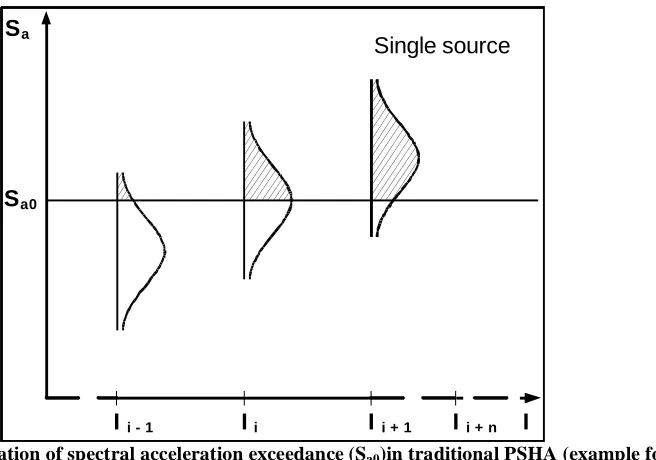
Although the methodology of a seismic PRA to some extent has become standardized, different seismic PRA studies differ significantly in their results. This is due primarily to the different approaches used for Probabilistic Seismic Hazard Analysis (PSHA) which define the respective seismic hazard inputs to the PRA. While older studies used an intensity-based hazard maintaining a close link between damaging effects of earthquakes (clearly and uniquely defined in a probabilistic way by the corresponding intensity scale), newer studies use define hazard in terms of peak ground motion parameters which are typically not directly linked to damaging effects of earthquakes. This is shown in Fig. 1, which illustrates the calculation process of a traditional PSHA.
Figure 1 Evaluation of spectral acceleration exceedance (Sa0)in traditional PSHA (example for a single
source, I is a damage intensity parameter, Sa –spectral acceleration)
The problem is made more severe by the circumstance that most PSHA studies are based on empirical ground motion prediction equations for spectral accelerations. These models rely on recorded or stochastic ground motion time histories but do notprovide information on the damaging effects of the time histories on structures and components. Peak accelerations used for design are a poor characterization of the damage potential of earthquakes. The lost link between damaging characteristics of earthquakes and the output results of a PSHA (this is typically a uniform hazard spectrum – UHS) causes practical problems leading to unrealistic results from seismic PRAs when compared with empirical observations. This problem is partly exaggerated by the currently in use fragility analysis method. Empirical fragilities for structures and components are derived from field observations covering only damaging earthquakes. This was confirmed by a re-visit of the ABSG Consulting Inc.’s earthquake database with respect to observed component damage reports. The database was originally structured based on MMI intensities and pga and combines data from earthquakes with completely different magnitudes, collected at different distances from the epicentre and with different and frequently not even recorded strong motion duration. Thus, the earthquake energy characterizing the different recordings, and that imparted to the observed structures was completely different. The energy represented in the earthquake time history is well correlated with peak ground accelerations and strong motion durations, as has been shown by Vanmarcke and Lai (1980). For the same seismic input energy, the strong motion duration (root mean square duration) and the pga are nearly inversely proportional.
Fragilities for components derived from tests are also conditioned to the occurrence of damaging earthquakes, because qualification tests are based on time histories representing high magnitude seismic events. Frequently, the fragility functions are updated using Bayesian procedures (Porter et al, 2007), sometimes without due consideration of the different energy content of the earthquake or test time histories combined in the update process. An additional problem is caused by the use of the Ang-Tang uncertainty model (Klügel, 2009) combining two different types of uncertainty, epistemic (knowledge based) uncertainty and aleatory variability (measurable variation of quantities in a population) into a single random parameter for which a deterministic (non-random) mean is estimated. Because only the aleatory variability reflects an
!
I i - 1 I i I i + 1 I i + n I
Sa0
Sa
observable property of real world systems, systematic deviations between the results of PSHA or fragility analysis from empirical observations have to be expected.
The objective of the research presented here is to achieve improved compliance between the results of seismic PRA and fragility analysis with empirical observations by adjusting the fragility method to the seismic hazard input.
3
PROCEDURE FOR THE ADJUSTMENT OF FRAGILITY FUNCTIONS
3.1
General description of the adjustment procedure
The adjustment procedure suggested here makes use of the macroseismic method (Giovinazzi and Lagomarsino, 2004) for the vulnerability analysis of buildings linking it to the traditional fragility analysis. The macroseismic method is based on the use of EMS-98 intensities (EMS-98, Grünthal, 1998). This method classifies the Eearthquake strength in terms of EMS-98 intensities based on the statistically observed damage in the affected area using a system of well calibrated building types, for which vulnerability functions are derived. The vulnerability functions although originally presented in terms of fuzzy sets mathematics can be regarded as equivalent to a traditional fragility function. In this sense the macroseismic method provides the conditional probability of failure for calibrated building types given an earthquake of specific site intensity (in EMS-98 scale). The significant advantage of the macroseismic method is that it is directly based on empirical information. The link between the macroseismic method and the fragility analysis can be developed if fragility functions from tests for some of the standardized building or structure types are available. Such information is starting to be available today. For example, a recent study (RISK-EU, 2004) has reported the extensive use of the macroseismic method in the European RISK-UE project.
To implement the macroseismic method in a PRA the results of the associated PSHA have to be converted into intensity scale. This is only possible by performing a detailed deaggregation of the uniform hazard spectra typically provided as an output product of a PSHA. Deaggregation results are usually represented in terms of magnitude –distance bins. Using a regional magnitude-intensity conversion formula and a regionally validated intensity attenuation relationship it is possible to derive site intensities, which can be used to assess the conditional probability of failure for the standardized structure types used in the EMS-98 intensity scale. Because the entire process is associated with some epistemic uncertainty care has to be taken to capture the uncertainties correctly. The method has been applied using the results of the PEGASOS study for the Goesgen nuclear power plant.
3.2
Application of the adjustment procedure to the PEGASOS results for the Goesgen
nuclear power plant
The specific application of the adjustment procedure for the PEGASOS results for the Goesgen
nuclear power plant included the following steps:
•
Detailed deaggregation of the seismic hazard into a bivariate distribution of controlling
earthquakes, characterized by their magnitude and distance for different spectral frequencies and
different frequencies of exceedance (hazard frequencies)
•
Development or selection of appropriate models for the conversion of controlling earthquakes
into site intensities in the EMS-98 scale for different levels of frequency of exceedance (hazard
frequencies)
•
Development of an enveloping distribution for site intensities resulting from the distribution of
controlling events.
•
Developing a distribution for an adjustment factor to be applied to the component level
fragilities. Thisallows. a corrected damage prediction using adjusted fragilities s and therefore
more reasonable PRA results, which comply with empirical observations.
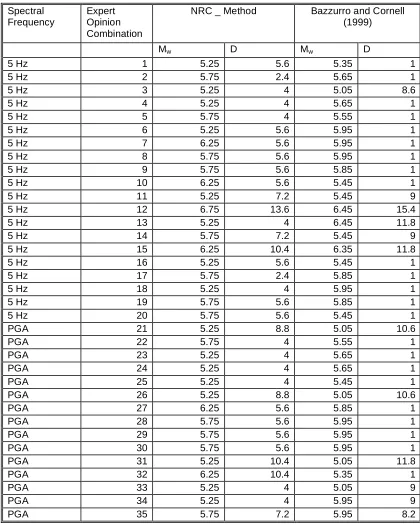
A detailed deaggregation of the PEGASOS hazard was performed using two different deaggregation methods (NRC RG1.165 (1997) and Bazzuro and Cornell (1999), see Klügel (2007)). The deaggregation was performed for three distance ranges (D1≤16km, 16km<D2≤40km, D3>40km), each of the combinations of expert opinions of the PEGASOS-project and different spectral frequencies. The deaggregation was performed for separate values of hazard exceedance frequencies. Table 1 shows a typical example for the deaggregation results as a set of 80 magnitude-distance pairs controlling the hazard with the Sa at 5 Hz and with pga. This set of scenario earthquakes is mathematically treated as a bivariate discrete probability distribution of controlling events.
Table 1 Deaggregation results for distance range D1 and hazard exceedance frequency 10-4/a Spectral
Frequency
Expert Opinion Combination
NRC _ Method Bazzurro and Cornell (1999)
Mw D Mw D
5 Hz 1 5.25 5.6 5.35 1
5 Hz 2 5.75 2.4 5.65 1
5 Hz 3 5.25 4 5.05 8.6
5 Hz 4 5.25 4 5.65 1
5 Hz 5 5.75 4 5.55 1
5 Hz 6 5.25 5.6 5.95 1
5 Hz 7 6.25 5.6 5.95 1
5 Hz 8 5.75 5.6 5.95 1
5 Hz 9 5.75 5.6 5.85 1
5 Hz 10 6.25 5.6 5.45 1
5 Hz 11 5.25 7.2 5.45 9
5 Hz 12 6.75 13.6 6.45 15.4
5 Hz 13 5.25 4 6.45 11.8
5 Hz 14 5.75 7.2 5.45 9
5 Hz 15 6.25 10.4 6.35 11.8
5 Hz 16 5.25 5.6 5.45 1
5 Hz 17 5.75 2.4 5.85 1
5 Hz 18 5.25 4 5.95 1
5 Hz 19 5.75 5.6 5.85 1
5 Hz 20 5.75 5.6 5.45 1
PGA 21 5.25 8.8 5.05 10.6
PGA 22 5.75 4 5.55 1
PGA 23 5.25 4 5.65 1
PGA 24 5.25 4 5.65 1
PGA 25 5.25 4 5.45 1
PGA 26 5.25 8.8 5.05 10.6
PGA 27 6.25 5.6 5.85 1
PGA 28 5.75 5.6 5.95 1
PGA 29 5.75 5.6 5.95 1
PGA 30 5.75 5.6 5.95 1
PGA 31 5.25 10.4 5.05 11.8
PGA 32 6.25 10.4 5.35 1
PGA 33 5.25 4 5.05 9
Spectral Frequency
Expert Opinion Combination
NRC _ Method Bazzurro and Cornell (1999)
PGA 36 5.25 12 5.05 10.2
PGA 37 5.75 2.4 5.45 1
PGA 38 5.25 2.4 5.45 1
PGA 39 5.75 2.4 5.95 1
PGA 40 5.75 5.6 5.35 1
Mean Value, (M, D)
5.63 4.9
Standard deviation (M,D)
0.38 3.8
The conversion of magnitude and distance data pairs into site intensities was based on the equations from the Earthquake Catalog of Switzerland (ECOS), Braunmiller et al (2005). The following equations were used:
1. Interception intensity
int 0.096 1.27 w 0.5
I = + M + (1)
2. Intensity attenuation relationship
( )
(
)
(
)
int with 0.043 for 0, 70
and 0.0115 for 70, 200 km site
I d I fd f d km
f d
= ! = "
= " (2)
The intensity attenuation relationship was intentionally based on the interception intensity Iintand not on the epicentral intensity to account for the uncertainty related to the site conditions of the Swiss strong motion network. The additional term
+
0.5
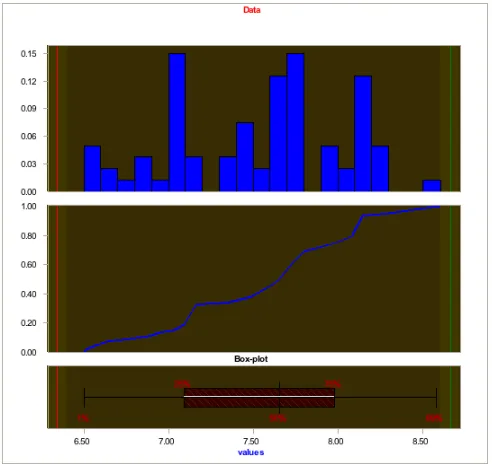
accounts for some possibly needed correction related to site conditions (stiff soil). The intensity attenuation relationship (eqn (2)) was compared against other available intensity attenuation relationships for the region, as for example with the correlation of Segesser and Mayer-Rosa for MSK64 (ASK/SED 1977) used originally for the development of the probabilistic seismic hazard maps of Switzerland and found to be conservative. Therefore, the use of eqn (2) assures a conservative representation of the epistemic uncertainty associated with intensity attenuation in Switzerland.Equations (1) and (2) were used to convert each of the scenario earthquakes obtained from the deaggregation of the PEGASOS hazard into corresponding site intensity. This allows developing a site intensity distribution for each of the hazard exceedance frequencies and each of the distance ranges used for the deaggregation of the PEGASOS hazard. Table 2 shows the main statistics of the resulting site intensity distribution in comparison with the older ASK/SED (1977) intensity attenuation model (MSK64). Fig. 2 shows as an example the intensity distribution for the hazard exceedance frequency 10-4/a and the distance range D1.
Table 2 Statistical Characteristics of the site intensity distribution (EMS-98 based intensity factors)
Statistical
characteristic
Exceedance
Frequency,
[1/a]
Distance Range D1 Distance Range D2 Distance Range D3
ECOS ASK/SED ECOS ASK/SED ECOS ASK/SED
Mean VI.6 V.2 VI.6 V.0 VI.2 IV.3
Minimum VI.3 IV.8 V.7 IV.0 V.0 III.0
Maximum VII.4 VI.0 VII.6 V.9 VII.3 V.4
Mode VI.7 V.4 VI.2 IV.9 VI.7 IV.8
Standard deviation
10-3
0.21 0.26 0.31 0.30 0.59 0.59
Mean VII.5 VII.0 VII.1 V.5 VI.6 IV.8
Minimum VI.5 V.2 VI.2 IV.6 V.2 III.4
Maximum VIII.6 VIII.1 VIII.4 VI.8 VIII.3 VI.6
Mode VII.1 VI.6 VII.1 V.5 VI.7 IV.8
Standard deviation
10-4
0.50 0.79 0.61 0.61 0.70 0.69 Mean VIII.5 VIII.3 VIII.1 VI.5 VII.1 V.3
Minimum VII.0 V.9 VI.3 IV.7 V.3 III.5
Maximum IX.4 IX.4 IX.0 VII.4 VIII.3 VI.4
Mode IX.4 IX.4 VIII.4 VI.8 VII.3 V.4
Standard deviation
10-5
0.69 0.77 0.64 0.64 0.58 0.58 Mean VIII.9 VIII.9 VIII.5 VI.9 VII.6 V.8
Minimum VII.2 VI.9 VI.3 IV.7 VI.4 IV.7
Maximum IX.8 IX.8 IX.3 VII.7 VIII.3 VI.4
Mode IX.1 IX.1 VIII.4 VI.8 VII.3 V.4
Standard deviation
10-6
0.55 0.58 0.54 0.54 0.44 0.45
Figure 3 Membership functions used in the EMS-98 scale to express statistically observed damage.
Table 3 Statistically expected damage for masonry buildings type B in dependence on intensity
Intensity VI Intensity VII Intensity VIII Intensity IX Intensity X Damage Grade I many most
Damage Grade II few many most Damage Grade
III
few many most
Damage Grade IV
few many most
Damage Grade V few many
1
ln
fail
m
a
p
a
!
"
"
"
#
#
#
=
$ %
%
%
%
%
&
&
&
&
&
'
(
'
(
'
(
(3)
Table 4 Fragility Parameters corresponding to EMS-98 Damage Grades for Type B Masonry Structures
Damage Grade II Damage Grade III Damage Grade IV Damage Grade V
am β am β am β am β
0.109 0.40 0.176 0.50 0.283 0.55 0.537 0.60
The site intensity distributions derived from the detailed deaggregation of the PEGASOS hazard are used to calculate the probability of failure of Type B masonry structures using the macroseismic method. The fragility analysis method using eqn (3) is used, on the other hand, to derive the seismic demand, which would correspond to the same degree of damage predicted from the intensity distribution. The ratio between the ground motion ( e.g. pga ) from PEGASOS (corresponding to the same frequency of exceedance) and the seismic demand developed on the basis of fragilities to achieve equivalent damage states, provides the correction coefficients required to calibrate the traditional fragility method to observed damage. To obtain a continuous probability distribution for the membership functions shown in Fig. 3 a set of overlapping subjective triangle distributions was created with the mode of the distribution at the intersection point of the adjacent membership functions.
Table 5 Adjustment factors for the fragility method – calculated based on the PEGASOS uniform hazard spectrum (UHS)
Frequency of exceedance
Mean site intensity factor (from PEGASOS hazard
deaggregation)
Mean pga, [g]
(from PEGASOS UHS)
Mean correction factor
Parameters of lognormal distribution for the
adjustment factor (mean and standard
deviation)
10-3/a VI.6 0.2 2.36 (2.36, 0.31)
10-4/a VII.5 0.46 3.80 (3.80, 1.14)
10-5/a VIII.5 0.89 4.06 (4.06, 1.35)
10-6/a VIII.9 1.3 2.87 (2.87, 0.96)
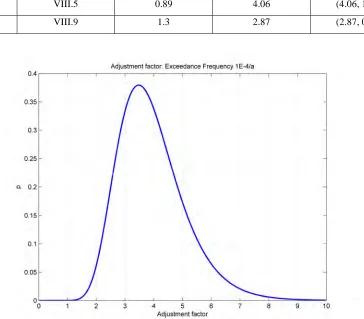
Figure 4 Probability density distribution of the adjustment factor for the exceedance frequency 10-4/a
4
CONCLUSIONS
Symbols
m
a Median seismic capacity expressed as pga [g]
a
Seismic demand expressed as pga [g]Combined uncertainty expressed as standard deviation of a lognormal
distribution
[-]
I Intensity EMS-98
scale
REFERENCES
Abrahamson, N. A., Coppersmith, K.J., Koller, M., Roth, P., Sprecher, C., Toro, G.R., and Youngs, R., 2004. Probabilistic Seismic Hazard Analysis for Swiss Nuclear Power Plant Sites (PEGASOS Project), Vol. 1 to 6, NAGRA.
ABSG Consulting Inc. (formerly EQE International Inc.), 2008, Earthquake and Fragility Database
Abteilung für die Sicherheit der Kernanlagen (ASK), 1977, Erdbebenrisikokarten der Schweiz. Basler& Hofmann, Schweizerischer Erdbebendienst..
Bazzuro, P. and Cornell, C.A., 1999, Disaggregation of Seismic Hazard, Bulletin of the Seismological Society of America, 82, pp. 501-520.
Braunmiller, J., Deichmann, N., Giardini, D., Wiesmer S., and the SED Magnitude Working Group, 2005, Homogeneous Moment-Magnitude Calibration in Switzerland, Bulletin of the Seismological Society of America, 95(1), pp. 58-74.
Giovinazzi, S. and Lagomarsino, S., 2004, A Macroseismic Method for the Vulnerability Assessment of Buildings. 13th World Conference on Earthquake Engineering, Vancouver, B.C., Canada, August 1-6, 2004, Paper No. 896.
Grünthal, G., 1998, European Macroseismic Scale 1998. Cahiers du Centre Europèèn de Géodynamique et de Séismologie, Volume 15, Luxembourg.
Klügel, J.-U., 2007, How To Eliminate Non-Damaging Earthquakes from the Results Of a Probabilistic Seismic Hazard Analysis (PSHA) – A Comprehensive Procedure with Site Specific Application, SMIRT 19, Toronto, Paper No. 1142.
Klügel, J.-U., 2009, Comment on „Sigma: Issues, Insights and Challenges“ by F.O. Strasser, N.A. Abrahamson, and J.J. Bommer, Seismological Research Letters, 80, pp. 494-497.
Labbé, P., 2007, PSHA results versus historical seismicity, Presentation at the Information Exchange Meeting: Experience on the Implementation of the Outputs from Probabilistic Seismic Hazard Analyses in France and Switzerland, EDF-NOK-KKG, Beznau., November 27th, 2007.
NRC, 1997. Identification and Characterization of Seismic Sources and Determination of Safe Shutdown Earthquake Ground Motion. RG 1.165.
Porter, K., Kennedy, R., and Bachman, R. 2007, Creating Fragility Functions for Performance-Based Earthquake Engineering, Earthquake Spectra, 23, (2), pp. 471-489
Risk-EU, 2004, The European Risk-UE project: An advanced approach to Earthquake Risk Scenarios with application to different European towns (2001-2004), www.risk-ue.net