DYNAMIC RISK MANAGEMENT APPROACH USING IMMUNE SYSTEM
AZADEH SARKHEYLI
DYNAMIC RISK MANAGEMENT APPROACH USING IMMUNE SYSTEM
AZADEH SARKHEYLI
A dissertation submitted in partial fulfillment of the requirements for the award of the degree of
Master of Science (Information Technology - Management)
Faculty of Computer Science and Information Systems Universiti Teknologi Malaysia
iii
To my dearly loved family and friends To my respected supervisor
iv
ACKNOWLEDMENT
Dr.Norafida Binti Ithnin, shows the way, gives my patience and the will to supervisor for this dissertation. I would like to express my greatest gratitude to my supervisor for her great support and guidance in helping me to complete the thesis. I also would like to give my appreciation to my sisters, for collaborating me to do this thesis and my parents, over the years they have continued to support and motivate me in my studies. Not to forget, my friends who helped me directly or indirectly.
v
ABSTRACT
Risks include the factors that might adversely affect on project outcomes. Risk analysis includes the processes concerned with identifying, analyzing and developing security strategy and plans for the factors. Although currently there are methodologies known such as (CCTA Risk Analysis and Management Method
(CRAMM) or Consultative, Objective and Bi-functional Risk Analysis (COBRA) etc.
i v
ABSTRAK
Risiko termasuk faktor-faktor yang mungkin memberikan kesan berlawanan terhadap hasil projek. Analisis risiko mengambil kira proses mengenal pasti, menganalisis dan membina strategi dan pelan keselamatan untuk faktor-faktor tersebut. Walaupun di masa kini terdapat kaedah-kaedah seperti (CCTA Risk Analysis
and Management Method (CRAMM) atau Consultative, Objective dan Bi-functional
Risk Analysis (COBRA) dan sebagainya untuk Pengendalian Risiko, namun
vii
TABLE OF CONTENTS
CHAPTER TITLE PAGE
DECLARATION ii
DEDICATION iii
ACKNOWLEDGEMENTS iv
ABSTRACT v
ABSTRAK vi
TABLE OF CONTENTS vii
LIST OF TABLES xii
LIST OF FIGURES xiv
LIST OF ABBREVIATIONS xvii
LIST OF APPENDICES xviii
1 INTRODUCTION 1
1.1 Background of the Study 1
1.2 Statement of the Problem 3
1.3 Objectives of the Study 4
1.4 Research Questions 4
viii
1.6 Significant of the Study 5
2 LITERATURE REVIEWS 7
2.1 Introduction 7
2.2 Security Management 8
2.3 Risk Management 10
2.4 Definition of Risk Management 13
2.5 The Problem that is real in the Process of RM 15 2.6 Existing Risk Management Methodologies 16
2.6.1 CRAMM 16
2.6.2 COBRA 20
2.6.3 RUSECURE 22
2.6.4 BRITISH STANDARDS 25
2.6.5 OCTAVE 27
2.6.6 OCTAVE-S 30
2.6.7 Summary 32
2.7 Research in Immune systems 35
3 RESEARCH METHODOLOGY 38
3.1 Introduction 38
3.2 Research Approach 39
3.3 Research Strategy 41
3.4 Operational Framework 41
3.4.1 STAGE 1 43
ix
3.4.3 STAGE 3 44
3.5 Summary 45
4 PROPOSE A NEW RISK MANAGEMENT PROCESS 46
4.1 Introduction 46
4. 2 Comparison of Risk Management Processes 47
4.3 Result of the Immune System Study 54
4.4 Propose Risk Management process 58
4.5 Summary 63
5 PROPOSED RISK MANAGEMENT RESULT 64
5.1 Introduction 64
5.2 Review of the Proposed Risk Management Process 65 5.2.1 Phase I: Aggregation of Data and Information 67 5.2.1.1 Information Asset Table 68 5.2.1.2 Threat/Attack Profile Table 70 5.2.1.3 Control Table 70 5.1.1.4 Probability Detection 71 5.2.1.5 Impact Analysis 72 5.2.1.6 Risk Determination 73 5.2.2 Phase II: Risk Identification 74 5.2.3 Phase III: Risk Management Using an Optional
Control 75
5.2.4 Phase IV: Risk Management Using an Especial
Control 77
x
5.3.1 Using ANFIS for Risk Identification 80
5.3.1.1 ANFIS Network 80
5.3.1.2 Risk Identification by ANFIS 85 5.3.2 Using LVQ for Control Specification 87
5.3.2.1 LVQ Network 87
5.3.2.2 Control Specification by LVQ 90
5.4 Result of the Proposed Risk Management Process 91
5.4.1 Aggregation of Data and Information 92 5.4.1.1 Experts role in this study 93 5.4.1.2 Experts Identification 93 5.4.2 Risk Identification 97 5.4.3 Control Specification 122
5.5 Summary 124
6 CONCLUSION 126
6.1 Introduction 126
6.2 Results and Achievements 127
6.2.1 Objective 1 127
6.2.2 Objective 2 127
6.2.3 Objective 3 128
6.2.4 Objective 4 128
6.3 Limitation of the Project 128
6.4 Future Works 129
xi
REFERENCES 131
APPENDIX.A 134
APPENDIX.B 135
APPENDIX.C 136
xii
LIST OF TABLES
TABLE NO. TITLE PAGE
2.1 The history of CRAMM 17
2.2 OCTAVE timetable 28
2.3.a The Process of all Risk Management Methodologies which
are selected 33
2.3.b The Process of all Risk Management Methodologies which
are selected 34
3.1 The differences between Quantitative and Qualitative
Methods 40
4.1.a Comprising the Risk Management Methodologies Process 48 4.1.b Comprising the Risk Management Methodologies Process 49
4.2 Legend of Figure4.3 53
4.3 Comparison of the Immune system process with the current
process of Risk Management 58
4.4 Comparison of the Immune system process with the
proposed process of Risk Management 60
5.1 Probability Definitions 72
5.2 Magnitude of Impact Definitions 73
5.3 Risk level Matrix 74
5.4 Information Assets Table 95
xiii
5.6 Likelihood and Impact of each UE 97
5.7 Data of creating membership functions based on expert’s
knowledge for the attributes of Equipment Security Asset 99 5.8 Data of creating membership functions based on expert’s
knowledge for Equipment Security Asset 100
5.9 Data of creating membership functions based on expert’s
knowledge for the attributes of Equipment Security Asset 101 5.10 Data of creating membership functions based on expert’s
knowledge for Equipment Security Asset 102
5.11 Data of creating membership functions based on expert’s
knowledge for the attributes of Equipment Security Asset 103 5.12 Data of creating membership functions based on expert’s
knowledge for Equipment Security Asset 104
5.13 Training data set for Equipment asset 108
5.14 Training data set for Equipment asset 110
xiv
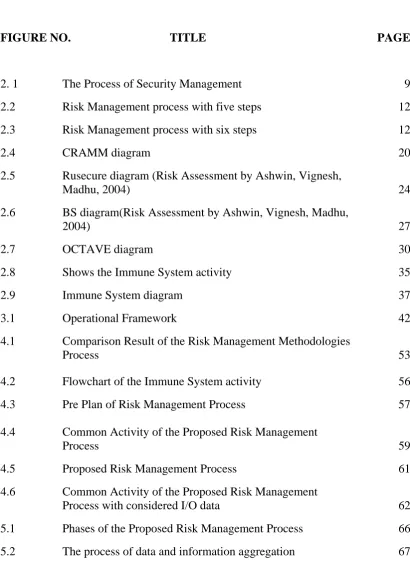
LIST OF FIGURES
FIGURE NO. TITLE PAGE
2. 1 The Process of Security Management 9
2.2 Risk Management process with five steps 12
2.3 Risk Management process with six steps 12
2.4 CRAMM diagram 20
2.5 Rusecure diagram (Risk Assessment by Ashwin, Vignesh,
Madhu, 2004) 24
2.6 BS diagram(Risk Assessment by Ashwin, Vignesh, Madhu,
2004) 27
2.7 OCTAVE diagram 30
2.8 Shows the Immune System activity 35
2.9 Immune System diagram 37
3.1 Operational Framework 42
4.1 Comparison Result of the Risk Management Methodologies
Process 53
4.2 Flowchart of the Immune System activity 56
4.3 Pre Plan of Risk Management Process 57
4.4 Common Activity of the Proposed Risk Management
Process 59
4.5 Proposed Risk Management Process 61
4.6 Common Activity of the Proposed Risk Management
Process with considered I/O data 62
xv
5.3 The process of risk identification as first barrier 75 5.4 The process of risk management using an optional control as
second barrier 76
5.5 The process of risk management using an especial control as
third barrier 78
5.6 Structure of Fuzzy Controller 81
5.7 ANFIS Architecture 82
5.8 ANFIS network for computing an asset value 86
5.9 A multiple ANFIS network for Risk Identification 87
5.10 LVQ neural network 88
5.11 LVQ network for Control Specification 91
5.12 The structure of proposed risk management system 92 5.13 MFs for inputs and outputs of equipment asset 105
5.14 Corresponding fuzzy subspaces 106
5.15 Rule defining in ANFIS for Equipment asset 107
5.16 ANFIS GUI after loading Training data set for Equipment
asset 109
5.17 ANFIS GUI after loading Checking data set for Equipment
asset 111
5.18 ANFIS Structure for determining the Equipment asset 112
5.19 ANFIS Training for Equipment asset 113
5.20 Testing the Network against Checking data for Equipment
asset 114
5.21 MFs of all inputs and output for information asset 115 5.22 ANFIS GUI after loading Checking data set for Information
asset 117
5.23 ANFIS network structure for determining Information asset
value 118
5.24 Testing the Network against Checking data for Information
asset 119
5.25 MFs of all inputs and output for system. Figure (a) shows Information asset value, (b) shows Equipment asset (c)
xvi
5.26 ANFIS network structure for determining System Value 121 5.27 Testing the Network against Checking data for System value
determination 122
5.28 The structure of LVQ Network for Control Specification 123
5.29 Percentages of output errors 123
xvii
LIST OF ABBREVIATION
RM Risk Management
IT Information Technology
IS Information System
CRAMM CCTA Risk Analysis and Management Method
COBRA Consultative, Objective and Bi-functional Risk Analysis
BS British Standards
ANFIS Adaptive-Network-based Fuzzy Interface System LVQ Learning Vector Quantization
xviii
LIST OF APPENDICES
APPENDIX TITLE PAGE
A Information assets table 134
B Threat/ attack profile table 135
C Control table 136
CHAPTER 1
INTRODUCTION
1.1 Background of the Study
This study tries to do IT Risk Management using Immune System, because of this at first Immune system as the main system, which this research wants to investigate base of it, will be described. After that try to answer the main question, it means that why Immune system have chosen for this project. Another question is related to how this study can improve Risk Management process for achieving better result. So, Risk Management process and how can give these process, will be defined as secondly in this section.
2
Like nature, the body has the natural ability to protect and heal itself. This happens through the immune system. Research shows a healthy immune system helps prevent most common illnesses.
The secret to the success of immune system is an elaborate and dynamic communications network. Millions and millions of cells, organized into sets and subsets, gather like clouds of bees swarming around a hive and pass information back and forth. Once immune cells receive the alarm, they undergo tactical changes and begin to produce powerful chemicals. These substances allow the cells to regulate their own growth and behaviour, enlist their fellows, and direct new recruits to trouble spots [2].
About Risk Management, it is clear that risks include any factors which might adversely affect project outcomes. Risk management includes the processes concerned with identifying, analyzing and responding to uncertainty to those factors that might adversely affect project outcomes [4]. An understanding of risk management is essential for any worker involved in a project, paid or unpaid, because each person is legally and ethically responsible for contributing to this process for being aware of, and minimizing the potential for risk in any given situation. The focus on risk management has emerged as a result of cases where there has been a failure to identify or respond to risk, resulting in accident, or other loss. Risk management has become a formalized approach which helps to ensure that workers and organizations are accountable for all activities and responses, thereby minimizing the consequences of adverse events. Risk management can also play a role in maximizing the results of positive events [6].
3
Process allows identifying each risk, quantifying the impact and taking action now to prevent it from occurring and reduce the impact should it eventuate.
Generally six steps proposed for Risk Management such as identify any hazards, identify the risks associated with those hazards, assess the risks, control the risks , document the process, Monitor and review the outcomes.
Although the process of Risk management which are exist in current organization used extremely for protection of their resources and productions, the importance of this subject and the common failure which are acquired in current methodologies cause the study focused to Risk Management using a complete system which tasks are similar and exist in nature, that is Immune System. So this research can simulate an organization with a human body. Consequently by investigation of the component of Immune Systems and study about their procedure and problems of Risk Management the study can design and propose tools for improving IT Risk Management.
1.2 Statement of Problem
4
1.3 Objectives of the Study
1. To study the existing method of Risk Management 2. To investigate the concept of Immune System
3. To design and propose a Risk Management process to embedding the concept of immune system
4. To develop the proposed Risk Management process
1.4 Research Questions
Main research question:
How to improve Risk Management process using Immune System approach?
Sub research questions:
1. What are the components inside the Immune System?
5
1.5 Scope
Selected Risk Management methodologies are CRAMM, RUSECURE, OCTAVE, OCTAVE-S, BS. And selected symbol for simulation is Immune System. Another thing is development of the proposed risk management process which MATLAB software will be used.
1.6 Significance of the Study
Currently there are known methodologies (CCTA Risk Analysis and Management Method (CRAMM) or Consultative, Objective and Bi-functional Risk Analysis (COBRA) and so on) for Risk Analysis/Management, but they have common failure.
1. There is no specific function which recover/avoid risks/attacks toward IS/IT component
2. Poor executive support 3. High cost of implementation 4. Untimely response
5. Insufficient accountability
6. Inability to qualitatively measure control environment 7. Infrequent in assessment
8. Inaccurate data
6
131
REFERENCES
1. Paul K. Harmer, Paul D. Williams, Gregg H. Gunsch, and Gary B. Lamont,‖ An Artificial Immune System Architecture for Computer Security Applications‖ , IEEE TRANSACTIONS ON EVOLUTIONARY COMPUTATION, VOL. 6, NO. 3, JUNE 2002.
2. P. D. Williams, ―Warthog: Toward an artificial immune system for detecting ‗low and slow‘ information system attacks,‖ M.S. thesis, Air Force Instit. Technol., Wright-Patterson AFB, OH, Mar. 2001.
3. Richard A. Gonçalves, Carolina P. de Almeida, ―A cultural immune system for economic load dispatch with non-smooth cost functions‖, Proceeding ICARIS'07 Proceedings of the 6th international conference on Artificial immune systems Springer-Verlag Berlin, Heidelberg 2007.
4. Boon Siong Neo, Kewong Sin Leong,"Managing Risks in Information Technology Projects" Journal of Information Technology Management, Volume V, Number3,1994
5. Golfried B.Williams_University of East London UK , ―Online Business Security Systems‖ Springer Science+Business Media, LLC 2007.
6. Shon Harris, "CISSP All-in-One Exam Guide" Fourth Edition, by the McGraw-Hill Companies, 2008.
7. You Lu ; Xin Yang ; ―Design risk management--the guarantee of product innovation‖, 9th
International Conference of Computer-Aided Industrial Design and Conceptual Design,IEEE. CAID/CD 2008.
132 9. Carol Woody_ Carnegie Mellon University, ―Applying OCTAVE‖ is sponsored
by the U.S. Department of Defense, May 2006.
10. Richard A.Caralli, James F.Stevens, William R.Wilson ‖Introducing OCTAVE Allegro: Improving the Information Security Risk Assessment Process‖, Software Engineering Institute from Carnegie Mellon University, May 2007. 11. Gary Stoneburner, Alice Goguen, and Alexis Feringa,‖ Risk Management Guide
for Information Technology Systems‖ NIST Special Publication 800-30, 2002. 12. Risk Management by ARMY, MARINE CORPS, NAVY, AIR FORCE,
february 2001.
13. Risk Management Tools, by Michael A. Greenfield Deputy Associate Administrator Office of Safety and Mission AssuranceLangley Research Center May 2, 2000.
14. Risk Management Guide for Information Technology Systems, Recommendations of the National Institude of Standards and Technology, 2002. 15. Risk Management byJames W. Meritt.
16. Christopher Alberts, Audree Dorofee, Carol Woody_ Carnegie Mellon University,‖Introduction to the OCTAVE Approach‖ is sponsored by the U.S. Department of Defense August 2003.
17. E. Henley, H. Kumamoto(1996). Probabilistic Risk Assessment 2nd edition, IEEE Press, New York.
18. Paulina, Januszkiewicz ; Marek, Pyka ;‖ Designing a Security Policy According to BS 7799 Using the OCTAVE Methodology‖, The Second International Conference on Availability, Reliability and Security IEEE. ARES 2007.
19. Maglogiannis, I.; Zafiropoulos, E.;‖ Modeling Risk in Distributed Healthcare Information Systems‖, Engineering in Medicine and Biology Society. EMBS '06. 28th Annual International Conference of the IEEE, 2006.
20. J. O. Kephart, G. B. Sorkin, M. Swimmer, and S. R. White, ―Blueprintfor a computer immune system,‖ in Proceedings of the Virus Bulletin International Conference. Abingdon, U.K.: Virus Bulletin Ltd., 1997.
21. Alwi, N.H.M.; Ip-Shing Fan; ―Information security management in e-learning‖, Internet Technology and Secured Transactions IEEE. ICITST 2009. 22. "CRAMM Management Guide" by Security Service on behalf of the UK
133 23. http://www.compservis.lt/cramm/index.php?Lang=5&ItemId=34625Source:
www.cramm.com.
24. Briand, L.C.; El Emam, K.; Bomarius, F.;‖ COBRA: a hybrid method for software cost estimation, benchmarking, and risk assessment ‖, International Conference on Software Engineering, IEEE. Proceedings of the 1998.
25. http://rusecure.rutgers.edu/cybermonth.
26. http://shop.bsigroup.com/en/ProductDetail/?pid=000000000030166440.
27. Handbook of Information Security Management, Domain3,"Risk management and Business Continuity Planning,"Micki Krause and Harold F.Tipton,editors(CRC Press LLC): www.cccure.org/Documents/HISM/223-228.html.
28. http://arm-group.net/RiskManagement/Default.aspx.
29. British Standard BS6079:1996"Guide to project management", British Standards Institute, ISBN 0-580-25594-8,1996.
30. http://www.electroresponse.com/1100/index.htm.
31. S. A. Hofmeyr and S. Forrest, ―Immunity by design: An artificial immune system,‖ in Proceedings of the Genetic and Evolutionary Computation Conference. San Mateo, CA: Morgan Kaufmann, July 1999, pp.1289–1296. 32. D. Dasgupta, Ed., Artificial Immune Systems and Their Applications,
Heidelberg, Germany: Springer-Verlag, 1999.
33. Guangfu Wei ; Xin Xhang ; Xinlan Zhang ; Zhifang Huang ;‖ Research on E-government Information Security Risk Assessment - Based on Fuzzy AHP and Artificial Neural Network Model‖ First International Conference on Networking and Distributed Computing (ICNDC) IEEE, 2010.
34. Fundamentals of Neural Networks, Architectures, Algorithms , and Applications, Laurene Fausett , Prentice-Hall, Inc. Upper Saddle River, USA, 1994, ISBN: 0-13-334186-0.
35. Artificial Neural Networks , Ajith Abraham, Oklahoma State University, USA, Handbook of Measuring System Design , 2005, John Wiley and Sons, ISBN: 0-470-02143-8.
36. ANFIS: Adaptive-Neural Network Based Fuzzy Interface System, Jyh-Shing Roger Jang, 1993, IEEE Transactions on systems, Vol 23, No 3.