Perceptions, Practices And Problems Of School-Based
Assessment For Primary School In Kluang, Johor
Elansegaran A/L Thangamani1*, Dr. Ahmad Johari Bin Sihes2 1, 2 Department of Educational Foundation and Social Science, Faculty of Education,Universiti Teknologi Malaysia, MALAYSIA. [email protected], [email protected]
(012-2237975:0127987578)
1.1 INTRODUCTION
Curriculum transformation in Malaysia is nothing new as it has been practiced since independence. The most recent curriculum change in Malaysia is the development and implementation of the Primary School Standard Curriculum (KSSR) in primary schools throughout the country, beginning 2011. This new curriculum gives special attention to school-based assessment (SBA). The aim of the introduction of School Based Assessment (SBA) in schools is to develop students who are balanced physically, emotionally, spiritually and intellectually (Malaysian Examination Board, 2011).
School Based Assessment is a holistic assessment that evaluates cognitive (intellectual), affective (emotional and spiritual) and psychomotor (physical) aspects in line with the National Education Philosophy and Curriculum Standard for Primary Schools (KSSR) (Ministry of Education, 2009). The components of SBA are divided into two areas, namely assessing the academic and non-academic which consists of academics School Assessment ( SA ) and Assessment Centre ( PP ), while the non-academic field consists of Psychometric Assessment ( PPsi ) Assessment for Physical Activity , Sport and the Curriculum ( PAJSK ). Both of these areas give recognition and autonomy for teachers to implement formative and summative assessment in schools according to their creativity and individual initiative(Malaysian Examination Board, 2011).
Primary School In Kluang, Johor
creativity as well as the Standard Document for Primary School Curriculum (KSSR). The instruments the teacher develops and uses will form evidence of the assessments they have conducted throughout the school year. Evidences are documents that need to be dealt systematically and it is a requirement for teachers to report the evidence in the School Based Assessment Management System (SPPBS). The implementation of SBA may raise several challenges to teachers.
1.2 Background of study
The main challenges associated with implementing various assessments (multiple assessment), regularly and continuously as a support to the changes needed in the education system is that, it can be a burden for teachers and students. The variety of assessments recognize the diversity of human talents and abilities and see intelligence as something that can change and grow. Therefore, assessment needs to be changed from simply measuring the cognitive aspects to measuring a variety of abilities, skills and values. Rather than an isolated assessment established by certain parties, assessment is integrated into teaching and learning and is considered to be a continuous and dynamic process. While SBA is very good at assessing holistic efficiency and student achievement, several issues may affect the perceptions, practices and become problems in the implementation of SBA in school.
1.3 Literature Review
1.3.1 Perceptions, Practices and Problems of Teahers in SBA
This is because the assessment includes all levels of Bloom's Taxonomy of the Cognitive Domain and the questions that are tested are within the scope of the teaching and learning process. Nevertheless, a study by Norani and Saifulazri (2010) found that there were teachers who were not ready to conduct the SBA. As a result of a lack of training, some teachers did not have the confidence to conduct the SBA.
Studies by Kamaruddin and Leong (2011) showed that teachers in Brunei require more time and preparation to implement SBA because it is more challenging. The interviews revealed some important teacher concerns. The teachers felt that courses that fulfilled the needs to meet the SBA requirements were important. There was also a need for other types of support such as computers and internet access.
Studies by Neal Green, Joseph Giacquinta and Marilyn Bernstein (1971) (in Rosli, 2008) had shown that there were many challenges that teachers had to face when they had to implement changes in the education system. One challenge was the lack of explanation of the changes to those who implement these changes. For that to happen, the latest information and changes must be disseminated to teachers from time to time. Staffs also lack the ability to perform their new roles. A combination of courses, workshops and seminars on the SBA can help to reduce this problem. Deterioration of teacher motivation in implementing the changes could lead to problems. Any failure to resolve the issues related to SBA will bring about a decline in work performance.
It would be worthwhile to uncover how teachers receive SBA as they are at the forefront of carrying out this new policy. This would enable to uncover the difficulties they face in implementing SBA and helped to inform policy makers for future improvement in implementing SBA.
We also believe that schools from urban and rural areas have different practices and cultures. So we believe there is a possibility that the teachers from these two different locations may receive SBA differently.
Primary School In Kluang, Johor
determine if there is a difference between junior and senior teachers in their acceptance of SBA.
1.3 RESEARCH OBJECTIVES
Based on the problems identified, the objectives of this study to be achieved are:
1. Identify the perceptions and problems faced by teachers in the implementation of SBA in KSSR .
2. Identify the practice of teachers in the implementation of SBA by the Standard Curriculum Document and Performance Standards in KSSR.
3. Identify the perceptions, issues and practices of teachers on the implementation of SBA in KSSR by category of school.
4. Identify the perceptions, issues and practices of teachers on the implementation of the SBA in KSSR based on length of teaching experience.
1.4 Research Questions
The study is based on the following research questions.
(a) What is teachers’ perception on the implementation of SBA implementation in Primary School Standard Curriculum? (b) What are teachers’ practices on the implementation of SBA
in Primary School Standard Curriculum? (c) What is the problems faced by teachers’ on the
1.5 Research Hypotheses
The study is based on the following research hypotheses:-
Ho(1): There is no significant difference in the perception, practices and problems of teachers in the implementation of SBA in Primary School Standard Curriculum across school category.
Ho(2): There is no significant difference in the perception, practices and problems of teachers in the implementation of SBA in Primary School Standard Curriculum across the length of teachers’ experience.
1.6 Methodology
1.6.1 Instrument and Sampling
The study is quantitative with data collection planned in advance by distributing a questionnaire prepared by the researcher. The researcher developed the questionnaire based on previous studies and based on researcher’s own experience. It’s uses 5 point Likert scale. The questionnaire is divided into four parts, namely Part A covers the background of the respondents, while Part B covers questions related to perception and Part C about the problems in the implementation of SBA and Part D involves the practice of teachers. The questionnaire answered by 267 teachers who teach in national schools in Kluang district.
1.6.2 Method of Analysis
Primary School In Kluang, Johor
1.7 Findings
1.7.1 Respondent Demographic
Table 1 : Respondent Demography
Table 2 shows the overall mean value for perception of teachers on the implementation of the SBA in Primary School Standard Curriculum is at a moderate level , namely 3.92( SD=0.58). The findings show that in general, teachers have positive perception in the implementation of the SBA in KSSR and they think it is important for teachers to really understand the purpose of implementing this system.
The overall mean values for practices of teachers in the implementation of the SBA in Primary School Standard Curriculum is at a higher level, namely 3.95 (SD=0.41). This shows teachers are following the guidance given by Ministry of Education truly.
The overall mean value for problems faced by teachers in the implementation of the SBA in Primary School Standard Curriculum is at a higher level, namely 3.84 (SD=0.58). These findings clearly show that teachers face many difficulties and obstacles in
Aspects Frequency Percentage (%)
Total
Gender Male 78 29.2 267
Female 189 70.8
Ethnic
Malay 155 58.1
267
Chinese 72 27
Indian 30 11.2
Others 10 3.7
Age
23-26 years 15 5.6
267 27-40 years 184 68.9
>40 years 68 25.5
Category of
School Urban 131 49.1 267
Rural 136 50.9
Teaching Experiences (No of Years)
< 5 41 15.4
267
5-10 70 26.2
Primary School In Kluang, Johor
implementing SBA in teaching and learning due to other workload. The heavy workload makes it difficult for them to implement the SBA system when an assessment is developed and conducted.
Table 2: Overall Mean and Standard Deviation of Perception, Practices and Problems in the implementation of the SBA in Primary School
Standard Curriculum
Aspects Overall Mean Overall S.D
Perception 3.78 0.58
Practices 3.95 0.41
Problems 3.84 0.58
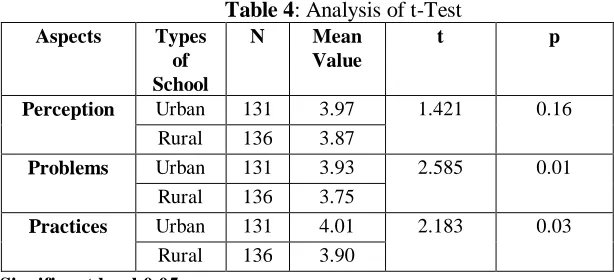
The findings show that, at the significance level of 0.05, the probability is 0.16 for the perception of teachers. Hence, the null hypothesis is accepted that there were no significant differences in perception between teachers on the implementation of SBA between rural and urban categories.
Table 4: Analysis of t-Test Aspects Types
of School
N Mean Value
t p
Perception Urban 131 3.97 1.421 0.16 Rural 136 3.87
Problems Urban 131 3.93 2.585 0.01 Rural 136 3.75
Practices Urban 131 4.01 2.183 0.03 Rural 136 3.90
Significant level 0.05
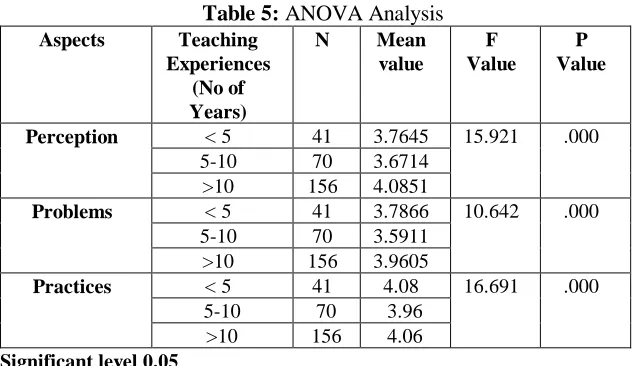
For the differences between teaching experience, ANOVA analysis showed that all the significant value is less than 0.05. Therefore, the null hypothesis can be rejected and it can be confirmed that there are significant differences in the perception of teachers, the problems teachers face and their practices in conducting SBA based on years of experience.
ANOVA analysis (Table 5), showed that all the significant value is less than 0.05. Therefore, the null hypothesis can be rejected that there are significant differences in the perception, practices and problems of teachers in the implementation of the SBA in Primary School Standard Curriculum.
Primary School In Kluang, Johor
Table 5: ANOVA Analysis Aspects Teaching
Experiences (No of Years)
N Mean value
F Value
P Value
Perception < 5 41 3.7645 15.921 .000 5-10 70 3.6714
>10 156 4.0851
Problems < 5 41 3.7866 10.642 .000 5-10 70 3.5911
>10 156 3.9605
Practices < 5 41 4.08 16.691 .000 5-10 70 3.96
>10 156 4.06 Significant level 0.05
1.8 Conclusion and Discussion
This study is about the implementation of school based assessment in the Primary School Standard Curriculum. The study focuses on teachers’ perception, practices and problems for the implementation of SBA in the curriculum. The findings of the study show that teacher as the respondents are ready to implement SBA in the curriculum. The findings on the understanding of SBA in this study is in parallel with the findings of a study by Faizah A Majid (2011) who made a study of English teachers teaching in Malaysian public schools. The findings show that teachers do understand about the implementation of SBA. Findings from a study made by Ismadiah Omar (2012) show that gender and experience does not affect the implementation about SBA among teachers.
The study also found that teachers who teach in urban schools face problems in implementing SBA effectively and systematically. This is because of the heavy workload the teachers are burdened with. The workload is caused by the large number of students, number of classes taught and the large number of instruments to be used for testing students. Teachers also need to systematically manage the SBA documentary, especially in terms of reporting students’ results.
The study is an effort to understand more about perception, practices and problems of teachers in the implementation of the SBA in Primary School Standard Curriculum.
8.0 Suggestions
This study is perception, practices and problems of teachers in the implementation of the SBA in Primary School Standard Curriculum limited to small sample size and one district in Johor. As for further research, it is suggested to broaden the aspects of the study to acquire a broader perspective about the smoothness of SBA implementation for the improvement of overall Primary School Standard Curriculum implementation. It is also suggested to have larger sample size, which includes teachers from all zones in Malaysia including East Malaysia in order to produce a representative sample which will allow generalization to be made to a wider population.
Although the results of this study show high scores for problems faced by teachers in implementing SBA in Primary School Standard Curriculum. The ongoing efforts made by the Ministry of education will realize the aspiration enshrined in the terms of National Philosophy of Education.
REFERENCES
Primary School In Kluang, Johor
achievement. Proceeding ICMEE 2006. Penang: Universiti Sains Malaysia.
2. Abu Bakar Nordin, Dr (1986) “Asas Penilaian Pendidikan”. Kuala Lumpur : Heinemann (Malaysia) Sdn Bhd.
3.Azura Ab Rasid (2005). Permasalahan Yang Dialami Dalam Pelaksanaan Pentaksiran On-line bagi kurikulum Bestari Di Sebuah Sekolah Menengah Di Kuala Lumpur Serta Pendekatan Awal Untuk Mengatasinya. Laporan Kajian Pendidikan Ijazah Sarjana Muda,UTM, Skudai.
4.Azizi Yahya, Shahrin Hashim, Jamaludin Ramli, Yusof Boon, Abdul Rahim Hamdan (2006). “Menguasai Penyelidikan Dalam Pendidikan”. Kuala Lumpur: PTS Profesional Publishing Sdn. Bhd.
5.Azizi Hj. Yahaya. (1998). Satu Penilaian Terhadap
Keberkesanan Program Kemahiran Hidup Di sekolah Menengah Di Malaysia Berdasarkan Model KIPP. Thesis Doktor Falsafah yang Tidak di Terbitkan.UPM
6.Azizi (2007), Penggunaan Model KIPP Dalam Penilaian Matapelajaran Kemahiran Hidup Di Sekolah-Sekolah
Menengah Di Malaysia Jurnal Pendidikan UTM.
7.Ismadiah Omar (2012). Pelaksanaan Pentaksiran Berasaskan Sekolah (PBS) Di Sekolah - sekolah Kebangsaan Gelang Patah, Johor.
8.Lembaga Peperiksaan Malysia (2007). Modul Penataran Pentaksiran Berasaskan Sekolah (PBS). Kementerian Pelajaran Malaysia.
9.Lembaga Peperiksaan(2010). Panduan Dan Peraturan Pentaksiran Berasaskan Sekolah Rendah Dan Menengah.Kementerian Pelajaran Malaysia.
10.Mohd Najib Abdul Ghafar (1998). Penyelidikan Pendidikan. Skudai: Universiti Teknologi Malaysia.
11.Khodori et al. (2006). Pentaksiran Berasaskan Sekolah – Cara Australia. Utusan Malaysia (Sisipan Khas Kementerian Pelajaran Malaysia), 26 Oktober 2006.
Berasaskan Sekolah di Institut Aminuddin Baki. 5 Okt 2011.
13.Mohd Salleh Lebar (1996). Pengenalan Ringkas Sosiologi Sekolah Dan Pendidikan. Selangor : Thinkers Library Sdn Bhd.
14.Esah.Sulaiman (2004), Modul Pengajaran Asas Pedagogi Jabatan Asas Pendidikan, Fakulti Pendidikan. Universiti Teknologi Malaysia. Cetak Ratu Sdn. Bhd
15.Sharifah Nor Binti Puterh.1998.Kajian Pelaksanaan Pentaksiran Kendalian Sekolah Menengah ( PKSM ). Kertas
Penyelidikan 12. Penyelidikan PendidikanKe Arah