76:13 (2015) 95–99 | www.jurnalteknologi.utm.my | eISSN 2180–3722 |
Jurnal
Teknologi
Full Paper
S
URFACE
P
LASMON
R
ESONANCE
S
ENSOR OF
S
ILVER
F
ILM
B
ASED ON
K
RETCHMANN
C
ONFIGURATION
Hood-Hong Ley, Asiah Yahaya, Yusof Munajat
*Applied Optics Research Group, Department of Physics, Faculty of
Science, Universiti Teknologi Malaysia, 81310 UTM Johor Bahru,
Johor, Malaysia
Article history Received 10 February 2015 Received in revised form
30 Mei 2015 Accepted 30 June 2015
*Corresponding author
[email protected]
Graphical abstract
Abstract
Performance of a surface plasmon resonance (SPR) sensor based on Kretchmann configuration for silver (Ag) film is evaluated via theoretical simulation. The film thickness and incident angle are varied to obtain the SPR wavelength in the range of 500-550 nm. Shift of SPR wavelength with refractive index of the dielectric defines the sensitivity whereas the resolution is obtained from the ratio of the instrumental resolution to the sensitivity. The SPR sensor shows increasing sensitivity for thicker film however the absorption magnitudes of such films are high and unfavourable for data acquisition. Film thickness of 45 nm and 50 nm which has good sensitivity and resolution with high absorbance magnitude of the SPR wavelength is the best thickness to be employed for sensing purpose.
Keywords: Surface Plasmon resonance, refractive index, sensor, Fresnel equation
Abstrak
Prestasi penderia permukaan plasmon resonans (SPR) berdasarkan konfigurasi Kretchmann untuk filem tipis perak (Ag) dinilai melalui simulasi berangka. Ketebalan filem dan sudut tuju dimanipulasikan untuk mendapatkan gelombang SPR dalam nilai 500-550 nm. Penderia SPR menunjukkan peningkatan dalam kesensitifan untuk filem yang lebih tebal. Namun begitu, magnitud penyerapan untuk filem tebal amat rendah dan tidak sesuai untuk tujuan perolehan data. Didapati filem dengan ketebalan 45 nm dan 50 nm paling sesuai untuk digunakan sebagai penderia indeks pembiasan kerana mempunyai magnitud penyerapan yang tinggi serta panjang gelombang SPR dalam nilai yang dikehendaki.
Kata kunci: Resonans plasmon permukaan, index pembiasan, penderia, persamaan Fresnel
© 2015 Penerbit UTM Press. All rights reserved
1.0 INTRODUCTION
Surface plasmon is an electromagnetic wave generated by the surface electrons of a conductor. The resonance phenomenon refers to the excitation of surface plasmon wave by incident photons specifically the transverse magnetic polarised (TM) or p-polarised. Hence, surface plasmon resonance (SPR) is observed when the light which reflects off the metal surface exhibit an abrupt decrease in the intensity of specific
wavelength known as the SPR wavelength [1-3]. The resonance condition depends on the incident wavelength, dielectric of the metal film, and the refractive index of the surrounding. Such properties of SPR is appealing as a sensitive method for measuring the change in refractive index and thus has ushered in various researches with promising applications in the field of biosensor.
configuration known as prism coupling, grating coupling or waveguide coupling [4]. Prism coupling method is further specified into two configurations known as Kretchmann’s configuration and Otto’s configuration. In this paper, our simulation construct is based on Kretchmann’s schematic for silver film. The film thickness and the photon’s incident angle is varied in order to design a sensor with corresponding SPR wavelength in the region of 500-550 nm. This study serves as preliminary result as part of our optimisation process of SPR sensor in the case of optical fibre sensor. Hence, the incident angles are chosen to be similar as the angle at which the rays would propagate in a fibre. Performance of the sensor is characterised in terms of its sensitivity and resolution.
2.0 THEORETICAL SIMULATION
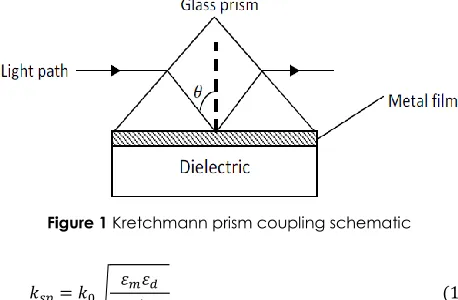
Kretchmann’s configuration is shown in Figure 1. Metal film in this study is silver film and the dielectric layer is the medium at which the refractive index is to be measured. Condition for excitation of surface plasmon wave is dependent on the wave vector of the incident light, such that the resonance condition will occur when equation 1 and 2 is equal [1-4].
Figure 1 Kretchmann prism coupling schematic
𝑘𝑠𝑝= 𝑘0√ 𝜀𝑚𝜀𝑑 𝜀𝑚+ 𝜀𝑑
(1)
𝑘𝑥= 𝑘0𝑛𝑝𝑟𝑖𝑠𝑚sin 𝜃 (2)
where 𝜀𝑚 is the dielectric constant of metal film, 𝜀𝑑 is
the dielectric constant of the surrounding dielectric layer, 𝜀𝑝𝑟𝑖𝑠𝑚 is the dielectric constant of the prism, 𝑘0 is
the wave vector in free space and 𝜃 is the incident
angle from the normal of the interface.
Applying Fresnel’s equation according to the configuration in Figure 1, for a three layer system, the reflectance magnitude of the light is given by equation (3) [1-3,5,6];
𝑅 = |𝑟123𝑝 |2= |𝑟12 𝑝
+ 𝑟23𝑝𝑒2𝑖𝑘2𝑑2
1 + 𝑟12𝑝𝑟23𝑝𝑒2𝑖𝑘2𝑑2|
2
(3)
where 𝑟123𝑝 is the reflection coefficient for layer 1 to 3, 𝑟𝑖𝑗𝑝 is the reflective coefficient at the boundary of layer 𝑖 and 𝑗, 𝑑2 is the thickness of the gold film, 𝑘𝑖(𝑗) is the
wave vector propagating from medium 𝑖 to 𝑗 given by
equation 4 and 5 respectively [4,5].
𝑟𝑖𝑗𝑝=𝑘𝑖 𝑛𝑖 2 ⁄ − 𝑘𝑗⁄𝑛𝑗2 𝑘𝑖⁄𝑛𝑖2+ 𝑘𝑗⁄𝑛𝑗2
(4)
𝑘𝑖(𝑗)= 𝑘0√𝜀𝑖(𝑗)− 𝜀𝑝𝑟𝑖𝑠𝑚sin2θ (5)
The SPR spectrum is simulated for silver film of several thicknesses to obtain the corresponding thickness which gives the SPR wavelength in the range of 500 – 550 nm. Film thickness of 20 – 60 nm was simulated with the step of 5 nm where its SPR wavelength is plotted for incident angle 76° to 86° with 2° increment. For the selected film thickness of desired SPR wavelengths, the SPR variation with refractive index is investigated for dielectric medium of refractive index 1.3300 to 1.3360 RIU with 0.0005 RIU increment. The performance of the sensor is then evaluated by determining the sensitivity as the ratio of the shift in SPR wavelength with refractive index of the dielectric layer, where as the resolution is given by the instrumental resolution divided by the sensitivity, where in this simulation the wavelength resolution is set to be 0.13 nm
3.0 RESULTS AND DISCUSSION
Figure 2 SPR wavelength for various film thicknesses
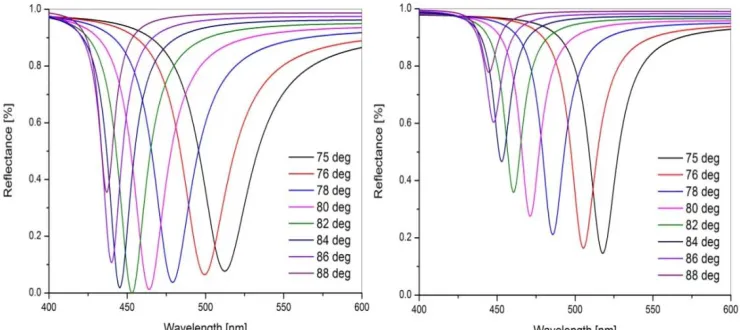
Extending the analysis for selected film thicknesses, the plot of the reflectance as a function of wavelengths obtained from equation (3) for selected incident angles is shown in Figure 3 for film thickness 45 nm and 60 nm to demonstrate the shift in the minimum of the reflectance curve with incident angle. Flexibility of SPR sensor allows the SPR wavelength to be tuned into the desired wavelength region by varying the film thickness and the incident angle. However, another point to consider is that for thicker film at higher incident angle shows a shallow dip in the reflectance which may pose difficulties in terms of data acquisition
as for detector which are subjected to electronic noise, the SPR wavelength measured will be erroneous. For that matter, it is best to design the sensor such that its reflectance magnitude of the SPR wavelength is lower than 50%. Decrease in the absorption for thicker film is due to the lower field amplitude of the evanescent wave that is able to penetrate the metal film. Figure 4 and 5 are plotted for the same refractive index of the dielectric layer which is set to 1.3300. Figure 4 illustrate the variation of reflectance curve as a function of wavelength for the selected film thicknesses.
Figure 4 Variation of SPR wavelength with incident angle (left) 45 nm and (right) 60 nm film thicknesses.
Figure 5 SPR profiles for various film thickness at incident angle 75° (left) and 88° (right).
Table 1 Sensitivity and resolution of the SPR sensor
Film thickness [nm] Sensitivity [𝝁𝒎/𝑹𝑰𝑼] Resolution [RIU]
45 2.109 6.162 × 10⁻⁵
50 2.138 6.079 × 10⁻⁵
55 2.162 6.010 × 10⁻⁵
60 2.163 6.010 × 10⁻⁵
Figure 5 shows that for the same incident angle and the same refractive index of the dielectric value, the SPR profile changes with the value increases for thicker film and the shape of the curve also exhibit distinction in terms of the FWHM. Ideally, the profile with sharper peak is desired for easy identification of SPR wavelength than that of a broader peak. Notice that for incident angle of 75°, the sharpness of the SPR profile increases with film thickness where for all thicknesses the reflectance magnitude is of acceptable value. However for higher incident angle the thicker shows SPR profile with high reflectance percentage such that only the film thickness of 45 nm and 50 nm is acceptable to ensure a sensor designed to give good repeatability of results.
the amount to solute or the concentration, thus this method can be used to measure the concentration of a solution. Our result is in agreement in terms of the magnitude of sensitivity as compared to the work by [8] who deposited silver film on optical fibre for measuring the refractive index of liquid samples.
4.0 CONCLUSION
The working principle of a SPR sensor based on silver film is demonstrated for measuring the change in refractive index of the surrounding dielectric medium for a Kretchmann’s configuration via simulation. Dependence of the SPR profile is studied by manipulating the film thickness and incident angle. Performance of a SPR sensor shows a higher sensitivity and decreasing resolution for higher film. Further increment of the film thickness for high sensitivity is not favourable due to the nature of the evanescent wave. The results suggest that the film thickness of 45 nm and 50 nm is best suitable for measuring change in refractive index in the wavelength region of 500 – 550 nm.
Acknowledgement
This work is supported by the Research Grant University (GUP) from Universiti Teknologi Malaysia of vote number Q.J130000.2526.08H59.
References
[1] Huang Y. et al. 2011. Research on Surface Plasmon Resonance Sensor Based on Wavelength Modulation By Using Theoretical Simulation. Third International Conference
on Measuring Technology and Mechatronics Automation.
83-86.
[2] Ho. H. P. and Wu S. Y. 2007. Simulation of a Novel High Sensitivity and Wide Dynamic Range Phase-Sensitive Surface Plasmon Resonance Sensor. Conference on
electron Devices and Solid State Circuits, IEEE. 301-304.
[3] Ng, S. P. et al. 2008. A White-light Interferometric Surface Plasmon Resonance Sensor with Wide Dynamic Range and Phase-sensitive Response. Conference on Electron Device and Solid State Circuits, IEEE, IEEE. 1-4.
[4] Maier, S. A. 2007. Plasmonics, Fundamentals and
Applications. Bath; Springer.
[5] Marcuse, D. 1974. Theory of Dielectric Optical Waveguides. New York: Academic Press.
[6] Yeh, P. 2005. Optical Waves in Layered Media. New Jersey; Wiley.
[7] Sharma, N. K. 2012. Performances of Different Metals in Optical-fibre Based Surface Plasmon Resonance Sensor.
Pramana. 78: 417-427
[8] Balaa, K. et al. 2007. Experimental Realization and Numerical Simulation of Wavelength-Modulated Fibre Optic Sensor Based on Surface Plasmon Resonance.