GAO FEI. Controller in Core: An Adaptive Microarchitectural Model for System-level Optimization. (Under the direction of Professor Suleyman Sair).
Modern processors are utilizing more complex microarchitectures to extract more
Instruction Level Parallelism (ILP) / Thread Level Parallelism (TLP) to improve
perfor-mance. In addition to performance concerns, power and thermal issues have also become
important for microprocessor designers because of the increasing power/heat density and
resulting cooling costs. Meanwhile, many runtime architectural optimization approaches,
called adaptive microarchitectures, are proposed to optimize system resources dynamically
based on the characteristics of applications. However, most of them focus on
improv-ing a specific microarchitecture component or metric. In this dissertation, we argue that
system-wide optimization is the future of adaptive microarchitectures that can balance the
tradeoffs between different optimization choices to achieve maximum overall performance.
We propose a runtime optimization architectural model - Controller in Core (CiC), which
uses a dedicated element to synthesize and analyze the system-wide runtime information
and make judicious optimization decisions. To demonstrate the CiC model, we present a
performance-oriented adaptive microarchitecture - an adaptive value predictor that tailors
its value prediction functionality based on runtime system performance bottleneck analysis.
We propose an event counter based performance model that can accurately estimate the
performance cost for critical system events. Based on this model, we propose the bottleneck
vector as the basis of long-term performance bottleneck analysis and a runtime bottleneck
phase tracking scheme. In addition, three bottleneck phase prediction schemes are studied.
predictor achieves 30% and 10% average performance gains when compared to the baseline
by
Fei Gao
A dissertation submitted to the Graduate Faculty of North Carolina State University
in partial fulfillment of the requirements for the Degree of
Doctor of Philosophy
Electrical and Computer Engineering
Raleigh
2006
Approved By:
Dr. Vincent Freeh Dr. Yan Solihin
Dr. Suleyman Sair Dr. Thomas M. Conte
Fei Gao is born in Xi’an - the old capital of China. He graduated from University of Science
and Technology of China (USTC) with M.S. and B.E. degree in Electronical Engineering
in June 2001. Then he entered into Ph.D. program of ECE Dept. of North Carolina State
University (NCSU). His research focuses on adaptive microarchitecture, data prefetching
and branch prediction. Following graduation, he will work in Mathworks as senior software
I would like to thank all the members of my committee for their advice and help: My
advisor - Dr. Suleyman Sair, Dr. Tom Conte, Dr. Yan Solihin and Dr. Vincent Freeh.
I would also like to thank my parents, sister and friends - without them, none of this
would be possible.
Contents
List of Figures vii
List of Tables ix
1 Introduction 1
2 Related Work 6
2.1 Energy-efficient adaptive microarchitectures . . . 6
2.2 Temperature-aware microarchitecture . . . 9
2.3 Performance-oriented adaptive microarchitectures . . . 10
2.4 Performance modeling . . . 12
2.5 Long-term program behavior . . . 14
2.6 Value prediction . . . 16
3 Controller in Core 20 3.1 CiC concept . . . 20
3.2 CiC logical feedback control model . . . 22
3.3 CiC chip floorplan . . . 24
4 Methodology 26 4.1 Simulator . . . 26
4.2 Benchmarks . . . 26
5 Performance Bottleneck Modeling 28 5.1 Performance modeling . . . 28
5.2 Performance bottlenecks . . . 31
5.2.1 Superscalar out-of-order microarchitecture . . . 31
5.2.2 Potential performance bottlenecks . . . 32
5.3 Counter-based performance bottleneck modeling . . . 34
5.3.1 Long-term event cost model . . . 35
5.3.2 Model verification . . . 37
5.4 Performance bottleneck phase tracking . . . 38
5.5 Performance bottleneck phase prediction . . . 44
6 Adaptive Value Predictor 48 6.1 Motivation . . . 48
6.2 Traditional value predictor . . . 52
6.3 Branch predictor assistant . . . 53
6.4 Data prefetching . . . 54
6.5 Instruction prefetching . . . 55
7 AVP CiC Design 57 7.1 AVP monitor . . . 57
7.2 AVP controller . . . 58
7.2.1 Controller operations . . . 58
7.2.2 Adaptation algorithm . . . 61
7.3 AVP default configurations . . . 65
8 Results 68 8.1 Adaptive vs. non-adaptive . . . 68
8.1.1 Speedup . . . 68
8.1.2 AVP behavior . . . 74
8.2 Comparison of adaptation algorithms . . . 75
8.2.1 History vs. Greedy algorithms . . . 75
8.2.2 conservative vs. Greedy algorithms . . . 78
8.3 Sensitivity study . . . 80
8.3.1 Sampling interval sensitivity . . . 80
8.3.2 Value predictor size sensitivity . . . 81
8.3.3 Cost unit sensitivity . . . 82
9 Conclusion 85
List of Figures
3.1 CiC feedback control model . . . 21
3.2 An example CiC floorplan . . . 24
5.1 7 stage out-of-order superscalar microarchitecture . . . 30
5.2 Major performance constraints . . . 33
5.3 Performance model . . . 35
5.4 Performance model verification . . . 39
5.5 Bottleneck Vector . . . 41
5.6 bzip2 performance bottleneck behavior . . . 42
5.7 gap performance bottleneck behavior . . . 42
5.8 gcc performance bottleneck behavior . . . 42
5.9 mcf performance bottleneck behavior . . . 43
5.10 vpr performance bottleneck behavior . . . 43
5.11 Bottleneck phase tracking architecture . . . 45
5.12 Prediction accuracy vs. phase ID numbers . . . 46
5.13 Bottleneck phase predictors . . . 47
6.1 Performance gain with ideal components . . . 49
6.2 Performance of traditional value predictor . . . 53
6.3 Branch prediction accuracy improvement with BPVP . . . 54
6.4 DL2 cache miss rate . . . 55
6.5 IL1 cache miss rate . . . 56
7.1 AVP Monitor . . . 58
7.2 AVP Controller . . . 59
8.1 Performance results of the AVP with the greedy algorithm . . . 69
8.2 Speedup of the AVP with the greedy algorithm . . . 70
8.3 Execution breakdown of 4 function choices . . . 70
8.4 AVP mcf behavior with the greedy algorithm . . . 76
8.5 AVP bzip2 behavior with the greedy algorithm . . . 77
8.6 Comparison of the three adaptation algorithms . . . 78
List of Tables
4.1 Architectural configurations . . . 27
4.2 The benchmarks studied in this dissertation . . . 27
7.1 Notes for algorithm description . . . 61
Chapter 1
Introduction
Over the past few decades, general-purpose microprocessors have been evolving
into million-transistor-on-chip systems from the first generation thousand-transistor
micro-processors at the beginning of 1970’s. The performance and complexity of micromicro-processors
increase steadily along with hardware budgets, from 4 bits to 32 and 64 bits, from
in-order single instruction execution cores to out-of-in-order superscalar and SMT (Simultaneous
Multithreading) designs, and from a single core to CMPs (Chip Multiprocessors). As the
number of on-chip transistors increases and the feature size decreases, power density in
mi-croprocessors has doubled almost every three years. Power dissipation has become a critical
design constraint in high performance microprocessors. Because energy consumed by the
microprocessor is converted into heat, the heat density is increased as well. The
exponen-tial rise in heat density is creating vast difficulties in reliability and high manufacturing
cost. Generally, the design process is an optimization problem involving a number of
power consumption, hardware cost and architectural parameters. Exhaustive exploration
of this design space is impractical. In practice, the common methodology is to limit the
variable values based on past experiences to shrink the search space, and then to evaluate
designs in this space using benchmark suites. In general, the parameter choices are made to
achieve bestaverage performance. The resulting design uses these fixed hardware resources,
functionalities and parameters across all applications.
Yet, distinct applications have different characteristics. Their need for particular
hardware resources, such as caches, issue queues, etc., vary significantly from application
to application. For general-purpose microprocessors with fixed parameters yearning for
good average performance, it comes as no surprise that a specific configuration may not
be the optimal choice for certain applications. If an individual application’s requirements
do not match well with this particular configuration, the program may even exhibit poor
performance. On the other hand, special-purpose processors can achieve significant
perfor-mance gains on some specific applications, such as digital signal processing and graphics
applications, because of their customized designs. In addition to the different
characteris-tics of applications, several studies [13, 45] show that even a single application may exhibit
significant variability during execution. The entire program execution consists of many
por-tions with similar behavior, calledprogram phases. Each phase may be quite different from
others, while still having homogeneous behavior within a phase. Varying program phase
behavior introduces another form of performance loss for fixed-parameter microprocessors.
Because of these inefficiencies in fixed-parameter general purpose microprocessor
mi-croarchitectures, to improve performance, power efficiency or thermal management. Unlike
fixed-parameter designs, adaptive microarchitectures build flexibility into the chip, some
design parameters can be reconfigured dynamically to meet application needs. With the
increasing architectural complexity of a modern microprocessor, more architectural
compo-nents become the target of runtime optimizations. Typical targets include instruction and
data caches [1, 3, 29], pipeline width [2, 20] and issue queue [8, 19]. In addition, voltage and
frequency scaling schemes have been shown to be very effective techniques for power and
thermal management. For example, Dynamic Voltage Scaling (DVS) [37] switches supply
voltage to low levels that results in lower execution frequency to reduce power consumption.
Multiple Clock Domains (MCD) [42, 41] divides a chip into different clock domains that run
at different frequency scaling regimes to save power. Recently, researchers propose several
temperature aware microarchitectures and dynamic thermal management (DTM) [6, 34, 46]
schemes to optimize thermal management.
Considering the many choices in reconfigurable microarchitectural components and
runtime optimization targets, we argue that a dedicated hardware component to analyze the
system-wide information to make optimization decisions is a worthy way to maximize the
benefits from system resources. For example, if there are multiple on-chip components with
saving modes, system-wide information can guide the system to the proper
power-saving mode to minimize performance loss. In addition to guiding system-wide optimization,
system-wide information analysis can benefit local optimizations as well. For example, a
cache can turn part of a bank off to save power. Typically, those schemes are guided by
If there is system-wide performance analysis that can estimate the performance impact of
cache misses, a more efficient power saving strategy can be applied.
In this dissertation, we introduce a microarchitectural model, Controller-in-Core
(CiC), to implement system-wide runtime optimization. We propose using a dedicated
hardware component to analyze system-wide performance information to guide the
adapta-tions of adaptive unit(s). Logically, the CiC adaptation procedure can be represented by a
feedback control model. There are two main elements in this control system: the adaptive
unit(s) and the control unit. The adaptive unit is the target of adaptive design, typically it
is one of the hardware components or parameters of a processor. Unlike a fixed-parameter
design, an adaptive unit is featured with extra control circuitry that enables
reconfigura-tion during program execureconfigura-tion. The key point of CiC is guiding runtime optimizareconfigura-tions
with the consideration of system performance and different optimization tradeoffs by using
system-wide information instead of local information, to maximize the benefit of adaptive
resources. There are two fundamental functions related to CiC design - distributed system
information collecting and centralized information analysis. Corresponding to these two
functions, there are two logical components inside CiC - a monitor and a controller. The
monitor is in charge of collecting system-wide information and the controller is for
informa-tion processing. CiC is a conceptual design model and its implementainforma-tion depends on the
specific microarchitecture and adaptation choices.
To demonstrate the CiC model, we present a performance-oriented adaptive
mi-croarchitecture design - an adaptive value predictor (AVP), which can adapt its functionality
patterns of register values and predict them to break data dependencies in early stages,
in-stead of waiting for results to resolve, to improve ILP. A value predictor can also be used to
help a branch predictor by predicting values and precomputing branch outcomes. And also,
the value prediction table and computation logic can be used to produce memory address
prediction for prefetching. The key idea of an adaptive value predictor is using a controller
to analyze system runtime performance bottlenecks and make adaptation decisions to
max-imize the performance benefit of a value predictor. For this purpose, we propose a runtime
performance bottleneck analysis model. Compared to the prior program phase work, our
scheme knows where the performance limitations are. It identifies performance bottlenecks
and applies optimizations accordingly, instead of searching for the optimal configuration like
prior phase guided work does. We believe the CiC model can open the door for new adaptive
microarchitectures and motivate microarchitects to produce more efficient adaptive designs.
The rest of this dissertation is organized as follows. We discuss the related work
in Chapter 2. In Chapter 3, we describe the CiC concept in detail. Chapter 4 presents
methodology of our experiments. In Chapter 5, we propose a runtime performance
bottle-neck analysis model. Chapter 6 presents a CiC application - adaptive value predictor. In
Chapter 7, we present AVP monitor and AVP controller designs in detail. Chapter 8
de-scribe AVP results. Finally, Chapter 9 concludes this dissertation and presents some future
Chapter 2
Related Work
This chapter summarizes the relevant prior work on adaptive microarchitectures
and value prediction. We divide the past adaptive microarchitecture work into three
cat-egories - energy-efficient, performance-oriented and thermal-aware. They are discussed in
the following sections respectively.
2.1
Energy-efficient adaptive microarchitectures
A number of proposals have been made for dynamically adapting the processor to
achieve energy efficiency improvements.
Cache is the most active target of energy-efficient adaptivity because of its high
percentage of total chip power consumption. Furthermore, caches have a regular structure
and this makes adaptation control relatively easy from a circuit design perspective.
Al-bonesi [1] proposes selective cache ways, which dynamically turns off cache ways to reduce
as-sociative caches in order to disable ways of the cache during the period where full cache
functionality is not required to reduce power dissipation with a small performance loss.
Bal-asubramonian et al. [3] propose a single-level cache hierarchy, instead of the conventional
multi-level design. This cache behaves as a virtual two-level cache hierarchy, and the sizes
and associativities of these two levels are configurable. They dynamically detect the phase
changes in an application by monitoring cache and TLB usage and reconfigure the cache
hierarchy to reduce dynamic energy dissipation. Kaxiras et al. [29] reduce leakage power
by invalidating and turning off the cache lines when they hold data that is not likely to be
reused, based on the observation that cache lines are frequently used when first brought
into the cache, and then have a period of dead time before they are evicted. Kim et al. [31]
and Flautner et al. [18] propose a dynamic voltage scaling approach to implement a drowsy
cache, where one can choose between two different supply voltages in each cache line. They
observe that during a fixed period of time the activity in a cache is only centered on a
small subset of the lines. They then exploit this behavior to reduce the leakage power of
large caches by putting the cold cache lines into a state preserving, low-power drowsy mode.
Moving lines into and out of drowsy state incurs a slight performance loss.
Similarly, the issue logic, as one of the most complex and power-consuming parts of
a dynamically scheduled superscalar processor, is an important adaptive structure.
Foleg-nani et al. [19] propose an issue queue scheme with the ability to dynamically resize the
queue, based on the observation that mostly older instruction queue entries are used for
issuing. They divide the entire instruction queue into 16 parts of eight entries each. Based
to avoid the unnecessary search of parallel instructions in parts of the queue that hardly
contribute to performance.
Buyuktosunoglu et al. [8] proposed an alternative circuit design for an adaptive
issue queue. They divide the issue queue into separate chunks, connected via transmission
gates. These gates are controlled by signals which determine whether a particular chunk is
to be disabled to reduce the effective queue size. The queue size control signals are derived
from counters that keep track of the active state of each entry on a cycle-by-cycle basis.
After an execution interval, the decision to resize the queue can be made based on activity
information.
In [2] Pipeline Balancing (PLB) is proposed. This scheme dynamically tunes the
pipeline resources (issue width, function units) of a general purpose processor to the needs
of the program by monitoring performance within each program. They analyze metrics
(Issue IPC and Floating Point Issue IPC) for triggering PLB, and detailed instruction
queue design, and observe the energy savings based on an extension of the Alpha 21264
processor. Soraya et al. [20] present an architectural mechanism that dynamically chooses
between different processor configurations, in-order, out-of-order and pipeline-gating, that
throttles instruction fetch to limit the speculative execution, by predicting IPC variation.
Dynamic voltage and frequency scaling of the CPU has been identified as one of
the most effective ways to reduce energy consumption of a program. The total execution
time (T) and energy consumption (E) of a program can be estimated by T ≈ W · 1
f and
E ≈C·W ·V2 where W is the total number of execution cycles, f is the clock frequency, C
be independent of frequency f. Since in dynamically voltage scaled (DVS) systems V varies
approximately linearly with f (V ∝f), the performance-energy tradeoff of frequency scaling
can be expressed as slowing down the clock frequency, which results in energy savings at the
cost of decreased performance. Several manufacturers, such as Intel and Transmeta, have
developed processors capable of global dynamic frequency and voltage scaling. Most current
DVS related work [10, 25] has been focused on determining appropriate clock frequencies
with respect to a predefined deadline for real-time systems. The basic idea is to recognize
CPU slack time and then scale voltage and frequency to save power while meeting the
deadline.
As clock frequency increases and feature size decreases, clock distribution and wire
delays present a growing challenge to the designers of singly-clocked, globally synchronous
systems. Semeraro et al. [42] propose a Multiple Clock Domain (MCD) processor, in
which the chip is divided into several clock domains, within each of which independent
voltage and frequency scaling can be performed. In their work, they use four clock domains,
corresponding to the front end (including L1 instruction cache), integer units, floating point
units, and load-store units (including L1 data cache and L2 cache). Their design attains
20% energy savings with less than 4% performance loss.
2.2
Temperature-aware microarchitecture
The increase in chip power density leads to higher chip temperature, which has
a significant impact on the overall energy consumption, product reliability, and platform
is becoming a significant part of total power consumption, and this leakage is exponentially
related to temperature. Therefore, a small increase in average temperature may result in
significant energy loss for deep-submicron designs. In addition, device reliability degrades
quickly with temperature. And finally, the higher the temperature, the more expensive the
thermal solutions, and this significantly affects the platform costs.
Brooks et al. [6] propose an Icache-toggling technique, which disables instruction
fetch to control the amount of in-flight instructions, thus reducing on-chip activity and
eventually reducing temperature. Icache-toggling disables the instruction fetch unit for
a specified interval. The length of this interval depends on power saving needs. Lim et
al. [34] propose a two-pipeline microarchitecture, a core pipeline and a simple pipeline.
The core pipeline is a general superscalar out-of-order pipeline and the simple one is an
in-order scalar pipeline. During normal operation, only the primary core is operating, and
thermal sensors distributed across the die are used to detect temperature excursions. When
temperature exceeds a given threshold, core pipeline will be clock-gated and the simple
pipeline will be engaged to relieve temperature. Skadron et al. [46] propose an
architecture-level thermal model - Hotspot, based on thermal resistances and capacitances model. In
addition, they also introduce several thermal management techniques, such as temperature
tracking frequency scaling and migrating computation to spare hardware units.
2.3
Performance-oriented adaptive microarchitectures
Another category of adaptive microarchitectures is performance-oriented adaptive
system performance, based on the observed values of predetermined metrics, such as IPC,
or cache miss rate and so on.
Since accessing the memory is still a performance bottleneck in current
micropro-cessors, caches get a lot of attention in performance-oriented adaptive microarchitectures as
well. Veidenbaum [53] uses an adaptive strategy to adjust cache line size dynamically to an
application. Qureshi et al. [38] propose a mechanism to provide the ability to perform global
replacement while maintaining the constant hit latency of a set-associative cache, called the
Variable-Way Set Associative Cache, or simply V-way cache. For the V-way cache, they use
a global replacement policy based on an access frequency measure called Reuse
Replace-ment. Reuse Replacement performs comparably to a least recently used (LRU) policy at
a fraction of the hardware cost and complexity. Other studies reduce the number of cache
misses by increasing the effectiveness of the memory hierarchy.
Johnson et al. [26] present a technique for dynamic analysis of program data access
behavior, which is then used to proactively guide the placement of data within the cache
hierarchy in a location-sensitive manner. They introduce the concept of a macroblock,
which allows to feasibly characterize the memory locations accessed by a program, and a
Memory Address Table, which performs the dynamic reference analysis. Speight et al. [48]
propose simple architectural extensions and adaptive policies for managing the L2 and L3
cache hierarchy in a CMP system.
Another example of performance-oriented adaptive designs is branch history length
adaptation. Accurate branch prediction is essential for obtaining high performance in
use global branch history to exploit the correlations between branches. However, the best
global branch history length depends on the code, the input data and frequency of
con-text switches. Juan et al. [28] explore dynamic history-length fitting (DHLF) and develop a
method for dynamically selecting a history length that accommodates the current workload.
Balasubramonian et al. [4] dynamically allocate available registers between the
primary program thread and a future thread. The future thread executes instructions when
the primary thread is limited by resource availability. The future thread is not constrained
by in-order commit requirements. It is therefore able to examine a much larger instruction
window and jump far ahead to execute ready instructions. Results are communicated back
to the primary thread by warming up the register file, instruction cache, data cache, and
instruction reuse buffer, and by resolving branch mispredictions early. Cazorla et al. [9]
introduce the concept of dynamic resource control in SMT processors. Using this concept,
they propose a novel resource allocation policy for SMT processors. This policy directly
monitors the usage of resources by each thread and guarantees that all threads get their
fair share of the critical shared resources, avoiding monopolization. They also define a
mechanism to allow a thread to borrow resources from another thread if that thread does
not require them, thereby reducing resource induced stalls.
2.4
Performance modeling
In our work, we propose an event counter based performance model in order to
identify the runtime performance bottlenecks. This section discusses several methods related
Software-based analysis tools are very useful in obtaining the basic information
about a program’s execution. Simulators and instrumentation tools are widely used for this
purpose. PROTES [5], a MIMD architecture simulator, can simulate parallel machines to
provide accurate information about the timing and behavior of an application. CPROF [33],
a cache profiler, can identify cache performance bottlenecks. ATOM [51] implements a
very flexible and efficient code instrumentation tool based on OM link-time technology.
The instrumented performance analysis routines are linked with the original program with
a procedure call interface.
Meanwhile, modern microprocessors provide hardware support for performance
analysis, called event counters. These counters are built into the chip to measure
corre-sponding events. In MIPS R10000 [55], there are two event counters that can capture
30 system events. The Pentium 4 [50] processor provides 18 event counters and 48 event
detectors. These event counter based performance analysis tools provide an accurate and
valuable inside view of dynamic program behavior. However, event counters can not
accu-rately attribute those events to instructions, especially for out-of-order machines. For this
reason, Dean et al. [12] proposed an instruction-level profiling technique - ProfileMe that
samples instructions. As a sampled instruction moves through the processor pipeline, a
detailed record of all interesting events and pipeline stage latencies is collected. ProfileMe
also supports paired sampling, which captures information about the interactions between
concurrent instructions. Similarly, to reveal the interactions of different instructions, Fields
et al. [17] proposed an interaction cost model that can associate execution cycles to one
In our work, we focus on long-term performance behavior rather than fine-grain
analysis. In addition, we propose a low-overhead performance bottleneck model based on
event counters instead of expensive instruction-level statistics.
2.5
Long-term program behavior
In our work, we study the program performance bottleneck behavior from a
long-term viewpoint, based on our performance bottleneck analysis model. There is a plethora
of relevant work on long-term program behavior. In general, these techniques try to
iden-tify and predict “program phases” (the execution portions that have similar behavior) by
tracking various program signatures.
Balasubramonian et al. [3] use a conditional branch counter to detect program
phase changes. The counter keeps track of the number of dynamic conditional branches
ex-ecuted over a fixed execution interval (measured in terms of the dynamic instruction count).
Phase changes are detected when the difference in branch counts of consecutive intervals
exceeds a threshold. Their scheme does not use a fixed threshold. Rather, the detection
algorithm dynamically varies the threshold throughout the execution of the program based
on the cache miss rate and the branch frequency.
Dhodapkar et al. [13] define a program phase as the instruction working set of the
program ( i.e. the set of instructions touched in a fixed interval of time). Program phase
changes are detected by comparing consecutive instruction working sets using a similarity
metric called the relative working set distance. Because complete working sets can be too
representations of working sets called working set signatures. Signatures are compared using
a metric called the relative signature distance. Phase changes are detected when the relative
signature distance between consecutive intervals exceeds a preset (fixed) threshold. They
show that signatures as small as 32 bytes in size can be used to resolve program phases in
most benchmarks studied.
Sherwood et al. [45, 44] propose the use of basic block vectors (BBVs) to detect
program phase changes. BBVs keep track of execution frequencies of basic blocks touched
in a particular execution interval. Phase changes are detected when the Manhattan
dis-tance between consecutive BBVs exceeds a preset threshold. Because entire BBVs cannot
be stored in hardware, BBVs are approximated by hashing into an accumulator table
con-taining a few counters. Their results indicate that as few as 32 24-bit counters are sufficient
to represent BBVs in hardware.
Dhodapkar et al. [14] compare these three dynamic program phase detection
tech-niques: using instruction working sets, BBVs, and conditional branch counts. They find
BBV techniques perform better than the other techniques providing higher sensitivity and
more stable phases. Lau et al. [32] examine different program structures that are
inde-pendent from underlying architecture performance metrics for capturing phase behavior.
The structures include basic blocks, loop branches, procedures, opcodes, register usage and
memory address information. They compare these different structures in terms of their
ability to create homogeneous phases, and evaluate the accuracy of using these structures
to pick simulation points.
they detect the locality phase by examining the data reuse distances. Then they analyze
the instruction trace and identify the phase boundaries in the code. Finally, after using
grammar compression to identify phase hierarchies, they insert program markers through
binary rewriting. During execution, the program uses the first few instances of a phase to
predict all its later executions. The new analysis considers both program code and data
accesses.
The key difference between our work and previous long-term program behavior
analysis is that we focus on performance bottleneck analysis - the cause of performance
behavior - to provide system-wide performance diagnosis from a long-term viewpoint. This
helps our technique identify beneficial configurations without searching the adaptive design
space.
2.6
Value prediction
To demonstrate the CiC model, we propose an adaptive value predictor, which uses
one value prediction table to implement four functionalities based on prior value prediction
work. These functions are traditional value prediction, branch prediction through value
prediction and prefetching. We present these work in this section.
Traditional value predictors exploit “value locality” to predict register values in
order to break up data dependence chain and improve ILP. There are three typical value
stream patterns - last value, stride, and context-based. The last value predictor [36, 35] uses
the current value of an instruction as its next value prediction. The stride value predictor
between that value and the previous value. The difference between these values is called
the stride. The new value prediction is the sum of the last value and the stride. Two-Delta
stride value predictor is verified to be more accurate. It only replaces the predicted stride
with a new stride if the new stride has been observed twice. Each entry of the prediction
table contains a tag, the predicted value, the predicted stride, and the last stride. The
context predictor [39, 40] bases its prediction on the last several values seen. A table called
the Value History Table (VHT) contains the last N values seen for each entry. Another
table, called the Value Prediction Table (VPT), contains the actual value to be predicted.
An instruction’s PC is used to index into the VHT, which holds the past history of the
instruction. The history values in this entry are hashed into a single index into the VPT.
This entry in the VPT contains the value to be predicted. The context predictor is able
to keep track of a finite number of reference patterns that are not necessarily constrained
by a fixed stride. Besides the stream pattern difference, there is also value prediction
classification based on where the pattern is captured, called local and global [56] value
prediction. For local value prediction, the value stream is observed for each instruction. For
global value prediction, the value stream is observed for all dynamic instructions according
to their execution order.
Gonzalez [22] proposed a branch prediction scheme - Branch Predictor through
Value Prediction (BPVP). This branch predictor predicts the outcomes of branches by
predicting the values of their inputs and performing an early computation of their results
according to the predicted values. A chooser chooses the final prediction from a general
Data prefetching is an effective technique to tolerate memory latency. Research
shows that the memory address stream is highly predictable. There are two basic stream
patterns: stride and context. Corresponding prefetchers are proposed to capture those
patterns. A stridepredictor [11, 16] keeps track of not only the last address referenced by
a load, but also the difference between the last address of the load and the address before
that. The predictor speculates that the new address seen by the load will be the sum of the
last address value and the stride. In [16, 39], two-delta stride prefetcher is proposed, which
only replaces the predicted stride with a new stride if that new stride has been seen twice
in a row. Context[39, 40, 54] andMarkov [27] predictors are fundamentally similar, in that
each predictor bases its prediction on a set of past values seen. An orderk context/Markov
predictor uses the k past values to predict the next one. While making a prediction, the
prediction table is also updated to record transitions in the address stream dynamically.
Individual instruction cache misses are usually more expensive than data cache
misses as instruction misses stall the processor pipeline, while a significant proportion of
data misses can often be overlapped with other instructions in an out-of-order execution
en-gine. Many previous work [23, 24, 47, 49] about instruction prefetching have been proposed.
Typically, instruction prefetching can be divided into two basic categories: sequential
in-struction prefetching and non-sequential inin-struction prefetching. The simplest sequential
instruction prefetching is next-line prefetching. The prefetcher fetches next cache line when
there is an instruction cache miss. For next-line prefetching, there is also a next-N-line
derivation. For this scheme, the prefetcher fetches N next lines instead of just one.
There are some schemes to target those non-sequential misses. For example, Hsu et al. [24]
proposed “target” prefetching. They used a table to remember the sequence of cache lines
fetched. This table is searched by the current fetch address. If there is a hit, the
Chapter 3
Controller in Core
This chapter presents the CiC design model. Since CiC is a conceptual
microar-chitectural model for adaptive microarchitectures, we discuss it mostly in a logical and
conceptual scope in this chapter. Its physical design depends on the specific microprocessor
and applications.
3.1
CiC concept
Modern microprocessors have become more complex and feature more and bigger
hardware components to extract more ILP/TLP. In addition to performance, power
con-sumption becomes a critical design constraint as the power density increases. The resulting
heat density is also increasing correspondingly. Adaptive microarchitectures try to meet the
application needs with built-in flexibility. Adaptation can target practically any component
of the microprocessor, and the adaptation goals include performance, power consumption
Control Unit
1 2
3
4
Monitor Controller
Raw System information
3 Preset Parameters
2 Processed System Information 4 Adaptation Decision
1
G
(x1, …xn)H(x
1, …xn)Adaptive Units
Figure 3.1: CiC feedback control model
adaptive targets on the chip. The resulting question is how to effectively manage these
adaptation possibilities to maximize the resource usage. We propose the CiC design model
to implement the system-wide analysis as an answer to this question.
The key point of CiC is guiding runtime optimizations with the consideration
of overall system performance and different optimization tradeoffs by using system-wide
information instead of local information. There are two fundamental functions related to
CiC design - distributed system information collecting and centralized information analysis.
Corresponding to these two functions, there are two logic components inside CiC - a monitor
and a controller. The monitor is in charge of collecting system-wide information and the
3.2
CiC logical feedback control model
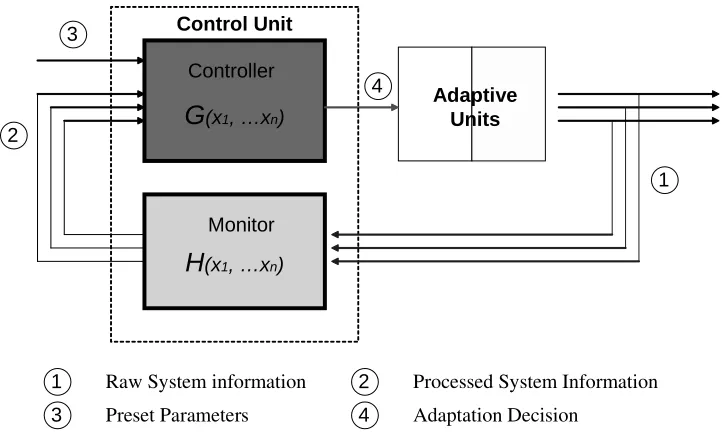
The CiC logic model is shown in Figure 3.1. Logically, the CiC adaptation
proce-dure can be represented by a feedback control model. There are two main elements in this
control system: the adaptive unit(s) and the control unit. The adaptive unit is the target
of the adaptive design, typically it is one of the hardware components or parameters of a
processor. Unlike a fixed-parameter design, an adaptive unit features extra control circuitry
that enables reconfiguration during program execution. Typical examples of adaptive units
are as follows.
• caches and TLBs - line size or associativity is adjusted to accommodate distinct
memory access patterns.
• memory hierarchy - cache resources are divided among levels of the memory hierarchy.
• branch predictor - the length of global history register can be varied during execution.
• issue window - parts of the issue window is disabled for power efficiency when the
entire issue window is not needed.
• pipeline- a portion of the pipeline resources can be turned off to save power or pipeline
can switch between in order, out-of-order, and pipeline gating modes of operation.
The control unit is the core of the CiC model. It is in charge of making adaptation decisions.
As Figure 3.1 shows, it consists of a monitor and a controller. The monitor is on the path
of the feedback loop that transmits the runtime system information back to the controller.
input of the monitor is raw system information that is related to the adaptation schemes.
The output of the monitor is the processed system information, because the raw information
can not be used for adaptation decisions directly. Usually, information processing is based
on a specific analytical model. The input of the controller consists of two parts - one is the
processed system information from the output of the monitor. The other is some preset
built-in parameters, such as threshold values that come from empirical experiments. The
output of the controller is the adaptation decision that changes the configuration of the
adaptive unit at runtime.
The CiC operation cycle is as follows.
• The monitor collects related system information across the chip. Typically, data is
collected at a fixed sampling period.
• The monitor processes the collected information, feeds the processed information back
into the controller.
• The controller analyzes the information feed and makes an adaptation decision based
on an adaptation algorithm.
• The adaptive unit tunes its configuration according to the controller’s decision.
• The reconfigured adaptive unit changes the related system information. And then a
new CiC operation cycle starts. The monitor will feed the changed system information
back into the control loop to show the effectiveness of the previous adaptation decision
L2 Cache Decoder Fetch Logic Issue Queue IL1 Sch e d u le r ROB
Int FU FP FU L/S U
Renaming ITLB DL1 DTLB A rc h T a b R e n T a b S h a d o w T a b B T B B ra c h P re d R A S In s t B u ffe r Int Queue FP Queue Load/Store Queue Reg File
Int Regs FP Regs
Decoder
Fetch Logic
Renaming Int Queue
FP Queue R e n T a b Decoder Fetch Logic Mo n ito r C o n tro lle r
Figure 3.2: An example CiC floorplan
3.3
CiC chip floorplan
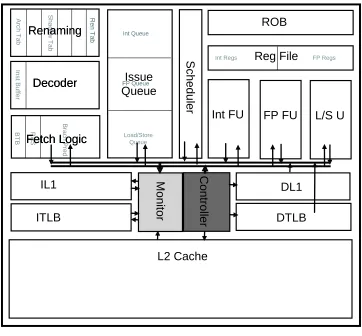
An example implementation of CiC chip floorplan is shown in Figure 3.2. It is a
hardware implementation of the CiC logic model. There is a dedicated onchip hardware
component - control unit that monitors and controls system optimizations. The monitor
implementation is similar to an event counter design, where an event detector resides in each
target component. When a corresponding event occurs, a signal is created to increment the
counter. For a sampling period, the event counters is read by the monitor and reset. And
vector and feed it into the controller. The controller is an application specific module to
Chapter 4
Methodology
4.1
Simulator
The simulator used in this study was derived from the SimpleScalar/Alpha 3.0 tool
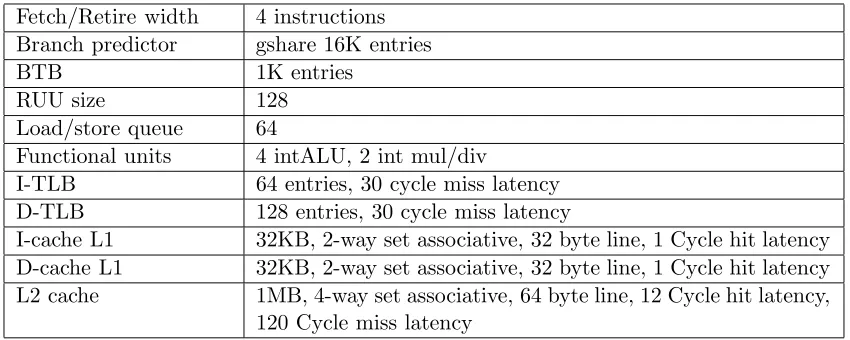
set [7], a suite of functional and timing simulation tools for the Alpha AXP ISA. Table 4.1
presents the configuration parameters for the baseline microarchitecture.
4.2
Benchmarks
This work studies 12 SPEC 2000 integer benchmarks. They aremcf, parser, vpr,
gzip, crafty,gcc,gap,parser,perl,eonandtwolf. Each program was simulated for 10
Billion committed instructions from the beginning. The benchmark details are presented
Table 4.1: Architectural configurations Fetch/Retire width 4 instructions
Branch predictor gshare 16K entries
BTB 1K entries
RUU size 128
Load/store queue 64
Functional units 4 intALU, 2 int mul/div
I-TLB 64 entries, 30 cycle miss latency D-TLB 128 entries, 30 cycle miss latency
I-cache L1 32KB, 2-way set associative, 32 byte line, 1 Cycle hit latency D-cache L1 32KB, 2-way set associative, 32 byte line, 1 Cycle hit latency L2 cache 1MB, 4-way set associative, 64 byte line, 12 Cycle hit latency,
120 Cycle miss latency
Table 4.2: The benchmarks studied in this dissertation benchmark input description
gzip input.source Compression
vpr *.in FPGA circuit placement and routing gcc 166.i C programming language compiler mcf inp.in Combinatorial optimization crafty crafty.in Chess game playing
parser ref.in Word processing eon chair Computer visualization perl splitmail PERL programming language gap ref.in Group theory, interpreter vortex lendian Object-Oriented database bzip2 input.source Compression
Chapter 5
Performance Bottleneck Modeling
The function of CiC monitor is collecting system-wide performance information for
performance bottleneck analysis. This chapter presents the performance bottleneck model
in detail.
5.1
Performance modeling
The performance of a modern microprocessor benefits from improvements in both
circuit technology and microarchitecture. Over the past decade, a typical
microarchitec-ture has evolved from in-order and scalar to out-of-order and superscalar with speculative
execution. However, as processors enjoy high instruction level parallelism from modern
mi-croarchitectures, system-level performance becomes harder to understand and the question,
“Where have the cycles gone ?”, becomes harder to answer, because many events overlap
and interact with each other. An effective performance analysis becomes more essential
optimizations.
There are many approaches developed to analyze program performance. The most
convenient way is software-based analysis tools, such as simulation [21, 5, 33] and
instru-mentation [51]. Simulation can provide details of program behavior, but causes several
orders of magnitude slowdown. Instrumenting original code can catch dynamic events, but
there still is code overhead and also the instrumentation code may change the behavior
of the original program. On the hardware side, modern microprocessors started providing
hardware support for performance analysis, called event counters [55, 50]. These counters
give an inside view of how the program interacts with the underlying hardware. Users can
access the counters with operating system and library support.
Modern microprocessors are able to execute a program at a speed of millions
of instructions per second. As a result, long-term program behavior interests researchers
because of the potential long-term optimizations, such as power and thermal management.
It has been shown that programs exhibit periods of similar behavior during their execution,
called program phases [3, 13, 45]. The reason of the phase phenomena is the regularity of
code execution. Tracking the footprint of instructions [45] and working sets [13] are typical
approaches to capture program phases.
Performance bottlenecks are both hardware and software dependent. Hardware
limitations, such as limited cache capacity, can slowdown program execution. The
charac-teristics of a program impacts performance as well, such as the amount of available inherent
code parallelism. Most previous performance bottleneck analysis are either profiling based
Next- PC logic BTB RAS PC +1 Ctl target MUX
I -TLB L1 Icache
L2 Cache MEM On-chip Off- chip L1 Dcache In st. B uff er IF Decoder Rename Table Arch map Shadow map ID IS Int Inst queue FP Inst queue Load Store queue
RR EX WB RE
A c ti v e Li s t F ree Li st Int Reg file FP Reg file
fu fu fu fu
Integer Exe Unit
fu fu
FP Exe Unit
Load & Store Unit
D -TLB BP
Figure 5.1: 7 stage out-of-order superscalar microarchitecture
instruction execution. In this paper, we analyze performance bottlenecks from a long-term
point of view. Unlike previous long-term work that catch the regular patterns of program
behavior to predict performance changes, our work provides a system-wide performance
diagnosis to find out what causes the current performance change and what the next
per-formance bottleneck will be.
In our work, we propose
• A counter-based long-term performance model to quantify the performance impact of
different system events,
• A bottleneck vector based bottleneck phase tracking scheme to capture program
bot-tleneck behavior at runtime,
5.2
Performance bottlenecks
Performance becomes hard to understand in a modern superscalar out-of-order
microprocessor because of the increasing number of inflight instructions and the
interac-tions between them. Therefore, it is necessary to review the instruction flow of a modern
microarchitecture and the potential factors that could cause performance slowdowns, before
we do further performance bottleneck analysis.
5.2.1 Superscalar out-of-order microarchitecture
Figure 5.1 shows a 7-stage out-of-order microarchitecture. The stages are IF
(In-struction Fetch), ID (In(In-struction Dispatch), IS (Issue), RR (Register Read), EX
(Execu-tion), WB (Writeback) and RE (Retire).
In the IF stage, the next instruction logic produces the next PC the processor
will fetch. The BTB (Branch Target Buffer) identifies the type of the current instruction.
For conditional branches, the branch predictor is involved for making a Taken/NotTaken
prediction. Unconditional branches are always predicted taken and the next PC is obtained
from this BTB entry. Return instructions are a special case where a RAS (Return Address
Stack) provides the return address. Otherwise, the default next PC is current PC plus one.
After generating (predicting) the next instruction address, the fetch engine accesses the
memory hierarchy to fetch the instructions into the pipeline.
In the ID stage, the fetched instruction is decoded first. Registers are renamed.
The source register is renamed by checking the renaming table. The output register gets a
is updated. Then, this renamed instruction is dispatched into the instruction issue queue
to wait for issuing.
In the IS stage, ready instructions are selected to move to EX stage, if the
corre-sponding functional units are available and issue logic has enough bandwidth.
In the RR stage, the issued instructions read values from the integer or floating
point register files or the forwarding paths.
In the EX stage, the ALU or the Floating-Point Unit executes instructions. The
execution latency is dependent on the type of instruction. Typically, division is the most
expensive instruction. Load instructions have variable latencies that depend on whether
they hit or miss in the L1 or the L2 cache.
In the WB stage, the outcome of EX stage is written back to the register file. Also,
the mispredicted branches are recovered in this stage.
In the RE stage, the instruction retires if it is safe. If the exception bit is set
for this instruction, recovery operations take place. All instructions after the exceptional
instruction are flushed and refetched.
5.2.2 Potential performance bottlenecks
There are many factors that can lead to performance loss. Based on whether the
performance constraints are hardware or software dependent, we classify those constraints
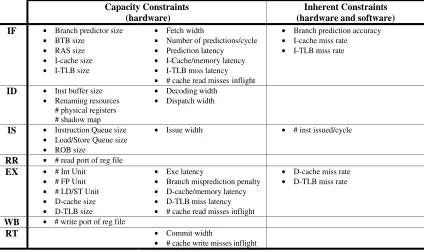
into two categories - capacity constraints and inherent constraints, which are listed in Figure
5.2. The capacity constraints are caused by limited hardware resources, such as cache size,
or read/write ports. The inherent constraints are both hardware and software dependent.
Capacity Constraints (hardware)
Inherent Constraints (hardware and software) IF • Branch predictor size
• BTB size
• RAS size
• I-cache size
• I-TLB size
• Fetch width
• Number of predictions/cycle
• Prediction latency
• I-Cache/memory latency
• I-TLB miss latency
• # cache read misses
• Branch prediction accuracy
• I-cache miss rate
• I-TLB miss rate
ID • Inst buffer size
• Renaming resources # physical registers # shadow map
• Decoding width
• Dispatch width
IS • Instruction Queue size
• Load/Store Queue size
• ROB size
• Issue width • # inst issued/cycle
RR • # read port of reg file EX • # Int Unit
• # FP Unit
• # LD/ST Unit
• D-cache size
• D-TLB size
• Exe latency
• Branch misprediction penalty
• D-cache/memory latency
• D-TLB miss latency
• # cache read misses inflight
• D-cache miss rate
• D-TLB miss rate
WB
RT • Commit width
• # cache write misses inflight inflight
• # write port of reg file
well as the branch characteristics of the program.
5.3
Counter-based performance bottleneck modeling
In this section, we present an event counter based performance model. For modern
microprocessors, event counters are becoming a standard on-chip resource. Utilizing event
counters is a low overhead mechanism to monitor the behavior of microprocessor execution.
However, for modern complex microarchitectures, event counters are not accurate enough
for fine-grain instruction-level performance analysis because of the overlapping of events and
the interaction between instructions. But, from a long-term program performance point of
view, the overlapping effect can be approximately modeled with the event counter statistics.
The goal of our counter-based performance model is to provide runtime
perfor-mance information to identify the perforperfor-mance bottlenecks that a microprocessor suffers.
As we described in Section 5.2.2, there are many constraints that impact performance.
With the consideration of hardware cost/effectiveness, investing the limited event counters
to those critical events is a reasonable choice. For our generic superscalar
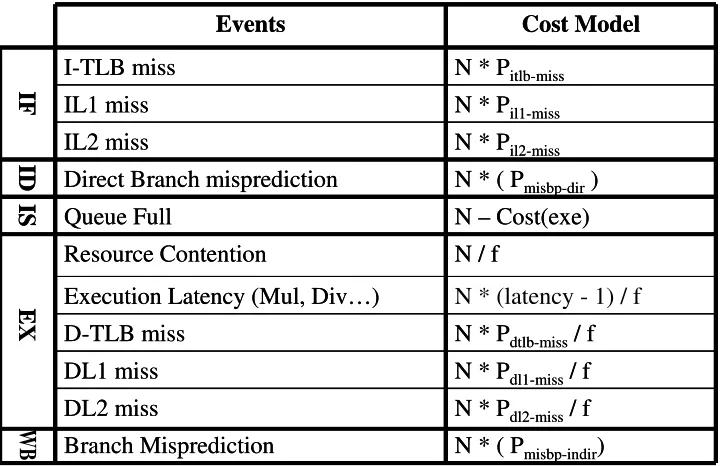
microarchitec-ture, the critical events we choose are: I-TLB miss, IL1 miss, IL2 miss, direct unconditional
branch mispredictions, issue queue being full, resource contention, expensive instructions,
D-TLB miss, DL1 miss, DL2 miss and rest of branch mispredictions. While other events
may be critical for a specific architecture or execution situation, these critical events we
define are enough to reveal the general performance behavior. In addition, our analysis
N * (latency - 1) / f
Execution Latency (Mul, Div…)
N * P
dl1-miss/ f
DL1 miss
N * P
dl2-miss/ f
DL2 miss
N * ( P
misbp-indir)
Branch Misprediction
N * P
dtlb-miss/ f
D-TLB miss
N / f
Resource Contention
E
X
N – Cost(exe)
Queue Full
IS
Direct Branch misprediction
N * ( P
misbp-dir)
ID
IL2 miss
N * P
il2-missN * P
il1-missIL1 miss
N * P
itlb-missI-TLB miss
IF
Cost Model
Events
Execution Latency (Mul, Div…)
N * P
dl1-miss/ f
DL1 miss
N * P
dl2-miss/ f
DL2 miss
N * ( P
misbp-indir)
Branch Misprediction
N * P
dtlb-miss/ f
D-TLB miss
N / f
Resource Contention
E
N – Cost(exe)
Queue Full
IS
Direct Branch misprediction
N * ( P
misbp-dir)
ID
IL2 miss
N * P
il2-missN * P
il1-missIL1 miss
N * P
itlb-missI-TLB miss
IF
Cost Model
Events
WB
Figure 5.3: Performance model
5.3.1 Long-term event cost model
The counters give the numbers of critical events for a sampling interval. However,
these numbers can not tell us how important each of them is from the whole
microproces-sor performance viewpoint. For example, we should treat L1 cache misses and L2 cache
misses differently, because the miss latency difference between them is almost 10 fold. It
is clear that different critical events have a different impact on the overall microprocessor
performance. Our model tries to translate those raw numbers of different events into a
quantitative representation of performance. The modeling of each event is shown in Figure
5.3.
• I-TLB miss: An I-TLB miss causes a fetch engine stall. The cost of I-TLB miss
when instruction fetch is stalled, a pipeline bubble will be created during the waiting
period.
• I-L1 miss: The cost of I-L1 misses is the product of the number of events and the I-L1
miss penalty.
• I-L2 miss: The cost of I-L2 misses is the product of the number of events and the I-L2
miss penalty.
• Direct branch mispredictions: An unconditional direct branch misprediction causes a
pipeline flush. The cost of direct branch mispredictions is the product of the number
of events and branch misprediction penalty. The reason is the ID stage is still in
in-order and a pipeline bubble will be created during the period of waiting for pipeline
recovery.
• Resource Contention: Some instruction types will be stalled if there are not enough
idle functional units. The cost of resource contention is the event number divided by
a parallelism coefficientf, because resource contention doesn’t cause a whole pipeline
stall. Other type ready instructions can execute without waiting. So the performance
impact of resource contention is proportional to the number of contention events and
inversely proportional to the ILP. Since IPC is an approximation of available ILP, the
coefficient fwe choose is IPC plus one. The addition is to avoid amplifying the event
cost when IPC is less than 1.
• Expensive Instructions: Some expensive instructions, such as division, take a longer
events and the extra execution latency divided by the parallelism coefficient f.
• D-TLB miss event: The cost of D-TLB misses is the product of the number of events
and D-TLB miss penalty divided by parallelism coefficient f.
• D-L1 miss event: The cost of D-L1 misses is the product of the number of events and
D-L1 miss penalty divided by parallelism coefficient f.
• D-L2 miss event: The cost of D-L2 misses is the product of the number of events and
D-L2 miss penalty divided by parallelism coefficient f.
• Rest of branch mispredictions: Mispredicted conditional branches and indirect branches
cause a longer instruction fetch engine stall. The cost is the product of the number
of events and the misprediction penalty.
• Issue queue being full: The issue queue being full causes a pipeline stall. But the stall
in EX stage is the major reason of issue queue being full. So the cost of issue queue
being full is the number of events minus the cost of events in EX stage.
5.3.2 Model verification
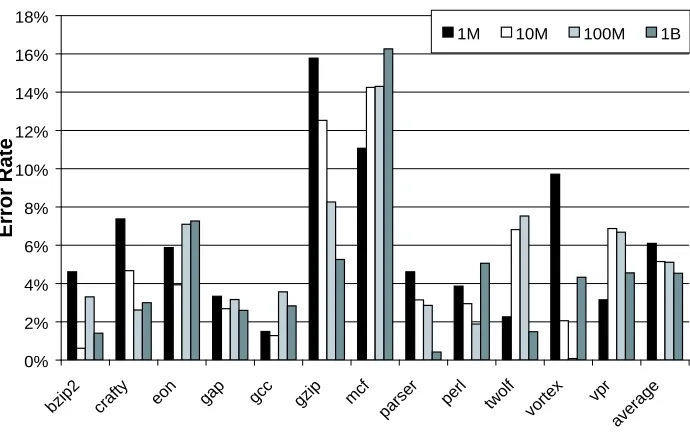
The goal of our cost model is to quantify the performance effects of events based
on the bubbles that are inserted into the pipeline. The straightforward way to verify our
cost model is to compare the actual execution cycles to the sum of the execution cycles in
an ideal pipeline (i.e. pipeline throughput without bubbles) and the event costs from our
Tmodel =Tideal+ X
i
Costi (5.1)
Rerror =|Treal−Tmodel|/Treal (5.2)
In Formula 5.1, the predicted execution time (Tmodel) from our model is computed
by adding the ideal execution time (Tideal) and the total event cost (Costi). The ideal
execution time is the number of executed instructions divided by the issue width, assuming
each pipeline stage takes one cycle. Formula 5.2 represents the relative model error rate
(Rerror) calculated by dividing the absolute value of the difference between real execution
time and predicted execution time with the real execution time. Figure 5.4 shows the error
rate for different execution periods - 1M, 10M, 100M and 1B instructions. On average, our
model can achieve a 5% error rate, when l0M or more instructions are executed.
5.4
Performance bottleneck phase tracking
In the previous section, we presented an approach to collect system performance
information. Now we discuss how to analyze performance bottlenecks based on that
infor-mation.
5.4.1 Bottleneck vector
Choosing an appropriate quantitative representation is very important for data
analysis. A good representation can make analysis much easier and more accurate. For our
0% 2% 4% 6% 8% 10% 12% 14% 16% 18%
bzip2 crafty eon gap gc c
gzip mcf par
ser per l
two lf
vortex vp r
aver age
E
rror
R
a
te
1M 10M 100M 1B
Figure 5.4: Performance model verification
reasons why we use a vector. The first is that the data we collect are disjoint values in event
counters. These counters convey different information about different components in the
microprocessor and will be handled separately. Therefore, keeping data in a vector will be
a proper way without information loss. The other reason is that vectors are a powerful and
fundamental mathematical representation. Computations based on vectors are relatively
easy in both computation and hardware cost.
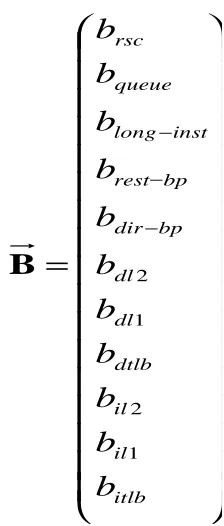
Based on the event counters we described in the last section, the bottleneck vector
has eleven dimensions which corresponds to each counter. The vector design is shown in
5.4.2 Bottleneck phases
Researchers proposed the program phase concept to describe the phenomena that
a program exhibits repeating long-term behavior. The principle behind program phases is
executing instructions visiting the static program with regular patterns. For example, in a
loop, the static loop body will be visited repeatedly during execution. It is not a surprise
that program phase phenomena has a similar effect on performance bottlenecks because
performance bottlenecks are determined by both hardware and software. With a fixed
hardware configuration, regular software patterns result in regular bottleneck behavior,
called bottleneck phases.
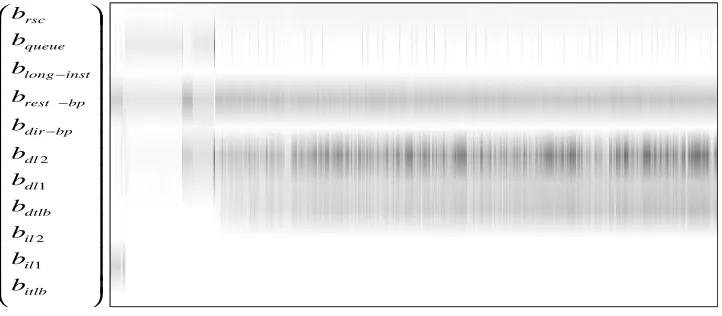
To illustrate the bottleneck phase behavior, we track the bottleneck vectors for
12 SPEC 2000 benchmarks for a 10B instruction execution, which is sampled every 1M
instructions. Each element of the vector is shown in parallel in the behavior graph. The
bottleneck intensity is represented by darkness. The darker the points are, the more intense
the performance bottleneck is. Figure 5.6, 5.7, 5.8, 5.9 and 5.10 show each benchmark
performance bottleneck behavior respectively.
• bzip2
Bzip2 varies its behavior during execution. It suffers from issue queue being full,
branch mispredictions and data cache misses intermittently.
• gap
Gap exhibits very regular behavior. There are very few outstanding performance
bottleneck during execution. Only in a very short period, it suffers from issue queue
=
− − − itlb il il dtlb dl dl bp dir bp rest inst long queue rscb
b
b
b
b
b
b
b
b
b
b
1 2 1 2B
Figure 5.5: Bottleneck Vector
• gcc
Gcc varies its behavior over the whole execution time. It suffers from issue queue being
full, instruction cache misses, data instruction cache misses and branch misprediction
for different periods.
• mcf
Mcf suffers extremely from a high data cache miss bottleneck. But in the beginning,
it is bottleneck-free.
• vpr
Vpr suffers from data cache misses and branch misprediction bottlenecks at same
− − − itlb il il dtlb dl dl bp dir bp rest inst long queue rsc b b b b b b b b b b b 1 2 1 2
Figure 5.6: bzip2 performance bottleneck behavior
− − − itlb il il dtlb dl dl bp dir bp rest inst long queue rsc b b b b b b b b b b b 1 2 1 2
Figure 5.7: gap performance bottleneck behavior
− − − itlb il il dtlb dl dl bp dir bp rest inst long queue rsc b b b b b b b b b b b 1 2 1 2
− − − itlb il il dtlb dl dl bp dir bp rest inst long queue rsc b b b b b b b b b b b 1 2 1 2
Figure 5.9: mcf performance bottleneck behavior
− − − itlb il il dtlb dl dl bp dir bp rest inst long queue rsc b b b b b b b b b b b 1 2 1 2
5.4.3 Bottleneck phase tracking
Identifying bottlenecks is not a difficult task from a mathematical perspective. We
can use the vector itself as an ID. However, hardware cost and computation complexity will
make this design very expensive. One efficient way to keep component cost information
without involving too much hardware budget is hashing the elements of the bottleneck vector
into a phase ID. The tracking scheme is shown in Figure 5.11. For a given sampling interval,
event counters are sampled and cleared. Then those raw event numbers are processed by
an array of function blocks. The function blocks perform two computations. One is average
cost computation based on the cost model. In our study, we use cost per 1K instructions
as the average cost for a sampling interval. The other is cost normalization computation,
which is translating the cost from the first step into the number of cost units. The cost
unit is a fixed cost window defined by users, depending on the accuracy requirement. The
reason for using the cost unit is to classify similar cost values into the same cost group.
Finally, the elements of the processed bottleneck vector are hashed into a bottleneck phase
ID.
5.5
Performance bottleneck phase prediction
In the previous section, we described how to track and identify a bottleneck phase
at runtime. There may be a need to predict bottlenecks in advance to guide system
opti-mization. In this section we will present the predictability of performance bottlenecks with
several prediction schemes.