WILSON, MICHELLE DENISE. A Holistic Case Study of First-Generation Community College Student Experience in a Performance-Based Scholarship Program: Implementation and Utilization of Social Capital. (Under the direction of Dr. Tuere A. Bowles).
This research is a collection of essays that examine various aspects of a performance-based scholarship program designed to build social capital among first-generation
community college students located in a large mid-Atlantic city in the United States. First-generation community college students, those whose parents did not attend college make up a significant portion of community college enrollment. First-generation community college students often struggle with the social and cultural norms of academia in large part due to the lack of preparatory resources and social capital afforded to continuing-generation students, those with at least one parent who completed a degree.
The overarching theoretical framework shaping this study is social capital, broadly viewed as an accumulation of tangible resources available for personal interests. The three-essay dissertation format presented is a holistic case study using qualitative methodology. This approach allowed for the exploration of the implementation of a performance-based scholarship program designed to address the challenges first-generation community college students encounter while matriculating.
first-Generation Students and their Academic Stories of Resilience in the First Year of Community College sought to answer the research question on how students experience a performance-based scholarship model by exploring facets of students’ educational trajectories and strategies in academic resiliency. Essay three, A Case Study of First-Generation Students Utilizing Social Capital to Navigate the First Year of Community College, was guided by the research questions exploring the personal, social, and environmental factors that shape the social capital landscape for first-generation community college students. The study sought to identify basic assumptions of the performance-based scholarship model using descriptive narrative from institutional agents and through exploration of students’ use of social capital resources in navigating their academic journey.
The findings from these essays offer a holistic view of an intervention designed to improve outcomes for first-generation community college students. The findings presented here have implications on multiple levels in the community college forum, specifically among practitioners, policy makers, and applied research.
Keywords: community colleges, first-generation community college student, performance-based scholarship, social capital, student experience, qualitative methods, case study
Performance-Based Scholarship Program: Building Social Capital
by
Michelle Denise Wilson
A dissertation submitted to the Graduate Faculty of North Carolina State University
in partial fulfillment of the requirements for the degree of
Doctor of Education
Adult and Community College Education
Raleigh, North Carolina 2018
APPROVED BY:
_______________________________ _______________________________ Dr. Tuere Bowles Dr. Michelle Bartlett
Committee Chair
DEDICATION
BIOGRAPHY
Michelle Fritts-Wilson is a native North Carolinian. She was born and raised in Asheville to Marian and Albert Fritts, the youngest of five with an eighteen-year age gap between the first and the last sibling. She was always referred to as the “surprise” baby given that her parents were in their forties.
Growing up, school was always her favorite place to be, and reading was her favorite pastime of choice. While her siblings took different paths post-high school (military,
cosmetology school, factory worker), she would be the first in her family to attend college, making her a first-generation college student. Upon reflection, it is not clear what the expectations were for her siblings, but she can say, without a doubt, that college was never presented as an option, but a foregone conclusion. It was never, “If you decide to go to college…”; rather, it was, “When you go to college….” So, she prepared for it. She took all the right courses; she participated in anything that anyone said would be useful for college. Michelle, along with her parents, thought she was ready until she went off to school at NC A&T and realized that she was not. She struggled, as many first-generation college students did and still do.
Michelle completed her Bachelor’s in Sociology with a minor in Cultural
ACKNOWLEDGMENTS
I’ll start by acknowledging my gratefulness for being the luckiest girl in the world to have had Marian and Albert Fritts as parents. I am eternally grateful the Universe saw fit to attach me to them.
To my husband Glenn Wilson, without you, I’m not sure there would be a reason for this. Thank you for your continued love, support and belief in me.
To my homies: Heddie, Watty, Lisa, Krissy, Smurffet, Jordan, and Janet. Your encouragement, support, proofreading, and feedback is everything.
To my personal trainers: Coach Shonuff, WithPatJames, and Jesse. I’m sure you’ve figured out that my training sessions are my therapy. Thank you for taking care of me!
To my Chair, Dr. Bowles, I don’t think I can express my gratitude for having the good fortune of connecting with you. You are simply the bomb!
TABLE OF CONTENTS
LIST OF TABLES ... ix
LIST OF FIGURES ... x
PROLOGUE ... 1
CHAPTER ONE: Introduction ... 4
Program Description ... 6
Definitions of Terms and Acronyms... 12
Chapter One References ... 13
INTERLUDE I ... 16
CHAPTER TWO: Environmental Forces Influencing Program Implementation: A Case Study on the Initial Implementation of a Performance-Based Scholarship Program at an Urban Community College ... 17
Abstract ... 17
Introduction ... 17
Literature Review... 20
The Role of Organizational Ecology in Implementation ... 20
Implementing Programs in Postsecondary Education ... 21
Research Methods and Selection of Research Site ... 22
Site Selection ... 23
Participant Selection ... 25
Data Collection and Analysis... 26
Institutional Agent Profiles ... 27
Dr. Lee. ... 28
Joya. ... 29
Audrey... 29
Fred. ... 30
Justin. ... 30
Dr. Charles. ... 31
Findings... 31
Challenges that Shaped Implementation ... 32
Theme 1: Meeting donor expectations. ... 32
Theme 2: Difficulty in recruiting the targeted population. ... 33
Theme 3: Identifying appropriate resources. ... 35
Theme 5: Administrative issues. ... 38
Factors That Facilitated Implementation of the Scholars Program ... 39
Theme 1: Institutional agent job readiness. ... 39
Theme 2: Program readiness for implementation. ... 40
Theme 3: Leveraging campus resources. ... 42
Theme 4: Community building. ... 43
Discussion and Implications ... 45
Microsystem ... 46
Mesosystem... 47
Exosystem ... 48
Macrosystem ... 48
Stages of Implementation ... 49
Conclusion ... 50
Chapter Two References ... 51
INTERLUDE II ... 55
CHAPTER THREE: First-Generation Students and their Academic Stories of Resilience in the First Year of Community College ... 56
Abstract ... 56
Introduction ... 56
Literature Review: First Generation Community College Students ... 58
First-Generation Resiliency and Lived Experience ... 59
Methods... 61
Site Selection ... 61
Participant Selection ... 62
Data Collection and Analysis... 62
Scholar Profiles ... 64
Michael ... 66
John ... 67
Jim ... 68
Alex ... 70
Maria ... 71
Jenny ... 72
Nicky ... 73
Frosty Yang ... 75
Alexis ... 78
Findings... 79
On Entering College ... 79
Alternate Plans ... 80
On Why They’re Here ... 81
Lived Experiences—The Good ... 82
Having their value recognized. ... 82
Understanding the value of support for personal growth... 83
Being valued for academic accomplishments. ... 84
Lived Experiences and Resiliency ... 85
It’s All About a Supportive Community ... 87
Discussion and Implications ... 89
Chapter Three References ... 93
INTERLUDE III ... 99
CHAPTER FOUR: A Case Study of First-Generation Students Utilizing Social Capital to Navigate the First Year of Community College ... 100
Abstract ... 100
Introduction ... 100
Conceptual Framework ... 103
Research Design... 107
Site Selection ... 107
Participant Selection ... 107
Data Collection ... 108
Analysis... 110
Researcher Bias and Assumptions ... 111
Study Limitations ... 111
Description of Scholar Participants ... 111
Description of Institutional Agents ... 113
Social Capital Resources Accessed ... 114
Findings... 116
Setting the Stage for Social Capital Building ... 116
Building Capital ... 118
Trust & Solidarity ... 119
Building Cohesion ... 121
Dimension 1: Groups and networks. ... 123
Dimension 2: College support/ trust and solidarity. ... 125
Dimension 3: Collective action and cooperation. ... 127
Dimension 4: Information and communication. ... 128
Dimension 5: Social cohesion and inclusion. ... 129
Dimension 6: Empowerment. ... 134
Discussion ... 134
Implications... 136
Chapter Four References... 138
Interlude IV ... 144
CHAPTER FIVE: Putting It All Together: Summary and Implications for Policy, Practice, and Future Research ... 145
Summary ... 145
Implications for Policy, Practice, and Research ... 148
Policy ... 148
Practice ... 149
Theory ... 150
Future Research ... 150
Chapter Five References ... 152
EPILOGUE ... 153
APPENDICES ... 154
Appendix A: Opportunity Scholar Recruitment Script ... 155
Appendix B: Opportunity Scholar Participant Interview Consent Form ... 156
Appendix C: Student Scholar Demographic Questionnaire ... 158
Appendix D: Student Scholar’s Interview Guide ... 162
Appendix E: Institutional Agent Invitation Email ... 166
Appendix F: Opportunity Scholar Institutional Agent Interview Consent Form ... 167
Appendix G: Institutional Agent Demographic Questionnaire ... 169
Appendix H: Institutional Agent Interview Guide... 171
Appendix I: Observation Guide ... 173
Appendix J: Aligning Field Notes with Interviews ... 174
Appendix K: Document Analysis Guide ... 175
Appendix L: Participant Contact Information ... 176
Appendix M: Bias and Limitations ... 177
LIST OF TABLES
Table 1.1 Description of the OS Major Program Components ... 7
Table 2.1 Required Components and Activities of the OS Program Model ... 25
Table 2.2 Institutional Agent Demographic Profile ... 28
Table 2.3 OS Challenges and Facilitators in the Stages of Implementation ... 49
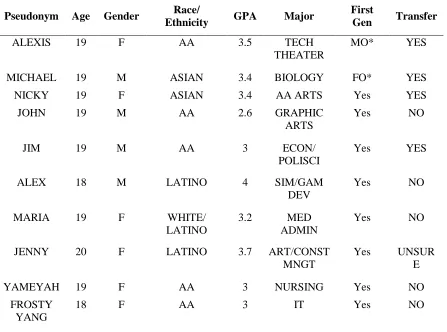
Table 3.1 Demographic Characteristics of Opportunity Scholar Participants ... 65
Table 4.1 Summary of the Six Dimensions of Social Capital Identified by the World Bank ... 109
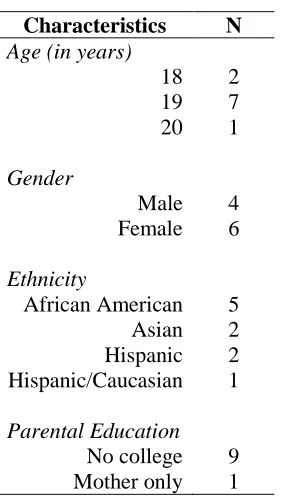
Table 4.2 Demographics ... 112
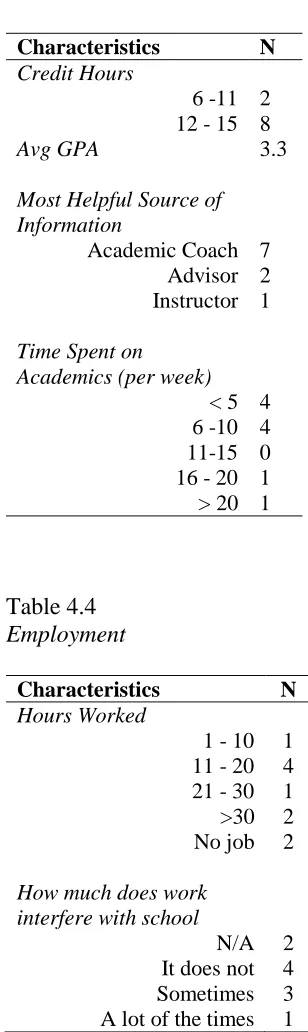
Table 4.3 Education ... 113
Table 4.4 Employment ... 113
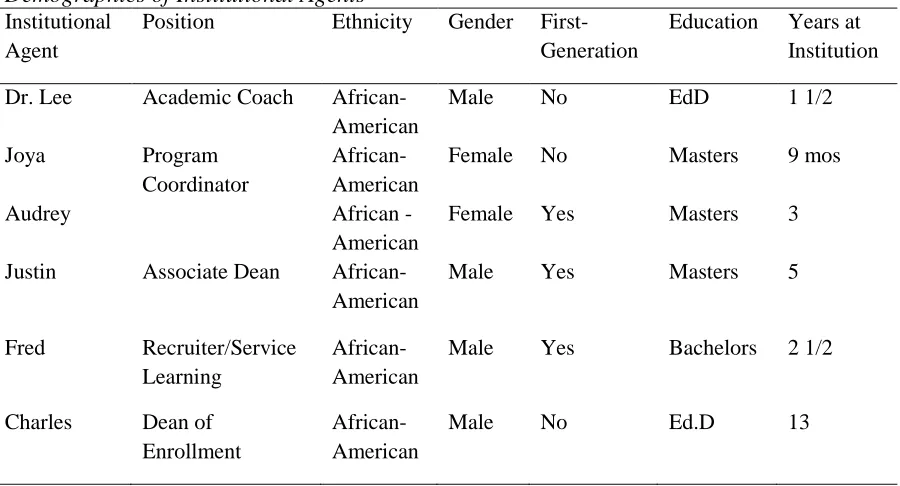
Table 4.5 Demographics of Institutional Agents ... 114
Table 4.6 Domains, Categories, and Frequencies of Scholar Strategies ... 115
Table 4.7 Opportunity Scholars Program Themes ... 117
LIST OF FIGURES
PROLOGUE
“How, on the one hand, can we be such a vital and opportunity-rich community, and on the other, be ranked dead last in the odds that our lowest income children and youth will be able to move up the economic ladder?” (Garmon-Brown & O’Dell, 2017, p.1). “Land of Opportunity? Not by a Long Shot” (Fraizer, 2015, p. 4) was the headline in response to a study released in 2014 by Harvard economist Raj Chetty that ranked Charlotte 50th out of the 50 largest cities for upward mobility for people born and raised in Charlotte. Furthermore, the report indicated a primary factor that contributed to Charlotte’s ranking was the lack of social capital available to those in the bottom quintile of the income distribution. Chetty et al. (2014) note that social capital is essentially the mechanism that allows people to interact with others and become a part of extended networks that can lead to job opportunities.
As the city of Charlotte wrestled with how to respond to the challenges revealed in the Chetty Report, an unfortunate event unfolded after police shot and killed an African American man. Peaceful protests followed that eventually erupted into violence in which 50 people were arrested, and yet another African American male, a 26-year-old student at the local community college, lost his life. In the days that followed, Charlotte was forced to confront the ugly realities of what was unleashed the night of the violent protests where "long-standing frustrations were finally being aired in the streets" (Garmon-Brown & O’Dell, 2017, p. 2).
Shortly after the release of the Chetty Report, the Charlotte-Mecklenburg Opportunity Task Force was formed with support from local foundations to address the economic and social mobility issues facing the city. The Task Force echoed the Chetty Report,
critical determinant that exacerbates the inequity crisis in Charlotte. While the city debated various tactics to confront the issues raised in the report, a prominent businessman from Charlotte, shocked by the extent of the anger in the community, was compelled to make a difference, stating in an interview, “It made me realize that there are challenges here that we have to deal with. I almost immediately began trying to think of how I could help right at that moment. We need to give people hope” (Price, 2016).
The notion of social capital as contributing to upward mobility makes the reality of Charlotte's ranking even starker. Specifically, the study noted that a child raised in the bottom fifth income level in Charlotte had only a four percent chance of rising to the top fifth. Thirty-eight percent will remain in the bottom quintile, and another 31 percent will move up only one quintile (Chetty et al., 2014). For Charlotte, a city that touts itself as the land of opportunity, this was a dubious honor.
Beyond identifying strategies, the task force provided specific recommendations for action. In their report Leading on Opportunity (2016), they called for increased support of first-generation college students with the focus of support to include several areas: a transition program such as Summer Bridge before the first semester of entry; a mentoring program; academic tutoring; financial assistance; and external partnerships to provide students with services and support.
The Community College responded to the task force’s call by creating
CHAPTER ONE: Introduction
Although first-generation college students enroll in all levels of postsecondary education, they tend to be more concentrated in two-year colleges (Thayer, 2000). Lack of access to the essential elements required to be successful in postsecondary education puts first-generation community college students at a distinct disadvantage, creating an untenable situation in which first-generation students are unable to develop the necessary capital to move beyond their circumstances. The access issues associated with social capital
confronting first-generation community college students require focused research efforts that examine the challenges.
This holistic case-study is a compilation of three embedded studies presented as a collection of essays. Holistic case studies allow for the exploration of sub-units that are situated within a larger case that creates a powerful research tool (Baxter & Jackson, 2008). The research presented here examines the implementation of a performance-based
scholarship program designed to build social capital in first-generation community students. The research focuses on how an institution implements its efforts, how students respond, and the ways in which students’ access and utilize social capital during their first year of college. Each essay is designed to address one of the following research questions:
1. What are the environmental factors that shape the implementation of a performance-based scholarship program for first-generation community college students?
2. How do first-generation community college students experience the performance-based scholars’ program during their first year of college?
The introduction presented in this chapter is designed to orient the reader to the dissertation. The overall structure of the study takes the form of five chapters, including this introductory chapter. The prologue, interludes, and epilogue are interlaced between the chapters as a way to weave the chapters together and remind the reader that while the essays can stand alone, it is one story about the journey of an institution and its mission to help students succeed. Chapter One gives an overview of the Opportunity Scholarship program with a focus on the major program components (see Table 1.1). A logic model is presented (Figure 1.1) to provide context for the Opportunity Scholarship program. Additionally, the logic model locates for the reader the researcher’s area of interest as it relates to the overall scholarship model. Chapter One concludes with a definition of terms and a list of acronyms that appear in this study.
Chapter Two, Environmental Forces Influencing Program Implementation: A Case Study on the Initial Implementation of a Performance-Based Scholarship Program at an Urban Community College, is the first of the three essays in this collection. The focus is on the initial implementation of the Opportunity Scholarship program at The Community College. Organizational ecology and implementation science provide the theoretical frames for this qualitative case study.
analysis of first-generation community colleges students’ experience in a performance-based scholarship program using their lived experiences as narrated by them.
Chapter Four, A Case Study of First-Generation Students Utilizing Social Capital to Navigate the First Year of Community College, examines social capital with an emphasis on how an institution structures access to it and how a student utilizes it. While social capital frames the overarching purpose of the study, Chapter Four delves into the literature
highlighting the work of contemporary influencers: Bourdieu (1986), Coleman (1988), and Putnam (1993). This qualitative case study uses interview and observational data from Institutional Agents and Scholars to frame the intent of the institution in imparting social capital and the Scholar’s use of it.
Chapter Five concludes the collection with a summary of the overall study. Insights and future directions are presented with a focus on policy, practice, theory, and future research.
Program Description
program components (see Table 1.1), maintain a 3.0 GPA, and declare a major by the end of the first year.
Table 1.1
Description of the OS Major Program Components
Component Description
Summer Bridge Gives students an opportunity to successfully transition from high school to college in a structured, supervised environment. The purpose is to make students aware of college expectations.
Orientation/ Scholar Ceremony
The official kickoff of the Opportunity Scholars program. Students receive the official welcome to the college by the College President and key members of campus administration as well as the
Opportunity Scholar team. Scholars are given their laptops and backpacks. Scholars also attend a meet and greet with their scholarship donor.
Career Services Counseling
Scholars attend career counseling sessions to assist with determining a career focus through personalized conversations with a career counselor. Scholars take part in career assessments and activities.
Real Talk Session Twice-a-month sessions that are designed to enhance the student socially, academically, and personally.
Academic Coaching Academic coaching is a personalized, one-on-one meeting with a trained academic coach assists the Scholar in reaching their academic goals.
Mentoring All scholars are assigned a mentor. Mentors can be an instructor, staff member or administrator who creates a structured and trusted relationship with the Scholar. Mentors offer guidance, support, and encouragement.
Service Learning Combines community service with classroom instructions, focusing on critical, reflective thinking as well as personal and civic
responsibility. Service-learning programs involve students in activities that address local needs and deepens their commitment to the community.
Internships Internships are flexible work experiences that allow Scholars to gain exposure to their field. Scholars work at an employer’s site for an extended period, working on projects related to their program of study. Upon successful completion of an internship, Scholars will receive a certificate acknowledging their achievement.
Source: Institution agent interview data and document review of program materials.
Scholarship requires students to enter a two-year career and technical education program that will prepare students immediately for the workforce. To support the primary stipulation of the scholarship, the OS program is rooted in the institutional practices of career pathways and learning communities. Jenkins & Spence (2006) note the primary goal of career pathways programs is to secure employment within a specific industry or occupational sector, an approach that has been embraced by the philanthropic community such as the one supporting the OS program.
Learning communities, a model that thematically engages cohorts of students in a series of targeted programs that provide both academic and student support, have been shown to help students become more integrated into the campus milieu (Goldrick-Rab, 2010; Jehangir, 2010; Scrivener, Weiss, & Teres, 2009). While results are mixed on its ability to improve performance (Scrivener et al., 2009), the model is still seen as a promising practice.
The work of the OS program falls under reform targeting institutional practices and as such encompasses a bundling of best practices identified and described here:
Student Life Skills: identified here as the Orientation/Scholar Awards, Real Talk sessions, and Career Counseling. Also known as support or wraparound services, these structures are designed to introduce effective college orientation and management skills. Research has shown that these types of programs generally have a positive impact on student success (Goldrick-Rab, 2010; Scrivener et al., 2009; Zeidenberg, Jenkins, & Calcagno, 2007). The OS program has embedded these kinds of services into their performance-based model.
AcademicCoaching:conducted by professional staff members who meet one-on-one with students. The purpose is to help students develop action plans and identify necessary steps to facilitate academic success. There is no succinct body of literature on coaching models due to the extreme variation in how it is referenced, operationalized and
implemented. Studies show that students who have access to some type of coaching support tend to persist in college beyond the coaching intervention (Bettinger & Baker, 2014).
Mentoring: programs whereby students receive one-on-one support through formal or informal networks with faculty, staff, or community members. Mentoring programs differ in design from institution to institution, but they have a general purpose of assisting students with acclimating to the academic and social culture of college (Smith, 2007).
Service learning: an educational approach that combines learning objectives with community service activities that provide a learning experience while at the same time meeting a community need. Service leaning allows students to gain organizational and interpersonal skills in various settings. These programs model the idea that giving something back to the community is an important college outcome, and that working with community partners is good preparation for citizenship, work, and life (Kuh, 2014).
Figure 1.1. The Opportunity Scholarship Logic Model
NOTE: Model includes contextual data that supports the driving factor for the scholarship program. The role of the community college identifies the overarching responsibility of the college for the scholarship. The
implementation looks at the organizational level and student level activities, highlighted here to show the focus area of the case studies. Outcomes include both system level and student level.
Context Proposal to address low access students from a city task force
Funding from members of the community and local foundations
Scholarship design, management and oversight.
Technical and formal management of scholarship
Securing Funding for Scholarship
Oversight of community relations with funding partners
INSTITUTIONAL AGENT ROLE
-Develop program core components into actionable plan -Recruit participants College level organization & program design Provide student support Track student progress Recruitment Provide oversight Academic support Student Experience Summer Bridge Orientation Workshops Academic Counseling Internships Service Learning Tutoring SYSTEM OUTCOMES Increased capacity to prepare low access students for wage earning careers.
Increased
awareness of what it takes to serve low-access students successfully.
STUDENT OUTCOMES
-Students enroll in career earning majors
Context Community
College Role
Implementation Outcomes
Low upward mobility ranking for those in the bottom income quintile.
Growing unease among city residents on equity challenges
City struggling to resolve equity issues
Need to find solutions to address equity challenges though support for 1st gen
students
Definitions of Terms and Acronyms
To understand and clarify the terms used in this study, the following have been defined. Continuing generation college student. A student with at least one parent who has obtained a college degree (Ifill, Radford, Wu, Wilson, & Hill, 2017).
First generation college student (FGGS). A college student whose parents have no college experience (McConnell, 2000).
Institutional agent (IA). An individual who occupies one or more hierarchical positions of relatively high-status and authority (Stanton-Salazar, 2011).
Performance-based scholarship. Scholarships designed to help reduce the financial burdens on low-income college students while providing incentives for good academic progress. Performance-based Scholarships are innovative financial aid structures designed to boost academic performance among a target group (Patel, Hayes, de la Campa, & Rudd, 2013).
Summer Bridge. A six-week program that gives students an opportunity to successfully transition from high school to college in a closed, structured and supervised environment (Evans, 1999; Kezar, 2013; Smith, 2007).
References
Baxter, P., & Jack, S. (2008). Qualitative case study methodology: Study design and implementation for novice researchers. The Qualitative Report 13(4), 544-559. Bettinger, E. P., & Baker, R. B. (2014). The effects of student coaching: An evaluation of a
randomized experiment in student advising. Educational Evaluation and Policy Analysis, 36(1), 3–19. https://doi.org/10.3102/0162373713500523
Chetty, R., Hendren, N., Kline, P., Saez, E., & Turner, N. (2014). Is the United States still a land of opportunity? Recent trends in intergenerational mobility. American Economic Review, 104, 141–147.
Evans, R. (1999). A comparison of success indicators for program and non-program participants in a community college summer bridge program for minority students. Visions, 2(2), 6–14.
Fraizer, E. (2015). The problem of upward mobility. Charlotte Observer. Retrieved from http://www.charlotteobserver.com/opinion/editorials/article17344655.html Garmon-Brown, O., & O’Dell, D. (2017). Leading on opportunity (pp. 1–92).
Charlotte-Mecklenburg Opportunity Task Force. Retrieved from
https://leadingonopportunity.org/wp-content/uploads/2017/03/ 20170320_LeadingOnOpportunity_Report.pdf
Goldrick-Rab, S. (2010). Challenges and opportunities for improving community College student success. Review of Educational Research, 80(3), 437–469.
https://doi.org/10.3102/0034654310370163
2016-401)). U.S. Department of Education. Washington, DC: National Center for Education Statistics. Retrieved from http://files.eric.ed.gov/fulltext/ ED563244.pdf Jehangir, R. R. (2014). Higher Education and First-Generation Students: Cultivating
Community, Voice, and Place for the New Majority (2010 edition). Basingstoke: Palgrave Macmillan.
Jenkins, D., & Spence, C. (2006). The Career Pathways How to Guide (Pathways to Competitiveness No. 2) (p. 56). Workforce Strategy Center: The Joyce Foundation. Retrieved from https://files.eric.ed.gov/fulltext/ED496995.pdf
Kezar, A. (2000). Summer Bridge Programs: Supporting All Students. ERIC Digest. ERIC Development Team. Retrieved from https://eric.ed.gov/?id=ED442421
McConnell, P. J. (2000). What community colleges should do to assist first-generation students. Community College Review, 28(3), 75–87.
https://doi.org/10.1177/009155210002800305
Patel, R., & Richburg-Hayes, L. (2013). Performance-Based Scholarships: Emerging Findings from a National Demonstration (p. 8). MDRC. Retrieved from https://www.mdrc.org/sites/default/files/full_269.pdf
The Pew Charitable Trusts. (2013). Moving on up. Retrieved from
http://www.pewtrusts.org/~/media/assets/2013/11/01/movingonuppdf.pdf
Price, M. (2016). Howard Levine sees more scholarships as answer to city’s violent protests. Charlotte Observer. Retrieved November 2, 2017, from
Scrivener, S., Weiss, M. J., & Teres, J. J. (2009). More Guidance, Better Results? Three-Year Effects of an Enhanced Student Services Program at Two Community Colleges (pp. 1–169). MDRC. Retrieved from https://www.mdrc.org/sites/default/files/full_450.pdf Smith, B. (2007). Accessing social capital through the academic mentoring process. Equity & Excellence in Education, 40(1), 36–46. https://doi.org/10.1080/ 10665680601088465 Stanton-Salazar, R. D. (2011). A social capital framework for the study of institutional agents
and their role in the empowerment of low-status students and youth. Youth & Society, 43(3), 1066–1109.
Thayer, P. B. (2000). Retention of students from first generation and low-income backgrounds. Council for Opportunity in Education. Retrieved from https://eric.ed.gov/?id=ED446633
U.S. Department of Education, Institute of Education Sciences. (2016).
Supporting Postsecondary Success Intervention Report: Summer Bridge Programs. Retrieved from http://whatworks.ed.gov
U.S. Department of Education. (2015, October 5). Title I, Part A Program [Program Home Page]. Retrieved September 25, 2018, from
https://www2.ed.gov/programs/titleiparta/index.html
Wyner, J., Witham, K., & Kelly, P. (2014). Using Comparative Information Guide. (pp. 1– 28). The Aspen Institute. Retrieved from https://assets.aspeninstitute.org/content/ uploads/files/content/docs/pubs/UsingComparativeInformationGuide.pdf
INTERLUDE I
“It’s interesting, because my last presentation with them [Opportunity Scholars] was at the beginning of their second semester. I shared with them some information about not being a good college student my first year. It was particularly for the eight or nine who didn’t do well. Several of them came up to me afterwards, and they were talking about them feeling the same way their first semester. They had done all right, but I also thought that they could do better. We talked a lot about how most things are temporary and that if you can get through this little temporary struggle and get back up and the key is to get back up, you then have a roadmap for life.”
CHAPTER TWO: Environmental Forces Influencing Program Implementation: A Case Study on the Initial Implementation of a Performance-Based Scholarship Program at
an Urban Community College Abstract
This essay explores the implementation of a performance-based scholarship program designed to build social capital in first-generation community college students. Using a constructivist framework, this study sought to understand the ways in which programs are influenced by and influence entities within the organization under study. The primary research question that guided this study explored factors—challengers and facilitators—that shape the implementation of a performance-based scholarship program for first-generation community college students. Organizational ecology and implementation theory frame this exploratory case study. Data analysis employed a qualitative methodology that included semi-structured interviews with institutional agents, field notes, document reviews, and observations. Findings from the study suggest micro-level ecological systems were the most consistent structures that facilitated implementation while challenges were situated primarily in the exo- and meso-ecological systems. The essay provides a useful framework for
institutions looking to design programs that target first-generation community college students.
Keywords: first-generation, ecological systems, organizations, community colleges, implementation, social capital
Introduction
goals, expectations, and definitions of success (Goldrick-Rub, 2010). More than ever, community colleges are being called upon to deliver on a diverse set of promises that is implicit in the very nature of open-access institutions. To meet the demands of the
community college milieu, colleges have had to go beyond the previous practice of operating with the intention of merely increasing access and start shifting towards a more outcomes-driven system (Wyner, 2014). The current focus, outcomes-driven in large part by the Complete College Agenda, challenges principle assumptions on how community colleges operate (Baldwin, 2014). The emphasis on improving outcomes has necessitated a change in strategies where building effective organizational structures become critical in creating environments that support the intended performance standards (Wyner, 2014).
The urgency in improving outcomes has transferred the focus from increased access to completion and is supported by data that show that by 2020, 65% of all jobs will require some form of postsecondary education (Carnevale, 2013). Social capital is one area of interest that has emerged as a crucial element to delivering on outcomes that will meet the demands of the future workforce. Social capital is defined at a basic level as a network of information and resources that benefits an individual (Moschetti & Hudley, 2014; Stanton-Salazar, 2011). Social capital has been linked to student outcomes such as access and completion in several ways. Most notably, social capital can provide students with
information and resources necessary to navigate college as well as connect students to career opportunities and educational pathways that could lead to wage-earning careers. (Moschetti & Hudley, 2014).
the attend college. One estimate shows that first-generation community college students make up 48% of first-time enrolled college students nationally, yet 2011-2012 data shows a three-year completion rate of nine percent (Ifill et al., 2017). Over the years, colleges, foundations, communities, and government efforts have supported programming with the goal of improving outcomes for this population. The challenge is in having enough resources to meet the demand, leaving community colleges in the position of having to develop
alternative options. The Institute for Higher Education Policy (2012) note programs like TRIO that serve low-income and first-generation students through tutoring, counseling, mentoring, and other supports can only serve 11 percent of the eligible students.
This essay takes an exploratory look at a community college’s effort to implement one such initiative through a performance-based scholarship (PBS) program designed to build social capital in first-generation community college students. PBS programs are designed to help reduce the financial burdens on low-income college students while
providing incentives for good academic progress. The performance-based scholarship is an innovative financial aid structure designed to boost academic performance of a target group (Patel, Hayes, de la Campa, & Rudd, 2013).
Literature Review The Role of Organizational Ecology in Implementation
The success or failure of a program can often be traced to the ecosystem or
organizational culture that it is situated within (Clugston & Calder, 1999). The importance of understanding contextual factors that underlie program implementation is crucial given the complex nature of educational systems. More and more, institutions and organizations are embracing a systems approach to understanding and implementing programs given their dynamic nature. In fact, Johnson (2008) notes that systems approaches are becoming increasingly popular in lieu of oversimplified linear models that fail to account for the complex and dynamic nature of educational outcomes.
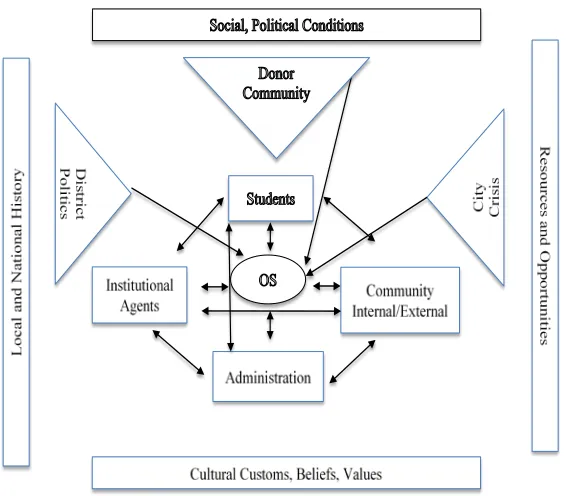
Ecological systems theory simultaneously focuses on interpersonal and environmental factors and the dynamic interplay between these factors (Eriksson, 2018; Johnson, 2008; Stokols,1996). Bronfenbrenner’s (1994) original ecological systems theory explored human development within the context of the system of relationships that forms a person’s
environment. Specifically, he defined ecological systems theory as “the progressive, mutual accommodation throughout the life course between active, growing human being and changing properties of the immediate setting in which the developing person lives” (p. 38). Bronfenbrenner’s model takes into account the interactions between and among ecosystems and is often used in higher education organizational studies (Johnson, 2008). The four ecological systems are defined here.
The microsystem layer is the pattern of activities, roles, and interpersonal
temperament, personality, and systems of belief (Bronfenbrenner, 1986). Johnson (2008) extends this theory to organizational development identifying the unit of interest as the organization. This layer is comprised of structures that are directly connected to the
organization. The influences between the organization and these structures are bidirectional. In other words, the organization is influenced by and influences the microsystem.
The mesosystem includes the connections between microsystems. As with the bidirectional nature of the microsystem, the mesosystem operates in the same manner. An example of this could include the interactions between two microsystem structures such as students and institutional agents. The exosystem incorporates a larger social system that includes events, policies, or procedures that go beyond the influence of an organization, making it a unidirectional influence. Macrosystem, identified as the social blueprint of a given culture, contains the overarching pattern of values, belief systems, lifestyles, opportunities, customs, and resources embedded into the fabric of the ecosystem. Implementing Programs in Postsecondary Education
Implementation science is the scientific study of variables and conditions that impact changes at the practice, organization, and systems levels. The aforementioned changes are required to promote the systematic uptake, sustainability, and effective use of evidence-based programs and practices in typical service and social settings (Fixsen, Naoom, Blase, & Friedman, 2005).
attending carefully to the process of implementation. The National Institute of Research Network (NIRN) (2015) defines implementation as the study of factors that influence the full and effective use of innovation in practice. The goal is not to answer the factual questions about what is, but rather to determine what is required.
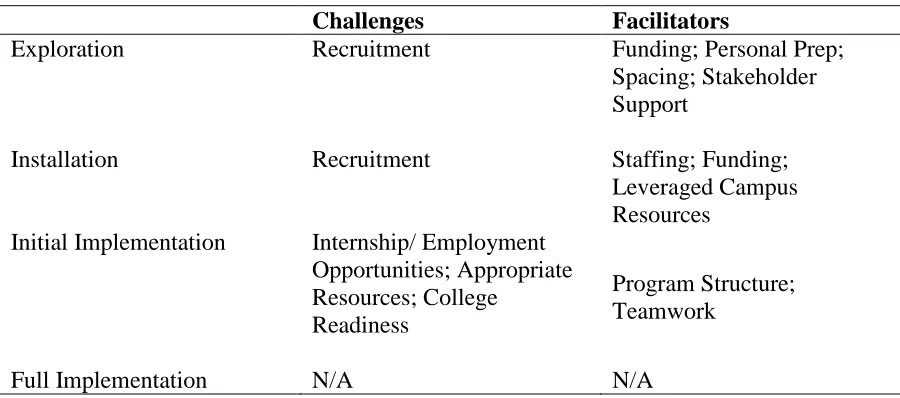
The stages of implementation framework asserts that implementation is an iterative process that happens in multiple phases and can take two to four years to complete a cycle (Fixsen, Blase, Naoom, & Wallace, 2009). The literature identifies four key stages of
implementation—exploration, installation, initial implementation, and final implementation. Those stages are identified below along with a description.
The exploration stage involves assessing the organizational readiness and preparation for implementing innovation. Stage two is the installation stage, which is about acquiring the resources needed to deliver the innovation or services. This includes the hiring, training staff, and program preparation. This stage is consistent with the core components
framework. Stage three is the initial implementation phase; it is here that program services or innovations are delivered using and implementing new policies, practices, and procedures. This is the most fragile stage where innovations are met with old ways of working.
Successfully negotiating between old and new ways of working can be critical to program success (NIRN, 2015). The NIRN identifies the final stage as full implementation. During this stage, innovations become standard ways of working and the program is providing services at a level that is producing desired outcomes.
Research Methods and Selection of Research Site
(Ponterotto, 2006). Case studies have a long history in the field of education research and are particularly useful in understanding process (Denzin & Lincoln, 2003; Merriam & Merriam, 1998; Stake, 1995; Yazan, 2015). Yin (2014) notes case study design is appropriate in a research setting where separating phenomenon from context is impossible as with
programming designed for a specific population. A purposeful sampling strategy was chosen for its practicality and the allowance for an inquiry into and understanding of a phenomenon. A well-chosen purposeful sampling strategy requires information-rich cases for in-depth study (Patton, 2002). The unit of analysis for this study was the program staff responsible for implementing the performance-based scholarship program, identified in this study as
Institutional Agents (IA). Site Selection
Table 2.1
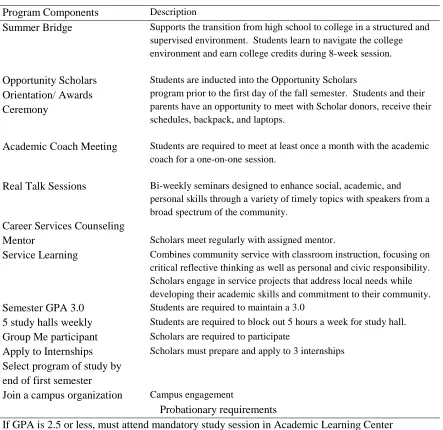
Required Components and Activities of the OS Program Model Program Components Description
Summer Bridge Supports the transition from high school to college in a structured and supervised environment. Students learn to navigate the college environment and earn college credits during 8-week session.
Opportunity Scholars Orientation/ Awards Ceremony
Students are inducted into the Opportunity Scholars
program prior to the first day of the fall semester. Students and their parents have an opportunity to meet with Scholar donors, receive their schedules, backpack, and laptops.
Academic Coach Meeting Students are required to meet at least once a month with the academic coach for a one-on-one session.
Real Talk Sessions Bi-weekly seminars designed to enhance social, academic, and personal skills through a variety of timely topics with speakers from a broad spectrum of the community.
Career Services Counseling
Mentor Scholars meet regularly with assigned mentor.
Service Learning Combines community service with classroom instruction, focusing on critical reflective thinking as well as personal and civic responsibility. Scholars engage in service projects that address local needs while developing their academic skills and commitment to their community.
Semester GPA 3.0 Students are required to maintain a 3.0
5 study halls weekly Students are required to block out 5 hours a week for study hall.
Group Me participant Scholars are required to participate
Apply to Internships Scholars must prepare and apply to 3 internships
Select program of study by end of first semester
Join a campus organization Campus engagement
Probationary requirements
If GPA is 2.5 or less, must attend mandatory study session in Academic Learning Center
Participant Selection
activities in the Scholars program. Interviews were conducted with six institutional agents each with distinct responsibilities within the program.
Data Collection and Analysis
Patton (2002) notes that collecting multiple forms of data provides a critical triangulation of information that can strengthen qualitative research. For this study, four types of qualitative data were collected and analyzed—semi-structured interviews, field notes, observations, and document reviews.
Participants were invited via email to participate in the interviews, which were scheduled based on their availability. Interviews were held in reserved study rooms at the library or in the researcher’s office based on the participant preference. Each participant completed a consent form and a brief questionnaire prior to the interview. Field notes were completed immediately after each interview. Interviews were recorded and transcribed verbatim. Once transcribed, the interviews were reviewed for accuracy and cleaned up to remove any identifiers. The original audio was reviewed to clear up any inaudibles identified by the transcriptionist which turned out to be slang or colloquialisms used by the participants. Cleaned and completely de-identified transcripts were emailed to participants with an
invitation to review and provide feedback, corrections, or clarifications as they saw fit. All were satisfied with the content in their transcripts.
All data—interviews, observations, field notes, and document reviews—were entered into MAXQDA (an electronic coding software program) for coding and analysis. MAXQDA was chosen based on this researcher’s review of available software programs and
construct that symbolizes data and thus attributes interpreted meaning to each individual datum for later purposes of pattern detection” (Saldana, 2016, p. 4).
Analysis consisted of first and second cycle coding structures. The first cycle included an amalgam of coding methods that align with the research questions posed in this study identified as attribute, process, and structural coding. Attribute coding was used as a descriptive log for the data and characteristics of participants as a reference source. Saldana (2016) suggests that attribute coding is useful in most qualitative studies with multiple participants and a variety of data forms. Process coding uses gerunds and is primarily used to signal action in the data, providing a foundation for identifying emerging themes.
Structural coding allowed the researcher to segment the interview data to align with the research question under study. Saldana (2016) notes that structural coding is appropriate when multiple participants, semi-structural data-gathering protocols, or exploratory investigations are involved.
The final step in the coding cycle was a thematic analysis. Thematic analysis or “theming the data” (Saldana, 2016) gives meaning and identity to observed patterns. Second cycle coding methods allowed the researcher the opportunity to reorganize and reanalyze data coded in the first cycle coding process.
Institutional Agent Profiles
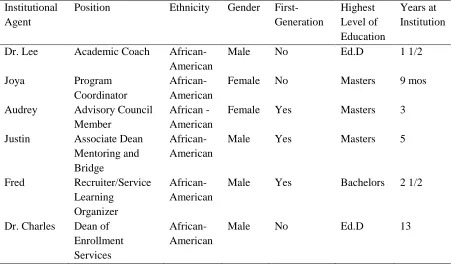
doctorate. Three of the IAs identified as first-generation college students. Table 2.2 presents a profile of each IA interviewed for the case study.
Table 2.2
Institutional Agent Demographic Profile Institutional
Agent
Position Ethnicity Gender First-Generation Highest Level of Education Years at Institution
Dr. Lee Academic Coach African-American
Male No Ed.D 1 1/2
Joya Program
Coordinator
African-American
Female No Masters 9 mos
Audrey Advisory Council Member
African - American
Female Yes Masters 3
Justin Associate Dean Mentoring and Bridge
African-American
Male Yes Masters 5
Fred Recruiter/Service Learning
Organizer
African-American
Male Yes Bachelors 2 1/2
Dr. Charles Dean of Enrollment Services
African-American
Male No Ed.D 13
Dr. Lee. Dr. Lee began working at The Community College in the office of Mentoring and Bridge which now houses the Opportunity Scholars program. He worked with students on developing academic plans and later moved into the Academic Coach position for the Scholars program. Dr. Lee has an Ed.D. in Educational Leadership. He is not a first-generation college student and readily notes the awe in which he regards the Scholars, in large part is due to his respect for their perseverance as he’s never had to
if they aren’t able to see that, “it’s an issue or a problem. It means we’ve failed someplace in the implementation phase.”
Joya. The part-time Academic Coordinator for the Opportunity Scholars program is also a full-time high school teacher at one of the five Title I schools located in the city. Joya was introduced to the OS program while completing a grad school practicum. Joya said she was invited to apply for the part-time coordinator position after she graduated and said she was eager to work in the program. Joya’s view on education, in general, can be summed up in the following statement she made on teaching:
I was more than ready to work in this program. With my background in education, I feel like if you can teach sixth, eighth, and high school students, you can pretty much conquer the world. I’m able to connect with the students and understand that students come from all walks of life. I’ve only taught at Title I schools. I understand what these students go through financially. I understand what they go through emotionally. I’ve seen them at a point in their life where the odds might be against them.
Joya’s entire teaching career has been in Title One schools, giving her a unique perspective on working with this population.
Opportunity Scholars program. Audrey has much to say about the OS program, and while fiercely loyal and devoted to its success, she candidly acknowledged that she struggles with how much has been given to the Scholars in the way of financial support. Her response, when asked what the institution needs to do less of, was simply this, “not give them [Scholars] everything.”
Fred. Fred, whose official title is “student recruiter,” also supports the OS program as the coordinator for service learning projects. Fred started as a non-traditional student at The Community College and was introduced to the office of Mentoring and Bridge as a work-study student and participant in the MAN UP program. After completing his Associate of Arts, Fred transferred to a small university nearby and completed his bachelor’s degree. Fred notes that he makes himself an asset to the college by positioning himself as a jack-of-all trades and his willingness to take on tasks outside of his role as a recruiter.
Justin. Justin, Associate Dean of the Mentoring and Bridge program, proudly
Dr. Charles. Dr. Charles is the Dean of Enrollment Management for The Community College and has worked in a number of positions in Student Services during his thirteen-year tenure at the college. Dr. Charles expressed that his aspirations for the students to do well is somewhat connected to his experiences as a college student. Dr. Charles readily admits that he was not prepared for college and he flunked out during his initial first year in college. He relays this story to the students he interacts with to say “anything is possible.” His hope for the students is that they understand how much people care about them:
I hope that they feel like someone cares about them. Just cared enough to help them with learning, with connecting to others, with feeling good about themselves. Being able to self-navigate for themselves, advocate for themselves. Have the tools that they need to survive. Not only while they’re in class, but when they move from class to a work environment or a shadowing environment. Or that this program gave them an opportunity to do something that they would not have had a chance to do. They felt like they had some lifelong connections.
Findings
The study sought to identify the factors that shaped the implementation of a
agents’ job readiness, (b) high level of program readiness for implementation, (c) leveraging campus resources, and (d) community building.
Challenges that Shaped Implementation
Theme 1: Meeting donor expectations. All new programs have performance expectations or benchmarks, and the OS program expectations were defined in large part by the donor community funding the initiative. Donors to the OS program were responding to a culmination of community events that included being named as a low-performing city for economic mobility and a recent community crisis that resulted in riots. Most of the
institutional agents were quick to point out the looming presence of the high-profile nature of the OS program. Dr. Lee likens the experience to “lifting a heavy weight.” There were two stipulations from donors supporting the OS program: 1) students must come from the poorest high schools in the city, and 2) students must major in a two-year career and technical
education program that would allow them to move into the workforce upon graduation and become wage earners immediately. Presumably, from the donor perspective, if the program is successful, it could prove to be a model that could begin to address economic mobility issues. Audrey summed up the challenge with the donor expectations:
were hustling for beer money in college; they weren’t hustling for life money. That’s what one of the board members said, just jokingly, when we did a presentation to him, and he also said openly, “Wow! I didn’t know the depths of the issues amongst this population. That was not my college experience.” If he’s openly expressing that, then how much more does he really not understand about what it’s going to take for this Opportunity Scholars to be successful even in an environment that has all of this support? So, I think that if that transparent conversation could happen, it would lessen some of the weight on the shoulders of the institution to perform, perform, perform, and just keep driving rather than taking a pause and saying, “Let’s reconfigure. Let’s keep the base foundation that we’ve got going on, but let’s tweak some important things so that we can make sure we’re really doing this right.”
The distance between donor awareness and the realities of the students’ lived experience put institutional agents in the position of moderating program expectations. When asked about strategies used to accomplish this, Justin replied that there is “no strategy. It is what it is.”
The document review suggests that in the final weeks leading up to the kick-off, only twenty-two of the forty-five slots had been filled. Another indicator that recruitment could pose challenges to the program was the timeline of the development of the OS initiative. OS program staff and The Community College had six months from the initial notice of funding to the official kickoff of the initiative which started with Summer Bridge. During this six-month period, IAs were responsible for fleshing out the components of the program and recruitment.
Internally, building out program components was a matter of coordinating the wrap-around services already in place at the college into a bundled packaged geared toward the needs of the Opportunity Scholars. Externally, the recruitment process continued to be a challenge that had the potential to alter the program. OS institutional agents noted that high school principals and counselors were reluctant to refer students who met the 2.6 GPA criteria to a community college. Instead, high school institutional agents were more interested in referring students with 2.6 GPAs or above to four-year institutions. OS staff suggested the rationale for the preference is connected to bragging rights on the number of students the high school put through to four-year colleges. Institutional Agents also cited misguided perceptions of community colleges as another challenge to getting high school IA support according to Dr. Lee:
idea of there being X number of students at that school that would be a target number. When you’re 2.6 or above, you’re either pushed to go to a four-year, or you’re pushed to go to a community college, but you’re pushed to do college transfer. Our challenge became, “Wow! We’ve got to identify the student who is a 2.6 or above that actually really wants to go straight into the career and technical field with an Associate’s Degree.” That was a challenge.
Audrey had a different take on the recruitment process with respect to finding the right student. She did this while simultaneously reflecting on her own experience in implementing a very different performance-based scholarship program at the college. Wondering out loud Audrey asked:
Resource challenges centered around having the right or most appropriate services in place for students. Most of the institutional agents discussed finding speakers that would engage the students in the Real Talk sessions; mentors that would actively support students; and having enough activities that would entice a student to engage in campus community events on a regular basis. The concern about program resources was presented in a manner that would allow to them adjust the program based on what they’ve learned from the inaugural cohort and looking ahead to the next cohort for which they will need to provide programming services, mentoring, and activities for over eighty scholars.
The internship, a key component in the OS program, is slated to take place during the summer between their first and second year. Institutional agents acknowledged having difficulty in developing the appropriate pathways for student internships. Specifically, Dr. Charles stated, “What we could not have anticipated was probably the challenge with
internships and co-ops, because real early we found out that the office [of internships] served the whole college. Their ideas of how to support the program didn’t run as deep as ours.” Upon more reflection, Dr. Charles offered the following: “The thing that we were a little challenged with is, ‘Are we staffed enough to coach every kid on how to apply for internships?’ that next level.”
you, and pick you up, and dust you off and send you on your merry little way. But, you have to allow us to be that for you. I ask of each of you, is to let us be your safety net.”
Observation of the awards ceremony revealed the sincerity of the institutional agents. Dr. Lee said his remarks were not planned, but he felt it was something the students needed to hear. According to Dr. Lee, for the OS team to be able to do their jobs with maximum impact, students must trust them. Building trust with the Scholars has been something the entire team has worked at; however, several of the IAs noted that a small number of students remain skeptical about believing in people. Dr. Lee thinks that a large part of the distrust is rooted in their backgrounds and in not recognizing when someone has their best interest at heart. Dr. Lee explained:
Once you establish that trust with the students, if they struggle academically or they struggle socially, they’ll bring it to you. The issues or the biggest challenges have been those students who have struggled, either academically, socially, emotionally. Those students who’ve had those problems but did not trust enough to share that information with you or anyone.
Institutional Agents Audrey and Fred identify the mindset of the students as one of the more pressing challenges. This is particularly true for Audrey, who believes in the end, the amount of money and resources will do little in helping students to reach their maximum potential if attention is not given to the mindset of students who come from low resource backgrounds. Audrey explained her perspective:
internally and bringing that self-awareness to it in helping individuals, but they’d be helping students find language around emotion and creating language for experiences and creating language for desires and fears. I think that’s important because if we’re not doing that for our students, then our students are basically just coming in, getting a whole lot of money thrown at them, being told to succeed, being pushed and pushed to succeed, but their storm underneath is not being calmed. It’s like basically you’ll have someone coming in and getting all of this education and help and then being put out into the world and they’ve never had, I’ll say therapy, because it can come in many ways, it doesn’t have to be on a couch, the therapy to heal and address what is keeping them where they are to begin with. Because they have this mentality and it’s going to be pervasive in whatever they choose to do. So, they don’t understand how to grow themselves up out of something and then invest that or use that wisely to support their success.
Fred echoed these sentiments and shared that for him, a vital part of his work is “selling to the capable but unwilling” the importance of getting beyond the mental blocks and challenges so they can do what they came to school to do. Fred, who identifies the mental blocks as mental oppression, believes it is important to talk to OS students about this but acknowledges that at times he may go overboard. He’s aware when the students have reached their limit: “They call me pops, old man, uncle. (belly laughter) I know that they mean, ‘You know what, we like you.’ It's love, yes, but I know they’ve had enough and need to digest what I’m saying.”
days. Currently, the OS program is staffed with one full-time Academic Coach and a part-time Program Coordinator for forty-five students. Dr. Lee and Joya who occupy those roles both see a need for the part-time coordinator position to be a full-time position. Each of the Institutional Agents, with the exception of the Dean, expressed a need to increase the staffing for the OS program as they gear up to take on another cohort of forty-five students in the fall. Justin notes, “Every year we’re bringing in 40-plus students at our current staffing level. Bringing in another 40 students is not practical. We can do it as long as we recognize that the staff needs to grow with the additional students.” The Dean, Dr. Charles, has a different perspective; he believes that as the current cohort moves into their second year, they will not need the same level of oversight, which will allow the OS staff to focus on the incoming cohort. He readily acknowledged that it’s not his preferred approach but rather a manageable approach should funding not allow them to increase staffing.
Factors That Facilitated Implementation of the Scholars Program
Theme 1: Institutional agent job readiness. Institutional agents used different tactics to prepare for their roles in the Opportunity Scholars initiative, yet they acknowledged while they were ready, they did not know what to expect. Joya described her preparations, saying, “Not to gas myself, but I was prepared. In a sense, I didn’t know what to expect. I didn’t know how the students would act. I didn’t know if the students would be receptive to what our expectations were. It was pretty much just going in head first, hoping everything would work out.”
physically and mentally ready to deal with what might come my way.” Dr. Lee relied on his previous experience in implementing programs, saying that “for me, it was going to some of the strategies I used previously in K through 12 as a teacher, and just trying to recognize the difference between 17 to 18 versus 18 to 20-year-olds.”
Theme 2: Program readiness for implementation. Collectively, IAs identified a high level of readiness for the Opportunity Scholars initiative. Institutional agents spent time reviewing other scholarship programs; several noted they introduced scholarship models from their previous work experience. Having secured the financial resources for the initiative early on, agents focused on building an embedded network to support the program. Having the financial backing from members of the community who personally finance the program has provided the OS program a level of comfort in preparedness.
Staffing. As mentioned earlier, the OS staffing model includes one full-time
Academic Coach and one part-time Program Coordinator whose sole purpose, according to the Academic Coach Dr. Lee, is to “fall in love with each student in the program and support them in their academic journey.” Dr. Charles, the Dean who oversees the Opportunity Scholars initiative, insists that having a dedicated Academic Coach for the program has been key. Reflecting on what makes the program work, he said:
group that maybe the person who has two or three things on their plate may not think of.
Spacing. Identifying a space for the OS program to operate from was an important
aspect of program readiness. College administration decided to house the OS program within the Office of Mentoring and Bridge. According to Audrey, “The office of Mentoring and Bridge already serves marginalized communities and students. They were a perfect place for that because they already do mentoring, they already do the extra support for students. It seemed like a natural fit.”
Program structure. Innovation in higher education is typically thought of as an idea,
product, or service that changes the game in education is some capacity. For the OS program, one of the more innovative features may very well be their approach to
programming. Institutional agents discussed how they used a “theming” approach to design the Opportunity Scholars initiative. Dr. Charles’ reflection on how theming approach was very matter-of-fact, which suggested an organic process that was used rather than a prescribed approach rooted in a methodology:
the personal counseling, and the internships. All of those pieces that really connect them that first semester.
Dr. Lee said that for him, the idea of creating themes was about creating a structured approach for keeping students engaged: “We wanted the students to feel actively engaged in the process of their education, so we wanted to try to do as many things to get them involved early.”
Theme 3: Leveraging campus resources. The most obvious facilitator of the
Opportunity Scholars program was the existence of financial resources made available for the scholarship program. Institutional agents implementing the program speak with awe and admiration of the community investment towards this initiative. Joya describes the connection between the institution and the donors:
People invested their personal money. People invested money that they’ve made from businesses. This isn’t something where I can just come here and chill all day. I have to make sure that these students are doing what they’re supposed to do. I think it’s amazing and I think it’s amazing because it’s people that don’t look like me and you. It’s amazing because they don’t look like me and you, but then I’m like, “Why did they do this? Why? Why do they care so much?”
Bridge such as Man Up, and Positive Community for Women, among a host of other campus resources available to the students.
Theme 4: Community building. Internally, the OS team intentionally sought to engage and embed the program within a number of layers within the college. While the OS team is a team of two, the entire Mentoring and Bridge office engages in program activities, whether they are leading them or supporting the OS program. Observations of program activities revealed the OS and Mentoring and Bridge team huddle together after each event during which time they would debrief on the activity and share praise for colleagues on what went well as well as make quick decisions about how to approach things differently in the future. Interviews conducted with Institutional Agents identified a high degree of cohesion among and between the IA colleagues. When asked to comment on the group dynamic, Joya explained the strength of her relationship with Dr. Lee:
[It is] a really good thing because a lot of times people that have to work so closely, they hate each other. I think that’s why we both enjoy… I don’t overstep, he doesn’t overstep and we both share ideas. No one knows more than the other person. We’re both just going at it. Again, I think because the students are the focus. I don’t have a big ego. I don’t think I know everything. I think our personalities just mesh in that way.
The proximity of the OS program office to other support program services at the college allows OS staff to connect students to resources that are centrally located and are in a direct pathway of a Scholar participant. One way they engaged the internal campus