Abstract
HALL, JR. WILLIAM LLOYD. A Qualitative Study of the Ways Students from the Biological and Life Sciences Solve Calculus Accumulation Tasks. (Under the direction of Dr. Karen Allen Keene).
Calculus serves a great many students from myriad fields of study. Investigations into
the ways students from these client disciplines of calculus reason about calculus concepts are
vital, yet lacking (Rasmussen, Marrongelle, & Borba, 2014). One such client discipline, the
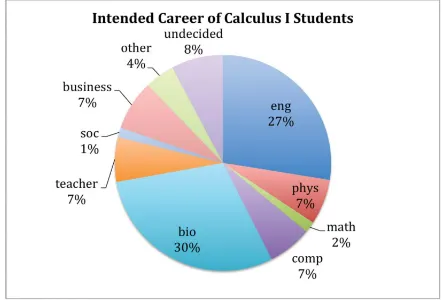
biological and life sciences, makes up 30% of traditional Calculus I students, the largest
single subgroup of such students in Calculus I (Bressoud, 2015). Using qualitative methods,
task-based interviews were conducted with 12 undergraduate students majoring in the
biological and life sciences. Data were analyzed via open coding from a constructivist
grounded theory approach (Charmaz, 2000), a priori literature-based codes, and with local
theory diagrams, an analytical tool developed to illustrate the ways students approached the
tasks by developing theories about the task and revising those theories by assessing their
viability in the face of the results of the hypotheses they generate. Results indicate that the
context of the calculus accumulation tasks presented to students and the representation of the
rate of change function influenced the students’ solution strategies. Additionally, students
utilized their understanding of the problem context to assess the viability of their assumptions
regarding the tasks. Thus, the students’ experiences in their chosen major have an impact on
their mathematical reasoning as it pertains to calculus accumulation tasks. Furthermore, the
new analytical tool, the local theory diagram, was helpful in demonstrating the ways students
© Copyright 2017 William Lloyd Hall, Jr.
A Qualitative Study of the Ways Students from the Biological and Life Sciences Solve Calculus Accumulation Tasks
by
William Lloyd Hall, Jr.
A dissertation submitted to the Graduate Faculty of North Carolina State University
in partial fulfillment of the requirements for the degree of
Doctor of Philosophy
Mathematics Education
Raleigh, North Carolina
2017
APPROVED BY:
_______________________________ _______________________________
Dr. Karen Allen Keene Dr. Hollylynne Stohl Lee
Dedication
Biography
William Hall was born in Dover-Foxcroft, Maine on April 25, 1985. He is the son of William
Hall and Loralie Fors. He graduated from Foxcroft Academy in 2003. He attended the
University of Maine and graduated with a Bachelor of Arts in Mathematics in 2007 and a
Master of Science in Teaching in Mathematics Education in 2010. In 2009, William married
Megan Hall and in 2010 he began the Ph.D. in Mathematics Education program at North
Carolina State University. During that time, he worked on various NSF-funded projects
including Calculus for Elementary Teachers: an Innovative Context (CELTIC), Project
MINDSET, and Teaching Inquiry-oriented Mathematics: Establishing Supports (TIMES). He
also spent two years teaching high school mathematics at Sanderson High School in Raleigh
and one year at the North Carolina School of Science and Mathematics in Durham. William
and Megan welcomed their first daughter, River Naomi Hall, in January of 2017. William
plans to continue his research in the teaching and learning of calculus in the biological and
life sciences at Washington State University, where he will join the mathematics department
Acknowledgements
Everyone’s path to and through a dissertation is unique, but the need for love and
support during such an endeavor is universal. While the great majority of the writing
happened squirreled away in coffee shops or isolated from the world inside headphones, it
could not have been completed without the tireless efforts of the following individuals.
You never truly learn something until you teach it to someone else, until you stand in
the shoes of those who have shared their experiences and knowledge with you. I am currently
in the transition from student to young professional, from graduate student to graduate
advisor and this transition will be as tough as they come. Luckily for me, I have a
tremendous role model to look to as I begin my new role. Dr. Karen Allen Keene pours
herself into her graduate students and it does not go unnoticed. She is kind, supportive, and
immensely generous. She went out of her way on countless occasions to give me experiences
she knew would be valuable to me and her ability and desire to tackle difficult questions is
unparalleled. I could go on for days, but I will just have to say: thank you.
Each member of my dissertation committee had a profound impact on me as a person
and as a researcher. One of my first experiences in graduate school at NCSU was with Dr.
Lee Stiff in his course, History of Mathematics Education. Dr. Stiff taught me to look beyond
the report and see the reporter, to understand the social significance and historical relevance
of the work that precedes our own. It was an invaluable lesson in how the field of educational
research works. Dr. Alina Duca showed me how to balance a passion for mathematics and
mathematics education. She is a shining example of how one does not have to work in a silo,
await. Dr. Hollylynne Lee always finds a way to get the best work out of her students. She is
relentless in her support of her students and the university and I cannot thank her enough for
that. I have benefited a great deal from her courses, her feedback on my dissertation, and in
our conversations about technology and pedagogy.
Starting a Ph.D. in mathematics education is nerve-wracking. Without the support of
countless folks along this journey, it may not have come to fruition. Thank you to Natasha
Speer, my master's thesis advisor. You showed me what mathematics education research
looked like and deftly guided me to NCSU. Thank you to Jen Tyne and Paula Drewniany for
giving me my first experience in teaching, illuminating a path now 13 years in the making.
Thank you to Bob Franzosa who was one of the first people to show me teaching
mathematics at the college level could be fun and entertaining. Thank you to Jere Confrey
whose course on learning theories changed my perspectives on not only learning but science
in general. Thank you to all my professors and classmates at NCSU, I learned a great deal
from every one of my courses. Thank you to all my colleagues at Sanderson and NCSSM, I
learned so much about teaching, the politics of education, and simply adult life from you all,
I am forever changed by meeting you.
Underneath my academic success is the love and support of my friends and family.
Thank you to my parents for believing in me from a young age and giving me the support
necessary to dream big. Thank you to my mother-in-law and grandmother for accepting me
into their family and giving me an amazing amount of love and support. Thank you to my
dear friends Ashely, Jared, and Nick. I cannot put into words what each of you have meant to
Partners ‘til the end. Everything I have been able to accomplish is in no small part
due to the support of my wife, Megan. She has been willing to pick up and move our whole
lives across the country so that I can follow this dream. She has stayed up through late-night
writing sessions, helped me edit countless papers, and recently she has become an amazing
mother to our daughter River, all while maintaining a high level of professionalism in her
Table of Contents
List of Tables ... x
List of Figures ... xiii
Chapter 1: Introduction ... 1
Significance of the Study and Research Questions ... 2
Important Terms and Definitions ... 5
Organization of the Paper ... 6
Chapter 2: Literature Review ... 7
Demographics of Traditional Calculus I Students ... 7
Quantitative Reasoning in the Biological and Life Sciences ... 10
Student Understanding of Definite Integrals in Calculus ... 14
Student Understanding of Definite Integrals in Physics ... 21
Conclusion ... 27
Chapter 3: Methods ... 28
Theoretical Perspective ... 29
Participants ... 31
Interview Protocol ... 34
Data Collection ... 39
Data Analysis ... 42
Chapter 4: Results from Coding ... 68
Tasks 2 and 4 ... 68
Task 3 ... 74
Task 5 ... 78
Results Across the Tasks ... 82
Conclusion ... 85
Chapter 5: Results from Local Theory Diagrams ... 87
Creating the Local Theory Diagrams ... 88
Student 1 - Mary ... 89
Student 2 – Tom ... 99
Student 3 – Anne ... 108
Student 4 – Jake ... 118
Student 5 – Gina ... 126
Results Across Tasks ... 134
Chapter 6: Discussion ... 137
Characteristics of Students’ Solution Strategies ... 138
The Role of Context in Students’ Solution Strategies ... 165
Situating Results within the Existing Research ... 177
Chapter 7: Conclusion ... 185
Summary of Results of the Study ... 185
Implications ... 190
Concluding Remarks ... 192
References ... 194
Appendices ... 202
Appendix A – Recruitment Materials ... 203
Appendix B – Interview Protocol ... 206
Appendix C – Annotations and Codes for Tasks 2 and 4 ... 213
Appendix D – Annotations and Codes for Task 3 ... 216
Appendix E – Annotations and Codes for Task 5 ... 218
Appendix F – Local Theory Diagrams and Interview Descriptions for Task 2 ... 220
Appendix G – Local Theory Diagrams and Interview Descriptions for Task 3 ... 244
Appendix H – Local Theory Diagrams and Interview Descriptions for Task 4 ... 263
List of Tables
Table 1. Summary of interview task context and rate of change representation ... 35
Table 2. Table of rate of change values given in Task 5 ... 39
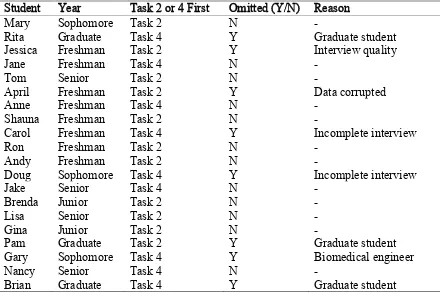
Table 3. Summary of interview participants listed chronologically with omitted students and reasons for omission ... 41
Table 4. Summary of interview participants analyzed in the current study with undergraduate status and task order ... 42
Table 5. Codebook chapter for Task 2 and Task 4 with examples of coded transcript ... 48
Table 6. Codebook chapter for Task 3 with examples of coded transcript ... 51
Table 7. Codebook chapter for Task 5 with examples of coded transcript ... 53
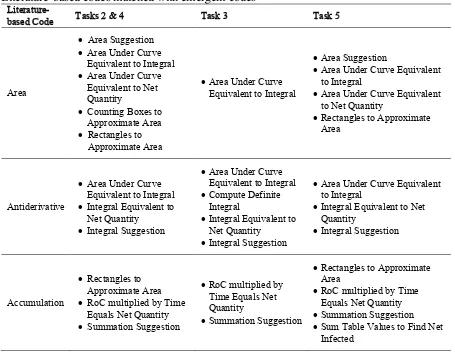
Table 8. Literature-based codes matched with emergent codes ... 60
Table 9. Codebook chapter for Task 2 and Task 4 ... 69
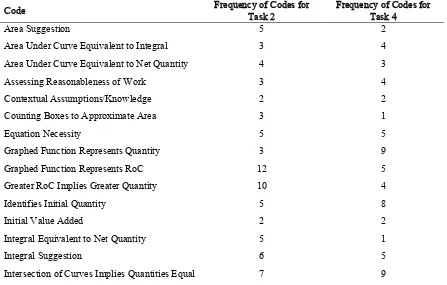
Table 10. Frequency of codes applied to Task 2 and Task 4 ... 71
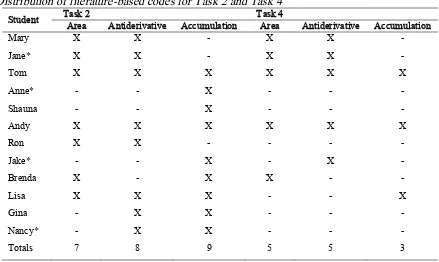
Table 11. Distribution of literature-based codes for Task 2 and Task 4 ... 73
Table 12. Codebook chapter for Task 3 ... 74
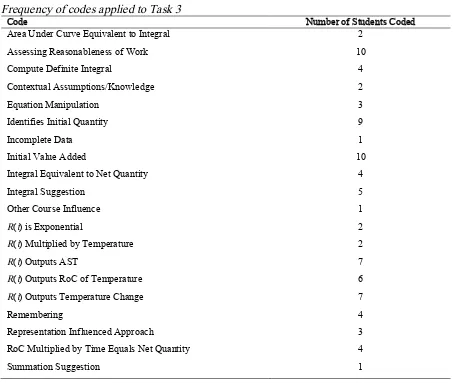
Table 13. Frequency of codes applied to Task 3 ... 76
Table 14. Frequency of codes concerning interpretations of the rate of change function in Task 3 ... 77
Table 15. Frequency of literature-based codes applied in Task 3 ... 78
Table 16. Codebook chapter for Task 5 ... 79
Table 17. Frequency of codes applied in Task 5 ... 81
Table 19. Frequency of literature-based conceptualizations of the definite integral used by
each student in each task ... 83
Table 20. Frequency of literature-based codes applied to Task 2 and Task 4 ... 84
Table 21. Number of literature-based conceptualizations of the definite integral used by
undergraduate group in each task ... 84
Table 22. Frequency of literature-based codes for each task ... 85
Table 23. Summary of interview participants whose local theory diagrams are described .... 88
Table 24. Frequency of cores of local theories for Task 2 ... 135
Table 25. Frequency of cores of local theories for Task 3 ... 135
Table 26. Frequency of cores of local theories for Task 5 ... 135
Table 27. Summary of codes applied to Task 2 pertaining to the calculation of accumulated
distance ... 141
Table 28. Summary of the codes applied to Tasks 2 and 4 pertaining to how students
calculated accumulated quantity ... 148
Table 29. Summary of students who were coded with literature-based code Area for each
task ... 159
Table 30. Summary of students who were coded with literature-based code Antiderivative for
each task ... 160
Table 31. Summary of students who were coded with literature-based code Accumulation for
each task ... 162
Table 33. Summary of the application of the Contextual Assumptions/Knowledge code
across each task ... 171
Table 34. Summary of which students were coded with Equation Necessity on Tasks 2 and 4
... 175
Table 35. Summary students were coded as either Equation Necessity and/or Sketch a Graph
List of Figures
Figure 1. Intended careers of Calculus I students (Bressoud, Carlson, Mesa, & Rasmussen,
2013, p. 691) ... 8
Figure 2. Career goals of Calculus I students by gender (Bressoud, 2015, p. 12) ... 9
Figure 3. Revision of graph to align with mathematical norms (Wemyss, Bajrachara, Thompson, & Wagner, 2011, p. 525-525) ... 25
Figure 4. Graph used in Task 2 ... 36
Figure 5. Graph used in Task 4 ... 37
Figure 6. Screenshot of example of interview data organization ... 45
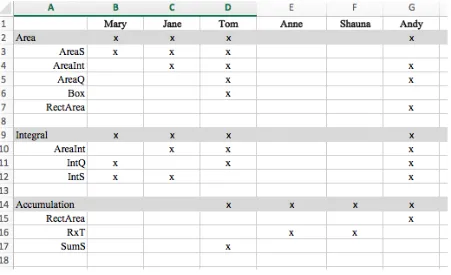
Figure 7. Screenshot of data analysis spreadsheet for Task 2 ... 58
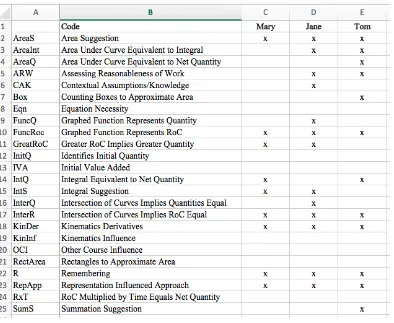
Figure 8. Screenshot of spreadsheet for analyzing literature-based codes for Task 2 ... 61
Figure 9. Local theory diagram for Jake's work on Task 2 ... 65
Figure 10. Local theory diagram for Mary's work on Task 2 ... 92
Figure 11. Local theory diagram for Mary's work on Task 3 ... 94
Figure 12. Local theory diagram for Mary's work on Task 4 ... 96
Figure 13. Local theory for Mary's work on Task 5 ... 98
Figure 14. Local theory diagram for Tom's work on Task 2 ... 100
Figure 15. Local theory diagram for Tom's work on Task 3 ... 103
Figure 16. Local theory diagram for Tom's work on Task 4 ... 106
Figure 17. Local theory diagram for Tom's work on Task 5 ... 107
Figure 18. Local theory diagram for Anne's work on Task 4 ... 110
Figure 20. Local theory diagram for Anne's work on Task 2 ... 114
Figure 21. Local theory diagram for Anne's work on Task 5 ... 117
Figure 22. Local theory diagram for Jake's work on Task 4 ... 119
Figure 23. Local theory diagram for Jake's work on Task 3 ... 121
Figure 24. Local theory diagram for Jake's work on Task 2 ... 123
Figure 25. Local theory diagram for Jake's work on Task 5 ... 125
Figure 26. Local theory diagram for Gina's work on Task 2 ... 128
Figure 27. Local theory diagram for Gina's work on Task 3 ... 129
Figure 28. Local theory diagram for Gina's work on Task 4 ... 131
Figure 29. Local theory diagram for Gina's work on Task 5 ... 133
Figure 30. Local theory diagram for Jane's work on Task 2 ... 143
Figure 31. Local theory diagram for Anne's work on Task 2 ... 144
Figure 32. Local theory diagram for Jake's work on Task 2 ... 145
Figure 33. Jake's written work on the Car 3 problem from Task 2 ... 147
Figure 34. Local theory diagram for Anne's work on Task 4 ... 150
Figure 35. Local theory diagram for Mary's work on Task 4 ... 151
Figure 36. Local theory diagram for Brenda's work on Task 3 ... 153
Figure 37. Local theory diagram for Shauna's work on Task 3 ... 155
Figure 38. Local theory diagram for Anne's work on Task 3 ... 168
Chapter 1: Introduction
Calculus is at the heart of a great many disciplines. Accounting, biology, chemistry,
computer science, economics, engineering, meteorology, and physics are just a few of the
undergraduate programs that require at least one semester of calculus. Helping us to model
how quantities change accumulate, calculus is invaluable to the study of differential
equations as well, which are used extensively in the biological and life sciences. As such,
investigations into the teaching and learning of calculus concepts are growing more
important. Enrollment in calculus courses (at the secondary and post-secondary levels)
continues to rise (Bressoud, Carlson, Mesa, & Rasmussen, 2013; Kaput, 1997) and so
understanding how students reason about calculus concepts is vital to better serve this
growing community. Mathematics education research has kept pace with this need. Since the
1980s, research in calculus teaching and learning has blossomed into a field unto itself where
researchers have explored several areas including the cognitive development of introductory
calculus concepts in students and the potential for new digital tools to change calculus
instruction (see Rasmussen, Marrongelle, & Borba, 2014 for a review).
Recent studies have highlighted the service nature of introductory calculus at the
undergraduate level, since “very few students in Calculus I - between 1% and 3% of those
enrolled in this course - intend to major in mathematics” (Bressoud et al., 2013, p. 691), most
students in these classes are majoring in other fields, what are often called the client
disciplines of calculus. Researchers have identified that 30% of the students in traditional
However, the traditional Calculus I course “is designed to prepare students for the study of
engineering or the mathematical or physical sciences” (Bressoud et al., 2013, p. 691).
The definite integral and accumulation are important topics in the study of calculus.
In this study, accumulation tasks are those that involve the definite integral of a rate of
change function. Integration and accumulation serve an important role in differential
equations and various models in the biological and life sciences. Research into student
understanding of the definite integral has identified that calculus students are good at using
the standard antiderivative techniques taught in introductory calculus (Ferrini-Mundy &
Graham, 1994; Grundmeier, Hansen, & Sousa, 2006; Mahir, 2009; Orton, 1983) and that
while area under the curve dominates instruction of the definite integral in calculus, the
multiplicative structure of the Riemann sum is a more powerful way to conceive of the
definite integral as seen in both mathematics and physics education research (e.g. Jones,
2015a; Sealey, 2014).
Significance of the Study and Research Questions
Research on the teaching of and learning about integrals has largely focused on the
definite integral and has primarily attended to students in the physical sciences and
engineering. Researchers have shown that some students focus on: analytic antiderivative
techniques when considering the definite integral (Jones, 2013, 2015a, 2015b), the definite
integral as area under a curve (Bezuidenhout & Olivier, 2000; Hall, 2010; Jones, 2013,
2015b; Orton, 1983; Sealey, 2006; Thompson & Silverman, 2008), Riemann sums as a
Fundamental Theorem of Calculus (Grundmeier, Hansen, & Sousa, 2006; Thompson, 1994;
Thompson & Silverman, 2008).
Findings paint a picture of a calculus student who learns integration techniques
adequately but struggles to see the larger picture of how the integral plays a role outside of
calculus. In their review of the impact of the research that has been done in calculus teaching
and learning, Bressoud et al. (2013) question “whether the traditional Calculus I curriculum
is preparing any students to use ideas of calculus in future courses in mathematics,
engineering or the sciences” (p. 692). As such, researchers have been pushing for a calculus
that better supports the client disciplines (e.g. Rasmussen et al., 2014).
However, it seems there is a disconnect in the world of calculus teaching and
research, namely, “the tension here is multifaceted and includes differences between the
secondary and tertiary level as well as differences between the needs of students studying
mathematics and those majoring in economics, biology, engineering, business, etc.”
(Rasmussen et al., 2013, p. 513). While the standard calculus curriculum was written for
“students in engineering or the physical sciences” and provides ample examples to those
fields, we find that “these students constitute only a third of those who take Calculus I”
(Bressoud et al., 2013, p. 691), meaning most students in Calculus I are not being presented
with examples and contexts that are meaningful to their intended career.
Furthermore, as far as preparing students in the client disciplines of calculus (those
that require undergraduate students to talk calculus) physics education researchers have
found that problem-solving strategies differ in relation to the context presented (e.g.,
are more or less productive in a physics context when compared to a decontextualized
mathematics context (Bajracharya, Wemyss, & Thompson, 2012; Jones, 2015a), and that
professionals in these different disciplines (e.g., mathematics, physics, engineering)
communicate differently about equivalent mathematical structures (Wemyss, Bajrachara,
Thompson, & Wagner, 2011; Dray & Manogue, 2004). However, as mentioned above, this
research is largely based on the abilities of students from fields like the physical sciences and
engineering and no studies have been conducted to investigate how students from the
biological and life sciences solve calculus accumulation tasks.
To better serve students from the myriad client disciplines of calculus, we must
understand how the specific calculus concepts are utilized and understood in those client
disciplines and how students solve calculus tasks set in contexts relevant to those fields.
Rasmussen et al. (2014) end their review of the state of research on calculus teaching and
learning with a call for “research that closely examines the ways in which calculus ideas are
leveraged in the client disciplines, how these ideas are conceptualized and represented in the
client disciplines, and what these insights might mean for calculus instruction” (p. 513). The
current study was designed to address this gap in the literature. My specific research
questions are:
1. How can we characterize the ways undergraduate students majoring in the biological
and life sciences solve calculus tasks involving accumulation?
2. What role does context play in how undergraduate students majoring in the biological
To answer the research questions posed, qualitative methods were employed. This study is
situated within a constructivist perspective on learning and research. As such, I utilized
task-based interviews with twelve undergraduate students majoring in the biological and life
sciences at a large public university in the Southeastern United States that I will call South
State University in the spring of 2016. Task-based interviews allowed me to investigate
students reasoning about calculus tasks involving accumulation and to probe their
understanding as they solved the problems. Data were analyzed with methods from
constructivist grounded theory (Charmaz, 2000) as well as with local theory diagrams, an
analytical tool developed for the interview data collected in this study.
Important Terms and Definitions
In this section, I will define the various important terms and concepts that will be
utilized in this study.
Antiderivative: Finding the antiderivative of a given function is the inverse process of differentiating.
Definite integral: A definite integral is a limit of a sequence of Riemann sums. This means we consider subsequent Riemann sums over partitions with arbitrarily small
subintervals. It is important to note that a Riemann sum is formed through summation of a
multiplicative relationship between a small change in the dependent variable and the function
value. This fact allows for one of the most common applications of the definite integral,
calculating area bounded by the x-axis and the graph of the function being integrated.
Indefinite integral: An indefinite integral of a given function is the set of all antiderivatives of the given function.
Riemann sum: Riemann sum is one of many ways we can approximate the area under a curve or some accumulated quantity. To construct a Riemann sum, we partition the domain
of the function into a finite number of subintervals and consider some values of the function
over each subinterval. The Riemann sum is the sum of products between the length of each
subinterval and the chosen value of the function at some arbitrary point in the subinterval.
Traditional Calculus I: Refers generally to what undergraduate educators would call Calculus I, in which students are exposed to standard derivative and antiderivative
techniques, limits of functions, the definite integral, and the Fundamental Theorem of
Calculus.
Organization of the Paper
In Chapter 2, I will review the existing research concerning who traditional Calculus I
students are and what client disciplines they belong to, the role of quantitative reasoning in
the biological and life sciences, and what we know about student understanding of the
definite integral in both mathematics and physics education. Chapter 3 describes the research
methods used in the current study. Chapter 4 presents the results of the open coding analysis
of the interview data while Chapter 5 presents the results of the local theory diagrams.
Chapter 6 is a discussion of both the open coding results and the local theory diagrams.
Chapter 7 includes conclusions drawn from the study as well as the limitations and
Chapter 2: Literature Review
In this chapter, I present the demographic information concerning who traditional
calculus students are and how a significant subgroup of these students belongs to the
biological and life sciences. I also review the existing research on quantitative reasoning in
the biological and life sciences. Additionally, I review the existing research on student
understanding of the definite integral. I discuss how we find that calculus students are good
at using the standard antiderivative techniques taught in introductory calculus
(Ferrini-Mundy & Graham, 1994; Grundmeier, Hansen, & Sousa, 2006; Mahir, 2009; Orton, 1983)
and that while area under the curve dominates instruction of the definite integral in calculus,
the multiplicative structure of the Riemann sum is a more powerful way to conceive of the
definite integral as seen in both mathematics and physics education research (e.g., Jones,
2015a; Sealey, 2014). The literature includes the finding that practitioners talk about
mathematics differently in mathematics and physics, so students are not always able to
readily apply their knowledge in these different fields (Dray & Manogue, 2004; Wemyss et
al., 2011). This research emphasizes that part of learning about the definite integral is
practice in the different client disciplines that utilize the definite integral.
Demographics of Traditional Calculus I Students
In the fall semester of 2010, a large national survey of calculus programs was
conducted with the support of the Mathematical Association of America (Bressoud, Carlson,
Mesa, & Rasmussen, 2013; Bressoud, 2015). The goals of this survey were to provide a more
detailed picture of the demographic background of traditional Calculus I students as well as
success. The survey was taken by more than 14,000 undergraduate students from over 200
different colleges and universities across the country. The researchers found that traditional
Calculus I students have a diverse set of career goals and the most common intended career
of students enrolled in traditional Calculus I are the biological and life sciences (30%),
followed closely by engineering (27%). See Figure 1 for the breakdown of intended careers
as reported by the researchers (Bressoud et al., 2013, p. 691).
Figure 1. Intended careers of Calculus I students (Bressoud, Carlson, Mesa, & Rasmussen, 2013, p. 691)
Interestingly, Bressoud (2015) breaks these demographics down even further to
45% of the men in Calculus I intend to pursue a career in engineering, mathematics, or the
physical sciences whereas this is true for only 19% of women. The biological and life
sciences are a much more popular intended career field for women as 43% of women in
Calculus I intend to pursue a career in the biological and life sciences whereas only 19% of
men in Calculus I intend to pursue a career in the biological and life sciences. This implies
that there are a great deal of students majoring in the biological and life sciences enrolling in
traditional Calculus I courses and that these students are predominately women.
Figure 2. Career goals of Calculus I students by gender (Bressoud, 2015, p. 12)
These statistics are important as they point out a rather striking equity issue in our
traditional Calculus I courses. Bressoud et al., (2013) point out that the traditional Calculus I
course “is designed to prepare students for the study of engineering or the mathematical or
physical sciences,” (p. 691) implying that we are privileging those students in our calculus
courses who study within one of those fields. As noted above, these students do not make up
The researchers note that Calculus I is “a service run for the benefit of departments other than
Mathematics” (p. 691) and yet our traditional approaches to the course are focused on a
minority of our students, when considered by major. As we will see later in this chapter, this
focus on engineering and the physical sciences in the teaching is mirrored in the research
concerning student understanding of the definite integral, leaving a significant gap in how we
approach both the teaching and learning of calculus, specifically as it relates to the various
client disciplines outside of engineering and the physical sciences. Research attending to this
gap is warranted given the previous demographic information and researchers have called for
studies that explore “the ways in which calculus ideas are leveraged in the client disciplines”
(Rasmussen et al., 2014, p. 513). Unfortunately, there is no research concerning how students
from the biological and life sciences think about and understand the definite integral.
However, more broadly, there is some research at the intersection of mathematics and
biology. In the next section I will describe work that has been done concerning quantitative
reasoning in the biological and life sciences.
Quantitative Reasoning in the Biological and Life Sciences
While there are not studies that directly identify how students majoring in the
biological and life sciences reason about calculus concepts, there has been some work done
at the intersection of quantitative reasoning and the biological and life sciences. Researchers
have found that there is a need for quantitative reasoning in the training of future biologists
as the field of biology now depends on advanced mathematical and computer programming
techniques (Bialeck & Botstein, 2004; Cohen, 2004; Gross 2004; Hastings & Palmer, 2003;
to be math averse (e.g., Hoy, 2004; Sorgo, 2010). Finally, biologists have noted that
complicated analytic techniques from calculus may not be as useful for students studying in
the biological and life sciences as qualitative and numerical solution strategies (Bossert &
Chin, 1987; Horn, 1987; Levin, 1987). These findings are elaborated in the following
sections.
Quantitative reasoning is important for biologists. In 2003, the National Research Council (NRC) published a report entitled BIO2010, suggesting university biology programs
develop stronger connections between the life sciences and the mathematical, physical, and
computer sciences (NRC, 2003). As a result of that report, several biology departments
across the country incorporated changes in how the quantitative sciences are utilized. Some
created new biology courses focused on quantitative skills (e.g., Chiel, McManus, & Shaw,
2010; Feser, Vasaly, & Herrera, 2013) while others created brand-new degree programs
focused on quantitative biology (e.g., Usher, Driscoll, Dhurjati, Pelesko, Rossi, Schleiniger,
Pusecker, & White, 2010).
Several researchers have specifically identified how the future of the biological and
life sciences is dependent upon future biologists being adept with mathematical and statistical
techniques (Bialeck & Botstein, 2004; Cohen, 2004; Gross 2004; Hastings & Palmer, 2003;
NRC, 2003). Bialeck & Botstein (2004) note that “dramatic advances in biological
understanding, coupled with equally dramatic advances in experimental techniques and
computational analyses, are transforming the science of biology” (p. 788). The researchers
claim that to “participate fully in the research of the future, it will be essential for scientists to
mathematics, computation, and the physical sciences” (p. 789). Gross (2004) highlights the
changing landscape of skills required of biologists, “it is next to impossible for those who are
skilled field observers to make substantial new contributions to our understanding of natural
system function without utilizing methods and approaches that natural historians of the past
would never have dreamed of, let alone be skilled enough to use” (p. 85). These authors
make it clear that the present and future of the biological and life sciences must include
mathematical skills and techniques. Unfortunately, as we shall see in the next section, there is
a sense of math aversion in the biological and life sciences.
Math aversion in the biological and life sciences. While there is some consensus concerning the importance of mathematical skills in the biological and life sciences,
researchers have found that students and professionals in the biological and life sciences tend
to be math averse (Brent, 2004; Chiel, McManus, & Shaw, 2010; Fawcett & Higginson,
2012; Hoy, 2004; Sorgo, 2010). Sorgo (2010) claims that “students often choose biology as a
safe refuge inside the archipelago of science disciplines, one where mathematics can be in
most cases tolerated or even ignored” (p. 196). This aversion is not only relegated to
students. Fawcett & Higginson (2012) analyzed the citation statistics in top journals for
ecology and evolution to investigate the impact of including mathematical equations on
citation rates. The researchers found that “equation density negatively affects citation rates,
leading on average to 22% fewer citations for each additional equation per page” (p. 11735).
The researchers conclude that “a scientifically strong theoretical paper risks dramatically
reducing its impact by presenting its mathematical details in a highly technical manner” (p.
not suffer the same negative effect. These results are problematic for a field that has
identified mathematics as an important component of the future of the field.
Focus on numerical methods and modeling. Several professional biologists have identified how qualitative and numerical techniques in calculus are more appropriate than
analytic techniques for students in the biological and life sciences (Bossert & Chin, 1987;
Horn, 1987; Levin, 1987). For example, Levin (1987) claims that “the availability of high
speed computers has…reduced the necessity of training students to be facile in the clever
manipulation of integrals (p. 117-118). Similarly, Bossert & Chinn (1987) claim that biology
students “need to be shown how to depend more on qualitative and numerical methods than
on those traditionally taught in the calculus” (p. 67). It is important to note that these are not
research findings but suggestions from professional biologists concerning what calculus
students in the biological and life sciences should know.
The lack of research studies that illustrate the ways students majoring in the
biological and life sciences think about and utilize calculus concepts is troubling. Given that
calculus is a required course for many biological and life science majors across the country, it
is important for us to know if there are idiosyncrasies in how these students approach
calculus tasks. In the current study, my goal is to explore how undergraduate students from
the biological and life sciences solve calculus accumulation tasks. In doing so, I hope to
provide some evidence regarding how these students’ solution strategies are the same as or
different from what we know about how students solve these kinds of tasks from the existing
next section I will describe what we do know about how students think about and reason with
the definite integral.
Student Understanding of Definite Integrals in Calculus
Researchers have found that students draw on several different conceptions of the
definite integral when working on calculus tasks. As an overview, results of these studies
indicate that students focus on the antiderivative techniques when considering the definite
integral (Hall, 2010; Jones, 2013, 2015a, 2015b), that many students conceptualize the
definite integral as area under a curve (Bezuidenhout & Olivier, 2000; Hall, 2010; Jones,
2013, 2015b; Orton, 1983; Sealey, 2006; Thompson & Silverman, 2008), and that some also
attend to Riemann sums and a multiplicative structure of the definite integral (Jones, 2015b;
Orton, 1983; Sealey, 2006, 2014). There is also some research on students’ understanding of
the Fundamental Theorem of Calculus (Grundmeier, Hansen, & Sousa, 2006; Thompson,
1994; Thompson & Silverman, 2008).
Recently, researchers have been championing an accumulation model of the definite
integral, where the multiplicative and summative structures of the Riemann sum are stressed
as a more productive means for students in understanding definite integrals when compared
with the more traditional area model (e.g., Jones, 2015a; Thompson & Silverman, 2008). I
discuss these findings in the following sections.
Students are successful with analytic techniques. Several researchers have
demonstrated that students are adept with using basic integration techniques (Ferrini-Mundy
& Graham, 1994; Grundmeier, Hansen, & Sousa, 2006; Mahir, 2009; Orton, 1983). For
students and found that students performed very well on the two examples that could be
solved by applying memorized integration techniques, with 92% of respondents answering
the first correctly and 74% answering the second correctly. Similarly, Grundmeier, Hansen,
& Sousa (2006) report that 32 of the 52 undergraduate calculus students they surveyed could
provide completely correct solutions to two definite integral problems involving basic
trigonometric functions (p. 185) and note that only 13% of students who made mistakes, did
so in a way relating to integrating the functions (p. 189). Overall, students have shown
computational fluency with regards to basic integration techniques; however, there are a few
areas in which students tend to make mistakes, namely, integrating functions that include
fractional and negative exponents and definite integral problems where the function crosses
the x-axis (Orton, 1983).
Success with analytic techniques does not imply understanding. Even when students
present strong procedural fluency with integration techniques, they tend to do so without
consideration of the deeper scope of such techniques, leading them to rely on computational
skills and algebraic representations even when simpler interpretations (e.g., graphical) are
available. For example, in Mahir’s (2009) study, one task presented to students was designed
to be solvable using a relatively simple integral-area relation, but also via trigonometric
substitution, a challenging analytical integration technique. Mahir found that 73% of students
attempted to solve the problem using trigonometric substitution and only 11% of those
students could solve it correctly, whereas each of the 8% of students who attempted to use an
integral-area relation were able to solve the problem correctly (p. 205). These results point to
knowledge that is not supported by conceptual understanding can produce only limited
success,” (p. 202) meaning that while it is encouraging that students are able to apply
integration techniques, it should give researchers and instructors pause when evaluating those
students’ level of understanding since such facility with techniques does not guarantee deeper
understanding.
Furthermore, researchers have shown that some students attend to the antiderivative
as the primary definition of the definite integral (e.g., Hall, 2010; Jones, 2015b). Relying on
such a conceptualization of the definite integral can cause significant issues for a student’s
understanding of the definite integral. Jones (2015b) concludes, “even when a student could
reasonably use an anti-derivative technique to calculate an integral, antiderivatives fall short
of providing coherence to the integral expression and a reason for why it calculates what it
does” (p. 13).
Connecting algebraic and geometric representations of definite integrals. Several
researchers have found similar results to those of Mahir (2009), concluding that students tend
to avoid geometric representations in favor of algebraic representations. Moreover, students
are not employing algebraic representations to their full potential, students are simply
memorizing procedures and when to apply them (Ferrini-Mundy & Graham, 1994; Mahir,
2009; Sevimli & Delice, 2010; Thompson, 1994). Ferrini-Mundy & Graham (1994) found
that one of their interview subjects “demonstrated great reluctance to use geometric
interpretations as a help in completing an algebraic process, and was much more inclined to
move to her algebraic context when possible” (p. 41). The researchers conclude, “graphical
unrelated algorithms for solving problems are applied, and where competing meanings can
be held” (p. 42). These results shed light on those of Mahir since students who cannot view
algebraic and graphical representations of definite integrals as equivalent are not able to
choose between complicated trigonometric substitution strategies and straightforward
graphical representations as they only see the algebraic path.
Understanding the definite integral as area under the curve. One powerful application of definite integrals is the computation of area under a curve. This fact often forms the
fulcrum about which integration instruction revolves, the definite integral is seen solely as
equivalent to finding area under a curve. While it is mathematically accurate to equate
elements of the definite integral with finding area under a curve, it can limit students’
abilities to relate integration to other, equally meaningful contexts. Additionally, the area
under the curve model can bleed into other, often unproductive arenas. For example, Hall
(2010) found that when asked about an indefinite integral, some students talked about
potential or infinite area, as if the indefinite integral was just a definite integral waiting for
limits of integration. This conception is not mathematically accurate and potentially
confusing for students’ future use of the definite integral.
Furthermore, students tend to struggle with contexts when physical area is
meaningless, e.g., the area under a cost curve representing total expense, not an actual
physical area (Bezuidenhout & Olivier, 2000; Orton, 1983; Sealey, 2006; Thompson &
Silverman, 2008). This is an important finding regarding the intersection of calculus and the
biological and life sciences. Modeling in the biological and life sciences often involves rates
space. For example, the area under a curve representing the rate of change of a city’s
population may be relevant for a student in the biological and life sciences but this area
represents gains or losses in overall population, not physical space.
This brings us to another possible complication of students relying solely on area to
understand the definite integral: the concept of “negative area.” Where area is a physical
quantity and therefore non-negative, definite integrals can take on negative values when the
integrand takes on negative values and the total accumulated quantity becomes negative.
Therefore, the definite integral of a function that is strictly negative over the interval being
integrated over, would give a negative value. This can be problematic if one believes the
definite integral always computes area under the curve. Orton (1983) found that “many
students interviewed had problems with finding areas when the curve crossed an axis, or
generally in understanding the relationship between a definite integral and areas under the
curve” (p. 12). Bajrachaya, Wemyss, & Thompson (2012) extend this research to positive
functions where the limits of integration have been reversed. The researchers found that
students reasoned about the sign of an integral with a positive function and reversed limits of
integration in one of three ways: by attending to the FTC and correctly evaluating the
problem algebraically, using Riemann sums but fixing the sign of the differential resulting in
a positive value, or by using the physical quantities in the problem. Students tended to reason
that area should always be positive and therefore so would be the accumulated quantity in
many of these cases. The researchers conclude “most students can correctly identify the signs
of definite integrals, but often with incomplete or incorrect reasoning” (p. 114). As will be
of negative area in physics contexts and therefore could be beneficial to students studying in
the biological and life sciences as well.
Understanding the definite integral as accumulation. Attending to an accumulation model of the definite integral in an introductory calculus course means abandoning the
primary identification of the definite integral with area under a curve and considering instead
how to help students develop productive views of accumulation as multiplicatively-based
summation. Accumulation, as opposed to area under a curve, can represent any accumulating
quantity, whether positive or negative. As Sealey (2006) illustrates, “I do not in any way
claim that area under a curve is a bad representation or that is should not be taught. Instead, I
claim that area under a curve is not sufficient for understanding the definite integral” (p. 52).
Even when students can reason about area and the definite integral, Sealey (2006) points out
they “may not be able to solve other accumulation problems without thinking about area
under a curve, or may not be able to relate the area under a curve to the structure of a
Riemann sum” (p. 52). Again, in context-rich problems where functions represent quantities
other than physical space, it is necessary that students can detach their understanding from
the traditional perspectives on area, and this is difficult for students. Sealey suggests that
when students can reason effectively about Riemann sums, they are able make such a
transition.
Multiplicative structure. Thompson & Silverman (2008) contend “for students to see
‘area under a curve’ as representing a quantity other than area, it is imperative that they
conceive of the quantities being accumulated as being created by accruing incremental bits
the definition of integrals as limits of Riemann sums. This point is confirmed and further
explored in the work of Jones (2013, 2015a, 2015b) who demonstrated three primary forms
that students draw on when making sense of integrals: antiderivative, area under the curve,
and adding up pieces. Jones (2015a) renames the “adding up pieces” form as
multiplicatively-based summation to focus more heavily on both the multiplicative and
additive structure that he found to be more productive for students in solving both
decontextualized mathematics problems and applied physics problems. Furthermore, Jones
found that even when students could not make sense of area under the curve in an applied
physics context, when they turned to the multiplicatively-based summation form, they were
more successful in making sense of the quantities involved and in the long run, how a
definite integral would help them solve the problem.
Unfortunately, students do not seem to rely on the more productive accumulation
model based on the multiplicatively-based summation nature of the Riemann integral. Jones
(2015b) found that students more regularly employ either an antiderivative or area
conceptualization. He concludes that "around half of all successful first-semester calculus
students might not draw on any type of summation conception as a basis for explaining the
meaning of these types of definite integral” (p. 11).
Reimann integral framework. Sealey (2014) establishes that there are four layers and
one pre-layer to student conceptualizations of the definite integral, orienting, product,
summation, limit, and function. Unlike Jones, Sealey found that students were quick to
identify the need for a summation in physics-based problems, but that identifying what
while working in the Product layer” given that students must “coordinate both factors in the
product as well as the new quantity that results from the multiplication” (p. 243). These
issues are compounded by the fact that students’ problem solving strategies and ability to
recognize the need for a multiplicatively-based summation change within different problem
contexts (e.g., Bajracharya & Thompson, 2014; Sealy, 2014). This finding is confirmed by
my study as well.
For students to develop an understanding of accumulation functions, students must do
more than evaluate definite integrals. As Thompson & Silverman (2008) conclude, “no one
would claim to teach the idea of function by having students calculate specific values of one.
Similarly, we should not think that we are teaching the idea of accumulation function by
having students calculate specific definite integrals” (p. 121). Again, it should be stressed
that arguments for focusing on accumulation within calculus instruction do not do so at the
exclusion of all connections between integration and area under the curve. In fact, such
connections are made more robust when students perceive integrals through the lens of
accumulation functions and then see area as a special case of such a function.
Student Understanding of Definite Integrals in Physics
As noted earlier, there is no research concerning how students from the biological and
life sciences reason about the definite integral. However, we can turn to other fields to
investigate how the mathematical structure of the definite integral is utilized in an applied
setting. Namely, there have been several important findings regarding how students use the
definite integral in the context of physics and engineering. In this section I describe these
Problem-solving strategies in integration problems are context-dependent. The fact that context influences problem-solving strategies is probably not surprising, when students
are more familiar with the context of a problem they are able to attend to different
components of the problem as opposed to when they must spend time understanding the
context. This idea was illustrated in Sealey’s (2014) Riemann Integral Framework by her
eventual inclusion of the orienting pre-layer, “which includes visualizing the situation,
understanding the variables in the problem, and understanding the quantities in the problem
(pressure, force, etc.)” (p. 237). She explains that while students could recognize the need for
a product in problems involving energy as the product of force and distance and distance as
the product of velocity and time, they were unable to do so in a problem involving force as a
product of pressure and area, until they redirected their attention because of their computing
an exact answer while the problem asked for an approximation. While all students eventually
recognized the need to approximate the resulting quantity using a product (the basis of a
Riemann sum and therefore a definite integral) the problem context seemed to influence how
readily that knowledge was accessible.
Like Sealey’s work, Bajracharya & Thompson (2014) interviewed students in
introductory physics and mathematics and found that students struggled more to correctly
solve physics problems involving definite integrals in contexts they were unfamiliar with
(pressure and volume) compared with a more familiar context (changing temperature). The
authors conclude, “although the underlying mathematical structures in both the questions
were the same, individual students treated the two problems quite differently indicating the
50). It is clear here that experience with the standard applications that show up in physics is
an important element of learning about integrals for physics students. These results indicate
there is a warrant for investigation of how problem context and setting of calculus tasks
influences students’ solution strategies from other client disciplines of calculus. In this
research report, I consider more than just what students do not do well, but how they reason
with context in solving calculus accumulation tasks.
Productive conceptions of the definite integral for physics students. Jones (2013, 2015a, 2015b) has spent time investigating what cognitive resources mathematics and
physics students draw upon when working with definite integrals. As noted earlier, he has
found that students largely conceptualize the definite integral through antiderivatives and
area under the curve and to a much smaller extent through multiplicatively-based summation.
However, when he investigated how productive each of these conceptions were for students
in both decontextualized mathematics problems and applied physics problems, he found that
while all three conceptualizations were productive for students in the decontextualized
mathematics problems, only the multiplicatively-based summation conception was
productive for students in the applied physics problems. For example, Jones (2015b) reports
that an antiderivative conception “is typically not the way that pressure is defined nor
discussed in physics and engineering textbooks” and thus “is a problematic way to interpret
these integrals and generally does not provide the meaning that is intended in physics and
engineering” (p. 10). In the context of an electric field on a bar of charge, Meredith &
physical effects to obtain a total physical effect,” a view they claim is inconsistent with the
antiderivative conceptualization of the definite integral (p. 576).
In the case of the area conceptualization, Jones (2015a) also found that one set of
students began their work with an area conceptualization and were unable to reason
productively about how area under the curve connected to the units given in the problem.
However, once they switched to a multiplicatively-based summation conception, they could
make sense of the integral and could then backtrack to explain how area under the curve was
meaningful. Jones concludes that a multiplicatively-based summation conception “was able
to provide meaning to the area underneath the curve even when the perimeter and area
conception itself could not provide this meaning to the students,” a sentiment echoed across
several studies (e.g., Bajracharya, Wemyss, & Thompson, 2012; Meredith & Marrongelle,
2008; Sealey, 2006). In sum, area under the curve is a powerful, but not a complete
conception of the definite integral. These findings point towards the importance of
investigating the contexts and applications that naturally crop up in the various client
disciplines of calculus so that we can be aware of and incorporate those contexts into
introductory calculus courses.
Differences in language and symbols. Discipline-specific language and assumptions are important for calculus instructors to be aware of as they prepare lessons. When
professionals from one field reference mathematical techniques and concepts in idiosyncratic
ways, students can get confused when moving between the various fields. Additionally,
certain techniques and assumptions may be specifically relevant for one discipline but almost
common in calculating accumulated charge on a charged bar, but is not as useful in a
biological setting in which the independent axis represents time and therefore switching the
limits of integration is more problematic.
Figure 3. Revision of graph to align with mathematical norms (Wemyss, Bajrachara, Thompson, & Wagner, 2011, p. 525-525)
The language of mathematics certainly carries over to other fields, however there are
subtle alterations that come into play. Researchers have noted these discrepancies to help
educators attend to such differences so that students can transfer their mathematics
knowledge more effectively (e.g., Dray & Manogue, 2004; Wemyss et al., 2011). One telling
example is the work of Wemyss et al. (2011) in which they describe the alteration of a
research item to align more with the standard representation practices of mathematics. In
their earlier work, a graph was shown to students with the endpoints labeled on the graph
itself instead of the horizontal axis (see left of Figure 3). This representation was later edited
acceptable representation” (p. 525), see the right of Figure 3 for the altered version. This is a
prime example of the subtle discrepancies between physics and mathematics and the
symbolic and linguistic worlds students are required to live within. Understanding these
nuances is imperative to helping students develop productive conceptions of the integral in
all the client disciplines it is relevant to.
Mathematical preparation of physics students. One encouraging finding from the physics education literature is that while students may have a hard time applying their
mathematics knowledge in physics settings, they do seem to have the requisite mathematics
background (Bajracharya & Thompson, 2014; Christensen & Thompson, 2010; Meredith &
Marrongelle, 2008; Rebello, Cui, Bennet, & Ozimak, 2007). As a result of interviewing
physics students in an effort to learn about how students transfer their mathematical
knowledge to a physics context, Rebello et al. (2007) report that their results “appear to
indicate that the main difficulty that students appear to have does not lie in their lack of
understanding of mathematics per se, rather it lies in their inability to see how mathematics is
appropriately applied to physics problems” (p. 30-31) as they found that students’ “typically
do have an adequate calculus knowledge and skills required for solving end-of-chapter
physics problems” (p. 20). Similarly, Bajracharya & Thompson (2014) conclude that students
seem to have the requisite mathematical knowledge, but they sometimes need to have that
knowledge elicited explicitly before they can use it in an applied physics setting.
These findings illustrate that students can learn the mathematics, but more attention
needs to be focused on the specific ways this knowledge is utilized in the various disciplines
important for helping us identify how students from the client disciplines of calculus reason
about accumulation tasks and whether (and if so, how) the context of the tasks plays a role in
the students’ abilities to apply their calculus knowledge.
Conclusion
In this chapter, we have seen that a significant proportion of the students in traditional
calculus courses are intending on careers in the biological and life sciences but that our
current instructional model and research base primarily support those students in the physical
sciences and engineering. We note that professional biologists have called for an increased
focus on quantitative reasoning within the biological and life sciences but that there is some
math aversion within the community. Finally, we have seen how researchers have shown that
while calculus students tend to be adept with standard integration techniques, the more useful
conception of the definite integral, a multiplicatively-based summation conception, still is not
the most prevalent conception of the definite integral for calculus students. What results is a
rather significant hole in the research concerning how students from the biological and life
sciences utilize various calculus concepts. This study was developed with the aim of filling a
component of that gap. In the next chapter I will describe the research methods I have
Chapter 3: Methods
This qualitative study was designed to add to the research about calculus learning by
life science students by answering the following research questions:
1. How can we characterize the ways undergraduate students majoring in the biological
and life sciences solve calculus tasks involving accumulation?
2. What role does context play in how undergraduate students majoring in the biological
and life sciences solve calculus tasks involving accumulation?
Qualitative research methods were chosen because they offer the opportunity to
thoroughly examine the solution strategies students employ as they solve calculus
accumulation tasks (Hesse-Biber & Leavy, 2011). Engaging students in the tasks and being
able to ask clarifying and probing questions afforded me unique opportunities to understand
more fully the cognitive structures that give way to solving the tasks. Therefore, I conducted
task-based interviews with twelve undergraduate students majoring in the biological and life
sciences at South State University in the spring semester of 2016. Note that this school name
is a pseudonym for the actual university. While I interviewed 20 students, I selected 12 of the
interviews that were both complete in data collection and best represent the community of
undergraduate students majoring in the biological and life sciences. Task-based interviews
allowed me to investigate how students thought through calculus tasks involving
accumulation and to probe their understanding as they worked. In this chapter, I describe my
theoretical perspective, the participants, the sampling process, the interview protocol, and the
Theoretical Perspective
When doing qualitative research, it is important to acknowledge and illustrate one’s
ontological and epistemological views. Our views on the nature of reality, knowledge, and
learning influence the questions we ask and the methods we feel are valid for answering such
questions (Hesse-Biber & Leavy, 2011). What follows is a presentation of my own beliefs
concerning the learning process, the nature of knowledge, and how these views influenced
the data collection and analysis in the current study. The perspective of learning that
influenced the construction and analysis of this study is constructivism, specifically a view of
knowledge as cognitive adaptation. Below, I briefly describe this theory of learning and in
the next section I discuss how this perspective directly influenced the development of the
local theory diagrams.
Constructivism. In a constructivist theory of learning, the fundamental assumption is that learners build up knowledge for themselves instead of being imbued with knowledge by
those around them. In other words, the learner must actively participate in the development
and organization of the cognitive structures making up their understanding of the world (von
Glasersfeld, 1982). The individual is the “primary unit of analysis for assessing and
evaluating cognitive achievements” in constructivism (Confrey & Kazak, 2006, p. 316).
However, to explore an individual’s understanding, one must consider the following three
factors: “the individual’s current state of development, social and cultural influences of a
tribe (group), and environmental/physical factors in relation to the task at hand” (Confrey &
learner, acknowledges that social and environmental factors must necessarily play a role in
that learning. For this study, such a perspective provides the foundation for analyzing
individual’s approaches to calculus tasks while framing those approaches within the
influence of those individual’s backgrounds (in this case, as undergraduate students majoring
in the biological and life sciences) and the interview setting itself.
Knowledge as an adaptive function. One aspect of constructivism that played a key role in the data analysis in this study is a view of knowledge as an adaptive function. Ernst
von Glasersfeld, in his interpretation and extension of the work of Jean Piaget, stresses the
connection between the mechanisms of evolution by natural selection and how individuals
learn. von Glasersfeld (1982) claims “knowledge for Piaget is never (and can never be) a
‘representation’ of the real world. Instead it is the collection of conceptual structures that turn
out to be adapted, or as I would say, viable within the knowing subject’s range of
experiences” (p. 4). Viability is the crucial idea. Just as with the evolution of an organism in
an ecosystem, what students learn is not driven by matching some objectively true reality, but
what the student, within their personal “ecosystem,” finds viable. For example, consider
Jane, a high school freshman learning to solve quadratic equations. Jane’s teacher provides
numerous examples of quadratic equations but only ones solvable via factoring as this is the
current skill the teacher wants Jane to learn. Jane gets quite good at factoring quadratic
equations and so her teacher gives her an example of a quadratic equation that cannot be
factored. Jane quickly realizes her previous tool will not help her solve this equation and asks
if there are other ways to solve quadratic equations. Prior to being given this last example,
example she solved fit within her current perspective on how to solve quadratic equations.
The last example provided a perturbation in that perspective – it showed Jane that her theory
of how to solve all quadratic equations was no longer viable and needed to be restructured in
some way. Had Jane never been given this last example, there would be no reason for her to
believe there were quadratic equations that could not be solved via factoring.
This example illustrates the process of learning is not matching what is “true”, but
developing mental schemes that prove viable. von Glasersfeld (1982) explains that “nature
does not…select the ‘fittest’, it merely lets live those that have the characteristics necessary
to cope with their environment and lets die those that have not” (p. 4). Therefore, for
learning, as in evolution, there is an emphasis placed on stability and equilibrium. von
Glasersfeld states that “in the sphere of cognition, though indirectly linked to survival,
equilibrium refers to a state in which an epistemic agent's cognitive structures have yielded
and continue to yield expected results, without bringing to the surface conceptual conflicts or
contradictions (p. 5). This is the heart of the concept of viability in constructivism, that
learning is the development of stable cognitive structures. This perspective forms the
foundation for the analytical tool developed herein, local theory diagrams, which were
designed to highlight this process of students assessing the viability of their mental schemes.
In the next section, I describe the participants of the study, followed by the interview
protocol.
Participants
The population under consideration are all undergraduate students majoring in the
biological and life sciences at SSU are Biological Sciences (BA/BS), Genetics,
Microbiology, and Zoology. The Department of Biological Sciences graduates approximately
500 students per year (NC and represents about 10% of the undergraduate population of SSU
(The College Board, 2017) SSU is a large, public university serving approximately 24,000
undergraduates. The students at SSU are of high academic caliber; half of all incoming
freshman rank in the top ten percent of their high school class with a GPA of at least 3.75.
SSU is considered “very selective” with 46% of applications admitted per year (The College
Board, 2017). Students majoring in the biological and life sciences at SSU at the time of this
study, were required to take at least two semesters of calculus, either the calculus sequence
for life and management sciences or Calculus I and II.
In qualitative studies, interview data is rich and takes a good deal of time to collect
and analyze, therefore finding a large, representative pool of the population for participants,
while optimal, is not always feasible. None