A SECURE VIRTUALIZATION MODEL FOR CLOUD
COMPUTING TO DEFEND AGAINST DISTRIBUTED
DENIAL-OF SERVICE ATTACK
SARA FARAHMANDIAN
DECLARATION OF THESIS / UNDERGRADUATE PROJECT PAPER AND COPYRIGHT
Author’s full name: SARA FARAHMANDIAN
Date of birth : 08 SEPTEMBER 1984
Title : A SECURE VIRTUALIZATION MODEL FOR CLOUD COMPUTING TO DEFEND AGAINST DISTRIBUTED DENIAL-OF SERVICE ATTACKS
Academic Session: 2012/2013
declare that this thesis is classified as :
I acknowledged that Universiti Teknologi Malaysia reserves the right as follows: 1. The thesis is the property of Universiti Teknologi Malaysia.
2. The Library of Universiti Teknologi Malaysia has the right to make copies for the purpose of research only.
3. The Library has the right to make copies of the thesis for academic exchange.
SIGNATURE SIGNATURE OF SUPERVISOR
L13487370
UNIVERSITI TEKNOLOGI MALAYSIA
CONFIDENTIAL (Contains confidential information under the Official Secret Act 1972)*
RESTRICTED (Contains restricted information as specified by the organization where research was done)*
OPEN ACCESS I agree that my thesis to be published as online open access (full text)
Dr. Mazdak Zamani
NAME OF SUPERVISOR (NEW IC NO. / PASSPORT NO.)
“I declare that I have read this project, in my
Opinion this project report has satisfied the scope and quality for the Award of Master Degree in Computer Science (Information Security).”
Signature :
Name of Supervisor : DR. MAZDAK ZAMANI
A SECURE VIRTUALIZATION MODEL FOR CLOUD COMPUTING TO
DEFEND AGAINST DISTRIBUTED DENIAL-OF SERVICE ATTACKS
SARA FARAHMANDIAN
A thesis submitted in partial fulfillment of the requirements for the award of the degree of Master of Computer Science (Information Security)
Faculty of Computer Science and Information Systems Universiti Teknologi Malaysia
ii
I declare that this project report entitled “A SECURE VIRTUALIZATION MODEL
FOR CLOUD COMPUTING TO DEFEND AGAINST DISTRIBUTED
DENIAL-OF SERVICE ATTACKS” is the result of my own research except as cited in the
references. The project report has not been accepted for any degree and is not
concurrently submitted in the candidature of any other degree.
SIGNATURE:
Name : SARA FARAHMANDIAN
iii
iv
ACKNOWLEDGEMENT
First of all thanks God for his blessing that grant me the chance and the ability to successfully complete this project. Second and foremost I wish to express my deepest gratitude to my supervisors Dr Mazdak Zamani for his valuable advice and guidance of this work. His precious help of constructive comments and suggestions throughout the experiment and thesis works have contributed to the success of this project. Special acknowledgments to my examiners, Dr. Teddy Mantoro and Dr. Bharanidharan Shanmugam, for their clarifications and critics that make this study more comprehensive and valuable. Also a deep gratitude to the supervisory staff of UTM AIS with their continuous help and kind assistance during my presence in UTM AIS. I am indebted to all my good friends and classmate for their valuable help and support.
Last but not least, I would like to pay high regards to my parents, and my dear sister for their sincere encouragement and inspiration through my journey to complete this study.
v
DECLARATION of PROJECT STATUS FORM
Student Name : Sara Farahmandian
Student ID : MC101285
Supervisor Name : Dr. Mazdak Zamani
Course code : MCU1016
Academic : Semester 3 Year 2012
Title of Project : A SECURE VIRTUALIZATION MODEL FOR CLOUD
COMPUTING TO DEFEND AGAINST DISTRIBUTED DENIAL-OF
SERVICE ATTACKS
The above project work has / has not*** fulfilled the necessary criteria
towards the completion of the project, hence the mentioned student is
ready / not ready*** to submit the project report and orally present
his/her project work.
*** Additional Remarks
_________________________
SUPERVISOR’S SIGNATURE
Date :
***Choose appropriately
vi
ABSTRACT
vii
ABSTRAK
viii
TABLE OF CONTENTS
CHAPTER TITLE PAGE
DECLARATION ii
DEDICATION iii
AKNOWLEDGEMENT iv
ABSTRACT vi
ABSTRAK vii
TABLE OF CONTENTS viii
LIST OF TABLES xiii
LIST OF FIGURES xiv
LIST OF ABBREVIATIONS xvi
LIST OF APPENDIX xviii
1 INTRODUCTION 1
1.1 Overview 1
1.2 Background of Problem 5
1.2.1 DDoS Attacks in Cloud Computing 6
1.3 Problem statement 8
1.4 Project Objectives 9
1.5 Research Questions 10
1.6 Project Aim 10
1.7 Project scope 10
1.8 Summary 11
2 LITERATURE REVIEW 12
ix
2.2 Cloud computing definition 12
2.2.1 Essential Characteristics of cloud computing 14
2.2.1.1 Broad network access 14
2.2.1.2 On-demand self-service 15
2.2.1.3 Pool of resources 15
2.2.1.4 Rapid elasticity 15
2.2.1.5 Measured service 15
2.2.2 Service models 16
2.2.2.1 Software as a Service 17
2.2.2.2 Platform as a Service (PaaS) 18
2.2.2.3 Infrastructure as a Service 19
2.2.3 Deployment Models 20
2.2.3.1 Public cloud 20
2.2.3.2 Private cloud 21
2.2.3.3 Community cloud 21
2.2.3.4 Hybrid cloud 21
2.2.4 Security Issue in Cloud Computing 22
2.2.5 Categorize of some risks through the cloud environment 23 2.2.5.1 Network and host intrusion attacks on remote Server 23
2.2.5.2 Cloud security auditing 24
2.2.5.3 Non-availability of cloud services 24
2.2.5.4 Lack of data interoperability standards 24
2.2.5.5 Data location 24
2.2.5.6 Data security 25
2.2.5.7 Data recovery 25
2.3 Virtualization 25
2.3.1 Background 26
2.3.2 Different varieties of virtualization 27
2.3.3 Taxonomies of virtualization 28
2.3.3.1 Full Virtualization 28
2.3.3.2 OS-Layer Virtualization 29
2.3.3.3 Hardware-Layer Virtualization 30
2.3.3.4 ParaVirtualization 31
x
2.3.3.6 Resource virtualization 32
2.3.3.7 Storage virtualization 33
2.3.4 Virtualization advantages 34
2.3.4.1 Flexibility 35
2.3.4.2 Availability 35
2.3.4.3 Scalability 35
2.3.4.4 Security 36
2.3.4.5 Load Balancing 36
2.3.4.6 Legacy Applications 36
2.3.5 Virtualization disadvantages 36
2.3.5.1 Overhead 37
2.3.5.2 Single point of failure (SPOF) 37
2.3.5.3 The management interface 37
2.3.6 Vulnerability in virtualization 37
2.4 Distributed Denial-of Service (DDoS) Attack 38 2.4.1 CTB Model to defend against DDoS attacks 38
2.4.2 PacketScore Method against DDoS attacks 39
2.4.3 APLi Method 40
2.4.4 Defend Against Denial of Service Attack with VMM 40 2.4.5 Distributed Cloud Intrusion Detection Model 41 2.4.6 Endpoint Mitigation of DDoS Attacks Based on Dynamic Threshold 42 2.4.7 Optimal Control of DDoS defense with Multi- Resource Max-Min
Fairness 42
2.4.8 A Filter Tree Approach to Protect Cloud Computing against XML
DDoS and HTTP DDoS Attack 43
2.4.9 Related work comparison 44
2.5 Summary 46
3 RESEARCH METHODOLOGY 47
3.1 Introduction 47
3.2 Research Phases 48
xi
3.2.2 Phase 2: Proposed a new model for protecting cloud computing against
DDoS attacks 50
3.2.3 Phase 3: Testing and implementing the new security model and
analyzing characteristics of the proposed model 51
3.3 Requirement Technology and Equipment 52
3.4 Summary 52
4 DESIGN AND IMPLEMENTATION 53
4.1 Introduction 53
4.2 Proposed model 54
4.2.1 Agent-based VM 57
4.2.1.1 Structure of ID Receiver 58
4.2.1.2 ID Packet Making 60
4.2.2 Proposed Plug in Components 62
4.2.2.1 ID Generator (IDG) 63
4.2.2.2 Request Checker (RC) 64
4.2.2.3 Analyzer 64
4.2.2.4 Decision Maker 65
4.2.2.5 Data Center (DC) 66
4.3 Implementation phase 67
4.3.1 Step 1: performing the VMware platform 67
4.3.2 Step 2: installing Hypervisor and Service Provider 68 4.3.3 Step 3: Installing Virtual Machines as the attacker 69
4.4 Proposed Model simulation 70
4.5 Summery 74
5 TEST AND EVALUATION 75
5.1 Introduction 75
5.2 Testing Phase 75
5.2.1 Step 1: VMs Request 76
5.2.2 Step 2: Computing Counters and Threshold 77
5.3 Analytical Comparison 81
5.3.1 PacketScore method Analysis 82
xii
5.3.3 Distributed Cloud Intrusion Detection Model Analysis 83 5.3.4 Confidence-Based Filtering (CBF) method Analysis 83 5.3.5 Defend against Denial of Service Attack with VMM model Analysis 84 5.3.6 Endpoint Mitigation of DDoS Attacks Based on Dynamic Threshold
model Analysis 85
5.3.7 Proposed Model Evaluation 85
5.3.8 Comparison between previous methods and proposed model 86
5.4 Summery 87
6 CONCLUSION AND FUTURE WORK 89
6.1 Introduction 89
6.2 Research summery 90
6.3 Contribution and Related Achievements 90
6.4 Future Works 91
REFERENCES 93
xiii
LIST OF TABLES
TABLE NO. TITLE PAGE
2.1 Comparison of Related workds 45
4.1 Software and Hardware Requirement 67
5.1 Inputs for Testing the Proposed Model 76
5.2
5.3
Results of Comparison Between Resource Usage and Treshold
comparison results
79
xiv
LIST OF FIGURES
FIGURE NO. TITLE PAGE
1.1 Architecture of a DDoS attack (Mirkovic nd Reiher,2004) 5 1.2 The Time Duration For Recovering Information in Different
Organization (Cha and Kim, 2011) 7
1.3 A DDoS attacks Against Cloud Computing (Chonka et
al.,2010) 8
1.4 DDoS Attack Against Cloud Servers (Mirkovic and Reiher, 2004)
9
2.1 The Enabling and Maturing Technologies of Cloud
Computing (Mell and Grance, 2009) 13
2.2 Advent of Cloud Computing (Mell and Grance, 2009) 14 2.3 NIST Cloud Definition (Mell and Grance, 2009) 16 2.4 Cloud Computing Service Models (Armbrust et al., 2010) 17
2.5 SaaS Service Model (Armbrust et al,2010) 18
2.6 PaaS Service Model (Jin et al,2010) 19
2.7 IaaS Service Model (Jin et al, 2010) 20
2.8 Deployment Models in Cloud Environment (Furht and Escalante, 2010)
22
2.9 A General Overview of One Virtual Model (Chiveh, 2005) 26 2.10 Full Virtualization Model (Sahoo et al.,2010) 29 2.11 OS-Layer Virtualization (Sahoo et al.,2010) 29 2.12 Hardware-Layer Virtualization (Sahoo et al.,2010) 30 2.13 ParaVirtualization Structure (Chiveh, 2005) 31
2.14 Storage Virtualization (Chiveh, 2005) 33
xv
2.16 File-Level Virtualization (Marvel et al., 2002) 34
2.17 CTB Model (Chonka et al, 2010) 39
2.18 Overview of Proposed Model by Using VMM (Zahoo et al., 2009)
40
2.19 Using IDS Against DDoS Attacks (Gul and Hussain, 2011) 42 2.20 General View of Endpoint Method (Kim et al., 2012) 42 2.21 Filter Tree Approach (Karnwal et al,2011) 43
3.1 The Research Methodology Flowchart 49
3.2 Related Criteria of Proposed Model 51
4.1 General View of Proposed Model 54
4.2 Flow Chart Class1 55
4.3 Class 2 Flow Chart 56
4.4 Class 3 Flow Chart 57
4.5 General View of Agent-Based VM 58
4.6 Getting Unique ID from ID Generator 60
4.7 Inputs of IDPM 61
4.8 Identification Field 61
4.9 Proposed Plugin 62
4.10 VM request for Getting Unique ID 63
4.11 Steps of Decision Maker 66
4.12 ESXi 5.1 Installation 68
4.13 vSphere Client Console 69
4.14 General View of VM 70
4.15 Main Form of Proposed Model Simulation 71
4.16 Inputs and Outputs of Proposed Model 72
4.17 A Sample of Unique ID as Input 72
4.18 Request Acceptance for Achieving Required Resource 73
4.19 Deleted Request 74
5.1 Database overview 77
5.2 Unique ID and Counter Database 78
5.3 Accepting the Input 80
5.4 Deleted rRequest with Biggest Number of Process 80
xvi
LIST OF ABBREVIATION
SOA Service Oriented Architecture IaaS Infrastructure as a Service PaaS Platform as a Service SaaS Software as a Service
VM Virtual Machine
OS Operating System
VMM Virtual Machine Monitor
DoS Denial-of Service
DDoS Distributed Denial-of Service XML Extensible Markup Language HTTP Hypertext Transfer Protocol
NIST National Institute of Standard and Technology
APPs Applications
CTB Cloud Trace Back
IDS Intrusion Detection system
NIDS Network Intrusion Detection System SKI Single Kernel Image
RAID Redundant Array of Independent Disk TCP Transmission Control Protocol
IP Internet Protocol
TTL Time to Live
FFDRF Feedback Filtering with Dual-Resource fairness
SP Service Provider
IDR ID Receiver
IDPM ID Packet Marking
IDG ID Generator
xvii
T Threshold
CRU Current Resource Usage
xviii
LIST OF APPENDICES
APPENDIX TITLE PAGE
A B
C
Gantt chart 96 Turnitin 97
Source Code of the Program 98
1
CHAPTER 1
1. INTRODUCTION
1.1 Overview
Cloud computing was a very old dreaming of computing as a service which would be used for transforming a huge portion of the IT industry, and also updated the usage of software pretty attractive as a service. It even created a great change in design and purchases of hardware and virtual technology in IT world (Armbrust et al., 2010).
In recent years, this technology is basically used as a platform for sharing resources such as software, application, Infrastructure resources, and even for business processes (Zhang and Zhou, 2009).
Technology of cloud computing is based on using the internet and remote servers for preserving data and applications. Being able to use the application without any installation on personal systems by just accessing to internet is an interested part in cloud computing. High progress and integration of computer technology like a high speed microprocessor, massive memory, trustworthy system architecture and fast networks are the basic foundation of the existence of cloud computing (Jain et al., 2011).
2
laptops, smart phones, cell phones which are capable of connecting to the internet and cloud base services such as social networking, webmail and video viewing. It also allows more well-organized by following centralized storage, memory, process-sing and bandwidth (Bakshi and Yogesh, 2010).
The system layer (is a virtual machine concept of a server), the platform layer (a Virtualization operating system of a server), and application layer (which include web applications) are three fundamental layers in cloud computing. Three services model which is involved in cloud computing are named as Platform as a Service (PaaS), Infrastructure as a Service (IaaS), and Software as a Service (SaaS) (Roschke et al., 2009).
SaaS gave ability for users to work with their software far from any anxiety of installing and running their applications on their own systems. In addition, it gives opportunity to vendors for only using their cloud Infrastructure and platforms, which provide software applications for their customers. In fact, in SaaS it is the duty of providers to control and maintains software applications, operating systems, and computer hardware. So, users have only a limited access to application configuration such as using Email (Roschke et al., 2009).
The PaaS layer provides a platform for users that their application can be run like Java platform. Actually, PaaS makes customer able to utilize of the provider's cloud infrastructure for deploying their web applications and other software by using supported vender's programming languages. The only controls and maintains that customers have been on their software applications and the other parts such as operating systems, physical computer hardware and even server applications is in the hands of providers (Roschke et al., 2009).
3
systems and software applications. However, it is still the duty of providers to control and maintains the physical computer hardware (Roschke et al., 2009).
In cloud computing one of the critical parts is virtualization which plays a significant role in constructing efficient and flexible usage of hardware devices. Actually, an abstraction of computer resources named as Virtualization. In recent years, Virtualization is used in majority level such as networks, and system storage, CPU, memory, application stack and databases which are also useful for improving security of systems, availability, reliability, and especially in terms of reducing costs and present a superior flexible system (Xing and Zhan, 2012).
By simulating the hardware, virtualization gave permission to multiple virtual machines to run different operating system and application on single computers which achieve multi tenancy and high scalability (Sabahi, 2011).
There are some phrases and layers which are pretty useful in virtual environments such as Virtual Machine (VM) that refers to a software computer, which exactly shows as a physical computer, for running an operating system and the other applications. Virtual machines have permission for sharing the resources of host machine but in a way which can be able to provide isolation between the virtual machines and the host (Sabahi, 2011).
An operating system which is run on the VM is named as a guest operating system. To be able to control and monitors the others Virtual machines which are running on the virtual network there is a layer called VM monitor or manager (Dong
et al., 2010).
4
The clients have the ability to achieve all their necessary information from that logical view without any trouble in accessing of data. With Inspiration of this logical view description of what virtualization technology tries to do is more understandable which is building a few different logical views from a physical machine which would be used by several users at the same time. Actually, virtualization technology by engaging the structure of an isomorphism tries to map a virtual guest system to a real host. It connects two guest state and host state together (Dong et al., 2010).
In a virtual environment, when clients work with a specific resources via a virtual view, it does not matter that the view is a sketch of physical resources or even just a diagram of a logic set of resources. The user is just interacted with the logic view which prepared by Virtual Machine Monitor (VMM), a layer of virtualization technology.
Although using virtualization brings more benefits in cloud computing technology, there are critical security issues which should be concerned in cloud computing such as Denial-of Service (DoS) and Distributed Denial-of Service (DDoS) attack which can demolish the availability of cloud networks by attacking to virtual servers and resources.
The biggest purpose of an attack such as Denial-of-service (DoS attack) and also Distributed Denial-of Service is to make network resources such as servers, and storage inaccessible for all intended clients. In the majority of cases of DoS attacks, the attacker usually targets sites or services, which are on high-profile web servers such as banks, credit card payment gateways and even in some cases Domain Name Servers (DNS Servers) but it is not just restricted to this field. It even used to attack on CPU, Storages, and the other resources on Networks (Cha and Kim, 2011).
5
synchronized behavior to one or more targets. These kind of attacks enormously increased based on bandwidth and technique (Muhai and Ming, 2010).
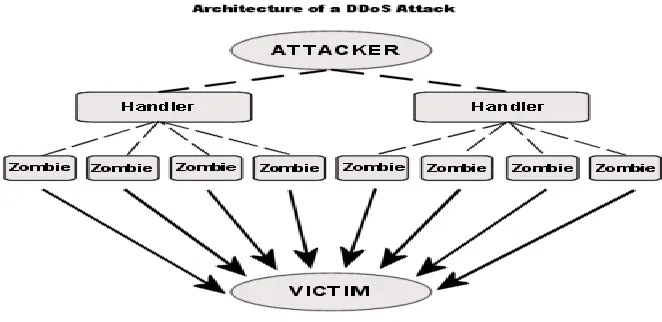
In cloud, environment DDoS attacks harshly decreased the performance of cloud services. One of the usage of DDoS attacks for the attacker is that make them able to freely control information through the networks and even by creating specific information on specific time decided that which information can be accessible for clients and which one not. Base on ability which gave to intruder DDoS attacks are the number one security threats in all kinds of network and especially in cloud networks in a distributed environment which make it so attractive for attackers to compromise it (Gul and Hussain). Figure 1.1 illustrated an attacker which by getting access control to other systems creates a zombie network against a victim system.
Figure 1.1: Architecture of a DDoS attack (Mirkovic and Reiher, 2004)
1.2 Background of Problem
Internet- based computing makes cloud computing abilities to share services, interfaces, and data which enable vendors to hire their space on their physical machines (Armbrust et al., 2010).
6
the rate of Crime increased especially on online customer, which used cloud computing for their business. So security of cloud is a big concerned in cloud computing (Armbrust et al., 2010).
In fact, with new technology always there are people who want to compromise the systems and even whole network. One of crucial attack that can bring down the entire of network in cloud named Distributed denial-of service (DDoS) which means many of systems attacks to one system in at the same time by sending exhausted request to target system. An example of such attacks is on the BitBuket.com cloud which according to a report went down for 20 h (Chonka et al., 2010).
1.2.1 DDoS Attacks in Cloud Computing
VeriSign Commissioned Forrester Consulting did a survey on the manner of Distributed denial-of Service (DDoS) attacks in March 2009. In this study which was involved around 400 cases in the US and Europe was planned for preparing a quantitative data base on DDoS threats and methods which companies chosen to defense against these attacks (Cha and Kim, 2011).
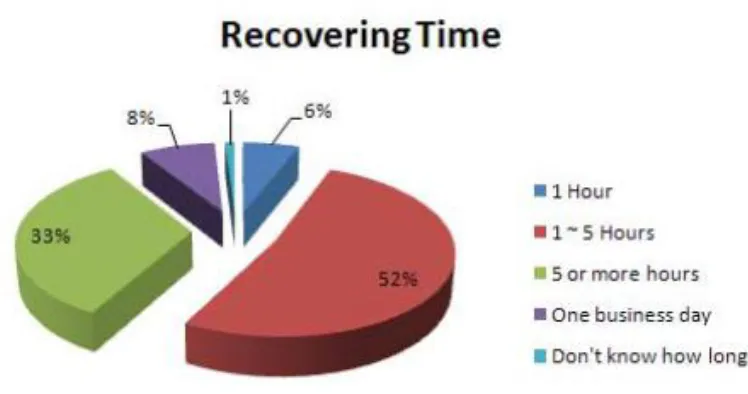
Approximately 124-survey respondent’s confession that their organizations had an experiment of DDoS attacks one or more which cause damage to their services. The time duration to bring back their information was different in every organization that related to policy and strategy of that particular company against such attack. For example around 64 organizations reported that it took between 1 and 5 hours for restoring their systems, whereas 41 organizations reported that time to be able to recover their services was between 5 to 8 hours (Cha and Kim, 2011).
7
Figure 1.2: The time duration for recovering information in different organization (Cha and Kim, 2011)
There are various kinds of DDoS attack tools such as Agobot (F-Secure, 2003; Sophos, 2009), MStream (Dittrich, 2000), and Trinoo (Dittrich, 1999) that still used by attacker today. But using the less complex web based attack tools such as Extensible Markup Language (XML) based Denial of Service or even Hypertext Transfer Protocol (HTTP) based Denial-of Service attack which have simple implementation and so difficult to detect and also because lake of the existing defense method against them are more prevalent among attackers (Chonka et al., 2010).
An XML-based DDoS attack happened when a lot of XML message is sent to a web server or web service which their content poisoned with malicious codes aiming to achieve control of their resources. Such attack concentrate on disrupting availability of servers or services from legitimate user who go for accessing and using of that resource (Chonka et al., 2010).
8
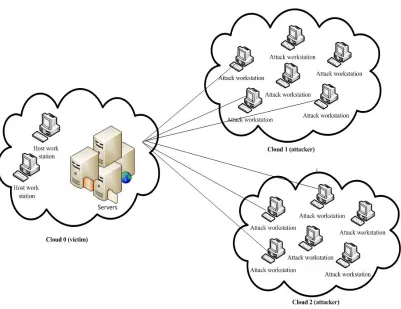
Figure 1.3: A DDoS attacks against cloud computing (Chonka et al., 2010)
1.3 Problem statement
9
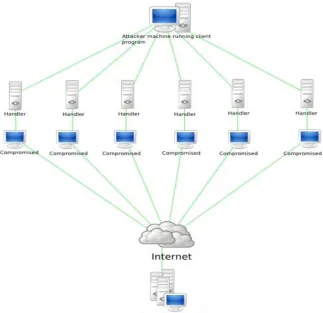
Figure 1.4 shows the architecture of DDoS attack to a special target that it can be a pool of servers which provide services for cloud users.
Figure 1.4: DDoS attack against cloud servers (Mirkovic and Reiher, 2004)
1.4 Project Objectives
i. To investigate previous existences defense methods against DDoS attack
ii. To propose a model for cloud computing to defend against DDoS attack.
10
1.5 Research Questions
The main questions this research motivates to answer are as follows:
i. What are the approaches to defend against DDoS attack in cloud computing?
ii. How to develop a new model to enhance the security of cloud computing against DDoS attacks?
iii. How to test and evaluate the proposed model against DDoS attacks?
1.6 Project Aim
The aim of this project is to propose a model to enhance the security specially availability of cloud resources against DDoS attack. The proposed model will then be tested against the attack by simulation application.
1.7 Project scope
This project focus on security issues in cloud computing which using virtualization technology to defend against a special threat named Distributed Denial-of Service (DDoS) attack that occurred in one of service layers of cloud computing which is Infrastructure as a Service (IaaS). The public cloud is an area of research for this project. So the other types of cloud computing are not discussed in this scope.
11
This proposed model concentrates to prevent of occurrence of DDoS attack for disturbing cloud resources. So the detection phase of this attack is not in the area of this study. This proposed model is going to prevent disruption of cloud resources during the attack period. Also VMware will be used as a crucial technology in this area.
1.8 Summary
Security is a significant portion in a cloud environment. To make cloud perfectly secure lots of things must be done specially based on virtualized network which are used in this kind of area. Although virtualization brings numerous advantages to cloud computing, there are many security concerns which must be carefully investigated and find the best solution for them. One of most important threat to cloud is DDoS which can effect on availability of cloud and its services.
93
REFERENCES
Armbrust, M., Fox, A., Griffith, R., Joseph, A. D., Katz, R., Konwinski, A., et al. (2010). A view of cloud computing. Communications of the ACM, 53(4), 50-58.
Ayres, P. E., Sun, H., Chao, H. J., and Lau, W. C. (2006). ALPi: A DDoS defense system for high-speed networks. Selected Areas in Communications, IEEE Journal on, 24(10), 1864-1876.
Bakshi, A., and Yogesh, B. (2010). Securing cloud from ddos attacks using intrusion detection system in virtual machine, 260-264.
Cha, B., and Kim, J. (2011). Study of Multistage Anomaly Detection for Secured Cloud Computing Resources in Future Internet, 1046-1050.
Chiueh, S. N. T. (2005). A survey on virtualization technologies. RPE Report, 1-42. Chonka, A., Xiang, Y., Zhou, W., and Bonti, A. (2010). Cloud security defence to
protect cloud computing against HTTP-DoS and XML-DoS attacks. Journal of network and computer applications.
Dong, H., Hao, Q., Zhang, T., and Zhang, B. (2010). Formal Discussion on Relationship between Virtualization and Cloud Computing, 448-453.
Furht, B., and Escalante, A. (2010). Handbook of cloud computing: Springer-Verlag New York Inc.
Gul, I., and Hussain, M. Distributed Cloud Intrusion Detection Model.
Gul, I., and Hussain, M. (2011). Distributed Cloud Intrusion Detection Model.
International Journal of Advanced Science and Technology, 34, 71-82. Hamlen, K., Kantarcioglu, M., Khan, L., and Thuraisingham, B. (2010). Security
issues for cloud computing. International Journal of Information Security and Privacy (IJISP), 4(2), 36-48.
Jain, P., Rane, D., and Patidar, S. (2011). A survey and analysis of cloud model-based security for computing secure cloud bursting and aggregation in renal
environment, 456-461.
94
Karnwal, T., Thandapanii, S., and Gnanasekaran, A. A Filter Tree Approach to Protect Cloud Computing against XML DDoS and HTTP DDoS Attack.
Intelligent Informatics, 459-469.
Kim, D., Kim, B., Kim, I., Kim, J., and Cho, H. (2012). Endpoint Mitigation of DDoS Attacks Based on Dynamic Thresholding. Information and Communications Security, 381-391.
Kim, Y., Lau, W. C., Chuah, M. C., and Chao, H. J. (2004). PacketScore: Statistics-based overload control against distributed denial-of-service attacks, 2594-2604 vol. 2594.
Laplante, P. A., Zhang, J., and Voas, J. (2008). What's in a Name? Distinguishing between SaaS and SOA. It Professional, 10(3), 46-50.
Maveli, N. S., Walter, R. A., Costantino, C. L., Roy, S., Alonso, C., Pong, M. Y. W., et al. (2002). Method and apparatus for virtualizing storage devices inside a storage area network fabric: Google Patents.
Mell, P., and Grance, T. (2009). The NIST definition of cloud computing. National Institute of Standards and Technology, 53(6), 50.
Mirkovic, J., and Reiher, P. (2004). A taxonomy of DDoS attack and DDoS defense mechanisms. ACM SIGCOMM Computer Communication Review, 34(2), 39-53.
Muhai, L., and Ming, L. (2010). An adaptive approach for defending against DDoS attacks. Mathematical Problems in Engineering, 2010.
Reuben, J. S. (2007). A survey on virtual machine security. Helsinki University of Technology.
Roschke, S., Cheng, F., and Meinel, C. (2009). Intrusion detection in the cloud, 729-734.
Sabahi, F. (2011). Virtualization-level security in cloud computing, 250-254.
Sahoo, J., Mohapatra, S., and Lath, R. (2010). Virtualization: A survey on concepts, taxonomy and associated security issues, 222-226.
Scarfone, K. (2011). Guide to Security for Full Virtualization Technologies: DIANE Publishing.
95
Wei, W., Dong, Y., and Lu, D. (2008). Optimal control of DDoS defense with multi-resource max-min fairness. Paper presented at the Cybernetics and Intelligent Systems, 2008 IEEE Conference on, 1285-1293.
Xing, Y., and Zhan, Y. (2012). Virtualization and Cloud Computing. Future Wireless Networks and Information Systems, 305-312.
Zhang, L. J., and Zhou, Q. (2009). CCOA: Cloud computing open architecture, 607-616.