74:1 (2015) 105–112 | www.jurnalteknologi.utm.my | eISSN 2180–3722 |
Full paper
Jurnal
Teknologi
Smoothing Wind and Rainfall Data through Functional Data Analysis
Technique
W. I. Wan Norliyana, Jamaludin Suhaila*
Department of Mathematical Sciences, Faculty of Science, Institute of Environmental & Water Resource Management, Universiti Teknologi Malaysia, 81310 UTM Johor Bahru, Johor, Malaysia
*Corresponding author: [email protected]
Article history
Received :21 May 2014 Received in revised form : 18 January 2015 Accepted :15 March 2015
Graphical abstract
Abstract
The pattern of wind and rainfall throughout Peninsular Malaysia are varied from one region to another, because of strong influences from the monsoons. In order to capture the wind and rainfall variations, a functional data analysis is introduced. The purpose of this study is to convert the wind and rainfall data into a smooth curve by using functional data analysis method. Fourier basis is used in this study since the wind and rainfall data indicated periodic pattern. In order to avoid such overfitting data, roughness penalty is added to the least square when constructing functional data object from the observed data. Result indicated that if we use a small number of bases functions, the difference is very small between with and without roughness penalty, showing that it is safer to smooth only when required. However, when a large basis function is employed, the roughness penalty should be added in order to obtain optimal fit data. Based on the contour plot of correlation and cross-correlation functions of wind and rainfall data, the relationship between both climate functions could be determined.
Keywords: Basis function; smoothing curve; roughness penalty; functional data; fourier basis
Abstrak
Corak angin dan hujan di Semenanjung Malaysia berubah mengikut wilayah disebabkan pengaruh kuat dari monsun. Bagi menerangkan variasi angin dan hujan, analisis data fungsi diperkenalkan. Tujuan kajian ini adalah untuk menukarkan data angin dan hujan ke dalam suatu fungsi licin dengan menggunakan kaedah analisis data fungsi. Basis Fourier digunakan dalam kajian ini kerana data angin dan hujan menunjukkan corak bermusim. Untuk mengelak data terlebih padanan, penalti kasar dikenakan ke atas kaedah kuasa dua dalam membentuk data fungsi dari data cerapan. Keputusan menunjukkan jika menggunakan bilangan fungsi basis yang kecil, perbezaan yang sangat sedikit dapat dilihat di antara kesan penalti kasar dengan tiada penalti kasar, maka lebih selamat untuk melicinkan sesuatu fungsi bila perlu. Walau bagaimanapun, jika basis yang besar digunakan, penalti kasar perlu dikenakan untuk menghasilkan padanan yang optimal. Berdasarkan, plot kontur korelasi dan korelasi silang fungsi angin dan hujan, hubungan antara kedua-dua fungsi iklim tersebut dapat ditentukan.
Kata kunci:Fungsi basis; lengkung licin; penalti kasar; data fungsi; basis Fourier
© 2015 Penerbit UTM Press. All rights reserved.
1.0 INTRODUCTION
Functional Data Analysis (FDA) develops fast in statistics area with the aim of estimating a set of related functions or curves rather than focusing on a single entity. The information about FDA such as the slopes, curvatures, and other characteristics are available based on the intrinsically smooth curves built up through FDA. The basic idea of FDA is to express discrete observations arising from time series into a functional data that represents the entire measured function as a single observation, and to draw modeling and make inference based on the collection of a functional data by applying statistical concept from univariate or multivariate data analysis.
FDA to forecast demographic rates and the structure of the population while in the area of meteorology, Suhaila and Jemain (2009) introduced FDA to convert rainfall observations into a smoothing rainfall curve which was then used in comparing the climate rainfall patterns between regions.
Generally, the wind in Malaysia is light and varies; however, some periodic changes in the wind flow patterns could influence the rainfall distribution. A strong wind is expected to bring heavy rainfall at the location. Our main objective in this study is to use FDA technique in representing the rainfall and wind data in the form of smoothing curves since wind and rainfall data are recorded as daily observations at a discrete time interval. FDA isused to represent the data in a way that could give information on the pattern and variation of the data and make use of the information in the slopes and curvatures of curves that are reflected in their derivatives. The smooth curve from FDA can then be used to compare rainfall and wind variability between regions. Contour plot of bivariate rainfall and wind could establish the relationship between both smoothing climate variables.
Therefore, a functional data analysis will be carried out to examine the changes and variability for both climate variables and establish the functional relationship between them. The outcome of this study is expected to be useful to policy makers, climatologist, and water resource planners dealing with climate change for the sustainable development and planning of water resources.
2.0 STUDY AREA AND DATA
Peninsular Malaysia is located between 1° 7′ North latitude and
100° 103′ East longitude. Peninsular Malaysia has several types of landscapes of its certain latitude and longitude measurements which has tropical weather and is affected by monsoonal climate. The wind speed at the east coast of Peninsular is mostly influenced by the northeast monsoon (NEM) which occurs from November to February, while the southwest monsoon (SWM) may possibly influenced the wind speed at the west coast of Peninsular between May and August. Based on the daily rainfall distribution, Suhaila et al. (2011) used four rainfall regions in Peninsular Malaysia which are the Northwest, West, Southwest and East. The east coast of Peninsular Malaysia experiences heavy rainfalls during the NEM. Heavy rains are also expected during the two inter-monsoons: March to April and September to October. On the other hand, the stations or areas which are sheltered by mountain ranges are relatively free from those monsoons. It is best to distinguish the rainfall distribution of the stations according to seasons.
Meteorological data were obtained from Malaysian Meteorological Services (MMS). The wind data is the speed of wind in meters per second meanwhile rainfall data is in millimeters per day for a period of 25 years from 1985 to 2009. The list of stations is provided in Table 1.
Table 1 The list of ten stations with their geographical coordinates
Code Stations Latitude Longitude
S01 Kuala Krai 5.45 102.30 S02 Batu Embun 4.15 102.75 S03 Temerloh 3.70 102.94 S04 Muadzam Shah 3.35 103.25 S05 Mersing 2.45 103.83
S06 Senai 1.63 103.67
S07 Bayan Lepas 5.30 100.27 S08 C. Highlands 4.60 101.50
S09 Ipoh 4.57 101.10
S10 Subang 3.12 101.55
3.0 METHODOLOGY
This section is divided into two main subsections. Method of finding suitable basis functions will be discussed in the first subsection. The method of least squares is used to estimate the parameters of the basis function. A functional descriptive statistics based on mean, standard deviation and correlation of functional data will be described in the second sub-section. Contour plots are used to describe the relationship between climates variables.
3.1 Basis Function
There are two methods that are normally used in representing the functional data, namely, smoothing and interpolation. If the discrete values are assumed to be errorless, the process involves interpolation method. But if they are some observational errors that need to be removed, the transformation from discrete data to function may require smoothing. The first step in FDA is to create a set of bases functions which used to convert the discrete values into a smooth curve. A set of linear combinations of bases functions is used in representing functions, which is given as
𝑥(𝑡) = ∑𝐾𝑘=1𝑐𝑘 ∅𝑘 (𝑡) (1)
where 𝑐𝑘 refers to the basis coefficient, ∅𝑘 is the known basis
function while 𝐾 is the size of the maximum basis required. Fourier series give the best known basis function for periodic data, which can then be written as;
𝑥(𝑡) = 𝑐0+ 𝑐1sin 𝜔𝑡 + 𝑐2cos 𝜔𝑡 + ⋯
(2)
defined by the basis function ∅0 (𝑡) = 1, ∅2𝑘−1 (𝑡) = sin 𝑘𝜔𝑡,
𝑋2𝑘 (𝑡) = cos 𝑘𝜔𝑡 with 𝑡 = 𝑡1, … , 𝑡𝑇. The basis is periodic, and the constant 𝜔 is related to the period 𝑇 by the relation 𝜔 =2𝜋𝑇. After the first constant basis function, Fourier basis functions are arranged in successive sine and cosine pairs.
Let 𝑦𝑖 be the observed discrete data points for 𝑖 = 1,2, … , 𝑇 , collected over a continuum time 𝑡. Assuming that there is a reasonably smooth function 𝑥(𝑡)that gives rise to those discrete points. Defining the model as
𝑦𝑖= 𝑥(𝑡𝑖) + 𝜀𝑖. (3)
with mean zero and constant variance 𝜎2, the errors, 𝜀𝑖 are assumed to be independent and normally distributed.
In order to estimate a reasonably smooth function 𝑥(𝑡), the most well-known method of Least Squares estimation (SSE) is used. When the function 𝑥(𝑡) is defined in terms of the basis function expansion in Equation (1), the coefficients of the expansion, 𝑐𝑘 are determined through the least squares method by minimizing the sum of squared residuals:
𝑆𝑆𝐸 = ∑𝑇𝑖=1(𝑦𝑖− 𝑥(𝑡𝑖))2 (4)
with 𝑦𝑖 represent the original observed data and 𝑥(𝑡𝑖) is the fitted smooth data.
𝑃𝐸𝑁𝑆𝑆𝐸 = ∑𝑇𝑖=1(𝑦𝑖− 𝑥(𝑡𝑖))2+ 𝜆 ∫(𝑥′′(𝑡))2𝑑𝑡. (5)
The smoothing parameter 𝜆 controls a compromise between the fit to the data and the variability in the function. Large values of 𝜆 will increase the amount of smoothing. However, to determine the best value for smoothing parameter 𝜆, generalized cross-validation (GCV) is applied and is defined as
𝐺𝐶𝑉(𝜆) = (
𝑇𝑇−𝑑𝑓(𝜆)
) (
SSE𝑇−df(λ)
)
(6)where 𝑑𝑓(𝜆) refers to the number of degrees of freedom and 𝑇 is the number of observations. Several values of
𝜆
are tested, and value of𝜆
which gives the smallest GCV is used.3.2 Descriptions of Functional Data
The descriptive statistics such as mean, variance, standard deviation, covariance and correlation are estimated for functional data. The correlation function, describe the relationship between times for a climate variable while the cross-correlation function is used to determine the dependency between climate variables. Let 𝑥𝑖, 𝑖 = 1, … 𝑁, be a sample of curves or functions fits to
data. The mean and variance are given as below; with the standard deviation function is the square root of the variance function;
𝑥̅ = 𝑁−1∑ 𝑥 𝑖(𝑡) 𝑁
𝑖=1 (7)
𝑣𝑎𝑟𝑋(𝑡) = (𝑁 − 1)−1 ∑𝑁𝑖=1[𝑥𝑖(𝑡) − 𝑥̅(𝑡)]2. (8)
The covariance function summarizes the dependence of records across difference argument values, and is computed for all 𝑡1 and
𝑡2 by
𝑐𝑜𝑣𝑋(𝑡1, 𝑡2) = (𝑁 − 1)−1 ∑𝑁𝑖=1{𝑥𝑖(𝑡1) − 𝑥̅(𝑡1)}{𝑥𝑖(𝑡2) − 𝑥̅(𝑡2)}.
(9)
Meanwhile, the associated correlation function is given as
𝑐𝑜𝑟𝑟
𝑋(𝑡
1, 𝑡
2) =
√𝑣𝑎𝑟𝑐𝑜𝑣𝑋(𝑡1,𝑡2)𝑋(𝑡1)𝑣𝑎𝑟𝑋(𝑡2)
.
(10)
Then, the dependency between variable can be quantified by the cross-covariance function
𝑐𝑜𝑣𝑋,𝑌(𝑡1, 𝑡2) = (𝑁 − 1)−1 ∑𝑁𝑖=1{𝑥𝑖(𝑡1) − 𝑥̅(𝑡1)}{𝑦𝑖(𝑡2) − 𝑦̅(𝑡2)}
(11) Using Equation (11), the cross-correlation function is given as
𝑐𝑜𝑟𝑟
𝑋,𝑌(𝑡
1, 𝑡
2) =
𝑐𝑜𝑣𝑋,𝑌(𝑡1,𝑡2)√𝑣𝑎𝑟𝑋(𝑡1)𝑣𝑎𝑟𝑌(𝑡2)
.
(12)
Contour plots display the contour line for a function of two climate variables between times and variables.
4.0 RESULT AND DISCUSSION
This section is divided into three main sections. In the first sub-section, the number of bases functions required for each region will be identified and the results will be validated by examining the residuals to obtain an optimal fit to data. Smoothing the functional data with and without roughness penalty will be investigated in the second sub-section. The third sub-section will summarize the
pattern of wind-rainfall data using the functional descriptive statistics and establishing the relationship between climate variables based on correlation values.
4.1 Identifying the Number of Basis Functions
In this study, FDA technique involves building a functional data object from the observations that provide information on the pattern of the data. By comparing the deviance between the estimated and the observed values, we can determine the number of bases functions that best described the wind and rainfall data.
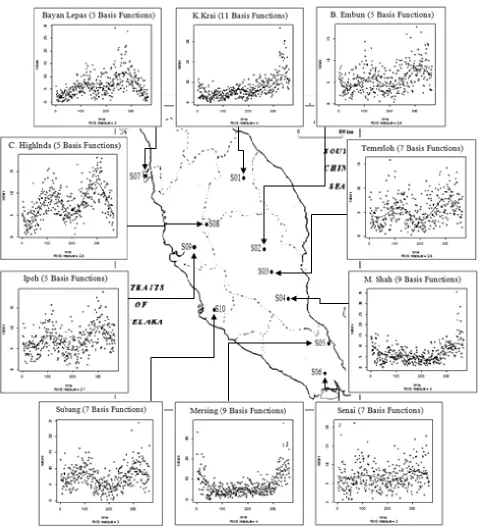
Table 2 illustrates the example showing the analysis of deviance of mean wind speed for Batu Embun and mean rainfall for Muadzam Shah. Low p-value indicates the possibility of rejecting the null hypothesis. Based on those results, there is evidence to show that seven basis functions with three harmonics are required in describing mean daily wind speed for Batu Embun while nine basis functions which represent four harmonics are sufficient in describing mean daily rainfall for Muadzam Shah. Figure 1 (wind speed) and Figure 2 (rainfall) display the resulting smooth curves based on the number of basis functions that have been obtained for ten stations. The wind and rainfall patterns are compared regarding to the smoothing curves of each station.
As shown in Figure 1, five and seven bases are required to describe the variation in wind speed for most of the stations. The highest number of bases functions is observed for Mersing in which eleven bases are required to describe the variation of wind speed of the station. High mean speed is observed during the northeast monsoon months (Nov to Feb) for stations Muadzam Shah, Mersing and Senai while sudden drops in the speed values are observed between April and October. Conversely, for other stations such as Kuala Krai, Batu Embun, Temerloh, Ipoh and Subang, high mean speed is recorded in April and October during the inter-monsoon months and slightly dropped during November to February. Different patterns are achieved for each station may possibly due to the factors such as geographical locations, distance from the sea and monsoons influence.
Figure 2 displays the smoothing rainfall curves with their number of bases functions of each station. There are different rainfall patterns are found between stations at east Peninsular and west Peninsular. As shown in Figure 2, a unimodal rainfall pattern is displayed for Mersing station at the east Peninsular. The highest seasonal rainfall peak is observed during the Northeast monsoon months while low rainfall values are recorded by the rest of the months. On the other hand, bimodal rainfall patterns are displayed by most of the stations at west Peninsular. The first seasonal rainfall peaks are observed in April to May while the second peak is in Sept to Oct. The second inter-monsoon is found to be wetter than in the first inter-monsoon. In comparison, the period from mid January to early February and from mid June to mid August are considered as dry periods for stations in the Western region.
4.2 Smoothing With and Without Roughness Penalty
For the smoothing data, we can sometimes get good results, by keeping the small number of bases functions related to the amount of data being approximated. On the other hand, to obtain an optimal fit to data, the other strategy aims by employing a powerful basis expansion. Roughness penalty may be added to the least square when constructing functional data object from the observed data. This approach allows finer control over the amount of smoothing. Based on the minimum GCV, parameter λ is chosen.
GCV, the value of lambda is shown as 𝜆 = 1𝑒7. The degrees of freedom for wind and rainfall data, are given as 𝑑𝑓(𝜆) = 4.98 ≈
5, which is equivalent to the number of bases functions that are used. Figure 3 shows the smooth functional data for Temerloh and Cameron Highlands with and without roughness penalty by using
small basis functions. As we can see from both stations, the differences of smoothing functions are too small in which the graphs seem to be overlapping with each other. This shows that by smoothing the functional data without a roughness penalty, we will not lose much and it is safer to smooth only when compulsory.
Figure 2 Smoothing rainfall curves with the required basis functions
Table 2 Analysis of deviance of mean daily wind speed and daily rainfall for Batu Embun and Muadzam Shah
Harmonic Basis Degrees of
Freedom
Reductio n Deviance
Mean Deviance
F
P-Value
Harmonic Basis Degrees of
Freedom
Reductio n Deviance
Mean Deviance
F P-Value
Batu Embun
Between Day
1 364 134.43
Muadzam
Shah
Between Day 1 364 7005.67
1 3 2 11.53 5.766 23.41 0.00 1 3 2 1816.86 908.43 81.30 0.000
2 5 2 27.11 13.555 55.04 0.00 2 5 2 608.61 304.30 27.23 0.000
3 7 2 4.26 2.128 8.64 0.01 3 7 2 348.61 174.31 15.60 0.000
4 9 2 1.16 0.580 2.36 0.31 4 9 2 155.65 77.82 6.96 0.031
5 11 2 1.42 0.710 2.88 0.24 5 11 2 50.81 25.41 2.27 0.321
Table 3 Values of lambda, degrees of freedom and GCV by using small basis functions
Temerloh (Wind) C. Highlands (Rainfall)
Loglam Lambda,λ Degrees of Freedom
GCV Loglam Lambda,λ Degrees of Freedom
GCV
5 1.00E+05 4.9998 0.2464 5 1.00E+05 4.9998 6.6052
6 1.00E+06 4.9981 0.2464 6 1.00E+06 4.9981 6.6051
7 1.00E+07 4.9814 0.2463 7 1.00E+07 4.9814 6.6050
8 1.00E+08 4.8287 0.2468 8 1.00E+08 4.8287 6.6405
9 1.00E+09 4.0327 0.2674 9 1.00E+09 4.0327 7.8917
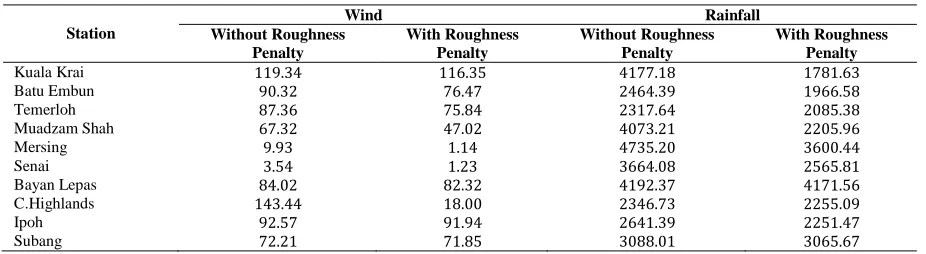
Figure 4 show the smooth functional data for Temerloh and Cameron Highlands with and without roughness penalty by using 365 basis functions. Roughness penalty are added to the least square when constructing the functional data object from observed data in order to reduce the unwanted errors. Table 4 provides the values of sum of squared residuals for both variables. The results indicated that the sum of squared residuals for
smoothing curve with roughness penalty is smaller than the case without roughness penalty. In conclusion, it is better to smooth the data with roughness penalty when using a large number of bases functions.
(a) (b)
Figure 3 Smoothing curves with and without roughness penalty for (a) Temerloh (Wind) and (b) Cameron Highlands (Rainfall) using small number of bases functions
(a) (b)
Figure 4 Smoothing curves with and without roughness penalty for (a) Temerloh (Wind) and (b) Cameron Highlands (Rainfall) using large basis functions
5 6 7 8 9 10
1 28 55 82
1 0 9 1 3 6 1 6 3 1 9 0 2 1 7 2 4 4 2 7 1 2 9 8 3 2 5 3 5 2 Me an W In d ( m /s )
Without Roughness Penalty With Roughness Penalty
0 5 10 15 20
1 28 55 82
10 9 13 6 16 3 19 0 21 7 24 4 27 1 29 8 32 5 35 2
M
ean
Rain
fal
l (m
m
)
Without Roughness Penalty With Roughness Penalty
5 6 7 8 9 10
1 28 55 82
10 9 13 6 16 3 19 0 21 7 24 4 27 1 29 8 32 5 35 2 Me an W in d (m/ s)
Without Roughness Penalty With Roughness Penalty
0 5 10 15 20
1 28 55 82
10 9 13 6 16 3 19 0 21 7 24 4 27 1 29 8 32 5 35 2 Me an Ra in fall (m m )
Table 4 Sum of squared residuals for wind and rainfall data for large number of bases functions
Station
Wind Rainfall
Without Roughness Penalty
With Roughness Penalty
Without Roughness Penalty
With Roughness Penalty
Kuala Krai 119.34 116.35 4177.18 1781.63
Batu Embun 90.32 76.47 2464.39 1966.58
Temerloh 87.36 75.84 2317.64 2085.38
Muadzam Shah 67.32 47.02 4073.21 2205.96
Mersing 9.93 1.14 4735.20 3600.44
Senai 3.54 1.23 3664.08 2565.81
Bayan Lepas 84.02 82.32 4192.37 4171.56
C.Highlands 143.44 18.00 2346.73 2255.09
Ipoh 92.57 91.94 2641.39 2251.47
Subang 72.21 71.85 3088.01 3065.67
4.3 Summarize the Pattern of Data using The Functional Descriptive Statistics
In this sub-section, we recast the concepts of mean, standard deviation, covariance and correlation into functional terms. Figure 5 shows the average pattern of the mean and standard deviation of wind and rainfall functions for all ten stations in Peninsular Malaysia. High mean speed is observed in August
with 7.3𝑚/𝑠 while low mean speed is recorded in June and November. On the other hand, a large variability of wind speed is observed between March and April, and September to October. For rainfall data, high mean rainfall function is observed in November to December with large rainfall variability was also observed during the same period of time. It is expected that high mean rainfall is observed during the northeast monsoon months.
Figure 5 The mean and standard deviations of wind and rainfall functions
Figure 7 The contour plot of the cross-correlation functions for wind and rainfall
Figure 6 shows a contour plot of the bivariate correlation function 𝑐𝑜𝑟𝑟𝑤𝑖𝑛𝑑(𝑡1, 𝑡2) for the wind data and the corresponding
plot for rainfall data which is based on 365 days. Generally, the wind data show high positive correlations throughout the year. This concludes that the wind speed is highly related between times at any points of the year. However,
different values are recorded for rainfall function over times. It seems that rainfalls are highly correlated during the times in January and February with the correlation value of 0.8. By contrast, moderate negative and positive correlation values are observed from April till October.
The cross-correlation function of two climate variables
𝑐𝑜𝑟𝑟𝑤𝑖𝑛𝑑,𝑟𝑎𝑖𝑛 is plotted onto Figure 7. The contour plot of
cross-correlation functions, 𝑡1is plotted along the horizontal axis and 𝑡2
along the vertical axis, which represent either wind or rainfall. Generally, it could be said that moderate and low positive and negative correlations are found between two variables throughout the year. Zero values between wind and rainfall functions are observed during the period of July and August within any point throughout the year, which indicate no relationships exist between the variables functions. However, rainfall and wind are highly correlated at the end of the year during the northeast monsoon. It shows the cross-correlation value with 0.70 during November to March gives the strong positive relationship between wind and rainfall, which indicate that the wind speed could influence the rainfall pattern.
5.0 CONCLUSION
This study focused on how to define wind and rainfall data in the form of smoothing curves for ten stations in Peninsular Malaysia. Optimal number of bases functions is determined in describing the characteristics of the wind and rainfall of each station. Based on the smoothed curves obtained for each station, the wind and rainfall patterns are compared. Large variation in rainfall and wind speed of the station required large number of bases functions. Different results are achieved for wind and rainfall curves at the stations may possibly due to several factors such as geographical locations, distance from the sea and monsoons influence.
In establishing the relationship between the two climate variables, it shows a positive correlation during the northeast monsoon season based on the contour plot, while no clear indication of relationships exist for the rest of the months. Therefore, it could be said that the monsoons play a major role
in influencing the relationship between wind and rainfall data. Several applications of FDA such as functional principal component, canonical analysis, clustering and functional analysis of variance should be employed in future study to examine the variation of climate variables and establish relationship between the climate variables.
Acknowledgement
The author wishes to acknowledge the Malaysian Meteorological Service (MMS) for providing the daily wind and rainfall data for this study. This research was partially supported by MyBrain15 and Research University Grant QJ130000.2526.07H00 from Universiti Teknologi Malaysia.
References
[1] Cuevas, A., Febrero, M., Fraiman, R. 2003. An Anova Test for Functional Data. Comput. Stat. Data Anal. 47: 111–122.
[2] Ferraty, F., Vieu, P., Viguier-Pla, S. 2006. Factor-based Comparison of Groups of Curve. Comput. Stat. Data Anal. 51: 4903–4910.
[3] Hyndman, R. J., Booth, H. 2008. Stochastic Population Forecasts using Functional Data Models for Mortality, Fertility and Migration. Int. J. Forecasting. 24: 323–342.
[4] Manteiga, W. G., Vieu, P. 2007. Statistical for Functional Data. Comput. Stat. Data Anal. 51: 4788–4792.
[5] Nikitovic, V. 2011. Functional Data Analysis in Forecasting Serbian Fertility. Institute of Social Sciences. 2: 73–89.
[6] Ramsay, J. O., Ramsey, J. B. 2002. Functional Data Analysis of the Dynamics of the Monthly Index of Nondurable Goods Production. J. Econometrics. 107: 327–344.
[7] Ramsay, J. O., Hooker, G., Graves, S. 2005. Functional Data Analysis with R and Matlab. Springer. New York.
[8] Ramsay, J. O., Silverman, B. W. 2005. Functional Data Analysis. second ed. Springer, New York.
[9] Ratcliffe, S. J., Leader, L. R., Heller, G. Z. 2002. Functional Data Analysis With Application to Periodically Stimulated Foetal Heart Rate Data. I: Functional Regression. John Wiley & Sons, Ltd. 21. 1103– 1114.
[10] Suhaila, J., Jemain, A. A. 2011. A Comparison of the Rainfall Patterns between Stations on the East and the West coasts of Peninsular Malaysia using the Smoothing Model of Rainfall Amounts. Meteorol. Appl. 16(3): 391–401.
[11] Suhaila, J., Jemain, A. A., Hamdan, M. F., Zin, W. Z. W. 2011. Comparing Rainfall Pattern between Regions in Peninsular Malaysia via a Functional Data Analysis. J. Hydro. 411: 197–206.
[12] Tian, T. S. 2010. Functional Data Analysis in Brain Imaging Studies.