114
FINDING GLOBAL MINIMUM USING FILLED FUNCTION METHOD
Omar Zahid Bin Ahmad & PM Dr. Rohanin Binti Ahmad
Abstract:
Filled function method is an optimization method for finding global
minimizers. Filled function method is a combination of a local search in findings local
solutions as well as global solution. It is basically a construction and eventually the inclusion
of an auxiliary function called the filled function into the algorithm. Optimizing the objective
function at an initial point will only yield a local minimizer. By using the auxiliary function,
the local minimizer is shifted to a new lower basin of the objective function. The shifted
point is the new initial solution for the local search to find the next local minimizer, where
the function value is lower. The process continued until the global minimizer is achieved.
This research used several test functions to examine the effectiveness of the method in
finding global solution. The results show that this method works successfully and further
research directions are discussed.
Keywords:Optimization, global optimization, local optimization, global minimum, filled
function method
Introduction
The field of optimization has grown rapidly during the past few decades. Many new
theoretical, algorithmic, and computational contributions of optimization have been proposed
to solve various problems in many areas. Recent developments of optimization methods can
be mainly divided into deterministic and heuristic approaches. Deterministic approaches take
advantage of the analytical properties of the problem to generate a sequence of points that
converge to a global optimal solution. Heuristic approaches have been found to be more
flexible and efficient than deterministic approaches; however, the quality of the obtained
solution cannot be guaranteed. Moreover, the probability of finding the global solution
decreases when the problem size increases. Deterministic approaches (e.g., linear
programming, nonlinear programming, and mixed-integer nonlinear programming, etc.) can
provide general tools for solving optimization problems to obtain a global or an
approximately global optimum. With the increasing reliance on modeling optimization
problems in real applications, a number of deterministic methods for optimization problems
have been presented. The study focuses on analyzing the recent advances in deterministic
optimization approaches (Lin, Tsai and Yu, 2012).
Optimization has attracted a great deal of attention from the research community
since many problems arising in many different fields can be posed and solved through
mathematical programming techniques. Interest in optimization intensified in the middle of
20
thcenturies with the linear programming model which was simple, practical, and perhaps
the only solvable model using the computing power available at the time.
115
Literature Review
In this section, we focus on one FFM that is widely used and become the reference to many
researchers that is
-function, introduced by Renpu Ge in 1990.
, , ½)
=
1/0 + C()5 l2 T
‖&8∗‖99
W
.
(1)
It was originally put forward by RenpuGe as an effective algorithm of finding global
minimizer of a multi-modal function.
During the year, the theory is raised mainly to cope with unconstrained optimization
problems. The rudimental notion of
filled function
method is: when a local minimizer is
reached, it is hoped that "escaping" this local minimizer is possible. Furthermore, keep
searching, and a better local minimizer is reached. By constructing an auxiliary function, a
local minimizer is shifted into a local maximizer. We make the point perturbed
deterministically, and then, take this perturbed point as the initial point to search, and try to
find the auxiliary function’s local minimizer which is a better local minimizer of the
objective function, or at least as well as the original one (Fang, 2006).
Fang stated that Ge’ FFM is a two-phase iterative: the minimizer phase and the
filling phase. In the first phase, we can use classic minimizer method, such as quasi-Newton
method, the method of steepest descent, etc. to search for a local minimizer
∗in objective
function. During the second phase, we take the present minimizer as the basic to define a
filled function, and using it to find
′
. Then we take
′
as the starting point and repeat the
first phase. This occurs again and again until the best local minimizer could not be found.
The
filled function method
fully grasps the present local information, for it only applies the
mature local minimizer method, it is greatly popular with the theoretical and practical
operators.
Methodology
An optimization based methods which provide a mechanism to find global solution to the
objective function. A local search is used as a tool to minimize the objective function as well
as the auxiliary function in order to find local minimizer and new initial point respectively.
Which we are already discussed in the literature review. This method provide a ‘jump’ from
one local solution to another local solution until better local called global solution achieved.
This research is concerned with the problem of finding a global minimizer of a twice
continuously differentiable function
C
on
ℝ
%. Suppose
C
)
satisfies the condition
C
⟶
∞
as
‖‖
→
+∞
(2)
Then there exists a closed bounded domain
Ω ⊂ ℝ
%whose interior contains all global
minimizers of
C()
.
We assume that
Ω
is known and our methods only consider points in
Ω
.
We also assume that
C()
has only a finite number of minimizers in
Ω
and therefore, every
minimizer is an isolated minimizer.
1. Filled Function Method Procedure
116
Phase 1: Finding the local minimizer
We need to find a local minimizer
7∗starting from an initial point and use any local
minimization method such as Newton method.
Phase 2: Finding a new solution in a lower basin
After the local minimum
7∗in the Phase 1 is obtained, then the filled function is
constructed at that point and minimize the filled function in order to identify a point
7#with
C
(
7#) C(
7∗)
. If
7#is formed,
7#is certainly in a lower basin than
ô
7∗.Use
7#as an initial point in Phase 1 again.
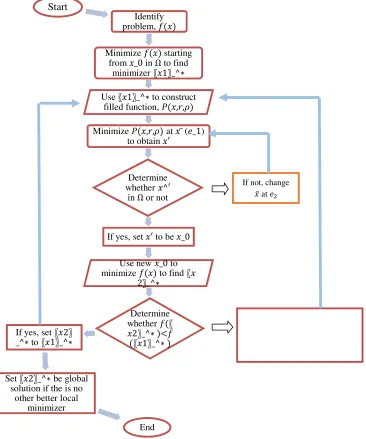
Figure 1
: Procedure flow of the algorithm of filled function method
Start
Identify problem, C()
Minimize C()starting from _0in Ωto find
minimizer 〖1〗_^∗
Use 〖1〗_^∗to construct filled function, (,,½)
Minimize (,,½)at ̅(l_1) to obtain ′
Determine whether ^′ in Ωor not
If yes, set ′to be _0
Use new _0to minimize C()to find 〖
2〗_^∗
Determine whether C(〖 2〗_^∗ )<C (〖1〗_^∗ ) If yes, set 〖2〗
_^∗to 〖1〗_^∗
Set 〖2〗_^∗be global solution if the is no
other better local minimizer
End
If not, change ̅ at l!
Increase both ½! and
C(∗) 0 make the ratio
½!/( C(
117
Figure 1 shows the flow chart on the procedure flow that we are concerning in this
research study. The basic idea from Ge (1990) is as follows. At the beginning one may use
any local minimization method. For instance, fminsearch function (Built is used to find a
minimizer
∗of
C
in the domain
Ω
. Then one attempts to find another minimizer of
C
,
!∗say, which satisfies the inequality
C
!∗≤ C
∗.
(3)
The idea of finding
!
∗from
∗is to fill the basin of
C
at
∗and other higher
basins of
C
than
ô
∗so that
∗is a maximizer of the filled function and the basin
ô
∗is a
part of a hill of the filled function. Furthermore, the filled function has no minimizers or
saddle points in higher basins of
C
then
ô
∗, but it does have a "minimizer" along the
direction
∗
in a lower basin of
F(x)
than
ô
∗if one exists. Thus, one can use an initial
point near
∗to minimize the filled function. The minimization sequence
7leads away
from
∗and tends to a point
′
which is in a lower basin
ô
!∗of
C
.
Using x' as an initial
point to minimize
F(x),
one can obtain a lower minimizer
!∗of
C
, and so on.
Results and Discussion
In this section, the algorithm is tested on some optimization problems.
(a)
C
2 sin
!− sin − 2√
s.t
0 ≤
≤ 6
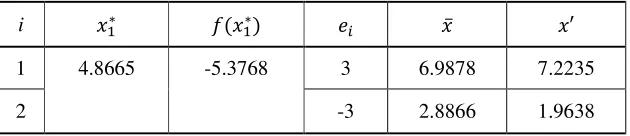
Table 1:
Results of minimizing
-function at
∗.
i
∗C
∗l
M̅
′
1
4.8665
-5.3768
3
6.9878
7.2235
2
-3
2.8866
1.9638
From the result tabulated in Table 4.1, the first iteration of minimizing the
-function, the algorithm took the first preset direction,
l
give
(7
.
2235
from the first
local minimizer
∗4
.8665.
This value,
(is outside of the
Ω
, so this value is rejected and
continue the algorithm with the next preset direction,
l!
. Eventually, the algorithm arrived at
(= 1.9638
which in the
Ω
and then, take it as an initial point to minimize
C()
, get local
minimizer
!
∗1.7251
and the function value
C(!
∗5
.5677.
Compare the value of
C
(!
∗with
C
∗
. In this case,
C
!∗< C
∗infact
C
!∗≈ C
∗, hence the method
arrives at the global minimizer.
From this test, we can see clearly the flow of the algorithm form Phase 1
(minimizing the objective function) to Phase 2 (minimizing the
-function). The process
repeat until the global minimizer found. Thus, the initial testing for the algorithm is quite
successful. Next, the algorithm is tested with higher number of local minima problem.
(b)
C sin sin
2 − cos 4
s. t − 2 ≤ ≤ 4.
118
k
i
7
∗C
7∗l
M̅
′
7#∗C
7#∗1
1
3.079333 -1.03113
-0.5
2.72578
-0.15206 -0.19637 -1.28488
2
-1
-
-
-
-
2
1
-0.19637
-1.28488
-0.5
-0.54993 -3.5825
-
-
2
-1
-0.69135 -1.18632 -1.45232 -2.11752
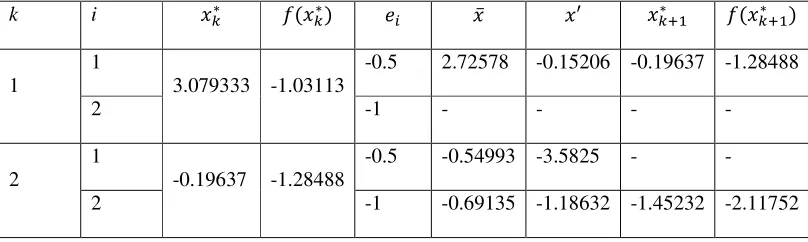
The result shows that the algorithm able to find another new local minimizer in
lower basin from the previous local minimizer. This confirmed that the algorithm continues
to run until there is no local minimizer found anymore.
Noted that, the use of preset directions,
l
Mare different from problem (a) with
problem (b). It is define differently according to the problem as well as the parameters
½
and
C
. Though the value of the parameter need to be chose and adjust until the global
solution come out from the algorithm. The preset direction also taking as important part as it
take role as movement of the
-function in finding the
′
.
Table 3 :
Result of minimizing Problem (4.2) at different value of parameter
½
.
From table above, at different value of
½
, that is
½
0.5
, the computing of the
algorithm will arrive at local minimizer of
b
basin. The result is then,
C
(!
∗≥
C
∗which
means the algorithm had through Step 7 as in the algorithm in Section 3.5. The value of
½
is
increased so that the ratio
½
!/0 C
∗5
becomes small.
According to Ge (1990), the reasons for obtaining
C
!∗≥
C
∗are either the ratio
½
!/0 C
∗
5
is not small enough or
‖
7 ∗‖
is too large so that the computer cannot
recognize the change of
, , ½)
.
Therefore, the both
½
!and
[ C(
∗5
need to be
increase to make the ratio
½
!/0 C
∗5
smaller than the previous one as in Step 7 (refer to
FFM algorithm in Section 3.5). Do not only decrease
½
!to decrease the ratio
½
!/0 C
∗5
because too small
½
!makes the filled function descend very quickly when
is close to
∗but very slowly when
is a little bit further from
∗and therefore some difficulty arises in
the minimization process of
, , ½)
.
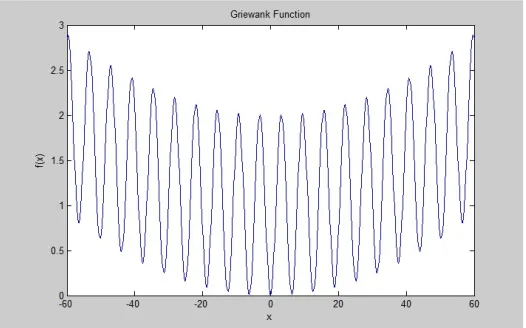
(c)
G
riewank
%∑
%MäX"""P9∏
cos T
P√M
W
1
% Mä