IMPROVEMENT OF CLUSTER HEAD SELECTION IN LEACH PROTOCOL OF WIRELESS SENSOR NETWORK
MUHAMMAD ZIA-UL-RAHMAN ABUBAKAR
A dissertation submitted in partial fulfillment o f the requirements for the award o f the degree o f
Master o f Computer Science
Faculty of Computing Universiti Teknologi Malaysia
ACKNOWLEDGEMENT
Alhamdulillah! Alhamdulillah!! Alhamdulillah!!!
My profound gratitude goes to Almighty Allah (SWT) who has always given me health, support and infallible guide in all my undertakings. May HE be praised.
Special gratitude goes to my supervisor, PM. DR. Toni Anwar, for his guidance, patience and encouragement. His timely intervention at crucial moment of my study is greatly appreciated. Likewise, I am most grateful to my programme coordinator, Dr. Mohamad Shukor Bin Talib for his concern and advice. Gratitude equally goes to all the faculty lecturers and staff for their support and understanding.
My appreciation goes to the Management o f Bauchi State University, Gadau, Bauchi State, Nigeria, for approving my study fellowship.
Worthy o f mention again are my parents for their prayers and well wishes. I thank my elder brother Zaharadeen, siblings and relatives for their care and concern.
This tribute will definitely be incomplete without acknowledging the efforts and assistance rendered to me by friends, associates, course mates, BASUG colleagues and NiSA community during my trying times. I remain grateful indeed.
v
ABSTRACT
ABSTRAK
TABLE OF CONTENT
CHAPTER TITLE PAGE
DECLARATION ii
DEDICATION iii
ACKNOWLEGEMENT iv
ABSTRACT v
ABSTRAK vi
TABLE OF CONTENT vii
LIST OF TABLES xi
LIST OF FIGURES xii
1 INTRODUCTION 1
1.1 Background o f Study 1
1.2 Problem Background 4
1.3 Related work 6
1.3 Problem Statement 8
1.4 Research Questions 9
1.5 Research Objective 10
1.6 Scope o f W ork 10
1.7 Significance of Study 11
1.8 Outline 11
2 LITERATURE REVIEW 13
2.1 Overview 13
2.2 Review o f Wireless Sensor Networks 13
2.2.1 W hy Wireless Sensor Networks? 22
2.2.2 Constraints o f Wireless Sensor Networks 22
2.2.3 Causes o f Energy Waste 23
2.3 Clustering 24
2.3.1 Cluster-based Hierarchical Model 26
2.4 Routing Protocol 27
2.4.1 Design Issues o f Routing Protocols 28 2.5 Classification o f Routing Protocols for WSN 29
2.5.1 Proactive Routing Protocols 30
2.5.2 Reactive Routing Protocols 31
2.5.3 Hybrid Routing Protocols 31
2.5.4 Hierarchical Routing Protocols 31
2.5.5 Location-based Routing Protocols 39
2.5.6 Multipath Routing Protocols 39
2.5.7 Query-based Routing Protocols 40
2.5.8 QoS based routing protocols 40
2.5.9 Coherent-based Routing Protocols 41
2.5.10 Destination Initiated Routing 41
2.5.11 Cluster Based Routing Protocols 42
2.6 Summary 47
3 METHODOLOGY 48
3.1 Overview 48
3.2 Research Frawework 48
3.2.1 Phase 1: Background, Analysis and Problem
Formulation 49
3.2.2 Phase 2: Research Design and Development 50 3.2.3 Phase 3: Evaluation and Validation 53
3.4 Detailed Experimental Environment 55
3.5 Summary 56
4 DESIGN AND IMPLEMENTATION 57
4.1 Overview 57
4.2 The LEACH protocol 58
4.2.1 Description o f LEACH algorithm 58
4.2.2 Cluster head algorithm selection 58
4.2.3 Cluster formation phase 61
4.2.4 Schedule creation 62
4.2.5 Data transmission 62
4.2.6 Limitation in LEACH 63
4.3 Development o f modified LEACH algorithm 66 4.3.1 Modified LEACH implementation in NED 66 4.3.2 Modified LEACH implementation in C++ 67 4.3.3 Initialization of the module network parameters 67
4.4 The Modified LEACH protocol 68
4.4.1 Overview 68
4.4.2 Modified LEACH description 68
4.4.3 Set-up phase 69
4.4.4 Steady-state phase 70
4.4.5 Pre set-up phase 70
4.3.6 Implementation o f Modified LEACH 71 4.5 Implementation o f CH selection in Modified LEACH 71
4.5.1 Stochastic Threshold algorithm 71
4.6 OMNET++ Simulation for LEACH algorithm 76
4.7 Summary 77
5 RESULT ANALYSIS AND DISCUSSION 82
5.1 Overview 82
5.2 Simulation parameters 82
5.2.1 Parameters for simulation testing 84 5.3 LEACH and modified LEACH discussion and analysis 85 5.4 Discussion on the improvement in Modified LEACH 98 5.5 Distribution o f energy in LEACH and modified LEACH 98
5.4 Summary 99
6 CONCLUSIONS 100
6.1 Achievement 100
6.2 Recommendation 101
LIST OF TABLES
TABLE NO. TITLE PAGE
2.1 Classification o f the cluster-based routing protocols for WSNs 19 2.2 Comparison o f the cluster-based routing protocols for WSNs 21
2.3 Survey on clustering routing protocol in WSNs 43
2.4 Clustering routing protocol in WSNs 44
2.5 Cluster head selection approach in WSNs 46
3.1 Initial parameters Used in the Simulator 53
3.2 Overall Research Plan 54
5.1 Simulation Parameters 83
LIST OF FIGURES
FIGURE NO. TITLE PAGE
1.1 W SN Architecture 2
1.2 Sensor Node Architecture 3
2.1 Cluster-Based Wireless Sensor Network Architecture 27
2.2 Classification o f Routing Protocols for W SN 30
2.5 Cluster Head selection in LEACH protocol 35
2.7 Phases in LEACH protocol 37
2.9 Cluster-Based Wireless Sensor Network Architecture 42
3.1 Research Framework 50
3.2 Cluster formation phase 51
4.1 LEACH protocol for Wireless Sensor Network 58
4.4 Flowchart o f the operation for LEACH 65
4.7 Flowchart for the Modified LEACH algorithm 75
5.1 First Order Radio Model 83
5.3 Number o f Live Nodes Vs Rounds for Modified LEACH 87 5.6 Average Energy Consumed Vs Rounds for Modified LEACH 90
5.9 Packet Delivery Vs Rounds for Modified LEACH 93
CHAPTER 1
INTRODUCTION
1.1 Background of Study
In pervasive computing, a new technology o f network has been the center of research. The class o f network is referred to as Wireless Sensor Network (Akyildiz et al., 2002; Anastasi et al., 2009). This technology is aimed at providing efficient, effective and qualitative inter-connection between the human world and the computer world. Applications o f sensor networks include but are not limited to: monitoring of environmental changes, prediction and relief of natural disaster, security area, and healthcare sector, manufacturing industries, transportation and day-to-day home appliances. When applied to health type applications, they are referred to as Health Care Wireless Sensor Networks (HCWSNs) (Malan et al., 2004), that is related to Wireless Body Network. The difference between W LAN and W SN technology application is the criticality and excellence reliability o f data transmission which has a number of characteristics that differentiate them from application. Hence reliability is o f paramount importance in WSNs.
remotely retrieve the data sensed by accessing the infrastructure networks. These networks are capable o f collecting audio, seismic wave and other types o f data. They collaborate to carry out a high level duty in the network. The wireless environment consumes substantial amount o f energy, so there is need to reduce the amount of energy expended by the sensor nodes for transmission and reception o f data. Presently, researchers direct their strength in sensor networks with focus on matters that involves development o f energy efficient protocol, cost effective, safe and fault tolerance networks.
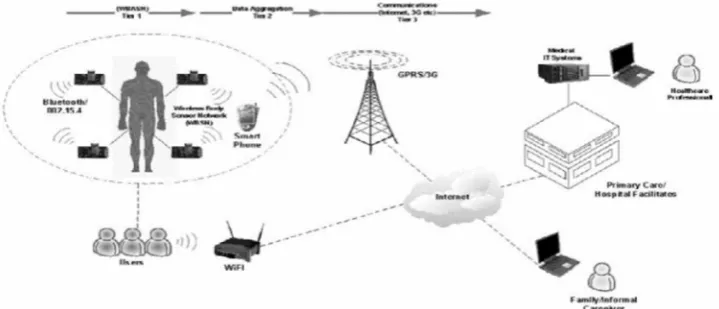
Figure 1.1 shows a general architecture for W SN. It is important to note that this illustration is not peculiar to any particular system; it only shows the relationship of classes o f components or devices with one another. In general sense, the operation of W SN involves acquisition o f data and reporting o f data. So, there is a network for acquisition o f data and network for distribution o f data and a center that takes care of monitoring and control (Lewis, 2004) as illustrated in Figure 1.1. The Figure shows two kinds o f network topologies. The sensor nodes either form a first node dead in which the nodes perform function o f routers that transfers data across a multi-hop routing to a sink or a half node dead in which more powerful fixed or mobile relays are used to bring together and connect the sensor data to a sink.
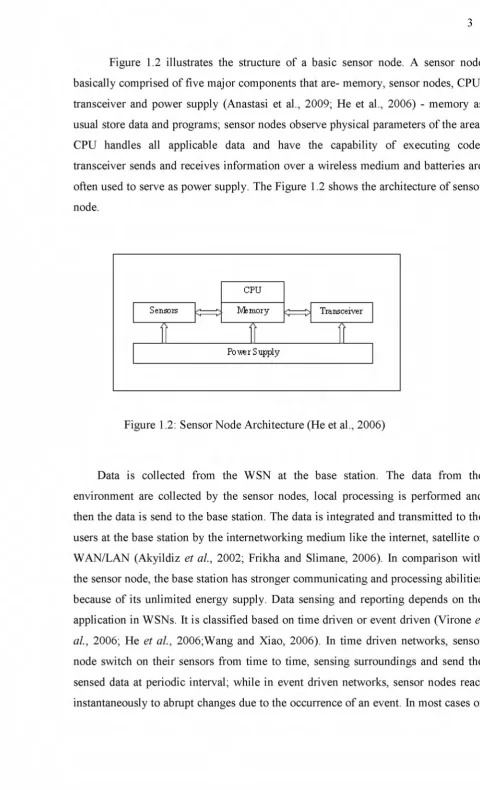
Figure 1.2 illustrates the structure o f a basic sensor node. A sensor node basically comprised o f five major components that are- memory, sensor nodes, CPU, transceiver and power supply (Anastasi et al., 2009; He et al., 2006) - memory as usual store data and programs; sensor nodes observe physical parameters o f the area; CPU handles all applicable data and have the capability o f executing code, transceiver sends and receives information over a wireless medium and batteries are often used to serve as power supply. The Figure 1.2 shows the architecture o f sensor node.
3
Figure 1.2: Sensor Node Architecture (He et al., 2006)
event driven applications, for example when sensor nodes detect fire, data must be send and arrive at the BS as rapidly as possible. W SNs can be of single hop or multi hop communications, Anastasi et al. (2009); Virone et al. (2006); Tilak et al. (2002). In a single-hop communication, a sensor node communicates with other sensor nodes or with a base station; but in multi-hop, sensor node may comprise series o f hops to communicate with one another or with a base station. The fact that wireless sensor nodes has limited power resources- the batteries, optimization o f power efficiency is essential to maximize the life span and reliability o f the wireless sensor networks.
1.2 Problem Background
In general, the Wireless Sensor Networks consists o f a large number o f small and cheap sensor nodes that have very limited energy, processing power and storage. They usually monitor areas, collect data and report to the base station (BS). Due to the achievement in low-power digital circuit and wireless communication, many applications o f the W SN are developed and already been used in habitat monitoring, military formation and object tracking. The energy consumption can be reduced by allowing only a portion o f the nodes, which called cluster heads, to communicate with the base station. The data sent by each node is then collected by cluster heads and compressed. After that the aggregated data is transmitted to the base station. Although clustering can reduce energy consumption, it has some problems. The main problem is that energy consumption is concentrated on the cluster heads. In order to overcome this demerit, the issue of how to distribute the energy consumption in cluster routing must be solved. The representative solution is improved cluster head selection in LEACH, which is a deterministic clustering method.
al., 2006; Yick et al., 2008; Liang et al., 2008). Given that replacing batteries may be demanding or somehow impossible in many applications and since the life span o f a sensor node rely solely to a large degree on the life span o f the batteries as well as the network coverage and connectivity, it is crucial to tailor energy efficient approaches for these networks. Sensor nodes are set out at random in the sensing field, with the expectation that they perform without any factor that limits the energy availability to the sensor nodes. Some existing routing protocols meant for conventional networks cannot work properly in most network setup due to:
i. The data collected by the multiple sensor nodes is centered on a common event and there is a degree o f redundancy in the sensed data. ii. Sensor networks are specific for a particular application.
iii. Sensor nodes are immobile, that is they are not mobile.
iv. Sensor networks have substantial numbers o f sensor nodes which does not need distinct addresses because maintaining so many addresses means having additional overhead.
v. Since sensor networks are unattended and all network organization and configuration operates automatically, there is need for sensor nodes to be self-organized.
vi. Data collection in the sensor network is centered on location.
Therefore for such situations, there is need to have a method that will provide a dependable and fault tolerant communication, fast reconfiguration and least consumption o f energy. Routing protocols play a vital role in most, if not all o f these activities. Besides the infrastructure less, inadequate resources in relation to energy, space and computational capabilities nature o f W SNs makes routing more difficult. A lot o f routing protocols have been deployed to address all the aforementioned problems but some o f which are more appropriate in some scenarios having better performance while not suitable in other situations having significant limitations taking into consideration the architecture and application demands o f WSNs. So, it is vital to evaluate routing protocols for applications.
In this research work, an effective cluster head selection technique which can overcome the deficiencies o f the LEACH algorithm is proposed. LEACH being the protocol widely used for energy efficient routers needs improvement on the energy, that is why the enhancement done on it. The selection o f cluster heads is primarily based on the residual/current energy o f the nodes. Data transmission overhead can be reduced by considering the distance factor between the CH and sink. Thus, those nodes having high residual energy and at the same time having low distance with respect to sink are elected as cluster heads. Also, during the cluster formation phase, a distance-based approach is undertaken for the selection o f a CH by a non-cluster head node.
LEACH cluster-heads are randomly selected using probability variables. In order to select cluster-heads, each node n determines a random number between 0 and 1. If the number is less than a threshold T(n), the node becomes a cluster-head. This method is enhanced by using a modified stochastic threshold algorithm, which is the deterministic algorithm. This overcomes the problem o f the random selection based on probability.
1.3 Related Work
i. In the cluster head election phase o f the LEACH protocol, there is a probability that some nodes with minimum energy will get selected as the cluster head in all iterations. This results in uncontrolled use o f limited battery power by the node.
ii. Overhead due to data transmission.
iii. During the cluster formation stage, some non-cluster head nodes may join a cluster, such that the distance between its cluster head and the base station will be even greater than the distance between that particular sensor node and the base station.
The concept o f cluster centered routing is exploited for the heterogeneous sensor network in the LEACH scheme to enhance the network lifetime, Heinzelman et al. (2000). In this work, each and every weighted election probability for each node is calculated to decide the success o f a node to be cluster head or not. For a hierarchical WSN, the cluster head selection process is in a distributed way, Dilip et al. (2009).
Tang et al. (2010) handled the clustering problem o f W SN by the chain head selection method. This work is able to achieve better energy saving than the conventional LEACH protocol. LEACH-VF virtual forces protocol is another work used to solve the selection problem by overlapping sensing holes upon the sensing coverage, Yassein et al. (2009). But the energy efficiency is slightly compromised, while solving the area problem. In the protocol, time-based applications are focused by controlling data transmission over the CH, Manjeshwar & Agrawal (2000).
LEACH-C; (Geetha et al., 2012) an extension o f LEACH algorithm is based on centralized clustering. In LEACH-C, using a centralized clustering protocol, the steady state stage is quite similar to LEACH. In the set-up phase, each and every sensor node sends the current position and the battery level to the BS. Using the global network data the BS selects better clusters that require the minimal power for data transmission. A Global Positioning System (GPS) or the some other location
tracking technique is necessary to find the current location. Cost is the considerable factor here. The BS then broadcasts the information to all sensor nodes in the network. Optical-LEACH (O-LEACH) is introduced as an optical, low-energy, adaptive clustering hierarchy, which is again an improved form o f LEACH protocol; El Khediri et al. (2014). In the research, the node whose current energy is greater than ten percent gets the chance to act as a CH.
Another enhancement o f the LEACH algorithm is carried out as a Two-Level Hierarchy LEACH- “TL-LEACH” . TL-LEACH has a bi-stage CH selection, which includes primary and secondary stage and this process serves as a single stage in LEACH. The CH elected by the primary stage connects with the secondary CHs, and the consequent secondary CHs get connected with their cluster members. Similar to LEACH, data fusion will also happen here (Loscri et al., 2005). Data transfer from the source node to the BS could be attained in two steps: Initially the secondary CHs accumulate data from their respective cluster members and thus collected data are fused for further processing. Thus fused data are collected by the primary CHs and the second level data fusion is done in the primary cluster head. This in turn reduces the battery consumption, ultimately reducing the total energy usage.
1.4 Problem Statement
protocol will be analyzed and area o f improvement will be focused to make it energy efficient. For analysis, a simulator will be used.
It has been observed that many researches that have been done on the area of energy consumption in WSNs show that about 70% o f the energy is being consumed during the data transmission phase. Therefore, energy consumption is among the main problems in WSNs application. In W SN applications, the sensor nodes are usually deployed in an unattended field or environment and replacement o f batteries is very difficult if not impossible. These sensor nodes are used to transmit accurate sense information o f some resources to the base station for analysis. These communication activities cause the depletion o f the SN’s energy quickly which reduces the network lifetime; therefore exposing the patient life into risk due to the need o f real time information about the patient condition and the current location of the doctors/nurses in case o f any emergency. So there is a need to improve the cluster head selection process to achieve higher efficiency and life span.
9
1.5 Research Questions
To overcome the problem statement o f this study, the main research question is:
1.6 Research Objective
The aim o f this research is design o f an enhancement o f cluster head selection based on LEACH routing protocol that is used in W SN applications to improve energy efficiency and network lifetime.
To achieve this aim, the following objectives were identified:
i. To design a cluster head selection technique based on LEACH.
ii. To implement the cluster head selection technique by using the deterministic threshold algorithm stochastically.
1.7 Scope of Work
1.8 Significance of Study
In this research, an energy-efficient communication protocol for WSNs, that is LEACH cluster-based routing protocol is studied with the aim o f enhancing the cluster head selection process to improve performance, energy reduction and network lifetime. Data from member nodes are collected by the cluster heads, aggregation of the data is done and the aggregated data is transmitted to the base station for higher level processing. In order to prolong the network’s life span for data communication, it is vital to focus on how to reduce energy consumption in the WSNs. The protocols divide the sensor network into clusters o f nodes headed by a cluster head; these clusters are used to form a logical hierarchy in a flat topology. The proposed improvement in the cluster head selection is therefore dynamic because it adapts to changes in network connectivity and reduces energy consumption. Energy conscious protocol LEACH would be adopted based on various network topologies.
The result o f the analysis will show how large amount o f energy is saved by using the improved cluster head selection, ultimately reducing energy consumption and communication overheads within the sensor networks. This will justify the advantages of using the improved clustering process.
11
1.9 Outline of the thesis
Chapter 1 introduces the research area, the motivation o f the research and general description on WSNs and objectives o f the research.
Chapter 3 compares some networks simulators that are available to implement the proposed algorithm.
Chapter 4 describes the design and implementation. The design o f the algorithm is described. And the implementation is explained.
Chapter 5 discusses the simulation and its results, with detailed analysis.
102
REFERENCES
A. E. Kostin, Y. Fanaeian, and H. Al-Wattar. (2016). Anycast tree-based routing in mobile wireless sensor networks with multiple sinks. W ireless Networks, vol. 22, no. 2, pp. 579-598.
Akkaya, Kemal, & Younis, Mohamed. (2005). A survey on routing protocols for wireless sensor networks. A d hoc networks, 5(3), 325-349.
Akyildiz, Ian F, Su, Weilian, Sankarasubramaniam, Yogesh, & Cayirci, Erdal. (2002). W ireless sensor networks: a survey. Computer networks, 55(4), 393 422.
Alemdar, Hande, & Ersoy, Cem. (2010). W ireless sensor networks for healthcare: A survey. Computer Networks, 54(15), 2688-2710.
Anastasi, Giuseppe, Conti, Marco, Di Francesco, Mario, & Passarella, Andrea. (2009). Energy conservation in wireless sensor networks: A survey. A d hoc networks, 7(3), 537-568.
Anitha, Ru, & Kamalakkannan. (2013). Performance Evaluation O f Energy Efficient Cluster Based Routing Protocols In Mobile Wireless Sensor Networks. International Journal o f Engineering Science and Technology
(IJEST), 5(06S), 97-105.
B. A. A. Attea, E. A. Khalil, and A. Cosar. (2015). M ulti-objective evolutionary routing protocol for efficient coverage in wireless sensor networks. Soft Computing, vol. 19, no. 10, pp. 2983-2995.
Behboudi, Negin, & Abhari, Abdolreza. (2011). A Weighted Energy Efficient Clustering (WEEC) fo r Wireless Sensor Networks. Seventh International Conference on Mobile Ad-hoc and Sensor Networks (MSN), 2011.
C. Tunca, S. Isik, M. Y. Donmez, and C. Ersoy. (2015). Ring routing: an energy- efficient routing protocol for wireless sensor networks with a mobile sink. IEEE Transactions on Mobile Computing, vol. 14, no. 9, pp. 1947-1960. Chen, Bor-Rong, Peterson, Geoffrey, Mainland, Geoff, & Welsh, Matt. (2008).
Livenet: Using passive monitoring to reconstruct sensor network dynamics Distributed Computing in Sensor Systems (pp. 79-98): Springer.
Egbogah, Emeka E, & Fapojuwo, Abraham O. (2011). A survey o f system architecture requirements for health care-based wireless sensor networks. Sensors, 11(5), 4875-4898.
Frikha, Mounir, & Slimane, Jamila Ben. (2006). Conception and simulation o f energy-efficient A O D V protocol in ad hoc networks. Proceedings of the 3rd international conference on Mobile technology, applications & systems. G. S. Kumar, M. V. Vinu Paul, G. Athithan, and K. P. Jacob. (2008). Routing
protocol enhancement for handling node mobility in wireless sensor networks. Proceedings o f the IEEE Region 10 Conference (TENCON ’08), pp. 1-6, IEEE, Hyderabad, India.
G. Xing, M. Li, T. Wang, W. Jia, and J. Huang. (2012). Efficient rendezvous algorithms for data enabled wireless sensor networks. IEEE Transactions on Mobile Computing, vol. 11, no. 1, pp. 47-60.
H. Zhao, S. Guo, X. Wang, and F. Wang. (2015). Energy-efficient topology control algorithm for maximizing network lifetime in wireless sensor networks with mobile sink. Applied Soft Computing, vol. 34, pp. 539-550.
He, Tian, Vicaire, Pascal, Yan, Ting, Luo, Liqian, Gu, Lin, Zhou, Gang, Abdelzaher, Tarek. (2006). Achieving real-time target tracking using wireless sensor networks. Proceedings o f the 12th IEEE conference on Real Time and Embedded Technology and Applications Symposium.
104
networks. Proceedings o f the 33rd annual Hawaii international conference on System sciences.
Ilyas, Mohammad, & Mahgoub, Imad. (2004). Handbook o f sensor networks: compact wireless and wired sensing systems: CRC press.
Imran, Muhammad, Said, Abas Md, & Hasbullah, Halabi. (2010). A survey o f simulators, emulators and testbeds fo r wireless sensor networks. International Symposium in Information Technology (ITSim), 2010.
J. Shi, X. Wei, and W. Zhu. (2016). An efficient algorithm for energy management in wireless sensor networks via employing multiple mobile sinks. International Journal o f Distributed Sensor Networks, vol. 2016, Article ID 3179587, 9 pages.
J. Wang, X. Yang, T. Ma, M. Wu, and J.-U. Kim. (2012). An energy efficient competitive clustering algorithm for wireless sensor networks using mobile sink. International Journal o f Grid and Distributed Computing, vol. 5, pp. 79-92.
J. Wang, Y.-Q. Cao, B. Li, S.-Y. Lee, and J.-U. Kim. (2015). A glowworm swarm optimization based clustering algorithm with mobile sink support for wireless sensor networks. Journal o f Internet Technology, vol. 16, no. 5, pp. 825-832.
J. R. Srivastava and T. S. B. Sudarshan. (2015). A genetic fuzzy system based optimized zone based energy efficient routing protocol for mobile sensor networks (OZEEP). Applied Soft Computing Journal, vol. 37, pp. 863-886. Jovanov, Emil. (2006). Wireless technology and system integration in body area
networks fo r m-health applications. 27th Annual International Conference of Engineering in M edicine and Biology Society, 2005. IEEE-EMBS 2005. Jovanov, Emil, Milenkovic, Aleksandar, Otto, Chris, & De Groen, Piet C. (2005). A
wireless body area network o f intelligent motion sensors for computer assisted physical rehabilitation. Journal o f NeuroEngineering and rehabilitation, 2(1), 6.
K. Do-Seong and C. Yeong-Jee. (2006). Self-organization routing protocol supporting mobile nodes for wireless sensor network. Proceedings o f the 1st International Multi-Symposiums on Computer and Computational Sciences (IMSCCS ’06), pp. 622-626, Hangzhou, China.
Lewis, Franck L. (2004). W ireless sensor networks. Smart environments: technologies, protocols, and applications, 11-46.
Liang, Chiu-Kuo, Huang, Yu-Jie, & Lin, Jian-Da. (2008). An energy efficient routing scheme in wireless sensor networks. 22nd International Conference on Advanced Information Networking and Applications-Workshops, AINAW.
M. R. Jafri, N. Javaid, A. Javaid, and Z. A. Khan. (2013). Maximizing the lifetime o f multi-chain LEACH using sink mobility. W orld Applied Sciences Journal, vol. 21, no. 9, pp. 1283-1289.
Malan, David, Fulford-Jones, Thaddeus, Welsh, Matt, & Moulton, Steve. (2004). Codeblue: An ad hoc sensor network infrastructure fo r emergency medical care. International workshop on wearable and implantable body sensor networks.
Manjeshwar, Arati, & Agrawal, Dharma P. (2001). TEEN: a routing protocol fo r enhanced efficiency in wireless sensor networks. Parallel and Distributed Processing Symposium.
N. A. A. Latiff, N. M. A. Latiff, and R. B. Ahmad. (2011). Prolonging lifetime of wireless sensor networks with mobile base station using particle swarm optimization. Proceedings o f the 4th International Conference on Modeling, Simulation and Applied Optimization (ICMSAO ’11), pp. 1-6, IEEE, Kuala Lumpur, Malaysia.
R. Sudarmani and K. R. S. Kumar. (2013). Particle swarm optimization-based routing protocol for clustered heterogeneous sensor networks with mobile sink. American Journal o f Applied Sciences, vol. 10, no. 3, pp. 259-269. R. U. Anitha and P. Kamalakkannan. (2013). Enhanced cluster based routing
106
Engineering (PRIME ’13), pp. 187-193, Salem, India.
R. Velmani and B. Kaarthick. (2014). An energy efficient data gathering in dense wireless sensor networks. ISRN Sensor Networks, vol. 2014, Article ID 51826.
R. Velmani and B. Kaarthick. (2015). An efficient cluster-tree based data collection scheme for large wireless sensor networks. IEEE Sensors Journal, vol. 15, no. 4, pp. 2377-2390.
S. Cakici, I. Erturk, S. Atmaca, and A. Karahan. (2014). A novel crosslayer routing protocol for increasing packet transfer reliability in wireless sensor networks. W ireless Personal Communications, vol. 77, no. 3, pp. 2235 2254.
S. A. B. Awwad, C. K. Ng, N. K. Noordin, and M. F. A. Rasid. (2011). Cluster based routing protocol for mobile nodes in wireless sensor network. Wireless Personal Communications, vol. 61, no. 2, pp. 251-281.
S. Mottaghi and M. R. Zahabi. (2015). Optimizing LEACH clustering algorithm with mobile sink and rendezvous nodes. AEU— International Journal of Electronics and Communications, vol. 69, no. 2, pp. 507-514.
S. Deng, J. Li, and L. Shen. (2011). M obility-based clustering protocol for wireless sensor networks with mobile nodes. W ireless Sensor Systems, IET, vol. 1, no. 1, pp. 39-47.
S. Sarangi and S. Kar. (2011). Genetic algorithm based mobility aware clustering for energy efficient routing in wireless sensor networks. Proceedings o f the 17th IEEE International Conference on Networks (ICON ’11), pp. 1-6, Singapore.
Sumorok, Daniel, Starobinski, David, & Trachtenberg, Ari. (2004). Simulation of TinyOS W ireless Sensor Networks Using OPNET. OPNETWORK
Tao, Lu, Qing-Xin, Zhu, & Luqiao, Zhang. (2010). An improvement fo r LEAC H algorithm in wireless sensor network. 5th IEEE Conference on Industrial Electronics and Applications (ICIEA).
(PHASeR) protocol for wireless sensor networks. Pervasive and Mobile Computing, vol. 21, pp. 47-61.
Tilak, Sameer, Abu-Ghazaleh, Nael B, & Heinzelman, Wendi. (2002). A taxonomy o f wireless micro-sensor network models. AC M SIGMOBILE Mobile Computing and Communications Review, 6(2), 28-36.
Vales-Alonso, Lopez-Matencio, Gonzalez-Castano, Francisco J, Navarro-Hellin, Honorio, Banos-Guirao, Perez-Martinez, Duro-Fernandez, Richard. (2010). Ambient intelligence systems for personalized sport training. Sensors, 10(3), 2359 -2385.
Virone, G, Wood, A, Selavo, L, Cao, Q, Fang, L, Doan, Stankovic, J. (2006). An advanced wireless sensor network fo r health monitoring. Transdisciplinary Conference on Distributed Diagnosis and Home Healthcare (D2H2).
Wang, Lan, & Xiao, Yang. (2006). A survey o f energy-efficient scheduling mechanisms in sensor networks. Mobile Networks and Applications, 11(5), 723-740.
Welsh, Matt, & Chen, B. (2006). Codeblue: W ireless sensor networks for medical care. Division o f Engineering and Applied Sciences, Harvard U niversity. Welsh, Matt, Myung, Dan, Gaynor, Mark, & Moulton, Steve. (2003). Resuscitation
monitoring with a wireless sensor network.
Xin, Guan, Yang, W u Hua, & DeGang, Bi. (2008). EEHCA: An energy-efficient hierarchical clustering algorithm for wireless sensor networks. Information Technology Journal, 7(2), 245-252.
Y. Chen, Z. Wang, T. Ren, and H. Lv. (2015). Lifetime optimization algorithm with mobile sink nodes for wireless sensor networks based on location information. International Journal o f Distributed Sensor Networks, vol. 2015, Article ID 857673.
Y. Yue, J. Li, H. Fan, and Q. Qin. (2016). Optimization-based artificial bee colony algorithm for data collection in large-scale mobile wireless sensor networks. Journal o f Sensors, vol. 2016, Article ID 7057490.
108