Abstract
IYER, PRASHANT. The Complexity of Traffic Grooming in Optical Path Networks with Egress Traffic. (Under the direction of Carla D. Savage.)
We consider the problem of minimizing network costs when grooming traffic in optical networks that support Wavelength Division Multiplexing (WDM). While the general problem has been shown to be NP-Hard for a number of cost measures, there still exist restricted problems for which no complexity bound is known. In this research, we restrict our attention to traffic grooming for path networks with egress (all-to-one) traffic. This restricted model has practical significance for high speed (optical) access networks and can also lead to better bounds and approximations on more general network topologies (such as ring and star networks) that can be decomposed into path networks. Three important cost measures for this restricted model are studied.
The first cost measure is the total number of ADMs used by the solution. Minimizing this cost was known to be NP-Complete even for egress traffic without using cross connects. We show that allowing an unbounded number of wavelengths obviates the need for digital cross connects at the nodes and hence the problem remains NP-Complete even when cross connects are allowed.
The second cost measure is the number of transceivers used by the solution. We show that the problem of minimizing the number of transceivers is NP-Complete, even when restricted to egress traffic. We then develop a simple approximation scheme where the transceiver cost exceeds the minimum by at most the number of required wavelengths. Finally, we show that under certain conditions, there exist solutions that simultaneously minimize both ADM and transceiver costs.
THE COMPLEXITY OF TRAFFIC GROOMING IN OPTICAL
PATH NETWORKS WITH EGRESS TRAFFIC
by
Prashant Iyer
a thesis submitted to the graduate faculty of
north carolina state university
in partial fulfillment of the
requirements for the degree of
master of science
department of computer science
raleigh
May 2003
approved by:
co-chair of advisory committee
Carla D. Savage
co-chair of advisory committee
Rudra Dutta
Biography
Prashant Iyer was born on the 20th of June 1977 in Tirupati, India. He did his schooling in Bangalore, and completed his Bachelor’s degree in Electronics and Telecommunication Engineering at BMS College of Engineering, Bangalore, in 1999.
Prashant worked as a systems engineer for a short period at Wipro Technologies before joining Texas Instruments, India, as a software designer, in June 2000. In the Fall of 2001, he left TI to start his MS program in computer science at NC State University.
He is currently engaged to Sowmya and looks forward to sharing many many long walks with her.
Acknowledgments
I would like to thank my advisor Dr. Carla D. Savage for her invaluable guidance in my research. I wish to thank Dr. Rudra Dutta and Dr. George N. Rouskas, for their support and encouragement as members of my advisory committee. And finally, I would also like to thank my parents, for always being there for me, and my fiance Sowmya, for her patience and unflagging support.
Table of Contents
List of Figures vi
List of Algorithms vii
1 Introduction 1
1.1 Our Contribution . . . 2
1.2 Overview . . . 3
2 Problem Definition 4 2.1 The path grooming problem . . . 4
2.2 Restricted path grooming . . . 5
2.3 Network cost measures . . . 6
3 Minimizing the Number of ADMs 9 3.1 Previous work . . . 9
3.2 Wavelength assignment and ADM cost . . . 10
3.3 Electronic switching and ADM cost . . . 12
4 Minimizing the Number of Transceivers 17 4.1 Complexity results . . . 17
4.2 Upper bound . . . 19
4.3 Performance of the approximation algorithm . . . 22
4.4 Comparing ADM and transceiver costs . . . 23
5 Minimizing the Electronic Switching Cost 26 5.1 Complexity results . . . 27
5.2 Wavelengths with unlimited capacity . . . 28
5.2.1 Motivation . . . 29
5.2.2 Structure of optimal solutions . . . 29
5.2.3 The dynamic programming algorithm . . . 31
5.2.4 Uniform traffic . . . 33
5.3 Wavelengths with finite capacity . . . 38
5.3.1 Uniform unit traffic . . . 38
5.3.2 WhenW = 2 andri≤C . . . 39
6 Conclusion and Future Work 41 6.1 Summary of results . . . 41 6.2 Open problems and future directions . . . 42
List of References 44
A Maple 8.0 program for PathGroomingMinES 46
B Maple 8.0 program for Fn(c1, c2, d1, d2) 48
List of Figures
2.1 Various cost measures . . . 7
3.1 Transformations to makeln≤ln . . . 13
4.1 Best case inputs forPathGroomingMinLP. . . 22
4.2 Worst case input forPathGroomingMinLP . . . 23
4.3 Sub-optimal input forPathGroomingMinLP with uniform traffic . . . 23
5.1 Intersecting lightpaths . . . 30
5.2 Sample output whenC=∞. . . 33
5.3 Unit traffic with unbounded capacity . . . 37
5.4 Unit traffic with bounded capacity . . . 38
5.5 Sample output whenW = 2 is fixed . . . 40
List of Algorithms
1 PathGroomingMinLP(N, W, C,r) . . . . 20 2 Assign(i, j,r,λ, N, W) . . . 20 3 PathGroomingMinES(N, W,r) . . . 32
Chapter 1
Introduction
Wavelength Division Multiplexing (WDM) allows an optical fiber to carry traffic on multiple channels by assigning to each channel a unique wavelength in which the corresponding traffic is transmitted. A WDM network consists of a set of nodes interconnected by optical fiber links. Each node is equipped with a Wavelength Add-Drop Multiplexer (WADM) that can start or terminate traffic on a subset of the wavelengths supported by the network. Traffic on the remaining wavelengths at a node is said topass-through that node without being processed electronically. This allows the creation of a virtual topology where the nodes are connected bylightpaths that may span multiple physical links. Each such lightpath between two nodes will be assigned a fixed wavelength that will optically pass-through the WADMs at intermediate nodes. Lightpaths sharing a physical link will carry their traffic on distinct wavelengths. Traffic requests are thus satisfied by routing them on a sequence of lightpaths in the virtual topology.
Practical deployments have shown that the bandwidth available in each wavelength (e.g., OC-48, OC-96) far exceeds the typical requirement per traffic request (e.g., T3 or OC-3). Hence, multiple requests can be multiplexed onto wavelengths, leading to a better utilization of available bandwidth. This grooming of low speed traffic onto lightpaths is performed by wavelength specific Add-Drop Multiplexers (ADMs) located at the nodes. The effect of traffic grooming on network costs has been the topic of much study [1, 2, 3, 4, 5, 6].
The general problem of traffic grooming to reduce network costs has been shown to be NP-Complete for a number of cost models [2, 7]. We restrict our attention to the traffic grooming problem in unidirectional, WDM path networks with static requests to a single egress node. Path networks are a simple but important class of networks primarily because most of the commonly used topologies such as ring, star and tree networks can be easily decomposed into path networks. We can thus use solutions to path networks to obtain approximations and/or bounds on the optimum solutions for the more general topologies [2]. The additional restriction of all-to-one traffic to a
Chapter 1. Introduction 2
single egress node is a valid assumption for high speed (optical) access networks. The study of this restricted model also yields a better understanding of some of the complexity inherent in the general traffic grooming problem.
1.1
Our Contribution
We study the problem of minimizing three different network cost measures for traffic grooming in path networks with egress (all-to-one) traffic. For each cost model, we analyze the inherent complexity of the problem and derive properties of the structure of their optimum solutions. Some of these properties are then used to devise algorithms and/or obtain bounds for the cost of an optimum solution.
The first cost measure is the total number of ADMs used by the solution. Minimizing this cost was known to be NP-Complete even for egress traffic provided the nodes do not route traffic using cross connects. We show that allowing an unbounded number of wavelengths obviates the need for digital cross connects at the nodes and hence the problem remains NP-Complete even when the use of cross connects is allowed.
The second cost measure is the number of transceivers used by the solution. We show that the problem of minimizing the number of transceivers is NP-Complete, even when restricted to egress traffic. We then develop a simple approximation scheme where the transceiver cost exceeds the min-imum by, at most, the number of required wavelengths, and also show that under certain conditions, there exist solutions that simultaneously minimize both the ADM as well as the transceiver costs.
Chapter 1. Introduction 3
1.2
Overview
Chapter 2
Problem Definition
In this chapter, we define the problem of traffic grooming for path networks. We then present a restricted version of the problem that will be studied in depth in later chapters. Finally, three different measures for network cost are presented along with concrete examples that illustrate the difference between them.
2.1
The path grooming problem
We consider a path network consisting ofN nodes numbered 1 toN. There are physical optical links connecting node ito node i+ 1 for 1≤i < N. Each physical link is capable of carrying traffic in at mostW wavelengths and each wavelength has a capacityC expressed in an appropriate unit for network traffic (e.g. OC-3, OC-12, T3). Alightpathbetween nodesiandj is the allocation of a fixed wavelength in the series of physical links between nodesi and j such that the intermediate nodes optically pass-through traffic on this wavelength. Lightpaths sharing a physical link are assigned distinct wavelengths. The number of lightpaths traversing a link will be referred to as itslink load. These lightpaths terminate at WADMs located at the nodes. The traffic requests are specified by a matrix of integers R = [rij], 1 ≤ i < j ≤ N where each rij represents the number of units of traffic requests from nodei to nodej. These requests are multiplexed onto lightpaths by means of wavelength specific Add-Drop Multiplexers (ADMs) located at the nodes. In addition, we assume that each node is capable of electronically switching the traffic requests from incoming lightpaths onto outgoing lightpaths (on potentially different wavelengths) by means of digital cross-connects (DXCs).
A set of lightpaths in a path network can be viewed as a virtual topologyimposed on the path network to route requests with improved efficiency and cost. Such a virtual topology is said to be feasibleif it is possible to route all the traffic requests on the lightpaths in the topology such that
Chapter 2. Problem Definition 5
i) the maximum link load does not exceed the number of available wavelengths and ii) the traffic in each lightpath does not exceed the capacity of a wavelength. The traffic grooming problem in path networks is to design a virtual topology and specify a routing that satisfies all the requests so as to minimize a given cost measure. The path grooming problem can thus be formalized as follows.
Given: The number of nodesNin the path network, the number of available wavelengths
W, the capacity of each wavelengthC, and the traffic request matrix R= [rij], 1≤i <
j ≤N,
find: (i) a virtual topology specified as the matrix B= [bij], wherebij is the number of lightpaths between nodesiandj; and (ii) a routing given by the set of integersd(ijsd)for 1≤i < j≤N and 1≤s < d≤N, corresponding to the number of requests fromstod
that are routed through a lightpath inbij, satisfying: the capacity constraint,
1≤s<d≤N
d(ijsd)≤C for all 1≤i < j ≤N
and the wavelength constraint,
1≤i<k≤j≤N
bij ≤W for all 1< k≤N.
Note that the virtual topology may have multiple lightpaths between the same two nodes. However, we do not distinguish between such lightpaths when specifying the routing for the requests asd(ijsd). The traffic grooming problem as defined in [2] requires an additional phase - to assign wavelengths to the lightpaths in the virtual topology such that no two lightpaths that share a physical link have the same wavelength. However, for path networks, it is also noted in [2] that this can always be done in linear time. This phase is hence not included in the path grooming problem defined above. An Integer Linear Program formulation for the problem can be easily derived as in [8]. However, due to the generality of available ILP solvers, this approach remains infeasible even for moderately sized networks.
2.2
Restricted path grooming
The path grooming problem can be further simplified by assuming that all traffic is destined to a single egress node at one end of the path network, say nodeN. This implies that the request matrix
Chapter 2. Problem Definition 6
The restricted path grooming problem is particularly common in access networks and hence the results are directly applicable to such networks. In addition, studying this restricted model not only provides better understanding of traffic grooming in general, but may also prove useful as the foundation for heuristics and approximations to the more general case.
2.3
Network cost measures
A wide number of criteria have been proposed to measure the cost of a solution to the traffic grooming problem [9, 7, 2]. This paper concentrates on the following three cost measures.
1. Total number of ADMs used in the network [7]. 2. Total number of transceivers used in the network [9].
3. Total amount of electronic switching performed in the network [2].
Cost 1 assumes that the network cost is dominated by Add-Drop Multiplexers (ADMs). Although every lightpath requires one ADM at each of its endpoints, ADMs may be shared by two lightpaths at a common endpoint, provided the two lightpaths are assigned the same wavelength. Thus, in general, the lightpaths need to be assigned wavelengths before this cost can be measured for a proposed virtual topology and routing. However, it may be possible to come up with lower bounds on the number of ADMs without specifying a complete wavelength assignment. In this paper, we let k1 represent the ADM cost of the network, when such a cost measure is available. Chapter 3
discusses this cost model in detail.
Cost 2 assumes that the network cost is dominated by transceivers. A transceiver is similar to an ADM in that it is present at the nodes and terminates lightpaths. However, unlike an ADM, transceivers cannot be shared by multiple lightpaths. In other words, every lightpath requires exactly two transceivers, one at each endpoint. Minimizing transceivers is thus identical to minimizing the number of lightpaths used by the solution. In terms of the path grooming problem defined above, the number of lightpaths used is given byk2 =i,jbij. This cost model is discussed in detail in Chapter 4.
Cost 3 measures the amount of electronic switching done by the nodes in the network. A node has to electronically process traffic carried on the lightpaths that terminate at the node. Each time a node forwards a request from an incoming lightpath to another outgoing lightpath, it has to perform electronic switching. This cost is thus reduced by minimizing the total number of lightpath hops taken by the requests on the virtual topology. In terms of the path grooming problem defined above, the costk3 corresponding to this model is given byk3=i,j,s,db
(sd)
Chapter 2. Problem Definition 7
k1 = 11; k2 = 9; k3 = 182
(b)
N = 10; C = 31; W = 3
k1 = 8; k2 = 5; k3 = 31 (c)
k1 = 8; k2 = 4; k3 = 24
(d)
N = 5; C = 8; W = 4
k1 = 15; k2 = 10; k3 = 101
(e)
N = 10; C = 31; W = 3
N = 5; C = 8; W = 3
k1 = 15; k2 = 9; k3 = 101 (a)
N = 10; C = 31; W = 3
2 9 6
10 7 2 12 2 11
0 0 0 1 1 1 0 0 1 1 00 00 11 11 00 00 11 11 0 0 1 1 00 00 11 11 0 0 1 1 00 00 11 11 0 0 1 1 00 00 11 11 00 00 00 11 11 11 00 00 00 11 11 11 0 0 1 1 5
7 2 12
2 9 6
10 7 2 12 2 11
2 11 10 8 6 5 5
6 9 2 5 6 8
0 0 0 1 1 1 0 0 1 1 00 00 11 11 0 0 1 1 0 0 1 1 00 00 00 11 11 11 0 0 0 1 1 1 00 00 00 11 11 11 0 0 0 1 1 1 0 0 0 1 1 1 0 0 0 1 1 1 00 00 00 11 11 11 0 0 0 1 1 1 00 00 00 11 11 11 0 0 0 1 1 1 00 00 00 11 11 11 00 00 11 11 00 00 00 11 11 11 0 0 0 1 1 1 00 00 00 11 11 11 0 0 0 1 1 1 00 00 00 11 11 11 0 0 0 1 1 1 00 00 00 11 11 11 00 00 00 11 11 11 0 0 0 1 1 1 0 0 0 1 1 1
Chapter 2. Problem Definition 8
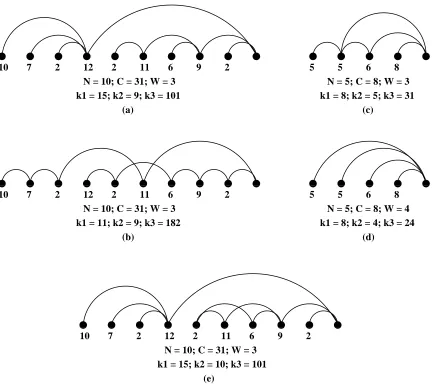
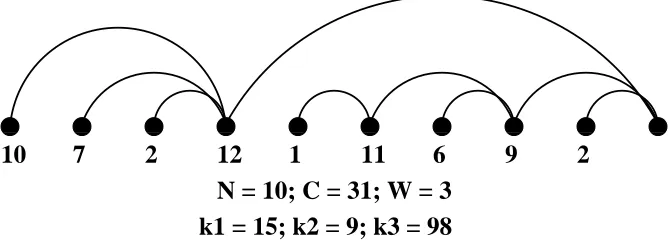
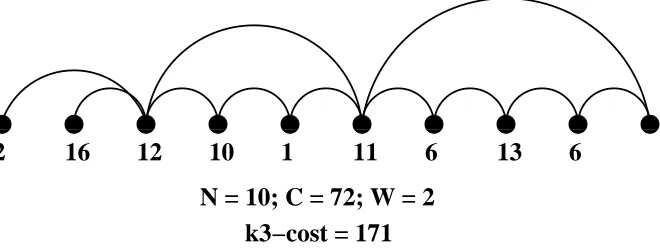
Figure 2.1 shows two instances of the restricted path grooming problem. The nodes in the network are represented by dots and the number under each node corresponds to the number of requests from that node to the egress node. The nodes are assumed to be in sequential order, with node 1 at the leftmost end and the egress node, node N, at the rightmost end. The physical link between successive nodes is not shown. For each instance, we give examples of feasible virtual topologies, with the arcs representing the lightpaths created in the topology. For each topology, we indicate the minimum cost that can be achieved using the three cost models above. Note that a valid routing of requests from each node can be easily obtained for the given examples.
For the first problem instance (with N = 10; C= 31; W = 3), Figure 2.1a presents a solution that minimizes the total electronic switching (k3-cost). Figure 2.1b shows another solution which
requires the least number of ADMs (k1-cost). Both of these solutions require the minimum number
lightpaths (k2-cost). For the second problem instance (withN = 5; C= 8; W = 3), traffic must be
split at a node to achieve a valid solution. Such a solution is presented in Figure 2.1c. Figure 2.1d shows how the presence of an additional wavelength may be used to reduce the number of lightpaths. These diagrams clearly bring out the differences between the cost models and how the design of the virtual topology affects the costs. In particular, Figure 2.1a shows that minimizingk2ork3may
not minimize k1; Figure 2.1b shows that minimizing k1 or k2 may not minimize k3. Figures 2.1c
and 2.1d show that minimizingk1 may not minimize k2and Figure 2.1e shows that minimizing k3
may not minimizek2.
Another way to investigate the differences between the cost models is to determine if it is possible (and if so, under what conditions), to simultaneously minimize more than one cost measure. The problem instance in Figures 2.1a and 2.1b is an example for which costsk1 andk3 cannot be
simul-taneously minimized. In Section 4.4 we prove sufficiency conditions for simulsimul-taneously minimizing
k1and k2. The possibility of minimizing bothk2 andk3 is still an open question.
Chapter 3
Minimizing the Number of ADMs
In this chapter, we consider the problem of minimizing the number of ADMs (k1-cost) in the path network. After presenting known results for this cost model in Section 3.1, we show, in Section 3.2, how wavelength assignment can be used to minimize ADM cost for a given topology and routing. Section 3.3 shows that digital cross connects cannot be used to reduce ADM costs in path networks when there is no bound on the number of available wavelengths. We conclude this Section by extending the NP-Completeness result (for minimizingk1-cost) to the case where nodes are allowed
to use cross connects.
3.1
Previous work
The problem of minimizing the ADM count in a network has been shown to be NP-Complete [7] even when restricted to path networks with an egress node. The network architecture and cost model used in [7] differs from our definition in the following two ways. First, the model in [7] does not place any resource bounds on the number of wavelengths available, whereas our model specifies an upper bound ofW. Secondly, it is assumed that the nodes in the network are not equipped with Digital Cross-Connects (DXCs) and hence traffic requests cannot change wavelengths on their route to the egress node. In our problem definition, each node is equipped with DXCs, thus allowing the low rate traffic to change wavelengths by means of electronic switching.
In the absence of DXCs’ and wavelength bounds, [7] shows that the problem of minimizing the number of ADMs is NP-Complete for path networks with egress node traffic. We briefly summarize the main points of this NP-Completeness proof. The optimization problem considered in [7] is to minimize the number of ADMs given an instance N, W = ∞, C, R ={ri | 0 < ri ≤ C} of the restricted path grooming problem, under the assumption that no DXCs are used at the nodes. A related decision problem PATH-GROOMING-MIN-ADM is formulated as follows. Given an instance
Chapter 3. Minimizing the Number of ADMs 10
N, W =∞, C, R={ri | 0 < ri ≤C}, and a goal k1, determine if there exists a solution to the
restricted path grooming problem such that the number of ADMs required does not exceed k1.
Since the problem does not specify a limit on the number of wavelengths, it is argued in [7] that if
ri ≤C, for 1≤i < N, there exists a solution with the optimum number of ADMs, that does not split the requests from a node onto more than one wavelength. In other words, there is optimum solution that uses exactly one ADM at each node ifor 1≤i < N, and as many ADMs at nodeN
as there are lightpaths carrying traffic to it. We note that such a solution will always use N −1 lightpaths (one from each node that has requests going to the egress node). Further, since requests are not allowed to change wavelengths, the number of wavelengths used in the solution is exactly the number of lightpaths terminating at the egress node. Thus, reducing the number of ADMs is equivalent to reducing the number of wavelengths used in the solution. This latter problem is, in turn, equivalent to the NP-Complete BIN-PACKING problem, with the number of bins corresponding to the number of wavelengths used. PATH-GROOMING-MIN-ADM is thus proved to be NP-Complete even ifri ≤C.
The paper [7] also presents a polynomial time greedy algorithm that solves the problem exactly for path networks with egress nodes, when each node has the same number of requests to the egress node. For non-uniform traffic, [4] presents exact solutions when the capacity is fixed at 2, 4, and 8. It is also shown in [4] that anyα-approximation for BIN-PACKING can be employed to obtain a solution to the restricted path grooming problem, that is within (1 +α)/2 of the optimum. In all of these, it is assumed thatW =∞, and that the nodes do not have cross connect capability.
For instances that allow nodes to have cross connect capability, [10, 11, 12] discuss the problem of minimizing ADMs using the smallest number and size of DXCs onring networks. Concrete examples in [10] show that cross connects do help reduce the number of ADMs in ring networks. [10] also derives lower bounds on the number of ADMs as a function of the number of nodes with DXCs and provides heuristic algorithms that try to reach this lower bound. The question of whether or not DXCs help reduce the ADM requirement in path networks (for both all-to-all and all-to-one traffic) has so far remained open. We provide partial answers in Section 3.3.
3.2
Wavelength assignment and ADM cost
We mentioned in Section 2.3 that in general, thek1-cost of a solution to the path grooming problem
Chapter 3. Minimizing the Number of ADMs 11
problem of wavelength assignment for a virtual topology reduces to interval graph coloring, which can be solved using a greedy algorithm in linear time. Such an algorithm essentially iterates through the nodes such that forifrom 1 to (N−1), each lightpath originating from nodei is assigned the least numbered unused wavelength currently available at that node. This version of the greedy algorithm guarantees that the total number of wavelengths used is at most the maximum number of lightpaths crossing a physical link. We now show, in Lemma 1 and Theorem 1, that by slightly modifying the wavelength selection strategy at each node, we can also achieve the lower bound on the number of ADMs required for the given virtual topology. Note that in the following argument, since the virtual topology is already specified, we do not make any assumptions regarding the use of DXCs or the presence of bounds on the number of wavelengths.
Given a virtual topology for a path network, let ln and ln denote the number of lightpaths terminating and originating at nodenrespectively.
Lemma 1 For path networks, given a virtual topology, it is always possible to assign wavelengths to the lightpaths such that the following conditions are simultaneously satisfied.
1. The total number of wavelengths used is at most the maximum number of lightpaths crossing
any physical link.
2. The number of different wavelengths assigned to the lightpaths originating and terminating at
a noden is at most max(ln, ln).
Proof. Consider the following modified version of the greedy algorithm for wavelength assignment described in the previous paragraph. For each node n, taken in sequence from node 1 to node
N−1, we know that the wavelengths assigned to thelnlightpaths terminating at that node are now available for re-assignment. When selecting a wavelength for one of the ln lightpaths originating from noden, we first select one such available wavelength that was used on a lightpath terminating at noden. When no such wavelength is available, we can start assigning any available wavelength to the remaining lightpaths. Thus, if ln ≥ ln, all lightpaths originating at node n will re-use the wavelengths assigned to lightpaths that terminate on that node - and the total number of wavelengths used at nodenwill beln. On the other hand, ifln< ln, all wavelengths assigned to lightpaths that terminate on noden will be re-used on outgoing lightpaths - and the total number of wavelengths used at nodenwill be at mostln. Thus, the maximum number of wavelengths used at a nodenis at most max(ln, ln) and Statement 2 of the lemma is true.
This modification of the wavelength selection strategy clearly uses the same number of available wavelengths at each node as the previous strategy. Hence Statement 1 is still true of the modified
Chapter 3. Minimizing the Number of ADMs 12
Theorem 1 Given a virtual topology for a path network, the following statements are true. 1. Nn=1max(ln, ln)is a lower bound on the number of ADMs required.
2. There exists an assignment of wavelengths to the lightpaths in the topology that achieves this
lower bound on the number of ADMs.
Proof. Given a virtual topology for a path network, we note that each of thelnlightpaths terminating at node ntraverses the physical link between nodes (n−1) and n and hence must be on distinct (among the ln lightpaths) wavelengths. Thus node n must be capable of electronically switching at least ln wavelengths. Similarly, each of the ln lightpaths originating from node ntraverses the physical link between nodesnand (n+ 1) and hence must be on distinct wavelengths. Thus noden
must also be capable of switching at leastln wavelengths. However, some lightpaths originating at nodenre-use the wavelengths assigned to lightpaths that terminate at noden. We know that each node requires one ADM for each wavelength that it has to process electronically. Hence, the lower bound on the number of ADMs required at nodenis max(ln, ln). Summing this lower bound over all the nodes in the network, we get the lower bound on the total number of ADMs for the given virtual topology asNn=1max(ln, ln). Thus, statement 1 of the lemma is true.
From Lemma 1 we know that there exists a wavelength assignment such that for each node
n, all the lightpaths that terminate and originate at node n can be assigned at most max(ln, ln) wavelengths. The number of ADMs required by such an assignment achieves the lower bound as per statement 1. Thus, statement 2 is true and the lemma is proved.
3.3
Electronic switching and ADM cost
As we mentioned in an Section 3.1, while [10] shows that DXCs do help reduce ADM costs in ring networks, the question of whether they do so for path networks is still open. In this section we begin to analyze the effect of DXCs and finite wavelength resources on the number of ADMs required for the restricted path grooming problem. In Lemma 2, we show that when nodes are equipped with DXCs, even if there is a bound on the number of wavelengths, there exists a minimum ADM solution in which no node terminates more lightpaths that it originates. This lemma is used by Theorem 7 in Section 4.4 to compare thek1 andk2costs of a solution to the restricted path grooming problem.
Chapter 3. Minimizing the Number of ADMs 13
Lemma 2 There exists a solution (using cross connects) to the restricted path grooming problem with a finite wavelength bound, that minimizes the number of ADMs such that the number of lightpaths
terminating at node n,1 ≤n < N, is at most the number of lightpaths originating at that node -i.e., ln≤ln.
Proof. Consider a solution that minimizes the number of ADMs with the property that k1 =
1≤i≤Nmax(ln, ln) (we know from Theorem 1 that such a solution exists) and let n < N be the largest numbered node in the solution withln> ln.
(c) c1 + c2 > C; n1 < n2 (b) c1 + c2 <= C; n1 < n2
(a) c1
. . .
. . .
. . .
. . .
. . .
. . .
. . .
. . .
. . .
. . .
n’ n2 n n1 n’ c’ c1 c1 c’ c2. . .
. . .
. . .
. . .
. . .
n’ n2 n n1 c1+c2−c’ c’ c1+c2 n2 n n1 0 0 0 1 1 1 00 00 00 11 11 11 0 0 0 1 1 1 0 0 0 1 1 1 0 0 1 1 0 0 1 1 00 00 11 11 00 00 11 11 0 0 1 1 0 0 1 1 00 00 11 11 00 00 11 11Figure 3.1: Transformations to makeln≤ln
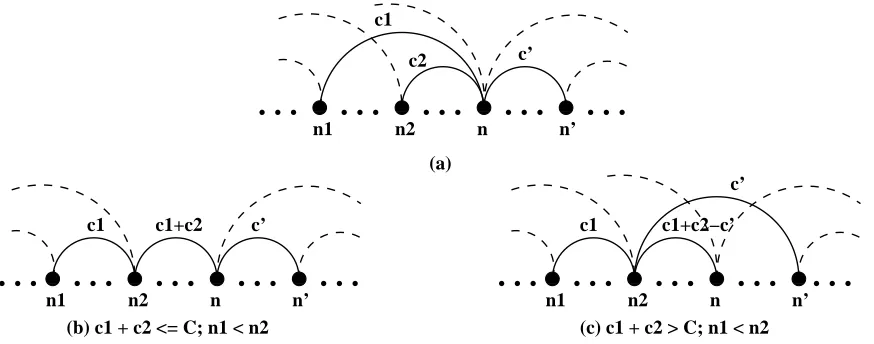
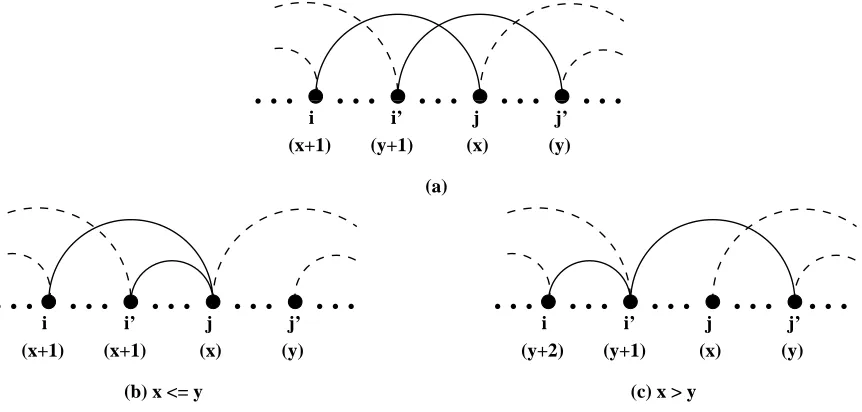
In the routing specified by the solution, if there exist two lightpaths (n1, n) and (n2, n) with
n1≤n2, carryingc1 andc2units of traffic respectively, such thatc1+c2≤C, the virtual topology
and the specified routing can be transformed to form a new solution as follows. Ifn1 =n2, one of
the two lightpaths is deleted and all thec1+c2units of traffic is routed on the other. Ifn1< n2(see Figure (3.1b)), the lightpath (n1, n) is replaced by a new lightpath (n1, n2). All thec1units of traffic
from n1 in the deleted lightpath is now routed first to node n2 using the new lightpath, and then
onto noden using lightpath (n2, n). The c2 units of traffic previously routed on lightpath (n2, n)
remains unchanged. This new solution clearly satisfies the wavelength and capacity constraints and also decreases the number of lightpaths terminating at node nby one. Since the original topology satisfied the condition ln > ln, by Theorem 1, the new solution requires one less ADM at noden. In addition, it may need an extra ADM at noden2, but the total ADM count will not increase and the number of lightpaths terminating at nodenhas decreased.
Chapter 3. Minimizing the Number of ADMs 14
such that c1 ≤c2. Then, we have c1+c2 > C. Since the incoming traffic at node n exceeds the
capacity of a single wavelength, node nhas at least two outgoing lightpaths i.e. ln ≥2. Letc be the largest traffic on these outgoing lightpaths and let one such lightpath (say p3) with traffic c
terminate at node n > n. Let cin and cout be the total incoming and outgoing traffic at node n. Since cl ≥cout ≥cin ≥c1l, andl > l, we have c > c1 and c1+c2−c < c2 ≤C. We can now
transform the virtual topology and routing to form a new solution as follows (see Figure (3.1c).) We first observe that sincec1+c2> C,c ≤C,ln >1 and the nodes have DXCs, we can re-route traffic in the given topology such that thec units of traffic in lightpathp3 consists only of traffic coming
into nodenfromn1orn2. Such a re-routing clearly does not affect thek1cost of the solution. Now,
in the new solution, lightpathp1 is deleted andp3 is replaced by a new lightpathp3 = (n2, n). If
n1< n2, a new lightpathp1= (n1, n2) is created and thec1 units of traffic onp1 is first routed to
node n2 throughp1. At node n2, the outgoing traffic c1+c2 is split such that c units are routed
to node n using p3 and the remaining c1+c2−c is routed to node n using lightpath p2. The other requests in the network can be routed as before. This solution clearly satisfies all requests without violating the capacity and wavelength constraints. In addition, the new solution has one less lightpath terminating and originating at noden, thus decreasing bothln andln (and therefore max(ln, ln)). The corresponding decrease in the number of ADMs at node n (as per Theorem 1) may be offset by a requirement for an additional ADM at noden2, but the total number of ADMs
in the new solution does not increase. We also note that li and li remain unchanged for nodes i,
n < i < N.
The two transformations above may be repeatedly applied at node nuntil ln ≤ln is satisfied. Note that ifln = 1, the outgoing traffic at node nis at most C and hence the first condition will remain true until the number of incoming lightpaths is also reduced to 1. At this point,li ≤li is thus true for nodesi, n≤i < N.
This set of transformations can now be repeated until, for every node n < N, we have ln ≤ln.
This completes the proof of the Lemma.
Lemma 3 Given an instance of the restricted path grooming problem with W =∞, there exists a minimum ADM solution such that for each non-egress noden,ln ≤ln and the traffic on a lightpath originating from nodenis at least as much as the traffic on a lightpath assigned the same wavelength
terminating at noden, if such a lightpath exists.
Chapter 3. Minimizing the Number of ADMs 15
Consider one such minimum cost solution and wavelength assignment which does not also satisfy the conditions of this Lemma. Letn be the least numbered node for which there exist lightpaths
p1= (n1, n) andp2= (n, n2) such thatp1and p2 are assigned the same wavelength (sayλ), and in
the specified routing, the trafficc1onp1 is greater than the trafficc2onp2. We now transform the
solution so that nodenno longer has such lightpaths.
First, we note that since c2 < c1, it is always possible to re-route traffic at noden, if required, such that all the requests on lightpath p2 are from the c1 units of traffic on p1. Such a re-routing
can be accomplished without changing the topology of the solution and without changing the total traffic on any lightpath, by exchanging the route of a non-c1request onp2with that of ac1-request
on another lightpath.
Next, since there are no bounds on the number of wavelengths available, we create a new lightpath
pN = (n1, N) (on a new wavelength, sayλnew) and route thec1 units of traffic from noden1, using
this new lightpath, directly to the egress node. All lightpaths on wavelengthλterminating at node
n1 and earlier are re-assigned to the new wavelength λnew. This step is required to preserve the number of ADMs at nodesi≤n1. The traffic on other lightpaths originating at nodenwill decrease
only if they carry traffic from thec1units onp1. This decrease however, does not affect the validity
of the solution. Note that if the traffic on such a lightpath decreases to zero, depending on whether or not another lightpath terminates at node n on the same wavelength, this lightpath will either be deleted by a future iteration of this transformation at noden or will be completely redundant and can be removed immediately. However, the latter possibility implies the existence of a lower ADM cost solution and hence will lead to a contradiction. The resulting topology and routing are thus valid, satisfy all the requests, and maintain theln ≤ln constraint. In addition, the number of wavelengths at nodenin which traffic is reduced on account of switching, is decreased by one.
The effect of these changes on the cost of the solution is as follows. The new solution requires one more ADM at the egress node (due to the new wavelength), and at least one less ADM at node
ndue to the deletion of lightpathsp1andp2. We also note that bothln andln are decreased by one, and noden has one less wavelength on which outgoing traffic is less than incoming traffic. Finally, we note that for nodesi < n, the condition of the Lemma continues to be satisfied.
This procedure can be applied repeatedly until we have the minimum ADM solution in which, at each noden < N, incoming traffic on a wavelength is at most equal to the outgoing traffic on
that wavelength. Hence the Lemma is proved.
This Lemma can now be used to prove the following Theorem.
Chapter 3. Minimizing the Number of ADMs 16
Proof. We only have to note that given a minimum ADM solution that satisfies Lemma 3, we can always change the specified routing so that all traffic coming into a node through lightpaths leave the node on the same wavelength. Thus, increase in traffic on any wavelength across a node will only be due to requests that originate from that node. As a result, the cross connect capability of a
node is not employed.
A direct consequence of Theorem 2 is that the decision problem PATH-GROOMING-MIN-ADM, from [7], discussed previously in Section 3.1, can be reduced to a similar problem that, in addition, allows nodes to use DXCs. Since PATH-GROOMING-MIN-ADM is NP-Complete, we have the following Theorem.
Chapter 4
Minimizing the Number of Transceivers
In this chapter, we measure cost in terms of the number of transceivers used in the virtual topology of the proposed solution. This cost model and its justification have been discussed as cost model 2 in Section 2.3. Since every lightpath requires a distinct transceiver at each of its endpoints, minimizing the number of lightpaths results in minimizing the number of transceivers and hence thek2-cost of
the network.
In the following discussion, we continue to use the problem definition presented in Chapter 2. Specifically, nodes are assumed to be equipped with DXCs and an external bound is imposed on the number of wavelengths available. The restriction on the number of available wavelengths implies that there will be cases in which the optimum can be achieved only by splitting traffic at a node onto more than one lightpath (wavelength) even ifri≤C for 1≤i < N.
A heuristic algorithm to solve the traffic grooming problem in general networks under this cost model is presented in [9]. The paper [9] also compares the performance of the algorithm with optimum solutions for a variety of traffic patterns but the question of whether the problem was NP-Hard was left open.
4.1
Complexity results
We use an approach very similar to that of [7] described in Chapter 3, to prove that a decision version of the restricted path grooming problem is NP-Complete when minimizing the number of lightpaths. After determining a lower bound for thek2-cost of a solution in Lemma 4, we define the
decision problem PATH-GROOMING-MIN-LP and show, in Theorem 4, that it is NP-Complete. Lemma 4 N −1 is a lower bound on the number of lightpaths required to groom traffic from N
nodes to an egress node, provided0< ri ≤C, for 0≤i < N.
Chapter 4. Minimizing the Number of Transceivers 18
Proof. If each of the N −1 nodes has ri > 0 requests, each node i must have at least ri/C lightpaths originating from it in order to route all the requests from that node. Thus the total number of lightpaths must be at leastk2 =Ni=1−1ri/C. If, in addition,ri ≤C,ri/C= 1 and
hence the lower boundk2 sums toN−1.
Using this lower bound, we formulate a decision problem PATH-GROOMING-MIN-LP as follows: Given N, C, W and{ri}, determine if there exists a solution to the restricted path grooming using
at most k2 = N −1 lightpaths. This formulation is different from the decision problem
PATH-GROOMING-MIN-ADM resulting in Chapter 3 in thatW is finite and all nodes have full switching capability. However, when the target is N−1, andW is finite, we show that switching at a node cannot help. Nevertheless, we can use the same reduction from BIN-PACKING as in [7] to prove PATH-GROOMING-MIN-LP NP-Complete. This proof is presented in Theorem 4.
Theorem 4 The PATH-GROOMING-MIN-LP decision problem is NP-Complete even if for each nodei < N,0< ri≤C.
Proof. The problem is clearly in NP, since a candidate solution can be verified in polynomial time for correctness and in addition, itsk2-cost, i.e. the number of lightpaths used by the solution, can be verified to be less than or equal toN−1. We show that the problem is NP-Hard by reduction from the BIN-PACKING [13] problem.
The BIN-PACKING problem can be stated as follows. Given integersC, N, k, and a multi-set
Rof integers ri >0, 0≤i < N, determine if there exists a partition ofRinto k subsets such that the sum of the elements in each subset does not exceedC.
An instance of the BIN-PACKING problem, specified by N, C, k, R ={ri}, is transformed into an instance of the PATH-GROOMING-MIN-LP problem as follows. Let N = N, W = k,
C=C, and requestri=ri. This transformation can clearly be done in time polynomial inN. If the BIN-PACKING instance has a solution, then let Sj, 1 ≤ j ≤ k be the corresponding partition of the setR. For each subsetSj, we order the elements in the subset by their indexi in
R. In the corresponding PATH-GROOMING-MIN-LP instance, we create a lightpath from node k
to nodel ifrk andrlare consecutive elements inSj. In addition, nodeiwill have a lightpath to the egress node ifri is the last element inSj. This completes the construction of the virtual topology for the PATH-GROOMING-MIN-LP instance. We now show that this topology is valid and has costk2=N−1.
First, each node i, 1≤i < N, has exactly one lightpath associated with it. Hence, the number of lightpaths used in the solution is exactlyN−1.
Chapter 4. Minimizing the Number of Transceivers 19
and hence will be at mostC=C. Each of the other lightpaths clearly carry less traffic and hence also satisfy the capacity constraint.
Finally, to see that the wavelength constraint of W is not exceeded, we note that each lightpath in the solution connects consecutive nodes in some Sj. Thus the set of lightpaths in the virtual topology forms a collection of chains leading to the egress node with one chain per subset Sj. If more than one lightpath traverses the same physical link, their endpoints must belong to different subsets and hence such lightpaths would be in different chains. Since there are at most k = W
subsets, there are at most W chains and thus, at most W lightpaths crossing any given physical link.
To complete the NP-Completeness proof, we have to show that if the PATH-GROOMING-MIN-LP instance to which the problem was reduced has a solution, the BIN-PACKING problem also has a solution. We begin with the observation that at most W lightpaths can terminate at the egress node. All requests are thus routed to the egress node through theseW lightpaths. Further, since there N−1 lightpaths, exactly one lightpath originates from each node and so, no ri is split over more than one of these. We can thus partition the nodes into equivalence classes such that two nodes are equivalent if and only if their requests use the same final lightpath to arrive at the egress node. Each of the lightpaths can carry at mostC units of traffic. This means the sum of the number of requests from all nodes in an equivalence class cannot exceedC. Finally, sincek =W andC=C, the equivalence classes form a partition of the set R using at most k bins, with the sum of the
elements in each bin not exceedingC.
We note that the structure of the solution in the last paragraph above does not require the use of DXCs at any of the nodes. Further, the ADM cost of such a solution is given byN−1 +W.
4.2
Upper bound
We now present a greedy approximation algorithm to solve the restricted path grooming problem. LetW =(iN=1−1ri)/Cbe the minimum number of wavelengths with capacityCrequired to obtain a valid solution that satisfies all requests. We will show that our algorithm produces a solution that exceeds the lower bound in Lemma 4 by no more than W. This algorithm can hence be used to obtain an upper bound on the minimum number of lightpaths required to solve the restricted path grooming problem.
The procedure PathGroomingMinLP (Algorithm 1) takes as input an instance of the restricted path grooming problem specified byN, W, C,r. It initializes the available capacityλion wavelength
Chapter 4. Minimizing the Number of Transceivers 20
Algorithm 1PathGroomingMinLP(N, W, C,r)
1: fori= 1 toW do{Initializeλ}
2: λi←C
3: fori= 1 toN−1do {Initializer}
4: ri←ri
5: Assign(1,1,r,λ, N, W){See Algorithm 2}
Algorithm 2Assign(i, j,r,λ, N, W)
1: if i < N andj≤W then
2: if ri< λj then
3: Lightpath(i, i+ 1)
4: λj←λj−ri; ri ←0
5: Assign(i+ 1, j,r,λ, N, W)
6: else
7: Lightpath(i, N)
8: ri←ri−λj; λj ←0
9: Assign(i, j+ 1,r,λ, N, W)
The procedure Assign (Algorithm 2) is called with parameters i < N, j ≤ W,r,λ, N and
W. This procedure recursively uses the capacity available in wavelengths j . . . W (as indicated by
λj. . . λW), to obtain a virtual topology and routing that satisfiesrk requests from each nodekfor
i≤k < N. Each timeAssignis called, one of the following actions will be occur.
1. If ri < λj (Lines 2 - 5), a lightpath is created from node ito node i+ 1 and it will carry all theri requests (along with prior requests routed on wavelengthj) to the nodei+ 1. All the
ri requests are deemed routed and the available capacityλj is accordingly adjusted. Assign is then called recursively to solve for requestsri+1, . . . , rN−1on wavlengthsλj, . . . λW. 2. If ri ≥ λj (Lines 6 - 9), a lightpath is created from node i to the egress node N and this
lightpath will carryλjrequests from nodei(along with prior requests routed on wavelengthj) to the egress node. Nodeiwill haveri−λjrequests unrouted and the capacity on wavelength
j will be 0. Assignis then called recursively to solve for requests ri, . . . , rN−1 on wavlengths
λj+1, . . . λW.
The procedure terminates when all requests are routed (i = N) or none of the wavelengths have available capacity (j=W + 1). In the former case, we have a valid virtual topology which satisfies all the requests and in the latter case we can conclude that the available capacity was not sufficient to route all requests.
We use the above algorithms to derive an upper bound on the number of lightpaths required to solve the restricted path grooming problem. LetSi =
N−1
Chapter 4. Minimizing the Number of Transceivers 21
from nodesitoN−1 andLi=
W
i=iλi be the total capacity available in wavelengthsitoW. We can now prove the following result.
Lemma 5 If Si ≤ Lj, then procedure Assign will route the remaining Si requests using at most
N−i+W −j additional lightpaths.
Proof. The lemma is proved by induction oniandj. For the base case, consideri=N−1, j=W. The condition rN −1 ≤ λW implies that Case 1 (Lines 2-5) will be true. Hence one lightpath is created, followed by a call to Assign with i = N. We see from Line 1 that when i = N, the procedure exits without creating any lightpaths. Thus total number of additional lightpaths created is 1 and the Lemma holds true for this base case.
For the induction step, we assume that the Lemma is true for all i > i andj > j. Consider a call toAssign with parametersi < N and j≤W. If Case 1 (Lines 2-5) holds, then one lightpath is created followed by a recursive call toAssign with parametersi+ 1 and j. Further, sinceλj is decremented byri, the conditionSi≤Lj which was true at the start of the procedure now implies that Si+1 ≤Lj. Thus the inductive hypothesis can be applied and the total number of additional lightpaths created will not exceed 1 + (N−(i+ 1) +W −j) =N−i+W−j.
Similarly, if Case 2 (Lines 6-9) holds, a lightpath is created followed by recursive call toAssign with parametersiandj+1. Since bothriis decremented byλj, the conditionSi≤Ljwhich was true at the start of the procedure now implies thatSi≤Lj+1and we can apply the inductive hypothesis and the number of additional lightpaths created will not exceed 1+(N−i+W−(j+1)) =N−i+W−j.
Thus the Lemma is true for 1≤i < N and 1≤j≤W.
The procedure PathGroomingMinLP solves the path grooming problem by calling Assign with
i= 1 andj= 1. Applying Lemma 5, it is clear that ifri ≤CW, there is a solution that uses at mostN+W−2 lightpaths. In addition, we note that procedureAssigncompletely uses the capacity available in wavelengthibefore routing requests on wavelengthi+ 1. Hence the resulting solution (and its k2-cost) would not change for different values of W provided ri ≤ CW remains true. Hence thek2-cost of the solution given byPathGroomingMinLPwill in fact not exceedN+W−2,
whereW=(ri)/Cis the minimum number of wavelengths (each with capacityC) required to satisfy the given requests. This leads to the following upper bound on the optimal solution to the restricted path grooming problem.
Theorem 5 There exists a solution to the restricted path grooming problem that uses at most N+
W−2 lightpaths, whereW is the minimum number of wavelengths (each with capacityC) required
Chapter 4. Minimizing the Number of Transceivers 22
4.3
Performance of the approximation algorithm
In this section, we first show that PathGroomingMinLP is a 2-approximation algorithm. Then, we look at some concrete examples that illustrate the behavior of the algorithm presented in the previous section. In particular, we present problem instances where the solution achieves the lower bound in Lemma 4 or the upper bound in Theorem 5, and we also study the behavior of the algorithm on uniform traffic - i.e. when each node has the same number (r) of requests to the egress node.
The following theorem provides an alternate interpretation of Theorem 5 on the worst case performance of algorithmPathGroomingMinLP.
Theorem 6 ProcedurePathGroomingMinLPis a 2-approximation algorithm for minimizing the num-ber of lightpaths for the restricted path grooming problem.
Proof. From the proof of Lemma 4 we know thatkl=
ri/Cis a lower bound on the minimum number of lightpaths for a solution to the restricted path grooming problem. From Theorem 5, we know that the procedure PathGroomingMinLP gives a solution whosek2-cost has the upper bound
ku=N+W−2, whereW=(
ri)/C. Thus, ifkois the minimumk2-cost for a problem instance, we have,ku=N−2+W =N−2+(
ri)/C≤N−2+
ri/C=N−2+kl≤N−2+ko≤2ko−1.
Thus, we getku/ko<2 and the theorem is proved.
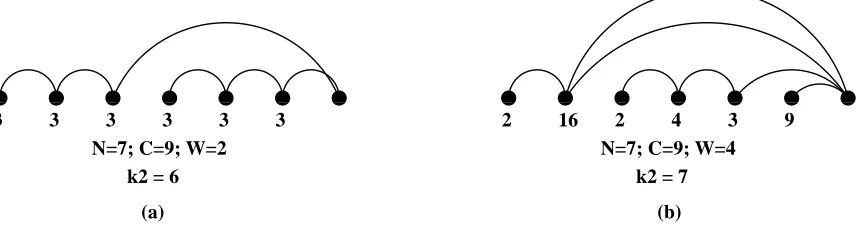
We now consider some concrete examples illustrating the performance of PathGroomingMinLP. First, we note that the algorithm will achieve the lower bound as per Lemma 4 whenever the nodes
k2 = 6
N=7; C=9; W=2 N=7; C=9; W=4
k2 = 7
(a) (b) 00 00 00 11 11 11 0 0 0 1 1 1 00 00 00 11 11 11 00 00 00 11 11 11 0 0 0 1 1 1 00 00 00 11 11 11 0 0 0 1 1 1 00 00 00 11 11 11 0 0 0 1 1 1 00 00 00 11 11 11 00 00 00 11 11 11 0 0 0 1 1 1 0 0 0 1 1 1 0 0 0 1 1 1
3 3 3 3 3 2 16 2 4 3 9
3
Figure 4.1: Best case inputs forPathGroomingMinLP
can be partitioned into sets such that each set contains consecutive nodes and the sum of the requests from nodes within a set is a multiple of the capacityC. This is illustrated in Figure 4.1(a) for uniform traffic and Figure 4.1(b) for non-uniform traffic (with someri> C).
Figure 4.2 presents a problem instance for which the algorithm performs as badly as possible, achieving the upper bound of Theorem 5. Figure 4.2(a) shows the solution given by algorithm
Chapter 4. Minimizing the Number of Transceivers 23
k2 = 5 k2 = 9
(a) N=6; C=3; W=5
(b) N=6; C=3; W=5
0 0 0 1 1 1 00 00 00 11 11 11 0 0 0 1 1 1 0 0 0 1 1 1 00 00 00 11 11 11 0 0 0 1 1 1 0 0 0 1 1 1 00 00 00 11 11 11 00 00 00 11 11 11 00 00 00 11 11 11
3 3 3 3
2 00 00 00 11 11 11
3 3 3 3
2 00 00 00 11 11 11
Figure 4.2: Worst case input forPathGroomingMinLP
the lower bound with cost k2 = N−1 = 5. This example can be generalized as follows. Given any N >1 andC >1, the path grooming problem specified by N, W =N−1, C, R={ri}such that r1=C−1 and ri =C for 1< i < N will have a solution with cost k2=N−1 whereas the
PathGroomingMinLPalgorithm will yield a solution with cost k2=N+W−2.
(b)
k2 = 6
N=6; C=3; W=4
k2 = 7
(a)
N=6; C=3; W=4
00 00 00 11 11 11 00 00 00 11 11 11 00 00 00 11 11 11 0 0 0 1 1 1 0 0 0 1 1 1 0 0 0 1 1 1 0 0 0 1 1 1 00 00 00 11 11 11 0 0 0 1 1 1 00 00 00 11 11 11 00 00 00 11 11 11
2
2
2
2
2
002
2
2
2
2
00 00 11 11 11
Figure 4.3: Sub-optimal input forPathGroomingMinLPwith uniform traffic
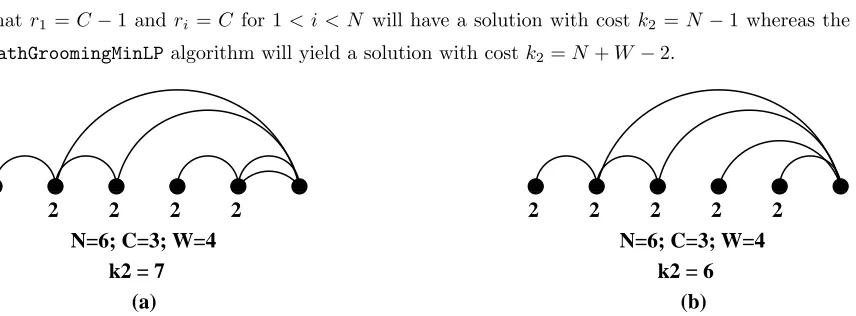
For uniform traffic, the algorithm may or may not lead to an optimum solution. Figure 4.3 shows that even with minimumW, the algorithm does not always yield an optimum solution. This example can be generalized for anyr >1 as follows. Given anyr >1, the path grooming problem specified byN = 3 +C, W = 2 +r, C= 2r−1, R={ri=r}will have a solution with costk2= 3r
whereas thePathGroomingMinLP algorithm will yield a solution with costk2= 3r+ 1.
4.4
Comparing ADM and transceiver costs
Chapter 4. Minimizing the Number of Transceivers 24
proof in Section 4.1 implies that some solutions that require onlyN−1 lightpaths also require only
N−1 +W ADMs and thus achieve the lower bound for both costs. In this section we study some other conditions under which there exist solutions that minimize both the ADM and lightpath costs of the network.
Theorem 7 If an instance of the restricted path grooming problem specified byN, W, C, R={ri}
satisfies the condition 0 < ri ≤C for1 ≤i < N, then, there exists a solution that simultaneously minimizes both k1 andk2.
Proof. If an instance of the restricted path grooming problem satisfies the condition 0 < ri ≤C for 1≤i < N, then the number of lightpaths used in the solution i.e., the k2 cost of a solution is
given byk2= (N−1) +s, wheresis the total number of traffic splits. Since (N−1) is fixed for a
particular instance, a solution minimizesk2 if and only if it minimizess.
Now we consider the number of ADMs used by a solution. In the following argument, we show that if ri ≤ C for 1 ≤ i < N, there is an optimum solution whose k1-cost is given by
k1= (N−1) +W+s, wheresis the number of traffic splits. SinceN andW are fixed, this cost is
optimum if and only ifsis minimized. From the previous paragraph, we know that such a solution also minimizes thek2-cost and is hence simultaneously optimum for both the cost models.
Recall that a solution to the restricted path grooming problem specifies both a virtual topology that satisfies all requests and a routing of the requests on the topology. Given the virtual topology specified by a minimumk1-cost solution, letln andln be the number of lightpaths terminating and originating at noden(1≤n≤N) respectively. From Theorem 1 and Lemma 2, we know that there is a minimum k1-cost solution for which ln ≤ ln is true for all non-egress nodes n < N. Such a solution requires exactlyln ADMs for each non-egress noden. Thek1-cost of this solution is given byk1= (N−1) +s+w, wherewis the number of lightpaths terminating at the egress node ands
is the number of traffic splits (s=Nn=1−1(ln−1)).
For the optimum solution satisfying these properties, if w < W and s > 0, we show that it is always possible to reduce s by creating a new lightpath terminating on the egress node. Letn be the largest numbered non-egress node withln >1.
We first show that no physical link across nodes i ≥nuses all W wavelengths. Since n is the largest node with ln >1, all non-egress nodes i > n have li = 1. If the link between nodes i−1 andi(wheren < i < N) hasW lightpaths, it follows that the link between iandi+ 1 also hasW
lightpaths because exactly one of these lightpaths must terminate at nodei (note thatli≤li = 1) and exactly one lightpath must originate from it. This however implies (by induction) that W
Chapter 4. Minimizing the Number of Transceivers 25
Now, consider a wavelength assignment that achieves the optimalk1value specified above. If, in
this wavelength assignment, the traffic on wavelengths that terminate at node ndoes not decrease (due to electronic switching), we can route all the requests originating from noden(rn), directly to the egress node on a new wavelength. All other lightpaths originating from this node will now have to carry exactly as much traffic as the corresponding lightpaths terminating at the node on the same wavelength. (If no other lightpath terminates at the node on the same wavelength, the originating lightpath is clearly redundant and can be deleted.) Since there is no change in the total traffic on each of these wavelengths, each lightpath pair (n1, n) and (n, n2) on the same wavelength can be
replaced by a single lightpath (n1, n2) on that wavelength. As a result, nodenwill now require just
one ADM (as opposed to the previousln>1 ADMs) and the egress node will require an additional ADM for the new wavelength. Thus, the totalk1 cost is not increased.
On the other hand, if the wavelength assignment is such that traffic on a wavelength (say λ) that terminates at noden is decreased due to electronic switching, we can use the transformation described in Lemma 3 to delete the two lightpaths that terminateλat node n(and thus decrease both ln andln by at least one), and use the new wavelength to create a lightpath that terminates at the egress node. This new solution reducessby one, increaseswby one, preserves the condition
ln ≤ln, and maintains thek1 cost.
This procedure can be repeated until eithers= 0 orw=W. Thus, thek1-cost can be minimized
by using allW ADMs at the egress node and then minimizing the number of splits s. However, as we noted earlier, a solution that minimizessalso achieves the optimumk2 cost. We conclude that
the theorem is true.
Chapter 5
Minimizing the Electronic Switching Cost
In this chapter, we consider the dominant cost of the network to be the total amount of electronic switching in the network. As mentioned in Section 2.3, electronic switching is required at a node for each incoming request that has to be re-transmitted on an outgoing lightpath. Hence, the total electronic switching cost of a solution can be measured (as first presented in [8]) by the sum of the number of lightpath changes in the virtual topology route assigned to each traffic request. In the following discussion, we will use a slightly different measure for the total electronic switching cost. We define the costk3as the sum of number of lightpaths used in the virtual topology route assigned
to each request. Note that since the number of lightpaths in a route is always one more than the number of lightpath changes in the route, the difference in the two cost measures is just the total number of traffic requests and minimizing the latter cost will automatically minimize the former.
It is proved in [14] that the problem of minimizing total electronic costs in path networks is NP-complete for any-to-any traffic. In addition, [14] shows that it is in fact NP-Complete to determine whether a valid routing that satisfies all the requests and meets the capacity constraints exists when the virtual topology in the path network is fixed. In this chapter, we prove complexity results and present algorithms for the problem of minimizing k3 for path networks with egress node (i.e., all requests terminate at the single egress node). Specifically, in Section 5.1, we show that, in contrast to the case for general path grooming, given a virtual topology, we can find a minimumk3-cost routing
for the requests in polynomial time. Then, in Section 5.2 we present a polynomial time dynamic programming algorithm that solves the path grooming problem when the wavelength capacity is not bounded. In Section 5.3, we discuss how the results for infinite capacity can be used to derive upper bounds on the optimum solutions for unit traffic with finite capacity and also present an algorithm for non-uniform requests when the number of available wavelengths is restricted to two.
Chapter 5. Minimizing the Electronic Switching Cost 27
5.1
Complexity results
In [14], it is proved that the problem of minimizingk3 for a path network is NP-Complete for
any-to-any traffic even when a virtual topology is already specified. We now show that the restricted path grooming problem (with egress traffic) reduces to the problem of minimizing cost in a weighted network flow problem. The latter can be solved in polynomial time by a number of standard algorithms. The NP-Completeness of restricted path grooming when no virtual topology is specified, is however, still an open question.
The minimum cost flow problem is defined in [15] as follows. Let G = (V, E) be a directed network defined by a setV ofnverticesand a set E ofm directed edges. Each edge (i, j)∈E has an associated cost ci,j that denotes the cost per unit flow on that edge. This cost varies linearly with the amount of flow. Each edge (i, j)∈E is also associated with a capacity uij that denotes the maximum amount that can flow on that edge and alower boundlij that denotes the minimum amount that must flow on the edge. Each vertex i ∈ V is associated with an integer number bi representing its supply/demand. The decision variables in the minimum cost flow problem are edge flows and the flow on edge (i, j)∈Eis represented byxij. The optimization model for the minimum cost flow problem can now be formulated as follows. Minimize
(i,j)∈E
cijxij
subject to
{j:(i,j)∈E}
xij−
{j:(j,i)∈E}
xji=bi for alli∈V,
lij ≤xij ≤uij for all (i, j)∈E, whereni=1bi= 0.
Theorem 8 When a virtual topology is already specified, thek3-cost of a restricted path grooming
problem can be minimized in polynomial time.
Proof. Given a virtual topology for an instance of the restricted path grooming problem, the complete solution requires a routing of the requests using the given topology. In order to find a minimum
k3-cost routing in polynomial time, we find a minimum cost flow in the following network flow
problem.